Predictive modelling in healthcare is about using patient data to make better decisions before health problems become serious. Instead of waiting for a patient’s condition to worsen, hospitals and doctors use data from past cases to understand what might happen next.
In healthcare, many problems do not appear suddenly. Patients often show small warning signs long before complications, readmissions, or emergencies occur. These signs are easy to miss when care teams are busy or working with limited information.
Predictive modeling helps identify these risks early. It supports healthcare teams in deciding who may need closer attention, extra follow-up, or timely treatment. Before looking at how it works or the methods behind it, it is important to first understand what predictive modeling means in a healthcare setting and why it is used.
In this blog, you’ll learn what predictive modeling means in a healthcare context, the kinds of problems it solves, how it works at a high level, and where it is used in real-world patient care.
What Is Predictive Modeling in Healthcare?
Predictive modeling in healthcare is the use of data to estimate what is likely to happen next, so healthcare teams can act earlier and make better decisions.
At its core, it works by looking at patterns from the past and applying them to current situations. When similar conditions appear again, predictive modeling helps signal possible risks, outcomes, or needs before they become obvious problems.
What Data Does It Use?
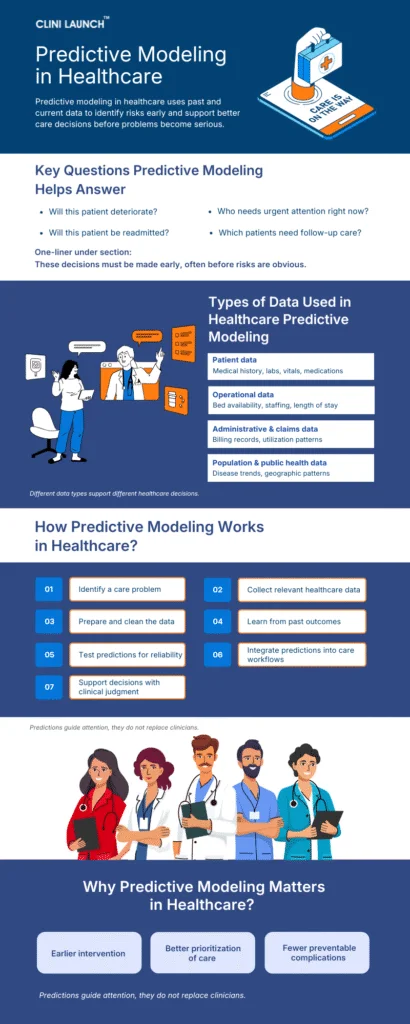
Predictive modeling in healthcare can use several kinds of data, depending on the problem being addressed:
- Patient data for clinical data analysis, such as medical history, lab results, vital signs, medications, and treatment timelines
- Operational data, such as bed availability, staff workload, length of stay, and patient flow
- Administrative and claims data, including billing records, procedure codes, and healthcare utilization patterns
- Population and public health data for population health analytics, such as disease trends, geographic patterns, and seasonal outbreaks
Each type of data helps predict different kinds of outcomes. Patient data supports clinical care decisions, while operational and population data support hospital planning and public health management.
AI and ML in Healthcare
Acquire the skills to develop and apply Artificial Intelligence and Machine Learning algorithms to medical diagnosis, treatment planning, and drug discovery. This program focuses on transforming healthcare delivery through predictive analytics and automated data-driven insights.

What Problems Predictive Modeling Solves in Healthcare
Predictive modeling is used in healthcare because many important decisions must be made early, often before problems are obvious. In real clinical environments, doctors and care teams work under time pressure and with incomplete information. When risks are identified late, patients face avoidable complications, and healthcare systems absorb unnecessary strain. Predictive modeling exists to reduce this gap by helping teams anticipate what may happen next and act while there is still time to intervene. Below we are discussing some of the most common predictive modeling healthcare applications today.
Will This Patient Deteriorate?
In hospitals, patient deterioration is rarely sudden. Most patients show subtle warning signs long before a serious event occurs. Small changes in vital signs, lab values, oxygen levels, or mental status may indicate that a patient’s condition is worsening. However, these changes are easy to miss during routine checks, especially when clinicians are responsible for many patients at once.
Predictive modeling helps by analyzing patterns across time rather than isolated measurements. By comparing current patient trends with historical cases, it can flag patients who are at higher risk of deterioration even when they appear clinically stable. This allows care teams to increase monitoring, adjust treatment, or escalate care earlier, reducing the chances of sudden emergencies such as cardiac arrest or unplanned ICU transfer.
|
Case Study: Early Warning Systems for Patient Deterioration – Acute Care & ICU Settings (Philips, 2020)
Hospitals have implemented predictive early warning systems that continuously analyze vital signs and monitoring data to detect patient deterioration hours before visible clinical collapse. These systems generate risk scores that alert care teams when subtle physiological patterns suggest rising danger, even if patients appear clinically stable during routine checks. In real-world deployments, hospitals reported up to a 35% reduction in adverse events and an over 86% decrease in cardiac arrests after integrating predictive alerts into clinical workflows. This case demonstrates how predictive modeling significantly improves patient safety by enabling earlier intervention and faster escalation of care. |
Will This Patient Be Readmitted?
Hospital readmissions are often driven by issues that occur after discharge rather than during the hospital stay itself. Patients may struggle with medication management, fail to attend follow-up appointments, misunderstand discharge instructions, or lack adequate support at home. These factors are difficult for clinicians to assess consistently using manual judgment alone.
Predictive modeling helps identify patients who are more likely to be readmitted before they leave the hospital. By recognizing patterns associated with past readmissions, healthcare teams can focus additional support on higher-risk patients. This may include clearer discharge education, early follow-up appointments, medication reconciliation, or post-discharge check-ins. The goal is not to prevent discharge, but to improve recovery and reduce avoidable returns to the hospital.
|
Case Study: Reducing Hospital Readmissions with Predictive Modeling – Corewell Health (USA)
Corewell Health used predictive modeling to identify patients at high risk of 30-day hospital readmission at the time of discharge. The system combined clinical data with behavioral and social factors to generate risk scores, which were reviewed by clinicians and care coordination teams. Rather than relying on prediction alone, high-risk patients received targeted follow-up support, improved discharge planning, and focused transition-of-care interventions. This approach demonstrates direct, real-world use of predictive analytics to improve healthcare outcomes. Over approximately 20 months, this strategy prevented around 200 avoidable readmissions and generated nearly USD 5 million in cost savings. This case highlights that predictive modeling in healthcare works best when risk identification is paired with human clinical judgment and timely clinical action, rather than fully automated decisions. |
Who Needs Urgent Attention Right Now?
In emergency departments and busy hospital wards, not all patients can be treated immediately. Patients often arrive with similar symptoms, and some may appear stable even though their condition is likely to worsen in the next few hours. Relying only on visible symptoms or arrival order can delay care for those at highest risk.
Predictive modeling supports prioritization by estimating which patients are more likely to deteriorate in the near term. This allows care teams to direct attention toward higher-risk patients sooner, even if they do not yet appear critically ill. As a result, urgent cases are less likely to be overlooked, and delays that lead to adverse outcomes can be reduced.
|
Case Study: Suicide Risk Prediction Using EHR Data – Vanderbilt University Medical Center (USA)
Vanderbilt University Medical Center developed a machine learning–based system that analyzes routine electronic health record (EHR) data to estimate suicide risk during patient encounters. The model runs silently in the background, grouping patients by risk level so clinicians can identify individuals who may need mental health screening even when no obvious warning signs are present. During evaluation, the system identified a high-risk group that accounted for over one-third of subsequent suicide attempts, demonstrating how predictive modeling can surface hidden risk early. This case highlights how predictive analytics supports earlier screening and prevention for rare but critical outcomes by complementing clinical judgment rather than replacing it. |
Will This Patient Be Readmitted?
Hospital readmissions are often driven by issues that occur after discharge rather than during the hospital stay itself. Patients may struggle with medication management, fail to attend follow-up appointments, misunderstand discharge instructions, or lack adequate support at home. These factors are difficult for clinicians to assess consistently using manual judgment alone.
Predictive modeling helps identify patients who are more likely to be readmitted before they leave the hospital. By recognizing patterns associated with past readmissions, healthcare teams can focus additional support on higher-risk patients. This may include clearer discharge education, early follow-up appointments, medication reconciliation, or post-discharge check-ins. The goal is not to prevent discharge, but to improve recovery and reduce avoidable returns to the hospital.
|
Case Study: Reducing Hospital Readmissions with Predictive Modeling – Corewell Health (USA)
Corewell Health used predictive modeling to identify patients at high risk of 30-day hospital readmission at the time of discharge. The system combined clinical data with behavioral and social factors to generate risk scores, which were reviewed by clinicians and care coordination teams. Rather than relying on prediction alone, high-risk patients received targeted follow-up support, improved discharge planning, and focused transition-of-care interventions. This represents a direct and practical use of predictive analytics for improving healthcare outcomes. Over approximately 20 months, this approach prevented around 200 avoidable readmissions and generated nearly USD 5 million in cost savings. |
Who Needs Urgent Attention Right Now?
In emergency departments and busy hospital wards, not all patients can be treated immediately. Patients often arrive with similar symptoms, and some may appear stable even though their condition is likely to worsen in the next few hours. Relying only on visible symptoms or arrival order can delay care for those at highest risk.
Predictive modeling supports prioritization by estimating which patients are more likely to deteriorate in the near term. This allows care teams to direct attention toward higher-risk patients sooner, even if they do not yet appear critically ill. As a result, urgent cases are less likely to be overlooked, and delays that lead to adverse outcomes can be reduced.
|
Case Study: Suicide Risk Prediction Using EHR Data – Vanderbilt University Medical Center (USA)
Vanderbilt University Medical Center developed a machine learning–based system that analyzes routine electronic health record (EHR) data to estimate suicide risk during patient encounters. The model runs silently in the background, grouping patients by risk level so clinicians can identify individuals who may need mental health screening even when no obvious warning signs are present. During evaluation, the system identified a high-risk group that accounted for over one-third of subsequent suicide attempts, demonstrating how predictive modeling can surface hidden risk early. This case highlights how predictive analytics enables earlier screening and prevention for rare but critical outcomes by supporting proactive clinical decision-making. |
Which Patients Need Follow-Up Care?
After diagnosis or treatment, maintaining follow-up is a major challenge in healthcare. Some patients miss appointments, delay recommended tests, or discontinue treatment, which can lead to late diagnoses, disease progression, or emergency visits. Following up with every patient at the same level is not realistic given limited resources.
Predictive modeling helps identify patients who are more likely to miss follow-ups or develop complications if care is interrupted. By focusing reminders, outreach, and follow-up efforts on these patients, healthcare teams can improve continuity of care and prevent avoidable deterioration outside the hospital setting.
|
Case Study: Early Sepsis Detection Using Machine Learning – ICU & Hospital Research Deployments
Machine learning models trained on large clinical datasets have demonstrated the ability to identify sepsis risk earlier than traditional scoring systems. By continuously analyzing trends in vital signs and laboratory results, these models detect early warning signals hours before sepsis becomes clinically obvious. Research-based deployments consistently show earlier detection and improved risk discrimination, forming the foundation for real-time sepsis alert systems now used in hospitals. This case reinforces the role of predictive modeling in preventing life-threatening complications through timely identification and early clinical intervention. |
How Predictive Modeling Works in Healthcare (Explained Through Real Healthcare Scenarios)
Predictive modeling in healthcare is not built in isolation by data teams. It is shaped by real clinical problems, real patient behavior, and real operational constraints. Each step in the process exists because healthcare decisions carry risk, and getting even one step wrong can lead to unsafe or misleading predictions.
To understand how predictive modeling works in practice, it helps to walk through the process as it unfolds inside a healthcare setting.
Defining the Problem: Starting With a Care Gap
Predictive modeling begins when healthcare teams notice a recurring problem they cannot reliably manage using observation alone. For example, a hospital may realize that many patients who end up in the ICU showed warning signs earlier, but those signs were not recognized in time. In another case, leadership may notice that readmissions are high even though discharge criteria are being followed correctly.
At this stage, the goal is not to build a model, but to clearly define what needs to be predicted. Is the priority to identify deterioration early? To prevent readmissions? To prioritize patients during peak workload? In healthcare, vague questions lead to unsafe predictions, so this step ensures the model is built to support a specific clinical decision.
Gathering Data: Reconstructing the Patient Journey
Once the problem is clear, healthcare teams collect data that reflects how care actually unfolds. For patient deterioration, this includes vital signs, lab results, oxygen levels, medications, and how these values change over time. For readmissions, the data may include discharge timing, medication changes, prior hospital visits, and follow-up history.
This step is critical because healthcare outcomes are rarely caused by a single factor. Predictive modeling depends on understanding patterns across entire patient journeys, not isolated snapshots. Without the right data, predictions may overlook the very signals clinicians are trying to catch early.
Preparing the Data: Making Sure the Story Is Accurate
Healthcare data is often messy because it is collected across multiple systems and departments. A patient’s lab results may be recorded in one system, vital signs in another, and discharge information elsewhere. Incomplete or inconsistent records can distort patterns and create false signals.
Before any learning can occur, the data must be aligned so it tells a consistent story. This step matters because predictive models do not understand context; they only learn from what they are given. In healthcare, poor data preparation can translate directly into unsafe recommendations.
Learning From Past Outcomes: Finding What Actually Comes Before Trouble
With reliable data in place, predictive modeling looks backward before it looks forward. It examines previous patient cases to understand what typically happened before certain outcomes occurred. For example, it may reveal that patients who were later readmitted often showed specific lab trends, medication changes, or follow-up gaps in the days before discharge.
This step is important because healthcare intuition alone is not enough at scale. While clinicians may recognize patterns in individual cases, predictive modeling helps confirm which signals consistently matter across hundreds or thousands of patients.
Testing Predictions: Making Sure Patterns Hold Up
Not every pattern discovered in data is meaningful. Some patterns appear by chance or reflect temporary conditions. Before predictions are trusted, they must be tested against real historical cases to ensure they reliably identify risk without generating excessive false alarms.
In healthcare, this step is essential for safety. A model that flags too many patients creates alert fatigue, while one that misses risk undermines trust. Testing ensures predictions strike the right balance between sensitivity and usefulness in real clinical environments.
Integrating Into Care: Making Predictions Usable
Even accurate predictions are useless if they do not fit into clinical workflows. Healthcare professionals do not have time to interpret complex outputs or separate dashboards. Predictive insights must be presented in a simple, actionable form, such as a risk score or early warning indicator within existing systems.
This step matters because healthcare decisions are made quickly and often under pressure. Predictive modeling succeeds only when it supports, rather than disrupts, how care is delivered.
Acting With Clinical Judgment: Supporting, Not Replacing, Care Teams
Predictions are designed to draw attention, not dictate action. When a patient is flagged as high risk, clinicians assess the situation in context, considering factors that data may not capture, such as patient behavior, social support, or recent changes in condition.
This step exists because healthcare is not deterministic. Predictive modeling provides early signals, but human judgment remains essential to ensure safe and appropriate care.
Monitoring Over Time: Keeping Predictions Relevant
Healthcare does not stand still. Treatment protocols evolve, patient populations change, and hospital workflows adapt. Predictive models must be monitored to ensure they remain accurate and fair as conditions change.
This step is especially important in healthcare because outdated predictions can be as harmful as incorrect ones. Ongoing monitoring ensures that predictive modeling continues to support patient safety and care quality over time.
Biostatistics
Master the development and application of statistical methods to health data. This program equips you with the technical expertise to analyze complex biomedical data, interpret research findings, and drive evidence-based practice in public health and life sciences.
How Healthcare Systems Learn Patterns: Algorithms Used in Predictive Modeling
Once healthcare data is prepared and past outcomes are understood, the next question is simple: how does the system actually learn from this information? This is where algorithms come in.
An algorithm, in this context, is a method that helps the system learn patterns from past healthcare data. When an algorithm is trained on real data, it produces a predictive model that can estimate risk for new patients or situations. Different healthcare problems require different learning approaches, which is why multiple algorithms are used instead of one universal method.
Logistic Regression: Estimating Simple Clinical Risk
Many healthcare decisions involve a clear yes-or-no question. Will a patient be readmitted? Is there a high risk of complications? Should closer monitoring be triggered? Logistic regression is commonly used in these situations because it focuses on estimating probability rather than making absolute claims.
Healthcare teams value this approach because it produces clear risk scores and is relatively easy to interpret. Clinicians can understand which factors contribute to higher risk, making it suitable for decisions that must be explained, reviewed, or audited. It is often used as a first-line approach for clinical risk prediction because it balances simplicity, transparency, and usefulness.
Decision Trees: Mimicking Clinical Reasoning
In many healthcare settings, decisions follow logical steps. Clinicians often think in terms of conditions and thresholds, such as whether a lab value is above or below a certain level or whether specific symptoms are present. Decision trees reflect this type of reasoning by breaking decisions into a sequence of simple rules.
This approach is useful when explainability is critical. Clinicians can follow the decision path and understand how a conclusion was reached. While decision trees may not always provide the highest accuracy, they align well with clinical workflows and guideline-based decision-making.
Random Forests: Improving Reliability in Complex Cases
Healthcare data is rarely clean or consistent. A single decision tree can be sensitive to small variations in data, which may lead to unstable predictions. Random forests address this by combining many decision trees and using their collective output to make predictions.
This approach improves reliability and accuracy, especially when dealing with complex patient data from electronic health records. While random forests are harder to explain than a single decision tree, they are often used when healthcare teams need stronger performance and are willing to trade some interpretability for better prediction quality.
Neural Networks and Deep Learning: Learning From Complex Data
Some healthcare data is too complex for rule-based or statistical approaches. Medical images, physiological signals, and genomic data contain patterns that are difficult for humans to define explicitly. Neural networks and deep learning are designed to learn these patterns directly from large volumes of data.
These approaches are commonly used in areas such as medical imaging and diagnostics, where accuracy is critical and patterns are not obvious. Because they are harder to interpret, they are usually deployed with additional validation and oversight, especially in clinical environments.
Survival Analysis: Understanding When Events May Happen
In healthcare, timing often matters as much as risk. Clinicians may need to know not just whether an event will occur, but when it is likely to occur. Survival analysis focuses on time-based outcomes, such as how long before a patient is readmitted or how disease risk changes over time.
This approach is widely used in clinical research and long-term care planning because it handles follow-up data naturally and provides insight into how risk evolves. It is particularly valuable when outcomes unfold gradually rather than immediately.
Why Healthcare Uses Multiple Algorithms
No single algorithm can handle every healthcare problem safely or effectively. Some situations demand clarity and explainability, while others demand higher accuracy or the ability to handle complex data. Healthcare teams choose algorithms based on the clinical question, the type of data available, and how predictions will be used in practice.
This is why predictive modeling in healthcare is not about finding the “best” algorithm, but about choosing the right learning approach for the right decision.
Limitations of Predictive Modeling in Healthcare
Predictive modeling can improve decision-making in healthcare, but it is not a flawless solution. Because predictions influence real patient care, understanding the limitations of predictive modeling is essential. When these systems are misunderstood or overtrusted, they can introduce new risks rather than reduce existing ones.
Data Quality Directly Limits Prediction Quality
Predictive models depend entirely on the data they learn from. In healthcare, data is often incomplete, inconsistent, or fragmented across multiple systems. Patients may receive care from different hospitals, labs, and providers, and important information may be missing or recorded differently. When predictive models are trained on this kind of data, they learn from an imperfect representation of reality. This can result in predictions that appear precise but are fundamentally unreliable. Predictive modeling cannot correct poor data quality; it only reflects it.
Bias in Historical Data Can Be Reinforced
Predictive modeling learns from past healthcare decisions and outcomes. If historical data reflects unequal access to care, delayed treatment, or systemic bias against certain patient groups, those patterns can be unintentionally carried forward. This can lead to underestimating risk for some populations while overestimating it for others. In healthcare, where equity and safety are critical, unmanaged bias can worsen existing disparities rather than improve care.
Limited Understanding of Human and Social Context
Predictive models do not understand patients as individuals. They lack awareness of social circumstances, emotional state, family support, or sudden life changes unless these factors are explicitly captured in data. A patient may be classified as low risk based on clinical indicators while still facing significant challenges outside the healthcare system. This limitation makes it essential for predictions to be interpreted alongside clinical judgment and real-world context.
Risk of Over-Reliance and Alert Fatigue
Predictive modeling produces probabilities, not certainties. However, in practice, there is a risk of treating predictions as definitive answers. Over-reliance on risk scores or alerts can lead to unnecessary interventions or missed edge cases. In busy clinical environments, frequent alerts can also cause fatigue, reducing attention to genuinely critical signals. Predictive modeling should guide attention, not replace decision-making.
Models Can Become Outdated Over Time
Healthcare environments evolve continuously. Treatment protocols change, patient populations shift, and new conditions emerge. Predictive models trained on older data may lose accuracy if they are not regularly reviewed and updated. Without ongoing monitoring, even well-performing models can become misleading, creating false confidence in outdated predictions.
Regulatory, Ethical, and Trust Constraints
Healthcare is a highly regulated domain. Predictive models must be explainable, auditable, ethical, and aligned with patient safety standards. Clinicians are less likely to trust systems they cannot understand or challenge. Patients may also feel uneasy when care decisions appear to be driven by opaque systems. These concerns limit how predictive modeling can be deployed, especially in high-stakes clinical settings.
Why These Limitations Matter
Predictive modeling delivers value only when its limitations are clearly understood. It is most effective when used as a decision-support tool, not a decision-maker. Recognizing where predictive modeling can fail helps healthcare teams apply it responsibly, combine it with clinical expertise, and avoid false confidence. In healthcare, the goal is not perfect prediction, but safer and earlier decision-making.
Future Trends in Predictive Modeling in Healthcare
Predictive modeling in healthcare is evolving, not because of flashy algorithms, but because healthcare itself is changing. Data availability is improving, care is moving beyond hospital walls, and expectations around safety and accountability are rising. These shifts are shaping how predictive modeling will be built and used in the coming years.
From Static Predictions to Real-Time Risk Monitoring
Early predictive models were often run periodically, using snapshots of patient data. The future is moving toward continuous, real-time risk assessment. Instead of generating a score once a day or at discharge, predictive systems will update risk levels as new lab results, vitals, or monitoring data arrive.
This matters because patient conditions change quickly. Real-time prediction allows healthcare teams to respond to early signals as they emerge, rather than discovering risk after deterioration has already begun.
Predictive Modeling Extending Beyond Hospitals
Predictive modeling is no longer confined to inpatient care. As healthcare shifts toward outpatient, home-based, and virtual care, predictive systems are being used to monitor patients outside traditional clinical settings. Data from wearables, remote monitoring devices, and follow-up interactions are increasingly incorporated into risk assessment.
This expansion supports earlier intervention for chronic conditions, post-discharge recovery, and home-based care, helping prevent avoidable hospital visits before they occur.
Greater Emphasis on Explainability and Transparency
As predictive modeling becomes more embedded in care decisions, explainability is becoming non-negotiable. Clinicians need to understand why a patient is flagged as high risk, not just that they are. Regulators and healthcare organizations are also demanding clearer documentation of how predictions are generated and used.
Future predictive systems will place greater emphasis on transparent reasoning, traceable inputs, and interpretable outputs so predictions can be reviewed, questioned, and trusted.
Increased Use of Combined and Hybrid Approaches
Healthcare problems rarely fit neatly into one modeling approach. Future predictive systems will increasingly combine multiple learning methods to balance accuracy, timing, and interpretability. Simpler approaches may be used for early screening, while more complex methods refine predictions in the background.
This hybrid approach reflects a practical shift away from searching for a single “best” model toward building systems that work reliably across different stages of care.
Stronger Governance, Monitoring, and Accountability
As predictive modeling influences more clinical decisions, healthcare organizations are placing stronger controls around how models are deployed and maintained. Continuous monitoring for accuracy, bias, and unintended consequences is becoming standard practice rather than an afterthought.
This trend reflects a broader understanding that predictive modeling is not a one-time implementation, but a living system that must be governed throughout its lifecycle.
Predictive Modeling Supporting Population-Level Planning
Beyond individual patient care, predictive modeling is increasingly used to support population health and system-level planning. Health systems and public health agencies are using predictions to anticipate demand, manage staffing, prepare for disease surges, and allocate resources more effectively.
At this level, predictive modeling helps healthcare systems prepare rather than react, improving resilience during periods of stress.
Conclusion
Predictive modeling is not about predicting the future with certainty. In healthcare, its value lies in helping teams recognize risk earlier, make more informed decisions, and intervene before problems escalate. When used responsibly, it supports safer care, better prioritization, and more efficient use of limited resources.
As healthcare continues to generate more data and operate under increasing pressure, the ability to interpret patterns and act early will only become more important. Predictive modeling provides a structured way to do that, but its impact depends on how well it is understood, implemented, and combined with clinical judgment.
For professionals looking to build practical skills in this space, understanding predictive modeling in a healthcare context is no longer optional. Clinical Research Training Institute offers industry-ready programs, including AI and ML in Healthcare, designed to bridge the gap between healthcare knowledge and real-world data applications. These programs focus on applied learning that aligns with how predictive modeling is actually used across hospitals, clinical research, and digital health.
FAQs
1. What Is the Role of Predictive Analytics in Healthcare?
Predictive analytics helps healthcare teams make better decisions ahead of time. Instead of reacting after something goes wrong, it helps identify risks early, prioritize patients who need attention, and improve planning for care and resources.
2. How Are Machine Learning and Data Science Used in Healthcare?
Machine learning and data science are used to analyze large amounts of healthcare data, such as patient records, test results, and medical images. They help find patterns that are hard to see manually and support predictions related to diagnosis, risk, and treatment outcomes.
3. How Is Predictive Modeling Used in Medical Research?
In medical research, predictive modeling helps researchers understand how diseases progress and how patients may respond to treatments. It is used to study trends, identify risk factors, and support better study design and clinical decision-making.
4. What Are the Benefits of Predictive Analytics for Healthcare Outcomes?
Predictive analytics improves healthcare outcomes by enabling early intervention, reducing avoidable complications, lowering readmission rates, and supporting more personalized care. It also helps healthcare systems work more efficiently.
5. How Is Predictive Modeling Used in Healthcare?
Predictive modeling is used to identify high-risk patients, support clinical decisions, prioritize care, plan follow-ups, and reduce preventable hospital visits. It helps healthcare teams focus their efforts where they matter most.
6. What Are Examples of Predictive Analytics in Healthcare?
Common examples include predicting patient deterioration, identifying readmission risk, detecting disease early, prioritizing emergency care, and forecasting long-term health outcomes for chronic conditions.
7. How Does Machine Learning Improve Healthcare Predictions?
Machine learning improves healthcare predictions by learning from large volumes of past data and continuously refining patterns. This allows predictions to become more accurate over time, especially in complex cases where simple rules are not enough.