Top bioinformatics careers in 2026 include Bioinformatics Analyst, Genomics Data Scientist, Computational Biologist, and Clinical Bioinformatics Director. These roles offer strong demand across healthcare, biotechnology, genomics, AI-driven drug discovery, and precision medicine industries.

Why Bioinformatics Career Opportunities are Growing in 2026 

Bioinformatics is emerging as one of the most transformative and fast-growing careers at the intersection of biology, data science, and computing, particularly as large-scale genomic research initiatives continue to expand worldwide. Fueled by advancements in genomics, proteomics, machine learning, and precision medicine, the bioinformatics industry is experiencing robust global expansion. According to industry research, the global bioinformatics market is projected to grow from USD 17.66 billion in 2025 to USD 25.87 billion by 2030, reflecting sustained growth as more companies adopt advanced biological data analysis tools and technologies. Many learners are also exploring bioinformatics online to build flexible, industry-relevant skills. 

Advances in genomics, AI-enabled biological analysis, and precision medicine are rapidly expanding career opportunities in bioinformatics across pharmaceuticals, biotechnology, healthcare, and research.  

This blog explores the top bioinformatics careers for 2026 across beginners, intermediate, and advanced levels to help life science and technology graduates identify practical, future-ready career paths. For those interested in developing practical skills in this field, structured programs such as an advanced bioinformatics course like the Advanced Diploma in Bioinformatics provide hands-on exposure to real-world biological data analysis. This makes it increasingly important for building practical, job-ready skills. 

Top Factors Driving Bioinformatics Career Growth in 2026 

Bioinformatics careers are growing rapidly because companies and research institutes are handling vast amounts of biological data from genomics, proteomics, and health studies, and they need specialists to interpret it. The global bioinformatics market is projected to expand significantly in the coming years, with estimates showing it could grow at double-digit rates through 2030 as demand increases for data-driven discoveries. This growth reflects the central role bioinformatics plays in modern biological sciences and healthcare. 

For beginners, this shift has created more structured entry and mid-level roles within bioinformatics teams. As organizations build layered teams, early-career professionals support data processing and analysis under defined workflows, while senior experts focus on strategy and translation. This structure makes bioinformatics a practical and sustainable career path for those interested in combining biology with data and technology. This growth is also increasing the demand for structured bioinformatics training programs. 

Why are bioinformatics professionals in high demand globally? 

The demand for bioinformatics professionals has grown rapidly as healthcare, biotechnology, and life sciences industries become increasingly data driven. 

Bioinformatics professionals are in high demand globally because modern life sciences and healthcare are increasingly driven by large, complex biological datasets from genomics, drug discovery, clinical trials, and precision medicine. Organizations across pharmaceuticals, biotechnology, healthcare, and research rely on bioinformatics expertise to analyze, validate, and interpret this data, while professionals who combine biological knowledge with computational skills remain limited, creating a persistent global demand for bioinformatics talent. 

Where do Bioinformatics professionals work? 

Bioinformatics professionals work in organizations where biological data is generated, where biological data is generated and bioinformatics solutions are applied, including: 

  • Pharmaceutical companies – supporting drug discovery, target identification, biomarker analysis, and data-driven R&D decisions 
  • Biotechnology firms – analyzing genomic, transcriptomic, and proteomic data for research and product development 
  • Clinical Research Organizations (CROs) – working on clinical trial data, genomics studies, and research analytics, often collaborating with professionals trained in areas such as clinical research and bioinformatics
  • Genomics and diagnostic laboratories – processing sequencing data and supporting clinical genomics reporting 
  • Hospitals and precision medicine centers – assisting with patient-specific genomic analysis and decision support 
  • Healthcare and life-science technology companies – developing platforms, pipelines, and analytics tools for biological data 
  • Academic and government research institutions – conducting large-scale biological, genomic, and public health research. 

Skills Required for a Successful Bioinformatics Career 

Bioinformatics combines biology, data science, and computational methods to solve complex problems in healthcare, biotechnology, genomics, and life sciences research. To build strong Bioinformatics career opportunities, professionals need a combination of biological understanding, programming skills, and analytical thinking. 
Biology Knowledge 

A strong foundation in biology is essential for anyone entering bioinformatics. Professionals need to understand concepts such as molecular biology, genetics, cell biology, microbiology, and biochemistry to interpret biological data correctly. This knowledge helps bioinformatics professionals work with DNA, RNA, proteins, disease pathways, drug discovery datasets, and clinical research data more effectively. 

Python and R Programming 

Programming is one of the most important technical skills in bioinformatics. Python is widely used for data processing, automation, machine learning, and handling biological datasets, while R is commonly used for statistical analysis, visualization, and genomics research. These programming languages help professionals analyze sequencing data, build bioinformatics pipelines, create visual reports, and work with large-scale biological datasets efficiently. 

Genomics Knowledge 

Genomics is a core area within bioinformatics and focuses on studying genes, DNA sequences, mutations, and genetic variations. Bioinformatics professionals frequently work with next-generation sequencing (NGS), genome mapping, transcriptomics, and precision medicine datasets. Understanding genomics helps professionals contribute to areas such as cancer research, personalized medicine, rare disease analysis, and biotechnology innovation. 

Data Analysis Skills 

Bioinformatics generates massive amounts of biological and healthcare data that must be cleaned, processed, analyzed, and interpreted accurately. Strong data analysis skills help professionals identify patterns, validate research findings, and generate meaningful biological insights. Professionals often work with datasets from clinical trials, sequencing technologies, laboratory experiments, and healthcare systems, making analytical thinking a critical skill in bioinformatics careers. 

Machine Learning Basics 

Machine learning is becoming increasingly important in modern bioinformatics applications. Basic knowledge of machine learning helps professionals work on predictive modeling, disease classification, drug discovery, protein structure prediction, and AI-driven healthcare research. As AI adoption grows across healthcare and biotechnology industries, machine learning skills can significantly improve career opportunities in advanced bioinformatics roles. 

Top Bioinformatics Career Roles for 2026 

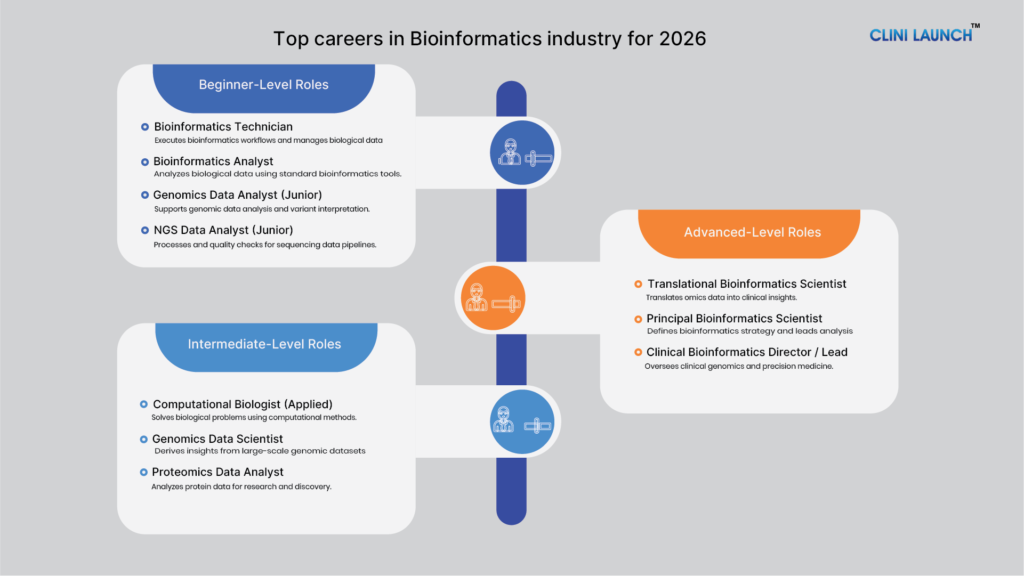
Bioinformatics offers diverse career roles, from beginner-level data analysis positions to advanced scientific and leadership roles. These careers provide clear growth paths across healthcare, biotechnology, and research. 

Career Path in Bioinformatics: 

Bioinformatics careers typically begin with data-focused roles and progress toward research, strategy, and leadership positions as professionals gain technical and analytical experience. 

A typical career path may include: 

Entry-Level Roles- Bioinformatics Technician, Bioinformatics Analyst, Genomics Data Analyst, NGS Data Analyst 

Mid-Level Roles- Computational Biologist, Genomics Data Scientist, Proteomics Data Analyst 

Senior & Leadership Roles- Translational Bioinformatics Scientist, Principal Bioinformatics Scientist, Clinical Bioinformatics Director 

With experience and specialization, professionals may also move into areas such as precision medicine, drug discovery analytics, and bioinformatics platform development. 

  1. Bioinformatics Technician 

About the Role: A Bioinformatics Technician supports genomics and bioinformatics teams by managing biological datasets and executing predefined analysis of workflows. The role focuses on ensuring that data pipelines run smoothly and that datasets are properly organized for analysis. It is a highly practical, entry-level role designed for beginners who want hands-on exposure to bioinformatics systems and workflows without deep analytical or research responsibilities. 

Primary Responsibilities: 

  • Assist in running standard bioinformatics and sequencing workflows 
  • Manage and organize biological data files and datasets 
  • Perform basic data checks and ensure data completeness 
  • Support analysts and scientists during data processing tasks 

Role Overview

Category Details
Average Salary (India) ₹3 – ₹6 LPA (entry-level role, varies by organization and domain)
What They Do / Nature of Work Support bioinformatics workflows by managing data, executing predefined processes, and assisting analysts and scientists.
Senior / Global Level Salary ₹8 – ₹15+ LPA in India; USD 60,000 – 90,000 annually in global markets.
Growth Outlook (Next 5 Years) Steady growth as genomics and data-driven research expand across healthcare and life sciences.
Job Mobility Moderate to high opportunities across genomics labs, biotech firms, CROs, healthcare research units, and bioinformatics service providers.
Key Benefits Beginner-friendly role, hands-on exposure, low entry barrier, and a strong foundation for moving into analyst or specialist roles.

2. Bioinformatics Analyst – Career Role in 2026

About the Role: A Bioinformatics Analyst works with biological and healthcare data to identify patterns, generate insights, and support research and clinical decision-making. The role involves analyzing genomic datasets, interpreting sequencing results, and using bioinformatics tools to assist research teams in biotechnology, pharmaceuticals, healthcare, and genomics organizations. In 2026, this role continues to grow rapidly due to increasing demand for precision medicine, AI-driven healthcare, and genomic research.

Primary Responsibilities:

  • Analyze genomic, proteomic, and biological datasets using bioinformatics tools
  • Interpret sequencing and molecular biology data for research projects
  • Support clinical and pharmaceutical research through data-driven insights
  • Perform data visualization, reporting, and quality analysis
  • Collaborate with researchers, scientists, and healthcare teams on bioinformatics workflows
  • Maintain accuracy and integrity of biological databases and analytical results
  • Assist in developing and optimizing bioinformatics pipelines and analysis methods

Role Overview

Category Details
Average Salary (India) ₹4 – ₹8 LPA (entry-level to early-career professionals, depending on skills and organization)
What They Do / Nature of Work Analyze biological datasets, execute validated bioinformatics pipelines, interpret results, and support research or clinical decision-making.
Senior / Global Level Salary ₹15 – ₹30+ LPA in India; USD 90,000 – 140,000 annually in global markets.
Growth Outlook (Next 5 Years) Strong and sustained growth driven by genomics expansion, AI-enabled research, and data-driven drug discovery.
Job Mobility High opportunities across pharma, biotech, CROs, genomics labs, healthcare technology firms, and research institutions.
Key Benefits Beginner-friendly entry role, strong learning curve, global applicability, and clear progression into advanced bioinformatics and genomics roles.
  1. Genomics Data Analyst (Junior Level)- 
     

About the Role: A Genomics Data Analyst (Junior Level) works with DNA-based datasets to support genomics research, diagnostics, or clinical studies. The role focuses on analyzing genomic sequencing data, identifying genetic variants, and assisting in interpretation under established workflows. It is a beginner-friendly role for individuals interested in understanding how genetic data is analyzed and applied in research and healthcare settings. 

Primary Responsibilities: 

  • Analyze genomic sequencing data using standard analysis pipelines 
  • Perform quality checks on genomic datasets 
  • Assist in variant identification and annotation 
  • Support genomics research or clinical teams with analysis summaries 

Role Overview

Category Details
Average Salary (India) ₹4 – ₹7 LPA (entry-level to early-career professionals, depending on organization and skill set)
What They Do / Nature of Work Analyze genomic data, assist in variant annotation, and support research or clinical genomics workflows.
Senior / Global Level Salary ₹12 – ₹25+ LPA in India; USD 80,000 – 120,000 annually in global markets.
Growth Outlook (Next 5 Years) Strong growth driven by expansion of genomics research, diagnostics, and precision medicine.
Job Mobility High opportunities across genomics labs, biotech companies, diagnostic firms, CROs, and healthcare research centers.
Key Benefits Entry-friendly genomics role, strong biological focus, and clear progression into advanced genomics or clinical bioinformatics careers.
  1. NGS Data Analyst (Junior Level)- 

About the Role: An NGS Data Analyst (Junior Level) focuses on processing and managing data generated from next-generation sequencing platforms. The role is centered on executing sequencing analysis pipelines, monitoring data quality, and ensuring that raw sequencing data is correctly processed for downstream analysis. It is a structured, workflow-driven role that serves as an ideal entry point for beginners who prefer hands-on technical work with sequencing data. 

Primary Responsibilities: 

  • Run standard NGS data processing pipelines 
  • Perform quality control checks on sequencing data 
  • Process raw sequencing files into analysis-ready formats 
  • Support genomics and bioinformatics teams with clean datasets. 

Role Overview

Category Details
Average Salary (India) ₹4 – ₹7 LPA (entry-level to early-career professionals, varies by organization and domain)
What They Do / Nature of Work Process and manage sequencing data, execute NGS pipelines, and ensure data quality for downstream analysis.
Senior / Global Level Salary ₹12 – ₹25+ LPA in India; USD 80,000 – 120,000 annually in global markets.
Growth Outlook (Next 5 Years) Strong growth due to widespread adoption of NGS in research, diagnostics, and clinical genomics.
Job Mobility High opportunities across genomics labs, diagnostic centers, biotech firms, CROs, and sequencing service providers.
Key Benefits Highly structured entry role, strong technical foundation, hands-on exposure to sequencing workflows, and a clear path into genomics or bioinformatics analyst roles.
  1. Computational Biologist (Applied Level)- 

 About the Role: A Computational Biologist (Applied Level) works on solving biological problems using computational and statistical methods. Unlike entry-level analyst roles, this position involves designing analysis approaches, applying existing models, and independently interpreting complex biological datasets. The role bridges biology, data science, and applied research, and is typically pursued after gaining hands-on experience in bioinformatics or genomics roles. These roles contribute directly to developing scalable bioinformatics solutions for research and drug discovery. 

Primary Responsibilities: 

  • Apply computational methods to analyze complex biological datasets 
  • Design and adapt analysis workflows for research or discovery projects 
  • Perform statistical and model-based analysis of biological data 
  • Interpret results in biological and experimental contexts 

Role Overview

Category Details
Average Salary (India) ₹8 – ₹14 LPA (mid-level professionals, depending on experience and organization)
What They Do / Nature of Work Apply computational and statistical methods to analyze biological data and support research or discovery decisions.
Senior / Global Level Salary ₹20 – ₹40+ LPA in India; USD 100,000 – 150,000 annually in global markets.
Growth Outlook (Next 5 Years) Strong growth driven by increased use of computational biology in drug discovery, genomics, and systems biology.
Job Mobility High opportunities across pharma R&D, biotech firms, genomics companies, research institutions, and health-tech organizations.
Key Benefits Higher analytical ownership, intellectually challenging work, strong global demand, and a pathway to senior scientific and leadership roles.
  1. Genomics Data Scientist- 

 About the Role A Genomics Data Scientist works on extracting insights from large-scale genomic datasets using statistical, computational, and data science methods. This role goes beyond running standard pipelines and involves designing analytical approaches, integrating genomics data with other datasets, and supporting research, clinical, or product decisions. It is an intermediate-level role typically taken after experience in genomics or bioinformatics analyst positions.  

Primary Responsibilities: 

  • Design and execute analytical approaches for large genomic datasets 
  • Apply statistical and data science methods to genomics problems 
  • Integrate genomic data with phenotypic or clinical information 
  • Support research, diagnostics, or precision medicine initiatives 

Role Overview

Category Details
Average Salary (India) ₹10 – ₹16 LPA (mid-level professionals, depending on experience and organization)
What They Do / Nature of Work Analyze and model genomic data using data science methods to support research, diagnostics, or product development.
Senior / Global Level Salary ₹22 – ₹45+ LPA in India; USD 110,000 – 160,000 annually in global markets.
Growth Outlook (Next 5 Years) Strong growth driven by genomics expansion, precision medicine, and data-driven healthcare.
Job Mobility High opportunities across genomics companies, pharma R&D, biotech firms, diagnostics labs, and healthcare technology organizations.
Key Benefits High-impact analytical role, strong global demand, exposure to advanced genomics and data science, and a pathway to senior scientific or leadership roles.
  1. Proteomics Data Analyst- 

About the Role: A Proteomics Data Analyst specializes in analyzing protein-level data generated from techniques such as mass spectrometry. This role focuses on identifying proteins, quantifying expression levels, and interpreting proteomic patterns to support research in drug discovery, biomarker identification, and disease mechanism studies. It is an intermediate-level role typically pursued after gaining experience in bioinformatics or omics data analysis. 

Primary Responsibilities: 

  • Analyze proteomics datasets generated from mass spectrometry experiments 
  • Identify and quantify proteins and peptides 
  • Interpret proteomic results in biological and experimental contexts 
  • Collaborate with research and discovery teams to support scientific conclusions. 

Role Overview

Category Details
Average Salary (India) ₹9 – ₹15 LPA (mid-level professionals, depending on experience and organization)
What They Do / Nature of Work Analyze and interpret proteomics data to support research in drug discovery, biomarker analysis, and disease studies.
Senior / Global Level Salary ₹20 – ₹40+ LPA in India; USD 100,000 – 150,000 annually in global markets.
Growth Outlook (Next 5 Years) Steady growth driven by increasing use of proteomics in drug discovery, biomarker research, and systems biology.
Job Mobility Moderate to high opportunities across pharma R&D, biotech firms, research institutes, and proteomics service providers.
Key Benefits Specialized skill set, strong relevance in drug discovery, exposure to advanced experimental data, and a pathway to senior scientific roles.
  1. Translational Bioinformatics Scientist- 

About the Role: A Translational Bioinformatics Scientist focuses on bridging biological research data with clinical and real-world applications. This role translates insights from genomics, proteomics, and other omics data into outcomes that support drug development, biomarker discovery, and precision medicine. It is an advanced role that typically comes after strong experience in genomics, computational biology, or data science. 

Primary Responsibilities: 

  • Integrate research-level biological data with clinical or real-world datasets 
  • Translate multi-omics findings into clinically or therapeutically relevant insights 
  • Support biomarker identification, patient stratification, and treatment strategies 
  • Guide analytical approaches for translational and precision-medicine programs 

Role Overview

Category Details
Average Salary (India) ₹15 – ₹25 LPA (advanced professionals, depending on experience and organization)
What They Do / Nature of Work Translate biological and omics data into clinically meaningful insights that support drug development and precision medicine.
Senior / Global Level Salary ₹30 – ₹50+ LPA in India; USD 120,000 – 180,000 annually in global markets.
Growth Outlook (Next 5 Years) Strong growth driven by precision medicine, translational research, and data-driven clinical development.
Job Mobility High opportunities across pharma R&D, biotech companies, clinical research organizations, and healthcare innovation teams.
Key Benefits High-impact scientific role, strong strategic relevance, global demand, and a pathway to principal or leadership positions.
  1. Principal Bioinformatics Scientist- 

About the Role: A Principal Bioinformatics Scientist is a senior leadership role responsible for defining bioinformatics strategy, guiding complex analytical programs, and making high-impact scientific decisions. This role oversees advanced bioinformatics initiatives across drug discovery, genomics, translational research, or clinical development, and typically comes after several years of deep technical and domain experience. 
 

Primary Responsibilities: 

  • Lead and design advanced bioinformatics and multi-omics strategies 
  • Oversee complex analytical projects across research and clinical programs 
  • Guide teams on data interpretation, modeling approaches, and best practices 
  • Collaborate with senior stakeholders across R&D, clinical, and product teams 

Role Overview

Category Details
Average Salary (India) ₹20 – ₹35 LPA (senior leadership level, varies by organization and responsibility)
What They Do / Nature of Work Define bioinformatics strategy, lead advanced analytics, and guide scientific decision-making across programs.
Senior / Global Level Salary ₹40 – ₹70+ LPA in India; USD 140,000 – 200,000+ annually in global markets.
Growth Outlook (Next 5 Years) Strong demand driven by complex data needs, AI integration, and precision medicine initiatives.
Job Mobility High opportunities across pharma R&D, biotech leadership teams, genomics companies, and global research organizations.
Key Benefits High strategic impact, leadership authority, global recognition, and influence over scientific direction and innovation.

Clinical Bioinformatics Director – 

About the Role: A Clinical Bioinformatics Director (or Clinical Bioinformatics Lead) oversees the application of bioinformatics in clinical and patient-facing contexts. This role ensures that genomic and biological data analysis directly supports diagnostics, treatment decisions, and precision medicine initiatives. It is a senior role typically held by professionals with deep experience in clinical genomics, regulatory environments, and cross-functional leadership. 

Primary Responsibilities: 

  • Lead clinical bioinformatics programs and teams 
  • Oversee genomic data analysis used for diagnostics and patient care 
  • Ensure compliance with clinical, regulatory, and data quality standards 
  • Guide strategy for precision medicine and clinical genomics initiatives 

Role Overview

Category Details
Average Salary (India) ₹20 – ₹35 LPA (senior clinical leadership level, varies by organization)
What They Do / Nature of Work Lead and govern clinical bioinformatics activities supporting diagnostics, treatment, and precision medicine.
Senior / Global Level Salary ₹40 – ₹70+ LPA in India; USD 140,000 – 200,000+ annually in global markets.
Growth Outlook (Next 5 Years) Strong growth driven by expansion of clinical genomics and precision medicine programs.
Job Mobility Moderate to high opportunities across hospitals, diagnostic labs, pharma, biotech, and healthcare research organizations.
Key Benefits High clinical impact, leadership authority, global relevance, and long-term career stability.

Career Progression in Bioinformatics 

Career growth in bioinformatics is typically driven by a combination of biological knowledge, computational skills, and real-world project experience. Professionals gradually move from executing predefined analysis workflows to designing analytical strategies and leading research initiatives. 

As experience increases, responsibilities expand to include interpreting complex biological data, collaborating with multidisciplinary research teams, and guiding scientific decision-making. Senior roles often involve strategic planning, project leadership, and translating biological insights into clinical or commercial applications. The bioinformaticians salary typically increases significantly with experience and specialization. 

Bioinformatics Salaries and Career Opportunities in India 

India is emerging as a significant hub for bioinformatics due to its expanding biotechnology sector, growing pharmaceutical research ecosystem, and increasing investment in genomics and precision medicine.  

Several factors are driving opportunities in India: 

  • Expansion of genomics and sequencing laboratories 
  •  Growth of pharmaceutical and biotechnology research centers 
  • Increasing clinical research and drug discovery activities 
  • Government-supported life science research initiatives 

Major cities such as Bangalore, Hyderabad, Pune, Delhi NCR, and Chennai host many biotechnology companies, research institutions, and genomics laboratories that actively hire bioinformatics professionals. In India, bioinformaticians salary ranges from ₹3 LPA at entry level to ₹30+ LPA in advanced roles. 

Bioinformatics Career Opportunities and Salaries in Global Markets  

Globally, bioinformatics careers are expanding rapidly as healthcare and life sciences become increasingly data-driven, particularly with the growing adoption of genomics and precision medicine in global health systems. Countries such as the United States, Germany, the United Kingdom, Canada, and Singapore have strong demand for bioinformatics professionals in areas like genomics research, drug discovery, and clinical data analysis. 

Large pharmaceutical companies, biotechnology firms, genomics startups, and academic research institutions rely heavily on bioinformatics expertise to interpret biological datasets and support scientific innovation. 

As precision medicine and AI-enabled biological analysis continue to grow, global demand for bioinformatics professionals is expected to remain strong across research, healthcare, and biotechnology industries. Globally, bioinformaticians’ salaries can exceed USD 100,000 annually for experienced professionals. 

Advanced Diploma in

Bioinformatics 

Develop in-depth skills to analyze, manage, and interpret large-scale biological data used in genomics, clinical research, and drug discovery. This program focuses on applying computational methods and analytical pipelines to transform complex biological data into actionable research insights. The program is designed as practical bioinformatics training aligned with industry workflows. 

IN PARTNERSHIP WITH
4.8(2,300+ ratings)

AI and Automation Trends in Bioinformatics 

Artificial intelligence is rapidly becoming part of modern biological research. As a result, bioinformatics professionals are increasingly expected to understand AI-driven analytical approaches. These skills allow researchers to analyze complex biological datasets using advanced computational methods. 

Key AI-driven skills include: 

– Machine learning applications in genomics and biological data analysis 
– Deep learning for biological sequence and structure prediction 
– Predictive modeling for drug discovery and biomarker identification 
– Handling large-scale omics datasets from public biological databases such as the NCBI genomic repositories  

These skills are becoming particularly important in fields such as precision medicine, genomics research, and AI-driven drug discovery. 

Conclusion 

Bioinformatics has become a critical field in modern life sciences, helping researchers and healthcare organizations interpret large biological datasets. As organizations increasingly rely on biological data to guide decisions, the need for skilled bioinformatics professionals continues to grow across industries and geographies. This makes bioinformatics a stable, future-oriented career choice rather than a short-term trend. 

What makes this field especially attractive is its structured career progression from beginner roles that focus on data handling and analysis to advanced positions involving strategy, translation, and leadership. With the right mix of biological understanding, computational skills, and continuous upskilling, professionals can build meaningful and impactful careers in this domain. To gain deeper, job-oriented knowledge and practical exposure, enrolling in a structured bioinformatics course like the Advanced Diploma in Bioinformatics can help you build the skills required to enter and grow in this field with confidence. 

Frequently Asked Questions

Yes, bioinformatics is considered a strong career option in India due to the growing demand for genomics, biotechnology, healthcare analytics, clinical research, and AI-driven life sciences applications. The field offers opportunities in pharmaceutical companies, biotech firms, research organizations, healthcare technology companies, and academic research.
The salary of a bioinformatician in India can vary based on skills, specialization, and experience. Freshers may start with entry-level packages, while experienced professionals with expertise in genomics, programming, AI, or data analysis can earn significantly higher salaries in biotechnology, pharma, and healthcare organizations.
Yes, bioinformatics can be learned online through structured courses, virtual labs, coding practice, genomics training, and project-based learning programs. Many online bioinformatics courses also provide flexibility for students, working professionals, and researchers to learn at their own pace.
Degrees in biotechnology, bioinformatics, microbiology, biochemistry, genetics, computer science, life sciences, or related healthcare and biological science fields are commonly considered suitable for bioinformatics careers. Specialized certifications and practical training in programming, genomics, and data analysis can further improve career opportunities.
Yes, bioinformatics jobs are expected to remain in strong demand in 2026 due to rapid growth in genomics, precision medicine, AI in healthcare, drug discovery, and biotechnology research. Organizations worldwide continue to seek professionals who can combine biological knowledge with computational and analytical skills.
Genomics is one of the core areas of bioinformatics. Understanding DNA sequences, genetic variations, and molecular biology concepts helps professionals interpret biological datasets accurately.
Yes. With increasing use of genomics, precision medicine, and data-driven research, the demand for bioinformatics professionals is growing across pharmaceutical companies, biotechnology firms, and healthcare research organizations worldwide.
Yes. Many bioinformatics professionals begin with a background in biotechnology, microbiology, pharmacy, or other life science fields and then develop computational and data analysis skills through bioinformatics online platforms or structured programs.
The strongest demand comes from pharmaceutical research, healthcare technology & biotechnology companies, genomics laboratories, clinical research organizations, and academic research institutions.
Entry-level roles can be accessed within a few months of focused training and practical exposure. As professionals gain experience, they can move into advanced research or leadership roles over several years.
Bioinformatics will continue to grow as biological research becomes increasingly data driven. Advances in genomics, artificial intelligence, and precision medicine are expected to create even more opportunities in this field.
Top Bioinformatics Career Roles for 2026
What Tools Do Physician Assistants Use for Clinical Documentation?

Physician Assistants use clinical documentation tools such as EHR systems, AI-powered documentation software, voice dictation tools, medical scribes, and clinical reference platforms to manage patient records efficiently. These tools reduce documentation burden, improve accuracy, and ensure compliance in healthcare workflows.

Clinical documentation is essential for care of continuity, legal compliance, insurance billing, and coordinated treatment. However, growing patient loads mkes timely and accurate record-keeping more challenging.  

With increasing digital systems, documentation tools now directly affect efficiency and accuracy in clinical workflows. They influence charting time, after-hours work, and decision support within EHR systems. 

To manage this, tools like EHR systems, AI-assisted notes, voice dictation, and scribe support are increasingly used to reduce administrative burden while maintaining clinical responsibility.  

Professionals interested in building careers in healthcare documentation often pursue a clinical documentation course, medical coding course, or clinical research course to develop industry-relevant skills.  

Build practical skills in medical coding and clinical documentation used across hospitals, healthcare providers, and global healthcare services. This medical coding course also functions as a practical clinical documentation course for professionals interested in documentation-driven healthcare roles. Learn how diagnoses, procedures, and services are accurately translated into standardized medical codes for billing, compliance, and data integrity. 

Learn More

What is Clinical Documentation in Healthcare? 

Clinical documentation refers to the systematic recording of patient health information, including medical history, diagnoses, treatments, procedures, and outcomes. It is a core part of clinical documentation management that ensures accurate and organized clinical documentation across healthcare settings. A well-designed clinical records management system also helps healthcare providers securely store, retrieve, and manage patient information while supporting continuity of care, auditing, and healthcare analytics across departments. This information is stored and managed through a clinical records management system, such as electronic health records (EHRs), to support continuity of care, clinical decision-making, billing accuracy, and legal compliance. Proper documentation improves patient safety, enhances communication among healthcare providers, and ensures all clinical actions are traceable and evidence based. Many professionals strengthen these skills through a clinical documentation course or medical coding course focused on healthcare documentation standards.  

Start Clinical Documentation Training

Who is a Physician Assistant and What is their role in Clinical Documentation? 

Physician Assistants (PAs) are licensed healthcare professionals who work closely with doctors to support patient care across clinics, hospitals, and emergency settings. They are involved in examining patients, reviewing medical history, ordering diagnostic tests, assisting in diagnosis, and contributing to treatment decisions. In many healthcare environments, PAs serve as a key point of contact for patients, combining clinical responsibility with decision-making support. 

As part of their daily responsibilities, Physician Assistants play a direct and active role in clinical documentation. They record patient history, examination findings, assessments, diagnoses, treatment plans, follow-ups, and discharge information in the medical record. This documentation supports continuity of care, enables clear communication across healthcare teams, and meets legal, regulatory, and billing requirements. Accurate documentation by PAs is essential because it reflects real-time clinical decisions and directly influences patient safety and care outcomes. 

Types of Clinical Documentation Tools Used by Physician Assistants 

Documentation tools influence three key areas of a PA’s daily workflow: efficiency, accuracy, and compliance. Effective clinical documentation management ensures that records are structured, compliant, and aligned with billing and regulatory standards. In many healthcare environments, documentation quality directly influences reimbursement, audit outcomes, and interdepartmental communication. Inaccurate or incomplete records can lead to claim denials, compliance issues, or patient safety concerns. As healthcare systems increasingly rely on structured data for quality reporting and performance metrics, the accuracy of documentation becomes measurable and accountable. For Physician Assistants, this means documentation tools are not merely administrative aids they shape clinical defensibility, workflow efficiency, and professional credibility. The various types of clinical documentation tools used are: 

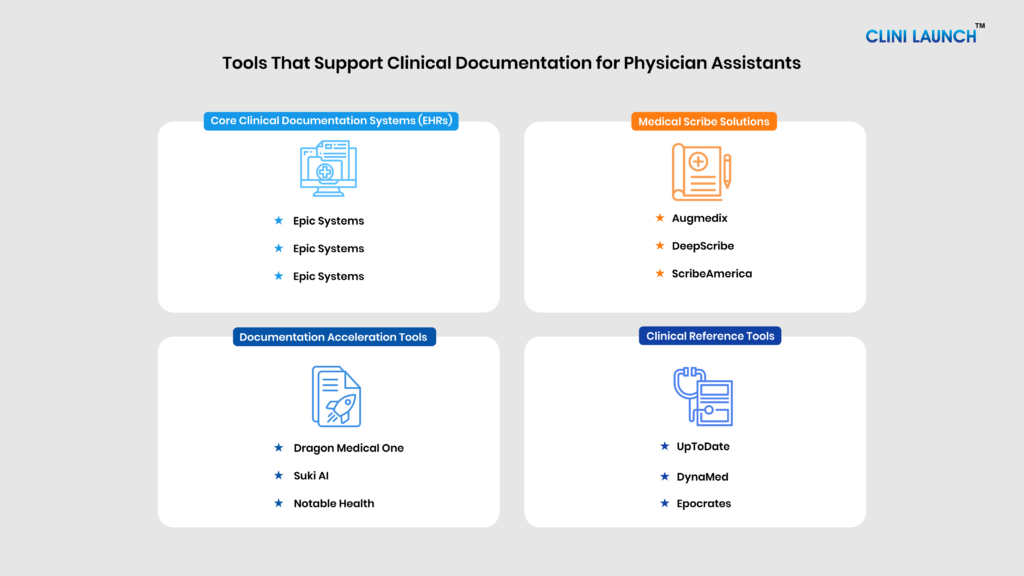
  •   EHR Systems: Epic Systems, Oracle Cerner, Athenahealth  
  • AI Documentation Tools: Suki AI, Notable, DeepScribe  
  • Voice Dictation Tools: Dragon Medical One  
  • Medical Scribe Solutions: Augmedix, ScribeAmerica  
  • Clinical Reference Tools: UpToDate, DynaMed, Epocrates 

Comparison of Best Clinical Documentation Tools  

Clinical documentation tools help healthcare organizations streamline patient record management, improve documentation accuracy, reduce administrative workload, and support efficient clinical workflows. Below is a comparison table of the best clinical documentation tools used across hospitals, clinics, and healthcare systems. 

Clinical Documentation Tools Used in Healthcare

Category Tool Primary Function
EHR System Epic Systems Integrated electronic health record and clinical workflow management
EHR System Oracle Cerner Enterprise-level EHR and interoperability management
EHR System Athenahealth Cloud-based EHR and outpatient practice management
AI Documentation Tool Suki AI AI-powered voice-assisted clinical note generation
AI Documentation Tool Notable AI automation for documentation and patient intake workflows
AI Documentation Tool DeepScribe Ambient AI medical scribing and clinical note creation
Voice Dictation Tool Dragon Medical One Real-time speech recognition for medical documentation
Medical Scribe Solution Augmedix Remote medical scribing and documentation support
Medical Scribe Solution ScribeAmerica Human medical scribe services for healthcare providers
Clinical Reference Tool UpToDate Evidence-based clinical decision support resource
Clinical Reference Tool DynaMed Point-of-care clinical reference and treatment guidance
Clinical Reference Tool Epocrates Drug reference and clinical information support tool

Tools Used by Physician Assistants for Clinical Documentation Support 

Basic Documentation Tools (Foundational Systems) 

Basic documentation tools form the foundation of a Physician Assistant’s daily workflow. These systems are used to document patient encounters, manage records, reference clinical guidelines, and ensure regulatory compliance. Proficiency in these platforms is considered essential for safe, structured, and legally sound documentation across healthcare settings. These platforms collectively function as a clinical records management system, allowing healthcare organizations to store, retrieve, and standardize patient documentation across departments. 
1. Epic Systems 

Epic is a comprehensive enterprise-level Electronic Health Record (EHR) system widely used in large hospitals and academic medical centers. It enables Physician Assistants to document complete patient encounters, manage orders, review labs and imaging, and support billing-compliant workflows within a structured environment. Because Epic is deeply integrated into hospital systems, proficiency in navigating its templates and documentation standards is considered a foundational competency for PAs working in inpatient and high-volume care settings. 

2. Cerner (Oracle Health) 

Cerner, now part of Oracle Health, is an enterprise EHR platform commonly used in emergency departments and acute care environments. It supports real-time documentation, order entry, medication management, and interdisciplinary communication within fast-paced clinical workflows. For Physician Assistants working in hospital-based roles, familiarity with Cerner helps improve efficiency under time pressure and supports accurate, workflow-aligned documentation. 

3. Athenahealth 

Athenahealth is a cloud-based EHR platform primarily used in outpatient and ambulatory care settings. It allows Physician Assistants to document patient visits, manage prescriptions, handle billing tasks, and coordinate follow-ups within a streamlined interface. Its simplified design supports quicker documentation turnaround, making it especially useful for PAs managing high patient throughput in clinic environments. 

4. UpToDate 

UpToDate is an evidence-based clinical decision support resource widely used across healthcare institutions. While it does not generate documentation, it supports Physician Assistants by strengthening the clinical reasoning and evidence behind diagnoses, treatment plans, and management decisions recorded in patient notes. Its regularly updated content helps ensure documentation aligns with current medical standards. 

5. DynaMed 

DynaMed is a point-of-care clinical reference tool that provides concise, structured summaries of medical conditions and treatment guidelines. It supports rapid clinical confirmation during patient encounters, helping Physician Assistants document care decisions accurately and efficiently. Its streamlined format is particularly useful in time-sensitive clinical environments. 

6. Epocrates 

Epocrates is a widely used drug reference tool that provides information on medication dosing, interactions, contraindications, and safety considerations. While not a documentation system itself, it supports accurate medication-related entries within patient records. For Physician Assistants managing prescribing responsibilities, it strengthens documentation reliability and reduces the risk of medication errors. 

AI in Clinical Documentation & Automation Trends for PAs 

Advanced documentation tools focus on accelerating workflows through voice recognition, AI-assisted drafting, and scribe support. These technologies reduce manual charting burden but still require active review and approval by the Physician Assistant. Understanding how these tools function is increasingly important in digitally integrated healthcare systems. 

1. Nuance Dragon Medical One 

Dragon Medical One is a medical-grade voice recognition tool that converts spoken clinical notes into structured documentation within the EHR. It integrates with major platforms such as Epic and Cerner, enabling real-time dictation during patient encounters. For Physician Assistants managing busy clinics or ward rounds, voice-enabled documentation significantly reduces typing time while maintaining note accuracy and completeness. 

2. Suki AI 

Suki AI is an AI-powered clinical documentation assistant designed to help clinicians generate structured SOAP notes using voice commands or conversational inputs. It drafts documentation within the EHR, allowing Physician Assistants to review, edit, and finalize notes before submission. By reducing repetitive formatting and data entry, Suki supports faster documentation completion while maintaining clinical oversight and responsibility. 

3. Notable Health 

Notable Health uses AI-driven automation to assist with documentation and post-visit workflows, including follow-ups and administrative tasks. Rather than replacing clinical input, it streamlines repetitive documentation processes that often extend beyond patient encounters. For Physician Assistants in high-efficiency outpatient settings, this reduces after-hours charting and improves overall workflow balance. 

Medical Scribe Solutions are designed to reduce how much documentation a Physician Assistant needs to personally write. In this model, a human scribe, AI system, or a combination of both prepares the clinical note, which the PA then reviews, edits if needed, and signs off. 

4. Augmedix 

Augmedix provides remote medical scribe services supported by AI, where trained professionals prepare clinical documentation based on patient encounters. The Physician Assistant reviews and approves the drafted notes before final submission. This hybrid model significantly reduces the time spent writing detailed notes, especially in high-volume clinical environments, while preserving clinician accountability. 

5. DeepScribe 

DeepScribe uses ambient AI technology to listen during patient visits and automatically generate structured clinical notes without requiring active dictation. The system operates in the background and produces draft documentation for review. For Physician Assistants seeking minimal workflow interruption during patient interaction, this hands-free model supports documentation efficiency while maintaining final clinical oversight. 

6. ScribeAmerica 

ScribeAmerica provides trained human medical scribes who document patient encounters directly within the EHR under clinician supervision. This model significantly reduces the amount of manual charting required from Physician Assistants, particularly in emergency departments and inpatient settings. The PA remains responsible for reviewing and signing off on documentation to ensure accuracy and compliance. 

How Documentation Tools Influence Burnout and Workload 

Administrative workload is one of the most cited contributors to clinician burnout. For Physician Assistants managing high patient volumes, after-hours charting can extend the clinical day significantly. Documentation acceleration tools, ambient AI systems, and scribe support reduce time spent typing and formatting notes. However, efficiency gains depend on proper tool selection and workflow integration. Tools that require excessive correction or poor EHR integration may increase frustration rather than reduce it. The true value of documentation systems lies not just in speed, but in how seamlessly they fit into real-world clinical routines. 

Competencies Required for Physician Assistants 

Beyond technical familiarity, PAs must develop structured thinking in documentation. This includes understanding how to write defensible clinical notes, documenting medical decision-making clearly, and aligning documentation with billing levels of service. As AI-generated drafts become more common, the ability to detect subtle inaccuracies, missing context, or incorrect auto-populated data becomes critical. Competency now extends beyond writing — it includes reviewing, validating, and ensuring compliance before final sign-off. To use modern documentation tools effectively, Physician Assistants must develop structured documentation skills, EHR navigation proficiency, and awareness of billing-compliant note formatting. Advanced AI and scribe tools also require the ability to critically review auto-generated content, correct inaccuracies, and ensure clinical responsibility remains intact. In specialized roles focused on documentation accuracy and reimbursement compliance, professionals may also pursue CDI certification training to develop expertise in clinical documentation improvement processes. 

For professionals interested in expanding into documentation-driven healthcare roles such as clinical research, regulatory affairs, medical coding, or positions like a clinical documentation specialist, structured training becomes increasingly valuable. A clinical documentation course helps learners understand healthcare workflows and documentation standards, while a medical coding course develops expertise in coding systems, reimbursement processes, and compliance. A clinical research course further supports professionals interested in protocol documentation, audit readiness, clinical trial documentation, and regulatory operations.  

Advanced Diploma in

Medical Coding

Build practical skills in medical coding and clinical documentation used across hospitals, healthcare providers, and global healthcare services. This program also functions as a practical clinical documentation course for professionals interested in documentation-driven healthcare roles. Learn how diagnoses, procedures, and services are accurately translated into standardized medical codes for billing, compliance, and data integrity. 

IN PARTNERSHIP WITH
4.8(2,500+ ratings) 

As healthcare shifts toward federally supported digital health infrastructure and Electronic Health Record (EHR) standards, tool proficiency becomes a professional competency — not just a technical skill. 

Clinical Documentation Specialist Career Opportunities 

The demand for skilled clinical documentation specialist professionals is increasing across hospitals, healthcare BPOs, medical coding companies, insurance firms, and healthcare technology organizations. With the growing adoption of digital healthcare systems and clinical records management platforms, professionals trained through a clinical documentation course can explore roles related to medical documentation review, healthcare compliance, clinical data quality, and coding support. Learners from a medical coding course often develop expertise in documentation accuracy, coding systems, and reimbursement workflows, while professionals from a clinical research course gain exposure to protocol documentation, regulatory compliance, audit readiness, and healthcare data management. Many learners also pursue cdi certification training to strengthen their expertise, improve career prospects, and qualify for advanced opportunities in the healthcare documentation and revenue cycle management industry.  

Clinical Documentation Specialist Salary in India 

The salary of a Clinical Documentation Specialist in India varies based on experience, healthcare domain knowledge, certifications, and familiarity with clinical documentation software and healthcare compliance standards. Freshers entering the field after completing a clinical documentation course or medical coding course can expect competitive entry-level salaries, while experienced professionals working with hospitals, healthcare BPOs, medical coding companies, and clinical documentation management teams often earn significantly higher packages. Professionals trained through a clinical research course may also transition into documentation-focused healthcare and regulatory roles. Expertise in medical terminology, clinical records management systems, ICD coding, and healthcare analytics continues to increase demand across the healthcare industry.   

Salary Range for Denial Management Roles in India

Level Average Salary Range in India Experience
Entry Level ₹2.5 LPA – ₹4.5 LPA 0 – 2 Years
Mid-Level ₹5 LPA – ₹8 LPA 3 – 6 Years
Senior Level ₹9 LPA – ₹15+ LPA 7+ Years
Advanced Diploma in

Clinical Research

Build industry-ready skills to work across real clinical trial environments. Learn how clinical studies are designed, conducted, documented, and monitored, with a strong focus on ethics, patient safety, and global regulatory compliance. 

IN PARTNERSHIP WITH
4.8(2,500+ ratings) 

Workflow Impact of Documentation Tools 

Documentation tools influence not only how notes are written, but also when and where Physician Assistants complete them. The comparison below highlights how different systems affect after-hours of charting, real-time documentation, and adaptability to clinical workflow. 

Workflow Impact Comparison

Tool When Documentation Happens Effect on After-Hours Charting Adaptability to PA Workflow
Epic Systems During & after visit Moderate High
Cerner (Oracle Health) During & after visit Moderate High
athenahealth Mostly during visit Low Moderate
Nuance Dragon Medical One During visit Low High
Suki AI During visit Low Moderate
Notable Health After visit Very Low Moderate
Augmedix During visit Very Low Moderate
DeepScribe During visit Very Low Low–Moderate
ScribeAmerica During visit Very Low Low
UpToDate During documentation N/A High
DynaMed During documentation N/A High
Epocrates During prescribing N/A High

Risks and Limitations of Clinical Documentation Tools

While documentation technologies improve efficiency, they introduce new responsibilities. AI-generated drafts may contain subtle errors. Ambient transcription systems may misinterpret clinical nuance. Overreliance on structured templates may oversimplify complex patient cases. Understanding these risks ensures that efficiency does not compromise clinical judgment. 

• Overreliance on AI-generated documentation 
• Risk of inaccuracies in ambient transcription 
• Patient privacy concerns in audio-recorded encounters 
• Data security risks 
• Alert fatigue within EHR systems 
• Reduced critical thinking if documentation is blindly accepted 

While tools enhance efficiency, final accountability always remains with the Physician Assistant. 

The Future of Clinical Documentation for PAs 

 • Ambient AI documentation becoming more common  
• Real-time coding integration within notes 
• Predictive documentation prompts 
• Greater automation of billing alignment 
• Increased AI-assisted compliance checks 

The future of documentation will likely be hybrid combining human clinical reasoning with intelligent automation. 

Conclusion 

Clinical documentation has become one of the most critical and time-intensive responsibilities in a Physician Assistant’s role. Effective clinical documentation management now supports continuity of care, regulatory compliance, billing accuracy, and audit readiness across healthcare systems. Beyond recording patient encounters, documentation today supports continuity of care, regulatory compliance, billing accuracy, audits, and data-driven decision-making across healthcare systems. As digital platforms, AI-assisted tools, and automation become standard, understanding how documentation works within these systems is no longer optional. 

From core EHR platforms to documentation acceleration tools, scribe solutions, and clinical reference systems, each category plays a distinct role in shaping how Physician Assistants manage their workload and maintain clinical accuracy. The ability to work effectively with these tools depends not only on technology, but also on a strong understanding of clinical workflows, compliance requirements, and structured healthcare documentation. 

The evolution of documentation tools reflects a broader shift in healthcare from manual record-keeping to structured, data-driven systems. As digital infrastructure expands, Physician Assistants who understand both clinical reasoning and documentation systems will be better positioned to adapt to evolving regulatory and technological environments. 

For professionals interested in building careers around clinical documentation, regulatory processes, and healthcare data beyond bedside roles formal training becomes increasingly important. Clinilaunch Research Institute offers clinical research course that equips learners with practical knowledge of clinical documentation, protocols, audits, and data handling used across hospitals, CROs, and research organizations, helping them transition confidently into documentation-driven healthcare roles. Professionals can also strengthen their expertise through a clinical documentation course or medical coding course focused on healthcare documentation standards, coding systems, and compliance workflows.
Frequently Asked Questions
1. What are non-bedside career options for nurses?
Nurses can explore roles in clinical research, pharmacovigilance, medical coding and auditing, health informatics, telemedicine, and digital health.
2. How can nurses transition from bedside to clinical research or data roles?
Transitioning requires training in research protocols, data management, and regulatory compliance. Programs like CliniLaunch help build practical skills.
3. Are technology-driven nursing careers in demand?
Yes, roles in health informatics, telemedicine, and digital health are rapidly growing due to healthcare digitalization and AI adoption.
4. What skills do nurses need for health informatics or telemedicine roles?
Key skills include clinical knowledge, data analysis, patient assessment, digital tools proficiency, and communication for virtual care.
5. Can nurses work in clinical research without prior experience?
Yes, with proper training and certification. Many programs teach clinical trial basics and data handling for beginners.
6. What is the scope of medical coding and auditing for nurses?
Medical coding roles are in demand across hospitals, insurance companies, and BPOs, ensuring accurate documentation and billing.
7. How do nurses benefit from taking an Advanced Diploma in Clinical Research?
It provides hands-on training, tools, mentorship, and exposure to real clinical trials for better career opportunities.
8. Are non-clinical nursing roles better for work-life balance?
Yes, these roles offer predictable hours, less physical strain, and reduced stress compared to bedside nursing.
9. What companies hire nurses for alternative or digital health roles?
Hospitals like Apollo, Fortis, Max Healthcare; startups like Practo, mfine, Tata 1mg; and pharma companies hire nurses.
10. How can CliniLaunch courses help nurses switch to non-bedside careers?
CliniLaunch provides structured training, practical tools, mentorship, and placement support for research and digital health roles.

Role of a Denial Management Specialist

A denial management specialist is responsible for analyzing denied claims, identifying root causes, correcting billing errors, submitting appeals, and preventing future denials. They play a critical role in denial management in healthcare by improving reimbursement accuracy, reducing revenue loss, and ensuring compliance in medical billing and clinical research.

Overview of Clinical Trials and Financial Accountability 

Clinical trials are structured research studies designed to evaluate the safety and effectiveness of new drugs, medical devices, or treatment strategies. They follow approved study protocols, regulatory guidelines established by agencies such as the U.S. Food & Drug Administration (FDA), and defined sponsor agreements. Beyond scientific execution, clinical trials also involve detailed financial workflows. Each patient visit, laboratory test, imaging procedure, or consultation must be correctly classified as sponsor-funded research activity or routine care billable to insurance. Because trial-related services operate both research and healthcare billing systems, financial accuracy becomes as important as clinical accuracy. When billing errors occur, they do not just affect revenue — they can trigger audits, delay sponsor payments, and disrupt trial continuity. Federal agencies such as the National Institutes of Health (NIH) also outline strict guidelines for trial conduct and financial transparency. 

In clinical research, claim denials are more common than many beginners expect. A significant number of trial-related claims face initial rejection due to billing mismatches, documentation gaps, or unclear responsibility between sponsors and insurers. These denials often occur even when the clinical study is conducted correctly. 

For investigator sites, repeated denials lead to payment delays, increased rework, and disruption of core study activities.  

Over time, this impacts site finances, delays study timelines, and strains relationships with sponsors and payers. 

This challenge is expected to grow further. Industry forecasts indicate that the global healthcare denial management market is projected to grow from around USD 15 billion in 2024 to over USD 30 billion by 2030, reflecting increasing claim complexity, tighter reimbursement controls, and the rising importance of denial management in healthcare and clinical research operations. 

As clinical trials become more complex and reimbursement regulations tighten, denial management has evolved into a strategic function within research operations. This shift has created demand for specialized professionals who understand both protocol compliance and revenue protection

Want to build a career as a Denial Management Specialist? Learn the complete denial management process, billing workflows, and claim analysis with practical training designed for healthcare careers.

What is Denial Management in Healthcare? 

Denial management in healthcare is the structured process of identifying, analyzing, correcting, and preventing rejected or unpaid insurance claims. According to AGS Health, the denial management process involves systematically reviewing denied claims, identifying root causes, correcting errors, resubmitting claims, and implementing preventive strategies to ensure accurate reimbursements. At its core, it transforms rejected claims into paid claims while improving billing accuracy, compliance, and operational efficiency. This function is critical because unresolved denials directly impact cash flow, lead to revenue leakage, and often indicate deeper issues such as coding errors, incomplete documentation, or non-compliance with payer guidelines. 

Denial management is widely used across hospitals and healthcare providers as part of revenue cycle management (RCM) and also applies to clinical research for handling trial-related billing. It focuses on managing medical claims denials, which occur due to errors like incorrect data, coding issues, missing documentation, or lack of medical necessity. 

These denials can be temporary or permanent, requiring specialists to identify root causes, correct claims, and take preventive actions—making denial management a key function for improving revenue and ensuring compliance. 

Denial Management Jobs & Career Opportunities in India 

Denial management jobs in India are growing rapidly as healthcare organizations focus on improving revenue cycle efficiency and reducing claim losses. Demand is especially strong in major hubs like Bangalore, Hyderabad, Pune, Chennai, and Gurugram, where healthcare BPOs and RCM companies are actively hiring. This creates strong career opportunities in medical billing, AR calling, and denial analysis across healthcare operations. 

  • In Bangalore, there are 180+ active job openings for denial management and related roles, including AR callers and billing specialists  
  • Across India, platforms show 1,300+ denial management job opportunities, highlighting large-scale demand nationwide  
  • In Hyderabad and Pune, companies like Optum and RCM service providers actively hire professionals for denial management, appeals, and claims resolution role 

Denial Management Salary Growth by Experience

Level Experience Salary Range (LPA) Typical Roles
Entry Level 0–3 years ₹1.8 – ₹6 LPA AR Caller, Medical Billing Executive, Denials Specialist
Mid Level 3–6 years ₹4 – ₹8+ LPA Denial Analyst, Senior AR Analyst, RCM Specialist
Senior Level 6+ years ₹8 – ₹15+ LPA Team Lead, Manager – Denial Management, RCM Manager

Entry Level

Experience: 0–3 years

Salary: ₹1.8 – ₹6 LPA

Roles: AR Caller, Medical Billing Executive, Denials Specialist

Mid Level

Experience: 3–6 years

Salary: ₹4 – ₹8+ LPA

Roles: Denial Analyst, Senior AR Analyst, RCM Specialist

Senior Level

Experience: 6+ years

Salary: ₹8 – ₹15+ LPA

Roles: Team Lead, Manager – Denial Management, RCM Manager

Hiring Sectors 

  • Healthcare BPO & KPO Companies 
  • Hospitals & Healthcare Chains 
  • IT & Consulting Firms 
  • HealthTech & AI-driven Platforms 

Who is a Denial Management Specialist in Clinical Research? 

A Denial Management Specialist in clinical research analyzes and resolves insurance claim denials, ensuring accurate reimbursements and compliance also known as a Denials specialist or Denial analyst. 

The role focuses on managing trial-related denials by ensuring services are billed correctly to sponsors or insurance based on protocols and coverage rules. Specialists identify root causes, correct errors, and support appeals, making the role essential for maintaining compliance and protecting research revenue. 

Denial Management Process in Medical Billing 

The denial management process in medical billing is a structured workflow used to identify, analyze, correct, and prevent medical claims denials, ensuring accurate reimbursements and minimizing revenue loss. 

Important Steps in the Denial Management Process 

  1. Claim Submission 
    Submit complete and accurate claims with correct patient details, coding, and documentation.  
  1. Denial Identification 
    Identify denied or rejected claims through EOB (Explanation of Benefits) or ERA reports.  
  1. Root Cause Analysis 
    Determine the exact reason for denial, such as coding errors, missing information, or eligibility issues.  
  1. Correction 
    Rectify errors by updating codes, patient data, or attaching necessary documents.  
  1. Appeal 
    File an appeal with proper justification and supporting documentation for reconsideration.  
  1. Prevention 
    Implement corrective actions and process improvements to reduce future denials. 

List of Common Denial Codes in Medical Billing 

Understanding common denial codes is essential in the denial management process, as it helps quickly identify the reason behind medical claims denials and take corrective action. Industry resources like Credenza Health provide detailed insights into frequently occurring denial codes and their causes. 

High-Frequency Denial Codes 

  • CO-16 – Missing Information 
    This denial occurs when required details such as patient data, modifiers, or documentation are incomplete or missing.  
  • CO-50 – Not Medically Necessary 
    The payer determines that the service provided does not meet medical necessity guidelines.  
  • CO-97 – Included in Another Service 
    The service is considered part of another billed procedure and is not separately payable.  
  • CO-29 – Time Limit Exceeded 
    The claim was submitted after the allowed time frame set by the insurance provider 

Clinical Research Billing Workflow and Common Denials 

In clinical research, billing depends on correctly determining who pays for each service. When this classification is incorrect, medical claims denials occur and require review. Clinical trials include sponsor-paid services and routine care billed to insurance errors in this separation often lead to denials. 

How the clinical research billing workflow typically works: 

  • Trial-related services are reviewed and classified as research-only or routine care 
  • Research-only services are billed to the study sponsor 
  • Claims are submitted along with required trial and billing documentation 
  • Denials arise when billing does not align with the study protocol or coverage requirements 

In this workflow, denials usually fall into a few common patterns rather than random errors. 

Common types of denials in clinical research billing: 

  • Protocol-related denials – services billed do not clearly match the approved study protocol 
  • Sponsor vs insurance denials – research procedures mistakenly billed to insurance 
  • Coverage and eligibility denials – routine care services not covered under payer policies 
  • Authorization-related denials – missing or incorrect approvals 
  • Documentation-based denials – insufficient records to support the billed service 

By understanding the billing flow and common denial types, denial management specialists can quickly identify issues, take corrective action, and reduce repeated denials during clinical trials. 

Since clinical research billing involves study protocols, sponsor agreements, and payer rules, denial resolution is not a routine task. It requires focused analysis and coordination across research, finance, and compliance teams making a dedicated specialist essential for accurate and compliant operations. 

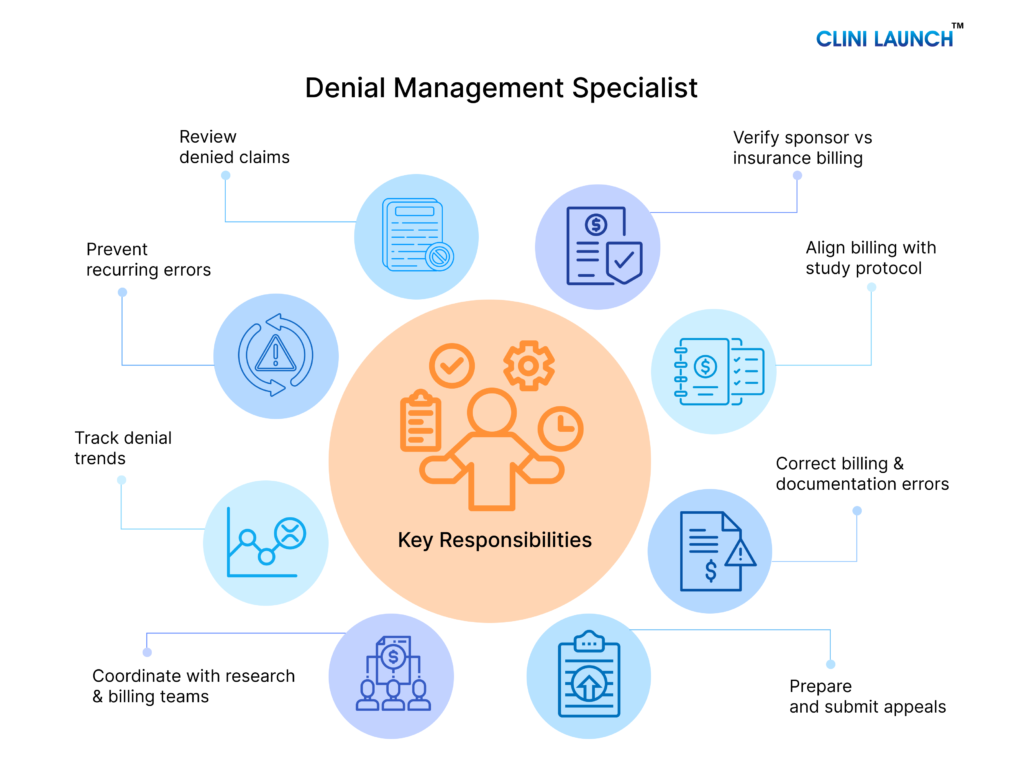
Core Responsibilities of a Clinical Research Denial Management Specialist 

In clinical research, denial management is not limited to correcting rejected claims. The Denial Management Specialist plays a structured role in reviewing denials, ensuring billing accuracy, and supporting compliant reimbursement for clinical trial services. The responsibilities below outline the key areas where this role contributes to effective trial billing and financial stability for research sites and sponsors. These responsibilities collectively form the structured denial management process used to identify, analyze, resolve, and prevent billing denials during clinical trials. 

  • Denied Claim Review  
  • Sponsor vs Insurance Billing Verification  
  • Protocol and Coverage Mapping  
  • Billing and Documentation Correction  
  • Appeal Preparation and Submission Support  

All the above responsibilities are explained briefly below.

1. Denied Claim Review 

Denied claim review is the process of examining rejected claims related to clinical trial services to understand why the denial occurred and how it should be resolved. In clinical research, this step focuses on verifying whether the service was billed to the correct party, either the study sponsor or the insurance, and whether the billing aligns with the study protocol, coverage analysis, and trial agreements. 

  • Reconcile denied charges in the hospital billing system with the study calendar in the Clinical Trial Management System (CTMS) and the Clinical Trial Agreement (CTA) 
  • Review the study protocol and coverage analysis to confirm whether a service was intended to be sponsor-paid or insurance-billed 
  • Identify documentation or authorization gaps that contributed to the denial and coordinate with research teams to address them 

This review forms the foundation for all further denial resolution and helps prevent similar billing errors from recurring during the clinical trial. 

2. Sponsor vs Insurance Billing Verification 

Sponsor vs insurance billing verification involves confirming that the clinical trial services are billed to the correct payer based on the study protocol, coverage analysis, and sponsor agreements. In clinical research, errors often occur when research-only procedures are mistakenly billed to insurance, or routine care services are incorrectly charged to the sponsor. 

  • Review study protocols, coverage analysis documents, and Clinical Trial Agreements (CTAs) to determine the correct billing pathway 
  • Validate whether denied services fall under sponsor-funded research activities or insurance-covered routine care 
  • Work with billing and research teams to correct payer assignments and re-route charges when misbilling is identified 

Accurate sponsor versus insurance billing verification helps reduce unnecessary denials, ensures compliant reimbursement, and protects both investigator sites and sponsors from financial and audit-related risks. 

3. Protocol and Coverage Mapping 

Protocol and coverage mapping involve linking each clinical trial service to the correct billing pathway based on the approved study protocol and coverage analysis. This responsibility ensures that services performed during a trial are clearly identified as sponsor-funded research activities or insurance-billed routine care. 

  • Review the study protocol to understand scheduled procedures and visit requirements 
  • Match trial services to the coverage analysis to confirm billing responsibility 
  • Identify mismatches between protocol-defined services and how they were billed 

Accurate protocol and coverage mapping helps prevent billing errors at the source, reduces denial risk, and supports compliant clinical research billing practices. 

4. Billing and Documentation Correction 

Billing and documentation correction focuses on fixing errors that lead to claim denials in clinical research billing. These errors may involve incorrect charge entries, missing or incomplete documentation, or inconsistencies between clinical records and billing information. 

  • Correct billing errors such as incorrect codes, modifiers, or payer assignments 
  • Ensure required clinical and trial-related documents are complete and accurately reflected in the billing record 
  • Coordinate with research and billing teams to update or resubmit corrected claims 

Timely billing and documentation correction helps speed up claim resolution, supports compliant reimbursement, and reduces the likelihood of repeat denials during a clinical trial. 

5. Appeal Preparation and Submission Support 

Appeal preparation and submission of support involve assisting in the formal response to denied claims by providing the necessary clinical, billing, and trial-related justification. In clinical research, appeals must clearly demonstrate that the billed service aligns with the study protocol, coverage analysis, and applicable payer rules. 

  • Compile supporting documents such as study protocols, coverage analysis, IRB approvals, and clinical notes 
  • Draft or support appeal narratives explaining why the denied service is eligible for reimbursement 
  • Coordinate with billing teams to ensure appeals are submitted accurately and within payer timelines 

Effective appeal preparation improves the chances of claim approval, reduces revenue loss, and ensures that clinical research billing decisions are properly justified and compliant. 

Ready to gain real-world skills in medical billing, denial analysis, and revenue cycle management? Get hands-on training with industry tools and case-based learning.

Real-World Denial Scenarios: – 

The following examples illustrate how denial management decisions directly impact clinical trial operations: 

Case Study 1: Sponsor vs Insurance Billing Mismatch Leading to Claim Denial 

During a clinical trial visit, a routine laboratory test was performed as part of a study-specific assessment. The claim was billed to insurance and later denied because the service was not covered under the patient’s policy.  

On review, the Denial Management Specialist identified that the laboratory test was listed as sponsor-funded in the study protocol and Clinical Trial Agreement (CTA) but had been incorrectly routed to insurance. Clinical research billing policies clearly state that trial-related services must be billed to the appropriate payor based on study documentation, and misrouting charges can lead to denials  

The specialist corrected the billing pathway, coordinated with the billing team to move the charge to sponsor invoicing, and aligned the documentation with the study calendar. The denial was resolved, payment was recovered, and similar billing errors were avoided for future visits. 

Case Study 2: Protocol Deviation Leading to Denial of Imaging Services 

During a clinical trial visit, a patient underwent an MRI scan as part of an optional exploratory assessment. The claim was submitted to insurance but was denied because the procedure did not align with the approved study protocol for reimbursable services. 

The Denial Management Specialist reviewed the study protocol and coverage analysis, identified that the imaging service was optional and required sponsor pre-approval, and corrected the claim submission, ensuring future optional procedures were flagged for prior authorization to prevent repeated denials  

As a result, the denied MRI claim was resubmitted, approved, and reimbursed, and the site implemented workflow checks to avoid similar denials in the future. 

Tools and Documentation Used in Clinical Research Denial Management 

Denial Management Specialists rely on a range of tools and documents to manage claims accurately and efficiently. Systems like CTMS, EHR, and billing software help track study procedures, patient visits, and claim status, while coverage analysis records, Clinical Trial Agreements, study protocols, and prior authorization forms provide the information needed to prevent and resolve denials. Together, these tools and documents ensure compliance, reduce errors, and support smooth billing operations in clinical research. 

AI-Powered Advanced Tools in Denial Management 

With increasing claim complexity and data volume, many organizations now use AI-powered revenue cycle tools to support denial management. These tools help automate claim review, detect error patterns, and predict potential denials before submission. 

Many large healthcare systems and CROs now integrate denial analytics within enterprise Revenue Cycle Management (RCM) platforms. These tools use historical billing data, payer behavior trends, and protocol mapping patterns to identify high-risk claims before submission. 

Examples of AI-enabled tools include: 

AI-Driven Denial Analytics Platforms: Use machine learning to identify recurring denial patterns and high-risk claim categories. 

Predictive Claim Scrubbing Tools: Flag billing inconsistencies before submission to reduce denial risk. 

Automated Appeal Drafting Systems: Generate structured appeal templates using clinical and billing data. 

Denial Prediction Dashboards: Analyze historical data to forecast denial trends across studies and payers. 

These systems are increasingly integrated into enterprise RCM environments within large hospital networks and CROs, reflecting the growing role of predictive analytics in clinical billing oversight. 

While AI tools improve efficiency and early detection, final review and compliance responsibility remain with the Denial Management Specialist. 

Alternative Career Paths 

With denial management experience, professionals can move into: 

• Clinical Research Billing Specialist 
• Revenue Cycle Analyst 
• Compliance Officer 
• Clinical Trial Finance Manager 
• Healthcare Operations Manager 
• RCM Technology / AI Analytics Specialist 

Skills and Career Progression for Denial Management Specialist 

The career progression of a Denial Management Specialist typically begins with claim review and billing verification responsibilities. With experience, professionals move into senior analytical roles, senior analytical roles, denial trend analysis of leadership and cross-functional coordination, and cross-functional coordination. Advancement depends on strengthening compliance knowledge, data interpretation skills, and workflow optimization expertise. Over time, specialists may transition into revenue cycle leadership, clinical trial finance management, or compliance-focused roles within research organizations. 

Professionals aiming to build expertise in denial management and compliant billing often pursue structured training programs that combine coding, documentation, and regulatory knowledge. 

Advanced Diploma in

Medical Coding

Build practical skills in medical coding and clinical documentation used across hospitals, healthcare providers, and global healthcare services. Learn how diagnoses, procedures, and services are accurately translated into standardized medical codes for billing, compliance, and data integrity. 

IN PARTNERSHIP WITH
4.8 (2,500+ ratings) 
Advanced Diploma in

Clinical Research

Build industry-ready skills to work across real clinical trial environments. Learn how clinical studies are designed, conducted, documented, and monitored, with a strong focus on ethics, patient safety, and global regulatory compliance.

IN PARTNERSHIP WITH
4.8(2,500+ ratings) 

Why Denial Management is critical for Clinical Research today 

In modern clinical research, denial management in healthcare and clinical trials directly influences operational continuity and financial stability. When claims are denied due to protocol deviations, misbilling, missing documentation, or delayed authorizations, it can disrupt study timelines, create financial strain, and increase administrative burden for research teams. Recent data show that nearly 17 % of initial insurance claim submissions are denied, highlighting how common denials can be and why dedicated oversight is essential. A Denial Management Specialist ensures that denials are promptly identified, analyzed, and resolved, keeping trials compliant, on schedule, and financially protected. Beyond resolving individual claims, effective denial management also helps prevent recurring issues and strengthens overall billing workflows.

Key reasons: 

  • Protects study timelines: Resolves claim denials quickly to avoid delays in patient visits, reporting, or sponsor payments. 
  • Ensures financial accuracy: Minimizes lost revenue for research sites and sponsors by addressing denials efficiently. 
  • Maintains compliance: Ensures billing aligns with study protocols, Clinical Trial Agreements, payer rules, and regulatory standards. 
  • Prevents recurring errors: Analyzes denial trends to improve workflows, reduce repeated mistakes, and optimize future claim submissions. 

Challenges faced in Denial Management 

Despite its strategic importance, denial management presents several operational and compliance challenges: 

• Complex sponsor vs insurance billing rules 
• Frequent documentation gaps 
• Tight appeal submission timelines 
• Changing payer policies 
• High denial volume & workload pressure 
• Compliance and audit risk exposure 

Billing misclassification in clinical trials can trigger compliance reviews under U.S. Department of Health & Human Services (HHS) oversight

When does the role begin in a Clinical Trial? 

The role of a Denial Management Specialist typically begins during the trial execution phase, when patient visits and billable services are initiated. However, involvement may start earlier during study setup, particularly in protocol and coverage mapping discussions to prevent future billing errors. The role continues through active trial conduct and remains critical during study close-out, when final reconciliations and sponsor invoicing are completed. 

Take the next step toward a high-growth healthcare career. Enroll in a structured program and gain the skills needed to work in hospitals, RCM companies, and clinical research.

Conclusion 

In modern clinical research, denial management directly influences operational stability and financial sustainability. By combining protocol knowledge, billing precision, and data-driven analysis, Denial Management Specialists ensure that clinical trials remain compliant, efficient, and financially secure. With the right combination of tools, documentation, and skills, these specialists not only protect research sites and sponsors but also contribute significantly to the overall success of clinical studies. 

If you want to build a career in clinical research and gain the expertise needed to manage denials, claims, and trial billing efficiently, CliniLaunch Research Institute offers a comprehensive Clinical Research Course designed to equip you with practical skills and industry-ready knowledge. Join today and take the first step toward a future-ready role in clinical research. 

Frequently Asked Questions

1. What does a Denial Management Specialist do?
They analyze denied claims, identify root causes, coordinate with billing teams, correct errors, and implement preventive measures to reduce recurring denials.
2. Why are insurance claims denied?
Common reasons include coding errors, missing documentation, incorrect coverage assignment, lack of prior authorization, or billing not aligned with policies.
3. What tools does a Denial Management Specialist use?
Key tools include RCM/billing software, EHRs, spreadsheets for tracking, prior authorization systems, and claim dashboards for monitoring and resolving denials.
4. What skills are required for this role?
Analytical thinking, attention to detail, compliance awareness, communication, problem-solving, and coordination with clinical and billing teams.
5. How does denial management impact organizations?
Effective denial management reduces revenue loss, improves workflow efficiency, ensures compliance, and prevents repeated claim errors, supporting financial and operational stability.
6. What is the career path for a Denial Management Specialist?
Typical progression: Denial Analyst → Senior Denial Specialist → Denial Management Lead → Billing/Operations Manager, with opportunities in hospitals, healthcare providers, and research organizations.
7. Can learning denial management skills benefit my career?
Yes — expertise in analyzing, resolving, and preventing claim denials builds credibility and opens leadership roles in healthcare and revenue cycle management.
8. How can I get trained in denial management?
Professional courses and certifications in healthcare billing, revenue cycle management, and denial resolution provide practical skills for a career as a Denial Management Specialist.
9. How is denial management in clinical research different?
Clinical research denial management must align with study protocols, sponsor agreements, and coverage analysis, not just standard billing rules. Errors can create compliance risks in addition to revenue loss.
10. What metrics measure denial management performance?
Common metrics include denial rate, appeal success rate, resolution time, recurring denial patterns, and recovery percentage of denied claims. These indicators help improve billing accuracy and reduce repeat errors.

Alternative Careers for Dentists

Alternative careers for dentists include clinical research, medical writing, public health, healthcare management, and data analytics. These roles offer better work-life balance, stable income, and global opportunities beyond clinical practice.

These competencies are highly transferable and open up a wide range of careers for dentists beyond traditional clinical practice. If you’re exploring career options beyond clinical practice—whether for better work–life balance, income stability, or exposure to technology and leadership—this guide outlines structured, realistic pathways. 

According to the reports, India has over three lakh registered dentists, with high urban clustering Dental Council of India Annual Report. This density increases competition in metropolitan areas while rural regions remain underserved.  

In India, BDS graduates are increasingly shifting toward non-clinical and hybrid roles due to rising competition, evolving healthcare systems, and the growth of research, digital health, and corporate healthcare sectors.  

Simultaneously, the World Health Organization reports that nearly 3.7 billion people worldwide are affected by oral diseases under its Global Oral Health Action Plan. The implication is clear: oral healthcare demand is expanding globally, but opportunity is increasingly distributed across research, public health systems, digital platforms, industry ecosystems, and regulatory frameworks — creating diverse career options after dentistry beyond private clinics. 

Why Dentists Seek Alternative Careers 

  • Burnout & Schedule Strain: Clinical dentistry involves long procedures, physical strain, and high mental focus, leading many professionals to seek structured roles with predictable schedules. 
  • Market Saturation & Income Variability: Urban saturation increases competition and reduces income predictability, especially early in practice. Structured roles offer more stable salary growth. 
  • Technology & Scaled Impact: Digital technologies like CAD/CAM, AI diagnostics, and teledentistry are transforming oral healthcare, creating opportunities to work at a scale beyond individual patient care. 
  • Remote Work & Geographic Flexibility: Roles in telehealth, writing, regulatory work, and analytics allow flexible and location-independent careers.  
  • Income Diversification: Industry and corporate roles enable multiple income streams beyond clinical practice. 
  • Public Health Motivation: Those interested in population-level impact often move into public health, policy, and prevention programs. 

As a result, career options for dentists in India are expanding beyond traditional clinics into research organizations, healthcare companies, digital health startups, and corporate healthcare environments. 

Transferable Core Competencies Dentists Already Possess 

Dentists possess professional strengths that transition seamlessly into alternative domains: 

  • Clinical judgment & patient assessment  
  • Manual precision & attention to detail  
  • Infection control & regulatory awareness  
  • Documentation discipline 
  • Patient communication & consent handling  
  • Radiographic interpretation  
  • Materials science knowledge 

Core Bridging Skills You May Need 

Many professionals explore career options after BDS by adding complementary skills that allow them to apply their clinical knowledge in research, digital health, and healthcare industry roles. It means adding focused, complementary skills that allow you to apply your clinical knowledge in new environments. 

Good Clinical Practice (GCP) Certification 

Covers ethical guidelines, patient safety, and clinical trial protocols. Essential for research and regulatory roles. It covers informed consent, patient safety monitoring, protocol adherence, and documentation practices. If you are considering clinical research, medical affairs, or regulatory roles, GCP is often the minimum eligibility requirement and a strong starting point. 

Clinical Trial Operations & EDC Systems 

Focuses on study workflows, data handling, and platforms like Medidata Rave and Oracle Clinical. Required for CRC and CRA roles. 

Medical Writing & Literature Review  

Involves interpreting scientific data and preparing regulatory or publication documents. Key for writing and medical affairs roles. 

Data Analytics (Excel, SQL, R/Python) 

Enables analysis of clinical and operational data. Important for informatics, digital health, and analytics roles. 

CAD/CAM & 3D Printing Tools 

Covers scanning, design software, and 3D workflows. Essential for digital dentistry and lab-based roles. 

Business & Healthcare Management 

Builds skills in operations, finance, and strategy. Useful for management, administration, and entrepreneurial roles. 

Today, top non-clinical jobs for dentists in India include clinical research, medical writing, healthcare analytics, public health, and corporate healthcare roles. 

Top 9 Alternative Careers for Dentists 

These roles represent some of the most promising BDS career opportunities for dentists who want to expand beyond clinical practice while still using their healthcare expertise. 

1) Clinical Research 

(CRC / CRA / Clinical Project Manager) 

Clinical research professionals manage and monitor clinical trials for drugs and medical devices. They ensure patient safety, maintain data integrity, oversee regulatory documentation, coordinate with sponsors and CROs, and ensure compliance with global trial standards. 

Entry Requirements 

A dental degree provides strong clinical credibility. However, employers typically expect Good Clinical Practice (GCP) certification and structured clinical research training. Exposure to site-level study of coordination or hospital-based research improves employability. Familiarity with trial workflow significantly strengthens entry into CRC roles. 

Skills (Core + Advanced) 

  • Clinical judgment and endpoint understanding 
  • Informed consent management 
  • Protocol adherence and deviation handling 
  • Documentation accuracy and audit readiness 
  • EDC systems (Medidata Rave, Oracle Clinical) 
  • Adverse event and SAE reporting 
  • Basic biostatistics interpretation 
  • Risk management 
  • Project management (PMP advantageous) 
  • Pharmacovigilance knowledge 

Career Path 

Clinical Research Coordinator → Clinical Research Associate → Senior CRA → Clinical Project Manager → Clinical Operations Director 

2) Dental / Oral Public Health & Policy 

Public health dentistry focuses on population-level oral health improvement. Professionals design prevention programs, conduct epidemiological surveys, evaluate health outcomes, and contribute to policy development. 

Entry Requirements 

An MPH or public health diploma is typically required for structured roles. Experience in community screening programs, NGO projects, or district health initiatives strengthens eligibility. Knowledge of epidemiological methods is highly valued. 

Skills (Core + Advanced) 

  • Epidemiology and disease surveillance 
  • Community program design 
  • Data interpretation and statistical analysis 
  • Stakeholder engagement 
  • Grant writing 
  • Health economics 
  • Policy analysis 
  • Program monitoring and evaluation 

Career Path 

Public Health Dentist → Program Manager → Policy Advisor → State/National Health Leadership 

3) Dental Technology & CAD/CAM Specialist 

Digital dentistry integrates scanning, prosthetic design, and additive manufacturing into modern workflows. Specialists manage digital systems in clinics or labs and bridge clinical and production environments. 

Entry Requirements 

A dental degree combined with hands-on CAD/CAM training is essential. Laboratory exposure and digital case portfolio demonstration improve hiring probability. 

Skills (Core + Advanced) 

  • Intraoral scanning 
  • Prosthetic design principles 
  • Occlusion and functional analysis 
  • CAD software (Exocad / 3Shape) 
  • STL file handling 
  • 3D printing workflows 
  • Biomaterials understanding 
  • Manufacturing quality assurance 

Career Path 

Digital Dentistry Specialist → Lab Manager → Product Application Specialist → Director of Digital Solutions 

4) Medical Writing 

Medical writers prepare regulatory documents, scientific manuscripts, and educational content based on clinical data. 

Entry Requirements 

A dental degree provides subject authority. Formal medical writing training and a writing portfolio are typically required for structured roles. Knowledge of regulatory documentation strengthens positioning. 

Skills (Core + Advanced) 

  • Scientific interpretation 
  • Literature review (PubMed familiarity) 
  • Referencing accuracy 
  • Structured documentation 
  • Regulatory writing (ICH familiarity) 
  • Publication planning 
  • Data summarization 
  • Clarity in technical communication 

Career Path 

Medical Writer → Senior Medical Writer → Publication Lead → Medical Affairs Specialist 

5) Dental Products & Industry Roles 

Industry roles combine clinical credibility with strategic execution. Professionals train clinicians, support product launches, and manage commercial strategy. 

Entry Requirements 

A dental degree is highly valued. Strong communication skills are essential. For product management roles, an MBA or structured business training adds competitive advantage. 

Skills (Core + Advanced) 

  • Presentation and training skills 
  • Clinical product demonstration 
  • KOL engagement 
  • Market analysis 
  • Launch strategy planning 
  • Regulatory alignment 
  • Health economics understanding 
  • Sales performance tracking 

Career Path 

Clinical Specialist → Product Manager → Medical Affairs Lead → Commercial Head 

6) Dental Lab & Biomaterials R&D 

This pathway focuses on innovation in restorative materials and implant systems. 

Entry Requirements 

A dental degree with research exposure or biomaterials training is recommended. Postgraduate research experience significantly improves eligibility. 

Skills (Core + Advanced) 

  • Dental materials science 
  • Laboratory testing protocols 
  • Strength and biocompatibility analysis 
  • Documentation standards 
  • In vitro testing models 
  • Regulatory device approval processes 
  • Product validation studies 

Career Path 

R&D Scientist → Product Development Lead → Head of R&D 

7) Forensic Odontology 

Forensic odontologists support legal systems through dental identification and medico-legal analysis. 

Entry Requirements 

Specialized forensic odontology training is required. Collaboration with forensic medicine departments strengthens case exposure. 

Skills (Core + Advanced) 

  • Dental record comparison 
  • Radiographic analysis 
  • Bite-mark interpretation 
  • Medico-legal documentation 
  • Court testimony 
  • Advanced imaging analysis 

Career Path 

Forensic Consultant → Expert Witness → Academic Forensic Trainer 

8) Tele dentistry & Remote Care Leadership 

Teledentistry integrates digital consultation and remote care into oral health systems. 

Entry Requirements 

A dental degree combined with telehealth platform training is required. Familiarity with digital documentation systems improves positioning. 

Skills (Core + Advanced) 

  • Remote clinical assessment 
  • Patient communication 
  • Digital case documentation 
  • Telehealth compliance 
  • EHR integration 
  • Program management 

Career Path 

Tele-Dentist → Telehealth Program Manager → Director of Virtual Care 

9) Health Informatics & Dental Data Analytics 

This field focuses on analyzing clinical and operational data to improve outcomes and efficiency. 

Entry Requirements 

A dental degree plus structured data analytics training is typically required. Demonstrable analytical projects improve employability. 

Skills (Core + Advanced) 

  • Advanced Excel 
  • SQL querying 
  • Clinical variable interpretation 
  • Dashboard creation (Power BI/Tableau) 
  • R or Python basics 
  • Predictive modeling 
  • Data governance 

Career Path 

Clinical Informatics Analyst → Senior Analyst→ Head of Informatics 

Confused About Your Next Career Move After BDS?

Not sure whether Clinical Research, Medical Writing, Healthcare Analytics, or Public Health is the right path for you? Get expert guidance to choose the best non-clinical career option based on your skills and goals.

Alternative Career Paths for Dentists

Career Path Career Growth Path Avg Salary in India
Clinical Research CRC → CRA → Project Manager → Clinical Operations ₹3 – ₹8 LPA
Public Health & Policy Public Health Dentist → Program Manager → Policy Advisor ₹4 – ₹10 LPA
Dental Technology (CAD/CAM) Specialist → Lab Manager → Digital Solutions Lead ₹4 – ₹12 LPA
Medical Writing Writer → Senior Writer → Medical Affairs ₹4 – ₹10 LPA
Industry / Product Roles Clinical Specialist → Product Manager → Commercial Head ₹5 – ₹15 LPA
Biomaterials R&D R&D Scientist → Product Lead → R&D Head ₹4 – ₹12 LPA
Forensic Odontology Consultant → Expert Witness → Academic ₹3 – ₹8 LPA
Teledentistry & Remote Care Tele-Dentist → Program Manager → Virtual Care Director ₹4 – ₹10 LPA
Health Informatics & Analytics Analyst → Senior Analyst → Data Lead ₹5 – ₹12 LPA
Advanced Diploma in

AI & ML in Healthcare 

Build practical skills to apply artificial intelligence and machine learning in real healthcare and life sciences use cases. Learn how healthcare data is analyzed, models are built, and AI-driven insights are applied across research and healthcare systems. 

IN PARTNERSHIP WITH
4.8(2,300+ ratings) 

Salary Comparison of Alternative Careers for Dentists 

Understanding salary potential helps in choosing the right direction after BDS. While income varies based on experience, location, and specialization, structured roles often offer more predictable growth compared to early-stage clinical practice. 

Average Salary Range in India (Approximate) 

  • Average Salary Range in India (Entry to Mid-Level) 
  • Clinical Research (CRC/CRA): ₹3 – ₹8 LPA  
  • Medical Writing: ₹4 – ₹10 LPA  
  • Public Health & Policy: ₹4 – ₹10 LPA  
  • Healthcare Management / MBA Roles: ₹5 – ₹15 LPA  
  • Dental Technology (CAD/CAM): ₹4 – ₹12 LPA  
  • Health Informatics & Data Analytics: ₹5 – ₹12 LPA  
  • Pharmacovigilance & Drug Safety: ₹3 – ₹9 LPA  
  • Corporate / Product Roles: ₹5 – ₹15 LPA 

These roles offer structured salary progression, especially in corporate, research, and analytics domains. With experience and specialization, compensation can grow significantly faster than traditional clinic-based. 

Best Courses After BDS for Career Switch 

Choosing the right course after BDS depends on the career path you want to transition into. Instead of pursuing multiple degrees, focusing on targeted, industry-relevant training helps accelerate entry into new roles. 

Courses Based on Career Path 

  • Clinical Research: 
    GCP Certification, Clinical Research Training Programs  
  • Medical Writing: 
    Medical Writing Certification, Scientific Writing Programs  
  • Healthcare Management: 
    MBA in Healthcare / Hospital Administration  
  • Public Health: 
    MPH (Master of Public Health)  
  • Health Informatics & Data Analytics: 
    Data Analytics (Excel, SQL, Python), Healthcare Informatics Programs  
  • Digital Dentistry: 
    CAD/CAM Certification, Digital Workflow Training  
  • Pharmacovigilance & Regulatory Affairs: 
    Drug Safety Certification, Regulatory Affairs Courses  

The key is to choose a course aligned with a specific role rather than exploring multiple unrelated certifications. Focused upskilling improves employability and shortens transition time. 

Highest Paying Non-Clinical Jobs for Dentists 

Not all alternative careers offer the same earning potential. Some roles provide significantly higher income growth due to industry demand, scalability, and leadership opportunities. 

High-Paying Non-Clinical Roles 

  • Healthcare Management & MBA Roles 
    Leadership positions in hospitals and healthcare companies offer strong salary growth and long-term career progression.  
  • Health Informatics & Data Analytics 
    With the rise of digital health, professionals who can analyze healthcare data are in high demand and command premium salaries.  
  • Clinical Research (CRA → Project Management) 
    Mid-to-senior roles in clinical research, especially in global trials, offer strong compensation and international exposure.  
  • Medical Affairs & Corporate Roles 
    Positions in pharma and medical device companies combine scientific expertise with strategic decision-making.  
  • Product Management & Healthcare Consulting 
    These roles involve market strategy, innovation, and business growth, often leading to higher salary brackets.  
  • Digital Dentistry & Technology Specialists 
    Professionals working with advanced digital systems and workflows are increasingly valued in modern dental ecosystems.  

Higher-paying roles typically require a combination of domain expertise, technical skills, and strategic understanding of the healthcare industry. 

Transition from Clinical Practice: A Structured Roadmap 

Moving beyond traditional clinical dentistry does not mean walking away from your qualifications. It is strategically expanding the applications. A successful transition depends less on chance and more on clarity, preparation, and deliberate execution. 

Here is a structured approach that makes the shift practical and realistic. 

Step 1: Define Your Core Motivation 

Identify whether you want better work-life balance, income stability, leadership roles, or technology-driven work. 

Research across healthcare professions consistently shows that structured career planning reduces burnout-related exits and improves professional satisfaction (Bureau of Labor Statistics, Occupational Outlook Handbook). 

Step 2: Assess Your Existing Strengths 

Evaluate your clinical skills, research exposure, certifications, and professional experience to identify relevant transition advantages. 

Step 3: Select One Target Domain 

Choose a clear direction such as clinical research, medical writing, digital dentistry, or healthcare analytics. 

Step 4: Conduct a Skill Gap Analysis 

Once your target field is chosen, review multiple job descriptions in that domain. Identify recurring requirements, certifications, and technical skills. 

Examples: 
  • Clinical Research → GCP certification, trial operations knowledge 
  • Public Health → MPH or epidemiology background 
  • Digital Dentistry → CAD/CAM proficiency 
  • Medical Writing → Writing portfolio and regulatory familiarity 
  • Health Informatics → Excel, SQL, and analytics exposure 

Review job descriptions and identify required certifications, tools, and technical skills for your chosen domain. 

Step 5: Upskill Strategically (3–12 Months) 

Focus on targeted training such as GCP, CAD/CAM, medical writing, analytics, MPH, or MBA depending on your pathway. 

According to workforce data from Payscale, structured corporate roles often show more predictable salary progression compared to early-stage independent practice. 

Step 6: Build Demonstrable Evidence 

Create portfolios such as writing samples, research summaries, digital cases, dashboards, or project work. 

Step 7: Network with Intention 

Engage with: Industry professionals through conferences, LinkedIn, alumni groups, and healthcare organizations. 

Step 8: Pilot Before Committing Fully 

Gain practical exposure through internships, freelance work, part-time roles, or collaborations. 

Build Skills That Employers Actually Hire For

Move beyond traditional dentistry with practical training in Clinical Research, AI & ML in Healthcare, Medical Coding, and more. Learn industry-relevant skills designed for BDS graduates.

Market Opportunity: India and the Global Landscape 

Before making a strategic career shift, it is important to understand the direction in which the larger dental and healthcare markets are moving. Career opportunities expand when industries expand. Dentistry today operates within a growing global ecosystem shaped by digital transformation, research innovation, organized corporate networks, and rising healthcare investment. 

Global Dental Services: Sustained Expansion 

The global dental services market continues to show steady and sustained growth. According to Grand View Research, the dental services industry is projected to grow at a consistent compound annual growth rate (CAGR) through 2030, supported by aging populations, increased awareness of oral health, rising cosmetic dentistry demand, and expanded insurance penetration in emerging markets. 

While exact market valuations vary between publishers, most industry forecasts place the sector in the hundreds of billions of dollars, with projections indicating significant expansion by the early 2030s. 

This growth does more than increase demand for chairside dentists. As dental networks scale and modernize, they create demand for non-clinical professionals who support the system — including clinical research coordinators, digital workflow managers, product specialists, regulatory professionals, and healthcare data analysts. 

Teledentistry: A High-Growth Digital Segment 

Teledentistry has emerged as one of the fastest growing subsegments within oral healthcare. As remote consultations, AI-supported triage, and digital case monitoring gain traction; the infrastructure around virtual dental care is expanding rapidly. 

According to Grand View Research, the global teledentistry market was valued at approximately USD 2.02 billion in 2024 and is projected to grow at a CAGR exceeding 15% through 2030. Similarly, Market Research Future highlights strong double-digit growth driven by increasing rural access initiatives, integration with electronic health records (EHRs), and broader telehealth acceptance post-pandemic. 

This growth translates into professional opportunities beyond direct clinical care. Emerging roles include telehealth program leadership, digital compliance management, virtual care coordination, health informatics integration, and vendor-side product development. 

For dentists interested in flexible work models or digital healthcare ecosystems, this segment offers one of the most accessible entry points. 

Dental Implants and Device Innovation 

Implantology remains one of the most financially significant and steadily growing segments within dentistry. Industry analyses consistently report single-digit to high single-digit CAGR growth in the global dental implants market, depending on region and product category. 

India: Organized Consolidation and Healthcare Growth 

India’s dental ecosystem is undergoing structural change, creating new career options for dentists in India across corporate dental chains, research organizations, digital health companies, and healthcare administration roles. Organized dental chains and corporate clinic networks are expanding across metropolitan and tier-two cities. Consolidation increases demand not only for clinicians but also for operations managers, quality compliance officers, digital workflow specialists, and corporate trainers. 

Simultaneously, India’s broader healthcare sector continues to grow. According to Grand View Research, the Indian healthcare market is projected to expand steadily through 2032, driven by increasing private sector participation, Ayushman Bharat implementation, and digital health adoption. 

As dentistry integrates more closely with hospital systems and corporate healthcare structures, roles expand in administration, clinical research, informatics, compliance, and program management. 

Start Your Career Transition with Confidence

Take the next step toward a stable, high-growth healthcare career with expert mentorship, hands-on learning, and placement-focused support from CliniLaunch.

Conclusion 

Dentistry today extends far beyond chairside practice, opening new careers for dentists in research, digital health, healthcare analytics, industry leadership, and public health systems. As global dental markets expand driven by digital adoption, implant growth, research innovation, and organized healthcare systems opportunities are shifting into clinical research, digital health, industry, public health, analytics, and leadership roles. 

The core competencies developed through dental training remain powerful and transferable. What changes is how and where those skills are applied. 

Career diversification is not a leap into uncertainty. It is a structured transition built on clarity, focused upskilling, portfolio development, and strategic positioning. 

If you are ready to explore structured pathways into clinical research, regulatory roles, digital integration, or emerging healthcare domains, CliniLaunch Research Institute provides industry-aligned training designed specifically for healthcare professionals seeking career expansion. 

Frequently Asked Questions

1. What are the best alternative careers for dentists?
Dentists can transition into domains such as clinical research, pharmacovigilance, regulatory affairs, medical writing, healthcare management, and data-driven or corporate healthcare roles.
2. Can dentists move into non-clinical roles without leaving healthcare?
Yes. Many alternative careers allow dentists to stay connected to healthcare through research, compliance, documentation, strategy, and leadership roles without daily chairside practice.
3. Is clinical research a good career option for dentists?
Clinical research is one of the most structured non-chairside paths for dentists, offering roles in trial coordination, monitoring, management, and medical oversight.
4. Do dentists need additional qualifications to switch careers?
Some domains require domain-specific training or exposure, while others rely more on clinical knowledge, documentation skills, and structured learning rather than formal degrees.
5. What is the difference between a career domain and a job role?
A career domain is a broad field like clinical research or regulatory affairs, while job roles are specific positions within that domain, such as coordinator, analyst, or manager.
6. How should dentists choose the right alternative career path?
Dentists should first identify the type of work they prefer and then select a suitable career domain before targeting specific job roles.
7. What to do after BDS except practice?
You can move into clinical research, medical writing, healthcare analytics, public health, or corporate healthcare roles in India.
8. Which course is best after BDS?
It depends on your goal—GCP for research, MBA for management, MPH for public health, or data/AI courses for analytics roles.
9. Can dentists switch careers?
Yes, with focused upskilling, dentists can transition into research, analytics, regulatory, and healthcare industry roles.
A Medical Coding Auditor works within the healthcare revenue cycle, reviewing codes assigned to patient records before or after billing to ensure accuracy, compliance, and proper reimbursement. They audit clinical documentation, identify coding errors, verify adherence to ICD-10, CPT, and HCPCS guidelines, and support regulatory and financial integrity.

Introduction 

Medical Coding Auditor Job roles involve maintaining accuracy and integrity across healthcare billing systems. Medical Coding Auditors work with clinical and coding teams to ensure documentation and codes are complete, accurate, and reimbursement-ready.

Beyond the obvious financial impact on the revenue, medical coding auditors act as an early checkpoint for compliance, reducing the risk of regulatory penalties and audit failures. At the same time, their insights help improve clinical documentation practices, making the overall system more efficient, accurate, and reliable. 

In this blog, we will explore the role of a Medical Coding Auditor, including their key responsibilities, required skills, and core competencies. We will also look at career scope, industry demand, and salary trends to help you understand the opportunities in this field. 

The importance of this role becomes clearer when we look at industry data. In FY 2024 alone, the Office of Inspector General identified billions in recoveries and hundreds of millions lost due to coding errors, improper billing, and documentation gaps , highlighting how small inaccuracies can lead to massive financial and compliance risks.

What is a Medical Coding Auditor and Why Are They Important in Healthcare? 

A Medical Coding Auditor is a healthcare professional responsible for ensuring that coded patient data accurately reflects the care delivered and supports compliant, correct reimbursement. The primary objective of the role is to protect the financial integrity and regulatory adherence of healthcare billing and coding processes. Their work involves reviewing coded records against clinical documentation, evaluating whether coding aligns with standards such as ICD-10, CPT, and HCPCS, and ensuring that claims are accurate before or after submission. Key performance indicators for this role typically include coding accuracy rates, audit findings, denial reductions, and overall compliance scores. 

To perform effectively, Medical Coding Auditors rely on strong analytical skills, attention to detail, and deep knowledge of coding guidelines and healthcare regulations. They work closely with medical coders, clinicians, billing teams, and compliance departments to identify discrepancies, improve documentation quality, and strengthen coding practices. Acting as a critical checkpoint within the revenue cycle, they help ensure that healthcare data, billing, and compliance remain aligned and reliable. 

Recent industry data highlights why this role is critical. The MDaudit 2025 Benchmark Report shows that the amount of revenue at risk during payer audits has increased by nearly 30%, while denial amounts have risen by 12–14%, with coding-related issues driving a significant share of these losses.

Roles and Responsibilities of Medical Coding Auditor 

The role of a Medical Coding Auditor extends far beyond reviewing codes, spanning quality control, compliance oversight, and revenue protection within the healthcare system. Operating at a critical juncture in the revenue cycle, they ensure that clinical documentation, coding practices, and billing practices are aligned to support correct reimbursement and regulatory adherence. Their responsibilities cover a wide range of functions, from detailed record reviews and audit analysis to documentation improvement and process standardization. 

1. Pre-Billing Coding Review 

Pre-Billing Coding Review Support is a key responsibility of a Medical Coding Auditor that focuses on validating coding outputs before claims are submitted for reimbursement. Unlike retrospective audits, this function ensures that potential coding issues are identified and corrected at an early stage, reducing the likelihood of claim denials, rejections, or payment delays. It acts as a preventive checkpoint within the revenue cycle, ensuring that only clean and complete coding data moves forward for billing. 

To execute this responsibility, auditors focus on these specific actions: 

  • Pre-Submission Review: Evaluating coded claims before they are sent to payers to ensure they meet required standards. 
  • Error Flagging: Identifying missing, incomplete, or potentially incorrect coding elements that could lead to denials. 
  • Claim Readiness Check: Ensuring all documentation, codes, and modifiers are appropriately aligned for submission. 
  • Coordination with Coders: Communicating issues to coding teams for immediate correction before billing finalization. 

Medical coding auditors directly impact revenue and operational efficiency through these tasks. By identifying errors before submission, Medical Coding Auditors help reduce denial rates, shorten reimbursement cycles, and minimize rework in the revenue cycle process. This proactive layer of review strengthens first-pass claim acceptance rates and improves overall billing efficiency for healthcare organizations. 

According to the 2026 medical coding and billing salary survey by AAPC , certified professionals earn around 20% more than non-certified professionals, showing that credentials strongly influence salary growth in medical coding and auditing roles.

2. Coding Variance & Error Pattern Analysis 

Coding Variance & Error Pattern Analysis is a key responsibility of a Medical Coding Auditor that focuses on identifying recurring coding inconsistencies, variations, and systemic errors across multiple cases. Instead of reviewing individual claims in isolation, this function examines broader coding trends to understand where and why errors occur within coding practices. It helps organizations move from reactive correction to proactive improvement in coding quality. 

To execute this responsibility, auditors focus on these specific actions: 

  • Error Trend Identification: Analyzing audit results to identify recurring coding mistakes such as under coding, over coding, or inconsistent coding patterns. 
  • Coder Variation Analysis: Comparing coding practices across different coders, departments, or service lines to detect inconsistencies. 
  • Root Cause Assessment: Investigating whether errors stem from documentation gaps, training issues, or guideline misinterpretation. 
  • Risk Pattern Flagging: Highlighting high-risk areas in coding that frequently lead to denials or compliance concerns. 

Medical coding auditors help healthcare organizations identify systemic weaknesses. By addressing patterns instead of individual mistakes, they contribute to long-term improvement in coding accuracy, reduced denial rates, and stronger overall revenue cycle performance. 

Audit Reporting and Sharing Insights are critical for Medical Coding Auditor. They ensure audit findings are not just documented but effectively translated into structured information that can guide action across the organization. It focuses on turning detailed coding evaluations and analysis outcomes into clear narratives that support operational clarity and informed decision-making. 

3. Audit Reporting & Sharing Insights 

To execute this responsibility, auditors focus on these specific actions: 

  • Audit Documentation: Preparing structured reports that summarize audit findings, coding issues, and compliance observations. 
  • Trend Summarization: Presenting high-level insights derived from coding variance and error analysis in a simplified format for leadership. 
  • Risk Highlighting: Identifying areas of potential financial or compliance risk based on audit outcomes. 
  • Stakeholder Communication: Sharing findings with coding teams, compliance officers, and revenue cycle leaders for informed decision-making. 

Medical Coding Auditors enable organizations to take informed action by converting complex audit data into structured insights. This improves visibility into coding performance, supports leadership decision-making, and strengthens overall governance within the revenue cycle. 

Advanced Diploma in

AI Augmented Medical Coding and Revenue Intelligence

Build advanced expertise in medical coding integrated with AI, analytics, and revenue intelligence to prepare for next-generation healthcare roles. Learn how clinical diagnoses, procedures, and services are translated into standardized code sets such as ICD-10, CPT, and HCPCS, while also understanding how AI-driven insights and healthcare data analytics improve coding accuracy, reduce denials, and strengthen revenue cycle performance across global healthcare systems. 

IN PARTNERSHIP WITH
4.8(2,400+ ratings) 

4. Providing Feedback and Corrective Actions 

Providing Feedback and Corrective Actions helps convert audit findings into real operational improvement. Once discrepancies are identified during audits, medical coding auditors ensure they are actively addressed so that the same issues do not repeat in future coding cycles. 

To execute this responsibility, Medical Coding Auditors focus on the following actions: 

  • Explaining identified coding errors to coding teams and healthcare professionals in a clear and structured manner  
  • Clarifying the correct coding approaches based on ICD-10, CPT, HCPCS, and payer guidelines  
  • Breaking down the root reasons behind documentation gaps or coding discrepancies  
  • Providing specific corrective inputs to address observed coding issues  
  • Reinforcing the proper application of coding rules and standards in daily practice  
  • Guiding teams in refining their coding methods to improve consistency and accuracy across cases 

This function directly influences the quality of coding at the source by improving understanding and reducing repeated mistakes over time. As a result, it strengthens coding consistency, minimizes recurring errors, and contributes to a more stable and reliable revenue cycle environment. 

Income in the field of medical coding increases steadily with experience, with professionals earning up to ~77% more over their career span, especially in the first 10–15 years. The field is not limited to entry-level coding roles—professionals progress into auditing, compliance, CDI, and revenue cycle management roles, which come with higher earning potential and responsibility, according to the 2026 Medical Coding and Billing Salary Survey by AAPC .

5. Training and Coding Capability Development 

Training and Coding Capability Development plays a long-term role in shaping the effectiveness of Medical Coding Auditors within healthcare organizations. Instead of focusing on individual corrections, this responsibility is centered on improving how coding teams understand and apply guidelines in real scenarios, ensuring that skill gaps are addressed at the source and do not repeatedly translate into coding errors. 

To execute this responsibility, Medical Coding Auditors focus on the following actions: 

  • Designing structured training sessions based on coding updates, documentation standards, and common error areas  
  • Conducting workshops on frequently misunderstood coding scenarios to improve practical understanding  
  • Using real audit findings and case examples to demonstrate error patterns and correction methods  
  • Explaining correct application of ICD-10, CPT, and HCPCS coding guidelines in real-world contexts  
  • Providing targeted guidance to coders to improve accuracy in day-to-day coding activities 

Through this Medical Coding Auditors build a stronger and more self-reliant coding workforce by reducing dependency on continuous corrections. The process leads to better alignment with coding standards, fewer repetitive mistakes, and improved overall efficiency and stability within the revenue cycle process. 

6. Compliance Policy Interpretation & Implementation Guidance 

Medical Coding Auditors play a critical role in bridging the gap between external regulatory requirements and internal coding practices by interpreting compliance policies and guiding their practical application within healthcare organizations. Rather than simply tracking regulatory updates, they actively work on converting complex rules and guidelines into clear, usable directions that can be consistently applied in real coding and billing scenarios. 

To execute this responsibility, Medical Coding Auditors focus on the following actions: 

  • Interpreting updates from regulatory bodies, payer policies, and healthcare compliance frameworks such as HIPAA, Medicare, and Medicaid guidelines  
  • Breaking down complex policy changes into practical coding and documentation implications for internal use  
  • Defining how updated rules should be applied within existing coding workflows and organizational processes  
  • Clarifying ambiguous or newly introduced compliance requirements to avoid misinterpretation in coding practices  
  • Supporting internal teams by explaining the real-world application of regulatory changes in a simplified and structured manner 

Through this function, Medical Coding Auditors ensure that evolving regulatory expectations are correctly understood and consistently applied across the organization. This helps reduce misinterpretation of policies, strengthens alignment between external requirements and internal practices, and supports a more stable and compliant coding environment over time. 

CMS CERT data shows an overall 6.55% improper payment rate , representing approximately $28.83 billion in Medicare Fee-for-Service payments. While these figures include multiple causes such as documentation, coverage, and coding issues, they highlight the scale of financial and compliance risk present in healthcare billing systems.

7. Clinical Data & Documentation Integrity (CDI) 

Clinical Data & Documentation Integrity (CDI) is a key function within the medical coding ecosystem that focuses on ensuring clinical records are complete, consistent, and accurately reflect the patient’s condition and care provided. It strengthens the connection between clinical documentation and coding outcomes by reducing gaps, ambiguity, and missing clinical details that can impact coding accuracy and reimbursement. 

To support this responsibility, Medical Coding Auditors focus on the following actions: 

  • Reviewing clinical documentation to identify missing, unclear, or incomplete information that may affect coding accuracy  
  • Assessing whether physician notes, reports, and medical records adequately support diagnosis and procedure coding  
  • Highlighting documentation gaps that require clarification or additional clinical detail from providers  
  • Ensuring consistency between clinical narratives and coded data across patient records  
  • Supporting documentation improvement by guiding teams on what constitutes complete and coding-ready clinical information  

Through this function, Medical Coding Auditors help strengthen the quality and reliability of clinical documentation, ensuring that it accurately supports coding decisions. This improves coding precision, reduces documentation-related errors, and enhances overall alignment between clinical care records and revenue cycle outcomes. 

8. Audit Methodology Development 

Audit Methodology Development is the process of defining how medical coding audits are structured, executed, and standardized within a healthcare organization. It establishes a clear framework that ensures every audit follows a consistent approach, making the review of coding practices systematic, comparable, and reliable across teams and departments. 

To support this responsibility, Medical Coding Auditors focus on the following actions: 

  • Define the scope and boundaries of audit activities based on organizational and departmental requirements  
  • Establish standardized evaluation criteria for assessing coding accuracy, documentation quality, and compliance adherence  
  • Design structured audit workflows that guide how cases are selected, reviewed, and assessed  
  • Develop audit checklists and reference guidelines to ensure uniformity in review methodology  
  • Refine and update audit procedures to align with changing operational needs and internal standards  

Through this function, Medical Coding Auditors ensure that audit activities are carried out in a consistent and controlled manner across the organization. This strengthens the reliability of audit outcomes, reduces variation in audit execution, and improves overall consistency in coding quality assessment. 

9. Fraud, Waste and Abuse (FWA) Detection 

Fraud, Waste and Abuse (FWA) Detection is a process where Medical Coding Auditors identify and evaluate patterns in coding and billing activities that may indicate inappropriate, excessive, or non-compliant use of healthcare services. It focuses on safeguarding the integrity of the revenue cycle by ensuring that billing practices reflect legitimate clinical services and adhere to regulatory and payer requirements. 

To support this responsibility, Medical Coding Auditors focus on the following actions: 

  • Review coded records and claims to identify unusual or suspicious coding patterns that deviate from standard practices  
  • Detect potential instances of overcoding, unbundling, duplicate billing, or medically unsupported services  
  • Analyze billing behavior trends across providers, departments, or service lines to identify irregularities  
  • Flag high-risk cases that may require deeper investigation or escalation for compliance review  
  • Cross-check clinical documentation against billed services to identify inconsistencies or unsupported claims  

Through this function, Medical Coding Auditors help healthcare organizations strengthen compliance and reduce financial and regulatory risk. This ensures that billing practices remain transparent, appropriate, and aligned with established healthcare regulations and payer guidelines. 

10. Technical Appeal Development 

Technical Appeal Development is a process where Medical Coding Auditors prepare structured appeal documentation to challenge denied or rejected claims by demonstrating the correctness and validity of coding decisions. It focuses on recovering legitimate revenue by ensuring that claim denials caused by coding-related or documentation-related issues are effectively addressed through accurate justification and supporting evidence. 

To support this responsibility, Medical Coding Auditors focus on the following actions: 

  • Review denied or rejected claims to identify the specific coding or documentation-related reason for denial  
  • Analyze clinical documentation and coded data to validate whether the original coding accurately reflects the services provided  
  • Compile supporting evidence such as medical records, coding guidelines, and payer policies to justify claim accuracy  
  • Develop structured appeal documentation that clearly explains the rationale for code selection and billing appropriateness  
  • Coordinate with billing and revenue cycle teams to ensure timely submission of appeals to payers  

Through this function, Medical Coding Auditors help healthcare organizations recover legitimate revenue that may have been denied due to coding interpretation or documentation issues. This ensures that valid claims are properly defended, financial losses are minimized, and reimbursement processes remain accurate and justified. 

Learn practical medical coding auditing, compliance review, and audit reporting skills used in real healthcare organization

Skills Required to Become Medical Coding Auditor 

A glance at the responsibilities of a Medical Coding Auditor clearly shows that it is a highly specialized role requiring a strong blend of technical expertise, analytical thinking, and healthcare domain knowledge. To perform effectively in this role, professionals must build a well-rounded skill set that enables them to assess coding accuracy, identify risks, and ensure compliance across complex healthcare systems. 

Technical Skills Soft Skills Tools & Systems Career Path & Growth
Medical Coding Knowledge Attention to Detail Electronic Health Records (EHR) Medical Coding Auditor → Senior Medical Coding Auditor
Regulatory Compliance Communication Coding Software Senior Medical Coding Auditor → Audit Manager
Audit Principles Analytical Thinking Audit Tracking Tools Audit Manager → Head of Coding Compliance
Documentation Review Problem Solving Document Management Systems Transition Opportunities: Compliance Officer, Revenue Cycle Director

Certifications Required for Medical Coding Auditor 

Certifications play an important role in building credibility and demonstrating strong expertise for a Medical Coding Auditor. Since this role requires advanced knowledge of coding systems, compliance frameworks, and auditing principles, professionals typically pursue industry-recognized certifications that validate their skills and improve career progression in healthcare revenue cycle and audit functions. 

Key certifications relevant for Medical Coding Auditors include: 

These certifications help professionals build the technical and analytical capabilities required to perform effective coding audits, ensure compliance, and support accurate reimbursement in healthcare systems. 

Master ICD-10, CPT, HCPCS, audit principles, and compliance systems to become job-ready for coding auditor roles.

Medical Coding Auditor Career Path and Salary 

The coding auditor salary varies depending on experience, certification, and location. Professionals with advanced auditing skills and industry certifications typically earn higher compensation in healthcare organizations and consulting firms. 

Career Level India (INR per annum) United States (USD per annum) UAE (AED per annum) Role Focus
Entry Medical Coding Auditor ₹6 – ₹10 LPA $60,000 – $85,000 AED 90,000 – AED 140,000 Pre/post billing audits, coding accuracy validation, basic compliance checks
Experienced Medical Coding Auditor ₹10 – ₹16 LPA $85,000 – $110,000 AED 140,000 – AED 200,000 Complex audits, coding variance analysis, CDI collaboration, risk evaluation
Senior / Lead Medical Coding Auditor ₹16 – ₹25+ LPA $110,000 – $140,000+ AED 200,000 – AED 300,000+ Audit leadership, compliance oversight, team mentoring, high-risk audit reviews
Audit Manager / Revenue Integrity Lead ₹25+ LPA $140,000 – $180,000+ AED 300,000 – AED 450,000+ Audit strategy, revenue integrity governance, compliance management
Advanced Diploma in

Medical Coding  

Build practical expertise in medical coding and healthcare documentation aligned with global coding standards and regulatory compliance requirements. Learn how clinical diagnoses, procedures, and services are accurately translated into standardized code sets such as ICD-10, CPT, and HCPCS, and how coded data supports insurance claims, reimbursement processes, audits, and regulatory reporting.  

IN PARTNERSHIP WITH
4.8(2,400+ ratings) 

Conclusion 

In conclusion, Medical Coding Auditing is a specialized career that plays an important role in strengthening the quality and reliability of healthcare billing systems. It allows professionals to work at a higher level of responsibility where accuracy, analytical thinking, and domain understanding come together to support the overall efficiency of healthcare operations. 

As the healthcare industry continues to expand and become more data-driven, the demand for skilled coding auditors is steadily increasing. For those looking to build a strong foundation and enter this career path, structured learning becomes essential. CliniLaunch Research Institute supports this journey through industry-oriented training programs that help learners build practical skills in medical coding and auditing, preparing them for real-world career opportunities in this growing domain. 

Begin your journey toward a high-paying Medical Coding Auditor career with industry-focused certification and hands-on training.

Frequently Asked Questions (FAQs)

Gain medical coding experience, earn certifications like CPC or CPMA, develop auditing skills, and move into audit roles through revenue cycle or compliance teams in healthcare organizations.

Common certifications include CPC, CCS, and CPMA. CPMA is most relevant for auditing roles, focusing on medical coding accuracy, compliance, documentation review, and healthcare audit standards.

A Certified Professional Medical Auditor (CPMA) typically earns ₹10–25 LPA in India, while internationally salaries range from $85,000 to $140,000+, depending on experience, specialization, and organization type.

CPC focuses on medical coding proficiency using ICD, CPT, and HCPCS, while CPMA focuses on auditing skills, compliance review, error detection, and ensuring coding accuracy in healthcare claims.

Yes, it is a strong career in India with growing demand in healthcare outsourcing, offering high salaries, global opportunities, specialization in compliance, and strong career progression in revenue cycle management.

Healthcare outsourcing firms, hospitals, insurance companies, and global RCM providers like Optum, Cognizant, Accenture, Cotiviti, and Episource hire medical coding auditors for compliance and audit roles.

It includes verifying coding accuracy, documentation support, ICD/CPT/HCPCS compliance, modifier usage, claim correctness, payer guidelines adherence, and identifying errors in coding or billing processes.

Coding compliance audit reviews medical records and claims to ensure correct coding practices, regulatory adherence, accurate reimbursement, and prevention of fraud, waste, and billing errors in healthcare systems.

Medical coding is a strong career choice in India, driven by healthcare growth, digital transformation, and global outsourcing demand. It offers stable entry-level opportunities, structured career growth, and long-term future potential, especially as AI and automation continue to reshape healthcare processes and improve efficiency.

Introduction 

Standing at the crossroads of education and employment, many Indian graduates feel overwhelmed by the countless career paths available, and with healthcare digitization and growing global demand, the need for skilled professionals is rising, making it challenging to know where to start. This is why the medical coding career scope in India is gaining strong attention among students and freshers looking for stable and future-ready healthcare careers. Many students today are exploring a medical coding course in India as a strong entry point into the healthcare industry, where clinical knowledge intersects with data precision, while trends like telemedicine, electronic health records, and digital health solutions continue to grow, making medical coding an essential field that drives healthcare efficiency and innovation.

The global medical coding market is expanding rapidly, projected to grow from USD 18.4 billion in 2024 to USD 32.7 billion by 2030, driven by healthcare IT and data-driven care models. In India, the market was valued at USD 865 million in 2024 and is expected to grow significantly, reflecting strong local and outsourced demand. This blog will explore the Medical Coding Career Scope in India, long-term growth, role diversity, company types and mobility, specialization, career opportunities, career paths (skills and tools), and future trends. 

Start Your Medical Coding Career Today

Why Medical Coding is Growing Fast in India

The medical coding field is experiencing significant transformation, driven by expanding healthcare services, regulatory changes, and digital adoption. This rapid evolution highlights the strong medical coding future scope in India, especially with increasing global outsourcing and healthcare digitization. 

  • Industry Growth and Opportunities in Medical Coding 

The expansion of healthcare services and growth in insurance and billing are creating significant career opportunities for medical coders. The Indian Healthcare BPO Market is projected to reach USD 694 billion by 2030, increasing the demand for skilled coders. As insurance coverage rises, claims processing grows, creating diverse roles in healthcare organizations, insurance companies, and outsourcing services. This growth ensures reliable, long-term opportunities, offering job stability and evolving career prospects for students entering the medical coding field. 

  • Regulatory Updates and the Need for Upskilling 

Regulatory updates, such as changes to ICD and CPT codes, occur annually, with ICD updates on October 1st and CPT revisions in January. These updates align coding systems with advancements in healthcare and treatment protocols, driving the demand for coders to implement new coding requirements. Coders must pursue professional certifications and continuous upskilling to stay compliant and accurate. This fosters job security, career growth, and specialization opportunities. As a result, healthcare organizations hire more medical coding professionals to meet evolving industry standards and manage the increased workload created by regulatory changes. 

  • Impact of Technology and Automation on Medical Coding Careers 

Technology and automation have revolutionized medical coding by streamlining routine tasks and enhancing accuracy. AI tools and automation now handle basic coding, allowing coders to focus on complex cases and compliance. The global AI in healthcare market is estimated to be USD 27.46 billion in 2024 and is projected to grow to USD 476.14 billion by 2033. This growth reflects the increasing integration of AI and automation in healthcare, driving demand for skilled professionals. This shift has created new roles, such as AI-based coding analysts, telemedicine coding specialists, and health data analysts. With advancements in AI, machine learning, blockchain, and cloud computing, the field is evolving, offering increased career opportunities. 

  • Remote and Hybrid Opportunities 

Remote and hybrid opportunities are transforming medical coding careers by offering flexibility and broader access to global job markets. These opportunities allow coders to work from anywhere, enhancing work‑life balance and increasing job satisfaction. According to the 2026 Medical Coding and Billing Salary Report by AAPC, 64.8% of medical records specialists work fully remote, highlighting the real shift toward flexible work in this field. As automation handles routine tasks, hybrid roles combining coding with data analysis and IT skills are emerging. 

Medical Coding Career Scope in India 

The medical coding industry in India is rapidly growing, driving demand for skilled coders. This section covers career growth, role diversity, opportunities, and specialization, highlighting success potential in this expanding field. 

  1. Long-term Career Growth in Medical Coding 

Medical coding offers a strong entry point through short-term training, allowing students to quickly start their careers, while experience opens pathways into specialized roles like auditing, compliance, and analytics. 

Regular advancements in coding standards and evolving healthcare regulations ensure that skilled professionals are always in demand, helping students stay relevant and build long-term career stability. 

Quality coding plays a direct role in hospital revenue and financial performance, making it a critical function in healthcare operations and ensuring consistent career importance over time. 

Global outsourcing and the rapid growth of healthcare services are expanding opportunities, giving students access to stable roles, international exposure, and long-term career progression in the medical coding industry. 

  1. Diversity of Roles in Medical Coding 

The medical coding field offers a wide variety of roles, allowing professionals to specialize in different areas. These roles span from specialty coding to administrative, compliance, and technology-driven positions. 

Specialty Coding Roles 

Specialty coding focuses on specific clinical areas within medical coding, requiring a deeper understanding of medical records and coding guidelines. With increasing adoption of electronic health records and standardized systems, these roles are becoming more structured and specialized across healthcare organizations. This shift is creating strong career opportunities for students to build domain expertise, move beyond general coding, and enter high-value roles that offer better growth, responsibility, and industry relevance. 

  • Risk Adjustment (HCC) Coder  
  • Clinical Documentation Improvement (CDI) Specialist  
  • AI-Assisted Coding Analyst  
  • Interventional Radiology (IR) Coder 

Administrative and Compliance Roles 

Administrative and compliance roles in medical coding focus on maintaining accurate documentation and ensuring adherence to regulatory standards across healthcare systems. With expanding electronic health records and increasingly strict compliance requirements, these roles are becoming more critical in managing coding quality and reducing errors. This growing importance creates strong career opportunities for students to develop expertise in auditing, compliance, and healthcare governance, leading to stable, high-responsibility roles within the healthcare industry. 

  • Coding Auditor  
  • Compliance Officer  
  • Health Information Administrator  
  • Coding Quality Analyst 

Technology and Innovation Roles 

Technology and innovation roles in medical coding focus on integrating advanced tools to improve accuracy, efficiency, and automation in healthcare documentation. With the rapid adoption of AI, machine learning, and digital health systems, coding is evolving into a technology-driven function. This shift is creating strong career opportunities for students to build skills in healthcare technology, data systems, and automation, enabling them to move into high-value roles that combine coding expertise with innovation. 

  • Health Informatics Specialist  
  • Medical Coding Technology Analyst  
  • AI-Assisted Coding Trainer  
  • Clinical Data Systems Manager 

3. Career Opportunities for Medical Coders in India 

India offers vast career opportunities for medical coders due to the rapid growth of the healthcare and IT-enabled services sector, with a rising demand for medical coding jobs for freshers across healthcare BPOs, insurance companies, and global outsourcing firms, providing strong entry-level opportunities, structured career growth, and exposure to international healthcare systems. 

Career Opportunities for Medical Coders in Medical Coding & RCM Companies 

  • Manage coding, billing, and insurance claim processes for global healthcare providers, supporting accurate documentation and reimbursement workflows 
  • Strong global outsourcing demand, especially from US and UK healthcare systems, ensures consistent project flow and scalability in operations 
  • For example, Cotiviti India expanded with a 900-seat Uppal Hyderabad facility, while Shine.com reports over 12,000 medical coding vacancies nationwide, reflecting strong hiring demand. 
  • Hiring organizations include Optum, Omega Healthcare, Cotiviti, Cognizant, and Infosys BPM 

Career Opportunities for Medical Coders in IT & Consulting Companies 

  • Integrate technology, data analytics, and automation into medical coding and revenue cycle management, enabling efficient, data-driven healthcare operations 
  • Increasing adoption of AI-driven platforms, automation tools, and healthcare data systems is expanding the scope of coding into technology-enabled, high-value domains 
  • Hiring organizations include Accenture, TCS, Deloitte, and IBM 

Career Opportunities for Medical Coders in Global Healthcare & BPO Companies 

  • Handle high-volume coding, billing, and claims processing with a focus on speed, accuracy, and large-scale healthcare operations 
  • Scalable process models enable continuous workflow, global exposure, and structured growth in operations, quality, and process management 
  • India’s healthcare outsourcing market is expected to grow over 10.7% CAGR, driven by global demand and digital transformation, expanding healthcare BPO services. 
  • Hiring organizations include Concentrix, EXL Service, Genpact, WNS, and Cognizant 

4. Specialization in Medical Coding 

Medical coding is evolving beyond general roles, with niche specializations becoming critical for career growth. Areas like risk adjustment, CDI, AI-assisted coding, and radiology require deep expertise and offer higher-value, future-focused opportunities. 

  • Risk Adjustment / HCC Coder 

Risk Adjustment (HCC) coding focuses on documenting patient health conditions for insurance and value-based care models. It helps determine risk scores and reimbursements using clinical data. According to recent reports, over 35 million Medicare Advantage beneficiaries are covered under risk-adjusted payment systems, showing strong demand for skilled coders in this domain 

  • Clinical Documentation Integrity (CDI) Specialist 

Clinical Documentation Integrity (CDI) Specialists ensure clinical records are complete, accurate, and properly reflect patient diagnoses and treatments for correct medical coding and reimbursement. They work closely with physicians to improve documentation quality and reduce coding errors in hospitals and healthcare systems. According to industry reports, CDI programs have been shown to reduce claim denial rates by up to 25%, highlighting strong demand for skilled professionals in this field across hospitals and healthcare organizations 

  • AI-Assisted Coding Analyst 

AI-Assisted Coding Analysts use AI and computer-assisted coding tools to assign and validate medical codes from clinical documentation. They ensure accuracy and compliance while reviewing AI suggestions. Industry insights show AI-driven coding can improve efficiency by up to 40%, increase demand for professionals skilled in both coding and AI tools. 

  • Interventional Radiology Coder (IR) 

Interventional Radiology (IR) coding involves assigning accurate codes for image-guided minimally invasive procedures like angioplasty, stent placement, and biopsies. It requires interpreting complex radiology reports for correct reimbursement and compliance. Industry reports show the interventional radiology market is growing at a CAGR of around 5.6%, increasing demand for skilled IR coding professionals 

Get Industry-Ready with CPC-Focused Training

Medical Coding vs Clinical Research: Which Career is Better? 

Both medical coding and clinical research are strong healthcare career paths, but they differ in focus, required skills, and growth opportunities, and this comparison helps students make an informed choice based on their interests, strengths, and long-term career goals. 

Medical Coding vs Clinical Research

Factor Medical Coding Clinical Research
Nature of Work Translating medical records into standardized codes Conducting clinical trials and drug development studies
Core Skills ICD/CPT coding, medical terminology, documentation Clinical trials, GCP, pharmacovigilance, data analysis
Technical Exposure Moderate (coding tools, EHR systems) High (AI tools, data analysis, research platforms)
Salary Growth Steady and consistent Higher potential with specialization
Advanced Diploma in

Medical Coding 

Build practical skills in medical coding used in healthcare documentation, insurance claims, and hospital operations. This program focuses on real-world coding standards, classification systems, and compliance processes used across global healthcare systems. 

IN PARTNERSHIP WITH
4.8(2,000+ ratings) 

Career Path for Medical Coders 

Medical coding careers begin with training and certification, leading to entry-level roles where professionals build foundational skills. With experience, they advance to senior coder, auditor, or specialist positions that require greater accuracy and domain expertise. Continuous upskilling and exposure to complex cases enable further progression into leadership roles such as team lead or manager. The field is projected to grow by 8% (2019–2029), ensure stable, long-term career opportunities. 

Medical Coder Career Progression 

Medical coding offers clear career growth, progressing from entry-level roles to specialized, auditing, and data-driven positions. 

Medical Coding Salary by Experience Level

Level Experience Salary Range Key Roles
Fresher / Entry-Level 0–2 Years ₹2.5 – ₹4.5 LPA (₹3–5 LPA with certification) Trainee Medical Coder
Mid-Level 2–5 Years ₹5 – ₹8 LPA Senior Medical Coder, SME
Experienced 5–10 Years ₹8 – ₹15 LPA Auditor, QA, Team Lead
Senior / Leadership 10+ Years ₹15 – ₹25+ LPA Operations Manager, Delivery Manager
Freelance / Remote Varies ₹25,000 – ₹1,00,000+/month Independent Coder

Healthcare Analyst Career Progression 

Healthcare analytics offers clear career growth, progressing from entry-level analyst roles to advanced, specialized, and strategic decision-making positions   

Healthcare Analytics Career Growth & Salary

Level Experience Salary Range Key Roles Key Growth Factors
Entry-Level 0–2 Years ₹3 – ₹5 LPA Junior Healthcare Analyst Excel, basic SQL, understanding of healthcare data
Associate Level 2–4 Years ₹5 – ₹8 LPA Healthcare Analyst Data analysis, dashboards, domain knowledge (RCM/clinical data)
Mid-Level 4–7 Years ₹8 – ₹14 LPA Senior Healthcare Analyst Advanced SQL, data visualization, problem-solving
Advanced Level 6–10 Years ₹12 – ₹18 LPA Lead Analyst / Analytics Consultant Stakeholder management, data storytelling, project handling
Leadership Level 10+ Years ₹18 – ₹30+ LPA Analytics Manager / Healthcare Consultant Team leadership, business strategy, client management

Risk Adjustment Auditor Career Progression 

Risk adjustment auditing offers structured career growth, progressing from coding roles to specialized auditing, compliance, and advanced risk analytics positions. 

Risk Adjustment Career Growth & Salary

Level Experience Salary Range Key Roles Key Growth Factors
Entry-Level 0–2 Years ₹3 – ₹5 LPA Risk Adjustment Coder / Trainee Strong basics in ICD-10, medical terminology, certification
Associate Level 2–4 Years ₹5 – ₹8 LPA Risk Adjustment Analyst / Coder HCC coding knowledge, accuracy, understanding of payer guidelines
Mid-Level 4–7 Years ₹8 – ₹12 LPA Risk Adjustment Auditor Audit skills, compliance knowledge, documentation review
Advanced Level 6–10 Years ₹12 – ₹18 LPA Senior Auditor / QA Lead Risk score validation, client reporting, team mentoring
Leadership Level 10+ Years ₹18 – ₹30+ LPA Audit Manager / Risk Adjustment Manager Team management, client handling, regulatory expertise

Key Skills to Build a Career in Medical Coding 

A successful career in medical coding goes beyond memorizing codes; it requires a strong foundation in clinical knowledge, precision, and data interpretation. As healthcare becomes more data-driven, these skills are essential for ensuring billing accuracy, compliance, and effective decision-making. Mastering both core coding skills and technical tools not only improves job performance but also paves the way for long-term career growth and specialization. 

Core Skills Required 

Building a strong foundation in core skills is critical for medical coding professionals. These skills help interpret clinical data accurately, assign the correct codes, and ensure compliance with healthcare standards. 

  • ICD-10-CM/PCS: Classifying diagnoses and inpatient procedures. 
  • CPT®: Reporting medical, surgical, and diagnostic services. 
  • HCPCS Level II: Services and supplies not covered by CPT, such as durable medical equipment 
  • Medical Terminology: Understanding prefixes, suffixes, and root words used in healthcare. 
  • Anatomy and Physiology: Knowledge of human body systems and how they function. 
  • Pathophysiology: Understanding the physiological processes related to disease and injury. 
  • Knowledge of Electronic Health Records (EHR): Navigating systems like Epic, Cerner, or Meditech. 

Certifications That Add Value 

Certifications play a major role in career growth and job readiness, with CPC certification medical coding being one of the most recognized qualifications, highly preferred by employers for validating coding expertise and improving career opportunities, while a structured medical coding certification course helps learners build strong foundations in coding systems, medical terminology, and compliance requirements, making them industry-ready for healthcare roles. 

AAPC (American Academy of Professional Coders) 

  • CPC (Certified Professional Coder): Focuses on physician-based and outpatient medical coding.  
  • COC (Certified Outpatient Coder): Specializes in outpatient hospital and facility coding.  
  • CIC (Certified Inpatient Coder): Covers coding for inpatient hospital services.  
  • CRC (Certified Risk Adjustment Coder): Focuses on risk adjustment and HCC coding. 

AHIMA (American Health Information Management Association) 

  • CCS (Certified Coding Specialist): Advanced certification for inpatient and outpatient hospital coding.  
  • CCS-P (Certified Coding Specialist – Physician-based): Focuses on coding for physician offices and clinical practices.  
  • RHIT (Registered Health Information Technician): Combines medical coding with health data management and patient records.  
  • RHIA (Registered Health Information Administrator): Focuses on managing health information systems and healthcare data operations. 

Future Trends that will shape Medical Coding Careers 

The field of medical coding is evolving rapidly, driven by technological advancements and the increasing integration of data-driven solutions in healthcare. As automation, AI, and new technologies reshape the industry; medical coders must adapt to stay ahead of these changes. Understanding these future trends is key for professionals looking to thrive in a dynamic and growing field. 

  1. AI and Automation (Autonomous Coding) 

AI is shaping the future of medical coding through advanced NLP engines, speech-to-code integration, and autonomous coding systems connected with EHRs. NLP technologies such as cTAKES, MetaMap, and CAC-integrated AI models will be increasingly used to process clinical data. Predictive technologies will enable real-time code generation and validation, automating routine tasks. This evolution will shift professionals toward auditing, analytics, and complex case validation within an efficient, AI-driven healthcare ecosystem. 

  1. Telehealth & Virtual Care Coding 

Telemedicine and digital health are expected to play a central role in future healthcare delivery, expanding virtual care services, and digital patient interactions. As these systems evolve, medical coding will increasingly adapt to new documentation formats, remote care workflows, and emerging guidelines, making coding more technology-driven and essential for accurate reimbursement, compliance, and data management in digital healthcare environments. 

  1. Data Security and Privacy (HIPAA) 

Data security and privacy will become increasingly critical as healthcare continues to shift toward digital systems, with evolving regulations strengthening protection of electronic patient information. Advancing technologies will drive stricter compliance and cybersecurity measures, increasing the need for professionals to ensure secure data handling, regulatory adherence, and trust in healthcare systems. 

  1. Data-Driven Decision-Making in Medical Coding 

Data-driven decision -making improves medical coding by enhancing accuracy, reducing errors, and enabling faster, insight-based workflows compared to traditional manual coding methods. In the evolving healthcare landscape, these approaches play a key role by leveraging complex datasets including electronic health records, medical imaging, patient demographics, and real-time monitoring data to support accurate code assignment, early error detection, compliance validation, and improved reimbursement outcomes. 

As data systems continue to expand driven by digital healthcare adoption, increasing patient volumes, and the integration of AI and analytics coding is evolving into a more analytical and technology-driven function. This shift requires professionals to interpret insights, enhance validation, and support advanced healthcare operations, positioning medical coding as a high-value, future-ready career path. 

Build a Future-Proof Career in Medical Coding

Advanced in

AI-Augmented Medical Coding & Revenue Intelligence Certificate 

Learn how artificial intelligence enhances medical coding accuracy and optimizes revenue cycle processes in healthcare. This program focuses on real-world applications such as AI-assisted coding, claims analysis, denial management, and revenue intelligence used in modern healthcare systems. 

IN PARTNERSHIP WITH
4.8(1,200+ ratings) 

Conclusion 

Medical coding has emerged as a promising career in India, fueled by the rapid growth of the healthcare industry, digitalization, and global outsourcing demand. Once viewed as a backend task, it is now a vital function impacting healthcare operations, billing accuracy, and compliance. With a clear career path and opportunities across multiple sectors, medical coding offers both stability and long-term growth. 

For life science graduates, medical coding provides accessible entry into the healthcare field. The integration of AI and technology is enhancing the profession, creating advanced roles instead of replacing jobs. With the right skills, certifications, and a commitment to continuous learning, medical coding can lead to a rewarding, future-ready career. This growing field provides professionals with the chance to contribute meaningfully to healthcare while enjoying strong career prospects and global opportunities. 

If you’re looking to build expertise at the intersection of healthcare, data, and medical coding, explore our Advanced Certificate in Medical Coding course at CliniLaunch Research Institute

Frequently Asked Questions (FAQs)

CPC certification is not always mandatory, but it is highly preferred by employers as it validates coding knowledge and improves job opportunities.
Yes, students from any background can enter medical coding with proper training in medical terminology, coding guidelines, and healthcare basics.
The demand for skilled medical coders is growing rapidly in India, driven by global outsourcing and healthcare digitalization.
Medical coding is generally structured and process-driven, but workload and deadlines can create moderate stress depending on the organization.
AI and automation help speed up repetitive tasks and reduce errors, but human coders are still needed for complex cases and compliance.
Yes, medical coding offers many remote work opportunities, especially with digital health growth and outsourcing.
Entry-level coders earn ₹2.5 – ₹4.5 LPA, while experienced coders can make ₹8 – ₹15 LPA or more.
Yes, medical coding is a great career for freshers with strong job stability and career growth opportunities.
AI will not replace coders but will assist them by automating repetitive tasks and improving accuracy.
Bengaluru, Chennai, Hyderabad, and Pune offer the highest number of medical coding job opportunities in India.

The best biomedical research tools used in the industry include PCR and qPCR systems for diagnostics, LIMS for laboratory workflow management, BLAST for bioinformatics, R, Python, and SAS for data analysis, Medidata Rave for clinical trials, eTMF for documentation, Argus Safety for pharmacovigilance, and EHR systems for healthcare records. These tools support diagnostics, clinical research, drug safety, and healthcare operations, forming the foundation of modern biomedical careers.

The biomedical industry is not driven by theory alone. It depends on the best biomedical research tools that support diagnostics, research, clinical studies, and healthcare data workflows. Core examples include PCR and qPCR systems for molecular diagnostics, LIMS for laboratory data management, bioinformatics tools like BLAST, statistical platforms such as R, Python, and SAS, clinical trial systems like Medidata Rave, documentation platforms such as eTMF systems, pharmacovigilance tools like Argus Safety, and Electronic Health Record (EHR) platforms used in healthcare.

Knowing which tools matter is often more valuable than trying to learn everything at once, especially when identifying the best biomedical research tools used in real-world settings. One trend that underscores this shift is the rapid growth of clinical data analytics tools, with the global market expected to grow from around US $18.8 billion in 2023 to over US $188 billion by 2033, highlighting how analytics, EHR systems, and digital platforms are reshaping biomedical workflows. 

This blog breaks down the best biomedical research tools that every graduate should be aware of. From medical laboratory tools and diagnostic tools in biomedical research to digital platforms supporting clinical research tools, safety, quality, and healthcare records, these tools form the foundation of modern biomedical careers. 

Advanced Diploma in

Bioinformatics

Build practical skills to analyze and interpret biological data generated from genomics, proteomics, and clinical research studies. Learn how computational tools and data-driven methods are used to convert raw biological data into meaningful insights for research and drug development. 

IN PARTNERSHIP WITH
4.8 (2,300+ ratings) 

A. Molecular & Diagnostic Laboratory Tools 

Molecular and diagnostic laboratory tools form the foundation of biomedical science by generating primary biological data from patient samples such as blood, swabs, or tissue. The accuracy of this data directly impacts downstream processes including clinical research, drug safety monitoring, and healthcare analytics. 

In practice, these tools are used for detecting pathogens, identifying genetic variations, and supporting diagnostic decision-making. Among the most essential tools in this category are PCR and qPCR systems. 

1. PCR (Polymerase Chain Reaction) 

Kary Mullis developed PCR, a technique used to amplify specific DNA sequences from very small samples, enabling detection even at extremely low concentrations. 

It is widely used to: 

  • Detect infectious diseases  
  • Identify genetic mutations  
  • Support research and forensic analysis  

2. qPCR (Quantitative PCR) 

qPCR, or real-time PCR, builds on PCR by measuring DNA amplification as it occurs using fluorescence signals, allowing both detection and quantification of genetic material. 

It is used to: 

  • Measure viral load in infections  
  • Analyse gene expression  
  • Track biomarkers in drug development  

B. Laboratory Data & Workflow Management Systems 

While molecular tools generate biological data, laboratory data systems ensure that this data is structured, traceable, and compliant. In modern biomedical environments, data integrity is as critical as scientific accuracy.  

Two key systems in this category are LIMS and ELN platforms. 

1. LIMS (Laboratory Information Management System) 

A LIMS acts as the operational backbone of laboratories by managing samples, workflows, and reporting processes. It ensures complete traceability from sample collection to final output. 

It is widely used for sample tracking, automation of workflows, audit trails, and compliance reporting in diagnostic labs and pharmaceutical environments. 

2. ELN (Electronic Lab Notebook) 

An ELN replaces paper-based documentation with structured digital recording of experiments and observations. While LIMS manages operations, ELN focuses on experimental documentation and collaboration. 

It is commonly used in research and R&D environments to improve transparency, prevent data duplication, and support regulatory compliance. 

C. Bioinformatics & Genomic Analysis Tools 

Bioinformatics and genomic analysis tools transform raw DNA and RNA data into meaningful insights used in research, diagnostics, and precision medicine. As genomics advances, these tools are becoming essential for understanding genetic variations and disease mechanisms. 

In practice, they are used for sequence comparison, variant detection, and workflow-based genomic analysis. Among the most widely used tools are BLAST, GATK, and Galaxy. 

1. BLAST (Basic Local Alignment Search Tool) 

BLAST is used to compare DNA and protein sequences against large biological databases to identify similarities, functions, and mutations. 

It is commonly used to: 

  • Identify genes and sequence similarities  
  • Analyse mutations and variations  
  • Validate sequencing results  

2. GATK (Genome Analysis Toolkit) 

GATK is a widely used framework for analysing high-throughput sequencing data. 

It is used to: 

  • Detect genetic variants (SNPs, insertions, deletions)  
  • Process large-scale genomic datasets  
  • Support clinical genomics and precision medicine research  

3. Galaxy 

Galaxy is a user-friendly platform that enables genomic analysis without requiring programming skills. 

It is used to: 

  • Perform workflow-based sequence analysis  
  • Run RNA-seq and variant analysis pipelines  
  • Support reproducible research in academic settings 

D. Biomedical Data & Statistical Analysis Tools 

Once biomedical data is generated, statistical tools convert it into meaningful insights that support clinical decisions, research outcomes, and regulatory submissions. These tools are widely used across clinical trials, healthcare analytics, and biomedical research. 

In practice, they support data cleaning, statistical modelling, visualization, and preparation of datasets for reporting and analysis. 

1. R 

R is widely used for statistical modelling, data analysis, and visualization in biomedical research and biostatistics. 

It is commonly used to: 

  • Perform statistical analysis and modelling  
  • Analyse clinical and genomic datasets  
  • Generate data visualizations and reports  

2. Python 

Python is a versatile programming language used for data processing, machine learning, and AI-driven healthcare applications. 

It is used to: 

  • Process and analyse large datasets  
  • Build predictive models and automation workflows  
  • Support AI and machine learning in healthcare  

3. SAS 

SAS is the industry-standard tool for clinical trial analysis and regulatory reporting. 

It is used to: 

  • Analyse clinical trial data  
  • Generate Tables, Listings, and Figures (TLFs)  
  • Prepare submission-ready datasets for regulatory authorities 

E. Clinical Trial Data Capture Tools 

Clinical trial data capture tools ensure that patient data is collected, validated, and maintained in a structured and regulatory-compliant manner across study sites. In global trials, these systems are essential for maintaining data accuracy, consistency, and traceability. 

In practice, they support workflows such as electronic Case Report Form (eCRF) design, data entry, validation checks, query management, and preparation of datasets for statistical analysis. 

1. Medidata Rave 

Medidata Rave is a widely used Electronic Data Capture (EDC) system in global clinical trials. 

It is used to: 

  • Design eCRFs and capture patient data  
  • Validate data and manage queries  
  • Enable real-time monitoring and audit trails  
  • Prepare data for downstream analysis  

2. Oracle Clinical 

Oracle Clinical is used for managing large-scale clinical trial data. 

It supports: 

  • Structured data capture and validation  
  • Discrepancy and query management  
  • Integration with other clinical systems  

3. REDCap 

REDCap is a flexible, web-based tool widely used in academic and investigator-led studies. 

It is used to: 

  • Create custom data collection forms  
  • Manage research data and participants  
  • Support smaller or observational studies 

F. Clinical Trial Data Capture Tools 

Clinical trial data capture tools ensure that patient data is collected, validated, and maintained in a structured and regulatory-compliant manner across study sites. In global trials, these systems are essential for maintaining data accuracy, consistency, and traceability. 

In practice, they support workflows such as electronic Case Report Form (eCRF) design, data entry, validation checks, query management, and preparation of datasets for statistical analysis. 

1. Medidata Rave 

Medidata Rave is a widely used Electronic Data Capture (EDC) platform in global clinical trials. 

It is used to: 

  • Design eCRFs and capture patient data  
  • Validate data and manage queries  
  • Maintain audit trails for compliance  
  • Enable data export for analysis  

2. Oracle Clinical 

Oracle Clinical is used for managing large-scale clinical trial data. 

It supports: 

  • Structured data capture and validation  
  • Discrepancy management  
  • Integration with other clinical systems  

3. REDCap 

REDCap is a web-based tool commonly used in academic and research settings. 

It is used to: 

  • Create custom data collection forms  
  • Manage research data  
  • Support smaller or investigator-led studies 

G. Pharmacovigilance & Drug Safety Tools 

Pharmacovigilance tools monitor drug safety after products reach patients, ensuring that adverse events are captured, evaluated, and reported in compliance with global regulatory requirements. These systems play a critical role in both clinical trials and post-marketing surveillance, where real-world data can reveal risks not identified during controlled studies. 

In practice, pharmacovigilance workflows involve case intake, medical review, coding, signal detection, and regulatory submission—all of which are managed through specialized safety databases. 

1. Oracle Argus Safety 

Oracle Argus Safety is one of the most widely used pharmacovigilance platforms globally for managing Individual Case Safety Reports (ICSRs). 

In real-world operations, Argus Safety is used to: 

  • Capture and validate adverse event data  
  • Perform medical coding using standardized dictionaries such as MedDRA  
  • Generate expedited and periodic safety reports  
  • Track case workflows and regulatory submission timelines  

It is extensively used by pharmaceutical companies and CROs to ensure compliance with global authorities such as the FDA and European Medicines Agency. 

2. LifeSphere Safety 

LifeSphere Safety is a modern pharmacovigilance platform designed to manage end-to-end drug safety workflows across global operations. 

In industry use, LifeSphere Safety supports: 

  • Case intake and processing across multiple sources  
  • Signal detection and risk evaluation  
  • Aggregate reporting and benefit-risk assessment  
  • Integration with regulatory submission systems  

It is particularly valuable for organizations managing large volumes of safety data across multiple regions, helping standardize workflows while maintaining compliance with regional regulations. 

Quick Overview of Biomedical Tools & Their Roles 

The table below summarizes the key tools used across different areas of the biomedical industry and their practical applications. 

Top 15 Biomedical Research Tools Used in Industry

Biomedical Industry Tools

Category Tools What It Does Where It’s Used
Molecular & Diagnostic Laboratory Tools PCR / qPCR Detects and quantifies DNA/RNA Diagnostics, molecular labs
Laboratory Data & Workflow Management Systems LIMS Tracks samples and manages lab workflows Diagnostic labs, pharma labs
Laboratory Data & Workflow Management Systems ELN Records experiments and research data R&D, research labs
Bioinformatics & Genomic Analysis Tools BLAST Compares DNA/protein sequences Genomics, bioinformatics
Bioinformatics & Genomic Analysis Tools GATK Analyses sequencing data and genetic variants Genomics research
Bioinformatics & Genomic Analysis Tools Galaxy Enables workflow-based genomic analysis Research, academic labs
Biomedical Data & Statistical Analysis Tools R Performs statistical analysis and visualization Research, biostatistics
Biomedical Data & Statistical Analysis Tools Python Supports data processing, AI, and automation Healthcare analytics, AI
Biomedical Data & Statistical Analysis Tools SAS Handles clinical trial analysis and reporting Clinical research, pharma
Clinical Trial Data Capture Tools Medidata Rave Captures and manages clinical trial data Clinical trials (industry)
Clinical Documentation & Compliance Systems eTMF Stores and manages trial documentation Regulatory compliance
Pharmacovigilance & Drug Safety Tools Argus Safety Tracks and reports adverse drug events Drug safety, pharmacovigilance
PCR / qPCR Category: Molecular & Diagnostic Laboratory Tools What It Does: Detects and quantifies DNA/RNA Where Used: Diagnostics, molecular labs
LIMS Category: Laboratory Data & Workflow Management Systems What It Does: Tracks samples and manages lab workflows Where Used: Diagnostic labs, pharma labs
BLAST Category: Bioinformatics & Genomic Analysis Tools What It Does: Compares DNA/protein sequences Where Used: Genomics, bioinformatics
Argus Safety Category: Pharmacovigilance & Drug Safety Tools What It Does: Tracks and reports adverse drug events Where Used: Drug safety, pharmacovigilance

While all these tools are used in the biomedical industry, beginners should prioritize learning PCR, LIMS, BLAST, and basic R/Python, while clinical research roles require expertise in SAS, EDC systems, and eTMF platforms. 

Advanced Diploma in

Clinical SAS Professional Certificate 

Build industry-ready skills in clinical data analysis using SAS, the gold-standard statistical tool used in global clinical trials and regulatory submissions. Learn how clinical trial data is structured, analysed, and reported in compliance with regulatory guidelines while working on real-world clinical datasets and workflows used by pharmaceutical companies and CROs. 

IN PARTNERSHIP WITH
4.8(1,500+ learners trained) 

Challenges and Limitations 

Despite rapid advancement, biomedical tools face persistent operational and structural challenges. One major issue is data fragmentation. Laboratory systems, clinical trial platforms, pharmacovigilance databases, and hospital information systems often function independently, making integration complex and time-consuming. Poor interoperability increases manual reconciliation efforts and can introduce compliance risks. 

Regulatory requirements also slow implementation. Systems must comply with frameworks such as GCP, GMP, and global data protection laws. Every update requires validation and documentation, increasing costs, and reducing agility. Financial barriers further limit adoption, as enterprise-level platforms and advanced laboratory tools demand substantial investment in licensing, infrastructure, cybersecurity, and maintenance. 

Workforce readiness remains a constraint. Many tools require specialized laboratory skills, statistical programming expertise, or regulatory knowledge that is not always covered in academic training. Additionally, cybersecurity risks are growing as more platforms move to cloud-based environments, making protection of genomic and patient data a critical concern. 

Biomedical Tools Linked to High-Paying Careers 

Understanding tools is important—but knowing which tools lead to high-growth, high-paying roles is what matters for career decisions. 

Different tools are directly linked to specific job roles across clinical research, data science, pharmacovigilance, and bioinformatics. 

Tool → Career Role → Salary Potential

Tool Common Job Roles Salary Potential (India)
SAS Clinical Data Analyst, Biostatistician ₹6–18 LPA
Python Data Scientist, Healthcare AI Specialist ₹6–25 LPA
R Biostatistician, Research Analyst ₹5–15 LPA
Medidata Rave Clinical Data Manager, Clinical Trial Associate ₹5–14 LPA
Oracle Clinical Clinical Data Manager ₹6–15 LPA
Argus Safety Drug Safety Associate, PV Specialist ₹4–12 LPA
LifeSphere Safety Pharmacovigilance Specialist ₹5–14 LPA
BLAST / GATK Bioinformatics Analyst, Genomics Scientist ₹5–18 LPA
LIMS Laboratory Analyst, Quality Analyst ₹3–10 LPA
PCR / qPCR Lab Technician, Research Associate ₹3–8 LPA
SAS Common Job Roles: Clinical Data Analyst, Biostatistician Salary Potential: ₹6–18 LPA
Python Common Job Roles: Data Scientist, Healthcare AI Specialist Salary Potential: ₹6–25 LPA
Medidata Rave Common Job Roles: Clinical Data Manager, Clinical Trial Associate Salary Potential: ₹5–14 LPA
Argus Safety Common Job Roles: Drug Safety Associate, PV Specialist Salary Potential: ₹4–12 LPA
PCR / qPCR Common Job Roles: Lab Technician, Research Associate Salary Potential: ₹3–8 LPA

Turn Skills Into High-Paying Career Opportunities
Master clinical SAS, bioinformatics, pharmacovigilance, and clinical research tools that employers actively look for in pharma and healthcare industries.

What This Means to your Career 

  • Data tools (Python, SAS, R) → Highest salary growth due to analytics + AI demand  
  • Clinical tools (EDC, SAS) → Strong demand in pharma & CROs  
  • Bioinformatics tools → High growth in genomics & precision medicine  
  • Lab tools (PCR, LIMS) → Entry-level but essential foundation 

Future Trends  

The biomedical tool ecosystem is moving toward deeper integration, automation, and intelligent decision support. Over the next decade, laboratory systems, clinical research platforms, and healthcare technologies are expected to function as interconnected digital environments rather than isolated tools. 

AI-native integration is one of the most significant shifts. Artificial intelligence is being embedded directly into statistical platforms, EDC systems, pharmacovigilance databases, and EHR systems to detect anomalies, predict patient risk, and optimize workflows in real time rather than after data collection. 

Cloud-connected infrastructures are expanding across LIMS, clinical trial systems, and hospital platforms, enabling remote monitoring, global collaboration, scalable storage, and faster regulatory submissions. This transition reduces local infrastructure dependency while improving operational flexibility. 

Precision medicine strengthens the link between molecular diagnostics, bioinformatics, and clinical analytics. Genetic testing data is increasingly integrated with clinical systems to support personalized treatment decisions based on biomarkers and real-world outcomes. 

Automation is streamlining validation, coding, reporting, and monitoring processes across clinical and healthcare operations. At the same time, interoperability standards are improving communication between EHR systems, laboratory databases, and regulatory platforms, reducing duplication and enhancing coordinated care. 

Digital health technologies such as wearables and remote monitoring tools are also expanding the volume of real-world data available for research and patient management. 

Together, these trends are shaping a connected, data-driven biomedical ecosystem where diagnostics, research, safety monitoring, and patient care operate within a unified digital framework. 

Ready to Work with Real Biomedical Industry Tools?
Get hands-on exposure to clinical trials, safety reporting, healthcare analytics, and biomedical workflows through career-focused professional programs.

Conclusion 

In a biomedical industry shaped by data, diagnostics, and regulatory standards, understanding how the best biomedical research tools are used in real workflows makes a meaningful difference. Whether your interest lies in laboratory operations, clinical data, pharmacovigilance, or healthcare analytics, familiarity with these tools helps bridge the gap between academics and industry expectations. 

At CliniLaunch Research Institute, training programs focus on practical exposure to many of the tools used in the biomedical industry, including clinical data workflows, electronic data capture, safety reporting, and quality systems, helping learners understand how these tools are applied in real clinical research environments. 

Frequently Asked Questions (FAQs)
Key tools include PCR and qPCR for diagnostics, LIMS for lab workflows, BLAST for genomic analysis, SAS for clinical trials, and platforms like Medidata Rave and Oracle Argus Safety for clinical and safety operations.
Pharma companies commonly use SAS for statistical analysis, Medidata Rave and Oracle Clinical for clinical trials, and Oracle Argus Safety for drug safety. Tools like LIMS and BLAST are also used in research and lab environments.
Freshers should start with foundational tools such as PCR/qPCR for lab understanding, LIMS for workflow management, and BLAST for bioinformatics basics. Learning Python or R is also beneficial for data-related roles.
SAS is preferred in clinical trials and regulatory reporting, while Python is more versatile for data science, automation, and AI applications. The better choice depends on your career path.
No, biomedical tools are used across laboratories, pharmaceutical companies, CROs, hospitals, and healthcare IT systems. Lab tools generate data, while digital platforms manage clinical trials, compliance, and patient records.
Not all tools require coding. Laboratory and clinical systems like Medidata Rave or Oracle Argus Safety do not require programming. However, tools like Python, R, and SAS do require coding skills.
Clinical trials commonly use Medidata Rave and Oracle Clinical for data capture, SAS for analysis, and eTMF for documentation and compliance.
Common bioinformatics tools include BLAST for sequence comparison, GATK for variant analysis, and Galaxy for workflow-based genomic analysis.
Tools like SAS, Python, and advanced bioinformatics tools are linked to high-paying roles in clinical data analysis, AI in healthcare, and genomics. Pharmacovigilance tools like Oracle Argus Safety also offer strong career opportunities.
Beginners should start with one laboratory tool (such as PCR), one data tool (like Python or R), and gradually move to domain-specific tools such as clinical trial or pharmacovigilance systems based on their career goals.
Clinical Research Jobs for Freshers in India

Clinical Research Jobs for Freshers in India

Clinical research jobs for freshers in India include roles like Clinical Trial Assistant, Clinical Data Coordinator, and Clinical Research Associate. With the rapid growth of clinical trials, increasing adoption of AI technologies, and expanding global outsourcing, life science graduates now have strong entry-level opportunities across CROs, hospitals, and research organizations.

India’s rapidly growing pharmaceutical and healthcare sector, backed by strong policy support, global investments, and cost-efficient innovation, is driving clinical research expansion. This creates increasing opportunities for freshers to enter clinical trials, data management, and research roles across CROs and healthcare organizations. 

India’s large and diverse patient pool, along with improving regulations, has accelerated this growth. In fact, over 18,000 clinical trials have been registered in India, highlighting the rapid expansion of research activity and global interest. 

For freshers, this field is increasingly becoming a preferred starting point due to its structured career path, global demand, and accessibility without extensive prior experience. This blog explores how clinical research is expanding opportunities and why it is becoming a reliable career option in India 

Factors Affecting Clinical Research Fresher’s Job Market 

The clinical research job market for freshers is influenced by a combination of industry demand, regulatory frameworks, and evolving technologies. Today, securing opportunities depends not only on academic qualifications but also on practical exposure, relevant skill sets, and an understanding of real-world research processes. 

With the growing emphasis on data-driven trials and adherence to global standards like ICH-GCP, it becomes essential for freshers to understand the key factors shaping this landscape and align themselves accordingly. 

  • Technological Advancements: 
    The growing use of AI, machine learning, and data analytics is reshaping clinical trials, making them faster and more precise. Recent trends show increasing adoption of decentralized trials, AI-based patient recruitment, and real-time monitoring, with over 60% of organizations investing in AI-driven solutions. Freshers with exposure to these technologies are gaining a clear advantage in the job market. 
  • Regulatory Changes: 

Transforming global standards like ICH-GCP and guidelines from the U.S. Food and Drug Administration are strengthening the focus on compliance and data integrity. Regulatory bodies are now emphasizing digital compliance, data transparency, and risk-based monitoring. This shift is increasing demand for professionals who understand evolving global regulations and audit readiness. 

  • Industry Growth (Pharmaceuticals, Biotechnology, Hospitals, Medical Device Industries): 
    The rapid expansion of pharmaceuticals, biotechnology, hospitals, and medical device industries is driving a steady increase in clinical trials. Growth in areas like personalized medicine, biologics, and vaccine development continues to accelerate demand. Recent industry reports highlight consistent 5–6% CAGR growth, with increased investments in oncology, rare diseases, and advanced therapies creating new opportunities for freshers. 
  • Outsourcing: 
    Global companies are increasingly outsourcing clinical research to countries like India due to cost efficiency, skilled talent, and strong digital infrastructure. India has emerged as a key hub for data management, pharmacovigilance, and remote trial operations. Recent trends show a surge in global capability centers (GCCs) and CRO expansions in India, significantly boosting entry-level hiring. 
  • Soft Skills: 
    Beyond technical expertise, employers are placing strong emphasis on communication, teamwork, and adaptability. With the rise of remote trials and global collaboration, professionals must work across time zones and cross-functional teams current hiring trends indicate that over 70% of employers prioritize soft skills, especially in roles involving coordination, documentation, and stakeholder communication. 

Clinical Research Job Market for Freshers in India 

clinical research jobs for freshers in India

Clinical Research Job Market for Freshers in India The clinical trials market is growing steadily at a 5.15% CAGR, driven by innovation, outsourcing, and decentralized trials. This expansion increases demand for freshers in clinical research, offering opportunities in trial management, data handling, and operations across CROs and healthcare organizations. India is emerging as a preferred destination for global clinical trials due to its diverse patient pool, cost advantages, and improving regulatory framework aligned with International Council for Harmonizations (ICH-GCP). At the same time, the integration of digital tools, AI, and remote monitoring is reshaping how trials are conducted, creating new roles in data analytics and technology-driven research. For freshers, this growth translates into wider entry opportunities—not just in traditional roles like CRC and CTA, but also in clinical data management and pharmacovigilance. As the industry evolves, demand is also rising for professionals with tech-enabled skills. With the right training and practical exposure, clinical research offers a stable career path with strong long-term growth in India. 

Advanced Diploma in

Clinical Research

Build practical skills required for alternative career paths in the pharmaceutical and healthcare industries. This program introduces clinical trial processes, regulatory documentation, drug safety monitoring, and research data management used in global clinical research operations. 

IN PARTNERSHIP WITH
4.8(2,400+ ratings) 

Top Clinical Research Jobs for Freshers in India 

Clinical research provides numerous entry-level career opportunities for graduates in life sciences, pharmacy, and medical fields. With the industry expanding rapidly in India, CROs, pharmaceutical companies, and hospitals are increasingly recruiting freshers for a variety of roles. 

1.Clinical Research Associate (CRA)  

As a Clinical Research Associate (CRA), freshers gain hands-on experience in monitoring clinical trials while ensuring compliance with study protocols. The role requires adherence to global standards such as the International Council for Harmonizations (ICH-GCP) and regulatory expectations set by agencies like the Food and Drug Administration (FDA). This combination of practical exposure and regulatory alignment makes it a strong entry point into the pharmaceutical and biotech industry, with solid career growth and increasing demand in India. 

What Does a Clinical Research Associate (CRA) Do? 

A Clinical Research Associate (CRA) is primarily responsible for monitoring clinical trials, ensuring compliance with regulatory requirements, and verifying the accuracy of clinical data. They manage site visits, monitor trial progress, and ensure patient safety. CRAs are critical in ensuring that the trials are executed according to the study protocol.  

Companies that are hiring Clinical Research Associates 

  • ICON plc (Bengaluru, Chennai): 
  • IQVIA (Bengaluru, Mumbai, Delhi, Hyderabad) 
  • Accenture in India (Bengaluru) 
  • Navitas Life Sciences (Bengaluru) 
Clinical Research Associate Role
Role: Clinical Research Associate
Entry-Level Salary Tools Key Skills
₹3 – ₹6.5 per annum EDC Systems (e.g., Medidata Rave, Oracle Clinical), CTMS, Veeva Vault Monitoring, Clinical Trial Management, GCP Knowledge, Data Verification, Communication, Regulatory Compliance

Educational Requirements for Clinical Research Associate  

  • Bachelor’s → Life Sciences / Pharmacy / Nursing  
  • Master’s (optional) → Clinical Research / Pharma fields  
  • Certifications → GCP, CRA (recommended) 

2.Clinical Research Coordinator (CRC) 

As a Clinical Research Coordinator (CRC), freshers manage site-level trial activities, including patient coordination and data collection, while ensuring protocol compliance. The role follows local regulations under the Central Drugs Standard Control Organization (CDSCO) and provides valuable hands-on experience in clinical research. 

What Does a Clinical Research Coordinator Do? 

A Clinical Research Coordinator (CRC) ensures clinical trials run smoothly by managing daily activities and keeping studies on track. 
They oversee patient recruitment, coordinate trial processes, and maintain accurate data and documentation. 
By ensuring compliance with ethical and regulatory standards, they play a key role in preserving the quality and integrity of clinical research. 

Companies that are hiring Clinical Research Coordinator 

  • ICON plc (Bengaluru, Chennai] 
  • IQVIA (Bengaluru, Mumbai, Delhi, Hyderabad)  
  • Accenture in India (Bengaluru, Hyderabad, Chennai)  
  • Navitas Life Sciences (Bengaluru)  
  • Apollo Hospitals (Chennai, 200+ cities) 
Clinical Research Coordinator Role
Role: Clinical Research Coordinator
Entry-Level Salary
₹3 – ₹6 per annum
Tools
EDC Systems (Medidata Rave, Oracle Clinical), Microsoft Office, CTMS
Key Skills
Patient Recruitment, Trial Coordination, Data Management, Regulatory Knowledge, Communication Skills

Educational Requirements for Clinical Research Coordinator   

  • Bachelor’s → Life Sciences / Pharmacy / Nursing  
  • Master’s (optional) → Clinical Research  
  • Certifications → GCP (important) 

3.Clinical Data Coordinator (CDC) 

Clinical Data Coordinator (CDC) ensures accurate data collection, entry, and validation in clinical trials, maintaining high data integrity. The role involves handling clinical trial data and ensuring it meets global standards such as International Council for Harmonisation (ICH-GCP). It offers freshers hands-on experience in clinical data management, helping build in-demand skills and a strong foundation for long-term growth in the clinical research industry. 

What does Clinical Data Coordinator do? 

A Clinical Data Coordinator (CDC) ensures the accuracy, integrity, and consistency of data collected during clinical trials. They manage data entry, cleaning, and verification, working with specialized software to maintain high standards of compliance. Their role is pivotal in supporting clinical research by ensuring reliable data for analysis and decision-making. 

Companies that are hiring Clinical Data Coordinator  

  • ICON plc (Bengaluru, Chennai, Thiruvananthapuram) 
  • IQVIA (Bengaluru, Mumbai, Delhi, Hyderabad, Cochin) 
  • Accenture in India (Bengaluru, Mumbai) 
  • Navitas Life Sciences (Chennai/Tamil Nadu) 
  • Forterra/formerly Covance (Bengaluru) 
  • Quanticate (Bengaluru) 
Clinical Data Coordinator Role
Role: Clinical Data Coordinator
Entry-Level Salary
₹3 – ₹5.5 per annum
Tools
EDC Systems (Medidata Rave, Oracle Clinical), Excel, SAS, CDMS
Key Skills
Data Management, Data Entry & Verification, Attention to Detail, Data Cleaning, Regulatory Compliance

Educational Requirements for Clinical Data Coordinator 

  • Bachelor’s → Life Sciences / Pharmacy / Biotechnology / Computer Science  
  • Master’s (optional) → Clinical Research / Data Management / Biostatistics  
  • Certifications → Clinical Data Management / GCP 

4. Regulatory Affairs Associate 

Regulatory Affairs Associate ensures healthcare products meet regulatory standards for approval and market distribution. The role involves preparing and managing submissions in line with the Central Drugs Standard Control Organization (CDSCO) and global agencies like the Food and Drug Administration (FDA). It offers freshers the opportunity to work at the intersection of science, law, and business while building in-demand compliance skills. 

What does Regulatory Affair Associate do? 

Regulatory Affairs ensures that healthcare products comply with all legal, safety, and regulatory requirements for approval and market release. The role involves preparing and submitting regulatory documents, managing product approvals, and ensuring ongoing compliance with industry standards to support safe and effective product use. 

Companies that are hiring Regulatory Affairs  

  • Accenture [Bengaluru] 
  • IQVIA[Bengaluru] 
  • ICONplc[Bengaluru] 
Regulatory Affairs Associate Role
Role: Regulatory Affairs Associate
Entry-Level Salary
₹3 – ₹6 per annum
Tools
Veeva Vault, Master Control, Track Wise, EDMS
Key Skills
Regulatory Guidelines (FDA, EMA), Attention to Detail, Communication, Problem-Solving, Project Management

Educational Requirement for Regulatory Affair Associate 

  • Bachelor’s → Pharmacy / Life Sciences / Biotechnology / Medicine  
  • Master’s (optional) → Regulatory Affairs / Pharmaceutical Sciences  
  • Certifications → Regulatory Affairs / GCP 

5.Drug Safety Associate  

A Drug Safety Associate monitors and reports adverse events to ensure patient safety during clinical trials. The role involves ensuring drug safety reporting aligned with global pharmacovigilance regulations. It offers freshers hands-on experience in pharmacovigilance, building essential skills and a strong foundation for career growth in drug safety and regulatory functions. 

What does Drug Safety Associate do? 

As a Drug Safety Associate, a fresher helps ensure patient safety by tracking and reporting adverse events in clinical trials. The role involves analyzing safety data, adhering to regulatory standards, and contributing to the safety profile of medications, providing a strong foundation for growth in pharmacovigilance and regulatory affairs. 

Companies that are hiring Drug Safety Associate  

  • ICON plc (Bengaluru, Chennai, Trivandrum)  
  • IQVIA (Bengaluru, Mumbai, Delhi, Hyderabad, Thane)  
  • Accenture (Bengaluru, Chennai)  
  • Navitas Life Sciences (Bengaluru, Chennai)  
  • Parexel (Bengaluru, Hyderabad, Delhi)  
  • Tata Consultancy Services (Mumbai, Pune, Bengaluru, Delhi) 
Drug Safety Associate Role
Role: Drug Safety Associate
Entry-Level Salary
₹3.5 – ₹6 LPA
Tools
Argus Safety, MedDRA, Veeva Vault, Oracle Clinical
Key Skills
Pharmacovigilance, Adverse Event Reporting, Regulatory Knowledge, Data Management

Educational Requirements for Drug Safety Associate 

  • Bachelor’s → Pharmacy / Life Sciences / Biotechnology / Medicine  
  • Master’s (optional) → Regulatory Affairs / Pharmaceutical Sciences  
  • Certifications → Regulatory Affairs / GCP (Good Clinical Practice) 

6. Medical Writer   

Medical Writer creates clear healthcare content such as clinical reports, research papers, and patient materials. The role includes developing regulatory documents in line with International Council for Harmonisation (ICH-GCP) and guidelines from the Food and Drug Administration (FDA). It offers freshers a stable, in-demand career combining writing skills with healthcare knowledge. 

What does Medical Writer do? 

As an entry-level Medical Writer, you’ll create clear and accurate documents such as clinical trial reports, patient information, and research papers. Your role involves researching medical data, ensuring proper formatting, and collaborating with clinical teams to ensure content meets regulatory standards. It’s an excellent opportunity to develop skills in medical writing and gain insight into the healthcare and pharmaceutical industries. 

Companies that are hiring Medical Writing  

  • Roche[Hyderabad] 
  • Indegene[Hyderabad] 
  • Paraxel[Hyderabad/Bengaluru] 
Medical Writing Role
Role: Medical Writing
Entry-Level Salary
₹3 – ₹6 LPA
Tools
Microsoft Word, EndNote, PubMed, Reference Manager
Key Skills
Research, Scientific Writing, Regulatory Knowledge, Medical Terminology, Proofreading

Educational Requirements for Medical Writing 

  • Bachelor’s → Life Sciences / Pharmacy / Biotechnology / Medicine  
  • Master’s (optional) → Medical Writing / Pharmaceutical Sciences / Regulatory Affairs  
  • Certifications → Medical Writing / GCP (Good Clinical Practice) / Regulatory Affairs 

7.Biostatistician  

A Biostatistician analyzes clinical and healthcare data to support evidence-based decisions on treatments and public health. This role offers freshers the opportunity to apply statistical skills in real-world settings, contributing to impactful research while building a stable, high-demand career in healthcare and pharma. 

What does Biostatistician do? 

As an entry-level Biostatistician, freshers assist in data collection, cleaning, and organizing healthcare or clinical research projects. They apply basic statistical methods to analyze data, support report writing, and collaborate with senior statisticians on research studies. The role provides hands-on experience with statistical software and offers an opportunity to contribute to meaningful public health and clinical outcomes. 

Companies that are hiring Biostatistician 

  • Exclera[Hyderabad/Bengaluru] 
  • Emmes Global[Bengaluru] 
  • Paraxel[Hyderabad/Bengaluru/Chandigarh] 
Biostatistician Role
Role: Biostatistician
Entry-Level Salary
₹4 – ₹8 LPA
Tools
R, SAS, SPSS, Stata, Excel
Key Skills
Statistical Analysis, Data Cleaning, Data Modeling, Research, Statistical Software Proficiency

Educational Requirements for Biostatistician 

  • Bachelor’s → Statistics / Mathematics / Life Sciences / Pharmacy / Biotechnology  
  • Master’s (optional) → Biostatistics / Public Health / Epidemiology / Statistics  
  • Certifications → Statistical Software (R, SAS), Epidemiology, Data Science, Public Health 

8.Clinical Trial Manager 

A Clinical Trial Manager supports the planning, coordination, and monitoring of clinical trials, overseeing end-to-end execution to ensure compliance with International Council for Harmonisation (ICH-GCP), timelines, and regulatory requirements. The role offers freshers exposure to trial management, building skills in operations, compliance, and research, with strong career growth potential. 

What does Clinical Trial Manager do ? 

As a fresher in the role of a Clinical Trial Manager, you would assist with trial planning, monitoring progress, ensuring regulatory compliance, and supporting data collection. You’d help coordinate communication between teams and manage documentation, gaining hands-on experience in clinical research operations 

Companies that are hiring Clinical Trial Manager  

  • Clinovex Clinical Research Solutions Pvt Ltd [Bengaluru/Pune] 
  • ProRelix Research [Pune] 
  • Athens Infotech Ltd [Hyderabad] 
Clinical Trial Manager Role
Role: Clinical Trial Manager
Entry-Level Salary
₹4 – ₹8 LPA
Tools
Microsoft Office, EDC Systems (Medidata, Veeva Vault), CTMS
Key Skills
Project Management, Clinical Research, Regulatory Compliance, Team Coordination, Communication

Educational Requirements for Clinical Trial Manager 

  • Bachelor’s → Life Sciences / Pharmacy / Biotechnology / Medicine  
  • Master’s (optional) → Clinical Research / Public Health / Pharmacology  
  • Certifications → Clinical Research Coordinator (CRC), Good Clinical Practice (GCP), Project Management (PMP) 

9.Clinical Quality Associate 

A Clinical Quality Associate supports quality management systems by testing, inspecting, and documenting processes to ensure regulatory compliance. The role involves quality assurance, audits, and adherence to standards like International Council for Harmonisation (ICH-GCP). It offers freshers hands-on experience in maintaining quality and building a strong foundation for growth in pharmaceutical and quality-driven roles. 

What does Clinical Quality Associate do? 

As a fresher in the role of a Clinical Quality Associate  you will assist in monitoring and maintaining the quality standards of products or services. Your responsibilities will include performing routine tests, inspecting materials, preparing reports, and ensuring compliance with regulatory requirements. You’ll also support the team in identifying areas for improvement and help implement quality control processes to ensure the product meets industry standards. 

Companies that are hiring Clinical Quality Associate 

  • Accenture [Chennai/Bengaluru/Hyderabad]   
  • Peters Surgical India [Manesar/Haryana] 
  • Syneos Health [Multiple Locations] 
Clinical Quality Associate Role
Role: Clinical Quality Associate
Entry-Level Salary
₹3 – ₹5 LPA
Tools
Microsoft Office, Lab Equipment, Quality Management Software
Key Skills
Quality Inspection, Attention to Detail, Regulatory Compliance, Documentation, Problem Solving

Educational Requirements for Clinical Quality Associate 

  • Bachelor’s → Life Sciences / Pharmacy / Chemistry / Biotechnology  
  • Master’s (optional) → Quality Management / Pharmaceutical Sciences  
  • Certifications → Good Manufacturing Practices (GMP), Quality Control / Assurance, Six Sigma, ISO Standards 

10.Pharmacovigilance Assistant 

A Pharmacovigilance Assistant monitors drug safety by collecting, analyzing, and reporting adverse drug reactions. The role involves monitoring adverse events and ensuring drug safety reporting aligned with global pharmacovigilance regulations. It offers freshers hands-on experience in regulatory compliance and builds a strong foundation for a growing career in pharmacovigilance and the pharmaceutical industry. 

What does Pharmacovigilance Assistant do? 

As a Pharmacovigilance Assistant fresher, you will support the monitoring and reporting of adverse drug reactions (ADRs) to ensure pharmaceutical product safety. You’ll assist in documenting safety events and help maintain compliance with regulatory standards. This role offers hands-on experience in pharmacovigilance processes, providing valuable exposure to the pharmaceutical industry’s safety protocols and tools. 

 Companies that are hiring Pharmacovigilance Assistant 

  • Accenture [Bengaluru/Chennai/Pune/Hyderabad]  
  •  Cognizant [Hyderabad/Pune/Mumbai/Chennai] 
  • Tata Consultancy [Mumbai/Bengaluru/Chennai] 
Pharmacovigilance Assistant Role
Role: Pharmacovigilance Assistant
Entry-Level Salary
₹3 – ₹5 LPA
Tools
Argus Safety, MedDRA, Veeva Vault, Oracle Clinical
Key Skills
Adverse Event Reporting, Regulatory Compliance, Data Analysis, Documentation, Communication

Educational Requirements for Pharmacovigilance 

  • Bachelor’s → Pharmacy / Life Sciences / Biotech / Medicine  
  • Master’s (optional) → Pharmacovigilance / Regulatory Affairs / Pharmaceutical Sciences  
  • Certifications → Good Clinical Practice (GCP), Pharmacovigilance, Drug Safety, Regulatory Affairs 

11.Clinical  Data Associate 

A Clinical Data Associate manages and validates clinical trial data to ensure accuracy and compliance. The role also supports data management processes such as data cleaning, query resolution, and maintaining database accuracy as per regulatory expectations. It offers freshers hands-on experience in data management, building essential skills for a strong, long-term career in clinical research and healthcare. 

What does Clinical Data Associate do? 

As a Clinical Data Associate fresher, you will support the collection, entry, and validation of clinical trial data. Your role will involve ensuring data accuracy, resolving discrepancies, and maintaining records in line with regulatory guidelines. This position provides valuable exposure to data management systems and clinical research operations, while assisting senior teams in maintaining data integrity 

Companies that are hiring Clinical Data Associate  

  • Accenture [Bengaluru/Mumbai/Hyderabad]   
  • IQVIA India [Bengaluru/Hyderabad/Mu 
  • Medpace[Hyderabad/Mumbai]   
Clinical Data Associate Role
Role: Clinical Data Associate
Entry-Level Salary
₹3.5 – ₹6 LPA
Tools
EDC Tools (Medidata Rave, Oracle Clinical), Excel, SQL (Basics)
Key Skills
Data Entry & Validation, Clinical Data Management, Attention to Detail, Regulatory Standards, Communication

Educational Requirements for Clinical Data Associate 

  • Bachelor’s → Life Sciences / Pharmacy / Biotechnology / Statistics  
  • Master’s (optional) → Clinical Data Management / Biostatistics / Public Health  
  • Certifications → Clinical Data Management / EDC Tools / GCP 

12.Clinical Operations Assistant  

A Clinical Operations Assistant supports the planning, coordination, and monitoring of clinical trials while ensuring proper documentation and regulatory compliance. The role involves handling study documentation, tracking trial progress, and coordinating with study teams. It ensures that trial activities follow protocols and align with global standards like International Council for Harmonizations (ICH-GCP) and local regulations under the Central Drugs Standard Control Organization (CDSCO). 

What does Clinical Trial Operations do ? 

As an entry-level Clinical Trial Operations Assistant in India, your role will involve supporting the management and coordination of clinical trials. You will assist in organizing trial activities, maintaining accurate records, ensuring compliance with regulatory guidelines, and facilitating communication between different teams involved in the trial. Your responsibilities may also include preparing documents, tracking timelines, and monitoring progress to ensure trials run smoothly and efficiently 

Companies that are hiring Clinical Operations Assistant 

  • Clininfotech [Hyderabad/Pune/Bengaluru] 
  • Jubilant Biosys Limited [Bengaluru/Noida] 
Clinical Operations Assistant Role
Role: Clinical Operations Assistant
Entry-Level Salary
₹3 – ₹5 LPA
Tools
Microsoft Office, CTMS (Clinical Trial Management Systems), EDC (Electronic Data Capture) Tools
Key Skills
Trial Coordination, Regulatory Compliance, Data Management, Documentation, Communication, Attention to Detail

Educational Requirements for Clinical operations Assistant 

  • Bachelor’s → Life Sciences / Pharmacy / Biotechnology / Nursing / Medicine  
  • Master’s (optional) → Clinical Research / Public Health / Healthcare Management  
  • Certifications → Good Clinical Practice (GCP), Clinical Research, Clinical Trial Management, Regulatory Affairs 
Salary Trends for Clinical Research Freshers
Clinical Research Associate
₹3 – ₹6.5 LPA
Clinical Research Coordinator
₹3 – ₹6 LPA
Clinical Data Coordinator
₹3 – ₹5.5 LPA
Regulatory Affairs Associate
₹3 – ₹6 LPA
Drug Safety Associate
₹3.5 – ₹6 LPA
Medical Writer
₹3 – ₹6 LPA
Biostatistician
₹4 – ₹8 LPA
Clinical Trial Manager
₹4 – ₹8 LPA
Clinical Quality Associate
₹3 – ₹5 LPA
Pharmacovigilance Assistant
₹3 – ₹5 LPA
Clinical Data Associate
₹3.5 – ₹6 LPA
Clinical Operations Assistant
₹3 – ₹5 LPA
Skills Required for Clinical Research Jobs
Clinical Research Associate
Monitoring, Clinical Trial Management, GCP Knowledge, Data Verification, Communication, Regulatory Compliance
Clinical Research Coordinator
Patient Recruitment, Trial Coordination, Data Management, Regulatory Knowledge, Communication Skills
Clinical Data Coordinator
Data Management, Data Entry & Verification, Attention to Detail, Data Cleaning, Regulatory Compliance
Regulatory Affairs Associate
Regulatory Guidelines (FDA, EMA), Attention to Detail, Communication, Problem-Solving, Project Management
Drug Safety Associate
Pharmacovigilance, Adverse Event Reporting, Regulatory Knowledge, Data Management
Medical Writer
Research, Scientific Writing, Regulatory Knowledge, Medical Terminology, Proofreading
Biostatistician
Statistical Analysis, Data Cleaning, Data Modeling, Research, Statistical Software Proficiency
Clinical Trial Manager
Project Management, Clinical Research, Regulatory Compliance, Team Coordination, Communication
Clinical Quality Associate
Quality Inspection, Attention to Detail, Regulatory Compliance, Documentation, Problem Solving
Pharmacovigilance Assistant
Adverse Event Reporting, Regulatory Compliance, Data Analysis, Documentation, Communication
Clinical Data Associate
Data Entry & Validation, Clinical Data Management, Attention to Detail, Regulatory Standards, Communication
Clinical Operations Assistant
Trial Coordination, Regulatory Compliance, Data Management, Documentation, Communication, Attention to Detail

Best Courses for Clinical Research Careers 

  • Certification in Clinical Research 

A Clinical Research Certification is a foundational program that introduces how clinical research works in real-world settings. It covers clinical trial processes, essential documentation, basic safety reporting, and clinical data handling. The program also includes global standards like International Council for Harmonizations – Good Clinical Practice (ICH-GCP). With a practical approach, it prepares learners to confidently step into entry-level roles with industry-relevant skills. 

  • PG Diploma in Clinical Research 

The PG Diploma in Clinical Research is a career-focused program designed to build strong, job-ready expertise across the complete clinical trial lifecycle. It covers key areas such as pharmacology, ethics, pharmacovigilance, clinical data management, biostatistics, and regulatory affairs, along with structured learning through IBM modules. With a strong emphasis on practical application, the program prepares learners to confidently step into high-demand clinical research roles. 

  • Advanced Diploma in Clinical Research 

The Advanced Diploma in Clinical Research is a structured program that builds a strong understanding of how clinical research operates in real-world environments. It focuses on developing practical skills in clinical trial operations, drug safety, data handling, and documentation. With an application-driven approach, the program prepares learners to become confident, industry-ready professionals aligned with current and evolving clinical research roles. 

Future opportunities for freshers in Clinical Research in india 

  • The ₹10,000 crore Biopharma SHAKTI initiative will significantly enhance the scope of clinical research jobs by funding the creation of a massive, nationally accredited network of over 1,000 clinical trial sites under the ICMR 
  • The ICMR Post-Doctoral Fellowship boosts clinical research activity by building skilled researchers, increasing trials and data generation. This drives demand for roles in data management, biostatistics, and clinical operations, expanding job opportunities across CROs, hospitals, and research organizations. 
  • Clinical Research Training Programme (CRTP): A DBT/Wellcome Trust India Alliance program that funds mentored research training fellowships for medical graduates to develop “Physician Scientists”. 
  • The Clinical/Public Health Research Centres (CRC) grant strengthens clinical research by funding infrastructure, training, and multidisciplinary collaborations. This increases research capacity and project volume, creating demand for skilled professionals. It expands opportunities in clinical operations, data management, and public health research roles across institutions. 
     

Conclusion 

Clinical research in India offers strong and growing opportunities for freshers across multiple roles. With increasing demand for skilled professionals and the shift toward data-driven, technology-enabled trials, this field provides a stable and rewarding career path. 

For freshers, developing practical skills and gaining industry-relevant knowledge can unlock diverse career opportunities and long-term growth in the healthcare and pharmaceutical sectors. At CliniLaunch Research Institute, we offer life science programs designed to prepare individuals for successful careers in pharma and healthcare industries.  

Frequently Asked Questions (FAQs)

1. Do I need a certification to get a clinical research job in India? +

Certification isn’t mandatory but is highly recommended. Employers expect basic clinical trial and ICH-GCP knowledge, which certifications provide. Without it, getting shortlisted becomes harder due to skill gaps.

2. Is a clinical research course necessary for getting a job? +

Not mandatory, but helpful. Short-term or postgraduate diplomas in clinical research or pharmacovigilance improve chances of selection.

3. What skills are required for freshers in Clinical Research? +

Freshers need basic biology and pharmacology knowledge, communication skills, attention to detail, understanding of GCP guidelines, and basic computer skills like Excel for efficient clinical data handling.

4. What is the starting salary for clinical research freshers in India? +

Starting salaries for clinical research freshers in India are entry-level and vary by role and company. Certifications, practical skills, and experience significantly influence faster salary growth and career progression.

5. Is clinical research a good career for freshers in India? +

Yes, clinical research is a good career for freshers in India, offering growth from entry-level roles to positions like CRA, project manager, or regulatory specialist with experience.

6. What are the best clinical research jobs for freshers in India? +

Freshers in India can start in clinical research roles like Clinical Research Coordinator (CRC), Clinical Trial Assistant (CTA), Clinical Data Coordinator, or Pharmacovigilance Associate with basic ICH-GCP knowledge and training.

Who is a Statistical Modeling Associate?

A Statistical Modeling Associate is a professional who applies statistical methods using software tools to analyze data, build and validate models, and interpret results. They work with structured datasets to support research, business, or healthcare decisions, ensuring accuracy, reproducibility, and clear documentation of statistical findings.

Many learners understand statistical concepts but struggle to see how statistical modeling is applied in real industry roles. The missing link is often the statistical analysis software used to execute those concepts in practical workflows. A Statistical Modeling Associate relies on specific statistical analysis software to manage data, build and validate statistical models, and prepare clear, auditable documentation for stakeholders.

Understanding these tools provides a realistic view of the role’s day-to-day responsibilities and industry expectations, especially in regulated environments that rely heavily on data analysis tools in healthcare and research analytics. The following sections outline the key statistical software tools used by Statistical Modeling Associates, organized according to their purpose within the statistical analysis workflow, from data preparation to final reporting.  

These statistical software tools allow analysts to perform modeling, validation, visualization, and reporting with accuracy and reproducibility. 

Trusted by 10,000+ learners in healthcare analytics

Top tools used by Statistical Modeling Associate 

A Statistical Modeling Associate uses a range of tools used in statistical modeling to apply statistical methods to real-world data. Along with commonly used analysis tools, the role may also involve advanced tools that support complex modeling, structured validation, and regulated reporting environments. These advanced tools help handle more sophisticated statistical methods such as mixed models, survival analysis, and workflow automation. Understanding the tools used in statistical modeling helps professionals connect statistical theory with real-world analytical workflows. 

In industries like clinical research and healthcare analytics, using both standard and advanced tools ensures accuracy, reproducibility, and clear documentation. Understanding these tools provides a realistic picture of how statistical concepts are applied in professional settings. 

A. Core Statistical & Modeling Tools (Primary) 

These tools are directly used by Statistical Modeling Associates to build, validate, and interpret statistical models and form the core of analytical work. 

1. SAS- Statistical Software for Data Analysis 

SAS is a widely used SAS tool for data analysis that helps manage large datasets and perform reliable statistical analysis. It helps users run calculations, apply statistical tests, and generate accurate outputs from structured data. The software is designed to handle complex datasets without manual errors. It also ensures that results are consistent and reproducible. 

 
For a Statistical Modeling Associate, SAS is critical because it supports regression analysis, survival analysis, and model validation. The role often involves working with regulated data where accuracy matters. SAS provides built-in procedures that reduce mistakes in statistical execution. This makes it a trusted tool for professional statistical modeling. 

In a clinical trial, a Statistical Modeling Associate uses SAS to analyze patient response data across treatment groups. The software helps calculate the efficacy of endpoints and safety statistics. These results support clinical decisions and regulatory submissions. The analysis must be precise and auditable. 

 
SAS is widely used in pharmaceutical companies, CROs, clinical research organizations, healthcare analytics firms, and insurance companies. It is especially dominant in regulated environments where compliance is mandatory. Because of its reliability and regulatory compliance, SAS is considered a leading SAS tool for data analysis in pharmaceutical and clinical research environments. 

2. R for Statistical Analysis and Visualization 

R is a programming language built specifically for statistical analysis and data visualization. It allows users to apply statistical models and create clear graphical outputs. R is flexible and supports many types of statistical methods. It is especially strong in exploring and interpreting data. 

Statistical Modeling Associates use R to build models, test hypotheses, and understand relationships in data. It helps them visualize results in a way that supports interpretation. R also allows customization of statistical analysis of workflows. This makes it valuable for analytical and research-driven teams. 

In healthcare analytics, R programming is used to analyze patient outcome data and identify trends across populations. Analysts use it to generate plots that explain model results to researchers. These insights support evidence-based decisions. Visualization plays a key role here. Tools like R are widely considered important data analysis tools in healthcare for analyzing clinical outcomes and population trends. 

R is commonly used in academic research, healthcare analytics, epidemiology studies, and some pharmaceutical analytics teams. It is popular in environments that value statistical depth and flexibility. Because of its flexibility, R is widely recognized as statistical software for research in academic and healthcare environments. 

3. Python for Statistical Analysis 

Python is a general-purpose programming language used for data handling and analysis. It helps clean, organize, and process large datasets efficiently. Python also supports statistical testing and modeling through Python statistical libraries such as NumPy, SciPy, and Statsmodels. It is often used when automation is required. 

A Statistical Modeling Associate uses Python to prepare data before modeling and apply classical statistical methods. It reduces manual effort when working with large datasets. Python is especially useful when multiple datasets need repeated processing. It supports faster and cleaner workflows. 

In a healthcare analytics project, Python is used to clean patient records and prepare analysis-ready datasets. Statistical tests are then applied to understand trends. The cleaned data is later used for formal modeling. Automation saves significant amounts of time. 

Python is used in healthcare analytics firms, research organizations, data-driven companies, and teams that combine statistics with data engineering. 

4. SPSS Statistical Software for Research 

SPSS is a statistical software that allows users to perform analysis through a graphical interface. It supports descriptive statistics, hypothesis testing, and basic modeling. Users can run analysis without heavy programming. This makes it easy to learn and apply. 

Statistical Modeling Associates may use SPSS for quick statistical analysis and summary reporting. It is helpful when coding expertise is limited or not required. SPSS allows for fast execution of standard statistical tests. This supports efficient analysis in simpler studies. 

In hospital-based research, SPSS is used to analyze patient survey data and treatment outcomes. Analysts generate statistical summaries for medical teams. The results help understand care effectiveness. Speed and simplicity are key advantages. 

SPSS is widely used in hospitals, universities, public health research, and social science studies. It is less common in large pharma modeling teams but still relevant in healthcare research. 

These platforms are widely recognized as essential statistical modeling software used across research, healthcare analytics, and data-driven industries. SPSS is also commonly used as statistical software for research, particularly in public health and university studies. 

Advanced Diploma in

Clinical Research

Build practical skills in clinical data analysis and reporting using SAS, aligned with regulatory standards used in clinical trials. Learn how clinical trial data is cleaned, analyzed, and presented for regulatory submissions and study reporting. 

IN PARTNERSHIP WITH
4.8(2,400+ ratings)

B. Data Handling & Pre-Processing Tools (Supporting) 

Before any modeling begins, data must be extracted, checked, cleaned, and structured using the following supporting tools. 

5. Microsoft Excel 

Microsoft Excel is a spreadsheet tool used to organize, review, and summarize data. It supports basic calculations, tables, and descriptive statistics. Excel helps users visually inspect datasets. It is often the first tool used in analysis. 

Statistical Modeling Associates rely on Excel to perform initial data checks. It helps identify missing values, inconsistencies, before modeling. Excel is also used to cross-check results from statistical software. This improves accuracy and confidence. 

Before running models in SAS or R, analysts review datasets in Excel to ensure data quality. They may calculate summary statistics to verify inputs. This step prevents errors later in modeling. It is a critical quality control step. 

Excel is used across all industries, including pharma, healthcare, research, analytics, and corporate environments. It is universally accepted and unavoidable. 

6.SQL (Structured Query Language) 

SQL is a language used to access and manage data stored in databases. It allows users to retrieve specific data by filtering, sorting, and combining tables. SQL works efficiently with large volumes of structured data. It prepares raw data for further analysis. 

A Statistical Modeling Associate uses SQL to extract the right dataset before starting statistical analysis. It helps reduce dependency on data teams for basic data access. SQL ensures analysts work only with relevant and accurate data. This makes the modeling process faster and more reliable. 

In a healthcare analytics project, SQL is used to collect patient records from hospital databases. The extracted data is then cleaned and analyzed using SAS or R. This step ensures only valid records are included. SQL acts as the first step in the analysis workflow. 

SQL is widely used in healthcare analytics firms, insurance companies, research organizations, hospitals, and enterprises that store data in databases. It is common wherever structured data is involved. 

7.Clinical Data Systems 

Clinical data systems are platforms used to collect, store, and manage data from clinical trials or healthcare settings. They organize patient data, lab results, and study records in a structured way. These systems ensure data integrity and traceability. They are not used for modeling directly. 

Statistical Modeling Associates rely on clinical data systems as the source of analysis-ready data. They typically receive cleaned or locked datasets from these systems. Understanding how data is sourced helps ensure correct interpretation. This reduces errors during statistical analysis. 

In a clinical trial, patient data is collected and managed within a clinical data system. Once the data is finalized, it is exported for statistical analysis. The associate then applies models using SAS or R. Accurate sourcing is critical for valid results. 

Clinical data systems are used in pharmaceutical companies, CROs, clinical research organizations, hospitals, and research institutions conducting clinical studies. They are standard in regulated clinical environments. 

C. Statistical Data Visualization Tools & Reporting Tools 

These tools act as statistical reporting tools that translate statistical results into visual formats that support interpretation and communication with stakeholders. These statistical data visualization tools help analysts translate numerical outputs into interpretable visual insights. 

8.R (ggplot2) 

ggplot2 is a visualization package in R used to create clear and structured graphs. It helps turn statistical results into visual patterns like trends, distributions, and comparisons. The visuals are customizable and easy to interpret. It supports consistent and reproducible plots. 

A Statistical Modeling Associate uses ggplot2 to visually interpret model outputs. Graphs help check assumptions and understand relationships in data. Visuals also make complex statistical results easier to explain. This improves clarity during analysis and reporting. 

In healthcare analytics, ggplot2 is used to visualize treatment outcomes across patient groups. Analysts plot trends and distributions to support statistical conclusions. These visuals help researchers understand results quickly. They often accompany model outputs. 

ggplot2 is widely used in academic research, healthcare analytics, epidemiological studies, and analytics teams that use R for statistical modeling. 

9.Python Statistical Libraries (matplotlib, seaborn) 

Matplotlib and seaborn are Python libraries used to create charts and statistical plots. They help visualize distributions, trends, and relationships in data. These tools convert numerical outputs into understandable visuals. They are often used alongside Python-based analysis. 

Statistical Modeling Associates use these libraries to visualize results when Python is part of the workflow. Visual checks help confirm model behavior and data patterns. They also support quick exploratory analysis. This makes interpretation more effective. 

In a healthcare data project, Python visualizations are used to examine patient data trends before and after modeling. Analysts generate plots to support findings. These visuals help validate assumptions. They also support internal reviews. 

These tools are used in healthcare analytics firms, research organizations, and teams that rely on Python for data processing and analysis. Many Python statistical libraries simplify statistical computation and help automate complex analytical workflows. 

10.Tableau / Power BI 

Tableau and Power BI are visualization tools used to create dashboards and interactive reports. They present data in a visual and easy-to-understand format. These tools focus on communication rather than analysis. They help summarize results clearly. 

Statistical Modeling Associates use these tools to communicate findings to non-technical stakeholders. Dashboards help present key outcomes without exposing complex statistics. They are used selectively, not daily. Their value lies in the presentation. 

After completing statistical analysis, results may be shared through dashboards. Stakeholders view summarized trends and key metrics. This helps decision-makers understand outcomes quickly. The modeling remains separate from visualization. 

Tableau and Power BI are used across healthcare organizations, pharma companies, corporate analytics teams, and enterprises for reporting and stakeholder communication. These dashboards act as effective statistical reporting tools for communicating complex analytical insights to stakeholders. 

D. Version Control & Documentation Tools 

Statistical modeling work also requires proper version control and clear documentation to ensure accuracy, traceability, and effective reporting. 

11.GitHub (Git) 

GitHub is a platform that uses Git to track changes in code and analysis files. It helps store scripts, manage versions, and record updates over time. Changes can be reviewed and reversed if needed. This prevents loss of work and confusion. 

A Statistical Modeling Associate uses Git to maintain clean and reproducible analysis of workflows. It helps track model changes and ensures consistency across team members. Version control reduces errors caused by overwriting files. This supports collaborative and reliable analysis. 

In a team-based analytics project, multiple analysts work on the same statistical scripts. GitHub records each update and keeps versions organized. If an issue arises, previous versions can be restored. This improves quality control. 

GitHub is used in healthcare analytics teams, research organizations, data science groups, and modern analytics environments that emphasize collaboration and reproducibility. 

12.Microsoft Word / PowerPoint 

Microsoft Word and PowerPoint are used to document and present analysis results. They help organize text, tables, and visual outputs in a structured format. These tools turn statistical results into readable content. They support clear communication. 

Statistical Modeling Associates use these tools to explain findings to non-technical stakeholders. Models and numbers must be translated into insights. Clear documentation ensures results are understood correctly. This is a critical part of the role. 

After completing statistical analysis, results are summarized in reports or presentations. These documents explain objectives, methods, and outcomes. Stakeholders rely on them for decision-making. Communication completes the analysis process. 

Microsoft Word and PowerPoint are used across pharmaceutical companies, CROs, hospitals, research institutions, and corporate analytics teams for reporting and presentations. 

Basic and Advanced Tools Used by a Statistical Modeling Associate 

Tools Used in Statistical Modeling

Basic Tools

Microsoft Excel
Data review and summaries
Initial data checks, identifying missing values, cross-verifying outputs
SQL
Data extraction
Pulling and filtering structured datasets from databases
SPSS
GUI-based statistical analysis
Descriptive statistics and basic hypothesis testing
Clinical Data Systems
Data collection and storage
Source of cleaned or locked datasets for analysis
Microsoft Word / PowerPoint
Documentation and reporting
Preparing structured reports and presentations
Tableau / Power BI
Dashboard reporting
Presenting summarized results to stakeholders

Advanced Tools

SAS
Statistical modeling and validation
Regression, survival analysis, regulated clinical analysis
R
Statistical programming and visualization
Advanced modeling, hypothesis testing, flexible workflows
Python
Data processing and automation
Data preparation, repeated workflows, automation
R (ggplot2)
Statistical visualization
Model diagnostics and trend interpretation
Python (matplotlib, seaborn)
Data visualization
Exploratory analysis and visual validation
GitHub (Git)
Version control
Reproducibility, collaboration, tracking model changes

Choosing the right statistical tool is essential for effective data analysis, as each software offers unique strengths depending on the type of work and industry requirements. 

Hands-on learning with expert mentorship

Statistical Modeling Tools Comparison

SAS
Best For: Regulated environments
Key Strength: High accuracy, validated outputs, compliance
Use Cases: Clinical trials, pharma, CROs
R
Best For: Statistical research & modeling
Key Strength: Advanced statistical methods & visualization
Use Cases: Research, epidemiology, healthcare analytics
Python
Best For: Data processing & automation
Key Strength: Flexibility, scalability, integration
Use Cases: Data analysis, automation, healthcare analytics

Skills Required for a Statistical Modeling Associate 

Beyond software tools, a Statistical Modeling Associate must develop strong technical and analytical skills to apply statistical concepts correctly and responsibly. 

1. Statistical Knowledge 

A solid understanding of regression analysis, hypothesis testing, survival analysis, ANOVA, and probability is essential. The associate must know not only how to run models but also how to interpret assumptions, validate outputs, and identify errors. 

2. Data Handling & Cleaning 

The ability to review datasets, identify inconsistencies, manage missing values, and prepare analysis-ready data is critical. Clean data forms the foundation of reliable statistical modeling. 

3. Programming & Analytical Thinking 

Working knowledge of statistical programming languages such as SAS, R, or Python is important. Logical thinking helps in structuring workflows, debugging code, and ensuring reproducibility. 

4. Model Interpretation & Validation 

A Statistical Modeling Associate must evaluate model performance, check assumptions, and interpret results correctly. Understanding diagnostics and validation techniques ensure statistical credibility. 

5. Attention to Detail 

Statistical work often supports research or regulatory decisions. Small mistakes can impact outcomes. Precision and careful documentation are essential. 

6. Communication & Reporting 

Statistical results must be translated into clear insights. The ability to explain methods, summarize findings, and prepare structured reports for non-technical stakeholders is a key professional skill. 

Learning the right software used for statistical analysis helps professionals translate theoretical knowledge into practical analytical work. 

Build job-ready statistical modeling skills

Conclusion         

Understanding the tools used by a Statistical Modeling Associate helps bridge the gap between statistical theory and real-world application. Each tool serves a clear purpose, from preparing data to presenting results. Rather than mastering every available tool, focusing on the right ones leads to better analysis and confidence in the role. This practical understanding forms the foundation for growth in statistical modeling careers. 

To build practical skills in statistical modeling and industry-relevant tools, CliniLaunch Research Institute offers a Advanced Diploma in Clinical SAS designed around real clinical research workflow. Enroll now to gain hands-on experience and role-focused training aligned with industry expectations. 

Frequently Asked Questions

A Statistical Modeling Associate works with data to build, validate, and interpret statistical models. They support analysis, reporting, and decision-making using statistical tools.

Core tools include SAS, R, and Python for modeling, along with Excel and SQL for data handling. Visualization and documentation tools support interpretation and reporting.

SAS is not mandatory in all roles, but it is highly preferred in clinical research and regulated industries. Many pharma and CRO roles expect SAS knowledge.

For beginners, tools like SPSS and Excel are easier to start with due to their user-friendly interfaces. As you progress, learning SAS, R, or Python is important for advanced statistical analysis and career growth.

Python is more flexible and widely used for automation and large-scale data analysis, while SAS is preferred in regulated industries like clinical research due to its reliability and compliance features.

SQL is used to extract and filter data from databases before analysis. It helps prepare the correct dataset for modeling in SAS, R, or Python.

Clinical research commonly uses SAS, R, and sometimes Python, with SAS being the most widely used due to regulatory compliance requirements.

Documentation ensures analysis is transparent, reproducible, and understandable. Reports and presentations explain how results were obtained.

Biostatisticians commonly use SAS, R, Python, and sometimes SPSS depending on analysis complexity and industry needs.

Beginners should focus on mastering one core tool along with data handling basics before expanding into advanced tools.

AI in regulatory affairs plays key roles in automating documentation, tracking global regulations, monitoring safety data, and supporting submission planning. It enhances efficiency and accuracy while enabling professionals to focus on strategic decision-making and compliance in an increasingly complex regulatory environment.

Every drug that reaches a patient has travelled through an invisible yet indispensable checkpoint of regulatory affairs. Before a molecule can become a medicine, it must follow strict rules. Companies must file paperwork. Scientists review the data. These steps help make sure the medicine is safe, effective, and ready to use. Regulatory affairs is changing fast. It is going through one of its biggest shifts ever. Artificial intelligence is driving this change. AI in Regulatory Affairs no longer just supports regulatory workflows. It now performs key roles like document automation and regulatory intelligence. It also supports safety monitoring and submission planning. As these roles expand, AI is becoming an integral part of how regulatory affairs functions operate today. To understand how AI is applied in real-world healthcare and regulatory environments, explore our Advanced Certificate in Healthcare AI & Analytics from CliniLaunch Research Institute.  

AI in Regulatory Affairs Course

What is Regulatory Affairs in Pharma? 

At its core, regulatory affairs (RA) is the discipline that ensures pharmaceutical, biotechnology, and medical device companies comply with guidelines set by health authorities such as the U.S. Food and Drug Administration (FDA), the European Medicines Agency (EMA), and the Central Drugs Standard Control Organization (CDSCO). It serves as the bridge between scientific innovation and legal authorization translating complex clinical data into structured submissions that regulators can evaluate and approve. 

In clinical research, RA works across the full drug development lifecycle. It supports IND applications and CTAs in early phases. It also manages safety reports and protocol changes during trials. It then supports the final NDA or MAA at the approval stage. Post-approval, it continues through pharmacovigilance, labelling updates, and lifecycle management. 

The stakes are high. A regulatory misstep can delay a drug launch by months, costing an estimated $8 million per day in lost revenue for a blockbuster drug. With drug development averaging 10–15 years and costing upward of $2.6 billion from Tufts Center for the Study of Drug Development, regulatory efficiency is not just a compliance concern — it is a business and public health imperative. 

This scale and complexity is precisely what makes RA one of the most compelling arenas for artificial intelligence today. 

AI vs Traditional Regulatory Affairs 

Regulatory affairs is shifting from manual, document-heavy work to AI-driven, data-centric workflows. The difference between the two approaches is clear: 

Aspect
Traditional Approach
AI-Driven Approach
Document Work
Manual creation and review
Automated drafting and validation
Regulatory Updates
Periodic manual tracking
Real-time global monitoring
Data Handling
Fragmented systems
Centralized, structured data processing
Safety Monitoring
Manual adverse event review
AI-based signal detection at scale
Submission Planning
Experience-based estimates
Predictive timelines and risk insights
Error Detection
Human review cycles
AI-based inconsistency flagging

Traditional regulatory work depends heavily on manual effort and is slower to scale. AI introduces speed, consistency, and predictive capabilities that improve overall efficiency. 

Even with these advancements, human expertise remains essential for judgment, compliance decisions, and final regulatory approval. 

Challenges in Traditional Regulatory Affairs 

For decades, regulatory affairs relied on manual documentation, paper-based submissions, and human-intensive review a system that was slow, costly, and increasingly unsustainable. 

A typical NDA submission can include many pages of clinical, preclinical, and manufacturing data.This data is compiled and cross-referenced by hand. The operational burden was enormous: 

  • Version control failures — data scattered across disconnected systems and spreadsheets 
  • Slow timelines — a standard submission cycle took 12 to 18 months, often longer for multi-market filings 
  • High cost — FDA Review and submission costs alone run $2–3 million per NDA application— and addressing regulatory concerns post-submission can escalate costs considerably. 
  • Siloed teams — clinical, pharmacovigilance, and medical writing functions worked in isolation, creating redundancies and delays 

According to the FDA’s Electronic Submissions Gateway (ESG) statistics, CDER alone received over 310,000 regulatory submissions in 2024  a number that has more than doubled since 2014 and continues to grow year on year. 

The reality is clear: growing data volumes, multiplying global regulations, and shrinking timelines have created an efficiency gap that manual processes can no longer close — and that gap is exactly where AI is stepping in.

Where AI is entering Regulatory Affairs today 

The convergence of increasing regulatory complexity, explosive growth in clinical data, and pressure for faster approvals has created the conditions for AI adoption in regulatory affairs

AI is currently entering four key areas: 

  • Document processing — automated extraction and classification of regulatory content 
  • Regulatory intelligence — real-time tracking of guideline changes across global agencies 
  • Submission automation — structuring and formatting dossiers to agency standards 
  • Compliance monitoring — continuous surveillance of post-market safety obligations 

The global AI in drug discovery and regulatory market is projected to reach $4.9 billion by 2028 — reflecting how rapidly this integration is accelerating. 

AI adoption is also being accelerated by the shift toward global multi-region submissions, where companies must comply with varying regulatory formats and timelines simultaneously. In such environments, traditional manual coordination becomes difficult, making AI-supported systems more relevant for maintaining consistency and speed. 

Beyond these core entry points, AI is starting to connect across linked regulatory systems. It can tie clinical data, safety systems, and submission platforms into one workflow. This integration enables organizations to move from fragmented processes to more synchronized regulatory operations, where data flows seamlessly across functions. As a result, regulatory teams are better equipped to manage increasing submission volumes without proportionally increasing operational complexity. 

Advanced Certificate in

 Healthcare AI & Analytics 

Learn how AI and data analytics are used in healthcare and clinical research. Explore real-world use cases like predictive analytics and decision support. For those looking to build skills in this domain, an AI in regulatory affairs course can help bridge the gap between regulatory knowledge and emerging technologies. 

IN PARTNERSHIP WITH
4.8(1,500+ ratings) 

Roles of AI in Regulatory Affairs 

AI performs multiple functional roles across the workflow, each addressing a specific operational challenge. AI acts as an operational layer within regulatory workflows. It improves how data is interpreted, decisions are made, and submissions are completed. Each role it performs links to a specific regulatory challenge, from managing data overload to ensuring global compliance. 

1. Intelligent Document Management and Dossier Automation 

AI serves as an intelligent document processor. It performs gap analysis and formatting. This can cut dossier preparation time by up to 70% (Veeva Systems). NLP engines scan thousands of pages for inconsistencies and errors that human reviewers miss under deadline pressure. 

  • Companies using platforms like Veeva Vault RIM have reduction in document preparation time, especially in eCTD submissions.  

This is especially valuable for large submissions where consistent formatting across thousands of pages is critical for regulatory acceptance. 

For example, during large global submissions, drug companies use AI platforms. They use them to compile and validate thousands of documents across regions. This greatly reduces manual coordination and submission errors. 

2. Regulatory Intelligence and Literature Review 

AI keeps watch on global agencies like FDA, EMA, PMDA, and CDSCO for real-time guideline updates. It maps each change to a company’s active submissions and pipelines. What once took a team days now takes minutes. 

This ensures that organizations remain aligned with evolving global requirements, particularly in multi-region submissions where regulatory variations can impact approval timelines. 

In highly regulated environments, even minor changes in guidelines can impact submission strategies. AI systems track these updates and place them in the context of ongoing projects. This helps regulatory teams assess the impact right away. Teams can then update documentation or adjust strategy without delays. 

3. Pharmacovigilance and Safety Signal Detection 

The FDA’s FAERS database receives over 2 million adverse event reports annually. AI processes this data at scale, detecting safety signals, patterns, and causality associations faster and more accurately than manual case review. 

  • AI-based safety systems detect safety signals faster and earlier than manual methods, improving risk identification speed and accuracy. 

Early risk identification is crucial. Faster signal detection can directly improve patient safety and guide regulatory actions. 

4. Labelling and Label Intelligence 

AI checks label text against source documents, flags inconsistencies, and tracks label changes across global markets.It replaces months of manual cross-checking across multiple regulatory jurisdictions. 

  • Global pharmaceutical companies manage multiple country-specific label variations due to differences in regulatory requirements, languages, and safety updates, making consistency and comparison of a complex process. 
  • AI cuts manual label reconciliation work by automating comparisons and consistency checks across regional labels. This process grows more complex in global submissions with frequent updates. 

This is essential in global markets, where even small label differences can cause compliance issues or approval delays. 

5. Submission Planning and Compliance Tracking 

AI supports submission planning and compliance tracking by mapping regulatory pathways, predicting agency timelines, and identifying potential gaps before filing. By analyzing historical submission data, it enables more proactive regulatory strategies and helps teams anticipate agency queries, reducing the likelihood of delays and resubmissions. 

  • AI models trained on historical submission data can help predict regulatory review timelines with improved accuracy, reducing unexpected delays.  

This improves submission predictability, helping organizations better prepare regulatory queries and avoid costly delays. 

This capability becomes particularly valuable in complex global submissions, where aligning timelines across multiple regulatory bodies requires precise coordination. AI-driven insights allow teams to simulate potential regulatory scenarios, improve preparedness, and reduce uncertainty in submission outcomes. 

Summary: Core Roles AI Plays in Regulatory Affairs

  • AI as a document automation engine – streamlining dossier creation, formatting, and review
  • AI as a regulatory intelligence system – tracking global guidelines and aligning submissions in real time
  • AI as a compliance monitoring layer – continuously evaluating safety data and regulatory obligations
  • AI as a decision-support tool – assisting teams with risk assessment, submission strategy, and planning

At a functional level, AI performs multiple roles within regulatory workflows.

Benefits of AI in Regulatory Compliance 

AI is not eliminating regulatory professionals. It is reshaping what they are expected to do. For students entering the field, this difference matters a lot. 

What gets automated: Routine tasks dossier formatting, guideline tracking, adverse event data entry, label cross-referencing are increasingly handled by AI, removing the most repetitive layers of regulatory work. 

What gets elevated: Strategic regulatory thinking, agency negotiations, risk-based decision-making, and scientific judgment capabilities that algorithms cannot replicate become the core value a professional brings. 

New roles emerging: Hybrid profiles are already appearing across leading pharma organizations: 

  • Regulatory Data Scientist: interprets AI-generated regulatory insights 
  • AI Compliance Analyst : validates AI tool outputs against GxP standards 
  • Digital Regulatory Strategist: aligns AI capabilities with global submission strategy 

2023 LinkedIn Workforce Report noted a 34% rise in regulatory affairs job postings requiring data analytics or AI literacy a trend that is only accelerating. 

What this means for you: The professionals who will thrive are those who combine regulatory domain expertise with digital fluency not one or the other. AI handles the volume; you bring the judgment. 

This evolution also introduces a shift in mindset from process execution to problem-solving. Regulatory professionals are increasingly expected to interpret AI-driven insights, validate outputs, and integrate them into regulatory strategies, making adaptability and analytical thinking critical competencies. 

This is not a threat to the profession. It is an upgrade and the best time to prepare for it is now. 

AI Tools used in Regulatory Affairs 

Understanding the tools used in regulatory affairs is essential as the field evolves with data and AI integration. These platforms support everything from document management to regulatory intelligence and compliance tracking. 

Tool / Platform Category Description
Veeva Vault RIM Regulatory Information Management System (RIMS) Centralized platform for managing regulatory documents, submissions, and global compliance data.
ArisGlobal (LifeSphere MARC) Regulatory Content Management Supports structured content authoring, submission automation, and lifecycle tracking.
CARA Regulatory Intelligence Tracks global regulatory updates and helps align submissions with current guidelines.
Regulatory AI Tools AI-driven Regulatory Intelligence Use AI to interpret and map global regulatory requirements for faster decision-making.
IBM Watson / AWS HealthLake NLP / ML Platforms Processes large volumes of clinical and regulatory data for insights and automation support.
FDA & EMA Digital Initiatives Agency Systems AI-supported modernization efforts for regulatory review, submissions, and compliance monitoring.

Challenges in Adopting AI in Regulatory Affairs 

Implementing AI in regulatory affairs comes with practical challenges, especially at the adoption level. One of the key issues is integration with legacy systems, as many organizations still rely on outdated, non-compatible platforms. 

  • Integration with legacy systems – Many organizations still rely on outdated platforms, making AI adoption complex and time-consuming  
  • Regulatory uncertainty – Global authorities are still defining clear frameworks for AI use in compliance-driven environments  
  • Data privacy & security concerns – Strict regulations require careful handling of sensitive clinical and patient data  
  • Skill gap in workforce – Limited availability of professionals with both regulatory knowledge and AI/data expertise  
  • High implementation cost – Significant investment needed for infrastructure, tools, and workforce training 

Future of AI in Pharma Compliance 

The current adoption of AI in regulatory affairs is just the beginning what comes next is a shift from AI as a support tool to AI as core regulatory infrastructure

Predictive decision-making — AI will anticipate agency queries and recommend submission strategies before a dossier is filed. Reactive compliance becomes proactive intelligence. 

Real-time monitoring — continuous surveillance of post-market obligations and evolving global guidelines, replacing periodic manual audits. 

Global harmonization — AI will adapt a single core dossier across multiple regional formats simultaneously — collapsing months of work into days. 

Human-AI collaboration as the norm Human–AI collaboration is set to become the norm, with the prediction that AI will increasingly be embedded across workflows and “touch all IT work by 2030.” The focus will shift from whether to use AI to how effectively professionals can work alongside it. 

Career Scope in Regulatory Affairs with AI 

AI is expanding regulatory careers from routine compliance roles to more strategic, data-driven positions. Professionals are now expected to work with AI tools for risk analysis, submission planning, and compliance monitoring, rather than only handling manual documentation. 

As workflows become more predictive and automated, the demand is growing for individuals who can combine regulatory knowledge with data interpretation and digital skills. 

Ways to Upskill in AI-Driven Regulatory Affairs: 

  • Learn basics of AI and data analytics in healthcare  
  • Get hands-on with tools like regulatory information systems (RIMS)  
  • Build skills in data interpretation and compliance analytics  
  • Stay updated with global regulatory guidelines and digital trends  

Professionals who adapt to this shift will have stronger career growth and relevance in the evolving regulatory landscape. 

Conclusion 

Regulatory affairs is entering a phase where expertise is no longer defined only by knowledge of guidelines, but by the ability to navigate complexity using data and technology. As regulatory environments become more dynamic and globally interconnected, the role itself is evolving beyond traditional boundaries. 

AI is not replacing regulatory professionals it is reshaping the skillset required to succeed in this field. The value now lies in combining regulatory understanding with the ability to interpret data, adapt to intelligent systems, and make informed, strategic decisions in a fast-changing environment. 

For those looking to build or grow in this domain, the shift is clear: staying relevant will require continuous learning, digital awareness, and the ability to work alongside evolving technologies. 

The future of regulatory affairs will belong to professionals who are not just compliant with regulations but aligned with the direction in which the industry is moving. 

If you’re looking to build expertise at the intersection of healthcare, data, and AI, explore our Advanced Certificate in Healthcare AI & Analytics at CliniLaunch Research Institute. 

Is regulatory affairs a good career?
Yes. It is a stable and growing field in pharma and healthcare, with strong demand for skilled professionals—especially those with AI and digital knowledge.
Do regulatory authorities accept AI-generated submissions?
Yes, but not without validation. AI-assisted submissions must still meet regulatory standards and undergo thorough human review before approval.
Is regulatory affairs a good job?
Yes. It offers strong career stability, growth opportunities, and increasing demand, especially with the integration of AI in regulatory processes.
Will AI reduce entry-level roles?
Entry-level roles may evolve but not disappear. The focus will shift from manual tasks to analytical and technology-assisted responsibilities.
What data is important for AI in regulatory affairs?
Structured clinical data, safety reports, regulatory guidelines, and submission documents are key data sources.
How long does AI implementation take?
Depending on infrastructure and scale, implementation can take from a few months to over a year.
Is coding required?
Not necessarily. Most roles require understanding AI tools and outputs rather than building algorithms.
How does AI impact global regulations?
AI helps standardize data formats and submission structures across regulatory regions.
Which industries use AI in regulatory functions?
Pharma, medical devices, biotech, cosmetics, food, and healthcare tech sectors.
What is the biggest risk of AI?
Over-reliance without proper validation can lead to compliance risks, so human oversight is essential.

Enroll Form