| A clinical trial protocol is a structured plan that defines how a clinical study is designed, conducted, monitored, and analyzed. It outlines objectives, participant eligibility, study design, safety measures, and statistical methods to ensure ethical, reliable, and consistent trial execution. |
Every clinical trial operates within a clinical trial protocol, even though most beginners only encounter it as a document to be followed. In reality, the protocol is what turns a research idea into a controlled, ethical, and measurable clinical study. Without it, trials would vary from site to site, decisions would be inconsistent, and patient safety would be difficult to protect.
For anyone entering clinical research, understanding how trials are structured is more important than memorizing regulations or job titles. The protocol sits at the center of that structure. It connects scientific objectives with real-world execution and ensures that everyone involved is working from the same plan.
This blog explains what a clinical trial protocol is, why it exists, and how it shapes the way clinical research is planned, conducted, and evaluated in practice.
What Is a Clinical Trial Protocol and Why It Exists
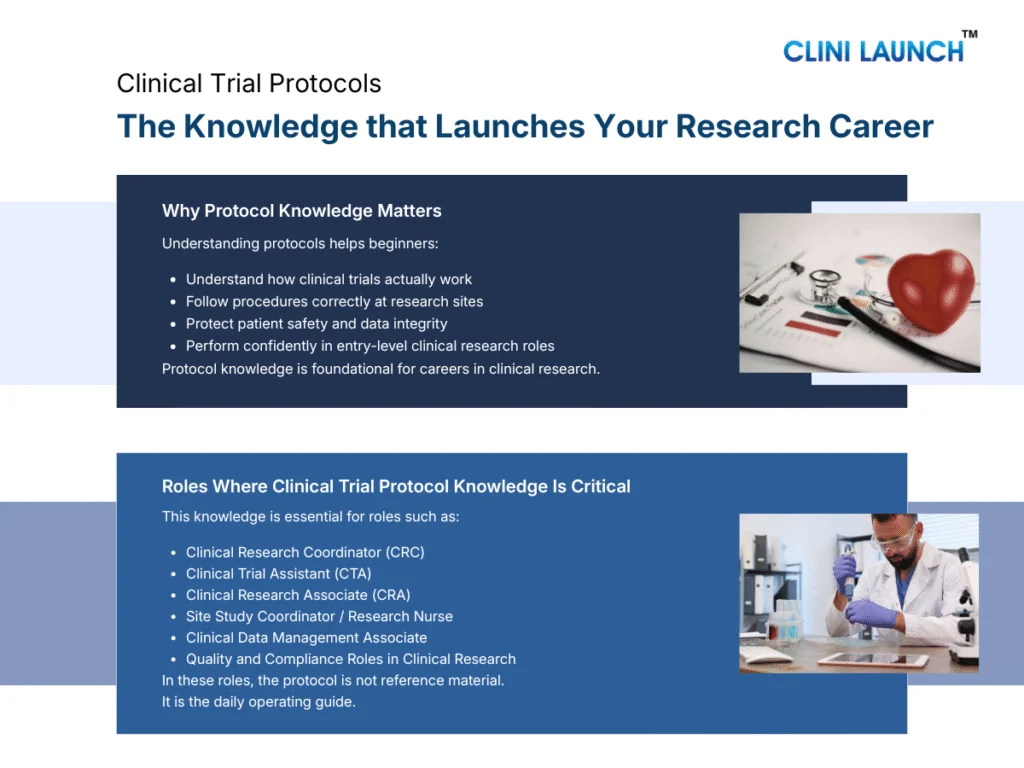
A clinical trial protocol is the written plan that explains how a clinical study will be carried out from start to finish. It defines what the study is trying to answer, who can participate, what procedures will be performed, how safety will be monitored, and how results will be analyzed.
Clinical trial protocols exist because clinical research cannot rely on informal decision-making. Studies involve human participants, medical interventions, and regulatory oversight. The protocol establishes clear rules before the trial begins so that actions taken during the study are consistent, justified, and defensible.
By setting these rules in advance, the protocol serves two critical purposes. First, it protects participants by defining eligibility criteria, visit schedules, and safety assessments. Second, it protects the scientific integrity of the study by ensuring that data is collected and analyzed in a structured and reliable way.
In practice, the clinical trial protocol acts as both a scientific blueprint and an operational guide, making it possible for clinical trials to be ethical, reproducible, and acceptable to regulators.
Who Uses a Clinical Trial Protocol
A clinical trial protocol is used by everyone involved in a clinical study:
- Investigators and doctors use it to understand how the study should be conducted and how participants should be treated.
- Clinical Research Coordinators (CRCs) follow the protocol to schedule visits, perform procedures, and collect data correctly.
- Clinical Research Associates (CRAs) use it to check whether the trial is being conducted according to plan.
- Data management and statistics teams rely on the protocol to know what data to collect and how it should be analyzed.
- Ethics committees and regulators, such as the FDA and ICH-GCP, review the protocol to ensure the study is ethical, safe, and scientifically sound.
In simple terms, the protocol in clinical trials acts as a shared guidebook for all stakeholders.
What Is Included in a Clinical Trial Protocol?
A clinical trial protocol contains clearly defined sections that explain why a study is conducted, how it will be carried out, and how safety and results will be evaluated. Each section plays a specific role in ensuring that the trial is ethical, consistent, and scientifically reliable.
1. Trial Identification and Administrative Details
This is the identity card of the study. It includes the official study title, protocol number, trial phase, sponsor name, investigator details, and version history.
Why it matters:
These details establish investigator responsibilities, trace accountability, and ensure that every site, auditor, and regulator is working from the same approved version. Any mismatch here is a compliance problem, not a clerical error.
2. Background and Scientific Rationale
This section answers a simple but brutal question: Why does this study deserve to exist?
It summarizes current medical knowledge, gaps in evidence, and limitations of existing treatments. The scientific rationale justifies exposing real humans to risk and effort. Without a solid rationale, the study fails both scientifically and ethically.
This is where a clinical trial protocol definition moves beyond theory and proves relevance with data and prior research.
For example, the AURORA cardiovascular outcomes trial was conducted because patients on long-term dialysis had high cardiovascular risk, yet there was insufficient evidence that statins reduced events in this population.
3. Study Objectives and Endpoints
Here, the protocol stops being philosophical and becomes measurable.
- Objectives state what the study is trying to prove.
- Endpoints define how that proof will be measured.
Primary and secondary endpoints are clearly separated to avoid post-hoc manipulation. This clarity protects the study from biased interpretation and supports regulatory compliance during review.
A weak endpoint definition is one of the fastest ways to kill a study’s credibility.
For example, In the West of Scotland Coronary Prevention Study (WOSCOPS), primary endpoint was the first occurrence of myocardial infarction or death from coronary heart disease.
4. Study Design and Methodology
This is the engineering core of the protocol.
The study design and methodology section explains:
- Trial type (randomized, controlled, open-label, etc.)
- Treatment arms and comparators
- Randomization and blinding methods
- Duration and follow-up structure
Good clinical trial protocol design ensures results are scientifically valid and defensible. Poor design guarantees wasted time, money, and participants.
5. Study Population and Eligibility Criteria
This section defines who gets in and who stays out.
Clear inclusion and exclusion criteria protect participants and prevent noise in the data. They also directly affect how widely the results can be applied in real clinical practice.
Eligibility criteria are a core part of risk benefit assessment. Enrolling the wrong population can expose patients to unnecessary risk or dilute meaningful outcomes.
For example, many clinical trials historically exclude pregnant women because of safety concerns for the fetus and the mother, and regulators have published guidance discussing when and how pregnant and breastfeeding women should be included in trial design.
6. Study Procedures and Schedule of Events
This is the operational playbook for trial sites.
It lays out:
- Visit timelines
- Assessments and lab tests
- Treatment administration
- Follow-up requirements
A well-written schedule ensures consistency across sites and supports accurate data collection and management. Ambiguity here leads to protocol deviations, not flexibility.
7. Safety Monitoring and Risk Management
This section defines how participant safety is actively protected, not just promised.
It explains:
- Adverse event reporting
- Serious adverse event escalation
- Stopping rules and discontinuation criteria
- Ongoing safety review processes
This is where ethical considerations in clinical trials meet legal obligation. Continuous safety monitoring is mandatory under global clinical trial protocol guidelines, especially for studies conducted under regulatory frameworks like INDs.
For example, during clinical trials conducted under an Investigational New Drug (IND) application, the sponsor (the organization running the trial) must report to the FDA any serious and unexpected suspected adverse reactions within specific time frames (e.g., within 7–15 days depending on severity).
8. Data Collection and Quality Control
Clinical trials live or die by data integrity.
This section details:
- How data is recorded (eCRFs, source documents)
- Review and verification processes
- Monitoring and quality control activities
- Data correction and audit trails
Without rigorous controls, even a perfectly designed trial becomes unusable. Regulators care as much about how data was collected as they do about the results themselves.
9. Statistical Considerations
This is where math prevents false conclusions.
The protocol defines:
- Sample size calculation
- Statistical tests and assumptions
- Power (typically 80–90%)
- Significance thresholds
Predefining statistics protects the study from selective analysis and supports transparent interpretation. Changing numbers later is not “optimization”; it’s a red flag.
For example, The WOSCOPS trial used predefined statistical power calculations to ensure sufficient participants were enrolled to detect meaningful treatment effects.
10. Ethical Considerations and Informed Consent
No participant enters a trial without this section being rock solid. The protocol explains the informed consent process, confidentiality safeguards, and participant rights. Consent is not a formality. It is an ongoing ethical obligation backed by global standards like ICH GCP. This section anchors the entire study in human protection, reinforcing that compliance exists to serve people, not paperwork.
For example, Under ICH Good Clinical Practice (GCP) standards, a participant cannot be enrolled in a clinical trial unless informed consent has been obtained and properly documented. This requirement ensures that participants clearly understand the purpose of the study, potential risks and benefits, and their right to withdraw at any time, forming the global ethical foundation for clinical research
Clinical Research
Build industry-ready skills to work across real clinical trial environments, from study initiation to close-out. Learn how clinical research actually operates in hospitals, CROs, pharma companies, and research organizations, with a strong focus on compliance, documentation, and trial execution.

Clinical Trial Protocol vs Other Trial Documents
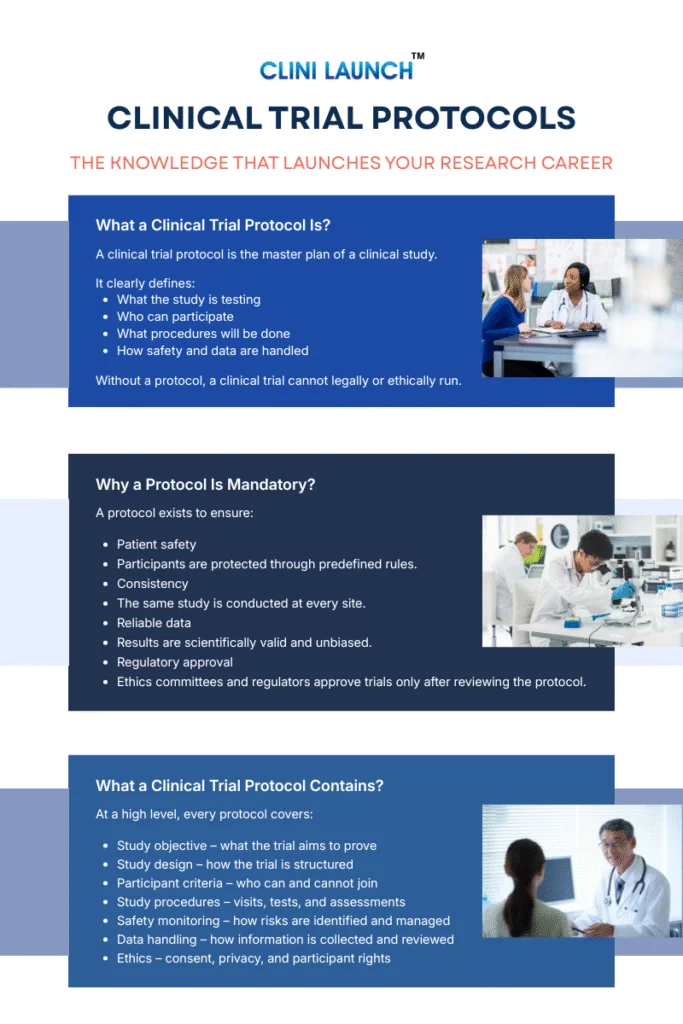
In a clinical trial, multiple documents are used at different stages of the study. While the clinical trial protocol sets the overall direction, other documents support communication, execution, analysis, and compliance. Understanding how these documents differ helps clarify who uses what and at which point in the trial.
- Protocol vs Informed Consent Form (ICF)
The clinical trial protocol is a technical document created for scientific and regulatory review. It defines the study framework and governs how the trial must be conducted.
The Informed Consent Form exists to support participant decision-making. Its role is ethical rather than operational; it ensures participants understand the study before agreeing to take part.
- Protocol vs Investigator Brochure (IB)
The protocol focuses on trial conduct, while the Investigator Brochure focuses on knowledge transfer. The IB equips investigators with background information needed to use the investigational product safely, but it does not dictate how the study itself is running.
- Protocol vs Statistical Analysis Plan (SAP)
The protocol establishes the analytical intent of the study on what outcomes matter and why. The SAP translates that intent into executable statistical instructions, ensuring that analysis of decisions is locked before results are examined.
- Protocol vs Case Report Forms (CRFs)
The protocol defines what should be observed in a participant. CRFs exist only to capture those observations in a structured, auditable way. If the protocol changes, CRFs must be updated to remain aligned.
- Protocol Amendments vs Protocol Deviations
Amendments reflect controlled evolution of the study plan, while deviations represent exceptions that occur during real-world execution. Both are tracked to assess their impact on safety and data integrity under ICH Good Clinical Practice.
How These Documents Function in a Trial
| Document | When It Is Used | Primary Owner | What It Enables |
|---|---|---|---|
| Clinical Trial Protocol | Before and throughout the trial | Sponsor | Regulatory approval and trial governance |
| Informed Consent Form (ICF) | Before participant enrollment | Investigator / IRB | Ethical enrollment of participants |
| Investigator Brochure (IB) | Before site initiation and during trial | Sponsor | Investigator training and product safety awareness |
| Statistical Analysis Plan (SAP) | Before database lock | Biostatistics team | Predefined, unbiased data analysis |
| Case Report Forms (CRFs) | During participant visits | Data management | Standardized data capture |
| Protocol Amendment | When trial design needs revision | Sponsor | Controlled updates to study conduct |
| Protocol Deviation | When protocol is not followed | Site / Monitor | Documentation of execution gaps |
Understanding how protocols translate into statistical plans and analysis is essential for roles that work closely with trial data and reporting.
Clinical SAS
Build practical skills in clinical data analysis and reporting using SAS, aligned with regulatory standards used in clinical trials. Learn how clinical trial data is cleaned, analyzed, and presented for regulatory submissions and study reporting.
Common Misconceptions About Clinical Trial Protocols
People new to clinical research often misunderstand what a clinical trial protocol actually does. These misconceptions usually come from seeing the protocol as a static or purely regulatory document, rather than a practical guide used throughout a trial.
1. The protocol is just paperwork
Many believe the protocol exists only to satisfy regulators.
In reality, the protocol guides daily trial activities such as participant visits, safety assessments, dosing decisions, and data collection.
2. Once written, the protocol never changes
It’s commonly assumed that protocols are fixed and cannot be modified.
In practice, protocols can be updated through approved amendments when scientific, operational, or safety-related changes are needed.
3. Only regulators care about the protocol
Another misconception is that the protocol is relevant only during inspections.
In reality, investigators, Clinical Research Coordinators, monitors, data managers, and statisticians rely on the protocol to perform their roles consistently.
|
Case Study 1: When the Protocol Made the Call During a clinical trial, a participant developed unexpected safety symptoms after dosing, leaving the site team unsure whether treatment should continue. Instead of relying on judgment, the team followed the clinical trial protocol, which had already defined stopping rules and reporting timelines. Treatment was discontinued and the event was reported as outlined in FDA IND safety reporting requirements. |
4. Protocol deviations mean the study has failed
Deviations are often viewed as signs of poor-quality trials.
In real-world settings, deviations are expected. What matters is how they are documented, assessed, and managed.
5. Participants read the clinical trial protocol
Some assume participants are given the full protocol.
In reality, participants interact only with the Informed Consent Form, which explains the study in plain language. The protocol remains a technical document used by the research team.
6. The protocol and SOPs are the same
Protocols and Standard Operating Procedures are often confused.
SOPs describe how an organization operates in general, while the protocol defines how one specific clinical trial must be conducted.
|
Case Study 2: A Missed Visit That Didn’t Break the Trial In another study, a participant missed a scheduled visit due to illness, raising concerns about protocol compliance. The team reviewed the protocol, documented the deviation, completed follow-up assessments, and allowed the participant to continue as described in standard clinical study conduct practices outlined by ClinicalTrials.gov. |
Conclusion
Clinical trial protocols form the backbone of how clinical research is planned, executed, and evaluated. They bring together scientific intent, participant safety, regulatory expectations, and operational clarity into a single framework that guides decisions throughout the life of a trial.
For anyone building a career in clinical research, protocol knowledge goes beyond understanding procedures; it reflects the ability to think critically, act responsibly, and respond correctly when real-world challenges arise. Strong protocol understanding supports ethical conduct, improves cross-functional collaboration, and ensures consistency across trial sites.
At CliniLaunch Research Institute, we approach protocol knowledge in our clinical research training programs as a critical capability to develop, not just a document to follow. Ultimately, mastering the protocol is what enables clinical research professionals to contribute meaningfully to high-quality, credible research and build sustainable careers in the field. This is why understanding what is clinical trial protocol is foundational for anyone serious about a career in clinical research.
Frequently Asked Questions (FAQs)
1. What is a clinical trial protocol in simple terms?
A clinical trial protocol is a detailed plan that explains how a clinical study will be conducted, including who can participate, what treatment is given, how safety is monitored, and how results are analyzed.
2. Why is a clinical trial protocol required before starting a study?
A protocol is required to ensure the trial is scientifically sound, ethically conducted, and safe for participants. It prevents decisions from being made midway and ensures consistency across all study sites.
3. Who prepares the clinical trial protocol?
Clinical trial protocols are developed collaboratively by sponsors, investigators, statisticians, and regulatory experts to ensure scientific validity, feasibility, and regulatory compliance.
4. Can a clinical trial protocol be changed after the study starts?
Yes. A protocol can be modified through approved protocol amendments if new safety, scientific, or operational information arises. Any change must be reviewed and approved before implementation.
5. What happens if a protocol is not followed?
When a protocol is not followed, it is documented as a protocol deviation. Deviations are reviewed to assess their impact on participant safety and data quality and do not automatically invalidate a study.
6. How is a clinical trial protocol different from informed consent?
The protocol is a technical document used by the research team, while the informed consent form is written for participants to help them understand the study and voluntarily agree to participate.
7. Why is protocol knowledge important for clinical research careers?
Protocol knowledge helps professionals make correct decisions, handle real-world trial situations, and communicate effectively across teams. It is a core skill evaluated in clinical research roles.
8. Do beginners need to understand statistics in a clinical trial protocol?
Yes, at a basic level. Understanding concepts like sample size, endpoints, and statistical power helps professionals understand why trials are designed in a certain way and how results are interpreted.
9. Are clinical trial protocols the same across all studies?
No. While protocols follow standard guidelines such as ICH Good Clinical Practice, each protocol is customized based on the study objective, population, and treatment being evaluated.