
| Role of a Site Management Associate (SMA) in Clinical Research |
|---|
| A Site Management Associate (SMA) is a clinical research operations professional who supports site-level coordination, documentation, and operational readiness in clinical trials. The role focuses on structured execution, communication, trial tracking, and quality follow-through without performing independent monitoring or oversight activities. |
A Site Management Associate (SMA) supports the smooth execution of clinical trials at the site level within regulated research environments. As global studies become more technology-driven and decentralized, the role has evolved beyond basic coordination. It now involves working within integrated eClinical systems, supporting remote and hybrid trial workflows, and maintaining stricter documentation standards aligned with updated regulatory expectations such as ICH E6(R3). While not responsible for independent monitoring, the SMA plays a central role in keeping site activities organized, compliant, and consistently aligned with study timelines and quality requirements.
To fully understand the responsibilities associated with the Site Management Associate role, it is important to understand how the role is defined and why it is significant within clinical research operations. This blog provides a clear and structured overview of the SMA role, explaining where it fits within clinical operations, why the function is critical to trial execution, and how its responsibilities contribute to consistency, compliance, and operational stability in research settings governed by established Good Clinical Practice (GCP) principles.
Who is a Site Management Associate & Why They Matter
A Site Management Associate (SMA) is a clinical research operations professional who provides structured administrative and coordination support to hospitals or research centers participating in clinical trials, supporting clinical research site management activities that keep site operations organized and compliant. The core objective of the role is to keep site-related work organized, documented, and on schedule once a study is assigned to a site and as it progresses. In practice, this includes organizing approval of paperwork before the study begins, maintaining updated study files, tracking enrollment timelines, and following up with sites on incomplete forms or delayed submissions. The role is primarily process-driven and administrative and does not involve making treatment decisions for patients or independently verifying clinical trial data.
This role is critical because clinical trials involve multiple sites, strict regulatory timelines, and continuous documentation requirements that must remain accurate and up to date. Even small delays in paperwork, missed submissions, or disorganized records can slow patient enrollment, trigger compliance findings, or impact study timelines. By ensuring that site documentation is complete, deadlines are tracked, and communication gaps are addressed early, the Site Management Associate helps maintain operational stability.
Core Responsibilities of a Site Management Associate (SMA)
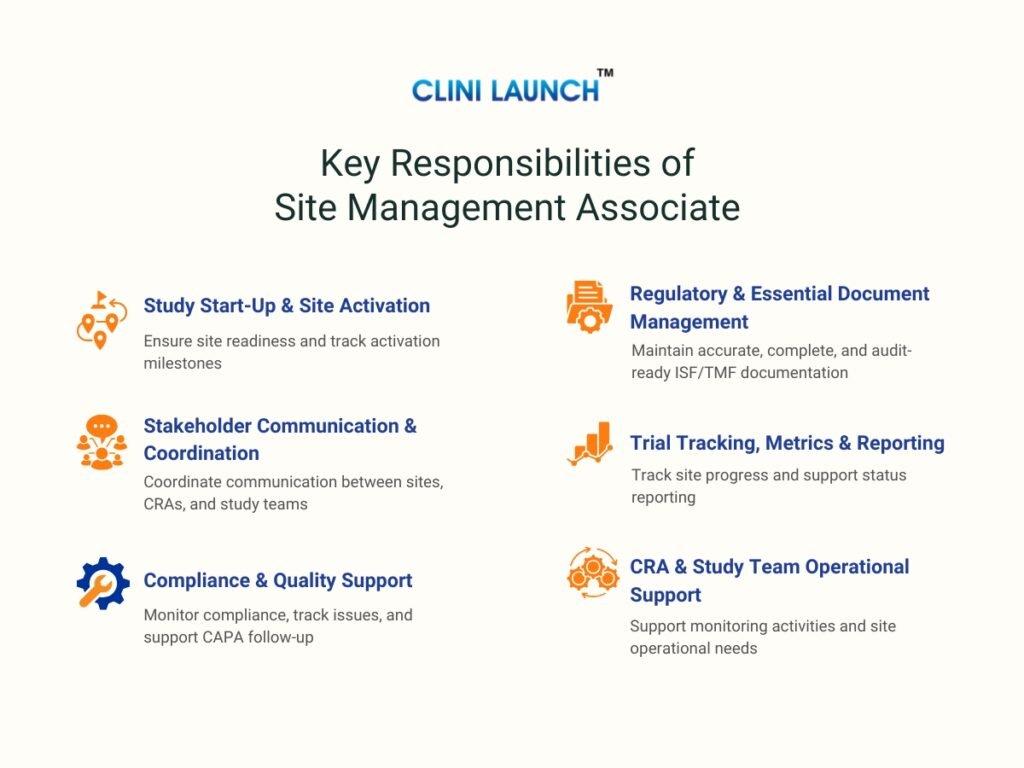
The core responsibilities of a Site Management Associate (SMA) span multiple operational areas that support day-to-day site activities across the clinical trial lifecycle. These responsibilities are organized into distinct functional areas, each addressing a specific aspect of site coordination, documentation management, stakeholder communication, progress tracking, and compliance support.
The sections below outline these responsibility areas in detail.
1. Study Start-Up & Site Activation Support
Study start-up represents the transition from trial planning to site readiness, marking the point at which an investigational site becomes eligible to begin clinical trial study activities. During this phase, the Site Management Associate (SMA) supports the coordination of start-up processes required to move a site from pre-activation status to formal initiation.
This responsibility includes supporting site initiation activities and assisting with the preparation, submission, and follow-up of required regulatory and ethics documentation, where applicable. The SMA helps track approval status, document completeness, and outstanding requirements to ensure that start-up progress remains visible, structured, and controlled, in alignment with internationally recognized Good Clinical Practice (ICH-GCP) principles that emphasize investigator readiness, documentation quality, and controlled trial conduct, as outlined in the ICH E6 (Good Clinical Practice) guideline.
Prior to clinical site activation for enrollment, the SMA supports confirmation that protocol-defined prerequisites, essential documentation, and operational readiness criteria have been met. This involvement concludes once activation conditions are satisfied, ensuring a clear and structured transition into the active study phase without extending into responsibilities associated with ongoing trial conduct or monitoring activities.
2. Regulatory & Essential Document Management
Regulatory and essential document management involves the controlled handling of site and trial documentation to ensure that records remain complete, current, and accurately organized in accordance with established filing standards. This responsibility area centers on documentation accuracy, traceability, and consistency, rather than regulatory interpretation, decision-making, or approval activities.
A key component of this responsibility involves maintaining the Investigator Site File (ISF) and Trial Master File (TMF) in line with predefined document lists and filing structures. The Site Management Associate (SMA) supports the identification of required documents, verifies their presence and completeness, and ensures that updates, amendments, and replacements are reflected accurately within the file structure. This includes monitoring document version control to prevent the retention or use of outdated or superseded records.
This responsibility also includes document indexing, naming consistency, and proper classification to support efficient retrieval during routine reviews, audits, or inspections. The SMA assists with document reconciliation by comparing site-held and sponsor-held records to identify missing, duplicate, or misfiled items. Through this structured approach, the role supports ongoing audit and inspection of readiness by ensuring documentation remains organized, complete, and accessible without the need for retrospective file correction.
3. Stakeholder Communication & Coordination
Stakeholder communication and coordination involve managing the flow of study-related information between clinical trial sites and the broader research team. Within this responsibility area, the Site Management Associate supports clear, timely, and structured communication to ensure that site queries, updates, and operational inputs are handled consistently.
Site Management Associates act as a central point for receiving site-level questions and requests, ensuring they are acknowledged, clarified when needed, and directed to the appropriate stakeholders for resolution. The SMA supports issue of escalation by identifying when site concerns require input beyond routine handling and ensuring that such issues are communicated through defined channels without delay.
In addition, SMAs coordinate operational interactions such as training sessions, study meetings, and scheduled follow-ups. The SMA supports logistic planning, attendance coordination, and follow-through discussion outcomes, helping ensure that agreed actions are tracked and communicated back to relevant stakeholders. This coordination function focuses on maintaining clarity, reducing miscommunication, and supporting alignment across site-facing interactions without extending into decision-making or oversight roles.
4. Trial Tracking, Metrics & Reporting
Trial tracking, metrics, and reporting involves maintaining clear operational visibility into site activity and overall study progress. This responsibility area centers on collecting, organizing, and presenting site-level information in a structured manner that supports ongoing review and timely awareness across study teams.
Within this scope, the Site Management Associate (SMA) supports tracking enrollment progress, site performance indicators, and predefined study milestones using approved tracking tools or systems. The emphasis remains on accuracy and consistency of reported information, ensuring that the current study status across sites can be reviewed without reliance on fragmented or ad hoc updates.
As part of the operational tracking, this responsibility may also include monitoring key enrollment-related metrics at the site level, such as patient recruitment rates, screen failure trends, and participant retention or dropout patterns. Tracking these indicators provides early visibility into enrollment performance and site-level challenges, enabling study teams to assess progress against defined targets using measurable data rather than isolated milestone completion alone.
This responsibility also includes preparation of operational status reports and routine updates, summarizing site progress, pending activities, and timeline movement. These reports are structured to highlight trends and emerging risks over time. Where delays, deviations, or potential risks are identified through tracking outputs, the SMA supports escalation by ensuring that the findings are documented and routed through established reporting channels.
By maintaining structured tracking and consistent reporting practices, this responsibility area supports informed review and decision support across study teams without extending into monitoring oversight, compliance assessment, or site communication management.
5. Compliance & Quality Support
In compliance and quality support, the Site Management Associate helps ensure that site activities follow the approved study plan and required standards. The role involves identifying potential quality issues, tracking them properly, and following up until they are resolved. This support helps maintain consistency in how the study is conducted at the site level without taking on audit or oversight responsibilities.
This responsibility includes supporting awareness of potential protocol deviations, procedural gaps, or quality concerns that arise during routine study activities. Rather than performing audits or making compliance determinations, the SMA supports quality processes by ensuring that such issues are appropriately recorded, monitored, and followed through using defined quality workflows.
In addition, this responsibility covers support for audit and inspection activities by coordinating quality-related follow-up actions and monitoring their progress. The SMA assists with Corrective and Preventive Action (CAPA) follow-up by tracking action items, supporting timely completion, and helping ensure that updates are communicated to relevant stakeholders. This function remains focused on quality issues of follow-through and operational consistency, without extending into document control or regulatory decision-making.
6. CRA & Study Team Operational Support
CRA and study team operational support involves helping with site-related tasks that support—but do not replace—monitoring and oversight activities. In this role, the Site Management Associate directly assists CRAs and internal study teams by organizing site updates, tracking follow-ups, and managing coordination tasks so they can focus on review, oversight, and decision-making.
In practice, this support is applied around site monitoring in clinical trials, where the SMA helps organize site-related inputs, maintain visibility on pending items, and follow through on agreed next steps. This coordination remains limited to operational follow-up and does not extend into review, verification, or assessment of activities that are the responsibility of CRAs.
Beyond monitoring-related support, this responsibility area includes assisting internal study teams with routine operational coordination. This may involve consolidating site-level updates, supporting preparation for internal discussions, and tracking site-related follow-ups that require cross-functional input. By managing these coordination and administrative activities, the SMA helps reduce operational burden on CRAs and study teams, allowing them to focus on oversight, review, and decision-making functions without interruption.
Key Skills & Professional Competencies
To perform effectively in a structured and regulated research environment, a Site Management Associate requires a combination of operational knowledge, coordination ability, and quality-focused discipline. The following skills support consistent execution of site-facing responsibilities:
- Understanding Clinical Trial Structure
Working knowledge of how clinical trials are organized, including trial phases, site workflows, and basic regulatory expectations.
- Documentation & Organizational Skills
Ability to manage study files, records, and operational information in a structured, accurate, and traceable manner.
- Clear Communication Skills
Strong written and verbal communication to coordinate effectively with sites, CRAs, and internal study teams.
- Time Management & Multi-Site Coordination
Capability to handle multiple sites or tasks simultaneously while meeting deadlines and maintaining accuracy.
- Attention to Detail & Quality Awareness
Careful review mindset to identify inconsistencies early and ensure alignment with study requirements and compliance standards.
AI and ML
Gain practical exposure to Artificial Intelligence and Machine Learning concepts used in modern applications. This course focuses on how intelligent systems learn from data, make predictions, and support automation across industries. Learn core ML techniques along with real-world applications of AI-driven solutions.

Career Progression: From Site Management Associate to Clinical Research Associate
The Site Management Associate role is commonly positioned as an entry or early-career role within clinical research operations and often serves as a starting point for professionals pursuing a clinical research associate career. Individuals typically move into this position after completing education or foundational training in life sciences, pharmacy, nursing, or related disciplines, or after gaining initial exposure to clinical research environments through coordination or support roles. The SMA position provides structured exposure to regulated research settings, helping professionals understand how clinical studies are organized and governed at the site level. As professionals gain experience and transition into advanced roles, factors such as experience, certifications, and industry demand can influence the site management associate salary and overall career growth within clinical research operations.
As professionals continue in the SMA role, they gain familiarity with how studies transition across phases, how site-facing activities are coordinated, and how operational processes are maintained over time. This exposure supports readiness for roles involving broader study oversight, without requiring immediate responsibility for independent monitoring activities.
A common progression pathway involves moving from Site Management Associate to an in-house or office-based Clinical Research Associate role, which prepares professionals for a wide range of clinical research associate jobs in contract research organizations, pharmaceutical companies, and research institutions. This step allows professionals to deepen their understanding of monitoring workflows within a supported environment. With additional experience, training, and demonstrated readiness, individuals may then progress to field-based CRA positions that involve independent site monitoring and direct interaction with investigative sites.
This career path is well suited for individuals who are interested in clinical research operations and prefer structured, site-facing work within regulated environments. It is particularly relevant for those seeking early-career exposure to clinical trial workflows and long-term growth within clinical research, without immediate responsibility for independent monitoring or oversight.
Conclusion
The Site Management Associate role highlights the importance of structured execution within clinical research operations. Beyond individual tasks or titles, the role represents how consistency, coordination, and process discipline support reliable trial conduct in regulated environments. Understanding this function offers a clear view into how site-facing operations contribute to the stability and continuity of clinical studies.
By outlining the scope, responsibilities, and career progression associated with the SMA role, this blog brings clarity to where the position fits within clinical research and how it supports long-term professional growth. Whether viewed as a foundational role or a steppingstone towards monitoring positions, the Site Management Associate remains a critical part of modern clinical research operations.
Building a solid foundation in clinical research operations requires practical exposure to how trials are executed, governed, and documented in real-world settings. Clinilaunch Research Institute’s PG Diploma in Clinical Research is designed around clinical trial workflows, regulatory expectations, and documentation practices that support site-level research operations. For individuals looking to enter the field with clarity and long-term career progression in mind, the program offers a structured and industry-aligned starting point.
Frequently Asked Questions (FAQs)
1. Which industries or organizations typically hire Site Management Associates?
Site Management Associates are most hired by Contract Research Organizations (CROs), pharmaceutical companies, biotechnology firms, and clinical research service providers that manage multi-site clinical trials.
2. Is prior site experience mandatory to get hired as a Site Management Associate?
Prior site experience is not always mandatory. Many organizations consider candidates with relevant education or formal clinical research training, particularly when combined with strong operational, documentation, or coordination of exposure.
3. How is a Site Management Associate role different from a site-based hospital research role?
Unlike hospital-based research roles, a Site Management Associate typically supports multiple investigative sites remotely and operates within sponsor or CRO teams rather than being embedded at a single research site.
4. What tools or systems does a Site Management Associate typically work with?
Depending on the organization, Site Management Associates may work with Clinical Trial Management Systems (CTMS), electronic Trial Master Files (eTMF), document repositories, and internal tracking tools used to support site operations.
5. Is the Site Management Associate role more process-driven or people-driven?
The SMA role is primarily process-driven, with a strong emphasis on coordination, documentation discipline, and operational consistency. However, it also requires regular interaction with site staff and internal study teams.
6. What are common challenges faced in the Site Management Associate role?
Common challenges include managing multiple sites simultaneously, balancing competing priorities, maintaining accuracy under time pressure, and coordinating across geographically dispersed teams.
7. How does working as a Site Management Associate help build long-term career stability?
The SMA role provides exposure to regulated clinical research operations, cross-functional workflows, and site coordination processes that are transferable across multiple clinical research career paths.
8. What should candidates realistically expect in their first year as a Site Management Associate?
In the first year, candidates can expect a steep learning curve focused on understanding clinical trial workflows, organizational processes, documentation standards, and coordination practices within regulated research environments.