Top Bioinformatics Careers in 2026
Top bioinformatics careers in 2026 include Bioinformatics Analyst, Genomics Data Scientist, Computational Biologist, and Clinical Bioinformatics Director. These roles offer strong demand across healthcare, biotechnology, genomics, AI-driven drug discovery, and precision medicine industries.
Modern life sciences and clinical research generate vast amounts of genomic, proteomic, and clinical data, but this raw information has little value without proper analysis. A Bioinformatics Analyst operates at the intersection of biology, data, and computation to process and interpret complex biological datasets. Working in areas such as genomic data analysis and bioinformatics in drug discovery, a bioinformatics analyst analyzes DNA, RNA, protein, and clinical datasets to convert raw biological information into meaningful insights that support scientific research, diagnostics, precision medicine, and pharmaceutical innovation.
Bioinformatics is no longer just a niche research field; it has become a rapidly growing discipline at the intersection of biology, data science, and computational research. The global genomics data analysis and bioinformatics market is rapidly expanding, with analysts projecting it could grow from around $5.68 billion in 2024 to over $20 billion by 2033, driven by advances in next-generation sequencing, precision medicine, and the need to interpret massive biological datasets generated every day. As demand for professionals in the bioinformatics analyst career path continues to rise, understanding the roles, responsibilities, and technical skills of a Bioinformatics Analyst becomes essential for anyone considering a future in bioinformatics and computational biology. Along with career growth, the bioinformatics job salary landscape has also seen steady increases due to rising demand in genomics, precision medicine, healthcare analytics, and pharmaceutical research. In advanced roles, a Bioinformatics Analyst may evolve into a bioinformatic scientist, contributing to complex research, genomic innovation, and AI-driven healthcare discoveries.
Why Bioinformatics Analysts are in demand today
Massive Growth of Genomic and Clinical Data: Advances in sequencing, proteomics, and digital healthcare have created massive volumes of biological and clinical data. Modern studies now generate far more data than traditional lab methods can analyze, making computational expertise essential. Large international genome initiatives supported by organizations such as the National Human Genome Research Institute (NHGRI) have further accelerated the generation of genomic data worldwide.
Laboratories and pharmaceutical companies cannot interpret large biological datasets manually: Raw biological data has no value until it is analyzed and organized. Manually interpreting large-scale genomic or clinical datasets is slow and impractical, so bioinformatics analysts use computational tools to convert raw data into useful biological insights.
AI, sequencing, and precision medicine demand data-driven biology: Personalized medicine and AI-driven research depend on accurate, well-analyzed biological data. Bioinformatics analysts ensure that sequencing and clinical data is properly processed and interpreted, enabling reliable research outcomes and informed healthcare decisions. This growing demand is directly influencing the bioinformatics analyst salary, making it a financially attractive career option.
Is Bioinformatics Analyst a Good Career in 2026?
Bioinformatics is becoming one of the most promising career paths in modern life sciences due to the rapid growth of genomics, artificial intelligence, precision medicine, and healthcare analytics. As healthcare and pharmaceutical industries become increasingly data-driven, the demand for professionals who can analyze and interpret biological data continues to rise globally. For learners interested in a computational biology career, healthcare bioinformatics, or genomic data analysis, Bioinformatics Analyst roles offer strong long-term growth potential across research, diagnostics, and biotechnology sectors.
Industry Demand
The demand for bioinformatics analyst jobs is increasing across pharmaceutical companies, biotechnology firms, genomics laboratories, CROs, healthcare technology companies, and research institutions. Organizations working in genomics, molecular diagnostics, precision medicine, and bioinformatics in drug discovery require skilled professionals who can manage and interpret complex biological datasets. As biological data generation continues to grow rapidly, computational analysis has become essential rather than optional.
Global Opportunities
Bioinformatics has become a globally relevant career field. Countries such as the United States, Germany, the United Kingdom, Canada, Singapore, and Australia are investing heavily in genomics research, AI-driven healthcare, and precision medicine initiatives. This expansion is creating strong global opportunities for professionals pursuing a genomics career or computational biology career in research, healthcare, and pharmaceutical innovation.
Remote Work Opportunities
Many bioinformatics analyst jobs support remote or hybrid work models because much of the work involves computational analysis, biological data interpretation, programming, and reporting. Professionals working in healthcare bioinformatics, genomic data analysis, and drug discovery analytics often collaborate with global research teams virtually, making bioinformatics one of the more flexible careers within life sciences.
Salary Growth
The bioinformatics job salary landscape has grown steadily over the last few years due to increasing demand for genomic analysis expertise and AI-driven biological research. Entry-level professionals can begin with competitive salary packages, while experienced genomic data analyst professionals and computational biology specialists often move into higher-paying research, pharmaceutical, and leadership roles. Specialized expertise in next-generation sequencing (NGS), AI-supported analysis, and bioinformatics in drug discovery further increases earning potential.
AI and Genomics Demand
Artificial intelligence and genomics are transforming modern healthcare and biomedical research. AI models are increasingly used to analyze genomic datasets, predict disease risks, support drug discovery analytics, and improve precision medicine strategies. This growing intersection between AI, healthcare bioinformatics, and genomics is significantly increasing the demand for Bioinformatics Analysts who understand both biological science and computational analysis.
Industries Hiring Bioinformatics Analysts
Bioinformatics Analysts are needed wherever large-scale biological and clinical data must be processed, interpreted, and converted into actionable insights. Their role cuts across research, healthcare, and technology-driven life science sectors.
Pharmaceutical Companies: Bioinformatics Analysts support drug discovery and development by analyzing genomic, proteomic, and molecular data. Their insights help identify drug targets, understand disease mechanisms, and support biomarker discovery during preclinical and clinical research stages.
Clinical Research & Genomics Labs: In clinical research and genomics laboratories, Bioinformatics Analysts work on sequencing data, genetic variation analysis, and study-specific datasets. Their analysis supports clinical trials, translational research, and personalized treatment strategies. In many organizations, professionals take on roles similar to a genomic data analyst, focusing specifically on sequencing and genetic variation of datasets.
Biotechnology Firms: Biotechnology companies rely on bioinformatics to develop diagnostics, therapeutic platforms, and biologics. Analysts help interpret experimental data, optimize research pipelines, and support innovation in genomics, proteomics, and molecular biology.
Hospitals & Precision Medicine Centers: In healthcare settings, Bioinformatics Analysts assist in precision medicine initiatives by analyzing patient genetic data. Their work supports disease risk assessment, treatment selection, and personalized healthcare decision-making.
Research Institutions & AI-Health Startups: Academic research institutes and AI-driven health startups use bioinformatics to explore new biological insights and develop data-driven healthcare solutions. Analysts often work at the intersection of biology, data science, and artificial intelligence to build predictive models and research tools.
Want to build a future-ready career in genomics, AI-driven healthcare, and biological data analysis?
Key Roles and Responsibilities of a Bioinformatics Analyst
The core roles and responsibilities of a Bioinformatics Analyst revolve around a structured analytical workflow that transforms complex biological data into meaningful insights. This role combines biological knowledge with computational and analytical methods to support research, diagnostics, and drug development across life science and healthcare domains.
A. Biological Data Analysis
The work of a Bioinformatics Analyst begins with biological data analysis. At this stage, the analyst receives large-scale datasets generated from sequencing platforms and laboratory experiments. These datasets may represent genomic data from DNA, transcriptomic data from RNA, or proteomic data derived from the proteins. The analyst examines these biological sequences to understand how genes and proteins behave under specific conditions. By comparing sequence data with reference datasets, the analyst identifies patterns, genetic variants, mutations, and biomarkers. This step establishes the biological foundation of the analysis and defines what scientific questions can be explored further.
B. Data Processing and Quality Control
Once the biological data is obtained, the next step is data processing and quality control. Raw biological datasets often contain errors, missing values, or technical noise introduced during sequencing or experimentation. The Bioinformatics Analyst cleans the data to remove unreliable entries and performs validation checks to assess sequencing quality and data consistency. This step ensures that the dataset is accurate and suitable for analysis, as downstream results are only as reliable as the data used at this stage.
C. Tool-Based Analysis and Pipelines
After quality-checked data is prepared, the analyst moves tool-based analysis using specialized bioinformatics platforms. At this stage, analysis workflows are built and executed to process large datasets efficiently. These workflows may involve sequence alignment, variant detection, or expression analysis, depending on the study objective. By automating repetitive analysis of steps through pipelines, the Bioinformatics Analyst ensures that results are reproducible, structured, and scalable across multiple datasets or studies.
D. Statistical and Computational Analysis
With processed data and structured workflows in place, statistical and computational analysis is performed to extract meaningful signals from the data. The Bioinformatics Analyst applies statistical methods to determine whether observed biological changes are significant. Scripting and computational techniques are used to manage large datasets and perform complex analyses. Importantly, results are not viewed in isolation; they are interpreted in alignment with biological knowledge to ensure scientific relevance.
E. Interpretation and Reporting
Once analysis is complete, the Bioinformatics Analyst focuses on interpretation and reporting. At this step, complex outputs are converted into clear insights that can be understood by non-technical stakeholders. The analyst prepares summaries, visualizations, and reports that explain what the data reveals and why it matters. This step enables research teams, clinicians, and drug developers to make informed decisions without directly handling raw biological data.
F. Cross-Functional Collaboration
Throughout the analysis process, Bioinformatics Analysts work closely with cross-functional teams. They coordinate with biologists to understand experimental design, collaborate with clinicians to align findings with clinical relevance, and work with data scientists when advanced computational methods are required. This collaboration ensures that bioinformatics analysis supports research, clinical studies, and diagnostic development in a coordinated and goal-driven manner.
In such workflows, the Bioinformatics Analyst often performs tasks like a genomic data analyst, focusing on interpreting large-scale sequencing data.
Daily Workflow of a Bioinformatics Analyst
While responsibilities vary across organizations, most Bioinformatics Analysts follow a structured workflow when working with biological datasets. The day-to-day responsibilities associated with a bioinformatics job role typically involve managing biological datasets, running analytical pipelines, and interpreting results that support research or clinical studies. Although responsibilities may vary depending on the organization, most analysts follow a structured genomic analysis workflow when handling biological data.
A typical day may include:
- Processing sequencing datasets generated from genomics experiments
- Running analysis pipelines for variant detection or gene expression studies
- Performing quality checks to ensure biological data reliability
- Interpreting results and identifying meaningful biological patterns
- Collaborating with researchers, clinicians, or data scientists to discuss findings
- Preparing reports and visualizations that explain analytical results
This genomic analysis workflow ensures that complex biological data is transformed into actionable insights that can guide research, bioinformatics in drug discovery, precision medicine, and clinical decision-making.
Bioinformatics Tools used by Bioinformatics Analysts
Bioinformatics Analysts rely on specialized genomic analysis tools, bioinformatics software, and computational biology tools to process, analyze, and interpret large-scale biological datasets. These technologies support different stages of the bioinformatics workflow, from sequence analysis and data processing to statistical evaluation and structural visualization. By combining programming languages, biological databases, workflow platforms, and advanced computational frameworks, Bioinformatics Analysts ensure that their analyses are accurate, reproducible, and scalable across research, clinical, and pharmaceutical applications.
To perform these responsibilities effectively, Bioinformatics Analysts rely on a combination of programming tools, biological databases, bioinformatics software, and computational biology tools that help streamline complex genomic analysis workflows and large-scale biological data interpretation.
Learn practical genomic data analysis, Python, NGS workflows, and bioinformatics software through industry-focused training.
Bioinformatics Tools & Technologies
| Category | Tools / Technologies | Why These Tools Are Used |
|---|---|---|
| Sequence Analysis | BLAST, FASTA | Used to compare DNA, RNA, or protein sequences against reference databases to identify similarities, variations, and functional relationships. |
| Workflow Platforms | Galaxy | Enables analysts to build, execute, and manage reproducible bioinformatics workflows without manual repetition of analysis steps. |
| Programming | Python, R | Used for data manipulation, statistical analysis, automation of analysis tasks, and handling large biological datasets. |
| Databases | GenBank, UniProt | Provide access to curated biological sequences and protein information required for reference-based analysis and annotation. |
| Structural Biology | PyMOL | Used to visualize and analyze protein structures to understand functional and structural impacts of mutations. |
| Data Handling | Linux, Command Line | Essential for managing large datasets, running bioinformatics tools efficiently, and working in high-performance computing environments. |
| AI / ML (Advanced) | TensorFlow, AlphaFold | Used in advanced applications to predict protein structures, identify patterns in complex biological data, and support AI-driven biological insights. |
Bioinformatics
Build practical skills to analyze and interpret biological data generated from genomics, proteomics, and clinical research studies. Learn how computational tools and data-driven methods are used to convert raw biological data into meaningful insights for research and drug development.

Eligibility and Educational Background for Bioinformatics Analysts
Bioinformatics is an interdisciplinary field that combines biology, data science, and computational analysis. As a result, professionals from several academic backgrounds can pursue careers as Bioinformatics Analysts.
Common educational backgrounds include:
- Biotechnology
- Microbiology
- Biochemistry
- Genetics
- Molecular Biology
- Bioinformatics
- B Sc Bioinformatics
- BTech Bioinformatics
- Pharmacy or Life Sciences
- Computer Science with biological data interest
- Life science graduates interested in genomics and computational research
Many professionals enter the field by developing computational skills alongside their biological knowledge. With the growing importance of genomics, precision medicine, and data-driven research, structured training programs and practical exposure to bioinformatics tools can help learners transition into this field more effectively. Many learners start their journey through a bioinformatics online course to build foundational, analytical, and practical skills required for modern bioinformatics careers.
Skills required for Bioinformatics Analyst
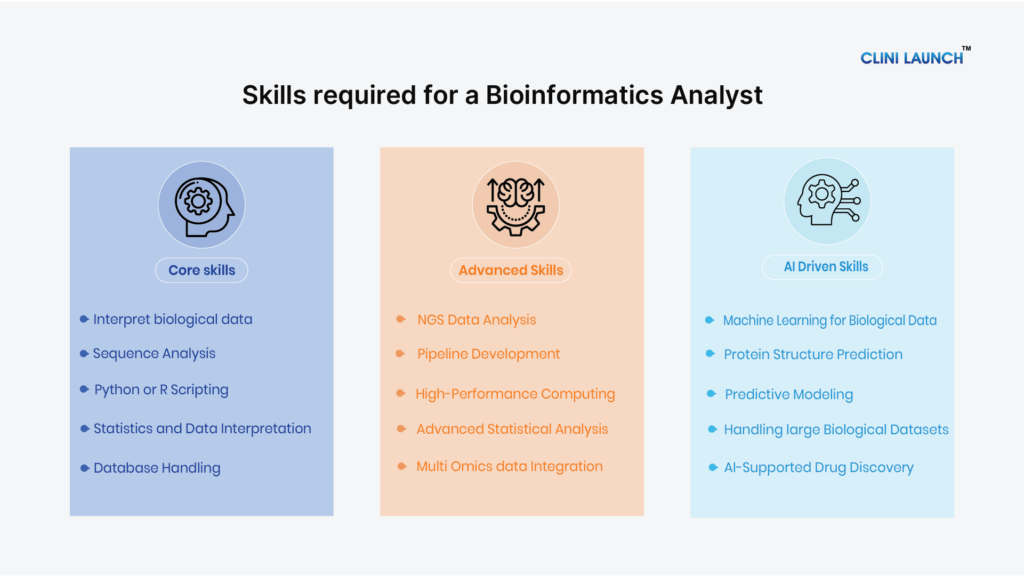
To perform their responsibilities effectively, Bioinformatics Analysts need a balanced combination of technical expertise and analytical ability. Technical skills enable them to work with biological data and computational tools, while non-technical skills support accurate interpretation, documentation, and communication of results. These advanced responsibilities often align with the role of a bioinformatic scientist, who works on complex computational biology problems.
- Basic Skills-
Basic skills form the foundation for anyone entering the field of bioinformatics. These skills focus on understanding biological concepts and developing familiarity with computational tools that support biological data analysis.
- Core Technical Skills-
Core technical skills allow Bioinformatics Analysts to work directly with biological datasets and computational tools. These skills help analysts process large datasets, perform sequence analysis, and extract meaningful insights from complex biological information.
Molecular Biology and Genetics: A Bioinformatics Analyst must understand basic molecular biology and genetics to interpret biological data correctly. This knowledge helps in understanding how DNA, RNA, and proteins function and how variations impact biological processes.
Sequence analysis skills are required to work with DNA, RNA, and protein sequences. Analysts use these skills to identify similarities, variations, mutations, and functional regions within biological sequences.
Python or R Scripting: Programming skills in Python or R are used to process large biological datasets and automate analysis workflows. These languages also support statistical analysis and data visualization tasks.
Statistics and Data Interpretation: Statistical knowledge helps analysts determine whether observed biological changes are meaningful. It ensures that results are interpreted accurately and supported by data rather than random variation.
Database Handling: Bioinformatics Analysts regularly work with biological databases to retrieve reference sequences and annotations. Database handling skills help in comparing experimental data with curated biological information.
- Advanced Skills-
As professionals gain experience in bioinformatics, they begin working with larger datasets and more advanced computational methods. These responsibilities often include building analytical pipelines and applying computational approaches to complex biological problems.
Advanced skills include:
NGS Data Analysis: Understanding next-generation sequencing workflows such as variant calling, genome assembly, and transcriptomics analysis.
Pipeline Development: Designing automated workflows for sequence analysis, variant detection, and gene expression analysis to process large datasets efficiently.
High-Performance Computing (HPC): Working with large genomic datasets often requires familiarity with HPC environments and cloud-based computing systems.
Advanced Statistical Analysis: Applying statistical models to identify meaningful biological patterns, biomarkers, and gene expression differences.
Multi-omics Data Integration: Combining genomics, proteomics, and transcriptomics datasets to generate comprehensive biological insights.
- AI-Driven Skills in Bioinformatics –
Artificial intelligence is increasingly shaping modern biological research. Bioinformatics analysts are gradually expected to understand how AI and machine learning techniques can support large-scale biological data analysis.
Important AI-related skills include:
Machine Learning for Biological Data: Applying machine learning models to identify patterns in genomic and clinical datasets.
Protein Structure Prediction: Using AI tools such as AlphaFold to predict protein structures and understand molecular interactions.
Predictive Modeling: Building models that help predict disease risk, drug responses, or biomarker patterns.
Handling Large Biological Datasets: Working with large-scale omics datasets generated from genomics and clinical studies.
AI-Supported Drug Discovery: Supporting drug discovery research by identifying potential drug targets and biological pathways using computational models.
- Soft Skills-
In addition to technical expertise, Bioinformatics Analysts also require strong analytical and communication skills. These abilities help them interpret complex results, collaborate with multidisciplinary teams, and clearly present insights derived from biological data.
Analytical Thinking: Analytical thinking allows Bioinformatics Analysts to approach complex biological problems in a structured manner and draw logical conclusions from data.
Attention to Detail: Accuracy is critical in bioinformatics, as small errors can affect entire analyses. Attention to detail ensures reliable data processing and interpretation.
Scientific Documentation: Clear documentation helps maintain transparency and reproducibility of bioinformatics workflows. It also supports collaboration and future references.
Communication Skills: Bioinformatics Analysts must explain complex results to non-technical stakeholders. Clear communication ensures that insights are understood and applied effectively.
Bioinformatics Analyst Salary in India and Globally
A career in bioinformatics typically begins with entry-level analytical roles where professionals work with biological datasets and standard bioinformatics tools. As they gain experience, analysts take on more complex analyses, contribute to research interpretation, and begin mentoring junior team members.
Over time, professionals can move into specialized scientific roles or leadership positions that involve designing analytical strategies, leading research initiatives, and supporting advanced areas such as genomics research, precision medicine, and AI-driven healthcare.
Bioinformatics Analyst → Senior Bioinformatics Analyst → Bioinformatic Scientist / Computational Biologist → Bioinformatics Lead
The bioinformatics job salary in India varies based on technical skills, expertise in genomic data analysis, programming knowledge, and experience with bioinformatics software and computational biology tools. Professionals with specialization in next-generation sequencing (NGS), AI-driven healthcare analytics, and bioinformatics in drug discovery often receive higher salary packages.
Bioinformatics Salary in India
| Experience Level | Average Salary Range in India | Typical Experience |
|---|---|---|
| Entry-Level Bioinformatics Salary | ₹3 LPA – ₹6 LPA | 0 – 2 Years |
| Average Bioinformatics Analyst Salary | ₹5 LPA – ₹9 LPA | 3 – 6 Years |
| Genomic Data Analyst Salary (Senior Roles) | ₹10 LPA – ₹18+ LPA | 7+ Years |
Growth Opportunities in Bioinformatics
Bioinformatics is one of the fastest-growing domains in life sciences due to the increasing use of genomics, artificial intelligence, and data-driven research in healthcare and biotechnology. As biological datasets continue to grow in size and complexity, organizations increasingly need professionals who can analyze and interpret this information using computational tools.
Indian Outlook
India is emerging as a significant hub for bioinformatics due to the expansion of biotechnology research, pharmaceutical development, and genomics initiatives. Cities such as Bengaluru, Hyderabad, Pune, and Delhi NCR host major biotechnology companies, genomics laboratories, and research institutions that actively hire bioinformatics professionals. Government-supported initiatives in genomics research and healthcare innovation are also contributing to the growth of bioinformatics careers in the country. Government initiatives led by organizations such as the Department of Biotechnology (DBT), Government of India, are also strengthening national bioinformatics infrastructure and genomics research programs.
Global Scenario
Globally, demand for bioinformatics professionals continues to rise across pharmaceutical companies, biotechnology firms, research institutions, and healthcare technology organizations. Countries such as the United States, Germany, the United Kingdom, Canada, and Singapore are investing heavily in genomics, precision medicine, and AI-driven healthcare research. As a result, skilled bioinformatics analysts have opportunities to work in international research collaborations, global pharmaceutical projects, and advanced biomedical innovation programs.
Get hands-on training in genomics, AI-driven biological analysis, and real-world bioinformatics workflows.
Conclusion
Bioinformatics offers a structured and skill-driven career path in bioinformatics and genomic data analysis for professionals interested in analyzing biological data and contributing to scientific research. With the right combination of biological knowledge, analytical skills, and hands-on tool experience, professionals can grow into specialized and leadership roles over time. As genomics and AI reshape healthcare and research, bioinformatics continues to remain a relevant and evolving career choice. Roles like genomic data analyst are becoming increasingly important as genomic datasets continue to expand globally. Choosing the right bioinformatics online course is essential for building industry-relevant skills.
At CliniLaunch, this need is addressed through an Advanced Diploma in Bioinformatics, designed to provide practical, industry-aligned training using relevant tools, workflows, and real-world use cases. The program focuses on bridging the gap between academic knowledge and industry expectations, helping learners develop job-ready skills for bioinformatics roles. Those looking to build or transition into a career in bioinformatics can consider enrolling in this program to gain structured guidance and practical expertise in this growing field. With experience, professionals can transition into roles such as bioinformatic scientists, leading high-impact research projects. The program also functions as a bioinformatics online course with a certificate, helping learners showcase validated skills.