Life Science Industry Skills in 2026
The life science industry in 2026 demands job-ready skills such as research analysis, laboratory techniques, data analytics, clinical research knowledge, regulatory awareness, and adaptability beyond academic degrees.
The science behind a blood test, a tablet you take, or a vaccine you receive is part of the life science industry, a core segment of the broader healthcare and life sciences industry. “This field studies living organisms and applies that knowledge across life science healthcare to develop medicines, diagnostic tests, and biological solutions that prevent and treat diseases. In India, the sector is expanding rapidly. The country’s bioeconomy has grown from USD 10 billion in 2014 to more than USD 165 billion in 2024, with a national target of USD 300 billion by 2030.
As the industry expands, employers are raising expectations for entry-level professionals. Academic education builds theoretical understanding, but companies increasingly look for candidates who also understand industry workflows, tools, and regulatory processes. As a result, practical skills such as data interpretation, laboratory methods, documentation, and regulatory awareness are becoming essential for employability in life science careers.
Students and fresh graduates exploring careers in life sciences often look for structured pathways such as clinical research training programs or bioinformatics courses to develop these industry-relevant skills. These structured pathways also open opportunities in areas like life science consulting, where scientific knowledge is applied to business, regulatory, and strategic decision-making.
Major Domains in the Life Science Industry
The life science industry is not limited to laboratory research alone. It includes multiple interconnected domains that contribute to the development, testing, approval, and monitoring of healthcare solutions. The life science industry operates as a key pillar within the global healthcare and life sciences industry, connecting research, innovation, and patient outcomes.
Some of the major domains within the life science industry include:
Biotechnology: Focuses on using biological systems and genetic technologies to develop medicines, vaccines, and diagnostic tools.
Pharmaceutical Research and Development: Involves drug discovery, preclinical testing, formulation development, and clinical trials before medicines reach the market.
Clinical Research: Studies how new drugs, vaccines, or therapies perform in humans through structured clinical trials.
Bioinformatics and Life Science HealthCare Data Analysis: Combines biology with computing to analyze genomic, molecular, and clinical datasets.
Pharmacovigilance and Drug Safety: Monitors medicine safety after approval through adverse event reporting and safety data analysis.
Regulatory Affairs and Quality Management: Ensures products meet regulatory guidelines, documentation standards, and compliance requirements.
Each of these domains plays a distinct role in how scientific discoveries move from laboratories to real-world healthcare applications.
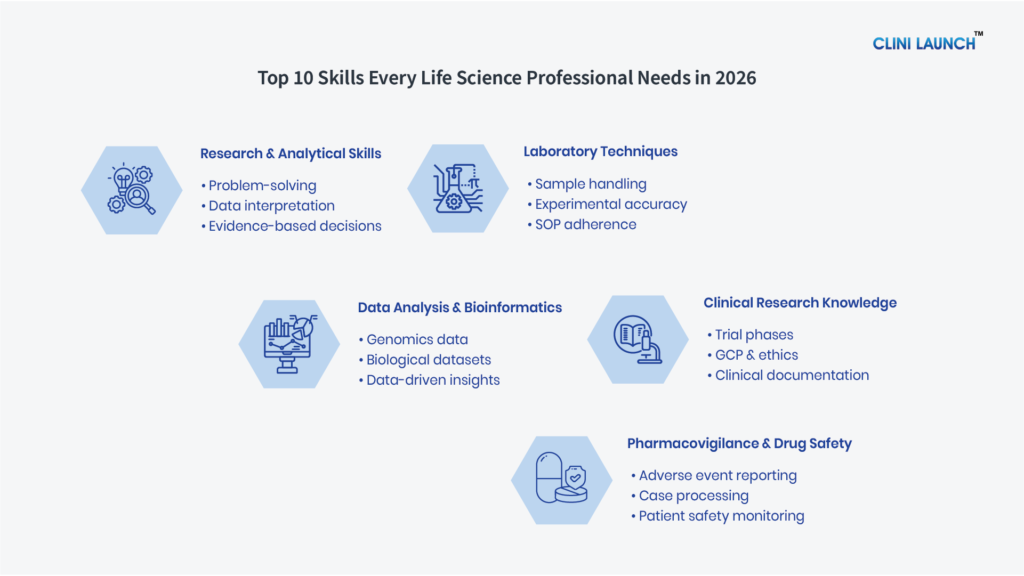
A) Core Technical and Clinical Skills Required in the Life Science Industry
These skills form the foundation for most life science careers and are commonly expected across research, biotechnology, and pharmaceutical organizations. These skills are essential across roles in life science, healthcare, research organizations, and even lifescience consulting environments.
- Research & Analytical Skills
Research and analytical skills are fundamental in the life science industry, where professionals are required to understand problems, analyze data, and draw accurate conclusions across research, clinical, and data-driven roles. According to the World Economic Forum’s Future of Jobs Report, analytical thinking is ranked as the number one core skill employers look for globally, highlighting its importance in modern, research-intensive industries like life sciences.
Employers therefore expect candidates to move beyond theory and demonstrate strong data interpretation, logical reasoning, scientific data analysis, research methodology understanding, and evidence-based decision-making. Professionals typically develop these capabilities through hands-on data work, research analysis, real-world project exposure, and analytical thinking skill development across practical scenarios. Hands-on exposure significantly improves readiness for life science roles by helping learners interpret scientific findings, evaluate research outcomes, and solve industry-relevant problems more effectively. These capabilities are also highly valued in life science consulting, where scientific and data-driven insights support strategic and business decisions.
Skill Snapshot: Research & Analytical Skills
| Aspect | Details |
| What it means | Ability to understand scientific problems and analyze data logically |
| Core activities | Data interpretation, result evaluation, critical and logical thinking |
| Used in | Research laboratories, clinical studies, data-driven projects |
| Roles that need it | Research Associate, Clinical Research Professional, Data Analyst |
| Why it matters | Improves accuracy, reduces errors, and supports reliable decision-making |
| Common methods | Reviewing data sets, interpreting study results, validating findings, documenting observations |
- Laboratory Techniques
Laboratory techniques refer to the skills used to perform tests and experiments in life science settings. These include pipetting, centrifuge handling, microscopy, PCR basics, preparing and handling samples, conducting experiments, following procedures, and recording results correctly. Accurate laboratory work plays a crucial role in science and health outcomes, and about 70% of medical decisions depend on laboratory test results, underscoring how critical lab accuracy is to research and diagnostics. Laboratory experience builds a strong foundation for understanding how scientific evidence is generated and validated. Laboratory expertise forms the foundation of many roles within life science healthcare and research-driven organizations.
Skill Snapshot: Laboratory Technique Skills
| Aspect | Details |
| What it means | Ability to perform laboratory procedures accurately and safely |
| Core activities | Sample preparation, conducting experiments, recording results |
| Used in | Research labs, biotechnology labs, clinical research settings |
| Roles that need it | Lab Technician, Research Associate, Clinical Research Professional |
| Why it matters | Ensures reliable results, maintains data quality, reduces errors |
| Common methods | Sample handling, following SOPs, equipment operation, maintaining lab records |
Data Analysis & Bioinformatics
Data analysis and bioinformatics are becoming essential in the life science industry as research and clinical work increasingly rely on large volumes of biological data. These skills involve biological data analysis, genomics analysis, NGS analysis, and the interpretation of experimental and clinical datasets to identify patterns, interpret results, and support scientific conclusions. As life science research shifts toward data-driven approaches, the ability to work with biological data and bioinformatics tools is no longer optional.
The growing importance of bioinformatics is reflected in increasing industry investment in life science analytics. The global life science analytics market is projected to grow from USD 11.02 billion in 2024 to USD 24.85 billion by 2034, indicating a strong and sustained increase in the use of data analytics and bioinformatics across healthcare and life sciences.
Employers increasingly look for professionals who can work with bioinformatics tools such as BLAST, FASTQC, and Galaxy, along with programming languages like Python and R for biological data analysis and interpretation. These skills are widely used in genomics, clinical research, precision medicine, and drug discovery workflows. Bioinformatics is also becoming one of the fastest-growing life science career paths globally, driven by the expanding demand for data-driven healthcare and genomics research professionals.
Skill Snapshot: Data Analysis & Bioinformatics
| Aspect | Details |
| What it means | Ability to analyze biological data and extract meaningful insights |
| Core activities | Data interpretation, pattern identification, result analysis |
| Used in | Genomics research, clinical studies, data-driven life science projects |
| Roles that need it | Bioinformatics Analyst, Clinical Data Analyst, Research Associate |
| Why it matters | Supports data-driven decisions and improves research accuracy |
| Common methods | Working with datasets, interpreting biological results, validating data findings |
Bioinformatics
Develop in-depth skills to analyze, manage, and interpret large-scale biological data used in genomics, clinical research, and drug discovery. This program focuses on applying computational methods and analytical pipelines to transform complex biological data into actionable research insights.

4. Clinical Research Knowledge
Clinical research knowledge is essential for life science professionals involved in drug development and medical research. It includes understanding the clinical research process, clinical trial management, trial phases, study protocols, and GCP guidelines used to ensure ethical and regulated research practices. These skills help professionals understand how treatments move from laboratory research to human clinical trials.
The global clinical trials market was valued at USD 87.42 billion in 2025 and is projected to reach USD 149.58 billion by 2034, reflecting the growing demand for professionals with clinical research expertise. Knowledge of clinical trial operations and documentation helps learners become job-ready for roles in pharmaceutical companies, CROs, and research organizations, making clinical research a strong career path in the life science industry.
Skill Snapshot: Clinical Research Knowledge
| Aspect | Details |
| What it means | Understanding how clinical trials are planned, conducted, and monitored |
| Core activities | Trial coordination, protocol review, clinical documentation |
| Used in | Clinical trials, pharma companies, CROs, research organizations |
| Roles that need it | Clinical Research Coordinator, Clinical Research Associate, Trial Support Roles |
| Why it matters | Ensures ethical conduct, regulatory compliance, and reliable trial data |
| Common methods | Reviewing protocols, maintaining trial documents, monitoring study activities |
5. Pharmacovigilance & Drug Safety
Pharmacovigilance and drug safety focus on monitoring the safety of medicines after they are approved and used by patients. This includes identifying, assessing, and reporting adverse drug reactions (ADR) to ensure medicines remain safe and effective throughout their lifecycle.
Professionals in this field work on drug safety reporting, case processing, safety documentation, and regulatory compliance activities. Employers increasingly look for candidates who understand adverse event reporting workflows, safety databases, and global reporting timelines. These skills are commonly developed through structured training and hands-on exposure to pharmacovigilance processes, helping learners become job-ready for roles in pharma companies, CROs, and drug safety teams within the life science healthcare industry.
Skill Snapshot: Pharmacovigilance & Drug Safety
| Aspect | Details |
| What it means | Monitoring and reporting the safety of medicines |
| Core activities | Adverse event reporting, case processing, safety documentation |
| Used in | Pharma companies, CROs, drug safety departments |
| Roles that need it | Drug Safety Associate, Pharmacovigilance Executive, Safety Analyst |
| Why it matters | Protects patient safety and ensures regulatory compliance |
| Common methods | Case review, safety reporting, signal detection support |
B) Advanced Digital Skills for Modern Life Science Careers
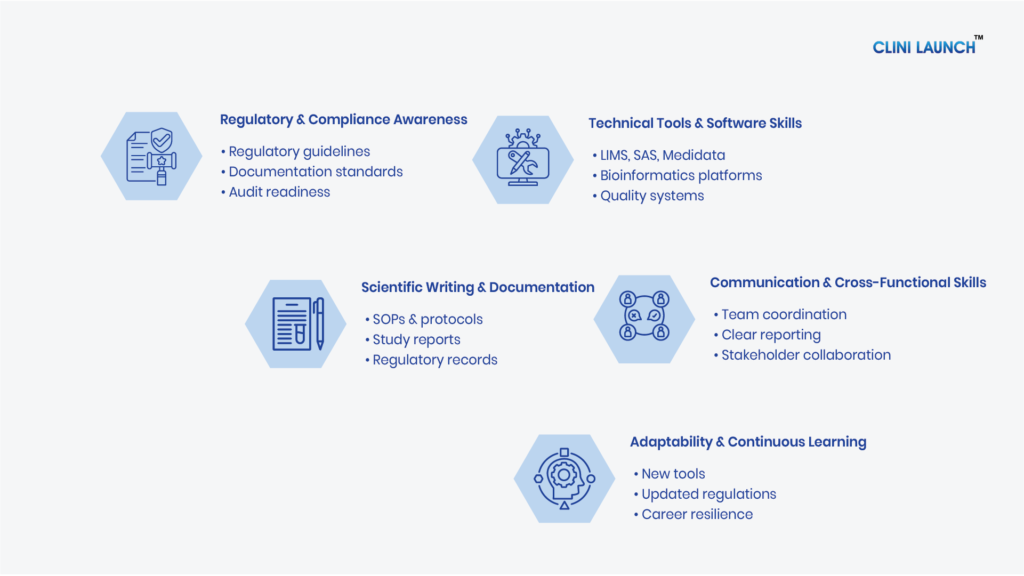
The life science industry is becoming increasingly digital, especially within the evolving healthcare and life sciences industry with research, clinical trials, regulatory documentation, and safety monitoring now supported by specialized software systems. From laboratory systems to clinical trial management platforms, professionals are expected to work with specialized software and data systems that support research, compliance, and regulatory reporting.
6. Regulatory & Compliance Awareness
Regulatory and compliance awareness is critical in the life science industry, where activities are governed by strict global standards and guidelines. This skill involves understanding regulatory requirements, maintaining documentation, ensuring SOP compliance, supporting audit readiness, and working within quality systems to maintain product quality and patient safety.
Employers increasingly expect professionals to be familiar with regulatory bodies and frameworks such as the FDA, EMA, CDSCO, and ICH Guidelines. Regulatory and compliance awareness is commonly developed through exposure to SOPs, regulatory documents, audits, and inspection processes. These skills help professionals become job-ready for roles across pharmaceutical, biotechnology, clinical research, and life science consulting organizations.
Skill Snapshot: Regulatory & Compliance Awareness
| Aspect | Details |
| What it means | Understanding and following regulatory rules and compliance standards |
| Core activities | Documentation management, SOP adherence, audit preparation |
| Used in | Pharma companies, biotech firms, CROs, quality departments |
| Roles that need it | Regulatory Affairs Associate, Quality Executive, Compliance Officer |
| Why it matters | Ensures legal compliance, product quality, and patient safety |
| Common methods | Reviewing guidelines, maintaining records, supporting audits |
7. Technical Tools & Software Skills
Technical tools and software skills are increasingly important in the life science industry, as most research, clinical, and regulatory work is now supported by digital systems. Employers increasingly expect freshers to have exposure to industry software systems before hiring, as organizations rely heavily on digital platforms for data management, analysis, documentation, and study tracking.
Common industry software exposure includes:
- Clinical Research Tools: Medidata Rave, Oracle Clinical
- Bioinformatics Tools: BLAST, Galaxy
- Analytics Tools: SAS, R, Python
These technical skills are commonly developed through hands-on practice, guided training, and project-based learning using sample datasets and real-world workflows. Familiarity with industry tools helps professionals become job-ready and build a competitive life science career across research, clinical, bioinformatics, and healthcare domains.
Skill Snapshot: Technical Tools & Software Skills
| Aspect | Details |
| What it means | Ability to use industry software and digital tools for life science work |
| Core activities | Data analysis, documentation, reporting, system-based workflows |
| Used in | Laboratories, clinical research, bioinformatics, quality and regulatory functions |
| Roles that need it | Research Associate, Clinical Data Associate, Bioinformatics Analyst, Quality Executive |
| Why it matters | Improves efficiency, reduces manual errors, ensures compliance and accuracy |
| Common tool categories | Lab systems, data analysis tools, clinical systems, safety and quality platforms |
| Examples of software | LIMS (Laboratory Information Management Systems), ELN (Electronic Lab Notebooks), GraphPad Prism, BLAST, Galaxy, SAS, R, Python, Medidata Rave, Oracle Clinical, REDCap, Argus Safety, Veeva Vault, Track Wise, CTMS (Clinical Trial Management Systems) |
8. Scientific Writing & Documentation
Scientific writing and documentation are important in the life science industry. Professionals work on research documentation, SOP writing, clinical documentation, research reports, and regulatory records. Proper documentation supports transparency, audit readiness, data integrity, and regulatory compliance across research and clinical environments.
Employers look for professionals who can maintain accurate records, prepare structured reports, and follow standardized documentation practices in pharmaceutical, biotechnology, and clinical research organizations.
Skill Snapshot: Scientific Writing & Documentation
| Aspect | Details |
| What it means | Ability to record scientific observations and prepare structured technical documentation |
| Core activities | Writing reports, maintaining lab records, documenting study results |
| Used in | Research laboratories, clinical trials, regulatory departments |
| Roles that need it | Research Associate, Clinical Research Associate, Regulatory Affairs Associate |
| Why it matters | Ensures data integrity, regulatory compliance, and research transparency |
| Common methods | Writing research summaries, maintaining laboratory notebooks, preparing study documentation |
9. Communication & Cross-Functional Skills
Communication and cross-functional skills are essential in the life science industry, where professionals regularly collaborate with clinical teams, data teams, regulatory teams, and QA teams. This skill involves clearly communicating scientific information, updates, and issues to ensure smooth coordination across research and operational functions.
Employers value professionals who can collaborate effectively, align timelines, and avoid communication gaps that may impact research progress or compliance. Cross-functional collaboration is now considered a critical professional skill in the healthcare and life sciences industry.
These skills are commonly developed through team-based projects, presentations, documentation reviews, and interaction with multiple departments, helping professionals work effectively in real-world life science environments.
Skill Snapshot: Communication & Cross-Functional Skills
| Aspect | Details |
| What it means | Ability to communicate clearly and work effectively across teams |
| Core activities | Information sharing, coordination, reporting, collaboration |
| Used in | Research, clinical operations, quality, regulatory, data teams |
| Roles that need it | Clinical Research Associate, Project Coordinator, Research Associate |
| Why it matters | Reduces errors, improves teamwork, supports smooth project execution |
| Common methods | Team meetings, clear reporting, presentations, cross-team coordination |
10. Adaptability & Continuous Learning
Adaptability and continuous learning are critical in the life science industry because technologies, regulations, and workflows evolve rapidly. Emerging trends such as AI in drug discovery, digital health, precision medicine, and automation are continuously reshaping research and healthcare operations. Professionals who adapt quickly and keep learning are better equipped to stay relevant in changing industry environments.
Employers value adaptability because it helps teams respond effectively to new tools, updated regulations, and evolving scientific methods. Continuous learning helps professionals remain employable in rapidly evolving healthcare and life science sectors.
These skills are commonly developed through training programs, workshops, industry updates, and hands-on projects that help professionals build long-term career resilience and growth in the life science industry.
Skill Snapshot: Adaptability & Continuous Learning
| Aspect | Details |
| What it means | Ability to adapt to change and continuously upgrade skills |
| Core activities | Learning new tools, updating knowledge, adjusting to new workflows |
| Used in | All life science domains and job roles |
| Roles that need it | All life science professionals, across levels |
| Why it matters | Ensures long-term career growth and relevance |
| Common methods | Continuous training, self-learning, hands-on practice |
As the industry continues to evolve, professionals must strengthen their capabilities through continuous learning and skill development.
Upskilling for Life Science Careers
As the life science industry evolves, professionals must continuously update their skills to stay competitive. Certification programs, industry training, online healthcare courses, and bioinformatics certification help individuals stay aligned with new technologies, regulations, and scientific advancements while improving long-term career growth.
Clinical Research
Build industry-ready skills to work across real clinical trial environments. Learn how clinical studies are designed, conducted, documented, and monitored, with a strong focus on ethics, patient safety, and global regulatory compliance.
Reskilling and Career Transitions in Life Sciences
Reskilling helps professionals transition into new domains within the life science industry, including clinical research, bioinformatics, pharmacovigilance, and regulatory affairs. Popular pathways include career switch to clinical research opportunities, non-IT healthcare careers, and life science jobs for freshers.
These transitions are supported through structured training, tool exposure, and hands-on projects that help bridge the gap between academic knowledge and industry requirements.
Common Career Transition Paths in Life Sciences
Some common transition pathways include:
• Life science graduate → Clinical Research Associate
• Lab technician → Clinical Data Associate
• Biotechnology graduate → Bioinformatics Analyst
• Pharmacy graduate → Pharmacovigilance Associate
• Research assistant → Regulatory Affairs Specialist
Emerging AI and Data-Driven Roles in Life Sciences
Artificial intelligence and data science are transforming the life science industry. Technologies such as AI in healthcare, machine learning in genomics, AI drug discovery, and healthcare analytics are increasingly used in drug discovery, genomics analysis, clinical trial optimization, and pharmacovigilance signal detection. AI-driven healthcare roles are expected to become one of the fastest-growing segments within the life science industry.
Emerging roles include:
• AI Research Scientist in Drug Discovery
• Clinical Data Scientist
• Bioinformatics AI Specialist
• Healthcare Data Analyst
• Machine Learning Specialist in Genomics
Life Science Career Opportunities in India-
India is a major hub for biotechnology, pharmaceuticals, and clinical research, supported by the growth of Hyderabad pharma companies, the Bengaluru biotech ecosystem, the Pune CRO industry, and Chennai healthcare analytics sectors.
The expanding global clinical research market is also increasing demand for skilled professionals in clinical research, pharmacovigilance, regulatory affairs, and bioinformatics, creating opportunities for international healthcare jobs and pharma jobs abroad.
Global Demand for Life Science Professionals-
Globally, the life science industry is expanding due to increased drug development, aging populations, and rapid advancements in biotechnology. Countries such as the United States, Germany, Switzerland, and Singapore continue to invest heavily in research, clinical trials, and pharmaceutical manufacturing. This growth is creating diverse opportunities across research, operations, and lifescience consulting globally.
Middle East: A Rising Hub for Pharmaceutical Manufacturing and Clinical Trials-
The Middle East is emerging as an important region for life science growth. Countries such as the UAE and Saudi Arabia are investing heavily in pharmaceutical manufacturing, biotechnology research, and clinical trial infrastructure.
Dubai and Abu Dhabi are attracting international pharmaceutical companies and research organizations, creating opportunities for skilled professionals in clinical operations, regulatory affairs, and healthcare data management.
Conclusion
The life science industry offers strong career opportunities within the rapidly expanding healthcare and life sciences industry, but success today depends on more than just academic qualifications. Employers increasingly look for professionals who understand real-world workflows, can work with industry tools, follow regulatory processes, and adapt to evolving technologies. This shift makes skill-based readiness essential for building a sustainable career in life sciences.
These skills highlight what employers value across research, clinical development, data analysis, pharmacovigilance, and regulatory functions. Developing these skills helps bridge the gap between education and employment, enabling professionals to contribute effectively from the start. With the right skillset and a mindset of continuous learning, life science professionals can build sustainable careers in an increasingly competitive and innovative-driven industry.
For those looking to build a strong career in clinical research, developing practical, industry-aligned skills is essential. CliniLaunch Research Institute focuses on hands-on learning, real-world workflows, and expert guidance, helping life science graduates become job-ready and transition confidently into clinical research roles. Building the right skills not only strengthens your position in life science healthcare roles but also opens pathways into emerging domains like lifescience consulting and advanced research.