Alternative careers for doctors include clinical research, pharmacovigilance, medical writing, healthcare consulting, digital health, and healthcare management. These non-clinical roles help doctors use medical expertise beyond hospitals while improving work-life balance and career growth.
For a long time, becoming a doctor meant one clear path. Today, many professionals are actively exploring alternative careers for doctors due to changing expectations and challenges in clinical practice. For many, what once felt like a calling now feels like a daily struggle to keep up. Today, many doctors feel that the reality of medical practice is much harder than they expected. Long working hours, constant pressure, heavy documentation, and limited personal time have become common. The global healthcare industry is also expanding rapidly. According to the World Health Organization (WHO), the world will face a shortage of nearly 10 million healthcare workers by 2030, increasing demand for medical expertise across research, digital health, and healthcare management sectors.
These pressures are influencing how doctors think about long-term careers, leading many to consider nonclinical career options for doctors that offer better balance. According to the American Medical Association, nearly 45% of physicians reported symptoms of burnout in 2023. As a result, many doctors are exploring ways to continue contributing to healthcare while maintaining better professional balance.
At the same time, the healthcare ecosystem itself is evolving. Medicine today extends far beyond hospital walls. Pharmaceutical companies, health technology firms, research organizations, and healthcare management systems increasingly require medical expertise. This shift is creating new nonclinical jobs for doctors where medical expertise is still highly valuable. These evolving opportunities are often referred to as doctor for alternative careers, where professionals move beyond traditional patient care roles.
Why Doctors Are Choosing Non-Clinical Careers in 2026
Many doctors move toward non-clinical careers due to burnout, long working hours, administrative pressure, and the growing demand for medical expertise in healthcare industries.
Burnout and workload- Long hours, night duties, and administrative responsibilities often lead to exhaustion.
Work–life balance concerns- Many physicians struggle to maintain personal time alongside demanding clinical schedules.
Administrative burden- Documentation, insurance processes, and regulatory requirements consume a large portion of clinical time.
Changing healthcare landscape- Healthcare now includes research, biotechnology, digital health, and policy development—areas where medical expertise is still highly valuable.
As a result, many doctors are exploring alternative careers for doctors, including both nonclinical jobs for doctors and broader non-medical careers for doctors.
Where doctors can work beyond Clinical Practice
An alternative career for doctors does not mean leaving medicine completely. It includes non-clinical career paths where medical expertise is applied in research, evaluation, planning, documentation, advisory, and decision-making roles. While doctors may not treat patients daily in these roles, their clinical knowledge remains essential for problem-solving, ethical judgment, and risk assessment.
Doctors today are increasingly working across pharmaceutical companies, CROs, biotech firms, digital healthcare companies, healthcare startups, medical affairs, healthcare analytics organizations, and public health systems. This reflects the growing integration of medicine with research, technology, and healthcare innovation, creating diverse non-clinical career opportunities for doctors.
Top Alternative Career Opportunities for Doctors
The global healthcare industry is undergoing rapid transformation. According to McKinsey, the digital health market is expected to exceed $650 billion by 2030, while the global clinical trials market continues expanding due to growing pharmaceutical research investments. Below are some of the most in-demand non-clinical jobs for doctors and structured doctor alternative careers available today.
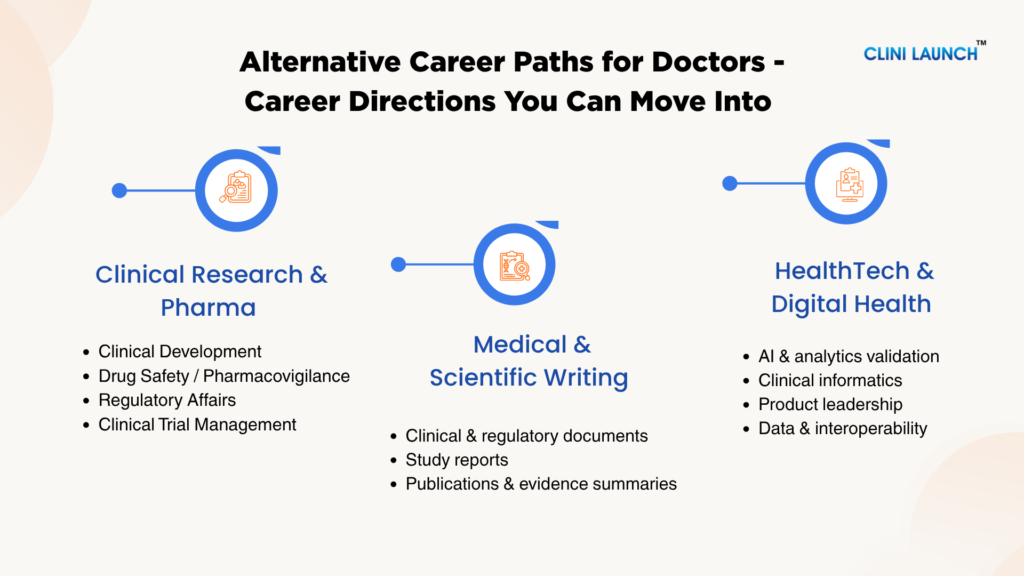
- Pharma Industry Careers
Why Pharma Careers Are Popular Among Doctors
“This pathway is one of the most preferred non-clinical career options for doctors, allowing them to move from direct patient care into medicine development, safety strategy, evidence generation, and scientific leadership within pharmaceutical, biotechnology, and CRO environments. Doctors contribute medical judgment across drug development, clinical trials, regulatory interactions, and lifecycle management. These roles are among the highest paying non-clinical jobs for doctors globally.
- Why do doctors prefer these roles?
It offers predictable schedules, global exposure, involvement in innovation, and opportunities to influence therapies on a scale. Instead of treating individual patients, physicians in pharmaceutical roles may influence treatment strategies that affect millions of patients worldwide.
- Role Description and New Skills Doctors Should Develop – Pharma Industry
Pharmaceutical careers allow doctors to contribute to drug development, clinical trials, regulatory strategy, and medical safety. These roles offer structured career growth and global industry exposure.
Clinical Research & Medical Career Roles
Principal Investigator (PI)
Leads trial, ensures safety & compliance.
- GCP understanding
- Leadership
- Documentation
Co-Investigator (Sub-Investigator)
Supports PI, performs trial tasks.
- Protocol compliance
- Patient management
- Teamwork
Medical Advisor
Guides therapy strategy & evidence.
- Scientific communication
- Evidence evaluation
- Collaboration
Drug Developer / Clinical Development Physician
Designs & evaluates studies.
- Study design
- Risk analysis
- Endpoint evaluation
Regulatory Affairs Manager (Medical)
Ensures compliance in submissions.
- Regulatory writing
- Detail orientation
- Compliance awareness
Physician Technical Writer / Medical Writer
Prepares clinical & regulatory docs.
- Structured writing
- Data interpretation
- Literature review
Clinical Research Associate (CRA)
Monitors sites & ensures compliance.
- Monitoring knowledge
- Communication
- Audit awareness
Clinical Research Coordinator (CRC)
Manages site operations & docs.
- Coordination skills
- Documentation discipline
- Time management
Clinical Research Manager (CRM)
Leads study operations & teams.
- Team management
- Planning
- Quality oversight
Project Manager (Clinical Trials)
Oversees trial programs.
- Project planning
- Risk management
- Stakeholder communication
Clinical Research Fellow
Gains trial experience.
- Research methodology
- Protocol review
- Analytical thinking
Senior Clinical Research Fellow
Leads & mentors fellows.
- Leadership
- Advanced interpretation
- Mentoring
- Medical Writing and Scientific Communication Careers
Medical writing is one of the fastest-growing non-medical careers for doctors, combining clinical expertise with scientific communication, regulatory writing, publication writing, and medical content development. It is a strong non-clinical career option that allows physicians to transition from patient care into scientific documentation, evidence interpretation, and medical communication across pharmaceutical companies, CROs, biotech firms, healthcare organizations, and research institutions.
Doctors in these roles contribute to regulatory submissions, research publications, clinical documents, and medical education content while ensuring accuracy, compliance, and clarity. With strong career growth, flexibility, and opportunities across the healthcare and life sciences industry, medical writing has become one of the most preferred doctor alternative careers.
- Scope & why many doctors prefer it
Medical writing offers intellectual engagement with science while providing structured work patterns, global collaboration, and the ability to shape how scientific evidence is communicated. Rather than treating individual patients, physicians contribute to materials that guide regulators, clinicians, and healthcare systems worldwide.
- Role Description and New Skills Doctors Should Develop – Medical Writing Careers
Medical Writing & Scientific Communication Careers
Medical & Scientific Reviewer
Validates scientific content for clinical accuracy and compliance.
- Clinical knowledge
- Regulatory understanding
- Evidence interpretation
Clinical Medical Writer
Develops protocols, study reports, and trial documents.
- Protocol writing
- Data interpretation
- Structured documentation
Regulatory Medical Writer
Prepares documents for regulatory submissions and responses.
- Regulatory submissions
- Global guidelines awareness
- Technical writing
Scientific & Medical Communications Writer
Creates educational and promotional materials for HCPs.
- Medical communication
- Storytelling with data
- Content planning
Senior Scientific Writer – HEVA
Leads development of value dossiers and evidence packages.
- HEVA knowledge
- Health economics
- Leadership
Associate Expert Scientific Writer – HEVA
Supports health economic narratives and comparative effectiveness documentation.
- Health economics
- Literature review
- Scientific writing
Team Lead – Scientific Writing
Manages writing teams, ensures quality, timelines, and strategy.
- Team leadership
- Project management
- Quality control
3. HealthTech and Digital Health Careers
Digital health roles are emerging alternative careers for doctors driven by AI in healthcare, healthcare automation, telehealth, remote patient monitoring, predictive analytics, and healthcare interoperability. These roles allow physicians to apply clinical expertise in technology-driven healthcare environments.
Doctors work with product and analytics teams on telemedicine platforms, AI-assisted diagnostics, healthcare cloud systems, clinical decision tools, and remote monitoring technologies using HL7 and FHIR standards. These non-clinical career options are growing rapidly across digital health companies and healthcare startups.
According to Deloitte, AI in healthcare could generate over $150 billion in annual savings globally by 2026, increasing demand for doctors with healthcare technology expertise.
- Scope & why many doctors prefer it
Health technology companies influence care delivery on a massive scale. Physicians in these roles shape how diagnostics are supported, how data guides decisions, and how healthcare becomes more efficient. The pathway often offers faster innovation cycles, cross-disciplinary exposure, and leadership opportunities in rapidly expanding global markets.
- Role Description and New Skills Doctors Should Develop – Health tech and Digital Health Careers
Digital Health & Healthcare Technology Careers
Health Data Scientist / AI Engineer
Designs and validates AI models using clinical data.
- AI/ML fundamentals
- Clinical data analysis
- Python/R
- Model validation
- Interpretation of outputs
Clinical Informatics Specialist
Optimizes how medical information is structured and used.
- Data structuring
- EHR/EMR systems
- Workflow optimization
- Clinical documentation
Healthcare Product Manager
Guides development of digital health solutions ensuring safety and value.
- Product lifecycle knowledge
- Clinical requirements gathering
- Communication
- Stakeholder management
Digital Health Platform Engineer
Builds and supports large-scale health tech systems.
- Software integration
- Cloud platforms
- Clinical data pipelines
- Problem-solving
- Testing
Interoperability & HL7/FHIR Architect
Designs frameworks for secure health data exchange between systems.
- HL7/FHIR standards
- APIs
- Interoperability design
- Data security
- Clinical workflow understanding
Cybersecurity Specialist (Healthcare)
Protects clinical data with security controls and compliance safeguards.
- Healthcare cybersecurity
- Risk assessment
- Regulatory frameworks
- Ethical hacking
- Compliance monitoring
Telemedicine Platform Developer
Develops technologies for remote consultations and digital care.
- Telehealth systems
- Software development
- User experience
- Data privacy
- EHR integration
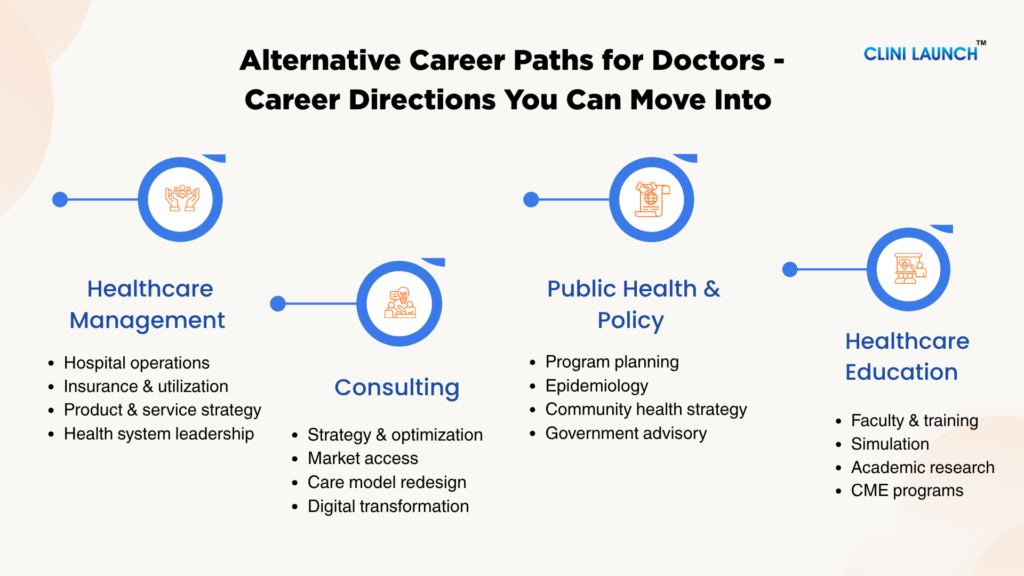
4. Healthcare Management and Administration Careers
This pathway allows physicians to transition from direct clinical practice into leadership, operations, and system-level decision-making within hospitals, healthcare networks, insurance organizations, and corporate health systems. Doctors contribute medical insights to improve service delivery, resource utilization, quality metrics, and patient experience across institutions. These leadership roles are well-established non-medical careers for doctors within hospital and corporate systems.
- Scope & why many doctors prefer it
Healthcare organizations increasingly require leaders who understand both medicine and management. These careers offer opportunities to influence how care is organized, financed, and delivered at scale. Physicians in administration often gain broader authority, structured growth pathways, and the ability to shape institutional strategy beyond individual patient interactions.
- Role Description and New Skills Doctors Should Develop – HealthCare Management and Administration Careers
Healthcare Management Career Roles
Hospital Administrator / Healthcare Manager
Leads hospital operations, services, and quality initiatives.
- Leadership
- Hospital operations
- Resource management
- Budgeting
- Quality control
Health Information Manager
Oversees governance, privacy, and strategic use of health data.
- Data governance
- EMR/EHR knowledge
- Compliance
- Analytical skills
Pharmaceutical Product Manager
Manages lifecycle, market strategy, and medical alignment of pharma products.
- Product strategy
- Market analysis
- Medical knowledge
- Stakeholder management
Medical Practice Manager
Manages operations, finances, and staffing within clinical practices.
- Practice operations
- Team management
- Finance basics
- Workflow optimization
Healthcare Consultant
Advises clinical efficiency, regulatory readiness, and growth strategy.
- Consulting skills
- Process improvement
- Regulatory knowledge
- Project planning
Public Health Policy Analyst
Guides policy using healthcare data and evidence.
- Policy analysis
- Epidemiology understanding
- Data interpretation
- Report writing
Health Insurance Manager
Leads clinical evaluation of claims and payer-provider coordination.
- Insurance knowledge
- Claims assessment
- Stakeholder management
- Analytics
Clinical Research Manager
Directs operational and financial execution of clinical programs.
- Trial management
- Team leadership
- Budgeting
- Compliance
- Reporting
Operations Manager – Health Startups / HealthTech
Builds scalable models, integrates clinical operations into products.
- Operations management
- Process optimization
- Team leadership
- Startup agility
5. Healthcare Consulting Careers
This pathway enables physicians to apply clinical expertise in healthcare business strategy, operational consulting, and healthcare digital transformation. Doctors support healthcare organizations, pharmaceutical companies, payers, and governments in improving operations, innovation, market access, product positioning, and healthcare outcomes.
- Scope & why many doctors prefer it
Healthcare Consulting offers exposure to diverse projects, rapid learning environments, and influence across multiple institutions rather than a single workplace. Physicians are drawn to this path because it provides strategic visibility, accelerated career progression, global mobility, and the opportunity to shape healthcare systems at scale.
- Role Description and New Skills Doctors Should Develop – Consulting Careers
Healthcare Consulting Career Roles
Medical Consultant
Provides clinical expertise to hospitals, pharma, government, and insurance.
- Clinical knowledge
- Strategic thinking
- Data interpretation
- Stakeholder communication
- Healthcare analytics
Healthcare Management Consultant
Improves operational efficiency and resource management in healthcare organizations.
- Operations analysis
- Process improvement
- Data interpretation
- Communication skills
Healthcare Strategy Consultant
Advises market access, growth planning, and portfolio expansion.
- Strategic planning
- Healthcare economics
- Business analysis
- Presentation skills
Senior Consultant – Healthcare
Leads complex projects and mentors across healthcare institutions.
- Project management
- Leadership
- Client management
- Cross-functional collaboration
Healthcare IT Consultant
Bridges clinical needs with digital solutions, advising on systems and integration.
- Health IT knowledge
- Interoperability standards
- Clinical workflow
- Technical communication
Talent Acquisition Consultant – Healthcare
Aligns workforce planning with recruitment and staffing strategy.
- HR consulting
- Talent mapping
- Healthcare staffing knowledge
- Communication
Nursing Consultant
Advises on nursing workflows, staffing, and patient care delivery.
- Nursing operations knowledge
- Workflow redesign
- Analytical skills
- Communication
6. Public Health and Healthcare Policy Careers
This pathway allows physicians to contribute to population health planning, prevention strategies, and public health surveillance. Doctors work with organizations such as the World Health Organization, Centers for Disease Control and Prevention, National Health Mission, NGOs, and research institutions to improve community health outcomes through large-scale healthcare programs.
- Scope & why many doctors prefer it
Public health physicians get opportunities to influence healthcare access, disease control, health equity, and national or global priorities. Physicians are attracted to this path because it offers meaningful societal impact, involvement in large-scale initiatives, and the ability to guide how resources are allocated across populations.
- Role Description and New Skills Doctors Should Develop – Public Health & Policy
Public Health Career Roles
Healthcare Manager
Leads planning, delivery, and evaluation of community or population health programs.
- Program management
- Resource planning
- Leadership
- Population health analysis
- Stakeholder coordination
Biostatistician
Designs and interprets statistical analyses for public health decisions.
- Statistical analysis
- Epidemiology
- Data interpretation
- Clinical research methods
- Reporting
Healthcare Consultant
Advises institutions and governments on improving health systems and services.
- Policy analysis
- Healthcare management
- Operational improvement
- Communication
- Stakeholder engagement
Epidemiologist
Investigates disease patterns and public health risks.
- Community health
- Patient education
- Screening programs
- Preventive care
- Documentation
Occupational Health and Safety Specialist
Develops workplace health frameworks and ensures regulatory compliance.
- Occupational safety
- Risk assessment
- Regulatory compliance
- Emergency planning
- Auditing
Public Health Program Director
Leads national or regional health initiatives.
- Community engagement
- Counseling
- Advocacy
- Social program planning
- Communication
Health Education Specialist
Designs and delivers initiatives promoting prevention and healthy behavior.
- Health education
- Training design
- Public communication
- Preventive strategies
- Content development
7. Healthcare Education and Academic Careers
This Healthcare Professions Education pathway allows physicians to move into teaching, mentoring, online medical education, simulation-based training, and medical curriculum development. Doctors in these roles train healthcare professionals, support clinical education, and contribute to academic research. These are stable non-clinical career options for doctors interested in teaching and mentoring.
- Scope & Why is it preferred?
Education roles offer intellectual engagement, professional stability, and opportunities to shape future generations of clinicians. Many physicians value the academic environment, structured schedules, research collaboration, and the ability to influence practice patterns through learning rather than individual treatment.
- Role Description and New Skills Doctors Should Develop – Healthcare Education
Medical Education & Academic Career Roles
- Teaching & facilitation
- Curriculum planning
- Assessment design
- Academic communication
- Clinical teaching
- Adult learning techniques
- Protocol instruction
- Communication
- Research design
- Data analysis
- Scientific writing
- Ethical compliance
- Leadership
- Program coordination
- Quality assurance
- Strategic planning
- Simulation design
- Debriefing methods
- Safety standards
- Clinical judgment
- Curriculum design
- Needs assessment
- Content delivery
- Evaluation
- Mentoring
- Feedback delivery
- Professional development
- Evaluation
Career Path and Growth in Non-Clinical Medical Careers
Doctors transitioning into non-clinical jobs for doctors often follow structured career paths often follow structured career paths like other industries. While entry roles may differ depending on the domain, growth typically occurs through increased responsibility, specialization, and leadership.
For example:
- Clinical Research
Clinical Research Coordinator → Clinical Research Associate → Clinical Project Manager → Clinical Program Director
- Medical Writing
Medical Writer → Senior Medical Writer → Scientific Lead → Medical Communications Director
- HealthTech
Clinical Informatics Specialist → Product Manager → Director of Digital Health → Chief Medical Information Officer
- Healthcare Management
Hospital Administrator → Operations Director → Healthcare Strategy Leader
With experience, doctors can progress into strategic leadership roles where they influence healthcare innovation, research programs, or health system development.
Future Growth of Non-Clinical Careers for Doctors
Non-clinical career options for doctors offer strong growth potential across multiple sectors. Pharmaceutical companies, biotechnology firms, and CROs continue to expand global drug development programs, increasing demand for clinical research and regulatory professionals.
As healthcare becomes more data-driven and technology-enabled, doctors with interdisciplinary skills will play an increasingly important role in shaping the future of healthcare delivery.
Upskilling and Skill Diversification
Transitioning from clinical practice into non-clinical careers often requires additional skills in research, healthcare analytics, regulatory processes, and digital technologies. Certifications such as GCP certification, clinical research training, healthcare analytics certification, and digital health certification can support successful career transitions for doctors.
Common skills doctors develop during career transitions include:
• Clinical research methodology and Good Clinical Practice (GCP)
• Medical writing and scientific communication
• Healthcare data analysis and interpretation
• Regulatory affairs and compliance
Targeted training programs, industry exposure, and mentorship can help doctors build these skills and transition smoothly into new professional roles.
Emerging Non-Clinical Opportunities for Doctors
- Rapid technological advancements are creating new career opportunities for doctors. AI-powered diagnostics, precision medicine, genomics, digital therapeutics, remote patient monitoring, and wearable healthcare technology are transforming healthcare delivery and personalized treatment strategies.
- Connected healthcare systems and digital health innovation are also creating new non-clinical roles for doctors across healthcare technology and research sectors.
- The global AI in healthcare market is projected to grow at a CAGR of over 37% between 2024 and 2030, according to industry market reports.
These developments indicate that the future of medicine will require doctors who can combine clinical expertise with technology, data analysis, and interdisciplinary collaboration.
Non-Clinical Career Opportunities for Doctors in India
India has become a major hub for pharmaceutical manufacturing, clinical research, and the Indian biotech ecosystem, with 3,000+ pharmaceutical companies, 1,500+ biotech startups, CROs, and growing health-tech firms.
Organizations such as Central Drugs Standard Control Organization (CDSCO), Indian Council of Medical Research (ICMR), and Startup India healthcare initiatives are supporting biotechnology research, digital health, and medical innovation, creating more non-clinical career opportunities for doctors across pharma, biotech, CROs, and healthcare technology companies.
Global Opportunities for Doctors Outside Clinical Practice
Globally, healthcare systems are increasing demand for professionals who combine medical expertise with research, technology, regulatory knowledge, and the global CRO industry.
The U.S. Food and Drug Administration (FDA), European Medicines Agency (EMA), and National Institutes of Health (NIH) play major roles in biotechnology innovation, clinical trials, and pharmaceutical development. Countries such as Germany, Switzerland, the United Kingdom, Singapore, and South Korea have become important global hubs for pharmaceutical research, biotechnology, and biomedical innovation.
Common Mistakes Doctors Make When Moving to Non-Clinical Careers
Transitioning from clinical practice to industry can be challenging if doctors are not familiar with how healthcare companies recruit and evaluate candidates. Understanding common mistakes can help doctors prepare more effectively for non-clinical roles.
1) Exploring widely but not choosing a target
People attend sessions, read articles, and look at multiple options.
But without deciding the exact role and entry path, preparation remains unfocused, and results stay limited.
2. Experience Doesn’t Always Mean Seniority
Clinical seniority is respected, but industry hiring depends on role readiness rather than years of practice. Doctors may need to start at a different level than expected; understanding this early helps set realistic expectations.
3) Learning concepts without workplace exposure
Certifications add value, but employers finally check whether a candidate understands real workflows, tools, and daily responsibilities. Practical familiarity builds confidence in interviews.
4) Not planning the financial side of transition
Some roles may start at a different compensation structure before growth improves. Having a plan for this period reduces pressure and allows for better decision-making.
5) Using a purely clinical CV
Hospital responsibilities are important, but recruiters want to see transferable skills such as coordination, documentation discipline, compliance awareness, and problem solving. Translating experience into industry language makes a big difference.
6) Underestimating communication changes
Corporate and research environments rely heavily on structured updates, documentation clarity, and teamwork across functions. Adapting to this style takes preparation.
7) Applying without industry connections
Speaking with professionals already working in the field helps understand expectations, hiring patterns, and realistic entry strategies. Networking often improves response rates.
A career move becomes smoother when preparation matches how the industry actually hires. With direction, practical exposure, and the right positioning, doctors can transition successfully into many impactful roles.
Conclusion
As healthcare continues to evolve, alternative careers for doctors are becoming more structured, diverse, and accessible through technology, research, and global collaboration; doctors have more career opportunities than ever before. Exploring alternative careers does not mean leaving medicine—it means applying medical expertise in new ways that improve healthcare systems, research innovation, and patient outcomes. Healthcare consulting is one of the most strategic doctor alternative careers, offering high-impact decision-making roles. Whether exploring doctors for alternative careers or specific non-clinical career options for doctors, choosing the right path requires clarity and skill alignment.
CliniLaunch Research Institute offers an Advanced Diploma in Clinical Research designed for doctors who want hands-on experience and practical knowledge. The program covers clinical research processes, pharmacovigilance, medical writing, and regulatory practices, preparing doctors for roles beyond traditional clinical practice. Enrolling in this course provides the guidance, industry exposure, and skills needed to start a successful non-clinical career in healthcare. With the right training, doctors can successfully transition into non-clinical jobs for doctors and build sustainable, future-ready careers.