A genomics analyst is a life-science professional who analyzes DNA and RNA sequencing data to understand how genes function, change, and influence health and disease. They transform raw genetic data into meaningful biological insights using computational tools, statistical analysis, and bioinformatics platforms rather than working primarily in traditional wet laboratories.
Enquire About Bioinformatics TrainingBiostatistics has evolved from a supporting analytical function into a core driver of modern healthcare and drug development. It applies statistical methods to biological and clinical data, enabling accurate study design, data interpretation, and evidence-based decision-making. In 2026, biostatistics industry trends show how the field is driving clinical trial success by directly shaping outcomes, regulatory approvals, and treatment strategies. These biostatistics industry trends clearly highlight how the role is evolving into a critical pillar of modern healthcare innovation and drug development.
Its importance today is driven by the rapid expansion of healthcare data and increasingly complex research models. From real-world evidence (RWE) and decentralized trials to AI-powered drug development, statistical precision is critical at every stage. Regulatory frameworks such as ICH E9(R1) further highlight the need for robust statistical validation, making biostatistics a key pillar in ensuring data credibility and compliance.
Global trends in R&D in 2025 demand continues to rise, with reports from some organizations and clinical trial market analyses indicating strong growth in data-driven healthcare roles. Biostatisticians are now expected to combine statistical expertise with programming and clinical knowledge, reflecting a clear shift in hiring expectations across pharma, CROs, and health-tech sectors. with programming and clinical knowledge, reflecting a clear shift in hiring expectations across pharma, CROs, and health-tech sectors.
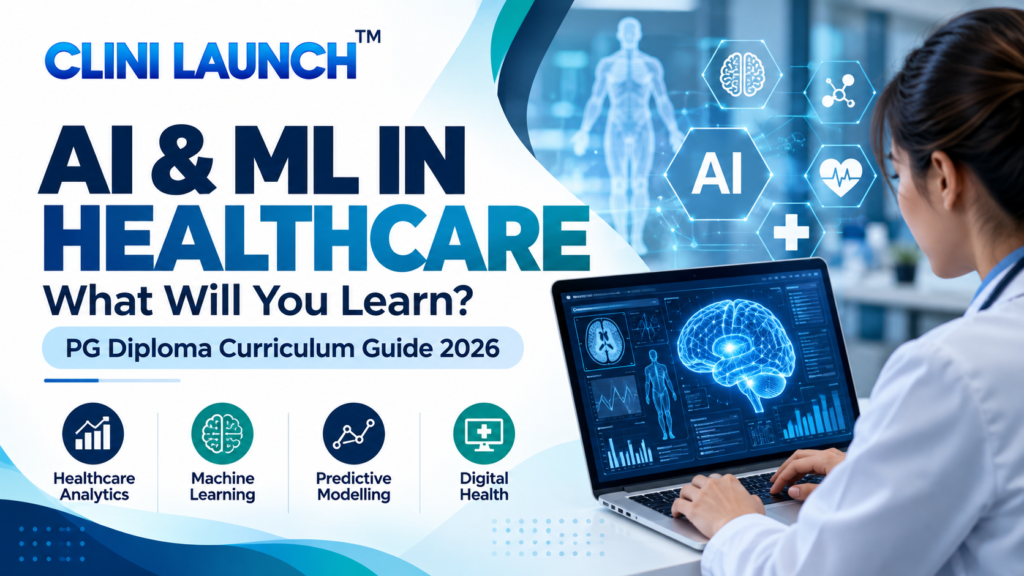
For those looking to build relevant expertise, programs such as the Advanced Diploma in Clinical SAS, Advanced Diploma in Clinical Research, and PG Diploma in AI & ML in Healthcare at CliniLaunch Research Institute focus on practical skills, real-world datasets, and industry-aligned tools preparing professionals for the evolving biostatistics job market.
What is driving the surge in demand for Biostatisticians in 2026?
The demand for biostatisticians is being accelerated by measurable industry shiftsrising data volumes, regulatory intensity, and sustained R&D investment across global healthcare ecosystems.
- The Explosion of Clinical Trial Data and the Need for Rigorous Statistical Oversight
As clinical trial data volumes grow exponentially, the need for robust statistical validation and regulatory-grade analysis is increasing. This shift is directly driving demand for biostatisticians, clinical data analysts, and statistical programmers who can ensure data integrity and compliance.
Global clinical trials exceeded 450,000 registered studies (ClinicalTrials.gov, 2025), with increasing complexity in multi-country and decentralized designs. The global AI-in-clinical-trials market is projected to grow from USD 2.04 billion in 2024 to USD 22.36 billion by 2034, with a CAGR of 27%.
- Precision Medicine and the Personalized Healthcare Revolution
Precision medicine is transforming healthcare by enabling treatments tailored to an individual’s genetic makeup, lifestyle, and environment rather than a one-size-fits-all approach. This shift is accelerating demand for professionals who can integrate clinical knowledge with data analytics and AI to deliver personalized, outcome-driven care.
Valued at USD 87.50 billion in 2023, the global precision medicine market is on track to nearly triple, reaching USD 249.24 billion by 2030 with a robust 16.3% CAGR Biomarker-driven trials and targeted therapies require advanced statistical methods for subgroup analysis, survival modeling, and predictive outcomes.
- The AI and Machine Learning Integration Imperative
AI and machine learning integration is becoming essential for healthcare organizations to move beyond isolated tools and build connected, data-driven systems that improve clinical and operational outcomes. This shift is also driving hiring demand for professionals who can integrate models into real-world workflows while ensuring scalability, compliance, and continuous performance monitoring.
The global artificial intelligence (AI) in healthcare market size is valued at USD 36.96 billion in 2025 and is predicted to increase from USD 51.20 billion in 2026 to approximately USD 613.81 billion by 2034, expanding at a CAGR of 36.83% from 2025 to 2034.
The McKinsey Global Institute (MGI) has estimated that the technology could generate $60 billion to $110 billion a year in economic value for the pharma and medical-product industries, largely because it can boost productivity by accelerating the process of identifying compounds for possible new drugs, speeding their development and approval, and improving the way they are marketed. At the same time, biostatistics automation trends are helping reduce manual work and improve efficiency in data analysis.
- Pharmaceutical and Biotech R&D Investment Surge
Pharmaceutical and biotech R&D investments are rising sharply, driven by the need to accelerate drug discovery, reduce development timelines, and integrate AI-driven research methods. This surge is directly influencing hiring trends, with increased demand for professionals skilled in computational biology, clinical data analysis, and AI-supported drug development workflows. These developments are also aligned with broader biotechnology hiring trends, where demand for data-driven roles is rapidly increasing.
Global pharmaceutical R&D spending has crossed USD 240 billion annually, with biologics and specialty drugs leading growth. This directly increases demand for biostatisticians in trial design, interim analysis, and regulatory submissions.
- The Structural Talent Gap That No One Is Talking About
The real challenge in AI-driven healthcare is not technology adoption, but the shortage of professionals who can bridge clinical knowledge, data science, and regulatory understanding. This structural talent gap is slowing implementation across organizations, making hybrid expertise one of the most valuable and scarce assets in the industry.
Despite rising demand, there is a shortage of job-ready professionals. India Decoding Jobs Report 2026 indicate that over 80% of pharma firms report acute talent shortages in clinical research jobs, regulatory affairs, and advanced life sciences roles.
- Post-Pandemic Public Health Prioritization and Regulatory Scrutiny
Post-pandemic, healthcare systems have significantly increased focus on public health preparedness, surveillance, and rapid response capabilities, supported by data-driven technologies. This shift has also intensified regulatory scrutiny, with stricter compliance, validation, and transparency requirements driving demand for professionals skilled in healthcare regulations, data governance, and AI validation frameworks.
Post-COVID, regulatory frameworks emphasize real-world evidence and statistical transparency. FDA and EMA submissions now increasingly require advanced statistical justification, while global medicine spending is projected to grow by ~38% through 2028 (IQVIA) further strengthening demand for biostatistical expertise. This highlights the growing importance of biostatistics in epidemiology for disease tracking and public health decision-making.
The U.S. Bureau of Labor Statistics projects a 36% growth in employment for statisticians (including biostatistics roles) between 2021 and 2031, making it one of the fastest-growing STEM careers (Source: Research.com / BLS projections).
Major Hiring Trends Shaping the Biostatistics Industry in 2026
The biostatistics talent landscape in 2026 is anything but incremental. Roles that sit at the heart of drug development including biostatistics are becoming increasingly difficult to fill as pharma and biotech organizations pivot from cost-cutting to full-scale execution. Against this backdrop, here are the ten defining hiring trends every professional and recruiter must watch. This shift is also directly influencing pharma and biotech hiring, where statistical roles are becoming essential.
Want to Learn These Skills?
1. Surge in Demand for Clinical Trial Biostatisticians Across Phases I–IV
Clinical trial activity is expanding globally, with over 500,000 registered clinical studies worldwide, significantly increasing the need for biostatisticians across all trial phases. As trial complexity and data volume grow, demand for statistical expertise continues to rise across pharmaceutical companies and CROs.
The global clinical trials market size was estimated at USD 84.54 billion in 2024 and is projected to reach USD 158.41 billion by 2033, growing at a CAGR of 7.5% from 2025 to 2033.
Example: Large-scale trials like RECOVERY (UK COVID-19 trial) require continuous statistical monitoring and interim analysis to validate treatment outcomes in real time.
Clinical trial start volumes have stabilized and have fully returned to pre-pandemic levels and priorities have continued to shift.
2. Adaptive and Bayesian Trial Design Expertise Becoming Core Hiring Criteria
Traditional fixed trial designs are being replaced by adaptive and Bayesian models to reduce cost and accelerate decision-making. Regulatory frameworks emphasize estimates and flexible design strategies.
Example: FDA’s Project Optimus is pushing for adaptive dose optimization in oncology trials.
Adaptive trials can reduce sample sizes by 20–30% (FDA/NIH insights), making statisticians with Bayesian expertise highly valuable.
3. Rapid Expansion of Real-World Evidence (RWE) and Real-World Data (RWD) Roles
Pharma companies are increasingly relying on EHRs, insurance claims, and patient registries to complement clinical trial data. The global RWE market is projected to exceed USD 3–4 billion by 2030.
Example: The FDA’s Real-World Evidence Program actively uses RWD for regulatory decision-making.
This shift is directly increasing hiring demand, as organizations require more biostatisticians and RWE analysts to handle large-scale real-world datasets, regulatory submissions, and post-market evidence generation.
4. Rising Demand for AI & Machine Learning Skills in Biostatistics Industry
Hiring is rapidly shifting toward biostatisticians who can integrate machine learning into traditional statistical workflows, particularly in areas like trial design, patient recruitment, and predictive modeling.
McKinsey estimates that AI could generate $60–$110 billion annually for pharma and medical-product industries by accelerating drug discovery, development, approval, and marketing.
Example: AI-driven platforms are used to identify eligible patients for trials, reducing recruitment timelines by up to 40%.
As a result, organizations increasingly prioritize professionals who can combine statistical inference with machine learning techniques, making hybrid skill sets a key hiring criterion.
5. Emergence of Hybrid Roles: Biostatistician + Data Scientist
The era of siloed job functions is over. AI-enabled R&D and digital trials require clinical data scientists and biostatisticians who can work seamlessly with clinical and real-world data a convergence that is generating a new class of hybrid roles.
Example: Job roles like Clinical Data Scientist and RWE Analyst are now common across CROs and pharma companies.
6. Rising Demand for Regulatory Biostatisticians (FDA, EMA, CDSCO Submissions)
NDA/BLA submissions require airtight statistical packages and regulators are scrutinizing them harder than ever. Rising drug development activity and global trial complexity are intensifying the demand for deeply specialized regulatory professionals, a talent class for which cross-sector mobility is extremely limited.
Example: During COVID-19 vaccine approvals, statistical teams played a central role in accelerated regulatory evaluations.
Regulatory-focused roles are increasing due to stricter compliance and global submission requirements (FDA/EMA guidelines).
7. Growth of Pharmacovigilance and Safety Biostatistics Roles
Post-market surveillance is no longer an afterthought it is a high-stakes analytical function. Pharmacovigilance and safety data management professionals are brought in to manage surges in adverse event reporting, with data volumes spiking as compounds advance through clinical phases
Example: The Vioxx withdrawal case led to stronger global safety monitoring frameworks.
Biostatisticians now contribute to signal detection, benefit-risk analysis, and periodic safety reports (PBRER).
8. Increasing Importance of Statistical Programming (SAS, R, Python + CDISC Standards)
Programming fluency is no longer a supplementary credential it is table stakes. As CDISC standards and regulatory guidance are routinely updated, data standards engineers and statistical programmers keep up with documentation requirements and the intent behind the guidance a role described by IQVIA’s Head of Alliance Management as especially critical as regulators harmonize international standards.
Example: Most global pharma companies require SAS proficiency, while R and Python are increasingly used for advanced analytics.
Demand for automated TLGs (Tables, Listings, Graphs) is rising across clinical data workflows.
9. Growing Hiring Demand in Genomics-Driven Biostatistics Roles
Hiring demand is increasing for biostatisticians with expertise in genomics, proteomics, and omics data analysis, as precision medicine becomes central to modern drug development.
This demand is driven by the growing complexity of biological data, where traditional statistical methods are no longer sufficient to handle large-scale genomic datasets and personalized treatment models.
Biostatisticians are now expected to design trials, analyze multi-dimensional patient data, and support biomarker-driven research for targeted therapies.
Example: Oncology trials increasingly use biomarker-based patient stratification and survival analysis models, making statistical expertise critical for developing and validating precision treatments.
10. CRO-Led Hiring Boom Driving Global Biostatistics Demand
Contract Research Organizations (CROs) have become the largest employers of biostatisticians globally, driving a significant share of hiring across the clinical research ecosystem.
The global CRO services market is projected to reach USD 125.95 billion by 2030, growing from USD 79.10 billion in 2024 at a CAGR of 8.3%, reflecting sustained demand for outsourced statistical expertise.
Example: Companies like IQVIA, Parexel, and ICON manage large-scale global trials that require dedicated biostatistics teams across multiple regions.
India has emerged as a key hub for outsourced biostatistics roles, offering global project exposure and driving large-scale hiring across CRO networks.
Confused About Career in Biostatistics?
Essential Skills Required for Biostatistics Careers in 2026
Biostatistics hiring in 2026 is skill-intensive, with employers prioritizing professionals who can combine statistical depth, programming capability, and regulatory awareness with strong communication and collaboration abilities. The focus has shifted from theoretical knowledge to applied job-ready competencies. Current biostatistics career trends show that employers prefer professionals with both statistical and programming expertise.
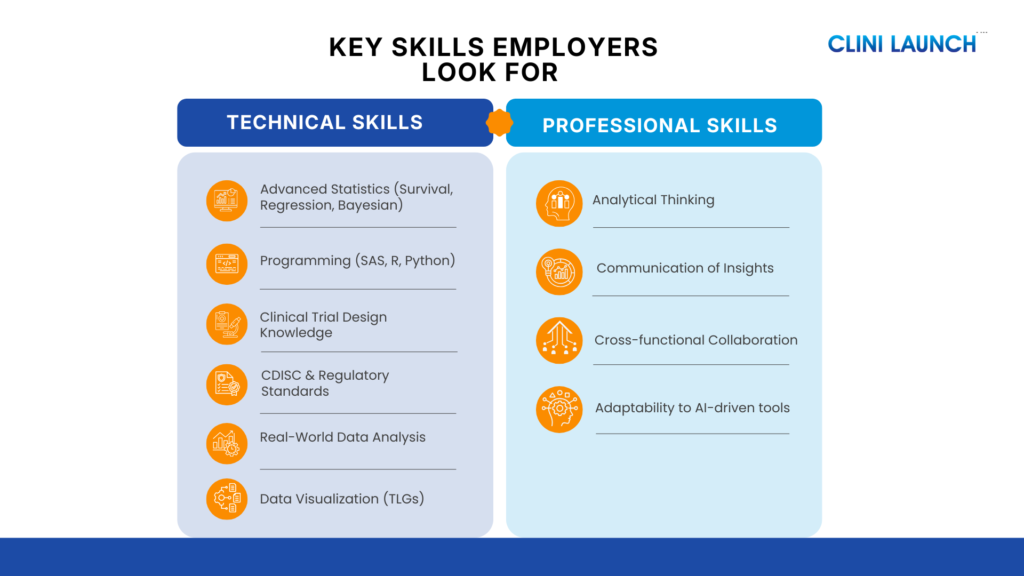
Technical Skills
Proficiency in statistical software like R, SAS, and Python, along with competence in advanced statistical modeling, research design, and data analysis. The proportion of AI-related roles among all job postings increased by 21% between 2018 and mid-2024.
Skills in machine learning and AI are particularly sought after, given the explosion of biological data from electronic health records, genetic sequencing, and wearable devices.
Core Analytical Skills
Analytical thinking to identify patterns from large datasets, critical thinking for study design and data interpretation, mathematical proficiency (calculus, statistics, linear algebra), and creative problem-solving for public health challenges.
Soft Skills
Communication skills to present complex statistical findings clearly to non-technical audiences, along with critical thinking to synthesize information from diverse sources.
Education & Credentials
A bachelor’s degree in biostatistics, statistics, or mathematics is the minimum; most roles prefer a master’s degree, and certifications can strengthen your profile.
With a median salary of $104,350 and 8% job growth projected through 2034, biostatistics offers strong and stable career prospects across healthcare, research, and pharmaceutical industries.
2026 Employer Insight: The 2026 employer signal is clear: Candidates who pair Bayesian/adaptive methods + SAS/R/Python with strong regulatory writing and cross-functional communication are commanding a 15–25% salary premium over single-dimension profiles.
Most In-Demand Biostatistics Job Roles in 2026
Biostatistics roles in 2026 are expanding beyond traditional trial support into data-driven, regulatory, and hybrid analytics functions. Hiring is increasingly focused on professionals who can combine statistical expertise with programming, clinical knowledge, and real-world data application.
There is strong growth in pharma biostatistics careers, especially in clinical trials, regulatory submissions, and safety analytics.
| Role | Core Function | Must-Have Skills | US Salary Range | India Range (LPA) |
|---|---|---|---|---|
| Biostatistician | Trial design, SAP authoring, regulatory analysis | SAS, R, survival analysis, CDISC | $83K – $133K | ₹4L – ₹18L |
| Senior Biostatistician | Lead SAP development, CRO/sponsor liaison, team mentoring | Adaptive designs, Bayesian methods, ICH E9(R1) | $130K – $190K | ₹9.5L – ₹20L |
| Statistical Programmer (SAS/R) | CDISC dataset creation, TLF generation, submission packages | SAS 9.4/Viya, R, SDTM/ADaM, Python | $80K – $147K | ₹4L – ₹18L |
| Clinical Data Scientist | ML-based trial analytics, predictive modeling, RWD integration | Python, ML frameworks, SAS, cloud platforms | $90K – $130K | ₹12L – ₹25L+ |
| RWE Analyst | EHR/claims-based outcomes research, HEOR support, post-market studies | Propensity scoring, R/SAS, Optum, MarketScan | $95K – $145K | ₹8L – ₹20L |
| Epidemiologist | Disease surveillance, signal detection, safety analytics | Stata, R, epidemiological modeling, SAS | $85K – $120K | ₹6L – ₹15L |
| Biostatistics Consultant | Protocol advisory, regulatory strategy, independent SAP review | Multi-regional regulatory knowledge, advanced statistics | $117K – $163K | ₹15L – ₹35L+ |
Clinical Research
Gain practical exposure to clinical trial design, data management, and regulatory processes that drive modern drug development. This program builds foundational and applied knowledge required for roles in clinical research, biostatistics support, and global clinical trial operations.

Strategic pathways to accelerate Biostatistics Career in 2026
Biostatistics careers are no longer built on degrees alone—progression depends on applied expertise, regulatory awareness, and visible proof of work. The following pathways reflect how professionals are actually positioning themselves in today’s hiring market. Starting with a biostatistics internship can help build practical exposure and improve job readiness.
Upskilling in Adaptive Trial Design and Bayesian Methodology
Adaptive and Bayesian designs are increasingly used in oncology and rare disease trials. Regulatory frameworks like ICH E9(R1) and initiatives such as FDA Project Optimus are driving this shift. Professionals with hands-on exposure to adaptive models are seeing faster career progression in trial design roles.
Transitioning iInto Biostatistics from Adjacent Fields
Professionals from data science, epidemiology, mathematics, or life sciences are actively transitioning into biostatistics due to overlapping skill sets.
Example: Data analysts with R/Python experience are moving into RWE and clinical data roles, especially in CROs and health-tech companies.
Building a Regulatory-Ready Statistical Portfolio
Organizations increasingly expect candidates to demonstrate:
- Sample Statistical Analysis Plans (SAPs)
- Mock TLGs (Tables, Listings, Graphs)
- CDISC-based datasets (SDTM/ADaM)
A portfolio aligned with FDA/EMA submission standards significantly improves shortlisting chances.
Industry Certifications That Signal Credibility to Hirers
Certifications in:
- Clinical SAS / Statistical Programming
- Clinical Research & GCP
- Biostatistics & Data Analysis
These validate practical skills and reduce onboarding time for employers, especially in CRO hiring pipelines.
Networking Through Industry Bodies and Conferences
Active participation in:
- ASA (American Statistical Association)
- PSI (Statisticians in the Pharmaceutical Industry)
- ISCB (International Society for Computational Biology)
These platforms provide exposure to hiring trends, research updates, and direct recruiter access.
Leveraging GitHub, Publications, and Open-Source Contributions
Hiring is increasingly portfolio driven. Candidates showcasing:
- GitHub projects (R/Python analysis, trial simulations)
- Research publications or preprints
- Open-source contributions
It stands out in competitive roles, especially for hybrid biostatistics + data science positions.

The rise of remote work has increased access to global biostatistics job opportunities.
Remote biostatistics jobs are allowing professionals to work with international teams and projects.
Biostatistics
Develop industry-ready statistical programming skills used in clinical trials, regulatory submissions, and biostatistics workflows. This program focuses on SAS-based data analysis, CDISC standards, and real-world clinical datasets, preparing learners for roles in biostatistics, statistical programming, and clinical data science.
Quick Takeaways Biostatistics Hiring Trends You Cannot Ignore in 2026
Conclusion: The Future of Biostatistics Careers
The biostatistics industry trends in 2026 clearly show a shift toward data-driven and AI-powered healthcare systems. As clinical trials grow more complex, regulatory expectations tighten, and data-driven medicine expands, the demand for professionals who can combine statistical expertise with programming, domain knowledge, and real-world application will continue to rise.
What sets successful professionals apart in 2026 is not just qualification, but practical capability and industry alignment. Those who invest in applied skills adaptive trial design, regulatory standards, statistical programming, and real-world data analysis will be best positioned to access high-growth roles across pharma, CROs, and global healthcare organizations.
For individuals looking to build or accelerate their careers in this space, structured, industry-focused learning plays a critical role. Programs like the Advanced Diploma in Clinical SAS, Advanced Diploma in Clinical Research, and PG Diploma in AI & ML in Healthcare offered by CliniLaunch Research Institute are designed to bridge the gap between academic knowledge and real-world expectations. These programs emphasize hands-on training, regulatory frameworks, and practical data analysis aligned with current hiring trends. This also reflects the future of biostatistics, where professionals with hybrid skills will be in highest demand globally.
Explore more about these programs and career pathways at CliniLaunch Research Institute and take a strategic step toward building a future-ready career in biostatistics.
Join Our Biostatistics Course & Get Placement Support
Get expert guidance, industry insights, and step-by-step support to begin your career in biostatistics.
Get Free Guidance Now