Predictive analytics in medical supply chains is no small feat. They are incredibly complex, with numerous stakeholders, perishable goods, and strict regulatory standards. At the heart of these systems lies a mission critical to patient care. It ensures that the right supplies reach the right place at the right time.
Unfortunately, the current supply chains face numerous challenges — stockouts, overstocking, inaccurate demand forecasts, and inefficiencies in transportation These issues are more than logistical headaches. Further, it may cause delay in treatments, comprehensive patient safety, and lead to skyrocketing costs.
Enter predictive analytics in healthcare — a game-changer for the medical supply chain industry. By leveraging techniques like machine learning, statistical modeling, and data mining, predictive analytics holds the promise of addressing these challenges head-on.
Benefits of Predictive Analytics in Medical Supply Chains
Creative Designed by Md Aayan Ansari(Graphic Designer at CliniLaunch)
We humans make predictions based on our past patterns. For example, if some food has caused you indigestion for the last four times, we are likely to be avoiding it. These predictions have equipped us to better adapt to challenges and adversities.
Predictive analysis offers a powerful tool for healthcare, enabling the rapid and accurate analysis of massive datasets. By identifying potential health risks and detecting diseases in their early stages, predictive analysis empowers proactive interventions and preventive measures. This early detection significantly improves treatment outcomes by allowing for timely and targeted care.
Predictive modeling in healthcare enhances emergency care and surgical outcomes by providing crucial insights that facilitate rapid and accurate decision-making in critical situations.
1. Improved Demand Forecasting
Predictive analytics empowers organizations to forecast demand with unprecedented accuracy. By analyzing historical sales data, seasonal trends, and even unexpected events like pandemics, it becomes possible to anticipate supply needs. This minimizes stockouts and prevents costly overstocking, ensuring critical supplies are always on hand.
2. Enhanced Inventory Management
Inventory management gets a major upgrade with predictive analytics. By using just-in-time inventory strategies, organizations can maintain optimal stock levels, reducing storage costs and minimizing waste from expired or unused items.
3. Optimized Logistics and Transportation
Transportation delays and disruptions can derail the entire supply chain. Predictive analytics in healthcare models can analyze factors like weather patterns, traffic conditions, and supplier reliability to preempt potential hiccups. Optimized delivery routes and schedules ensure supplies reach their destinations efficiently and on time.
4. Reduced Costs
Predictive analytics reduces waste, cuts down on inventory holding costs, and streamlines logistics. The result? Significant cost savings across the board, enabling organizations to allocate resources more effectively.
5. Improved Patient Care
Ultimately, every improvement in the supply chain trickles down to patient care. Timely availability of supplies ensures treatments aren’t delayed, enhancing patient outcomes and safety.
Implementing Predictive Analytics in Medical Supply Chains
Creative Designed by Md Aayan Ansari(Graphic Designer at CliniLaunch)
With the use of predictive analytics, healthcare officials can improve financial and operational decision-making, optimize inventory and staffing levels, manage their supply chains more efficiently, and predict maintenance needs for medical equipment.
1. Data Collection and Preparation
The journey begins with data. Key sources include historical sales records, patient data, supplier performance metrics, and external factors like weather or geopolitical events. Ensuring this data is clean and well-organized is crucial for reliable analysis.
2. Choosing the Right Predictive Models
Not all models are created equal. Whether it’s regression analysis for identifying trends or machine learning algorithms for complex predictions, selecting the right approach depends on your data and objectives.
3. Model Development and Validation
Training predictive models with historical data and validating their accuracy ensures reliable outputs. Metrics like precision, recall, and overall accuracy are critical for assessing performance.
4. Integration with Supply Chain Systems
Seamless integration of predictive models with existing systems like ERP (Enterprise Resource Planning) and WMS (Warehouse Management System) ensures actionable insights. Dashboards and reports allow stakeholders to visualize trends and monitor performance in real time.
Case Studies and Examples
Consider a global pharmaceutical company that adopted predictive analytics to optimize its supply chain. By analyzing historical demand and supplier performance, the company reduced stockouts by 30% and cut holding costs by 20%. In another case, a hospital network used predictive models to optimize inventory, reducing waste from expired products by 15%.
Challenges in Medical Supply Chain Optimization
Creative Designed by Md Aayan Ansari(Graphic Designer at CliniLaunch)
By leveraging data-driven healthcare logistics, the organizations dealing in the healthcare sector can optimize inventory management. It will help healthcare organizations enhance operational efficiency, and reduce costs. The implementation of predictive analytics requires considerable challenges, careful planning, change management strategies, and robust data management practices. Healthcare providers can streamline the operational processes. Ultimately, they can drive better outcomes for all stakeholders.
1. Data Quality and Availability
Collecting and integrating data from diverse sources can be challenging. Ensuring accuracy and completeness is non-negotiable for effective analytics.
2. Model Interpretability and Explainability
Trust in predictive analytics hinges on understanding the “why”behind predictions. Transparent models and clear explanations build confidence among stakeholders.
3. Ethical Considerations
Data privacy and security are paramount, especially when dealing with sensitive patient information. Predictive models must also be designed to avoid biases that could lead to unfair outcomes.
4. Implementation and Change Management
Resistance to change is natural. Providing training and demonstrating tangible benefits can help organizations overcome this hurdle and embrace predictive analytics.
Conclusion
In conclusion, predictive analytics is revolutionizing medical supply chain optimization, offering solutions to age-old challenges while attracting new opportunities for efficiency and patient care. As emerging technologies such as AI & ML in healthcare. Internet of things (IoT), and blockchain continue to evolve, the potential of further optimization is boundless. By this, the healthcare organizations must embrace this data-driven approach to deliver better care and reduce costs. The future of data-driven healthcare logistics is here – Are you ready to be a part of it?
At CliniLaunch, you will have a chance to change your future with data-driven insights based on healthcare analytics and more from PG Diploma in AI & ML in healthcare. Join us today.
FAQs for Predictive Analytics in Healthcare
What is predictive analytics in medical supply chains?
Predictive analytics involves using data-driven techniques like machine learning and statistical modeling to forecast trends and Medical supply chain optimization processes.
How does predictive analytics improve patient care?
By ensuring the timely availability of critical supplies, predictive analytics minimizes delays in treatment, leading to better patient outcomes.
What are the challenges in implementing predictive analytics?
Challenges include data quality issues, resistance to change, and ensuring model transparency and ethical considerations.
Can small healthcare facilities benefit from predictive analytics?
Absolutely! Scaled-down predictive models can help smaller facilities optimize inventory, reduce waste, and enhance operational efficiency.
What are future trends in medical supply chain optimization?
Emerging trends include AI-driven automation, IoT-enabled tracking, blockchain for transparent and secure supply chain management.
Revolutionizing Clinical Trials: Identifying Patients with NLP and Optical Character Recognition
Clinical trials play a pivotal role in the development of new medical treatments and therapies. However, identifying eligible patients for these trials has historically been a complex, time-consuming process. The advent of artificial intelligence (AI) technologies, particularly NLP AI (Natural Language Processing Artificial Intelligence) and Optical Character Recognition (OCR), is transforming how researchers streamline patient identification, making it more efficient and effective.
Optical character recognition is a very used technology which involves image processing and text extraction, they involve different tools and techniques which convert medical prescription images to text which is helping medical staff to do their job efficiently. Furthermore, Natural Language Processing Artificial Intelligence can help to reduce time and streamline the process by analysing medical trial records to understand who can meet trials criteria and who can not!
Whether Optical Character Recognition, converts scanned documents and images into machine-readable text. This capability is very much essential in the medical field when dealing with handwritten notes or older paper-based medical records, allowing data to be digitized and searchable.
By combining both NLPAI and OCR,the coordinators can rapidly scan through vast datasets to find eligible patients based on predefined criteria which is mainly reducing turnaround time for this process and also making healthcare providers job much easier by keeping track of health medications, dosages, and frequency of intake, all with the convenience of digital technology.
NLP AI improves patient identification in the following ways:
Data Extraction from Unstructured Text: Most patient data exist in free-text formats like electronic health records (EHRs). Natural language processing can extract specific medical conditions, treatments, and demographic information from this data.
Pattern Recognition: NLPAI systems can identify patterns and relationships between symptoms, diagnoses, and treatments, ensuring the selection of patients who meet the inclusion criteria.
Automating Eligibility Screening:NLPAI can automate the initial screening of patients by cross-referencing their medical data against the clinical trial requirements, significantly reducing the manual workload.
Benefits of Optical Character Recognition
OCR complements NLPAI by digitizing physical documents and making them searchable. Key benefits include:
Enhanced Data Availability:With digitized records, all patient information becomes accessible for analysis, even from older data sources.
Error Reduction:Manual data entry often leads to errors. OCR minimizes these risks by automating data extraction.
The Clinical Trial Phases and using NLP AI and OCR for Clinical Trial Phases Management
Clinical trials are vast research, which involves different phages. Below are the four main phases:
Phase I: Testing the safety of a new drug or treatment with a small group of volunteers.
Phase II: Assessing the effectiveness of the treatment and further evaluating its safety.
Phase III: Confirming effectiveness, monitoring side effects, and comparing with standard treatments across a larger patient pool.
Phase IV: Post-marketing studies to gather information on the drug’s long-term effects and use in broader populations.
Each phase involves managing large volumes of patient data, and NLPAI and OCR technologies can be game changers in efficiently handling this information.
NLP AI and OCR for Clinical Trial Phases Management
Natural language processor AI and OCR helping in all the four stages of clinical research as mentioned below:
Phase I: NLPAI can be used to identify healthy volunteers from existing datasets.
Phase II: NLP can help in finding patients with specific conditions by scanning through their EHRs for inclusion/exclusion criteria.
Phase III: Large-scale trials benefit from NLP AI’s ability to process vast datasets for suitable candidates across multiple sites.
Phase IV: Long-term patient monitoring can be facilitated using NLPAI for ongoing data analysis from health records.
Implementing Natural Language Processing with Python
Python is a leading programming language for implementing natural language processing applications due to its robust libraries. Popular Python libraries for NLPAI include:
spaCy: Used for advanced natural language understanding tasks.
Natural Language Toolkit: Useful for educational purposes and basic NLPAI tasks.
Scikit-learn: For machine learning models involving text classification.
The integration of NLPAI and OCR technologies holds immense potential for the future of clinical trials. By automating patient identification and data extraction, these tools can:
Speed up the recruitment process.
Ensure more accurate patient selection.
Reduce manual labor and associated errors.
Enhance the overall efficiency.
Conclusion
The use of NLP AI and Optical Character Recognition is revolutionizing how patients are identified. These technologies help healthcare providers streamline data extraction from both structured and unstructured sources, ensuring faster and more accurate patient matching. As natural language processing with Python continues to evolve, it offers powerful tools for automating key aspects, making research faster, smarter, and more inclusive.
By embracing NLPAI and OCR, the medical research field can improve both the speed and quality, ultimately leading to faster development of life-saving treatments and drugs.
To learn more about these fascinating topics please visit our website CliniLaunch, At CliniLaunch we are providing high quality AL ML in healthcare courses along with Clinical Research and Clinical SAS courses.
The healthcare industry is undergoing a significant transformation, driven by the rapid adoption of artificial intelligence (AI). AI technologies, particularly those taught through comprehensive AI for Healthcare Courses, are revolutionizing how healthcare systems operate. By converting routine tasks to automation, analyzing complex data, and supporting clinical decision-making, AI is addressing longstanding challenges such as resource allocation, patient wait times, and medical errors. Institutes offering specialized AI and ML in healthcare training in India are equipping professionals with the tools to navigate this transformative landscape.
Here in this blog, I am exploring different tasks and responsibilities that AI is reshaping in healthcare operations through improved administrative workflows, patient management, medical diagnostics, supply chain management, and clinical workflows. These advances demonstrate how AI technology in healthcare is not just enhancing operations but redefining the future of healthcare delivery. Scroll down to know more about artificial Intelligence and Healthcare.
1.AI Technology in Healthcare: Optimizing Administrative Tasks
Healthcare organizations often grapple with administrative burdens, from managing patient records, patients schedule treatment to scheduling appointments. AI technology providing solutions, emphasized in AI for Healthcare Courses, are transforming these operations. Technologies like natural language processing (NLP) and robotic process automation (RPA) streamline workflows by automating repetitive tasks such as billing and insurance claims.
2. AI for Healthcare Course: Improving Patient Management
One of the most significant impacts of AI technology in healthcare lies in enhancing patient management and patient care. Predictive analytics, a key focus of AI and ML in healthcare training institutes in India, allows healthcare providers to anticipate patient needs and design personalized care plans. These capabilities enable healthcare professionals to intervene early, improving outcomes and reducing hospital readmissions.
Chatbots and virtual assistants, powered by AI, are taking the patient engagement into a next level. These tools offer 24/7 live support, answer queries, and remind patients about medications, making healthcare more accessible and efficient to everyone. This integration of artificial intelligence and healthcare fosters better communication and patient adherence to treatment plans.
3. Artificial Intelligence: Enhancing Diagnostics and Decision-Making
AI is proving indispensable in diagnostics, particularly through its application in medical imaging , clinical decision-making and personalised medical treatment. Machine learning models, a critical component of AI for Healthcare Courses, analyze medical images with utmost accuracy, enabling early detection of acute diseases like cancer and heart conditions.
Moreover, decision-support systems guided by AI provide healthcare professionals with evidence-based treatment recommendations for better treatment plans. These advancements, emphasized in AI Healthcare Courses, demonstrate how AI technology in healthcare enhances diagnostic precision and reduces the cognitive burden on clinicians.
4. AI Healthcare Course: Streamlining Clinical Workflows
AI-powered tools support clinical decision-making by prioritizing cases based on urgency, ensuring that patients with critical conditions receive prompt attention. By integrating artificial intelligence and healthcare, providers can maintain high standards of care while focusing on patient-centric operations. AI is also revolutionizing clinical workflows by automating routine tasks and optimizing resource allocation. Wearable devices and IoT-enabled monitoring systems, integral topics in AI for Healthcare Courses, collect and analyze patient data in real time. These tools provide timely alerts to healthcare providers, improving efficiency and reducing manual monitoring efforts.
5. Transforming Supply Chain Management
Effective supply chain management is vital to healthcare operations, and AI is optimizing this domain by predicting demand and improving inventory management. Institutes offering AI and ML in healthcare training in India teach professionals how to leverage AI to analyze historical and real-time data for efficient resource allocation for healthcare needs.
By implementing AI-driven inventory systems, healthcare organizations can ensure that critical supplies are available when needed or not, minimizing waste and lowering costs. During the COVID-19 pandemic, the ability of AI technology in healthcare to predict demand surges showcased its immense value in managing healthcare crises.
The adoption of AI in healthcare operations, fueled by knowledge from AI Healthcare Courses, is transforming the industry into a more efficient, patient-centered ecosystem. To fully realize these benefits, healthcare professionals must embrace learning opportunities provided by top AI and ML in healthcare training institutes in India. These programs ensure that professionals are equipped to navigate the ethical, technical, and operational challenges of integrating AI technology in healthcare.
Discover the future of clinical operation and AI specialization with CliniLaunch, your trusted partner in streamlining healthcare workflows. Empower your team with cutting-edge AI-driven solutions and professional medical related courses. Whether you’re a healthcare provider, researcher, or administrator, CliniLaunch provides the tools you need to improve efficiency.
Contact us today and see how CliniLaunch can revolutionize your clinical operations for a smarter, faster, and more effective tomorrow. Enroll now!
Did you hear about that old friend who moved to the new firm with a better pay rise? Or about that counterpart of yours who has been promoted for a senior role? Are you wondering what special about getting these offers in such a short span of time?
It is time to unlock the mystery. It’s the magic of AI machine Learning Certification courses that has paved the way to better career opportunities. You can learn about in-depth skills and latest techniques in AI Machine Learning programs and courses. If you want to know more, just scroll down.
AI machine learning is one powerful tool in current date, which helps you to prove your skills and knowledge in the field of machine Learning in Healthcare. As you all must be very well aware by now about the AI machine Learning boom in multiple sectors, the healthcare industry is not exceptional. AI and ML have taken the healthcare field to the next level altogether for betterment of patient care.
The benefits of AI ML in the healthcare industry are numerous and to mention a few include, Precision medicine, data analysis, accurate diagnosis and predicting prognosis.
AI and ML Certification Training: Need of the hour
As the industry is growing rapidly, there is a constant look for skilled and knowledgeable professionals with AI ML training and ML AI certification. The AI market size, currently valued at over $240bn, is expected to reach $738.80bn by 2030. This staggering growth translates into a soaring demand for AI-skilled professionals in the healthcare domain in the coming future.
The AI and ML certification program is provided to professionals in the healthcare industry or to newcomers alike, who wish to move ahead in their career graph. This AI ML program equips individuals with the necessary and in demand key skills like, core AI concepts, machine learning fundamentals, Generative AI, Ethical considerations in AI implementation.
Along with these essential skills you will undoubtedly be more decisive, benefited with strategic thinking, industry transformation skills, solution developmental attitude and maintenance and performance tuning.
AI ML Certification: Prerequisites
If you are wondering what the prerequisites for AI and ML certification in healthcare are, CliniLaunch got you covered. The educational qualification must include graduation/ post-graduation with mathematics, science and statistics. The knowledge of math and statistics make up the fundamental educational requirement to understand the concepts of machine learning and deep learning. Interpreting and deriving the essential AI skills will test your science and statistical background.
However, with the new age flexible learning options and tools can be leveraged by aspirants from other industry backgrounds to learn about AI ML certification as well.
AI Machine Learning Certification Training: Step by step Guide
The most important step in selecting a certification course is to decide where to enroll. Once you have made up your mind to take up the AI ML certification course, machine learning in healthcare course, AI ML program can commence.
Now comes the biggest confusion, which course to choose from. There are hundreds of courses available on the market which makes it even more difficult to pick one.
Here is the solution: Make a list of your priorities, key skills and career goals.
This includes what is the need for you to take up the AI ML Certification course now. What are the skills you are good at in the sense of professional and educational qualification that matches with the prerequisites of the course. Where you want to see yourself progressing in your career with the help of AI ML training and machine learning in healthcare courses. Whether you want to move ahead towards senior leadership roles or be an expert in niche AI skills or opting different domains like data science.
Choosing the right AI Machine Learning certification course
Reflecting on your current skills and professional assessment is a very important step in choosing the right AI ML certification course, AI and ML certification program, which is most suitable for you.
The AI ML certification course you wish to join should and must help in complementing your present expertise and professional experience. The curriculum of the AI ML Certification course, AI ML training must comply with the industry standards and trends. Gaining theoretical knowledge from dedicated industry experts can be an unmatchable experience.
The AI ML program course, ML in healthcare course or AI ML Certification course curriculum can be elevated to a higher level with practical hands-on experience. Project based learning will aid in showcasing your existing knowledge and skills in machine learning in the healthcare field and help in implementing the insights from the AI ML certification, AI ML training as well.
While choosing the right AI ML Certification course, AI ML training that suits your industry knowledge and skills, don’t forget to choose the virtuous institute that grants ML in healthcare certificate, AI ML certification, AI ML training.
Choosing a well-rounded ML AI certification course is important but scrutinizing the institute is essential as well. Make sure the institute’s visions and goals align with your career objectives and personal beliefs. Double or triple check if the AI ML Certification, AI ML program, machine learning in healthcare, ML AI certification course and certificate is valid nationally and internationally.
The AI L certification must and should be recognized and respected by professionals, industry veterans and leading business owners. Having a valid and well recognized AI ML certification, ML in healthcare certificate, ML AI certificate, AI ML program training from a well accomplished institute adds on weight to your resume and increases your chance of getting placed in the top tier companies and with a good pay rise.
AI Machine Learning Certification course: Time and money matters
Although you have considered and finalized the particular AI ML Certification course, ML in healthcare course, AI ML training certificate course or ML AI certification course and well recognized institute providing industry approved certificate, your job is not over yet.
Now you have reached a point where you have to look at your personal responsibilities. The amount of time that you are ready to dedicate to this new AI ML Certification course along with your current job if you are a working professional or the study schedule if you are a student, matters a lot in stress-free completion of the AI ML Certification AI ML training course. Check if your institute can provide virtual or flexible learning modalities to ease your time constraints.
Along with tine, financial commitment also needs to be considered very seriously. Some of the Machine learning in healthcare certificates, ML AI certification course, AI ML certification course available in the market could be very expensive. Thinking wisely about the current investment and long-term benefits and returns is advisable. The value of the AI ML certification course, ML in healthcare certificate, in advancing your career should justify your investment. Additionally, check for financial aid from the institutes like scholarships and employer- sponsored programs from your current workplace.
AI and ML Certification: Scope in the Healthcare industry
Now that you have made the right decision about your AI ML certification course, ML in healthcare certificate, ML AI certification course, let us check out the scope of the sane in the industry.
AI and ML certification courses are hugely valued and professionals with extensive and in-depth knowledge about ML in healthcare are in high demand. With the right skills and expertise these courses will take you to new trajectories in your career whether moving to senior roles, project managing, Strategy development, planning and maintaining AI algorithms or heading a team.
Machine learning in the healthcare field is growing exponentially and it is opening myriad opportunities for well-seasoned professionals who are taking a step forward to advance in their career. These AI ML certification and AI ML training course are not just certificates but can be gateways to exciting and rewarding careers.
Through self-reflection of one’s understanding of skills and knowledge, career aspiration, personal commitments, choosing the right AI and ML certification that is best for your personal and professional growth is beneficial in enhancing your career.
To learn about this fascinating AI and ML techniques and how it is benefiting all populations and maximizing its positive impact. At cliniLaunch, we provide expert in-depth courses. Join us to gain valuable insights and become an expert leader in AI-driven healthcare innovation. Your journey to success starts here! Learn more: AI and ML in Healthcare
Content Creator at CliniLaunch, Shaping Therapies and bringing valuable insights into learning and developmental challenges.
Do you believe me if I tell you that your healthcare experience is about to change? Could you imagine the fascinating transformation AI in the medical field could bring to our healthcare industry!
Yes! you read it right, healthcare is about to witness an astonishing remodeling by incorporating artificial Intelligence AI in healthcare. For all these past years, we were used to taking treatments which were similar to our shopping experience. Where “one size fits all” was the primary concept. The advancements of artificial Intelligence AI in healthcare and AI in the medical field is redefining this concept, where medical treatments were made available tailored to specific individuals based on the core concept of genetic map.
One size fits all…??? Let’s delve deeper into this now.
For example, the painkiller prescribed by the doctor will contain a standard chemical composition, which cannot be modified. The same medicine will be prescribed to any patients with similar symptoms. Then how do we know, for whom this medicine is more effective and for whom this can cause a side effect? It is the time for Artificial Intelligence AI in healthcare and medical field to play its vital role in this domain. With advancements in AI and medicine and AI in medicine course, doctors or health care providers are able to make precise treatment plans for specific individuals based on their genetic makeup, biomarkers, previous medical history and any more personalized details.
Artificial Intelligence AI in Healthcare- A powerful tool
AI in medicine and AI in medical field has emerged as a powerful tool in the modern-day healthcare system. With the help of AI in medicine course, healthcare providers can streamline the diagnosis, customize the treatment plan and predict the prognosis in a more accurate manner.
To understand the advantages of AI in medical field, one must be familiar with the concept of uniqueness that every individual is made of. Every individual possesses a particular genetic makeup, and are built with different physiological, environmental, lifestyle and occupational factors where the AI in medicine and healthcare to offer its accuracy in data. Our health and disease states are directly and deeply connected to these unique factors.
Why do you think certain diseases run in those particular families? Why are specific groups of people living in a certain geographical location prone to some kind of epidemic? What makes certain individuals healthier than their counterparts? The answer lies in the above mentioned factors which attributes greatly on our physical well-being. And thus, AI in Medical field helps the healthcare industry to function in a very structured manner.
Genes: Our blueprint
We all are born with an unique set of genetic behavior which makes us resistant or vulnerable to certain diseases. Some people are prone to genetic predisposition to hereditary diseases like certain types of cancers, diabetes etc. Not only that, we also react differently to different treatments based on our genetic workbook. Some are very susceptible to certain adverse reactions or side effects while others metabolize the drug slowly or rapidly. That is where the main factors such as AI in Medicine and healthcare comes in to give a proper in-sight to help health professionals, so that they can work more precisely and accurately.
The role of Physiological elements
The physiological factors such as age, sex, physical stature, quality of the organ system functioning and so on. The dosage prescribed for an elderly patient will not be suitable for a young individual. Hormones could be the main contributing factors for any specific conditions and for metabolism of drugs as well. Impairment in the functioning of the vital organs like liver, kidney, lungs affect the absorption, distribution, metabolism and excretion of the drugs. AI in medicine and healthcare can process a large amount of patient data, medical records and individual’s history. This can provide faster and precise medical treatment and result in an improvement in the turnaround time for patient care.
Lifestyle and environmental factors: Fine contributors
Our daily activities play a major role in maintaining good health or succumbing to certain conditions and disorders. While exercise, balanced diet will lead to a healthy life; sedentary lifestyle, processed food along with smoking and alcohol consumption are major reasons for acquiring lifestyle disorders, mental health issues like stress, anxiety and depression.
Environmental factors like living in a place with polluted air or contaminated water and even a stressful working place or household will definitely affect the status of your physical and mental health. All these factors along with additional factors like occupational hazards, communicable diseases etc are put together as individual variables. These are the important deterring factors for the success of the treatment approach.
Artificial Intelligence AI in healthcare: A revolutionary invention
With the background of above mentioned contributing and alleviating factors, one can understand the possibility and probability of the success rate of any treatment proposed. In this era of AI in medicine and healthcare, healthcare providers can make informed decisions about the individual’s treatment based on the genetic database, as AI in medical field is a powered tool in the medical field that can retrieve the patient’s genetic information, based on the large datasets available.
AI Artificial Intelligence in healthcare has changed the way we see the world today. With possibilities beyond human imagination, AI in healthcare is accelerating progress in every field like never before. The advantages of AI in medicine are limitless. To mention a few, Personalized medicine or Precision medicine, ranks number one in the list. AI powered tools in AI Artificial Intelligence in healthcare, can gather and analyze large amounts of patient data which includes genetic information, previous medical histories accessing the electronic health records, analyze and interpret medical and diagnostic images accurately.
These inturn help the healthcare providers to tailor the treatment plan. The doctor can now accurately customize the group of drugs to be administered, the dosage form and route can be monitored and controlled. This can be done by periodic monitoring of the amount of drug in the patient’s blood. All these factors guide the healthcare providers and patients as well as to make a shared informed decision about the diagnosis and treatment plan that is tailored to the patient’s needs. Thanks to Ai in healthcare and medicine.
Artificial Intelligence AI in healthcare and Prognosis prediction
AI and medicine not only help in deriving the diagnosis and accurate treatment plan, it can also successfully predict the treatment outcomes. With the integration of vast amounts of data from a patient’s past medical records, genetic datasets and other contributing factors, AI and medicine in healthcare can make realistic predictions and precision decision making about the prognosis of the proposed treatment plan and estimate the success rate of the treatment. This gives the cues to the healthcare providers to monitor and adjust the treatment as per the requirement.
Artificial Intelligence AI in Healthcare course and Medical field: Opportunities for new discoveries
AI Artificial Intelligence in healthcare has made accessing patient information remotely, a new possibility. Patients can use wearable devices and wrist bands with sensors which can help healthcare providers to monitor the vital signs, activity levels, sleep patterns of the patient. This enables the healthcare providers with the scope for real time monitoring of the patient’s response to the treatments and to identify and rectify any deviations from the scheduled treatment plan.
AI in healthcare and medicine: The unmatchable accuracy in Image Recognition
AI algorithms as used in AI in medicine courses, along with deep learning subsets have proved incredibly efficient when it comes to the matter of image detection and diagnosis.
AI in healthcare with the knowledge of AI algorithms in AI in medicine course, can read medical images like CT scan, X- rays, BRIs, with exceptional accuracy. These details can easily escape from human eyes, contributing majorly to the early detection of the diseases which in turn leads to targeted treatment plans and better patient outcomes.
Conclusion
Artificial intelligence AI in healthcare has become a boon in modern day medicine. With its high precision and fast data analyzing capacities, AI and medicine has become very popular and top priority for patient care in the healthcare industry. The benefits are numerous, Personalized treatment approaches, accurate diagnosis, shared and informed decision making, automating the administrative work and being cost effective are attributed to the success story of Artificial intelligence AI in healthcare field.
Be a part of this fascinating field of AI in medicine and Healthcare. If you are a science graduate and a leniency towards the healthcare industry, Clinilaunch is offering AI and ML in healthcare as a part of their renowned curriculum.
Sign up and take your career to a new level with the power of AI Artificial Intelligence in healthcare.
If you are a passionate healthcare professional and ready for your next step, dream big, make a change in innovation, and make an impact on patients lives! A Masters in Business Administration (MBA) in Healthcare Management can be a powerful tool to transform your career and enhance your leadership quality in the healthcare domain. An MBA in hospital management bridges the gap between business expertise and medical knowledge, playing a crucial role in patient care. As health administration masters responsibilities grow, effective leadership ensures the availability of providers, resources, and funding to meet patient needs.
This program equips MBA healthcare professionals to tackle these challenges, fostering strong leadership skills to drive healthcare advancements. To unlock your leadership potential and enhance your future career in healthcare, enrolling for an MBA in hospital and healthcare management empowers you to achieve your goals.
An MBA in Hospital and healthcare management is a specific tailored business degree course mainly focusing on administration and leadership domain of healthcare industry. It provides extensive knowledge to students to blend business principles with healthcare operations, covering numerous topics such as healthcare policies, financial management, strategic planning, human resources, and marketing. Earning a degree in MBA hospital administration will help you understand the details regarding different aspects to manage healthcare and hospital settings.
This specially tailored program prepares students to effectively manage hospital resources, optimise patient health, and navigate complexities of the healthcare domain. Freshers and graduates are armed to take on leadership roles in clinics, institutes, hospitals, pharmaceutical industries, and healthcare industries, improving patient outcomes, and driving the overall success of healthcare institutions.
Scope and Recognition of MBA in Hospital Management
Credit: Karthik C(Graphic Designer at CliniLaunch)
Credit: Karthik C(Graphic Designer at CliniLaunch)
An MBA health administration masters program offers numerous benefits to professionals and healthcare providers along with freshers to make a lasting impact on the healthcare industry. To explore how this degree can transform your professional journey take a closer look at the benefits:
Flexible Schedule
In MBA in healthcare management one of the key benefits is the study timing schedules. You can have your online courses at your preferred timing. You can select timing and schedules for MBA courses as per your convenience. As there is no fixed timings and schedules you can get enrol to courses that prefer your prior commitment such as work, family and others.
The structure of an MBA in hospital management program is designed to fit around your ongoing professional work. Which will allow you to continue in your current job role while pursuing the management program.You can apply your hands-on real time experience to your on-going job, reinforcing your skills and tackling workplace challenges. Thus you can manage your work life balance as per your tailored course which in long run helps you grow professionally by reinforcing your learning without taking a career break, enhancing your effectiveness and boosting career advancement.
Diverse Career Opportunities
Post completion of an MBA in hospital and healthcare management opens doors to numerous career opportunities which were out of reach previously. The MBA in healthcare management program provides you with extencive business and management skills applicable to various opportunities in the healthcare sector. Freshers, graduates and proffesionals can pursue roles such as Health Services Manager, Project coordinator, Healthcare Marketing Manager, Pharmaceutical Project Manager, and much more. These profesional roles broaden the expertise in this field, including strategic planning, hospital management, and marketing strategies, positioning individuals for enhancing and advancement of new opportunities in the healthcare domain.
Post completing an MBA health administration masters, one can have a list of different professional roles with competitive salary expectations. These MBA in healthcare roles span across different sectors providing various opportunities and expand your skills in the healthcare horizon. The salary offering for various professional roles depend upon your experience, project collaboration, course credibility and internship you have done. Few job roles such as health information manager, hospital CEO can bag high income such as INR 8L to 40L annually. Some senior roles such as financial analyst, operational manager, clinical manager, hospital financial manager can bag an income ranging from 4 Lakhs to 10 Lakhs annually.
These health administration masters cover a variety of industries, giving candidates lots of chances to put their abilities to use and succeed in the fast-paced world of healthcare administration. Your experience, collaborative projects, work functions, program reputation, and other factors will affect the final pay call. One of the most significant takeaways from this blog is that it is always preferable to learn from a reputed institute, work on a project, do an internship, work part time for experience depending on your timetable. This additional experience can help your CV stand out to the world’s leading multinational corporations and recruiters.
Dual Specialization Programs from CliniLaunch
Credit: Karthik C(Graphic Designer at CliniLaunch)
MBA in hospital management programs will provide you advancement in your career by advancing your knowledge. You can enrol for an executive MBA in hospital administration and healthcare management, you will be getting the advantage to pursue one more specialisation. CliniLaunch offers specialisations and the courses are IAO, LSSSDC, NSDC, and IAF accredited. These courses are affiliated with Grade A++ NAAC accredited Bangalore University.
Healthcare Management (Major)
In this course we are offering a major course in MBA in Hospital Management. This major course helps you develop strategies in the context of the healthcare management domain. You will be able to prioritize various aspects of your profession and succeed in your career by mastering the ideas. The employment profiles listed below are available to postgraduate students: Healthcare manager, Hospital manager, Compliance officer, Chief executive officer, Chief nursing officer, and other positions related to the healthcare industry.
Specialization in marketing management is in high demand and has emerged as one of the most important competencies in the healthcare field. Selecting this particular area of expertise will undoubtedly make you a valuable asset to the related company. Possessing marketing management skills will help you progress in your career and open you a wide range of employment options.
Business Analytics (Specialization)
According to the U.S. Bureau of Labor Statistics, with the skyrocketing demand of data scientists, the market is projected to jump by 35% in job openings between 2022 and 2032 fueled by the critical role of data. In the generation of artificial intelligence, business analytics is making its impact on the workforce. A specialization in the field of business analytics is an added advantage for you. By getting knowledge in this field, you will be able to deliver meaningful actionable insights from the data that has been collected and organized.
In the context of logistics trends to watch, DHL Group reported the continuation of sustainable logistics as a success factor imperative to the environment in 2024. No business can sustain itself without food customer service. A specialization in logistics and supply chain management is very important. By enrolling, logistics & supply chain management specialization will equip you on the crucial segment of the business like customer service, inventory, and warehousing. Supply chain strategies, freight transportation, and revenue management go hand in hand as they are interdisciplinary and you will be benefited from it.
The postgraduate diploma offers you an advanced sub-discipline of study bridging the gap between real-world healthcare improvements and scientific discovery. Along with the curriculum’s theoretical components, this program is specifically focused on teaching students and working professionals how to use their knowledge and skills in the real world.
Ready to explore how artificial intelligence and machine learning in healthcare programs can improve the experiences of healthcare providers and patient care. This program includes topics such as AI fundamentals, ethical considerations, data analysis, model development, interdisciplinary collaboration, hands-on projects, and practical applications.
Conclusion
An MBA in healthcare management offers a flexible path to achieve your career goals, leveraging advanced technology to provide a student-centred learning experience. These MBA health administration programs are designed to meet the latest industry trends, ensuring you gain relevant and up to date knowledge. At CliniLaunch we offer an accessible and affordable MBA in hospital Management program, perfect for freshers and professionals looking to accelerate their careers without interrupting their current role and work. Whether you are looking to advance your leadership skills or expand your knowledge, this healthcare program is tailored to your needs. Contact our Academic Advisor today to begin your journey towards a brighter future.
MBA in hospital management program you can explore different options available, it is very important to consider whether the curriculum includes relevant courses or not. At cliniLaunch we offer dual specialisation courses provided by expert professionals. To learn more enrol at cliniLaunch.
AI ML in Healthcare tools are mostly used for diagnoses diseases, its early detection and patient treatment to manage healthcare systems, and conducting medical research. These technologies are helping push the limits of what is possible in medicine and healthcare. In recent years, ML in healthcare has introduced advanced tools in healthcare, such as using machine learning to organize large amounts of patient data, advanced sensors for monitoring health, natural language processing (NLP) for understanding medical records, and robotics in surgery.
These innovations are improving healthcare in many fields. In this blog post, we will explore some of the most exciting AI projects in healthcare. AI in Medicine and Healthcare are having a big impact on various aspects of modern life including delivering proper and precise medical services. Please scroll down to know more about artificial intelligence and machine learning in healthcare advanced projects using these tools.
AI ML in Healthcare Projects
Credit: Karthik C (Graphic Designer at CliniLaunch)
Skin Cancer Prediction
Skin cancer prediction has taken a tremendous shift driven by cutting edge technologies such as machine learning in healthcare. In skin cancer determination by using advanced technologies such as artificial intelligence and ML to enhance diagnostic accuracy and early detection. The common forms of skin cancer, being melanoma, basal cell carcinoma, and squamous cell carcinoma, are often diagnosed through visual examination, followed by biopsy.
As advanced tools have been introduced, ML in healthcare models like convolutional neural networks (CNNs) are used to analyze images of skin lesions with high precision and accuracy. Early detection through AI and ML-driven tools allows for timely intervention by significantly improving patient care and outcome. Moreover, the integration of patient data such as genetic information, patient history and environmental factors can further refine prediction models, providing a more tailored and effective approach to skin cancer management.
AI transformed cancer cell detection, strengthening diagnostic accuracy and precision. By using AI algorithms for analyzing histopathological images of tissue samples, convolutional neural networks can identify and classify cancerous cells with more precision and accuracy. These models are trained on large annotated datasets, allowing them to detect minute cellular patterns of malignancy. ML in healthcare based systems also assists in distinguishing between different cancer types, predicting tumor progression, and assessing treatment responses.
Machine learning algorithms also assist in predicting patient needs by analyzing and improving accuracy in diagnosis and treatment plans. ML in healthcare helps professionals save time, reduce human error, ensuring patient records are accurate and more easily accessible.
Supporting Multidisciplinary Collaboration in Cancer Care
AI ML in healthcare and medicine can analyze single sources of data but it can also help connect previously disconnected patient data, which will support healthcare professionals in their decision-making process. In cancer care, It can also help collect information across different clinical domains such as radiology, genomics – providing a clear, intuitive view of the individual’s disease state. Which can lead to timely informed treatment decisions and every patient gets the best chance of a positive treatment outcome.
This blog thoroughly explores how AI ML in healthcare is being used in different advance projects of healthcare. It helps doctors understand a patient’s condition better by analyzing complex data, and it is making a vast difference in the areas like cancer treatment, radiology, and healthcare administration. The healthcare industry is starting to see the value of ML in healthcare tools for improving medical technology. To sum up we can say that AI has the potential to greatly improve how healthcare services are provided and make healthcare operations more efficient in the future. To know more please visit www.clinilaunchresearch.in.
CliniLaunch, known as the best for AI in Healthcare Course, is a major market player in the healthcare industry. You can know more about this ML in healthcare and AI in medicine and healthcare projects by enrolling yourself in AI in healthcare courses in CliniLaunch. Your journey to success starts here! Learn more: https://test.clinilaunch.in/ai-and-ml-in-healthcare-training-institute-in-india/.
Robotics and Artificial Intelligence is revolutionising healthcare by enabling robots to perform tasks with exceptional precision and efficiency. Robotic systems, powered by AI in healthcare, are increasingly used in surgery, diagnostics, rehabilitation, and patient care. These AI powered robots can analyse vast amounts of data, assist in complex procedures, and adapt to individual patient needs. By reducing human error and improving accuracy, AI-driven robotics enhances treatment outcomes, streamlines healthcare operations, and paves the way for more personalised, accessible medical solutions. Robotics and AI have greatly improved areas like diagnosis, risk assessment, telehealth, supply chains, automation, disinfection, and drug research.
In this post, we explore how AI and robotics technologies are shaping the future of healthcare. To learn more about it, scroll down.
Robotics and Artificial Intelligence in Healthcare
The Potential of Artificial Intelligence
A research paper reported in the research paper under robotics and artificial intelligence offered innovative solutions. Healthcare technologies are enhancing patient care, improving diagnostic accuracy, and increasing the efficiency of medical procedures. From robotic-assisted surgeries to AI-powered diagnostic tools, the potential of these advancements is greatly reported by a systematic review. As AI and robotics in healthcare evolve, they are not only complementing the expertise of healthcare professionals but also opening new possibilities for personalised treatments and better patient care.
How Robotics and AI are Shaping the Operating Room
Robotics and Artificial Intelligence are revolutionising surgery by enabling greater precision, control, and minimal invasive procedures. Artificial Intelligence Robots and assisted surgeons can perform complex tasks with enhancing accuracy, reducing human error and turnaround time. As technology advances, AI in medicine and healthcare are poised to redefine surgical practices and enhance overall patient care.
The role of AI in Precision
Personalised healthcare, driven by robotics and artificial intelligence, leverages advanced algorithms to tailor medical treatments and diagnoses to individual patient profiles. AI in medical and healthcare analyses vast datasets, including genomic, clinical, and lifestyle information, to identify patterns and predict disease risk, enabling clinicians to create more precise treatment plans. By integrating AI healthcare and robotics in patient data, it facilitates early diagnosis, improving therapeutic efficacy and minimising adverse effects.
AI and robotics in healthcare enhances recovery by providing precise, well planned interventions through automation. Robotic with AI algorithms, adapt to a patient’s specific needs, offering personalised physical therapy and tracking progress in real-time. These technologies enable controlled, repetitive movements that improve motor skills and muscle strength, accelerating recovery.
Early Detection and Disease Management with AI and Robotics in Healthcare
Early detection and preventive measures powered by AI and robotics can mitigate the risk of transmission to a greater extent. AI algorithms process vast amounts of patient information, including medical imaging, genetic data, and clinical records, to identify subtle patterns that may be undetectable by human clinicians. Furthermore, the report says AI and robotics systems continuously learn from new data, refining diagnostic accuracy over time.
How AI and robotics in healthcare improve efficiency and safety?
Artificial intelligence and Robotic Process Automation services offer surgeons exceptional precision during performing complex procedures. These advanced robots enable minimally invasive surgeries, leading to faster recovery times and less disruption to the body. Thus, patients face reduced post-surgical discomfort and lower infection risks. Overall, AI and robotics make healthcare more accurate, efficient, and safe for patients.
As AI in healthcare becomes more common, several challenges arise, especially regarding ethics, privacy, and trust. There are few concerns about patient data privacy, as AI systems need access to sensitive health information. Overcoming these challenges will require clear regulations, guidelines to secure data handling, and continuous efforts to build trust in AI and robotics driven healthcare solutions.
The Impact of AI Robotics on Healthcare Costs and Efficiency
The integration of artificial intelligence and robotics in the healthcare industry has paved the way hospitals deliver care. As in recent years Hospitals have been under tremendous pressure to innovate and be different from competitors alongside taking care of sustainability and social responsibility. These AI and robotics technologies have shown high potential in improving operational efficiency, reducing costs, and driving competitive advantage by harnessing the power of AI and robotics in Healthcare.
AI and robotics hold significant promise in addressing global health challenges by enhancing disease prevention, diagnosis, and treatment. These technologies can rapidly analyse large datasets to identify emerging health threats, track disease outbreaks, rapidly spreading viruses and predict trends. Additionally, AI-driven robotic diagnosis improves early detection of conditions like cancer, infectious diseases and future health threats. Together, AI and robotics offer scalable, efficient solutions to improve healthcare access, equity, and outcomes worldwide for a better future.
This blog highlights the transformative potential of AI and robotics in healthcare and medicine for attaining competitive advantage and promoting sustainable development. By leveraging these different technologies, the health sector can improve patient care, enhance operational efficiency, reduce costs, increase turnaround time, predictive analysis and clinical guidance, differentiate themselves from competitors, and contribute to sustainable development goals. Nevertheless, for successful implementation, it is essential to thoroughly address the ethical, social, and operational factors involved. By embracing AI and robotics responsibly, hospitals and healthcare providers can embrace the future of healthcare.
AI and machine learning in healthcare uses various processes to simulate human intelligence, performing complex tasks like diagnosis, personalized treatment planning, and survival predictions. By analyzing vast amounts of data, artificial intelligence can detect patterns, trends, and anomalies more efficiently than humans, enhancing decision-making and improving patient outcomes. It offers immense potential in healthcare, transforming medical processes from disease diagnosis to personalized treatment plans for critical conditions like cancer.
Machine learning tools can analyze vast data to identify patterns and predict outcomes more accurately than traditional methods. Robotic systems with AI in medical field enhance precision by minimizing human error, reducing physical fluctuations, and providing real-time updates during operations. In this blog post, we will be going to know more about artificial intelligence and machine learning in medical diagnosis, pattern recognition, treatment planning, drug discovery, its operations, and future considerations.
AI specifically helps healthcare institutions or organizations with decision-making processes including workflow management, and task automation. In this situation, healthcare professionals like AI engineers use the latest machine learning techniques to flag abnormal activities while prioritizing life-threatening scenarios. Following are the two diagnosis systems that healthcare professionals use with AI and machine learning in healthcare techniques.
One notable innovation is a hybrid feature selection method using artificial neural networks, which helps identify the most important and biologically relevant data from large datasets. Additionally, ensemble classifiers, such as decision trees, are used to accurately classify medical images, like identifying malignant cells. These methods have achieved high sensitivity and specificity in clinical tests, improving diagnostic accuracy and supporting better and early detection in patient care.
AI in Medicine: Treatment Planning and Drug Discovery
Credit: Karthik C (Graphic Designer at CliniLaunch)
Personalized Medicine
Artificial Intelligence in medical field based personalized drug therapy is transforming how treatments are tailored to individual patients. It can forecast a patient’s reaction to particular drugs or treatments by evaluating enormous volumes of data, such as genetic information, medical history, and lifestyle factors. Artificial Intelligence in healthcare based personalized drug therapy offers significant advantages, such as improving treatment outcomes and minimizing side effects.
The use of Artificial Intelligence and machine learning in the healthcare and pharmaceutical industries has advanced significantly over the past few decades. AI and ML are essential tools in drug discovery, helping to analyze big data, which refers to massive, complex datasets that traditional methods struggle to process. Modern AI techniques allow scientists to extract valuable patterns and features from these datasets, such as gene expression data, which helps identify genes linked to diseases. By analyzing these genetic markers, AI aids in discovering drug targets for various conditions. Additionally, quantum mechanics, which calculates molecular properties at the subatomic level, plays a key role in understanding protein-ligand interactions.
While traditional computational methods can be costly and inaccurate, AI improves their efficiency and accuracy. AI-driven algorithms also enhance molecular docking processes, reducing costs and speeding up the drug development pipeline, thus improving both drug efficacy and research efficiency.
Artificial Intelligence in medical field Operations
Credit: Karthik C (Graphic Designer at CliniLaunch)
Administrative Tasks
Healthcare providers and staff often spend a lot of time on administrative tasks, such as processing claims and managing records. AI helps reduce the burden of administrative tasks from healthcare providers that refrain them from patient care. Technologies like robotic process automation (RPA) and machine learning can automate tasks like billing, clinical documentation, and other routine work. By using AI to handle these repetitive tasks, healthcare organizations can save time, cut costs, and improve efficiency. With more data available, AI can learn and improve workflows, making it easier for healthcare providers to focus on patients rather than administrative duties.
Addressing these challenges, it is crucial to ensure that AI is used ethically and with a focus on health equity, promoting fairness for all populations. The main goal is to embrace technological advancements in a way that improves healthcare, promotes justice and a fair share for everyone.
Future Trends
While supporting the overall public health of a population and using it, people manage chronic illnesses themselves, such as asthma, diabetes and high blood pressure. Artificial Intelligence in medicine helps people connect certain people with relevant screening and therapy by reminding them to take steps in their care, such as taking medication. In preventive care cancer screenings by mammogram or lung cancer screening, can leverage AI to help produce results faster.
AI in medicine also helps promote information on disease prevention online, reaching large numbers of people quickly, and even analyzes text on social media to predict outbreaks. When physicians are actively participating in caring for people and other clinical duties, it can be challenging for them to keep pace with evolving technological advances that support care. Artificial intelligence in healthcare can work with huge volumes of information from medical journals to healthcare records and highlight the most relevant pieces.
Conclusion
AI and Machine Learning in healthcare are proving to be more accurate than humans in many healthcare tasks, as studies have shown. Artificial intelligence in healthcare is revolutionizing public health and medicine, transforming how healthcare professionals interact with patients, communities, and health data. While AI has tremendous potential to improve healthcare outcomes, personalized drug therapy, reduce costs, and enhance public health, it is crucial that these technologies follow strict ethical guidelines.
Ensuring fairness and equity with AI in medicine deployment will be key to benefiting all populations and maximizing its positive impact. At cliniLaunch, we offer expert designed courses that provide in-depth knowledge of Artificial Intelligence in healthcare. Join us to gain valuable insights and become a future leader in AI-driven healthcare innovation. Your journey to success starts here! Learn more: https://test.clinilaunch.in/ai-and-ml-in-healthcare-training-institute-in-india/.
Master of Business administration Healthcare management is an extensive discipline comprehensively related to the business acumen of medicine. With the rising responsibilities of healthcare management, it is very critical to patient care successes. By fostering effective leadership in a healthcare setting, they ensure that there are enough providers and resources to meet the need of patient care along with its funding.
Providing extensive knowledge to students, MBA healthcare management is a two-year postgraduate degree offering candidates management skills combining business acumen specific to the healthcare and hospital industry. Earning a degree in MBA healthcare management will help you understand in detail regarding different aspects to manage healthcare and hospital settings.
In this blog post, we will be exploring Core competencies of MBA healthcare management, career paths in healthcare management including PG Diploma courses from CliniLaunch, and benefits of pursuing an MBA in healthcare management.
Importance of MBA Healthcare Management
Master of business administration healthcare management degree helps you groom and nurture your leadership abilities. By enrolling in MBA healthcare management aims to build future leadership in charge of managing tasks in pharmaceutical companies, hospitals, and healthcare settings or organizations. Its importance lies in helping you increase quality patient care, save costs, and embrace your leadership skills to be able to lead a healthcare staff. By understanding the issues faced by management and leadership roles require skill sets to perfect functioning of the healthcare sector.
Core Competencies of Healthcare Professionals with Master of Business Administration in Hospital Management
Generally, core competencies of leaders with MBA healthcare management degree include key factors such as knowledge, skills, and traits determining the abilities and readiness to provide high-quality patient care healthcare services. However, the professional with a shortage of updated skills often results in underperformance based on the role requirements. In the context of a systematic scope review, the competencies of hospital managers include the element related to professionalism:
Evidence-based decision making ability
Nowadays data as evidence influences decision-making like never before. With the explosion of data and evidence-based decision making has transformed the healthcare industry. InsightAce Analyticreported that the market size of patient-generated health data is valued at $5.9 Bn in 2023. It is also predicted to reach $21.05 Bn in 2031 at a compound annual interest rate of 17.3% based on the forecasted data for 2024-2031.
Presently, data comes from anywhere and the healthcare management professionals get the data from the various resources like disease registries, wearable devices, wellness applications including insurances, geographic, and financial data. Moreover, by getting the personal health information, population health statistics and other sources listed here helps the healthcare management professionals to influence evidence-based data decisions.
Management of resources with administration and operation
Additionally, the management healthcare professionals take the responsibilities to manage organizational physical resources that includes equipment, facilities, and supplies. It also involves the proper maintenance, repairs, and replacement of resources if necessary.
Organizational health communication and environment knowledge
A study from the National Academy of Medicine found that improved communication among healthcare providers can significantly reduce medical errors and thereof, improve patient outcomes. Effectively applying your communication skills are crucial to build relationships with healthcare staff, patients, and the community. By doing it as a healthcare management professional, you ensure that the information flows smoothly leading to better decision-making and coordination.
Furthermore, a thorough understanding of the environmental factors impact healthcare delivery is vital. These factors may include population health, economic conditions, and government policies. By inculcating remedial understanding of these factors, healthcare managers can develop strategies addressing specific needs of the healthcare community ensuring the organization is sustainable.
Interpersonal communication and relationship management skills
According to the International Journal of Organization Leadership, strong relationships with external stakeholders leads to increased support to the organizational goals and initiatives. Furthermore, building and maintaining relationships with external stakeholders are essential. These external stakeholders can be government officials, insurance companies, and community leaders. This may influence funding, policy decisions, and public perception of the healthcare organization.
Leadership in organizations and people
According to Betterworks, effective leadership inspires and motivates teams, foster a positive work environment, and drive organizational performance. Management leaders in healthcare organizations must possess a deep understanding of their team strengths, weaknesses, and aspirations to create a supportive and productive atmosphere.
In the context of strong leadership, it can significantly improve patient outcomes, employee satisfaction, and financial performance. Effective leaders create a shared vision, communicate effectively, and empower their team to make a decision. Healthcare managers as a leader also foster a culture of continuous learning and improvement, ensuring that the organization remains adaptable to the current healthcare scenarios.
The ability to enable and manage changes
In the context of the International Medical Science Research Journal, healthcare management professionals can successfully navigate change, able to improve patient outcomes, enhance operational efficiency, and drive financial sustainability. With the ability to enable and manage change is vital core competency for healthcare management professionals. In the context of the changing nature of healthcare, effective change management is essential for healthcare organizations to adapt to these changes and remain competitive based on the factors such as technological advancements, regulatory change, and shifting patient needs.
By anticipating and planning for change, healthcare management professionals can minimize disruption and ensure that the organization is well-positioned to take advantage of new opportunities. Additionally effective change management can help to improve employee morale and engagement, which is crucial for attracting and retaining top talent in the healthcare industry.
Benefits of Pursuing an MBA Healthcare Management
Credit: Karthik C (Graphic Designer at CliniLaunch)
Career Advancement Opportunities
With plenty of opportunities to explore in the field of healthcare management, it requires leadership skills to obtain management roles. In the context of master of business administration hospital management, following are the job title and average salary reported by Glassdoor and AmbitionBox:
A master of business administration in hospital management degree means an increase in salary expectations. The US Bureau of Labor Statistics suggests that they earn a median salary of $110,680 per annum in the context of medical healthcare and service managers. However, some of the highest-paid workers in the field of healthcare make an average $128,740 pa while working with public and private hospitals.
In comparison, healthcare professionals in the government sector earn a median salary of $125,590 pa and they are working in outpatient care facilities earning $104,710 pa. When it comes to medical and health service managers, working in doctor’s offices and nursing or residential care facilities with respect to a median salary $102,360 and $97,490 pa.
In comparison to these, the top 10% of healthcare management professionals in this field earn more than $216,750 per annum.
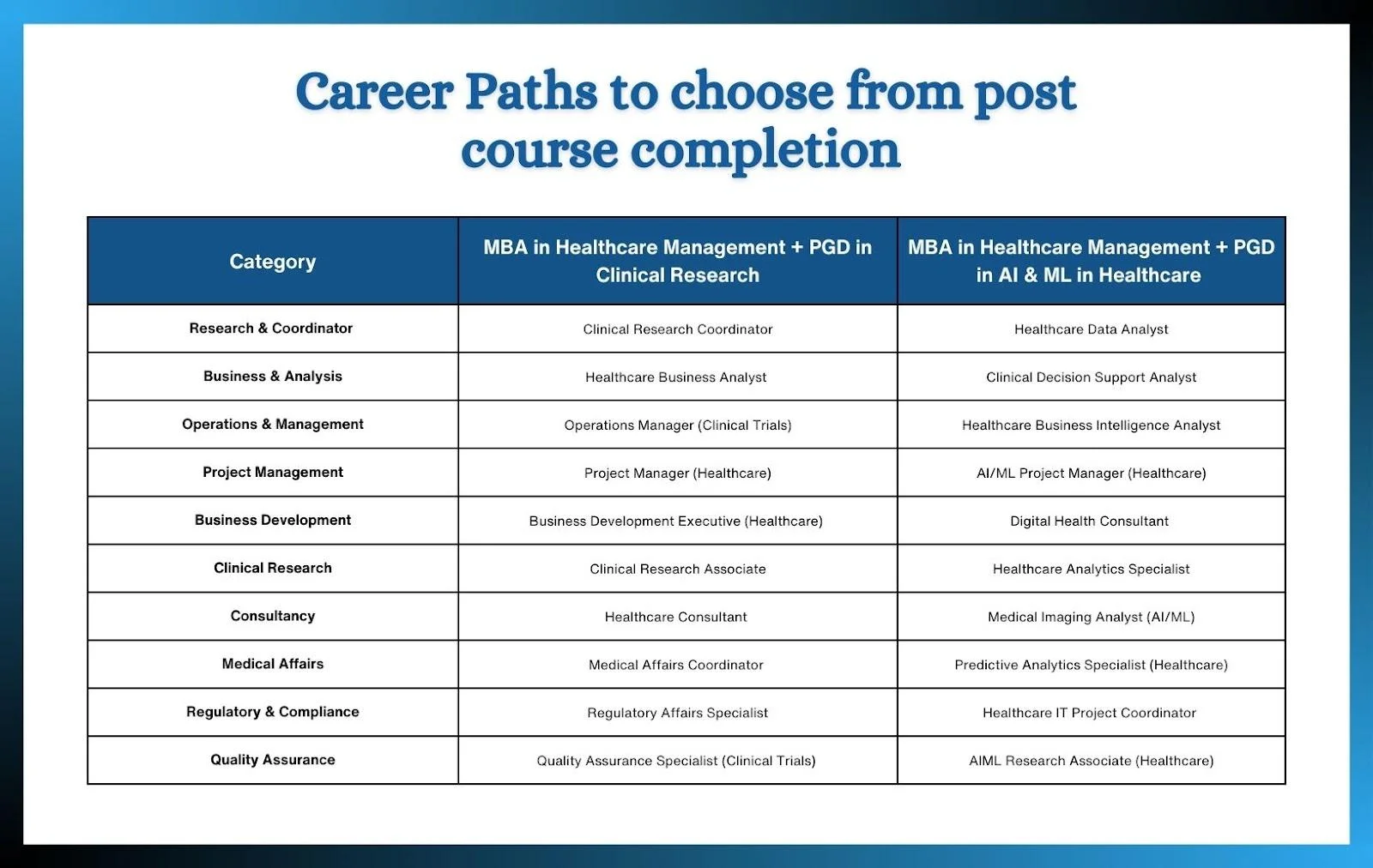
Logical Progression with PGD in Clinical Research or AI & ML
Providing experiential learning opportunities to students with a bachelor’s degree, master in hospital administration and healthcare management helps you to step up. CliniLaunch offers cross functional post graduate diploma courses to help you grow your career in particular areas of Clinical Research or AI & ML in healthcare.
The master of business administration healthcare management with dual specialization and a PG diploma program that complements each other. It is meant for students who already have some experience in a healthcare setting or have some education in management or administration. With a logical progression, you can get into leadership roles and see yourself moving forward in the management domain.
Want to pursue a master of business administration in hospital management to become a leader in the healthcare industry? Earning a degree in MBA will help you reach beyond personal career goals. Landing a job with a degree in the core area of healthcare management will be a great choice for you.
Post completion of MBA, you will be able to make data-driven decisions about healthcare management, marketing, business analytics, logistics & supply chain management, and others. Your decision can have a long-lasting impact on the lives of thousands of patients. With your leadership role in healthcare management, you will find yourself implementing changes or making improvements that save lives.
Thus, equipping yourself with the knowledge and skills to work in your preferred medical care setting to stand making a difference. Earning a MBA in hospital administration and healthcare management with a specialization to bring yourself in the managerial position requires expertise and passion.
In-depth Understanding of healthcare policies and regulations
With the vital skills you earned master of business administration in hospital management, you will be able to address unique challenges that may occur in a healthcare or hospital setting. However, with the courses coursework and specialized modules with a focus on healthcare management, the course enables you to gain in-depth understanding of healthcare, its policies, and regulations.
Enrolling for a master of business administration healthcare management from CliniLaunch opens up the door to choose two core areas in healthcare like Clinical research or AI & ML in healthcare and Business analytics or marketing management or logistics & supply chain management.
Dual Specialization Programs from CliniLaunch
Credit: Karthik C (Graphic Designer at CliniLaunch)
Pursuing MBA healthcare management? You will be able to focus on your career by including your specializations in your resume. By enrolling for an MBA in hospital administration and healthcare management, you will be getting the advantage to pursue one more specialization. With the advancements in educational and training parameters based on the industry, IAO, LSSSDC, NSDC, and IAF accredited CliniLaunch offers specializations in affiliation with Grade A++ NAAC accredited Bangalore University.
Healthcare Management (Major)
In the course, you will have a major course in Healthcare Management. This vertical of management helps you develop strategies to address all the business facets in the context of healthcare management. By learning the concepts, you will have the ability to excel in your career while prioritizing different areas in your profession. Following are the job profiles that are open to postgraduates: Chief executive officer, Chief nursing officer, Compliance officer, Healthcare manager, Hospital manager, and other profiles in alignment with the healthcare sector.
Marketing Management (Specialization)
In-demand marketing management specialization, it has become one of the most required skills in the healthcare profession. One who knows how market trends are going on, and makes policies or agendas for the organization. As a specialization, no doubt, choosing this area will make you a great asset for any organization. Marketing management skills will taper your path to career advancement and bring a vast variety of job roles to choose from.
Business Analytics (Specialization)
According to the U.S. Bureau of Labor Statistics, with the skyrocketing demand of data scientists, the market is projected to jump by 35% in job openings between 2022 and 2032 fueled by the critical role of data. In the generation of artificial intelligence, business analytics is making its impact on the workforce. A specialization in the field of business analytics is an added advantage for you. By getting knowledge in this field, you will be able to deliver meaningful actionable insights from the data that has been collected and organized.
In the context of logistics trends to watch, DHL Group reported the continuation of sustainable logistics as a success factor imperative to the environment in 2024. No business can sustain itself without food customer service. A specialization in logistics and supply chain management is very important. By enrolling, logistics & supply chain management specialization will equip you on the crucial segment of the business like customer service, inventory, and warehousing. Supply chain strategies, freight transportation, and revenue management go hand in hand as they are interdisciplinary and you will be benefited from it.
The postgraduate diploma offers you an advanced sub-discipline of study bridging the gap between real-world healthcare improvements and scientific discovery. Along with the curriculum’s theoretical components, this program is specifically focused on teaching students and working professionals how to use their knowledge and skills in the real world.
Ready to explore how artificial intelligence and machine learning in healthcare programs can improve the experiences of healthcare providers and patient care. This program includes topics such as AI fundamentals, ethical considerations, data analysis, model development, interdisciplinary collaboration, hands-on projects, and practical applications.
Choosing the Right Additional Program
Considering a program in Clinical research or AI & ML in healthcare, you must choose one that aligns with your personal interests and career aspirations. These alignments can significantly help you enhance your learning experiences, motivation, and long-term success. Accreditations from recognised regulatory bodies are specifically crucial factors that you should consider when selecting a program.
MBA Healthcare Management in affiliation with A++ grade NAAC accredited Bangalore University will help you to enhance your quality leadership skills in the healthcare sector. Similarly, a Postgraduate diploma in clinical research and AI & ML in healthcare from IAO, IAF, Brit Qualis, and NSDC accredited CliniLaunch helps you to ensure that it will help you initiate in the field of healthcare.
Career Paths Post Master of Business Administration Healthcare Management Course Completion
Master of business administration healthcare management degree opens doors to a wide variety of career paths. It includes roles in healthcare consulting, hospital administration, health information management and more. You can expect a salary based on various factors such as your experience, location, and roles & responsibilities. However, post Master of business administration hospitals management degree, competitive salaries and excellent career paths can be expected. Following are the combination of roles to leverage your expertise in healthcare management, clinical research and AI & ML in healthcare from CliniLaunch.
Credit: Karthik C (Graphic Designer at CliniLaunch)
To Sum Up
In conclusion, the pursuit of MBA Healthcare Management with additional programs offers a compelling pathway to a rewarding and impactful career in the healthcare industry. By equipping individuals with the essential business acumen, leadership skills, and specialized knowledge, these programs empower professionals to address the complex challenges and opportunities that lie ahead.
As the healthcare landscape continues to evolve, the demand for skilled and innovative leaders will only intensify. By investing in your education and professional development through an MBA Healthcare Management program, you can position yourself at the forefront of this dynamic field. Take your first step towards a fulfilling Career in Healthcare. Join this MBA in Hospital Administration and Healthcare Management.