Alternative Careers for Nurses

What Are Alternative Careers for Nurses?

Alternative careers for nurses include clinical research, medical coding, health informatics, telehealth, and pharmaceutical roles. These alternative careers for nurses allow professionals to use their clinical knowledge beyond bedside care while offering high salary potential, no night shifts, better work-life balance, and long-term career growth.

Explore Career Opportunities

Nursing today is not what it used to be. Long hours, emotional stress, and relentless shift work are pushing many nurses to the edge, alternative careers for nurses with nearly two‑thirds reporting burnout and around 31% leaving their jobs because of it. While bedside care remains demanding, a new world of opportunities is opening. In India, healthcare and pharmaceutical job postings grew by over 62% year-on-year, with significant demand for roles in clinical research, healthcare analytics, medical coding, and digital health technologies for Alternative Careers for Nurses.

For nurses, this means your clinical knowledge is more valuable than ever, not just at the bedside, but also in research, data management, telehealth, medical coding, and digital health roles. Alternative Careers for Nurses careers offer high salary potential, no night shifts, better work-life balance, and long-term growth, allowing you to make a real impact while avoiding the physical and emotional toll of traditional nursing shifts. 

What are the Alternative Careers for Nurses?

Alternative careers for nurses refer to roles that move beyond traditional bedside care while still utilizing clinical knowledge. These include opportunities in clinical research, medical coding, healthcare analytics, telehealth, and pharmaceutical sectors, offering flexible, high-growth career paths. 

Why Nurses Seek Alternative Career Paths 

Nursing is one of the most demanding professions in healthcare. It requires clinical precision, emotional strength, fast decision-making, and relentless dedication. However, as healthcare systems evolve and personal priorities shift, many nurses begin evaluating broader career options for nurses beyond traditional bedside roles. Many of these alternative roles are especially attractive because they offer structured daytime work schedules, higher earning potential, and reduced physical strain compared to bedside roles. 

Seeking an alternative career does not mean abandoning the profession; it often reflects a desire for sustainability, structured growth, intellectual expansion, or better alignment with life goals. Below are the most common and practical reasons for nurses exploring new directions within healthcare and life sciences. 

Burnout & Workforce Pressure 

Sustained high patient loads, rotating shifts, night duties, and emotional exposure to trauma can create long-term fatigue. Chronic staffing shortages in many healthcare systems further intensify workload pressures. Over time, this combination can lead nurses to reconsider whether bedside roles have been sustainable for decades. 

Career Growth & Compensation 

In many hospital settings, upward mobility may require moving into administrative or managerial tracks that are limited in number. Alternative Careers for Nurses roles such as clinical research, medical coding, analytics, or industry-based positions often provide clearer role hierarchies, defined promotion ladders, and measurable pay progression. 

Work–Life Balance & Flexibility 

Structured business hours, hybrid roles, and remote opportunities are increasingly available in non-bedside careers such as telehealth, research coordination, medical writing, and data analysis. For many professionals, predictable schedules significantly improve long-term career satisfaction. 

Skill Diversification 

Nurses possess far more than bedside capability. Many have strengths in analysis, documentation accuracy, education, workflow optimization, and coordination. Alternative career paths allow them to apply these competencies in broader contexts such as research operations, health informatics, regulatory affairs, quality improvement, and healthcare technology. 

Best Non-Bedside Nursing Jobs in 2026 

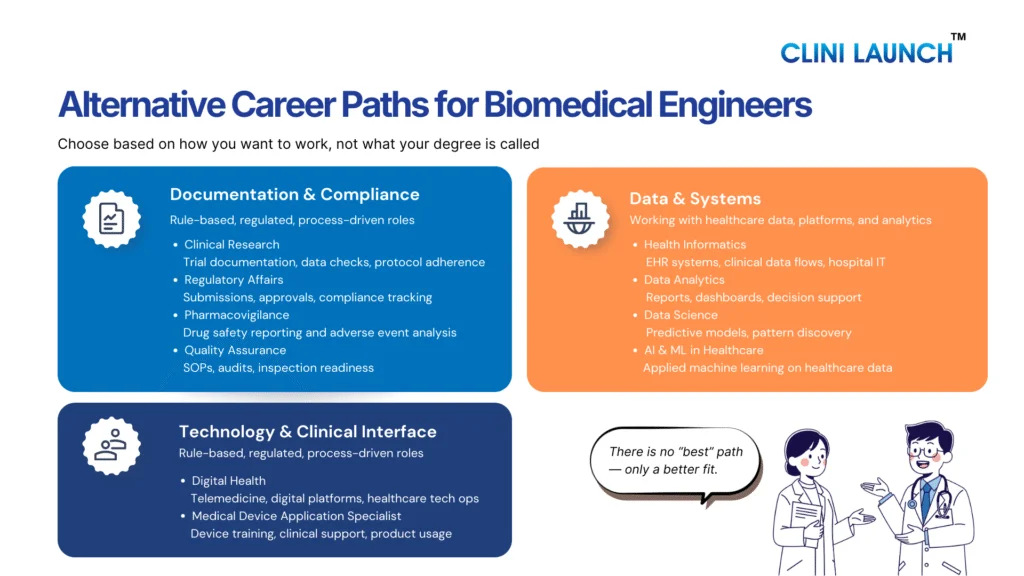
Nursing is no longer limited to bedside care. Today, many professionals are exploring alternative careers for nurses that allow them to use their clinical knowledge in research, data, technology, and healthcare systems—without the demands of hospital shifts. 

These roles are part of the fastest-growing non-bedside nursing jobs, offering high salary potential, no night shifts, better work-life balance, and long-term career growth. With the rise of digital health, clinical research, and healthcare analytics, nurses now have multiple pathways to build stable and future-ready careers. 

Alternative Careers for Nurses
alternative careers for nurses 

1) Clinical Research Coordinator (CRC) / Clinical Research Associate (CRA) 

Clinical research is one of the most structured and globally recognized career transitions for nurses. It focuses on ensuring that new treatments and drugs are tested safely, ethically, and effectively. 

What You Do: 

  • Coordinate clinical trial activities at hospitals or research sites  
  • Screen and recruit eligible participants  
  • Manage informed consent and regulatory documentation  
  • Ensure protocol compliance and patient safety  
  • Coordinate with sponsors, monitors, and ethics committees  

CRA Role (Advanced): 

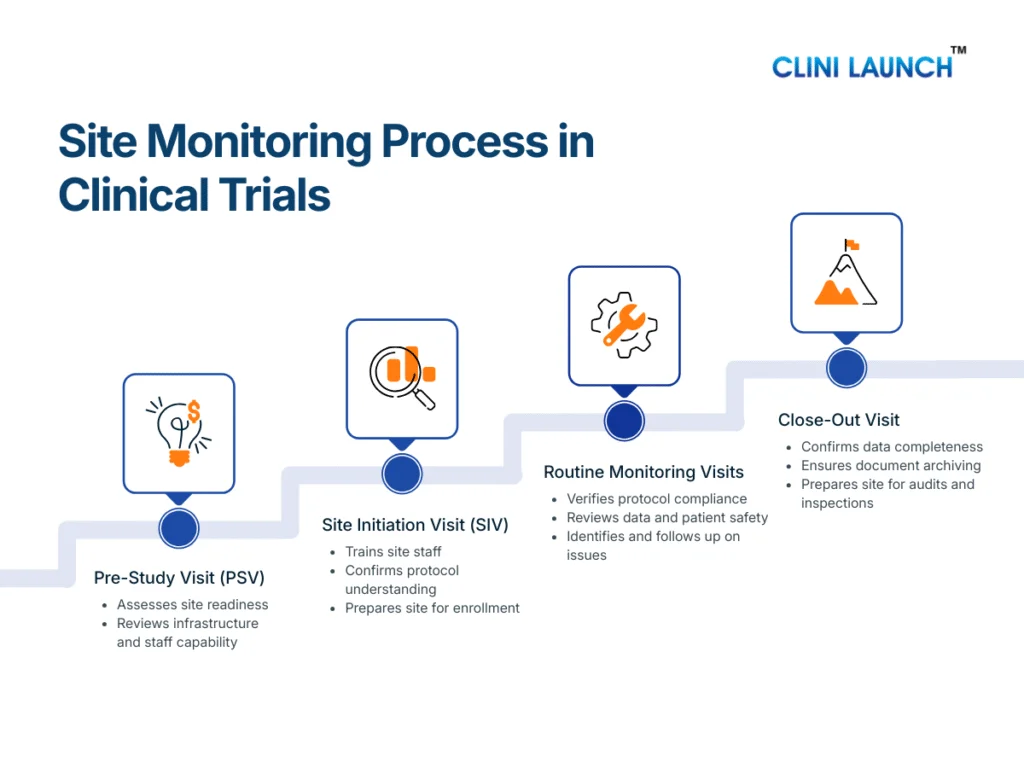
  • Conduct site monitoring visits  
  • Perform Source Data Verification (SDV)  
  • Ensure GCP and regulatory compliance  
  • Identify and resolve study deviations  

Core Skills: 

  • ICH-GCP knowledge  
  • Adverse event reporting  
  • CRF/EDC data entry  
  • Regulatory documentation 

Why Nurses Fit: 
Their understanding of patient care, safety, and clinical documentation makes them highly effective in research environments. 

2) Medical Coder / Health Information Specialist 

Medical coding is a documentation-focused role that supports hospital billing, insurance claims, and compliance processes. 

What You Do: 

  • Review patient charts, discharge summaries, and reports  
  • Assign ICD-10, CPT, and HCPCS codes  
  • Ensure accuracy in billing and reimbursement  
  • Maintain compliance with healthcare regulations  

Core Skills: 

  • Medical terminology and anatomy  
  • Coding systems (ICD, CPT, HCPCS)  
  • Documentation analysis  
  • Attention to detail  

Why Nurses Fit: 
Their clinical background helps interpret diagnoses and procedures accurately, reducing coding errors. 

3) Healthcare Data Analyst / Clinical Data Manager 

This role focuses on working with healthcare or clinical trial data to improve patient outcomes and support decision-making. 

What You Do: 

  • Analyze patient data, outcomes, and trends  
  • Create dashboards and performance reports  
  • Manage clinical trial data and validation processes  
  • Ensure data accuracy and regulatory compliance  

Core Skills: 

  • Advanced Excel and SQL  
  • Data interpretation and statistics  
  • Clinical data understanding  
  • EDC systems  

Advanced Skills: 

  • Python or R  
  • Power BI / Tableau  
  • Clinical data standards (CDISC)  

Why Nurses Fit: 
They understand what the data represents clinically, making their analysis more accurate and meaningful.

4) Medical Writer / Scientific Writer 

Medical writing involves creating scientific and healthcare content for research, regulatory, and educational purposes. 

What You Do: 

  • Write clinical study reports and protocols  
  • Develop regulatory and research documents  
  • Create healthcare blogs, articles, and training materials  
  • Simplify complex medical data into clear content  

Core Skills: 

  • Scientific writing  
  • Literature review  
  • Medical terminology  
  • Attention to detail  

Why Nurses Fit: 
Their clinical experience helps translate complex medical information into clear and accurate communication. 

5) Case Manager / Care Coordinator / Utilization Review Nurse 

This role focuses on managing patient care journeys and ensuring efficient use of healthcare resources. 

What You Do: 

  • Plan discharge and follow-up care  
  • Coordinate with doctors, insurers, and families  
  • Review medical necessity of treatments  
  • Ensure continuity of care  

Core Skills: 

  • Clinical assessment  
  • Care coordination  
  • Documentation review  
  • Communication skills  

Why Nurses Fit: 
Their patient care experience helps in managing treatment plans and improving care outcomes. 

6) Infection Control / Quality & Patient Safety Specialist 

This role focuses on improving healthcare quality and preventing infections in clinical settings. 

What You Do: 

  • Monitor infection rates and safety indicators  
  • Conduct audits and inspections  
  • Develop hospital safety protocols  
  • Lead quality improvement initiatives  

Core Skills: 

  • Infection surveillance  
  • Root cause analysis  
  • Quality audits  
  • Compliance standards  

Why Nurses Fit: 
They have direct exposure to clinical risks and can design better safety systems. 

7) Telehealth / Telenursing / Remote Patient Monitoring 

Telehealth allows nurses to deliver care remotely using digital platforms and monitoring tools. 

What You Do: 

  • Conduct virtual consultations  
  • Monitor patient vitals remotely  
  • Provide triage and clinical guidance  
  • Educate patients on treatment plans  

Core Skills: 

  • Virtual assessment  
  • Patient communication  
  • Digital documentation  
  • Remote monitoring tools  

Why Nurses Fit: 
Their clinical judgment enables accurate decision-making even without physical interaction. 

8) Pharmaceutical / Medical Affairs / Clinical Educator 

These roles exist in pharmaceutical and healthcare companies, focusing on clinical knowledge, product support, and education. 

What You Do: 

  • Deliver clinical and product training  
  • Support product launches and education  
  • Communicate scientific and medical information  
  • Develop educational content  

Core Skills: 

  • Clinical expertise  
  • Presentation and communication  
  • Scientific understanding  

Why Nurses Fit: 
Their real-world clinical experience adds credibility when communicating medical information. 

Salary of Alternative Careers for Nurses 

Many alternative careers for nurses not only offer better work-life balance but also come with strong earning potential. Compared to traditional bedside roles, several non-clinical pathways provide competitive salaries with structured growth and no night shifts. 

For example: 

  • Clinical Research roles can range from ₹4–14 LPA in India depending on experience and role progression.  
  • Medical Coding and Health Information roles typically offer ₹3–12 LPA, with higher earnings in specialized coding and auditing.  
  • Healthcare Data Analysts and Clinical Data Managers can earn between ₹6–18 LPA, especially with skills in SQL, Python, or analytics tools.  
  • Pharmaceutical and Medical Affairs roles often offer ₹6–20 LPA, particularly for professionals with domain expertise.  

As healthcare becomes more data-driven and technology-enabled, these roles continue to see faster salary growth compared to traditional nursing tracks. 

  • Target Your Niche: Pivot toward interests like Telehealth, Informatics, Case Management, or Clinical Research. 
The Bedside-to-Beyond Roadmap 
  • Translate Your Skills: Reframe clinical tasks into corporate language. (e.g., “Patient advocacy” becomes “Stakeholder management”; “Charting” becomes “Data documentation and compliance”). 
  • Upskill & Certify: Bridge the gap with targeted credentials like Medical Coding (ICD-10), Project Management (PMP), or Quality Assurance. 
  • Bridge the Experience Gap: Look for internal “non-bedside” committees at your current hospital or remote internships to build a non-clinical paper trail. 
  • Interview with Strategy: Focus on your ability to handle high-pressure environments, complex data, and regulatory standards. 
Pro Tip: Don’t underestimate the power of your “soft skills.” In the corporate world, the ability to prioritize tasks in a crisis is a rare and highly valued asset.

India and Global Opportunities  

India: 
India’s life-sciences and healthcare services ecosystem is expanding into high-value functions beyond bedside care. For example, Sanofi has announced the expansion of its Hyderabad Global Capability Centre to over 4,500 employees, strengthening roles in research, data analytics, and medical support services. At the same time, the healthcare analytics market in India is projected to grow from USD 1.71 billion in 2024 to USD 15.47 billion by 2033 at an estimated CAGR of around 25%, indicating rising demand for data-driven healthcare roles. Digital health adoption is also accelerating across the country, further expanding opportunities in telehealth, health IT, and remote care systems. This growth directly translates into increased hiring for non-bedside roles, especially in clinical research organizations (CROs), healthcare IT companies, and pharmaceutical firms. 

Global: 
Globally, healthcare systems are increasingly investing in analytics and digital delivery models. The global healthcare analytics market is projected to grow from approximately USD 44.8 billion in 2024 to around USD 166.6 billion by 2030, reflecting strong double-digit annual growth. Similarly, the telehealth market is expected to expand significantly, with projections estimating growth to nearly USD 455 billion by 2030, driven by hybrid care models and digital adoption. Additionally, the WHO’s State of the World’s Nursing 2020 report highlights ongoing global nursing workforce gaps, underscoring the importance of strengthening and diversifying nursing roles across health systems. This global expansion is creating strong demand for nurses who can transition into research, data, and digital health roles beyond traditional clinical settings. 

Why Demand for Non-Bedside Nursing Roles Is Rising

The shift toward digital healthcare, AI-driven systems, and data-based decision-making is rapidly changing how healthcare operates. Hospitals, CROs, pharmaceutical companies, and health-tech firms are actively hiring professionals who understand both clinical care and data or systems.

Nurses, with their strong clinical foundation, are uniquely positioned to fill this gap — making them highly valuable in emerging healthcare roles beyond bedside care.

Conclusion 

If you’re a nurse looking to escape burnout and explore new horizons, now is the time to take charge of your career and consider nursing career alternatives that offer stability, flexibility, and long-term growth. These roles represent some of the most promising non bedside nursing jobs, allowing professionals to leverage their clinical knowledge in research, health informatics, telehealth, and medical coding. 

At CliniLaunch Research Institute, we offer courses designed to help you step confidently into these high-demand roles. Programs like our Advanced Diploma in Clinical Research provide hands-on training, industry-relevant tools, and mentorship from experts, ensuring you’re job-ready from day one. Take the next step in your career evolution to enroll now and transform your clinical expertise into a rewarding, future-ready profession. 

Frequently Asked Questions
1. What are non-bedside career options for nurses?
Nurses can explore roles in clinical research, pharmacovigilance, medical coding and auditing, health informatics, telemedicine, and digital health. These careers leverage clinical expertise without direct bedside care.
2. How can nurses transition from bedside to clinical research or data roles?
Transitioning requires targeted training and understanding of research protocols, data management, and regulatory compliance. Courses like CliniLaunch’s Advanced Diploma in Clinical Research provide hands-on skills and mentorship for a smooth switch.
3. Are technology-driven nursing careers in demand?
Yes, roles in health informatics, telemedicine, digital health, and remote patient monitoring are rapidly growing due to healthcare digitalization and AI adoption.
4. What skills do nurses need for health informatics or telemedicine roles?
Key skills include clinical knowledge, data analysis, patient assessment, digital tools proficiency, and effective communication for virtual care or data interpretation.
5. Can nurses work in clinical research without prior experience?
Yes, with proper training and certification. Many programs teach research basics, clinical trial management, and data handling for beginners.
6. What is the scope of medical coding and auditing for nurses?
Medical coding and auditing roles are in demand for hospitals, insurance companies, and healthcare BPOs.
7. How do nurses benefit from taking an Advanced Diploma in Clinical Research?
The program provides hands-on training, industry tools, mentorship, and exposure to real-world clinical trials.
8. Are non-clinical nursing roles better for work-life balance?
Yes. Many alternative careers offer predictable hours and less physical strain compared to bedside nursing.
9. What companies hire nurses for alternative or digital health roles?
Hospitals like Apollo, Fortis, and Max Healthcare and digital health companies like Practo and Tata 1mg hire nurses for research and tech roles.
10. How can CliniLaunch courses help nurses switch to non-bedside careers?
CliniLaunch provides structured programs with practical training, mentorship, and placement guidance.
Regulatory Affairs Associate Role in Clinical Trials
A Regulatory Affairs Associate supports clinical trials by preparing and maintaining regulatory documentation, coordinating regulatory and ethics submissions, tracking approvals and amendments, and ensuring ongoing compliance from study start-up through close-out.

Clinical research and product development don’t move forward just because science looks promising. Every study, drug, or medical product must pass defined regulatory checks before it can start, continue, or close. Someone has to make sure those rules are followed consistently and on time. That responsibility sits with regulatory teams, and at the entry level, with the Regulatory Affairs Associate. 

A Regulatory Affairs Associate (RAA) supports the regulatory process by managing documentation, tracking approvals, coordinating inputs across teams, and ensuring compliance with approved requirements.  

 Regulatory Affairs Associate positions exist across pharmaceutical companies, biotechnology firms, clinical research organizations, and medical device companies. These professionals operate at the intersection of science, operations, and regulation, supporting studies and products throughout their lifecycle. 

This blog focuses strictly on the real-world responsibilities of a Regulatory Affairs Associate. You’ll learn where the role fits in clinical research, the core responsibility areas handled at the associate level, what the role does not include, and the skills used on the job. The goal is clarity, so you can judge early whether this role genuinely fits your career direction. 

What does a Regulatory Affairs Associate Do? 

A regulatory affairs associate operates at the execution layer of clinical research and product development. The role sits between scientific teams and regulatory authorities, ensuring that approved plans are followed exactly as required under applicable clinical trial regulations. 

In practical terms, an RAA is involved across the entire clinical trial lifecycle: 

  • Before a study starts: supporting regulatory and ethics submissions, tracking approvals, and confirming readiness to begin 
  • While the study is ongoing: managing amendments, maintaining compliance, and keeping regulatory documentation inspection-ready 
  • After the study ends: supporting close-out notifications, final documentation, and post-study regulatory readiness 

RAAs execute regulatory tasks under supervision, ensuring nothing moves forward without the required approvals in place. 

From a career standpoint, this is not a niche or academic role. Regulatory Affairs Associate positions exist across multiple parts of the healthcare industry: 

  • Pharmaceutical companies delivering regulatory compliance in pharmaceuticals such as Sun Pharma and Dr. Reddy’s 
  • Biotechnology company’s firms navigating complex drug regulatory affairs like Biocon 
  • Clinical Research Organizations (CROs) offering end-to-end regulatory affairs services including IQVIA and Syneos Health 
  • Medical device companies supporting global approvals such as Medtronic 

Across all these settings, the role stays fundamentally the same: support regulatory compliance, so studies and products can move forward without delays, findings, or legal risk. 

This positioning is important for beginners to understand early. A Regulatory Affairs Associate is not a “background” role. It is an operational control role, where small errors can have large downstream consequences. 

Why Can’t Clinical Research Move Forward Without Regulatory Teams? 

Clinical research isn’t just about science and discovery it’s about doing things the right way. Every clinical trial must meet strict regulatory rules and safety standards before it can begin or continue. Without proper oversight on regulations, approvals, and compliance, trials can face delays, increased costs, or even be halted entirely. 

For example, research analyzing global randomized clinical trials has shown that regulatory and administrative processes including ethics committee approvals and country-specific submission requirements are among the primary drivers of trial start-up delays, significantly affecting timelines and study progression. This demonstrates how critical regulatory oversight is in ensuring that trials move forward efficiently and compliantly. 

This rigorous regulatory environment exists to protect participants, maintain data integrity, and make sure that only safe and effective treatments progress — a responsibility that cannot be fulfilled without dedicated regulatory teams guiding the way. 

regulatory affairs associate role

How Do Regulatory Affairs Associates Support Regulatory Submissions? 

Once the importance of regulatory oversight in clinical research is clear, the next question is how this support is delivered in practice. Regulatory Affairs Associates play a critical role by getting involved early in the regulatory submission process, well before applications are filed with authorities. They work closely with clinical, quality, and manufacturing teams to ensure that required data, documents, and timelines align with regulatory expectations from the start. 

By supporting submission planning, reviewing documentation for accuracy and consistency, and tracking regulatory requirements, they help reduce the risk of last-minute gaps that can delay approvals. This early involvement is essential because regulatory submissions are built progressively, and issues identified late in the process are often costly and difficult to correct. Through this structured support, Regulatory Affairs Associates help submissions move forward smoothly and with greater confidence. 

Roles and Responsibilities of a Regulatory Affairs Associate Across Clinical Trial Phases 

1. Study Start-Up Phase 

The Study Start-Up Phase determines whether a clinical study can begin legally and ethically. Regulatory Affairs Associates ensure study design, documentation, and submission plans meet regulatory requirements. Gaps at this stage can delay approvals or prevent site activation. 

1. Defining the Study’s Regulatory Pathway 

At the beginning of a study, Regulatory Affairs Associates help interpret regulatory  requirements based on the country of conduct, study phase, and study type. They  ensure that the study follows the correct regulatory pathway and meets ethical  standards before submissions begin. 

  • Identify applicable regulations and guidance documents 
  • Ensure alignment with local and global regulatory expectations 
  • Support teams in understanding regulatory constraints early 

2. Preparing the Study for Regulatory and Ethics Approval 

Regulatory Affairs Associates play a key role in preparing and coordinating initial  submissions to regulatory authorities and Ethics Committees / IRBs. Their  responsibility is to ensure that submission packages are complete, accurate, and  compliant before they are filed. 

  • Assist in compiling submission-ready documents 
  • Coordinate inputs from clinical and other internal teams 
  • Ensure submission formats and content meet authority requirements 

3. Securing Approvals to Activate the Study 

Once submissions are made, Regulatory Affairs Associates track approval of  progress and support responses to authority or ethics queries. They ensure that all  required approvals are obtained before studying activation or subject enrollment. 

  • Monitor approval timelines 
  • Coordinate responses to clarification requests 
  • Confirm formal approvals before trial initiation 

Example scenario: Study Start-Up: Regulatory Support in Action 

Problem: 
A multi-country clinical study faced potential delays due to differences in regulatory and ethics requirements across regions. 

Action: 
The Regulatory Affairs Associate first focused on defining the study’s regulatory pathway by identifying country-specific regulatory expectations and appropriate submission routes. Next, they supported preparing the study for regulatory and ethics approval by coordinating submission-ready documents and aligning inputs from clinical teams. After submissions were filed, the Associate supported securing approvals to activate the study by tracking review timelines and coordinating responses to authority and ethics queries. 

Outcome: 
All required approvals were obtained on time, allowing smooth site activation and preventing delays during study start-up. 

2. Study Conduct Phase 

The Study Conduct Phase begins once the clinical study is activated and continues until the last subject visit is completed. During this phase, Regulatory Affairs Associates ensure that the study is conducted strictly according to approved protocols, regulatory requirements, and ethics approvals. Any unapproved changes or compliance gaps during this stage can lead to regulatory findings, delays, or study suspension. 

1. Maintaining Ongoing Regulatory Compliance 

During study conduct, Regulatory Affairs Associates support continuous compliance by ensuring that trial activities remain aligned with approved regulatory and ethics conditions. They help monitor adherence to protocols and regulatory commitments throughout the study lifecycle. 

  • Ensure study activities follow approved protocols and submissions 
  • Monitor compliance with regulatory and ethics conditions 
  • Support teams in understanding regulatory obligations during conduct 

2. Managing Protocol Amendments and Study Changes 

Clinical studies often require changes due to operational or safety reasons. Regulatory Affairs Associates support the preparation, review, and submission of protocol amendments and related documents to ensure changes are approved before implementation. 

  • Support preparation of protocol amendments and updated documents 
  • Coordinate amendment submissions to authorities and Ethics Committees / IRBs 
  • Ensure approvals are obtained before changes are implemented 

3.Supporting Safety and Regulatory Reporting

Regulatory Affairs Associates assist with ongoing regulatory reporting obligations during the study, particularly related to safety updates and regulatory notifications. Their role helps ensure timely and compliant communication with authorities. 

  • Support regulatory submissions related to safety updates 
  • Ensure reporting timelines are met 
  • Coordinate inputs from safety and clinical teams 
  1. Maintaining Regulatory Documentation and Records 

Accurate and up-to-date regulatory documentation is critical during study conduct. Regulatory Affairs Associates help ensure that regulatory files remain current, traceable, and inspection-ready throughout the study. 

  • Maintain regulatory records and submission histories 
  • Ensure document version control and traceability 
  • Support audit and inspection readiness 

Example Scenario: Study Conduct – Regulatory Oversight in Practice

Problem: 
During an ongoing clinical study, operational updates and safety-related changes created a risk of non-compliance if implemented without proper regulatory approval. 

Action: 
The Regulatory Affairs Associate supported maintaining ongoing regulatory compliance by ensuring study activities continue to align with approved protocols and regulatory conditions. When changes were required, the Associate supported managing protocol amendments by coordinating updated documents and submissions to regulatory authorities and Ethics Committees. In parallel, they supported safety and regulatory reporting by tracking reporting timelines and coordinating inputs from clinical and safety teams, while ensuring regulatory documentation remained current and audit-ready throughout the study. 

Outcome: 
All study changes and reports were managed in compliance with regulatory requirements, allowing the study to continue without findings, interruptions, or regulatory delays

C. Study Close-Out Phase 

The Study Close-Out Phase begins once the last subject visit is completed and continues until all regulatory and ethics obligations are formally closed. During this phase, Regulatory Affairs Associates ensure that the study is properly concluded in compliance with regulatory requirements and that all records are finalized, complete, and inspection ready. Incomplete close-out activities can lead to regulatory findings even after a study has ended. 

  1. Managing End-of-Study Regulatory and Ethics Notifications 

At study completion, Regulatory Affairs Associates support required notifications to regulatory authorities and Ethics Committees / IRBs to formally communicate study closure. 

  • Support preparation of end-of-study notifications 
  • Coordinate submissions to regulatory authorities and Ethics Committees / IRBs 
  • Ensure notifications are submitted within required timelines 
  1. Finalizing Regulatory Documentation and Records 

Regulatory documentation must be complete and accurate at the time of study close-out. Regulatory Affairs Associates verify that all regulatory records reflect the final status of the study. 

  • Review regulatory files for completeness and consistency 
  • Ensure all approvals, amendments, and correspondence are finalized 
  • Support proper archiving of regulatory documentation 
  1. Supporting Regulatory Inspections After Study Completion 

Even after a study is closed, regulatory inspections may still occur. Regulatory Affairs Associates help ensure continued inspection of readiness post close-out. 

  • Ensure regulatory records remain accessible and traceable 
  • Support document retrieval during inspections or audits 
  • Assist with responses to post-study regulatory queries 

Example Scenario: Study Close-Out – Regulatory Completion in Action 

Problem: 
As a clinical study reached completion, there was a risk of regulatory non-compliance if end-of-study notifications, documentation finalization, and regulatory records were not handled correctly or on time. 

Action: 
The Regulatory Affairs Associate supported regulatory close-out activities by coordinating end-of-study notifications to regulatory authorities and Ethics Committees. They ensured regulatory documentation was complete and accurate by verifying that all approvals, amendments, and correspondence were properly finalized and archived. The Associate also supported inspection of readiness after study completion by ensuring regulatory records remained accessible and audit-ready, even after the study formally ended. 

Outcome: 
All regulatory close-out requirements were completed within timelines; documentation was properly archived, and the study remained inspection-ready, ensuring long-term regulatory compliance after study completion. 

Skills Required for a Regulatory Affairs Associate 

Regulatory & Technical Skills 

These skills form the foundation of a Regulatory Affairs Associate’s role. They ensure that clinical studies and regulatory submissions align with applicable laws, guidelines, and ethical standards. Strong regulatory knowledge helps prevent compliance gaps and approval delays from the outset. 

  • Understanding of Clinical Trial Regulations and Guidelines 

Ensures studies follow approved legal and ethical frameworks. Helps identify what is permitted at each stage and prevent compliance gaps. Reduces approval delays and regulatory risk. 

  • Knowledge of Regulatory and Ethics Submission Processes 

Supports accurate preparation and filing of regulatory and ethics submissions. Ensure completeness and alignment with authority expectations. Enables timely approvals and smooth study progression. 

  • Familiarity with Protocols, ICFs, Amendments, and Regulatory Documentation 

Ensure consistency across core clinical trial documents. Helps identify gaps or discrepancies early. Maintains regulatory accuracy throughout the study lifecycle. 

Operational Skills 

Operational skills enable Regulatory Affairs Associates to translate regulatory requirements into day-to-day execution. They help manage coordination across teams, track regulatory timelines, and ensure regulatory activities move forward smoothly. These skills are critical for keeping studies on schedule without compliance risks. 

  • Coordination with Clinical, Quality, and Safety Teams 

Enables a timely collection of regulatory inputs from multiple teams. Ensure alignment of data and documentation. Prevents delays caused by missing or inconsistent information. 

  • Tracking Approvals, Timelines, and Regulatory Queries 

Ensures regulatory milestones and responses are not missed. Supports timely follow-up with authorities and teams. Keep studying on schedule. 

  • Maintaining Audit-Ready Regulatory Records 

Keeps regulatory documentation complete and traceable. Supports inspections during and after the study. Demonstrates ongoing compliance. 

Professional Skills 

Professional skills determine how effectively a Regulatory Affairs Associate performs under regulatory pressure. Accuracy, communication, and time management are essential in a role where small errors can have significant regulatory impact. These skills support consistent performance in high-accountability environments. 

  • Attention to Detail 

Prevents documentation errors and compliance issues. Ensure accuracy across submissions and records. Critical for avoiding regulatory findings. 

  • Clear Written Communication 

Ensures regulatory information is clearly understood and applied. Supports accurate documentation and responses. Enables effective cross-team coordination. 

  • Working Under Regulatory Timelines and Pressure 

Helps manage multiple deadlines without compromising compliance. Supports consistent performance in high-risk regulatory environments. Essential for maintaining study momentum. 

Advanced Diploma in

Clinical Research

Develop industry-ready clinical research skills used across pharmaceutical companies, CROs, and healthcare organizations. Learn how clinical trials are designed, conducted, monitored, and regulated, while gaining hands-on exposure to real-world clinical research workflows and compliance standards. 

IN PARTNERSHIP WITH
4.8(3,235 ratings)

Regulatory Affairs Associate Salary by Organization Type  

Organization Type Typical Experience Range Salary Range (INR) Approx. Salary Range (USD)
CROs 0–4 years ₹3.5 – ₹8 LPA $4,200 – $9,600
Pharmaceutical Companies 1–5 years ₹4 – ₹9 LPA $4,800 – $10,800
Biotechnology Firms 2–6 years ₹5 – ₹10 LPA $6,000 – $12,000
Specialized / Global Regulatory Roles 5+ years ₹9 – ₹12 LPA+ $10,800 – $14,500+

Ready to Build a Career in Regulatory Affairs? 

The role of a Regulatory Affairs Associate is central to how clinical research moves forward ensuring studies are compliant, approvals are secured on time, and regulatory risks are managed throughout the study lifecycle. From study start to close-out, regulatory professionals play a key role in maintaining ethical standards, data integrity, and regulatory credibility. 

For those looking to build a career in regulatory affairs or clinical research, gaining structured, industry-aligned training is essential. Programs like Advanced Diploma in Clinical Research are designed to bridge the gap between academic learning and real-world regulatory practice. With a strong focus on practical workflows, documentation, and compliance, this program can help you prepare roles such as Regulatory Affairs Associate and take a confident step into the clinical research industry. 

FAQ’S 

  1. Who is a regulatory affairs associate? 

A Regulatory Affairs Associate ensures that clinical trials and healthcare products comply with regulatory and ethical requirements. They support approvals, submissions, and ongoing compliance. 

  1. What is the role of a regulatory affairs associate? 

The role involves supporting regulatory submissions, tracking approvals, managing changes, and maintaining compliance across the clinical trial lifecycle. 

  1. What skills are needed in regulatory affairs? 

Key skills include regulatory knowledge, documentation accuracy, coordination across teams, and the ability to work under strict compliance timelines. 

  1. What do regulatory affairs associates do? 

They support regulatory and ethics submissions, manage approvals and amendments, and maintain audit-ready regulatory documentation. 

  1. What is the primary role of regulatory affairs? 

The primary role is to ensure products and studies meet regulatory requirements so they can be approved, conducted, and marketed legally and safely. 

  1. What are regulatory responsibilities? 

Regulatory responsibilities include ensuring compliance, managing approvals, maintaining documentation, and supporting inspections and audits. 

  1. What are regulatory affairs in pharma jobs? 

 
These roles focus on ensuring drugs meet regulatory requirements from development through approval and post-market compliance. 

  1. What are the two important functions of the regulatory affairs department? 

Ensuring regulatory compliance and securing timely approvals from regulatory authorities. 

  1. What is the difference between regulatory affairs and compliance? 

Regulatory affairs focus on approvals and interactions with regulators, while compliance ensures ongoing adherence to approved regulations and standards. 

  1. What is the purpose of regulatory agencies? 

Regulatory agencies protect public health by enforcing safety, quality, and ethical standards across clinical research and healthcare products. 

QA Associate Roles and Responsibilities in Clinical Trials
QA associates in clinical trials ensure that study activities follow approved protocols, Good Clinical Practice (GCP), regulatory requirements, and internal SOPs.

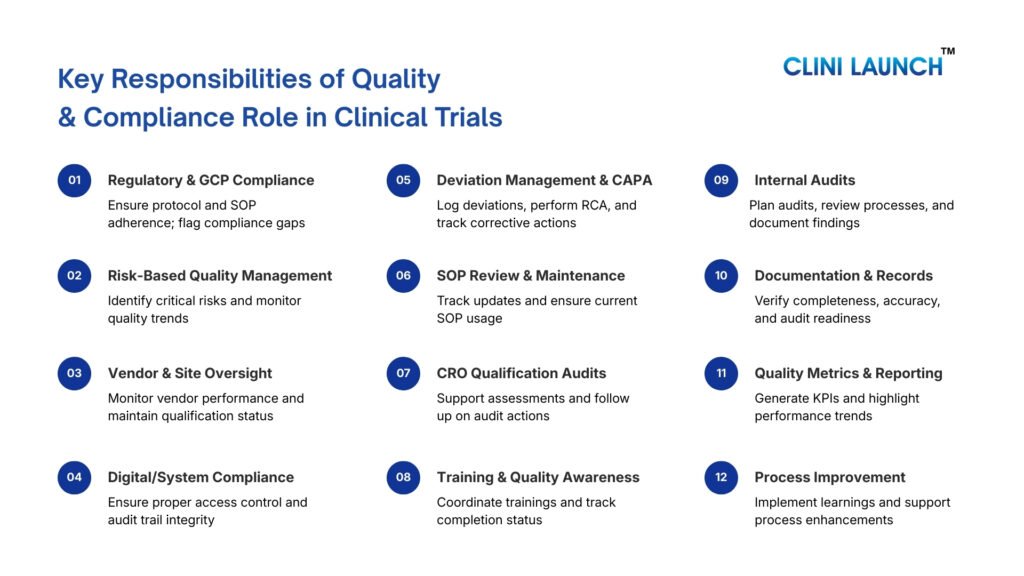
They support audits, manage deviations and CAPA, maintain documentation, and help organizations remain inspection-ready through proactive quality oversight. These QA associate roles and responsibilities in clinical research are central to the success of research programs.

Every clinical trial is built on one critical expectation: the data generated must be accurate, reliable, and ethically sound. As clinical research expands globally, maintaining this quality has become increasingly complex. Empirical research shows that Phase II and Phase III protocols average about 75 and 119 protocol deviations per study respectively, affecting nearly one-third of enrolled participants, which highlights how common quality lapses can be even in well-designed trials. Small compliance gaps can lead to regulatory findings; delayed approvals, financial losses, or risks to participant safety, making robust clinical trial compliance and oversight are essential. 

This is where clinical research QA roles become a strategic function within clinical research. Instead of reacting to errors after they surface, QA establishes robust quality systems, governance frameworks, and risk-based oversight mechanisms that proactively prevent failures capable of affecting participant safety, data credibility, or regulatory acceptance. 

Among the many professionals responsible for maintaining trial quality, the clinical trial quality assurance responsibilities function plays a central role in ensuring that compliance expectations are consistently upheld. QA involvement spans across processes, teams, and systems, supporting organizations in sustaining oversight and remaining prepared for regulatory scrutiny throughout the clinical trial lifecycle. Inspection readiness is a key focus for QA Associates in this context. 

This blog explores the QA associate roles and responsibilities in clinical research, the skills required for the role, and the career opportunities it offers in today’s growing clinical research landscape. 

Who is a QA associate in clinical research? 

A QA associate in clinical research ensures that studies comply with regulatory requirements, Good Clinical Practice (GCP), approved protocols, and SOPs. They support quality systems that protect participant safety, maintain data integrity, and uphold ethical standards. Clinical research documentation compliance is a critical aspect of their daily work. 

In their role, QA Associates monitor processes, support audits, manage deviations and CAPA, oversee vendor and site compliance, maintain documentation, and help keep studies inspection-ready. Their work transforms quality oversight from reactive checks into proactive, system-driven assurance that strengthens research reliability and credibility. This highlights the importance of clinical trial audit and GCP guidelines for clinical research in research environments. 

Advanced Diploma in

Clinical Research 

Build industry-ready skills to work across real clinical trial environments. Learn how clinical studies are designed, conducted, documented, and monitored, with a strong focus on ethics, patient safety, and global regulatory compliance. 

IN PARTNERSHIP WITH
4.8(3,235 ratings)

Roles and Responsibilities of a QA Associate  

QA Associates operate in a fast-paced environment where multiple studies, tight timelines, evolving regulations, and cross-functional dependencies intersect. Their role requires constant coordination, rapid problem identification, and meticulous follow-through to ensure that quality expectations are met without slowing trial progress. Balancing documentation accuracy, audit readiness, stakeholder communication, and risk management makes the position both challenging and highly impactful in everyday trial operations. 

QA associate roles and responsibilities in clinical research

  1. Ensuring Compliance with Regulatory Guidelines  

Regulatory compliance forms the foundation of the clinical research lifecycle because it ensures participant protection, data credibility, and acceptance of results by health authorities. Without consistent adherence to regulations and Good Clinical Practice (GCP), even scientifically sound studies may face rejection, delays, or legal consequences. 

Within this framework, QA Associates act as oversight partners who help translate regulatory expectations into operational execution. They provide ongoing assurance that processes across sites and functions align with approved standards and remain ready for inspection at any time. 

Typical tasks performed by QA Associate includes: 

  • Reviewing trial activities against GCP, protocols, and SOP requirements 
  • Identifying potential non-compliance risks before they escalate 
  • Supporting teams in understanding regulatory expectations 
  • Verifying that documentation supports what was performed 
  • Coordinating with operations, data, and regulatory groups to close compliance gaps 
  1. Deviation, CAPA, and Risk Management  

Deviations, CAPA, and risk management are among the most critical responsibilities of QA Associates because even minor deviations can compromise data integrity, participant safety, and regulatory compliance. Properly identifying, documenting, investigating, and preventing deviations is central to maintaining trial quality and inspection of readiness. This is a key element of CAPA management and risk management in QA associate clinical trials roles 

QA Associates act as the operational backbone of this process, working across functional teams to detect issues early, implement preventive strategies, and ensure corrective measures are effective. By integrating structured methods and using specialized tools, they help sustain high-quality standards throughout the trial lifecycle. 

Typical tasks and methods performed by QA Associates include: 

  • Logging and categorizing deviations in a deviation management system 
  • Conducting initial deviation reviews to assess impact and regulatory risk 
  • Performing root cause analysis using tools like Fishbone diagrams, 5 Whys, or risk matrices 
  • Collaborating with cross-functional teams to propose and document Corrective and Preventive Actions (CAPA) 
  • Tracking CAPA progress and verifying effectiveness using CAPA management software or quality trackers 
  • Supporting risk assessment exercises by identifying high-risk processes or critical data points 
  • Documenting mitigation strategies and integrating risk considerations into SOPs and monitoring plans 
  • Preparing reports for management review, audits, and regulatory inspections 
  1. Internal Audits and Quality Checks  

Internal audits are essential in the clinical research lifecycle because they help organizations identify process weaknesses, documentation gaps, and compliance risks before regulatory inspections occur. Routine quality checks strengthen oversight, improve consistency across sites, and protect both participant safety and data credibility. Quality metrics help QA Associates track performance trends. 

QA Associates support the audit framework by coordinating reviews, facilitating evidence collection, and ensuring that observations are addressed in a timely and structured manner. 

Typical tasks performed by QA Associates include: 

  • Preparing audit plans, checklists, and required documentation 
  • Reviewing Trial Master Files (TMF), essential documents, and study records 
  • Verifying adherence to approved protocols and SOPs 
  • Identifying and documenting audit findings or quality gaps 
  • Coordinating responses with functional teams 
  • Tracking corrective and preventive actions (CAPA) to closure 
  • Supporting follow-up reviews to confirm effectiveness of actions 
  • Maintaining audit logs, metrics, and inspection readiness records 
  1. Risk-Based Quality Management  

Risk-Based Quality Management (RBQM) is a core responsibility for QA associates in clinical trials. It is central to ensuring participant safety, data integrity, and regulatory compliance, particularly in complex or high-risk studies. By proactively identifying potential risks, QA Associates focus on resources and oversight on the most critical processes, preventing deviations and minimizing their impact on trial outcomes. 

Typical tasks performed by QA Associates include: 

  • Identifying high-risk processes, procedures, or sites using risk assessment tools and historical data 
  • Applying focused monitoring strategies to prioritize critical activities 
  • Supporting implementation of risk mitigation plans to prevent protocol deviations 
  • Collaborating with cross-functional teams to address potential quality gaps 
  • Tracking risk trends and updating risk logs for management review 
  • Using tools such as risk matrices, dashboards, and quality trackers to visualize and manage risks 
  • Communicating identified risks and mitigation plans to relevant stakeholders 
  1. Vendor and Site Quality Oversight 

External partners such as trial sites, laboratories, and service providers play a major role in study execution, making their performance critical to overall trial quality. Inconsistent practices across vendors can lead to delays, data variability, or compliance risks, which is why structured oversight is necessary throughout the study’s lifecycle. 

QA Associates contribute by supporting evaluation, coordination, and ongoing visibility into how vendors and sites operate against sponsor expectations and contractual quality requirements. This demonstrates clinical trial compliance in multi-site management and ensures vendor adherence to clinical trial protocol 

Typical tasks performed by QA Associates include: 

  • Assisting in collection and review of vendor qualification documentation 
  • Maintaining vendor quality files and approval records 
  • Supporting onboarding activities related to quality expectations 
  • Monitoring vendor performance indicators and reporting trends 
  • Facilitating communication of quality requirements between sponsor and partners 
  • Escalating observed risks or recurring issues to senior QA leadership 
  • Maintaining oversight trackers for site and vendor compliance status 
  • Supporting documentation readiness related to outsourced activities 
  1. Review and Maintenance of SOPs  

Standard Operating Procedures (SOPs) provide the operational backbone of the clinical research lifecycle, ensuring that activities are performed consistently, ethically, and in line with regulatory expectations. Well-maintained SOPs reduce variability across sites, support staff training, and form a critical component of inspection readiness. 

Within this system, QA Associates typically function as quality coordinators and reviewers rather than primary authors. They help ensure that procedures remain current, aligned with regulations, and properly implemented across teams. 

Typical tasks performed by QA Associates include: 

  • Supporting periodic SOP reviews to confirm relevance and regulatory alignment 
  • Tracking revision histories and maintaining document control records 
  • Coordinating approvals and ensuring updated versions are distributed 
  • Verifying that teams are following the currently approved procedures 
  • Assisting in change communication and training support when updates occur 
  • Identifying gaps between written procedures and actual practice 
  1. Documentation and Quality Records Management 

QA Associates are responsible for managing all quality-related documentation throughout the clinical trial lifecycle. This includes reviewing the Trial Master File (TMF), audit reports, CAPA logs, and quality metrics to ensure completeness, accuracy, and compliance with regulatory requirements. They oversee the proper storage, control, and retrieval of records, maintaining version control, and ensuring that documentation is updated promptly when procedures change. 

 By managing quality records effectively, QA Associates help preserve data integrity, facilitate inspections and audits, and support transparency across trial activities. Their meticulous approach to documentation ensures that regulatory authorities, sponsors, and internal teams have access to accurate and reliable records, reinforcing the credibility and compliance of the clinical trial. 

  1. Quality Metrics and Reporting  

Tracking and analyzing quality metrics is a critical part of maintaining compliance and operational excellence throughout the clinical trial lifecycle. By measuring performance trends, identifying recurring issues, and highlighting potential risks, QA Associates help ensure trials remain efficient, ethical, and inspection ready. 

QA Associates contribute by monitoring key quality indicators and providing actionable insights to management and cross-functional teams. Their work enables data-driven decisions, supports continuous improvement, and strengthens overall trial quality. 

Typical tasks performed by QA Associates include: 

  • Generating dashboards and KPI reports to monitor trial performance 
  • Analyzing trends from audit findings, deviations, and CAPA outcomes 
  • Identifying patterns or recurring issues to prevent future non-compliance 
  • Communicating quality trends and insights to management and functional teams 
  • Maintaining quality metrics trackers and historical records 
  • Supporting management review meetings with structured data and visualizations 
  • Using tools such as Excel, QA dashboards, TMF trackers, or BI software to consolidate and report metrics 
  1. Digital and Systems Compliance Oversight  

Electronic systems such as eTMF, eCRF, and other trial management platforms are central to modern clinical trials. Ensuring these systems maintain data integrity, compliance, and audit-readiness is critical for protecting participant safety, supporting regulatory inspections, and enabling reliable trial outcomes, especially in increasingly decentralized studies. 

QA Associates play a key role in overseeing these systems. They monitor electronic data, verify adherence to regulatory and SOP requirements, and support cross-functional teams to maintain system compliance across the trial lifecycle. 

Typical tasks performed by QA Associates include: 

  • Monitoring electronic trial systems for completeness, accuracy, and auditability 
  • Verifying access controls and user permissions to protect sensitive data 
  • Ensuring digital records comply with SOPs and regulatory requirements 
  • Supporting system validation activities and documentation 
  • Preparing electronic system evidence and documentation for inspections 

10.Training and Quality Awareness  

In clinical trials, processes, regulations, and SOPs are constantly evolving due to protocol amendments, updated regulatory guidance, or new sponsor requirements. Ensuring that all personnel are aware of these changes is critical to maintaining compliance, preventing deviations, and safeguarding participant safety. 

QA Associates play a pivotal role in embedding inspection of readiness and clinical research QA roles awareness throughout the trial lifecycle. They coordinate and monitor training, communicate changes in requirements, and ensure that staff are equipped to apply updated procedures in their daily activities. 

Typical tasks and methods performed by QA Associates include: 

  • Coordinating periodic and ad-hoc training sessions on GCP, SOPs, and protocol updates 
  • Tracking regulatory or SOP changes that affect trial operations 
  • Maintaining and updating training records using Learning Management Systems (LMS) or internal trackers 
  • Verifying completion of required training for all team members, including new hires and cross-site personnel 
  • Reinforcing training through reminders, job aids, and quick reference guides 
  • Supporting staff in understanding new procedures or process updates, ensuring correct implementation 
  • Conducting post-training assessments to confirm knowledge retention and identify gaps 
  • Facilitating a culture of continuous quality improvement by encouraging feedback and lessons-learned sharing 

11. Process Improvement Initiatives 

Continuous process improvement is a key responsibility for QA associates in clinical trials. Enhancing compliance, efficiency, and overall trial performance helps prevent errors, streamline operations, and strengthen the quality system across all study sites. 

QA Associates contribute by analyzing operations, identifying gaps, and supporting the implementation of best practices. Lessons learned from audits, inspections, and trial closeouts are applied to refine SOPs, workflows, and quality practices for current and future studies, ensuring trials meet high standards of regulatory compliance, data integrity, and operational excellence. 

Typical tasks performed by QA Associates include: 

  • Reviewing post-audit or inspection findings to identify process gaps 
  • Supporting updates to SOPs, workflows, and quality practices 
  • Participating in lessons-learned sessions and cross-functional discussions 
  • Monitoring implementation of approved process improvements 
  • Documenting best practices and sharing knowledge with teams 
  • Providing guidance to junior QA staff on process compliance and efficiency 

12. Support for Vendor/CRO Qualification Audits  

External partners such as vendors and Contract Research Organizations (CROs) play a critical role in clinical trials, and their compliance directly affects study quality, data integrity, and participant safety. QA Associates support sponsors, operations teams, and QA leadership by ensuring that these partners are qualified and capable of conducting trial activities reliably and in accordance with regulatory standards. 

Typical tasks performed by QA Associates include: 

  • Assisting in pre-study vendor and CRO audits by preparing documentation and audit checklists 
  • Reviewing vendor quality systems and SOPs for compliance with sponsor and regulatory expectations 
  • Maintaining vendor qualification files and approval records 
  • Monitoring vendor performance indicators and flagging potential quality gaps 
  • Coordinating with operations and regulatory teams to address any compliance issues 
  • Supporting follow-up reviews to ensure corrective actions from audits are implemented 

13. Inspection Support and Regulatory Interactions  

Regulatory inspections are a critical checkpoint in clinical trials, assessing compliance with GCP, protocols, and SOPs. QA Associates ensure that sponsor teams, trial sites, and regulatory authorities have access to accurate information and documentation, helping maintain confidence in the integrity of trial data. 

Primary responsibilities of QA Associates include: 

  1. Inspection Preparedness: Ensuring that trial records, SOPs, and essential documentation are organized, up-to-date, and ready for review by auditors or inspectors. 
  1. Regulatory Coordination: Acting as the liaison between clinical operations, data management, and regulatory teams to address queries and provide clarification during inspections. 
  1. Continuous Readiness: Maintaining a system of ongoing inspection readiness so that trials can be evaluated at any point without disruption. 

Typical tasks performed by QA Associates include: 

  1. Preparing and organizing inspection packages and supporting documents 
  1. Verifying completeness and accuracy of Trial Master File (TMF) and essential documents 
  1. Coordinating with clinical, data, and regulatory teams to respond to inspector questions 
  1. Tracking action items raised during inspections and ensuring timely closure 
  1. Documenting inspection findings, follow-up actions, and lessons learned 
  1. Maintaining audit logs, inspection trackers, and readiness checklists 

QA Associate: Skills and Growth Opportunities 

A successful QA associate in clinical research needs a combination of technical knowledge, soft skills, and proficiency with key tools. Below is a summary of the most important skills, systems, and career progression paths to help you understand what this role entails and how it evolves over time. 

Technical Skills Soft Skills Tools & Systems Career Path & Growth
GCP knowledge Attention to detail eQMS QA Associate → Senior QA Associate
Regulatory guidelines Communication TMF systems Senior QA Associate → QA Manager
SOP writing & review Risk-based thinking Document management systems QA Manager → Head of Quality
Audit principles Documentation accuracy Audit tracking tools Transition opportunities: Compliance, Audit, Vendor QA
Advanced Diploma in

Clinical SAS 

Build practical skills in clinical data analysis and statistical reporting using SAS, aligned with global regulatory standards used in clinical trials. Learn how clinical trial data is structured, analyzed, and prepared for submissions. 

IN PARTNERSHIP WITH
4.8(3,235 ratings)

Conclusion 

A QA Associate plays a critical role in ensuring the quality, compliance, and integrity of clinical trials. From managing SOPs and audits to overseeing vendors, tracking metrics, and implementing risk-based strategies, QA Associates safeguard both participant safety and trial data reliability. Building the right combination of technical knowledge, soft skills, and familiarity with key tools is essential for success in QA associate roles and responsibilities in clinical research and career growth in this field 

If you’re looking to start your journey in clinical research, CliniLaunch Research Institute offers a comprehensive Clinical Research course that equips you with practical skills, hands-on exposure, and mentorship to become a confident and industry-ready QA professional. 

Frequently Asked Questions (FAQs) 

1. What is the primary role of a QA associate in clinical trials? 

A QA Associate ensures that clinical trial activities comply with GCP, regulatory guidelines, approved protocols, and SOPs to protect participant safety and data integrity 

2. How is Quality Assurance different from Quality Control in clinical research? 

Quality Assurance is preventive and system-driven, focusing on avoiding errors, while Quality Control detects and corrects issues after trial activities are completed. 

3. What qualifications are needed to become a QA Associate? 

Most QA Associates have a background in life sciences or healthcare and a strong understanding of clinical research processes, GCP, and regulatory compliance. 

4. What are the key skills required for a QA Associate role? 

Attention to detail, GCP knowledge, audit principles, SOP management, risk-based thinking, documentation accuracy, and effective communication are essential skills. 

5. Does a QA Associate participate in audits and inspections? 

Yes. QA Associates support internal audits, prepare inspection documentation, coordinate with teams during regulatory inspections, and help address findings through CAPA. 

6. Is Quality Assurance a good career option in clinical research? 

Yes. QA is a critical and stable function in clinical research, offering long-term growth opportunities as trials expand, and regulatory expectations increase. 

India’s pharmaceutical and clinical research ecosystem plays a central role in both national healthcare delivery and global drug development. As of FY 2023–24, India’s pharmaceutical market was valued at around USD 50 billion, with approximately 20 % of the world’s generic medicines supplied from Indian companies to countries across the globe. Indian firms also supply a major share of global vaccines, reinforcing the sector’s strategic importance.  

This growth has set the foundation for careers of lakhs of professionals across the country. From drug development and clinical trials to safety monitoring and medical technology analytics, companies across these domains are actively recruiting freshers into meaningful roles. Whether you’re a life sciences graduate, a data enthusiast, or curious about regulatory and safety careers, many of these opportunities are driven by the rapid expansion of clinical research companies in India. 

The clinical research industry in India is becoming deeply integrated with global development pipelines, and major clinical trial companies increasingly rely on Indian talent and infrastructure. 

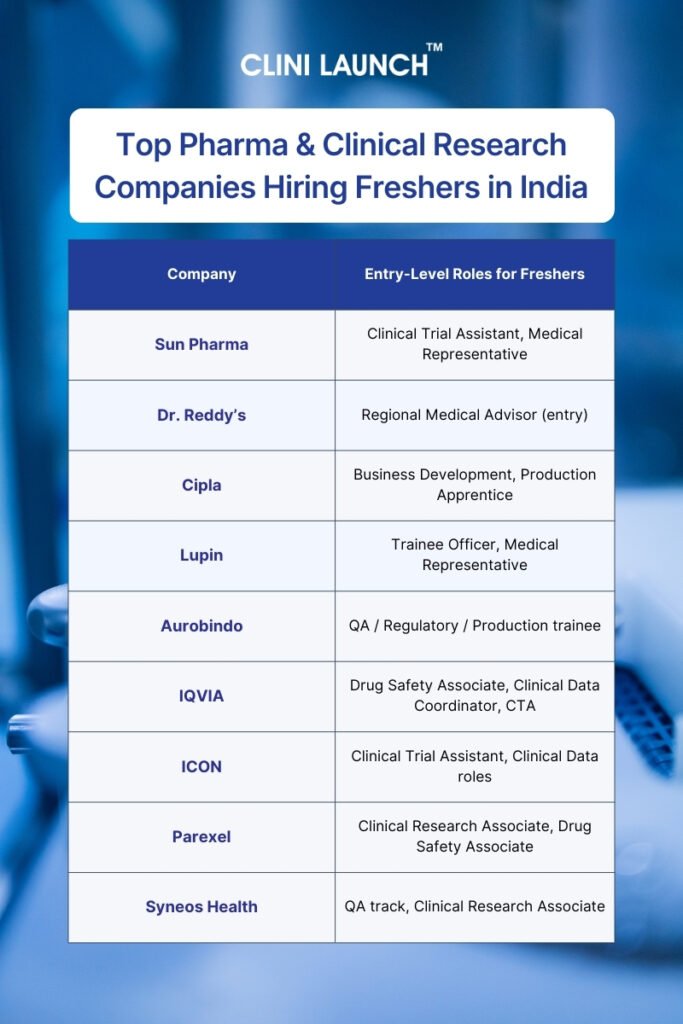
In this blog, we’ll highlight the Top 14 Pharmaceutical, Clinical Research and related companies hiring freshers in India. For the benefit of aspirants, the companies are categorized across core domains like pharmaceuticals, clinical research, pharmacovigilance, and data management, so you can discover where the jobs are and how to tap into them. 

Overview of the Medical Industry and Career Opportunities
The medical industry includes pharmaceutical companies, clinical research organizations, drug safety teams, data management groups, and medical device companies that develop, test, monitor, and regulate medicines and healthcare technologies.

In India, this industry is rapidly growing and offers freshers non-patient-facing careers in clinical research, pharmacovigilance, data analytics, quality, and regulatory roles across global companies.

Scope for Careers in Pharmaceutical and Clinical Research Companies in India 

In India, pharmaceutical exports reached USD 30.47 billion in 2024–25, reflecting robust manufacturing and global demand for Indian medicines and vaccines.  At the same time, the global contract research organisation (CRO) services market was valued at about USD 85.54 billion in 2024 and is projected to grow significantly through the next decade, driven by the increasing outsourcing of clinical trials and R&D activities. These growth trends indicate sustained expansion across pharmaceutical manufacturing, clinical operations, pharmacovigilance, and data management functions. As companies scale their global delivery capabilities, they continue to create structured entry-level opportunities for fresh graduates in regulated, process-driven roles across India. 

Why is the scope for freshers is expanding in Indian Pharma and CRO Space? 

  • Increased global outsourcing of clinical trials and R&D to India 
    Global pharmaceutical sponsors increasingly outsource clinical trials, data management, and regulatory operations to India due to cost efficiency, skilled talent availability, and regulatory experience. This has strengthened India’s position as a preferred destination for CRO-led research activities. 
  • Growth in generic drug exports and vaccine manufacturing 
    India’s strong manufacturing infrastructure and regulatory-approved facilities have boosted generic drug and vaccine exports to global markets. As production volumes rise, companies require trained professionals across quality, regulatory, safety, and operational roles. 
  • Rising demand for pharmacovigilance and regulatory compliance 
    Precise global safety monitoring requirements and evolving regulatory frameworks have increased demand for pharmacovigilance and compliance professionals. Continuous safety reporting and risk management have become core operational functions within pharma and CRO companies. 
  • Digital transformation in clinical data management and biostatistics 
    The adoption of electronic data capture (EDC), remote monitoring, AI-assisted analytics, and centralized trial management has expanded data-focused roles. Organizations now require professionals skilled in structured data handling, statistical programming, and data integrity oversight. 
  • Expansion of Global Capability Centers (GCCs) in India 
    Many multinational pharmaceutical and life sciences companies are expanding their Global Capability Centers in India to manage end-to-end research, safety, and data operations. These centers create consistent hiring pipelines for fresh graduates into standardized, globally aligned roles. 
Advanced Diploma in

Clinical Research 

Build practical, industry-aligned skills to work across real clinical trial environments. Learn how clinical studies are planned, conducted, documented, and monitored, with a strong emphasis on ethics, patient safety, and regulatory compliance throughout the trial lifecycle. 

IN PARTNERSHIP WITH
4.8(3,235 ratings)

Top Pharmaceutical Companies Hiring Freshers in India 

(Drug development & manufacturing) 

These companies focus on discovering, developing, manufacturing, and distributing medicines and vaccines. Freshers are commonly hired into quality, regulatory, safety, production, and clinical support roles. Several pharma companies hiring freshers are building structured early-career pathways, and leading pharmaceutical companies in india continue expanding research and manufacturing investments. Competition among pharma companies hiring freshers in india has increased as global demand rises. Many of these employers collaborate closely with clinical research companies in india to support trial and safety programs. 

1.Sun Pharmaceutical Industries 

Sun Pharmaceutical Industries Ltd (Sun Pharma) is India’s largest pharmaceutical company and a globally recognized leader in generic and specialty medicines. It manufactures, develops, and markets a wide range of pharmaceutical formulations and Active Pharmaceutical Ingredients (APIs) across more than 100 countries, supported by 40+ manufacturing facilities worldwide. The company’s products cover major therapeutic areas such as cardiology, dermatology, neurology, diabetology, oncology, and more, making it a cornerstone of both Indian and global medicine supply chains.  
Sun Pharma commands over 8% of the Indian pharmaceutical market, making it the top domestic pharma player by market share. Its global revenue is around US$ 6.2 billion, reflecting strong manufacturing, R&D, and export capabilities. The company also ranks among the largest specialty generic pharmaceutical firms in the world, trusted by healthcare professionals and patients for high-quality, affordable medicines.  

Career Opportunities for Freshers in Sun Pharmaceutical Industries 
Sun Pharma offers structured early-career opportunities and graduate trainee roles, especially in Clinical trial assistant, medical representative freshers. Fresh graduates can gain experience across cross-functional teams, exposure to regulated pharmaceutical processes, and mentorship from industry experts, making it a strong launchpad for careers in drug development and medical product operations. 

Company Snapshot 

Category Details
Company Size ~43,000+ employees globally (as of 2025)
What They Do Pharmaceutical formulations, generics, APIs, and specialty medicines
Headquarters Mumbai, India
Global Presence Medicines sold in 100+ countries worldwide
Notable Work Leading pharma market share in India with a wide therapeutic portfolio
Roles Hiring Clinical Trial Assistant, Medical Representative (Freshers)
Growth Focus Innovation in specialty generics and global expansion

2. Dr. Reddy’s Laboratories 

Dr. Reddy’s Laboratories Ltd is a major Indian multinational pharmaceutical company headquartered in Hyderabad. Founded in 1984, it manufactures and markets a broad portfolio of generics, branded generics, biosimilars, and APIs (Active Pharmaceutical Ingredients) across key global markets including India, the USA, Europe, and emerging regions. The company’s products span important therapeutic areas such as gastrointestinal, cardiovascular, oncology, respiratory, and dermatology, serving millions of patients worldwide.  
In the fiscal year ending March 31, 2025, Dr. Reddy’s Laboratories reported an annual revenue of over ₹325 billion (~USD 3.9 billion), reflecting year-on-year growth driven by strong demand across markets and diversification of its product portfolio. The company also reported consistent revenue growth (~14% YoY) in the trailing twelve months, highlighting its strong performance and market resilience within the pharmaceutical sector.  

Career Opportunities for Freshers in Dr. Reddy’s Laboratories 
Dr. Reddy’s offers structured early-career roles and graduate trainee opportunities across Regional Medical Advisor. Fresh graduates can gain exposure to regulated drug development processes, global compliance standards, and cross-functional teams, making it a strong platform to build a career in pharmaceutical operations and drug lifecycle management. 

Company Snapshot 

Category Details
Company Size ~27,000+ employees globally
What They Do Generics, branded generics, biosimilars, APIs & OTC products
Headquarters Hyderabad, India
Global Presence USA, Europe, India & emerging markets
Notable Work Broad therapeutic portfolio with consistent revenue growth
Roles Hiring Regional Medical Advisor
Growth Focus Expansion of biosimilars and global generics pipeline

3. Cipla Limited 

Cipla Limited is one of India’s leading multinational pharmaceutical companies, founded in 1935 and headquartered in Mumbai. The company is known for its extensive portfolio of over 1,500 medicines across many therapeutic categories and its global presence spanning more than 80 countries. Cipla focuses on respiratory, anti-infective, urology, cardiology, and chronic disease portfolios, and it continues to expand through strategic launches and strong demand for its products in India and overseas.  
Cipla reported revenue of approximately ₹27,267 crore (around USD 3.25 billion) in FY2025, with consistent double-digit growth in key markets and strong performance in respiratory and chronic care segments. The company also ranks among the top four pharmaceutical companies in India by revenue and holds a strong presence in high-growth markets across Africa and North America. 

Career Opportunities for Freshers in Cipla Limited  
Cipla recruits fresh graduates into roles such as Business Development, Apprenticeship in Production API, offering exposure to regulated pharmaceutical workflows and opportunities to work on large-scale manufacturing and global compliance projects. Its broad product portfolio and global operations make it a great launchpad for careers in drug development and regulated operations. 

Company Snapshot 

Category Details
Company Size ~30,000+ employees globally
What They Do Generics, APIs & therapeutic product portfolios
Headquarters Mumbai, India
Global Presence 80+ countries
Notable Work Wide therapeutic portfolio with robust revenue growth
Roles Hiring Business Development, Apprenticeship in Production API
Growth Focus Respiratory and chronic disease portfolios; global market expansion

4. Lupin Limited 

Lupin Limited is a major Indian multinational pharmaceutical company headquartered in Mumbai, known for producing a wide range of generic medicines, complex generics, and active pharmaceutical ingredients (APIs). Founded in 1968, Lupin has grown into one of the top pharmaceutical players in India and the world, with its products sold in over 100 countries and a strong presence in key markets including India and North America.  
In FY25, Lupin’s India business generated revenues of INR 75,773 million, accounting for about 34 % of its global turnover, and the company ranked as the 8ᵗʰ largest firm in the Indian Pharmaceutical Market (IPM) by value. This reflects Lupin’s strong footprint across chronic therapeutic areas such as cardiology, respiratory, diabetes, and anti-infective medicines.  

Career Opportunities for Freshers in Lupin Limited 
Lupin offers early-career opportunities and graduate trainee roles across Trainee Officer microbiology, Medical Representative. Fresh talent can gain hands-on experience in regulated drug development processes, quality systems, and global compliance frameworks, making it a great launchpad for careers in pharmaceutical operations, data analysis, and compliance. 

Company Snapshot 

Category Details
Company Size ~24,000+ employees globally (as of 2025)
What They Do Generic formulations, APIs, complex generics & therapeutics
Headquarters Mumbai, India
Global Presence Products sold in 100+ countries
Notable Work 8th largest in IPM with a broad therapeutic portfolio
Roles Hiring Trainee Officer (Microbiology), Medical Representative
Growth Focus Expansion in chronic therapy segments and global markets

5. Aurobindo Pharma 

Aurobindo Pharma Ltd is a major Indian multinational pharmaceutical company headquartered in Hyderabad and recognized among the top global generic pharma manufacturers. It develops, manufactures, and markets a wide range of generic formulations, active pharmaceutical ingredients (APIs), biosimilars, and speciality products used in therapy areas such as cardiovascular, anti-infective, anti-diabetic, CNS, and more. The company exports its products to 150+ countries, making it one of India’s most internationally diversified pharmaceutical firms. 
Aurobindo Pharma is ranked among the top 10 generic pharmaceutical companies in the world and has a strong global footprint across North America, Europe, Asia, Africa, and Latin America. In 2025, its consolidated revenues were substantial, reflecting its significant scale in formulations and API manufacturing, and it continues to expand its product portfolio and global partnerships.  

Career Opportunities for Freshers in Aurobindo Pharma 
Aurobindo offers structured graduate and trainee roles in areas such as quality assurance, regulatory compliance, production support, clinical operations, and supply chain analytics. Fresh graduates can benefit from hands-on experience in regulated pharmaceutical manufacturing, global compliance standards, and exposure to large-scale operations, making it an ideal launchpad for careers in the medical industry. 

Company Snapshot

Category Details
Company Size ~40,750+ employees globally (2025)
What They Do Generic drugs, APIs, biosimilars, specialty formulations
Headquarters Hyderabad, India
Global Presence Products sold in 150+ countries
Notable Work Top 10 global generics company with a broad therapeutic portfolio
Roles Hiring Quality, Regulatory, Clinical, Production & Analytics Trainees
Growth Focus Expansion of global markets and diversified therapeutic portfolios
Top Pharma and clinical research companies hiring freshers in india

Top Clinical Research & CROs Hiring Freshers in India 

(Clinical trials & operations) 

These companies manage and execute clinical trials for pharmaceutical and biotechnology firms. Freshers are commonly hired into clinical operations, data management, drug safety, and regulatory support roles. Many clinical research organizations in india work closely with global sponsors to manage multinational trials. A contract research organization in india may take responsibility for monitoring, safety reporting, and data delivery across regions. Several CRO companies in india now operate structured onboarding pipelines, and this model has made clinical research companies in india some of the largest recruiters of trained graduates. Below is a practical list of clinical research organizations frequently known for hiring beginners. 

1.IQVIA 

IQVIA Holdings, Inc. is one of the world’s largest clinical research organizations (CROs), integrating clinical trial services, advanced analytics, and real-world data to support drug development across the full lifecycle. The company works with pharmaceutical, biotechnology, and medical device organizations to manage Phase I–IV clinical trials, regulatory submissions, safety reporting, and real-world evidence generation across global markets. 

IQVIA operates at the intersection of clinical research and data science, using large-scale healthcare datasets and technology platforms to improve trial efficiency, evidence generation, and regulatory decision-making worldwide. 

In FY 2024, IQVIA reported revenue of USD 15.4 billion, reflecting its scale across clinical research, analytics, and life sciences services. The company also maintains one of the world’s largest healthcare data assets, with access to over 1.2 billion anonymized patient records, enabling advanced real-world evidence and outcomes of research used by regulators and life sciences companies globally. 

Career Opportunities for Freshers in IQVIA 

IQVIA offers structured entry-level and graduate roles across Drug Safety Associate, Clinical documentation specialist, Lab Center Project coordinator, Centralized Monitoring Assistant, Clinical Research coordinator, Clinical Data coordinator . Fresh graduates gain exposure to global clinical trials, regulated workflows, and data-driven research platforms, making IQVIA a strong starting point for careers in clinical research, trial operations, and life sciences analytics. 

Company Snapshot

Category Details
Company Size ~88,000+ employees globally
What They Do Clinical trials (Phase I–IV), real-world evidence, analytics, safety & regulatory services
Headquarters Durham, North Carolina, USA
Global Presence Operations across 100+ countries
Notable Work Global clinical trial execution and real-world evidence platforms
Roles Hiring Drug Safety Associate, Clinical Documentation Specialist, Lab Center Project Coordinator, Centralized Monitoring Assistant, Clinical Research Coordinator, Clinical Data Coordinator
Growth Focus Advanced analytics, AI-enabled trials, decentralized and hybrid trial models

2. ICON plc 

ICON plc is a leading global clinical research organization (CRO) that provides outsourced clinical development, trial management, data analytics, and regulatory support services to pharmaceutical, biotechnology, and medical device companies. The company supports drug and therapeutic development across all phases of clinical research (Phase I–IV), helping clients speed up product development and bring safe, effective therapies to market. ICON also integrates advanced healthcare intelligence and digital solutions to optimize trial outcomes and evidence generation.  
In 2024, ICON reported full-year revenues of approximately USD 8.28 billion, reflecting its global scale and leadership in clinical research services. ICON employs around 41,900 professionals across 106 locations in 55 countries, underscoring its expansive global footprint and ability to manage complex multinational trials.  

Career Opportunities for Freshers in ICON PLC 
ICON offers structured early-career opportunities and graduate roles in clinical trial assistant, clinical data management. Fresh graduates gain exposure to regulated workflows, real-world evidence studies, and global healthcare operations, ideal for building a career in research, analytics, and medical product support. 

Company Snapshot 

Category Details
Company Size ~41,900 employees globally (2024)
What They Do Clinical trials (Phase I–IV), data analytics, regulatory & development support
Headquarters Dublin, Ireland
Global Presence 106 locations across 55+ countries
Notable Work Strong global CRO operations and healthcare intelligence solutions
Roles Hiring Clinical Trial Assistant, Clinical Data Management
Growth Focus Integrated research services, digital health, and data-driven trial insights

3. Parexel 

Parexel is a leading global clinical research organization (CRO) that supports pharmaceutical, biotechnology, and medical technology companies in planning, managing, and executing clinical trials (Phase I–IV) and related research functions. The company provides a wide range of services including clinical trial operations, regulatory strategy, data management, biostatistics, pharmacovigilance, and real-world evidence analysis, helping accelerate the development and global approval of new medicines and therapies. 
Parexel operates with a global workforce of about 24,000 professionals, delivering clinical research support in numerous therapeutic areas including oncology, neuroscience, and infectious diseases — making it one of the world’s largest CROs. Additionally, the global clinical trials market was estimated at USD 48.2 billion in 2023 and is expected to grow to USD 73.2 billion by 2027, reflecting the growing scope and demand for CRO services like those Parexel provides.  

Career Opportunities for Freshers in Parexel  
Parexel provides opportunities for fresh graduates through roles such as Clinical Research Associate and Drug Safety Associate. These pathways introduce newcomers to clinical trial conduct, safety monitoring practices, and compliance-focused research environments while working with global teams. The experience supports steady career progression in clinical operations and pharmacovigilance. 

Company Snapshot 

Category Details
Company Size ~24,000+ employees globally (2025)
What They Do Clinical trial services (Phase I–IV), regulatory strategy, data & safety support
Headquarters Raleigh, North Carolina, USA
Global Presence Operates in 80+ countries (clinical sites & offices)
Notable Work Broad scope of clinical research services across therapeutic areas
Roles Hiring Clinical Research Associate, Drug Safety Associate
Growth Focus Global clinical trial delivery, regulatory support, and real-world evidence research

4. Syneos Health 

Syneos Health is a global clinical research organization (CRO) and biopharmaceutical solutions company that provides comprehensive support across clinical trials, data management, Regulatory strategy, and medical affairs. It partners with pharmaceutical, biotech, and medical device firms to help accelerate drug development, optimize trial outcomes, and bring safe, effective therapies to patients worldwide.  
Syneos Health employs around ~28,000 professionals across more than 110 countries, serving clients in clinical research and commercial services. Its integrated model combines clinical trial management with data-driven insights and commercial expertise, reinforcing its position as one of the top CROs in the world.  

Career Opportunities for Freshers in Syneos Health 
Syneos Health provides entry pathways for fresh graduates in areas such as Quality Assurance and Clinical Research Associate tracks, Safety and PV coordinator. These opportunities help newcomers understand regulated research practices, study oversight expectations, and compliance-driven environments while working alongside global teams. The exposure builds a solid base for long-term careers in clinical research and trial operations. 

Company Snapshot

Category Details
Company Size ~28,000+ employees globally (2025)
What They Do Clinical trials, data management, regulatory & commercial services
Headquarters Morrisville, North Carolina, USA
Global Presence Operations across 110+ countries
Roles Hiring Clinical Data Associate, Clinical Research Associate (Trainee Roles), Quality Control Trainee, Drug Safety Associate
Growth Focus Integrated research services and data-driven trial insights

5. Labcorp Drug Development 

Labcorp Drug Development (formerly Covance) is a leading global clinical research organization (CRO) and part of LabCorp’s biopharma services focused on clinical trials, drug development, safety testing, and regulatory support. It helps pharmaceutical and biotech companies accelerate therapies from early-stage research through late-phase clinical trials and approval, combining deep scientific expertise with extensive lab and trial infrastructure.  
Labcorp Drug Development supports drug development services used in major clinical research programs worldwide. Its parent company, Labcorp, achieved annual revenue of USD 13.01 billion in 2024 and employs more than 70,000 people across 100+ countries, reflecting its global scale in diagnostics, drug development, and research services.  

Career Opportunities for Freshers in Labcorp Drug Development  
Labcorp Drug Development offers entry opportunities through roles such as Clinical Project Associate and Clinical Project Coordinator. These positions give fresh graduates exposure to global clinical workflows, trial documentation practices, and coordination activities within regulated research environments. The experience helps build a dependable base for long-term growth in clinical operations and pharmaceutical development. 

Company Snapshot 

Category Details
Company Size Part of Labcorp (~70,000+ employees worldwide)
What They Do Drug development, clinical trials, safety & regulatory support
Headquarters Burlington, North Carolina, USA
Global Presence Services in 100+ countries
Notable Work Comprehensive drug development and clinical trial services
Roles Hiring Clinical Data Coordinators, QC Data Associates
Growth Focus End-to-end clinical trial delivery and regulatory excellence

Top Pharmacovigilance & Drug Safety Companies Hiring Freshers in India 

(Adverse event monitoring & compliance) 

These companies focus on monitoring the safety of medicines and medical products during and after clinical trials. Freshers are commonly hired into drug safety operations, adverse events of case processing, safety data review, signal detection support, and regulatory compliance roles. Large drug safety companies india as well as global pharmacovigilance companies rely on standardized reporting systems. Many of them collaborate closely with clinical research companies in india to maintain continuous safety oversight. 

1. Accenture Life Sciences 

Accenture Life Sciences is the life sciences and healthcare services arm of Accenture, supporting pharmaceutical, biotechnology, and medical device companies across pharmacovigilance, drug safety, regulatory compliance, and clinical operations. The company helps organizations manage adverse event processing, aggregate safety reporting, signal detection support, regulatory submissions, and post-marketing surveillance on a global scale. 

Accenture combines deep domain expertise in drug safety with advanced digital and analytics capabilities, enabling large pharmaceutical companies to modernize and scale their pharmacovigilance operations while meeting strict global regulatory requirements. 

Accenture works with 9 out of the top 10 global pharmaceutical companies, delivering large-scale pharmacovigilance, regulatory, and compliance operations worldwide. With a global workforce of 700,000+ professionals, Accenture supports high-volume, regulated life sciences programs across multiple regions. 

Career Opportunities for Freshers in Accenture Life Sciences  

Accenture provides entry pathways through roles such as Clinical Data Associate and Drug Safety Associate. These positions introduce fresh graduates to clinical and safety data workflows, adverse event documentation, and compliance-focused processes within global delivery environments. Structured training and large-scale systems help build a reliable foundation for long-term growth in clinical research and pharmacovigilance. 

Company Snapshot 

Category Details
Company Size 700,000+ employees globally
What They Do Clinical Data Associate, Drug Safety Associate
Headquarters Dublin, Ireland
Global Presence Operations across 120+ countries
Notable Work Large-scale global PV and regulatory programs for top pharma clients
Roles Hiring Drug Safety Associates, PV Case Processors, Regulatory Support Trainees
Growth Focus PV automation, analytics-led safety operations, and compliance transformation

2. Wipro Life Sciences 

Wipro Life Sciences is the life sciences and healthcare services division of Wipro, supporting pharmaceutical, biotechnology, and medical device companies across pharmacovigilance, drug safety operations, regulatory compliance, and clinical support services. The company helps organizations manage adverse event processing, safety data management, aggregate reporting, regulatory documentation, and post-marketing surveillance at a global scale. 

By combining drug safety domain expertise with technology, analytics, and process automation, Wipro enables life sciences organizations to run compliant, scalable pharmacovigilance operations aligned with global regulatory requirements such as FDA, EMA, and ICH guidelines. 

Wipro reported gross revenue of approximately USD 10.8 billion in FY 2024, reflecting its scale as a multinational services company delivering regulated life sciences, pharmacovigilance, and compliance operations worldwide. 

Career Opportunities for Freshers in Wipro Lifesciences  

Wipro provides entry opportunities for fresh graduates through positions such as Drug Safety Associate and Drug Safety Analyst. These roles offer practical exposure to safety case handling, pharmacovigilance operations, regulatory documentation, and compliance-driven workflows. With structured training and global systems, newcomers gain the foundation needed to build long-term careers in drug safety. 

Company Snapshot 

Category Details
Company Size 230,000+ employees globally
What They Do Pharmacovigilance, drug safety operations, regulatory & compliance services
Headquarters Bengaluru, India
Global Presence Operations across multiple continents
Notable Work Large-scale global PV and regulatory programs
Roles Hiring Drug Safety Associates, Drug Safety Analyst
Growth Focus PV automation, analytics-driven safety operations, and compliance transformation

Top Clinical Data Management & Biostatistics Companies ring Freshers in India 

(Trial data, SAS, analytics) 

These companies manage and analyze clinical trial data using SAS and statistical methods. Freshers typically enter through CDM, SAS programming, and biostatistics to support roles. Clinical data management companies play a critical role in preparing submission-ready information, and many of these opportunities later grow into specialized clinical data management roles. Sponsors and clinical research companies in india rely heavily on accurate datasets for regulatory approval. 

1. Medpace 

Medpace is a global full-service Clinical Research Organization (CRO) known for its fully in-house clinical data management and biostatistics teams. Unlike many CROs that outsource data functions, Medpace maintains integrated CDM, SAS programming, and biostatistics operations, allowing tighter control over trial data quality and regulatory readiness. The company has strong expertise in oncology, CNS, metabolic, and cardiovascular studies, where data accuracy and statistical rigor are critical. 

Medpace reported annual revenue exceeding USD 2.0 billion, reflecting consistent growth driven by complex, data-intensive and late-phase clinical trials. Its fully in-house data and statistics model is widely regarded as a key differentiator, particularly for regulatory-focused studies and submission-ready datasets. 

Career Opportunities for Freshers in Medpace  

Medpace offers accessible entry-level pathways through positions such as Data Coordinator and Assistant Clinical Data Analyst. These roles help newcomers build hands-on familiarity with clinical trial datasets, data review practices, CDISC expectations, and regulator-ready workflows. The experience supports steady growth toward long-term careers in clinical data management and biostatistics. 

Company Snapshot 

Category Details
Company Size ~5,000+ employees globally
What They Do Clinical data management, biostatistics, SAS & trial analytics
Headquarters Cincinnati, Ohio, USA
Global Presence Operations across North America, Europe & Asia
Notable Work In-house CDM & biostatistics teams; late-phase and regulatory trials
Roles Hiring Data Coordinator, Assistant Clinical Data Analyst
Growth Focus Data-driven trials, regulatory submissions, and complex study analytics
Advanced Diploma in

Biostatistics 

Build strong foundations in statistical methods used in clinical research and healthcare studies. Learn how clinical trial data is analyzed, interpreted, and validated to support evidence-based decisions and regulatory submissions. 

IN PARTNERSHIP WITH
4.8(3,235 ratings)

2. Quanticate 

Quanticate is a global data-focused clinical research organization (CRO) specializing in clinical data management, biostatistics, SAS/statistical programming, and data analytics for pharmaceutical, biotech, and medical device companies. It delivers expert statistical services, clinical data capture, reporting, and real-world evidence analytics to support regulatory-ready clinical trial outcomes and submission-quality datasets.  
Quanticate is recognized as a leading global data-centric biometric CRO, supporting comprehensive clinical data and biostatistics services that help sponsors transform raw clinical data into high-quality outputs for regulatory filings and scientific reporting across major therapeutic areas. The company operates multiple global offices — including locations in the UK, US, Canada, India, Poland, and South Africa — demonstrating its international footprint in life sciences data services.  

Career Opportunities for Freshers in Quanticate  

Quanticate provides structured opportunities in roles such as medical writing, data process associate, and statistical programming. These positions allow new professionals to work with regulatory-compliant clinical trial data, understand industry workflows, and collaborate with global research teams. The exposure builds practical knowledge, strengthens technical confidence, and creates a solid pathway toward long-term growth in clinical research, analytics, and biostatistics. 

Company Snapshot 

Category Details
Company Size ~280+ professionals globally (2025, est.)
What They Do Clinical data management, biostatistics, SAS/statistical programming & analytics
Headquarters Hitchin, United Kingdom
Global Presence UK, USA, Canada, India, Poland, South Africa
Notable Work Data capture, statistical analysis, and reporting for clinical trials
Roles Hiring Medical Writer, SAS/Statistical Programmers, Data Process Associate
Growth Focus Advanced analytics, real-world data, and evidence-based insights

Conclusion 

Breaking into the medical industry doesn’t require a clinical background or patient-facing experience. What it does require is an understanding of how medicines, trials, data, and safety systems work together behind the scenes. From pharmaceutical manufacturing and clinical research to drug safety, data management, and clinical technology platforms, this industry runs process, precision, and compliance, and that’s exactly where fresh graduates can build meaningful careers. 

For many learners, this becomes the gateway to long-term pharma industry careers india. 

For those starting out, the key is not just choosing a company but choosing the right domain and learning path. Each area highlighted in this blog offers a different kind of exposure, learning curve, and growth trajectory. Building a strong foundation in clinical research concepts, regulatory workflows, and industry practices can make entry into these roles far more structured and confident. Understanding how clinical research companies in india operate helps fresh graduates choose the right preparation strategy. 

This awareness also improves how candidates target clinical research jobs india in a competitive market. 

For freshers looking to prepare themselves for these opportunities, enrolling in a structured program like the CliniLaunch’s Advanced Diploma in Clinical Research can help bridge the gap between academic knowledge and real-world industry expectations making the first step into the medical industry clearer and more achievable. These skills are exactly what recruiters across clinical research companies in india look for in entry candidates. 

FAQs 

1. What is the medical industry?  

The medical industry includes companies that develop, test, manufacture, monitor, and regulate medicines, vaccines, diagnostics, and medical devices before they reach patients. 

2. How is the medical industry different from the healthcare industry? 

The medical industry focuses on creating and validating medical products, while the healthcare industry focuses on delivering care to patients through hospitals and clinics. 

3. Can freshers get jobs in the medical industry? 

Yes. Many entry-level roles in clinical research, drug safety, data management, quality, and regulatory support are designed specifically for fresh graduates 

4. What qualifications are required to enter the medical industry? 

Most entry roles require degrees in life sciences, pharmacy, biotechnology, statistics, or related fields, along with basic understanding of regulated industry workflows. 

5. Which medical industry domain is best for freshers? 

Clinical research, pharmacovigilance, clinical data management, and medical coding are the most beginner-friendly domains due to structured processes and clear workflows. 

6. What are the best entry-level roles in the medical industry? 

Common entry-level roles include Clinical Research Coordinator, Clinical Data Associate, Drug Safety Associate, Medical Coder, and Regulatory Support Executive. 

7. Is clinical research a good career for beginners? 

Yes. Clinical research offers structured career paths, global demand, and non-patient-facing roles focused on documentation, compliance, and trial operations. 

8. Can non-science graduates enter the medical industry? 

Yes. Roles such as medical coding, data operations, and regulatory documentation are accessible to non-science graduates with industry-focused training. 

9. What is the average salary for freshers in the medical industry in India? 

Freshers typically earn between ₹2.5 and ₹5.5 LPA, depending on the role, domain, and company. 

Yes. Continuous global demand for medicines, clinical trials, safety monitoring, and medical technologies makes the medical industry a stable long-term career choice. 
10. Is the medical industry a stable career option? 

Yes. Continuous global demand for medicines, clinical trials, safety monitoring, and medical technologies makes the medical industry a stable long-term career choice. 
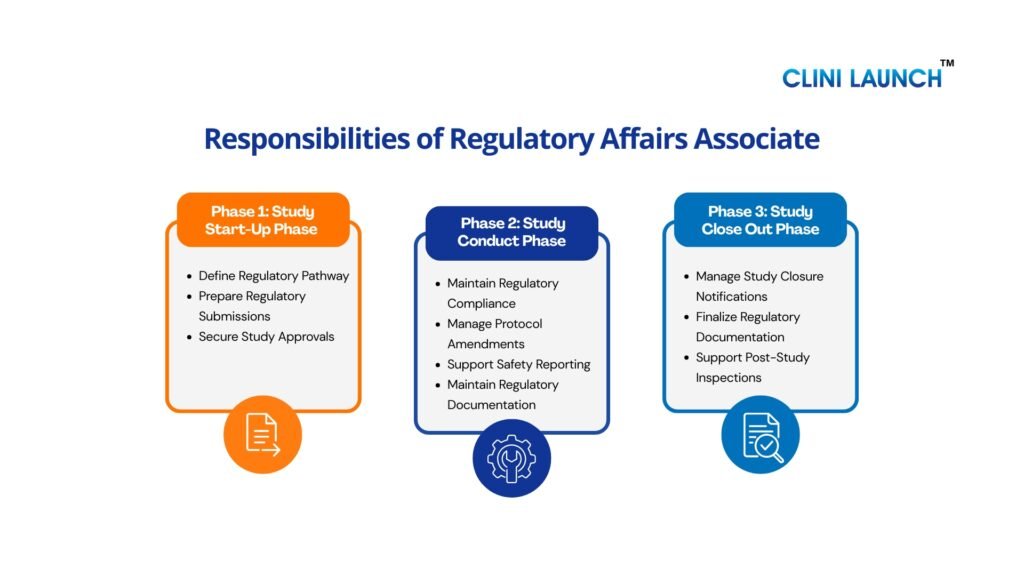
Clinical Project Associate
A Clinical Project Associate (CPA) supports clinical trial operations by managing study documentation, coordinating project activities, supporting sites and vendors, and ensuring compliance with GCP and regulatory standards. The role serves as an entry point into clinical research operations and project management.

A Clinical Project Associate (CPA) supports the execution of clinical trials by assisting Clinical Project Managers with core operational tasks. The role primarily involves managing study documentation, tracking project timelines, coordinating activities across sites and teams, and supporting regulatory compliance throughout the clinical trial lifecycle.  

CPAs work across multiple phases of a clinical trial and support routine operational workflows that help maintain alignment with planned study processes. Their involvement spans different trial stages, ensuring continuity across ongoing activities. 

Over the past two decades, clinical research roles have become more complex, with greater emphasis on documentation control, timeline tracking, and regulatory compliance. These evolving demands closely align with the core responsibilities of Clinical Project Associates.  

A Clinical Project Associate (CPA) supports clinical trial operations by managing study documentation, coordinating project activities, supporting sites and vendors, and ensuring compliance with GCP and regulatory standards. The role serves as an entry point into clinical research operations and project management. 

A Clinical Project Associate is a central operational professional within the clinical trial team who ensures consistency, coordination, and control across trial activities. CPAs act as a link between project managers, clinical sites, vendors, and internal teams, enabling smooth communication and task execution. 

The importance of the CPA role lies in its ability to prevent delays, reduce errors, and maintain audit readiness. By keeping documentation accurate, timelines visible, and communication aligned, CPAs help ensure that clinical trials move efficiently from study start-up to close-out, supporting the timely development of new treatments. 

While both roles support clinical trials, Clinical Project Associates (CPAs) and Clinical Research Associates (CRAs) have different responsibilities. A CPA focuses on project coordination, documentation, timeline tracking, and operational support, working closely with project managers, sites, and vendors to keep studies organized and compliant. 

In contrast, a CRA is primarily responsible for site monitoring activities, including site visits, source data verification, and ensuring protocol adherence at investigational sites. CRAs work directly with trial sites, while CPAs operate more from a central, coordination-based role. 

In simple terms, CPAs manage trial operations from behind the scenes, while CRAs oversee trial conduct at the site level. 

A CPA is responsible for supporting the coordination and smooth execution of clinical trials, ensuring that operational tasks are completed efficiently, on schedule and in compliance with regulatory standards. CPA roles and responsibilities include supporting documentation, timelines, coordination, and compliance. Below are the core roles and responsibilities of a CPA: 

Clinical trials generate large volumes of documents, and even minor documentation errors can delay approvals or trigger audit findings. CPAs are responsible for ensuring that every document is accurate, complete, current, and compliant with regulatory standards. 

They help prepare, organize, and maintain essential study documents such as protocols, informed consent forms, investigator brochures, and regulatory submissions. By properly indexing and maintaining study master files, CPAs make sure that documents are easily retrievable during audits, inspections, or sponsor reviews. These clinical project associate duties form the foundation of trial documentation control. This process ensures effective project documentation management throughout the study. 

Task Explanation
Ensure Regulatory Compliance of Documents CPAs ensure clinical trial documents are accurate, complete, and compliant with GCP and regulatory standards.
Prepare and Organize Study Files CPAs prepare and organize study documents (e.g., protocols, consent forms) and ensure proper indexing and storage for easy audit access.
Trial Master File (TMF) Maintenance CPAs organize and index study documents to maintain the TMF and ensure readiness for audits and inspections.

Clinical trials run on strict timelines, and delays at any stage can impact costs, patient recruitment, and regulatory submissions. CPAs support project managers by tracking milestones, monitoring progress, and flagging risks early. 

They coordinate activities across teams, help organize meetings, and ensure that assigned tasks are completed as planned. When delays occur, CPAs assist in identifying the cause and work with the team to adjust timelines or re-prioritize activities. 

Task Explanation
Track Project Progress CPAs ensure project milestones are achieved on time and assist in adjusting plans if there are delays.
Monitor Project Timelines CPAs ensure tasks remain on schedule and adjust timelines when necessary to meet project goals.
Coordinate Team Activities CPAs organize team meetings and ensure activities align with project objectives and deadlines, keeping all team members on track.
Identify and Address Delays CPAs proactively identify delays and collaborate with the team to resolve issues quickly.

Clinical trial sites and vendors play a crucial role in study execution, and CPAs support their readiness and compliance. During site initiation, CPAs help ensure that all required documents, supplies, and systems are in place before patient enrolment begins. Vendor coordination is a core responsibility during trial execution. 

They also assist in tracking site performance metrics, monitoring protocol adherence, and identifying compliance issues. When deviations or gaps are observed, CPAs support follow-up actions and documentation. CPAs play a key role during study start up activities at trial sites. 

Task Explanation
Support Site Initiation and Setup CPAs prepare clinical trial sites with required documents, supplies, and equipment to ensure readiness for patient enrolment.
Monitor Site Performance and Compliance CPAs monitor site activities to ensure protocol compliance, track performance metrics, and address any non-compliance issues.

CPA may not be the right fit if you prefer working independently with minimal coordination, or if frequent follow-ups, timelines, and documentation feel draining. But if you’re organized, proactive, and enjoy keeping complex clinical work on track, this role can be a strong and rewarding starting point in the industry. 

Accurate and complete data is the foundation of every clinical trial outcome. CPAs assist in data collection, data entry, and verification, ensuring that trial data is consistent, traceable, and ready for analysis. These activities contribute to ongoing regulatory compliance support. 

They also support the preparation of progress reports, safety reports, and final study reports that are reviewed by sponsors and regulatory authorities. While they may not perform statistical analysis, CPAs ensure that data flows correctly from sites to databases and into reports without gaps or inconsistencies.

Task Explanation
Assist in Data Collection and Entry CPAs ensure accurate data collection, entry, and verification while maintaining data completeness and consistency.
Support Report Preparation CPAs assist in preparing progress, safety, and final study reports for review by sponsors and regulatory authorities.

Clinical trials involve multiple stakeholders project managers, monitors, investigators, sponsors, vendors, and internal teams. CPAs act as communication facilitators, ensuring that information flows clearly and on time. 

They organize meetings, circulate updates, track action items, and prepare status reports that help teams stay informed. By supporting internal communication, CPAs reduce confusion, prevent misalignment, and help teams respond quickly to changes or issues. 

Task Explanation
Cross-functional Team Coordination CPAs coordinate team communication by organizing meetings and sharing project information with stakeholders, sponsors, and site teams.
Support Internal Project Team CPAs support internal project teams with updates, status reports, and clear communication to ensure access to necessary project information.

CPAs play a supportive role in training site personnel and internal teams on study protocols, GCP requirements, and trial processes. This ensures that everyone involved understands their responsibilities and follows standardized procedures. This ensures consistent SOP adherence across study teams. 

In addition, CPAs are expected to continuously stay updated on regulatory changes, evolving trial methodologies, and industry best practices. This ongoing learning helps them maintain compliance and contribute effectively to trial execution. 

Task Explanation
Assist with Training Site Personnel CPAs train site staff and project teams on study protocols, GCP standards, and processes to ensure compliance and data accuracy.
Stay Updated with Industry Regulations CPAs stay informed about regulatory changes, trial methodologies, and industry standards to maintain ongoing compliance.
PG Diploma in

Clinical Research

Gain in-depth understanding of how clinical trials operate across pharma companies, CROs, and research sites. This program focuses on the practical execution of clinical studies, ethical conduct, documentation, and regulatory compliance across the clinical trial lifecycle. 

IN PARTNERSHIP WITH
4.8(3,235 ratings)

A Clinical Project Associate begins the day by checking project updates and understanding what needs to be completed to keep the clinical trial on track. They review timelines, follow up on pending tasks, and ensure that study activities are progressing as planned. 

As the day continues, the CPA focuses on organizing and updating study documents. Trial files are reviewed for accuracy, new documents are filed correctly, and everything is kept ready for audits and inspections. Documentation control remains a constant responsibility throughout the day. 

The CPA then supports coordination between teams by sharing updates, tracking action items, and assisting with meeting follow-ups. Communication with clinical sites and external partners helps ensure that study requirements are met and any issues are documented and addressed. 

Before the day ends, the CPA updates trackers and reports, ensuring that all activities are recorded and visible to the project team. By maintaining order, coordination, and compliance, the CPA helps the clinical trial move forward smoothly. 

A bachelor’s degree in life sciences, health sciences, pharmacy, nursing, or a related field is required for the role. A master’s degree, such as an MSc in Clinical Research or an MPH, is preferred for more advanced or competitive positions. Certifications or training in clinical research, project management, or regulatory compliance (e.g., GCP certification) are also valuable. Additionally, some prior experience in clinical trial operations, clinical research coordination, data management, or a related field is beneficial. 

This role requires strong organizational and communication skills, attention to detail, and basic project management abilities essential for clinical project associate jobs. Knowledge of ICH GCP guidelines with trial tools (CTMS, spreadsheets) are essential for compliance. Adaptability and problem-solving skills are also crucial for managing changing trial demands and operational issues. Familiarity with a clinical trial management system is beneficial. 

Clinical Project Associates (CPAs) play a vital role in the smooth execution of clinical trials. They manage key tasks such as documentation, project coordination, site management, and data handling, ensuring that trials stay on track and comply with regulatory standards. CPAs are essential to maintaining trial efficiency, reducing delays, and supporting the timely delivery of new treatments. Their contributions are indispensable for the successful progression of clinical research, making them integral to the overall success of clinical trials. 

If you’re interested in pursuing a career in clinical research and becoming a vital part of clinical trials, the PG Diploma in Clinical Research by Clinilaunch providing excellent opportunity to gain the knowledge and skills needed to succeed. 

Yes. CPAs often support more than one study simultaneously, depending on trial complexity and organization structure. This helps them gain broader exposure to different trial phases and processes. 

No. Many organizations hire freshers or trained candidates for CPA roles. Relevant training, understanding of clinical trial workflows, and documentation practices are often more important than prior experience. 

CPAs usually do not communicate directly with regulatory authorities. However, they support regulatory submissions and documentation that are reviewed by sponsors or regulatory teams. 

Yes. Many CPA roles are office-based or remote, especially in CROs and sponsor companies, as the work primarily involves coordination, documentation, and system-based activities. 

Performance is commonly assessed based on documentation accuracy, timeline adherence, task follow-up, communication quality, and audit readiness support rather than field-based activities. 

The CPA role is operational rather than purely administrative. It requires understanding clinical trial processes, regulatory expectations, and coordination of workflows, not just routine office work. 

No programming skills are required. Basic proficiency in spreadsheets, document management systems, and clinical trial tools is sufficient for most CPA roles. 

Yes. With experience, CPAs can move into regulatory affairs, trial operations, quality assurance support, or training roles within clinical research organizations. 

Core responsibilities remain similar, but the exact scope can vary between sponsors, CROs, and research sites depending on organizational structure and trial scale. 

Typically, professionals can progress to senior or coordination roles within 2–4 years, depending on performance, exposure to multiple studies, and organizational opportunities. 

The role of a Clinical Data Manager (CDM) is to make sure clinical trial data is accurate, complete, and compliant. Clinical Data Managers set up EDC systems, design CRFs, check data quality, manage queries, and support database lock so the data can be safely analyzed and reviewed by regulators. 

PG Diploma in

Clinical Research

Gain in-depth understanding of how clinical trials operate across pharma companies, CROs, and research sites. This program focuses on the practical execution of clinical studies, ethical conduct, documentation, and regulatory compliance across the clinical trial lifecycle. 

IN PARTNERSHIP WITH
4.8(3,235 ratings)
Site monitoring in clinical trials is the process of overseeing study conduct at investigator sites to ensure protocol compliance, patient safety, data accuracy, and regulatory compliance. It is primarily carried out by Clinical Research Associates through planned monitoring visits across the trial lifecycle.

Site monitoring in clinical trials is a critical control mechanism that ensures a study is conducted exactly as approved. It exists to confirm that clinical trial activities follow the protocol, meet regulatory compliance requirements, and uphold ethical standards throughout the trial lifecycle. 

At the center of this process is the Clinical Research Associate (CRA), who serves as the operational link between the sponsor and the investigator site. Through structured site monitoring visits, the CRA verifies that patient safety is protected, trial data is accurate and traceable, and essential documents are properly maintained. 

Errors in trial conduct or documentation, if left undetected, can compromise data integrity, delay regulatory submissions, or raise serious compliance concerns during inspections. For this reason, site monitoring in clinical trials is not a routine formality. It is a safeguard that supports clinical trial oversight and ensures that studies generate reliable and credible results. 

This blog explains what site monitoring in clinical trials involves, the different types of clinical trial monitoring used in practice, and the step-by-step site monitoring process followed from site setup to study close-out, supported by a real-world case example. 

Clinical trial monitoring is a systematic process used to ensure that a clinical study is conducted, recorded, and reported in accordance with the approved protocol, Good Clinical Practice (GCP), regulatory requirements, and ethical principles. 

In practical terms, clinical trial monitoring functions as an ongoing quality control activity. It focuses on verifying that participant rights and safety are protected, that adverse event reporting is accurate and timely, and that trial data reflects what actually occurred at the site. This includes reviewing source documents, confirming protocol compliance, and ensuring that deviations are identified, documented, and addressed appropriately. 

An important aspect of site monitoring in clinical trials is its role in maintaining regulatory inspection readiness. Well-monitored sites are more likely to demonstrate compliance because essential documents, such as the Investigator Site File and Trial Master File, are kept current and complete. Through regular monitoring, sponsors gain confidence that the trial is being conducted as intended and that the data generated can withstand regulatory review. 

What is site monitoring

Clinical trials differ in complexity, risk profile, geographic spread, and data volume. For this reason, site monitoring in clinical trials is not performed using a single fixed approach. Instead, different types of clinical trial monitoring are applied based on study needs, regulatory expectations, and risk assessment outcomes. 

Each monitoring method serves a specific purpose, and in practice, most trials use a combination rather than relying on only one approach. 

On-site monitoring is the traditional and most direct form of site monitoring in clinical trials. In this approach, the Clinical Research Associate conducts monitoring visits by physically visiting the investigator site. These visits allow the CRA to directly observe trial conduct and verify that study procedures are being followed exactly as described in the protocol. 

During an on-site monitoring visit, the CRA reviews source documents to perform source data verification, checks informed consent documentation, assesses adverse event reporting, and evaluates drug accountability and storage conditions. Essential documents maintained in the Investigator Site File are also reviewed to confirm regulatory compliance. 

Because the CRA is present at the site, on-site monitoring allows for immediate clarification of issues and direct interaction with site staff. However, it is time-intensive and contributes significantly to monitoring-related costs in clinical trials. 

Remote site monitoring allows the CRA to conduct monitoring activities without physically visiting the site. Instead, monitoring is performed using secure electronic systems such as Electronic Data Capture platforms, electronic Trial Master Files, and Clinical Trial Management Systems. 

Through remote monitoring, the CRA can review trial data, track protocol deviations, assess documentation completeness, and follow up on monitoring findings in a timely manner. This approach improves efficiency, reduces travel requirements, and allows more frequent data review compared to traditional on-site visits. 

Remote site monitoring is particularly effective for ongoing data checks and document reviews. However, it has limitations when it comes to verifying physical processes, investigational product handling, and site facilities. 

Centralized monitoring is a data-focused approach in which study data from all participating sites is reviewed centrally by the sponsor or contract research organization. Using statistical tools and data analytics, centralized monitoring helps identify trends, outliers, missing data, or unusual patterns that may indicate quality or compliance issues. 

This method supports early risk detection across multiple sites and enhances overall clinical trial oversight. Centralized monitoring is especially useful in large, multi-center studies where consistent site-level issues may not be immediately visible through individual monitoring visits. 

While centralized monitoring strengthens trial-level oversight, it does not replace site-level verification and is typically used alongside on-site or remote monitoring. 

Risk-based monitoring is an approach that focuses monitoring efforts on the aspects of a trial that pose the greatest risk to participant safety and data integrity. Instead of applying the same level of monitoring to all sites and activities, RBM uses predefined risk assessments and ongoing data evaluation to guide monitoring intensity. 

Under risk-based monitoring, high-risk processes such as informed consent, primary endpoint data, and safety reporting receive greater attention, while lower-risk activities may be monitored less frequently. This approach allows resources to be used more effectively while maintaining regulatory compliance. 

RBM typically combines centralized monitoring, remote monitoring, and targeted on-site monitoring as part of a structured site monitoring plan. 

Hybrid monitoring combines elements of on-site and remote monitoring. In this approach, critical activities such as source data verification, informed consent verification, and drug accountability are performed during on-site visits, while routine data reviews and document checks are handled remotely. 

Hybrid monitoring provides a balanced approach, maintaining oversight of high-risk areas while improving efficiency. As clinical trials increasingly adopt digital systems, hybrid monitoring has become a widely used model in modern studies. 

Monitoring Type Where It Happens Key Activities Strengths Limitations
On-Site Monitoring At the clinical trial site SDV, IP checks, IC review, facility observation Most comprehensive; direct oversight Time-consuming; travel cost
Remote Monitoring Off-site (online review) EDC review, document checks, communication Fast, cost-effective, continuous access Limited ability to verify physical processes
Centralized Monitoring Sponsor/CRO central systems Data analytics, trend checks, anomaly detection Early detection of deviations across sites Does not replace site-level verification
Risk-Based Monitoring (RBM) Combination of methods Risk assessment, targeted checks Optimizes resources; focuses on critical risks Requires strong data systems & planning
Hybrid Monitoring Mix of on-site + remote Critical tasks on-site, routine tasks remote Balanced efficiency and quality Coordination needed between monitoring types

The site monitoring process in clinical trials follows a structured sequence of visits conducted across the study lifecycle. Each stage serves a distinct purpose, but together they ensure protocol compliance, patient safety monitoring, and data integrity from study start to closure. 

The Clinical Research Associate is responsible for planning, executing, documenting, and following up on these monitoring activities as part of ongoing clinical trial oversight. 

The Pre-Study Visit is conducted before a site is authorized to participate in a clinical trial. Its primary objective is to assess whether the site is capable of conducting the study in accordance with the protocol and regulatory requirements. 

During the PSV, the CRA evaluates the site’s infrastructure, including clinical facilities, investigational product storage areas, and data handling systems. The qualifications and experience of the investigator and site staff are reviewed to ensure they are appropriate for the study. The CRA also assesses whether the site can manage essential documents, adverse event reporting, and patient records in a compliant manner. 

This visit plays a preventive role. By identifying gaps early, the CRA can guide the site on corrective actions before trial initiation, reducing the risk of compliance issues later in the study. 

What is site monitoring

The Site Initiation Visit formally marks the transition from site preparation to active trial conduct. At this stage, the CRA ensures that the site fully understands the study requirements and is ready to enroll participants. 

During the SIV, the CRA reviews the approved protocol in detail with the site team, explaining study objectives, eligibility criteria, visit schedules, and safety reporting expectations. Training is provided on informed consent procedures, data entry into the EDC system, and handling of investigational products. The CRA also confirms that all essential documents are in place and that the site monitoring plan is clearly understood. 

A well-executed SIV establishes consistency in trial conduct and reduces the likelihood of protocol deviations during enrollment and follow-up. 

Routine monitoring visits are conducted at regular intervals throughout the trial and represent the core of site monitoring in clinical trials. These visits allow the CRA to verify that the study continues to be conducted as approved. 

During routine monitoring visits, the CRA reviews participant eligibility, confirms that informed consent was obtained correctly, and monitors patient safety through adverse event reporting. Data entered into the CRF or EDC system is compared with source documents as part of source data verification. The CRA also reviews the Investigator Site File to ensure that essential documents remain current and complete. 

Any issues identified during these visits are documented as monitoring findings. The CRA works with the site to resolve these issues and, where necessary, supports corrective and preventive actions to prevent recurrence. 

The Close-Out Visit is conducted once all trial activities at the site have been completed. The purpose of this visit is to ensure that the site has fulfilled all protocol, regulatory, and documentation requirements before the study is formally closed. 

During the close-out visit, the CRA confirms that all data queries have been resolved and that the study data is complete and accurate. Essential documents are reviewed to ensure proper archiving, and regulatory compliance is verified. The CRA also ensures that investigational products are returned or destroyed according to the protocol and applicable regulations. 

This final monitoring stage ensures that the site is prepared for audits or inspections and that the study can progress confidently toward analysis and reporting.  

This case illustrates how effective site monitoring in clinical trials directly protects data quality and scientific validity. 

During a routine monitoring visit, the Clinical Research Associate observed that a study participant scheduled for a Day 5 visit arrived nearly two hours later than planned. Despite the delay, the site staff proceeded with dosing and pharmacokinetic (PK) or pharmacodynamic (PD) sample collection without documenting the deviation or questioning its impact. 

At first glance, the situation appeared operationally minor. However, in clinical trials involving PK or PD assessments, sample timing is critical. Even small deviations can significantly affect data interpretation. 

When the CRA later reviewed the source documents, a serious discrepancy became evident. The visit was documented as if it had occurred exactly according to the protocol-defined schedule. There was no record of the delayed arrival, no protocol deviation reported, and the PK or PD sample times were recorded based on planned rather than actual collection times. 

This meant that the recorded data did not accurately reflect what occurred at the site. Because PK analyses depend on precise timing relative to dosing, the inaccurate documentation had the potential to distort the participant’s concentration profile and compromise the scientific integrity of the dataset. 

Having directly observed the deviation, the CRA escalated the issue to the Principal Investigator and the sponsor. The CRA ensured that the source documents were corrected to reflect the actual visit and sample collection times and that a formal protocol deviation was documented. 

In addition, the CRA supported corrective and preventive actions. These included targeted protocol and GCP retraining for the site staff and the introduction of a checklist to reinforce real-time documentation during critical visits. These actions were aimed at preventing similar issues in future visits. 

What is site monitoring

Because the issue was identified and addressed promptly, inaccurate PK data was prevented from entering the final analysis. The CRA’s intervention preserved the reliability of the study data and supported regulatory compliance. 

This case highlights the value of routine monitoring visits and demonstrates how vigilant site monitoring helps protect patient safety, data integrity, and overall trial credibility. It also reinforces why site monitoring is a critical safeguard rather than a procedural formality. 

Site monitoring is one of the most operationally critical functions in clinical trials. It is where protocol design, regulatory expectations, and real-world site execution intersect. Understanding how site monitoring works—across different monitoring types and visit stages—provides a practical view of how clinical trials are actually controlled and safeguarded. 

For individuals looking to enter clinical research, this knowledge is not optional. Roles such as Clinical Research Coordinator, Clinical Trial Assistant, and Clinical Research Associate all require a working understanding of site monitoring, protocol compliance, essential documentation, and patient safety oversight. 

At CliniLaunch Research Institute, the PG Diploma in Clinical Research is designed to build this exact operational understanding. The program focuses on real clinical trial workflows, including site monitoring processes, CRA responsibilities, regulatory compliance, and inspection readiness—preparing learners to function confidently in entry-level and growing clinical research roles. 

For those aiming to move from academic knowledge to industry-ready capability, structured training aligned with real trial operations makes the difference. 

The sponsor, often with input from the CRO, defines the site monitoring plan. This plan outlines the monitoring approach, visit frequency, and responsibilities based on study risk and complexity. 

Yes. Some form of site monitoring is required for all interventional clinical trials. The method may vary, but oversight of site activities is always expected by regulators. 

In some studies, monitoring may rely more on remote or centralized methods. However, critical activities such as informed consent and investigational product handling usually still require on-site verification at some stage. 

Unresolved monitoring findings can lead to protocol deviations, regulatory observations, delayed approvals, or rejection of trial data during inspections. 

Monitoring findings are recorded in a monitoring visit report. The site is required to respond, and corrective and preventive actions are tracked until closure. 

No. Site monitoring is a routine oversight activity. Audits and regulatory inspections are independent reviews conducted by sponsors or authorities to assess overall compliance. 

The CRA leads monitoring activities, but investigators and site staff are responsible for correcting issues and maintaining compliance at the site. 

Most academic programs focus on theory, while site monitoring involves operational decision-making, documentation control, and real-time risk management that are learned through practice. 

Imagine spending years discovering protein or weeks on data analysis for a clinical trial. This delay could set research back by years.  

Today, the life sciences industry is being transformed by advanced tools that streamline research, clinical trials, bioinformatics, and healthcare management. For instance, AlphaFold has predicted over 200 million protein structures in 2023, revolutionizing how researchers approach drug discovery and disease understanding. Meanwhile, platforms like Medidata and Oracle Clinical manage over 36,000 clinical trials, cutting down study build times from 12 weeks to just a few days, dramatically improving the speed and efficiency of clinical trials. 

Despite the availability of these tools for life science industry, there is a growing shortage of professionals skilled in their use. According to recent surveys, 85% of life sciences companies report difficulty finding skilled employees in bioinformatics, AI, machine learning, and data analytics. These skills are vital for making sense of the vast amounts of data generated in genomics, clinical research, and drug development. 

As the demand for professionals proficient in tools like BLAST, SAS, GraphPad Prism, TensorFlow, and LIMS rises, so do the career opportunities. The need for specialized training has never been more critical, as these tools continue to shape the future of healthcare, research, and medical advancements. 

Clinical trials and research are fundamental to advancing medical science and bringing new therapies to market. The tools used in these processes are vital in ensuring the integrity, efficiency, and regulatory compliance of studies. Below, we will break down each of the key tools for life science industry involved in clinical research management software: 

Medidata is a unified clinical‑trial software platform that supports electronic data capture (EDC), data management, patient experiences, and trial analytics. It’s hugely adopted — powering over 36,000 clinical trials, involving 11 million+ patients, across more than 2,300 customers globally, and was used in 72% of the FDA’s novel drug approvals in 2024. 

Category Medidata 
What It Does Medidata is a cloud-based platform for clinical trial data management
Who Uses This Clinical Data Managers, Clinical Research Associates (CRA), EDC Programmers, Systems Analysts 
How to Learn the Tool Learn through Medidata Academy, Coursera, or edX courses. Practice by building databases and automating trial workflows. 
Why Learn Medidata Learning Medidata, a leading EDC platform, can bring you closer to your career goals, as 27% of clinical trials are now using EDC systems to streamline data management and improve efficiency. 

Oracle Clinical is a robust clinical trial management system that is widely used by pharmaceutical and biotechnology companies for managing clinical trial data, ensuring compliance with regulatory standards like 21 CFR Part 11 (U.S. FDA regulations for electronic records). Oracle reports that 28 of the top 30 pharmaceutical companies worldwide rely on Oracle’s clinical systems, reflecting its widespread adoption in the industry. 

Category Oracle Clinical 
What It Does Oracle Clinical is a comprehensive data management system software for streamlining clinical trial data collection, validation, and analysis. 
Who Uses This Clinical Data Managers, Clinical Research Associates (CRA), Clinical Data Analysts 
How to Learn the Tool Learn through Oracle’s official training, Coursera, or edX courses. Practice by automating trial processes and validating data. 
Why Learn Oracle Clinical Oracle Clinical is integral to managing complex clinical data, ensuring regulatory compliance, and improving data accuracy, making professionals highly sought after. 

Veeva Vault is a cloud-based software platform used for managing clinical trial documents, ensuring regulatory compliance, and improving operational efficiency. It is trusted by over 1,500 life-science organizations globally. Veeva Vault is a leader in document and quality management for clinical trials and has been recognized for streamlining document access and enhancing collaboration. 

Category Veeva Vault 
What It Is Veeva Vault is a document management software that centralizes clinical trial documentation and improves collaboration. 
Who Uses This Clinical Documentation Managers, Regulatory Affairs Specialists, Clinical Research Associates 
How to Learn the Tool Veeva Vault is mostly learned on the job through hands-on experience. Training is available via Veeva’s platform or industry partners, but it’s typically specific to the company and role. 
Why Learn Veeva Vault Proficiency in Veeva Vault is valuable for clinical roles, ensuring compliance, audit readiness, and efficient document management. 

PhlexTMF is a cloud‑based electronic Trial Master File (eTMF) platform used by pharmaceutical companies and CROs worldwide. This document management software is designed to centralize and manage clinical trial documentation, ensuring regulatory compliance and audit readiness. It streamlines the storage, access, and collaboration of critical trial documents in real-time. Users report a 16% reduction in document‑processing time and a 95% accuracy rate, thanks to its AI‑powered automation. 

Category PhlexTMF 
What It Is PhlexTMF is a document‑management software for centralizing and managing clinical trial documentation. 
Who Uses This Clinical Documentation Managers, Regulatory Affairs Specialists, Trial Master File (TMF) Managers 
How to Learn the Tool Training modules and eLearning are offered by Phlexglobal; however, PhlexTMF is primarily learned on the job through hands-on experience. 
Why Learn PhlexTMF Proficiency in PhlexTMF opens career opportunities in Clinical Documentation and Regulatory Affairs — and with its AI‑enabled tooling, you’ll be working in a highly in‑demand, future‑oriented software. 

Clincase is an innovative e‑clinical solution used globally for managing clinical trials. It has supported 100,000+ subjects and been deployed in 400+ studies across 20+ countries, showcasing its extensive reach and proven capability. Compliant with FDA 21 CFR Part 11, EU GMP Annex 11, ICH-GCP, and GDPR, CLIN case is trusted by pharmaceutical companies and CROs worldwide to ensure regulatory compliance and trial integrity. 

Category Clincase 
What It Is A clinical trial management software that automates randomization, reduces errors, and improves efficiency. 
Who Uses This Clinical Research Associates (CRA), Clinical Trial Managers, Data Analysts
How to Learn the Tool On-the-job training and hands-on experience. 
Why Learn Clincase Key for roles in trial design, management, and data analysis, enhancing career prospects in clinical research. 

Pharmacovigilance is critical for monitoring the safety of drugs and ensuring public health. The tools used in pharmacovigilance are essential for detecting adverse drug reactions (ADRs), managing safety data, and complying with regulatory standards. Below, we break down the key pharmacovigilance tools used in the life sciences industry: 

These tools support effective adverse event reporting, signal detection, and regulatory compliance, ensuring the safe use of medications. Here are the list of tools for life science industry used in the pharmacovigilance sector. 

MedWatch is the FDA’s adverse event reporting system, allowing healthcare professionals, manufacturers, and consumers to report issues related to medical products, including drugs and devices. It ensures timely action on safety risks. The FDA receives over 2 million reports annually related to medical devices, highlighting its crucial role in public health safety. 

Category MedWatch 
What It Is The FDA’s system for reporting adverse events and safety issues in medical products. 
Who Uses This Healthcare professionals, pharmaceutical companies, medical device manufacturers, and consumers. 
How to Learn the Tool Online training and resources provided by the FDA; learned through healthcare practice. 
Why Learn MedWatch fundamental tool for pharmacovigilance and regulatory roles, critical for ensuring patient safety and complianc 

ArisGlobal is a global leader in pharmacovigilance, supporting 220+ life-sciences companies and government health authorities. With 57 go-lives in 2024 and a 23% YoY increase, it is at the forefront of drug safety. Their Generative AI upgrade boosts 90% data-extraction accuracy and 65% intake-efficiency improvement, automating workflows and enhancing signal detection to ensure better patient safety and compliance. 

Category ArisGlobal (LifeSphere) 
What It Is A comprehensive pharmacovigilance and regulatory‑operations platform for managing adverse‑event reporting and safety data. 
Who Uses This Pharma companies, CROs, regulatory affairs specialists, drug‑safety professionals, PV teams. 
How to Learn the Tool Online training, hands‑on practice, implementation of projects in safety/regulatory workflows. 
Why Learn ArisGlobal Opening pathways into drug‑safety, signal‑detection, regulatory‑affairs and AI‑enabled PV careers. 

MedDRA (Medical Dictionary for Regulatory Activities) is a standardized medical terminology used globally for classifying adverse event data in clinical trials and post-marketing surveillance. It provides a consistent framework for coding and reporting medical conditions, symptoms, and side effects. MedDRA is the global standard for adverse event coding and is used in over 100 countries for regulatory reporting, ensuring data consistency across regions. 

Category MedDRA 
What It Is A standardized medical terminology for classifying adverse event data in clinical trials and post-market surveillance. 
Who Uses This Regulatory agencies, clinical researchers, pharmaceutical companies, and CROs. 
How to Learn the Tool Online training and resources from the MedDRA Maintenance and Support Services Organization (MSSO). 
Why Learn MedDRA Essential for regulatory reporting, signal detection, and ensuring data consistency in clinical research and safety monitoring. 

Oracle Argus Safety is a widely used, industry-proven pharmacovigilance system for managing adverse events and regulatory reporting. With over 10 million cases processed annually, it is trusted by 400+ customers globally. Argus Safety handles more than 70% of drug ICSRs in the FDA’s FAERS database and over 90% of vaccine ICSRs in the FDA’s VAERS database, making it a leading solution in drug safety and regulatory compliance worldwide. 

Category Oracle Argus Safety 
What It Is A pharmacovigilance system for managing adverse events and regulatory reporting. 
Who Uses This Pharmaceutical companies, CROs, regulatory affairs specialists, and pharmacovigilance professionals. 
How to Learn the Tool Online training, webinars, and hands-on experience in pharmacovigilance and regulatory affairs. 
Why Learn Oracle Argus Safety Vital for roles in drug safety, signal detection, and regulatory compliance, enhancing career opportunities in pharmacovigilance. 

Signal™ by ArisGlobal is a cutting-edge tool for signal detection, monitoring, and risk management in pharmacovigilance. With 80% faster signal assessment, it enables physicians to evaluate safety signals significantly quicker compared to traditional methods. The tool also reduces false positives by 40-50%, enhancing accuracy and efficiency through advanced analytics. Signal™ seamlessly integrates with other systems, reducing IT overhead and complexity, making it an indispensable solution for proactive safety monitoring and regulatory compliance. 

Category Signal™ by ArisGlobal 
What It Is A tool for signal detection, monitoring, and risk management in pharmacovigilance. 
Who Uses This Pharmaceutical companies, CROs, pharmacovigilance professionals, and regulatory affairs specialists. 
How to Learn the Tool Online training, webinars, and hands-on experience in pharmacovigilance and risk management. 
Why Learn Signal™ key for professionals involved in signal detection, risk management, and regulatory compliance in pharmacovigilance.

OpenClinica is an open‑source clinical trial data management platform with integrated pharmacovigilance (PV) functionalities. It has powered over 15,000 studies and supported more than 3 million patients worldwide, establishing a strong track record in clinical data capture and research.  

Category OpenClinica 
What It Is An open‑source clinical trial data management platform with pharmacovigilance support. 
Who Uses This Clinical researchers, data managers, pharmaceutical companies, CROs, and academic institutions. 
How to Learn the Tool Online training, documentation, hands‑on trial workflows and integration exercises. 
Why Learn OpenClinica Ideal for professionals in clinical data management, regulatory compliance, and pharmacovigilance roles. 

Medrio is a clinical trial management and data‑capture platform (CDMS/EDC) with built‑in pharmacovigilance tools, supporting real‑time data access, safety‑event tracking, and streamlined trial workflows. It is trusted globally, being used in over 9,500 trials in 100 countries and capturing data from more than 1 million participants.  

Category Medrio 
What It Is A clinical trial management system (CDMS/EDC) with integrated safety/PV functionality. 
Who Uses This Clinical researchers, data managers, pharmaceutical companies, CROs, PV professionals. 
How to Learn the Tool Online training, documentation, hands‑on trial implementations, on‑the‑job practice. 
Why Learn Medrio An essential tool in clinical data management, trial operations, safety‑reporting and pharmacovigilance. 

Here is the list of life science tools used in the statistical and data analysis sector. 

R is a widely-used programming language for statistical analysis, data visualization, and scientific computing. It’s a powerful tool in data science, bioinformatics, and clinical research, known for its extensive libraries and packages for statistical computing. According to Tiobe Index 2025, R programming is one of the global top 10 programming languages.

Category R Programming 
What It Is A programming language and environment for statistical computing, data analysis and visualization. 
Who Uses This Data scientists, statisticians, bioinformaticians, clinical researchers, and data analysts. 
How to Learn the Tool Online courses, tutorials, hands‑on projects, and practical data‑analysis work in RStudio or similar environments. 
Why Learn R Learning R opens up career opportunities in data science, analytics, biostatistics, and clinical research — particularly valuable when dealing with large, complex datasets and visualization tasks. 

SPSS (Statistical Package for the Social Sciences) is a widely used software suite for statistical analysis in social sciences, healthcare, and clinical research. It offers powerful tools for data management, advanced analytics, and hypothesis testing, making it essential for researchers and analysts across various fields. According to tech‑stack usage data, SPSS is used by approximately 37,531 companies globally.

Category SPSS 
What It Is A software suite for statistical analysis and data management. 
Who Uses This Social scientists, healthcare researchers, market analysts, and clinical researchers. 
How to Learn the Tool Online tutorials, formal training programs, and practical analysis projects. 
Why Learn SPSS Essential for researchers and analysts in social sciences, healthcare, and clinical studies to conduct in-depth statistical analysis. 

Minitab is a statistics software package designed for data analysis and process improvement. Widely used in quality control, manufacturing, and research, Minitab helps professionals analyze data, identify trends, and improve processes through statistical methods. Over 90% of the Fortune 100 companies use Minitab Statistical Software, making it a popular statistical software package.

Category Minitab 
What It Is A statistics software package for data analysis and process improvement. 
Who Uses This Data analysts, quality control specialists, manufacturing engineers, and researchers. 
How to Learn the Tool Online resources, webinars, and hands-on training programs. 
Why Learn Minitab Key for professionals in quality control, process optimization, and manufacturing who need powerful statistical tools. 

MATLAB is a high-level numerical computing environment used for data analysis, algorithm development, and data visualization. The software has an estimated user base of over 4 million users globally. It is particularly popular in academia and industries such as engineering, finance, and healthcare for solving complex mathematical problems. 

Category MATLAB 
What It Is A numerical computing environment for data analysis, algorithm development, and visualization. 
Who Uses This Engineers, researchers, data scientists, and analysts in fields like finance, physics, and healthcare. 
How to Learn the Tool Online courses, documentation, and hands-on programming projects. 
Why Learn MATLAB Ideal for professionals in engineering, finance, and research fields where numerical computation and algorithm design are key. 

Pandas and NumPy are two of the most widely used libraries in Python for data manipulation and analysis. Pandas simplify data handling with powerful data structures, while NumPy offers robust capabilities for numerical computing, both crucial for data scientists and analysts. Python remains the dominant language for data science work: in the JetBrains survey ~48% of Python developers said they engage in data exploration/processing. 

Category Python Libraries (pandas, NumPy) 
What It Is Python libraries for data manipulation (pandas) and numerical computing (NumPy). 
Who Uses This Data scientists, analysts, engineers, and researchers. 
How to Learn the Tool Online tutorials, documentation, and coding exercises. 
Why Learn pandas & NumPy Crucial for data manipulation, numerical analysis, and building machine learning models in data science. 

Bioinformatics software tools are essential for analyzing and interpreting vast amounts of biological data, driving innovations in genomics, drug discovery, and personalized medicine. These tools help researchers identify genetic variations, analyze protein structures, and manage complex datasets. Below, we break down the key bioinformatics tools used in the life sciences industry: 

The bioinformatics tools list given are vital for sequence alignment, data analysis, protein structure prediction, and genomic research. Here is the list of tools for the life science industry in the bioinformatics sector. 

BLAST (Basic Local Alignment Search Tool) is a widely used tool for comparing nucleotide or protein sequences to identify similarities in biological data. It is essential for tasks like sequence alignment and gene identification. BLAST is used in over 60% of genomic research publications that involve sequence comparisons.  

Category BLAST 
What It Is A tool for sequence alignment and similarity comparison of nucleotide/protein sequences. 
Who Uses This Bioinformaticians, researchers in genomics, and molecular biologists. 
How to Learn the Tool Online tutorials, documentation, and hands-on sequence analysis. 
Why Learn BLAST Fundamental for genomic research and bioinformatics, especially for sequence alignment and functional annotation. 

Galaxy is an open-source platform that allows users to run bioinformatics workflows and analyze large biological datasets. Galaxy has over 500,000 users across the world. It provides a user-friendly interface for complex bioinformatics tasks, widely used in genomics, transcriptomics, and systems of biology. 

Category Galaxy 
What It Is An open-source platform for running bioinformatics workflows and analyzing biological data. 
Who Uses This Bioinformaticians, computational biologists, and researchers in genomics and systems biology. 
How to Learn the Tool Online courses, workshops, and community-driven resources on the Galaxy platform. 
Why Learn Galaxy Essential for managing and analyzing large-scale biological datasets and automating bioinformatics workflows. 

R/Bioconductor is a package for the R programming language used to analyze genomic data, including microarray and NGS (next-generation sequencing) data. Bioconductor hosts over 1,500 open-source R packages for bioinformatics, with over 200,000 downloads per month. It provides tools for statistical analysis and visualization of genomic datasets.  


Category R/Bioconductor 
What It Is A package for genomic data analysis, including microarray and NGS data analysis. 
Who Uses This Bioinformaticians, data scientists, and computational biologists. 
How to Learn the Tool Online tutorials, courses, and Bioconductor documentation. 
Why Learn R/Bioconductor Vital for those working with high-throughput genomic data and for performing advanced statistical analysis. 

PyMOL is a molecular visualization system that allows users to view 3D structures of biological molecules. It is widely used in structural biology, protein science, and drug design. PyMOL is used by over 5,000 research institutions worldwide. 

Category PyMOL 
What It Is A molecular visualization tool for viewing 3D structures of biological molecules. 
Who Uses This Structural biologists, biochemists, and researchers in drug discovery. 
How to Learn the Tool Online tutorials, PyMOL documentation, and hands-on visualization exercises. 
Why Learn PyMOL Essential for understanding molecular structures, protein-ligand interactions, and drug design. 

TensorFlow is an open-source AI library used for machine learning and deep learning, including applications in life sciences like genomics, drug discovery, and medical imaging. TensorFlow has been downloaded over 50 million times and is one of the most popular libraries for machine learning. 

Category TensorFlow 
What It Is An open-source library for machine learning and deep learning. 
Who Uses This Data scientists, AI researchers, and bioinformaticians. 
How to Learn the Tool Online courses, TensorFlow documentation, and hands-on deep learning projects. 
Why Learn TensorFlow Essential for building machine learning models, particularly in genomics, drug discovery, and medical imaging. 

AlphaFold is an AI-based tool developed by DeepMind for predicting protein folding and structure from amino acid sequences. AlphaFold achieved over 90% accuracy in predicting protein structures, outperforming traditional methods. It has revolutionized the field of structural biology by accurately predicting 3D protein structures. 

Category AlphaFold 
What It Is An AI-based tool for predicting protein folding and structure from amino acid sequences. 
Who Uses This Structural biologists, bioinformaticians, and researchers in drug discovery. 
How to Learn the Tool Explore DeepMind’s AlphaFold resources and tutorials on protein structure prediction. 
Why Learn AlphaFold A groundbreaking tool for predicting protein structures and advancing research in drug discovery and disease understanding. 

As the life sciences industry evolves, students are increasingly becoming statisticians, coders, and analysts, bridging the gap between biology and technology. The demand for professionals who can analyze vast amounts of biological and clinical data is enormous. Life science tools like R, Python, SAS, and others are at the core of this transformation, making proficiency in these technologies essential for success. 

At CliniLaunch, we equip you with the relevant tools for the roles that matter most in today’s life sciences industry. Learning these tools not only opens doors to a wide range of career opportunities in bioinformatics, clinical research, and drug development, but it also places students at the forefront of the data-driven revolution in healthcare. As the industry continues to grow, professionals skilled in data analysis and coding will be in high demand, making it an exciting time for life science students to gain expertise in these powerful tools. 

CDISC Data Standards to Improve Data Quality in 2025

The standardization of data format has become crucial, and the Clinical Data Interchange Standards Consortium CDISC is committed to enhancing medical research. As data management and analysis are essential data standardization is crucial to ensure the validity and accuracy of crucial findings and results. The complexity in clinical trials requires greater collaboration between the different individuals involved in the case study.   

CDISC data standards have collaborated with the FDA to establish data standards, which make it easier for regulatory reviewers to comprehend and process clinical trial data. This blog explores the importance of why CDISC data standards have become essential for clinical trials, highlighting its advantages and impact on the capability of medical research.   


Enroll Now: Clinical SAS course 

During clinical research, the Clinical Data Interchange Standards Consortium (CDISC) is a global non-profit organization that expands universal standards for collecting data. Previously CDISC began, the absence of standardization of data made submission to regulatory agencies and sharing details globally become extremely difficult and extensive with delays from acceptance to agreement. CDISC standards were developed in response to the evolving needs to coordinate data formats and facilitate communication between different individuals like clinical trial sponsors and regulatory bodies.  

The data standards developed by CDISC can be coordinated into four key categories:  

  • Basic: For defining data standards, CDISC refers to the basic standards as the core principles. The primary standards include all content such as clinical and non-clinical data, models, domains, questionnaires, scales, and ratings (QRS).  
  • Terminology: Within basics and therapeutic area standards, CDSIC terminology is an explanation created to offer standardized naming conventions for expressions or values.   
  • Data Exchange: These standards are generated to facilitate data sharing across diverse information systems, including those that have not enacted the basic CDISC in clinical research.  
  • Therapeutic Areas: This is a series of user guides (TAUGS) for therapeutic areas that serve as specified extensions for the basic standards.   

These supplies will establish four standards within CDISC basic standards and offer insights into their implementation.   

The SDTM in clinical trials are possibly the most well-recognized and widely enacted CDISC standard. It summarizes a global standard for how to structure and build content for data sets for individual clinical study data, while the Standard for Exchange of Nonclinical Data (SEND) is an implementation of SDTM clinical trials that offers the same structure to nonclinical data. SDTM and SEND are essential in the Food and Drug Administration (FDA) in the United States and the Pharmaceuticals and Medical Devices Agency (PMDA) in Japan requires SDTM.  

Furthermore, for defining each segment of data as a domain the SEND and SDTM in clinical trials are essential. It enables the people reviewing the data to find the details they need with limited to no-study understanding. These domains offer structure to all data, including highly specialized fields like pharmacokinetics. 


Read our blog in the topic of Promising 15 Branches of Pharmacology in Clinical Research

CDISC in clinical trials provides benefits such as enhancing the processes among stakeholders by offering a standardized framework, also optimized audits and regulatory approvals. Also, it mitigates risks and costs, while improving quality and gaining customer trust.  

Enhancement of Processes 

  • Clinical Data Interchange Standards Consortium CDISC plays a significant role in enabling cooperation among diverse stakeholders in the clinical research sector such as sponsors, regulatory authorities, researchers, CROs, and more. CDISC allows smooth and effective communication between these individuals by establishing standards that ensure clear and balancing data. 
  • This cooperative approach improves transparency and trust among the involved parties but also contributes to the overall efficiency of health product development like medicines by allowing faster and more informed decision-making. 
  • Companies can build a reputation for reliability, trust, and transparency by demonstrating a commitment to rigorous data collection, exchange, and analysis practices. As investors are more likely to support projects that demonstrate a solid methodological foundation, this can be particularly important when seeking funding or partnerships.  
  • CDISC is a crucial catalyst for more integrated and interconnected clinical research.  
  • From the beginning of a clinical research project, review and audit processes are considerably accelerated when data are rendered CDISC-compliant.  
  • Auditors and regulatory reviewers can more easily hold the data because the structure of the data remains identical between each study.  This enables them to easily navigate the datasets and comprehend the methodology used, thus reducing the time required to familiarize themselves with the data and study, and mitigating the time spent reviewing the data.      
  • This enables teams to concentrate on examining results rather than preparing documents for audits, thereby increasing overall project efficiency.   
  • CDISC data standards application also has a crucial impact on speeding up regulatory approval processes for clinical trials. 
  • The combination of the FDA and PMDA has made the CDISC standards mandatory for regulatory submissions. It makes it easy for manufacturers to comprehend and be experts in these standards. 
  • CDISC enables the submission of reports to regulatory agencies by providing uniform standards for the presentation of clinical data. These standards allow sponsors to structure their data consistently and in line with regulatory requirements, mitigating the risk of returns or requests for clarification from agencies. 
  • For efficient communication between researchers and regulators, CDISC supports mitigate review times and promotes faster decision-making on the approval of new treatments. 

  1. Enhanced data quality 
  • By utilizing CDISC standards it ensures better integration and explanation of information from different sources, also mitigating data errors and inconsistencies. 
  • Scientists can ensure that data is presented in a clear and consistent way with the help of standardized formats like SDTM and Analysis Data Model (ADaM) and significantly enhancing transparency. 
  • For enactment of CDISC formats has an opening cost (staff training, changes of existing collection standards, data mapping transformation) the impact on mitigating following costs and delays linked to data management remains significant. 
  • CDISC streamlines data management processes by using coordinating standards right from the collection stage, through to data management and analysis. This interprets for some errors and inconsistencies and mitigating the time needed for data cleansing and validation.  
  • Additionally, the utilization of standardized and consequently compatible formats enabling the integration of data from different sources and systems, by speeding up the overall workflow and enhancing operational efficiency.  
  • The combination of CDISC standards allows better risk management throughout the clinical trial. Teams can more quickly analyze potential problems like data errors or non-conformities with standardized processes and well-structured data.  
  • Proactive risk management means that remedial action can be put in place quickly, minimizing the impact on the project and ensuring that the trial stays on track.

Adopting CDISC standards in clinical trials presents notable challenges. Primarily, it often necessitates a complete overhaul of data collection processes, such as modifying questionnaires. Furthermore, a lack of understanding and familiarity with CDISC among research teams can lead to implementation errors, jeopardizing data quality. Resistance to change from teams and stakeholders also impedes effective adoption.  

To address these, comprehensive training, coaching, and clear communication are crucial. Ongoing training on this evolving format is essential, and companies must invest in it and appropriate technology to fully grasp CDISC’s impact. Early collaboration with experts is a key strategy, as the path to CDISC standardization, while requiring effort, ultimately delivers significant time and resource optimization. 

Conclusion 

The Clinical Data Interchange Standards Consortium (CDISC) is pivotal in modern clinical research. By standardizing data formats, CDISC data standards addresses the growing complexity of trials and the need for seamless collaboration among stakeholders. Adopting CDISC enhances process efficiency, accelerates regulatory reviews, improves data quality, and reduces risks and costs. While implementation presents challenges, including the need to modify data collection processes and ensure team training, the long-term benefits of CDISC compliance are undeniable. Ready to streamline your clinical trials? 

Clinilaunch Research offers expert solutions to help you navigate the complexities of CDISC in clinical research and ensure the success of your clinical research. Contact us today to learn more about our services and how we can support your journey. 

CDISC (Clinical Data Interchange Standards Consortium) data standards are a set of globally recognized formats for collecting, managing, and exchanging data in clinical trials. They are crucial because they facilitate better collaboration, streamline regulatory reviews by agencies like the FDA and PMDA, enhance data quality and consistency, and ultimately accelerate the drug development process. 

The blog highlights four key categories of CDISC data standards: Basic (core principles including models and questionnaires), Terminology (standardized naming conventions), Data Exchange (standards for sharing data across different systems), and Therapeutic Areas (specific extensions for different disease areas). 

SDTM clinical trials is a widely adopted CDISC standard that provides a global framework for structuring and organizing data sets from individual clinical studies. It’s essential because regulatory agencies like the FDA and PMDA require it for submissions, enabling reviewers to easily understand and navigate study data, even without in-depth study-specific knowledge. 

The blog outlines several benefits, including enhanced cooperation among stakeholders, faster review and audit processes, accelerated regulatory approvals, improved data quality and consistency, mitigation of data management costs and delays, and robust risk management throughout the clinical trial lifecycle. 

The main challenges include the need for a complete overhaul of existing data collection processes (like modifying questionnaires), a lack of understanding and familiarity with CDISC among research teams leading to errors, and resistance to change. These challenges can be overcome through comprehensive and ongoing training, effective coaching, clear communication strategies, investing in appropriate technological tools, and collaborating with CDISC experts from the early stages of clinical development. 

A guide to CDISC standards used in clinical research 

What Is CDISC and What Are CDISC Data Standards? 

CDISC: Towards successful clinical trials! 

https://efor-group.com/en/cdisc-towards-successful-clinical-trials

TABLE OF CONTENTS 

Step 1: Hyper-Targeting with Precision Data 

Step 2: Omnichannel Recruitment Strategies 

Step 3: Patient-Centric Engagement and Communication 

Step 4: Data-Driven Monitoring and Optimization 

Step 5: Post-Trial Analysis and Continuous Improvement 

Conclusion 

In clinical research, 2025 marks a pivotal point, where the intersection of advanced technology and evolving patient expectations is reshaping drug development. With the increasing complexity of clinical trials and the growing demand for personalized medicine, the clinical trial recruitment process has become more critical than ever. Studies indicate that delays in patient enrollment can extend trial timelines by months, even years, leading to significant financial burdens and delayed access to potentially life-saving therapies. In this dynamic environment, a proactive and data-driven approach is essential for successful recruitment.  

This blog aims to provide a comprehensive blueprint, outlining five key strategies that will revolutionize patient recruitment in clinical trials, ensuring efficiency, inclusivity, and ultimately, improved patient outcomes. 


Learn Clinical Trial Recruitment Process. Click here Clinical Research 

The days of casting a wide net for clinical trial participants are over in 2025. The future of effective patient recruitment in clinical trials lies in hyper-targeting, a strategy that leverages the power of precision data to identify ideal candidates. This involves utilizing advanced analytics tools to explore through vast datasets, including real-world data (RWD), electronic health records (EHRs), and genomic data. By analyzing these data sources, researchers can pinpoint patients with specific genetic markers, lifestyle factors, or comorbidities that align with the trial’s inclusion and exclusion criteria. 

The benefits of this approach are manifold. Precision matching not only increases enrollment rates by targeting individuals who are more likely to be eligible and interested in participating, but also improves the quality of data collected, leading to more robust and reliable trial results. Moreover, the integration of artificial intelligence (AI) and machine learning (ML) algorithms allows for predictive modeling, forecasting patient eligibility and interest with unprecedented accuracy. These technologies can identify patterns and correlations that are beyond human capabilities, enabling researchers to streamline the recruitment process and minimize delays. Therefore, to how to improve patient recruitment in clinical trials is to leverage the power of hyper-targeting. 

For example, imagine a clinical trial for a novel gene therapy targeting a rare genetic disorder. By analyzing genomic data from patient registries and EHRs, researchers can identify individuals with specific genetic mutations and contact them directly. This targeted approach significantly reduces the time and resources required for recruitment, while also ensuring that the trial population is representative of the patient population. 

In 2024, Phase I clinical trials started with 2368, phase II clinical trials started with 1764, and phase III clinical trials started with 1356. 

Reaching out patients in 2025 requires a multi-faceted approach leveraging a variety of digital and traditional channels. The modern patients are digital savvy and engage with healthcare information across various online platforms. Therefore, for a comprehensive CRO recruitment strategy, contract research organizations must encompass and must encompass an omnichannel approach. 

Digital strategies include targeted social media campaigns, engaging online patient communities and forums, utilizing telemedicine for remote screening, and optimizing trial-related content for search engines (SEO). Social media platforms like Facebook, Instagram, and LinkedIn offer powerful targeting tools allowing CRO patient recruitment strategies to reach specific patient demographics and interests. Online patient communities provide a space for individuals with shared medical conditions to connect and share information, making them valuable resources for recruitment. Telemedicine and remote screening options expand the geographic reach of trials, making participation more accessible to patients in remote areas. 

Traditional strategies, such as physician referrals and community outreach, remain vital. Building strong relationships with healthcare providers who can identify and refer eligible patients is essential. CRO patient recruitment strategies include partnering with local healthcare centers, clinics, and community organizations allowing them to engage with diverse patient populations. Collaborating with patient advocacy groups can help build trust and credibility, as these groups are often trusted sources of information for patients. 

When working with Contract Research Organizations (CROs), it’s crucial to ensure they employ diverse strategies. Understanding CRO patient recruitment strategies is vital to optimize the patient recruitment process in clinical trials. The seamless integration of digital and traditional channels is essential for maximizing reach and engagement. 

Recently, patients are more informed and empowered, demanding transparency, and personalized experiences. CROs patient recruitment strategies suggest building trust and fostering engagement for successful recruitment. To achieve this, researchers must adopt a patient-centric approach that prioritizes the patient’s needs and preferences. 

This includes simplifying the enrollment process by minimizing paperwork and offering online enrollment options. Personalized communication, tailored to individual patient needs, can address concerns and provide ongoing support. Providing comprehensive education about the clinical trial recruitment process, including its purpose, risks, and benefits, in a language that is easy to understand, is essential for building trust. Offering virtual trial options and remote participation can minimize patient burden and enhance accessibility. 

Gathering and acting on patient feedback is also crucial for continuous improvement. Researchers should implement feedback mechanisms, such as surveys and interviews, to understand patient experiences and identify areas for improvement. Ethical considerations, such as informed consent and data privacy, must be carefully addressed throughout the recruitment process. 

To truly how to improve patient recruitment in clinical trials, we have to focus on the patient journey and how we can make the experience better. 

Continuous monitoring and data analysis are essential for optimizing the clinical trial recruitment process. By tracking key performance indicators (KPIs), such as enrollment rates, time to enrollment, and patient retention, researchers can identify bottlenecks and implement timely adjustments. 

Advanced analytics platforms provide real-time insights into recruitment performance, allowing for data-driven decision-making. A/B testing of recruitment materials and strategies enables the identification of the most effective approaches. Regularly reporting and dashboards provide stakeholders with clear visibility into recruitment progress. 

Leveraging data to understand patient attrition and identify factors influencing dropout rates is crucial for improving retention. Implementing proactive strategies to address these factors can significantly enhance trial completion rates. 

Recruitment team can fix the strategy real-time with data driven insights responding to shifts in patient interest or availability. This agility improves recruitment success and speeds up the trial process itself.  

The final step in optimizing the clinical trial recruitment process is to conduct a thorough post-trial analysis. This involves evaluating the effectiveness of recruitment strategies, identifying areas for improvement, and documenting best practices. 

Post-trial surveys and interviews provide valuable insights into patient experiences and preferences. Analyzing recruitment data helps identify successful strategies and areas for refinement. Sharing best practices within the clinical research community fosters collaboration and innovation. 

In 2025, continuous improvement is paramount. Trial sponsors must stay abreast of emerging technologies and trends, adapting their recruitment strategies to meet the evolving needs of patients and the healthcare ecosystem. By focusing on how to improve patient recruitment in clinical trials, we pave the way for medical breakthroughs that benefit humanity as a whole. 


Read our recent blog post on Cryptography in Cybersecurity: A Comprehensive Guide | 2025  

In essence, optimizing the clinical trial recruitment process for 2025 and beyond requires a strategic shift towards hyper-targeting through precision data, omnichannel recruitment, patient-centric engagement, real-time data monitoring, and continuous improvement. By embracing these data-driven and patient-focused strategies, we can significantly enhance efficiency, inclusivity, and ultimately, accelerate medical breakthroughs, paving the way for a more robust and patient-centered clinical research landscape. By focusing on these five key steps, we can ensure that the patient recruitment process in clinical trials is optimized to meet the challenges and opportunities of the future.  

Ready to revolutionize your approach to clinical trial recruitment and stay ahead in the evolving healthcare landscape? Discover innovative strategies and advanced insights to enhance your professional growth. Visit CliniLaunch Research today to access transformative courses and resources that will empower you to excel in the future of clinical research. 

  1. 5 Key Strategies for Clinical Trial Patient Recruitment https://www.proximacro.com/news/5-key-strategies-for-clinical-trial-patient-recruitment  
  1. 5 Ways to Improve Patient Recruitment in Clinical Trials in 2025 https://www.patiro.com/insights/5-ways-to-improve-patient-recruitment-in-clinical-trials-in-2025 
  1. How 7 Steps Transform Clinical Trial Recruitment https://schedule-call.apexmedicalresearch.com/post/how-7-steps-transform-clinical-trial-recruitment   

Enroll Form