| QA Associate Roles and Responsibilities in Clinical Trials |
|---|
|
QA associates in clinical trials ensure that study activities follow approved protocols, Good Clinical Practice (GCP), regulatory requirements, and internal SOPs. They support audits, manage deviations and CAPA, maintain documentation, and help organizations remain inspection-ready through proactive quality oversight. These QA associate roles and responsibilities in clinical research are central to the success of research programs. |
Every clinical trial is built on one critical expectation: the data generated must be accurate, reliable, and ethically sound. As clinical research expands globally, maintaining this quality has become increasingly complex. Empirical research shows that Phase II and Phase III protocols average about 75 and 119 protocol deviations per study respectively, affecting nearly one-third of enrolled participants, which highlights how common quality lapses can be even in well-designed trials. Small compliance gaps can lead to regulatory findings; delayed approvals, financial losses, or risks to participant safety, making robust clinical trial compliance and oversight are essential.
This is where clinical research QA roles become a strategic function within clinical research. Instead of reacting to errors after they surface, QA establishes robust quality systems, governance frameworks, and risk-based oversight mechanisms that proactively prevent failures capable of affecting participant safety, data credibility, or regulatory acceptance.
Among the many professionals responsible for maintaining trial quality, the clinical trial quality assurance responsibilities function plays a central role in ensuring that compliance expectations are consistently upheld. QA involvement spans across processes, teams, and systems, supporting organizations in sustaining oversight and remaining prepared for regulatory scrutiny throughout the clinical trial lifecycle. Inspection readiness is a key focus for QA Associates in this context.
This blog explores the QA associate roles and responsibilities in clinical research, the skills required for the role, and the career opportunities it offers in today’s growing clinical research landscape.
Who is a QA associate in clinical research?
A QA associate in clinical research ensures that studies comply with regulatory requirements, Good Clinical Practice (GCP), approved protocols, and SOPs. They support quality systems that protect participant safety, maintain data integrity, and uphold ethical standards. Clinical research documentation compliance is a critical aspect of their daily work.
In their role, QA Associates monitor processes, support audits, manage deviations and CAPA, oversee vendor and site compliance, maintain documentation, and help keep studies inspection-ready. Their work transforms quality oversight from reactive checks into proactive, system-driven assurance that strengthens research reliability and credibility. This highlights the importance of clinical trial audit and GCP guidelines for clinical research in research environments.
Clinical Research
Build industry-ready skills to work across real clinical trial environments. Learn how clinical studies are designed, conducted, documented, and monitored, with a strong focus on ethics, patient safety, and global regulatory compliance.

Roles and Responsibilities of a QA Associate
QA Associates operate in a fast-paced environment where multiple studies, tight timelines, evolving regulations, and cross-functional dependencies intersect. Their role requires constant coordination, rapid problem identification, and meticulous follow-through to ensure that quality expectations are met without slowing trial progress. Balancing documentation accuracy, audit readiness, stakeholder communication, and risk management makes the position both challenging and highly impactful in everyday trial operations.
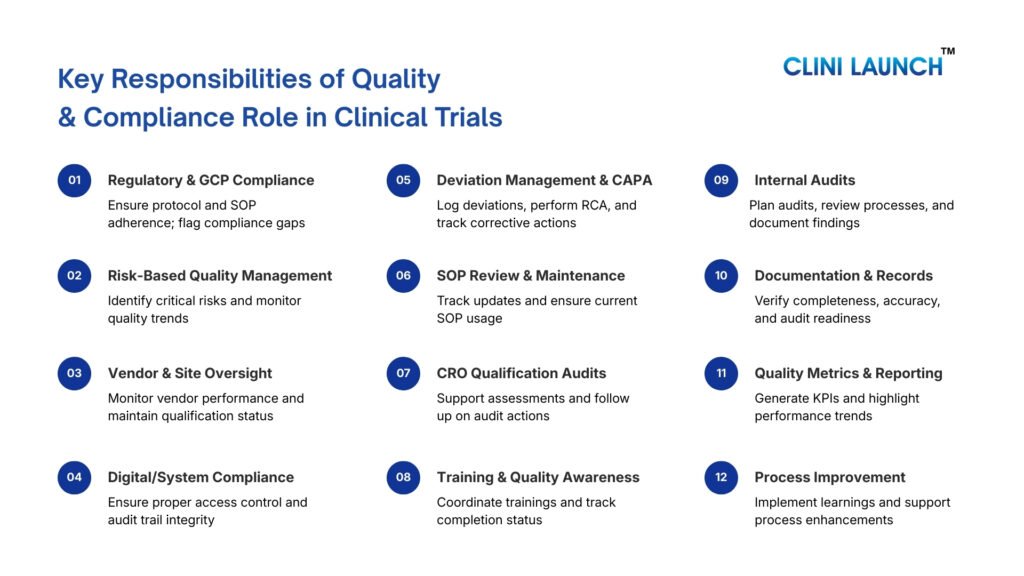
- Ensuring Compliance with Regulatory Guidelines
Regulatory compliance forms the foundation of the clinical research lifecycle because it ensures participant protection, data credibility, and acceptance of results by health authorities. Without consistent adherence to regulations and Good Clinical Practice (GCP), even scientifically sound studies may face rejection, delays, or legal consequences.
Within this framework, QA Associates act as oversight partners who help translate regulatory expectations into operational execution. They provide ongoing assurance that processes across sites and functions align with approved standards and remain ready for inspection at any time.
Typical tasks performed by QA Associate includes:
- Reviewing trial activities against GCP, protocols, and SOP requirements
- Identifying potential non-compliance risks before they escalate
- Supporting teams in understanding regulatory expectations
- Verifying that documentation supports what was performed
- Coordinating with operations, data, and regulatory groups to close compliance gaps
- Deviation, CAPA, and Risk Management
Deviations, CAPA, and risk management are among the most critical responsibilities of QA Associates because even minor deviations can compromise data integrity, participant safety, and regulatory compliance. Properly identifying, documenting, investigating, and preventing deviations is central to maintaining trial quality and inspection of readiness. This is a key element of CAPA management and risk management in QA associate clinical trials roles
QA Associates act as the operational backbone of this process, working across functional teams to detect issues early, implement preventive strategies, and ensure corrective measures are effective. By integrating structured methods and using specialized tools, they help sustain high-quality standards throughout the trial lifecycle.
Typical tasks and methods performed by QA Associates include:
- Logging and categorizing deviations in a deviation management system
- Conducting initial deviation reviews to assess impact and regulatory risk
- Performing root cause analysis using tools like Fishbone diagrams, 5 Whys, or risk matrices
- Collaborating with cross-functional teams to propose and document Corrective and Preventive Actions (CAPA)
- Tracking CAPA progress and verifying effectiveness using CAPA management software or quality trackers
- Supporting risk assessment exercises by identifying high-risk processes or critical data points
- Documenting mitigation strategies and integrating risk considerations into SOPs and monitoring plans
- Preparing reports for management review, audits, and regulatory inspections
- Internal Audits and Quality Checks
Internal audits are essential in the clinical research lifecycle because they help organizations identify process weaknesses, documentation gaps, and compliance risks before regulatory inspections occur. Routine quality checks strengthen oversight, improve consistency across sites, and protect both participant safety and data credibility. Quality metrics help QA Associates track performance trends.
QA Associates support the audit framework by coordinating reviews, facilitating evidence collection, and ensuring that observations are addressed in a timely and structured manner.
Typical tasks performed by QA Associates include:
- Preparing audit plans, checklists, and required documentation
- Reviewing Trial Master Files (TMF), essential documents, and study records
- Verifying adherence to approved protocols and SOPs
- Identifying and documenting audit findings or quality gaps
- Coordinating responses with functional teams
- Tracking corrective and preventive actions (CAPA) to closure
- Supporting follow-up reviews to confirm effectiveness of actions
- Maintaining audit logs, metrics, and inspection readiness records
- Risk-Based Quality Management
Risk-Based Quality Management (RBQM) is a core responsibility for QA associates in clinical trials. It is central to ensuring participant safety, data integrity, and regulatory compliance, particularly in complex or high-risk studies. By proactively identifying potential risks, QA Associates focus on resources and oversight on the most critical processes, preventing deviations and minimizing their impact on trial outcomes.
Typical tasks performed by QA Associates include:
- Identifying high-risk processes, procedures, or sites using risk assessment tools and historical data
- Applying focused monitoring strategies to prioritize critical activities
- Supporting implementation of risk mitigation plans to prevent protocol deviations
- Collaborating with cross-functional teams to address potential quality gaps
- Tracking risk trends and updating risk logs for management review
- Using tools such as risk matrices, dashboards, and quality trackers to visualize and manage risks
- Communicating identified risks and mitigation plans to relevant stakeholders
- Vendor and Site Quality Oversight
External partners such as trial sites, laboratories, and service providers play a major role in study execution, making their performance critical to overall trial quality. Inconsistent practices across vendors can lead to delays, data variability, or compliance risks, which is why structured oversight is necessary throughout the study’s lifecycle.
QA Associates contribute by supporting evaluation, coordination, and ongoing visibility into how vendors and sites operate against sponsor expectations and contractual quality requirements. This demonstrates clinical trial compliance in multi-site management and ensures vendor adherence to clinical trial protocol
Typical tasks performed by QA Associates include:
- Assisting in collection and review of vendor qualification documentation
- Maintaining vendor quality files and approval records
- Supporting onboarding activities related to quality expectations
- Monitoring vendor performance indicators and reporting trends
- Facilitating communication of quality requirements between sponsor and partners
- Escalating observed risks or recurring issues to senior QA leadership
- Maintaining oversight trackers for site and vendor compliance status
- Supporting documentation readiness related to outsourced activities
- Review and Maintenance of SOPs
Standard Operating Procedures (SOPs) provide the operational backbone of the clinical research lifecycle, ensuring that activities are performed consistently, ethically, and in line with regulatory expectations. Well-maintained SOPs reduce variability across sites, support staff training, and form a critical component of inspection readiness.
Within this system, QA Associates typically function as quality coordinators and reviewers rather than primary authors. They help ensure that procedures remain current, aligned with regulations, and properly implemented across teams.
Typical tasks performed by QA Associates include:
- Supporting periodic SOP reviews to confirm relevance and regulatory alignment
- Tracking revision histories and maintaining document control records
- Coordinating approvals and ensuring updated versions are distributed
- Verifying that teams are following the currently approved procedures
- Assisting in change communication and training support when updates occur
- Identifying gaps between written procedures and actual practice
- Documentation and Quality Records Management
QA Associates are responsible for managing all quality-related documentation throughout the clinical trial lifecycle. This includes reviewing the Trial Master File (TMF), audit reports, CAPA logs, and quality metrics to ensure completeness, accuracy, and compliance with regulatory requirements. They oversee the proper storage, control, and retrieval of records, maintaining version control, and ensuring that documentation is updated promptly when procedures change.
By managing quality records effectively, QA Associates help preserve data integrity, facilitate inspections and audits, and support transparency across trial activities. Their meticulous approach to documentation ensures that regulatory authorities, sponsors, and internal teams have access to accurate and reliable records, reinforcing the credibility and compliance of the clinical trial.
- Quality Metrics and Reporting
Tracking and analyzing quality metrics is a critical part of maintaining compliance and operational excellence throughout the clinical trial lifecycle. By measuring performance trends, identifying recurring issues, and highlighting potential risks, QA Associates help ensure trials remain efficient, ethical, and inspection ready.
QA Associates contribute by monitoring key quality indicators and providing actionable insights to management and cross-functional teams. Their work enables data-driven decisions, supports continuous improvement, and strengthens overall trial quality.
Typical tasks performed by QA Associates include:
- Generating dashboards and KPI reports to monitor trial performance
- Analyzing trends from audit findings, deviations, and CAPA outcomes
- Identifying patterns or recurring issues to prevent future non-compliance
- Communicating quality trends and insights to management and functional teams
- Maintaining quality metrics trackers and historical records
- Supporting management review meetings with structured data and visualizations
- Using tools such as Excel, QA dashboards, TMF trackers, or BI software to consolidate and report metrics
- Digital and Systems Compliance Oversight
Electronic systems such as eTMF, eCRF, and other trial management platforms are central to modern clinical trials. Ensuring these systems maintain data integrity, compliance, and audit-readiness is critical for protecting participant safety, supporting regulatory inspections, and enabling reliable trial outcomes, especially in increasingly decentralized studies.
QA Associates play a key role in overseeing these systems. They monitor electronic data, verify adherence to regulatory and SOP requirements, and support cross-functional teams to maintain system compliance across the trial lifecycle.
Typical tasks performed by QA Associates include:
- Monitoring electronic trial systems for completeness, accuracy, and auditability
- Verifying access controls and user permissions to protect sensitive data
- Ensuring digital records comply with SOPs and regulatory requirements
- Supporting system validation activities and documentation
- Preparing electronic system evidence and documentation for inspections
10.Training and Quality Awareness
In clinical trials, processes, regulations, and SOPs are constantly evolving due to protocol amendments, updated regulatory guidance, or new sponsor requirements. Ensuring that all personnel are aware of these changes is critical to maintaining compliance, preventing deviations, and safeguarding participant safety.
QA Associates play a pivotal role in embedding inspection of readiness and clinical research QA roles awareness throughout the trial lifecycle. They coordinate and monitor training, communicate changes in requirements, and ensure that staff are equipped to apply updated procedures in their daily activities.
Typical tasks and methods performed by QA Associates include:
- Coordinating periodic and ad-hoc training sessions on GCP, SOPs, and protocol updates
- Tracking regulatory or SOP changes that affect trial operations
- Maintaining and updating training records using Learning Management Systems (LMS) or internal trackers
- Verifying completion of required training for all team members, including new hires and cross-site personnel
- Reinforcing training through reminders, job aids, and quick reference guides
- Supporting staff in understanding new procedures or process updates, ensuring correct implementation
- Conducting post-training assessments to confirm knowledge retention and identify gaps
- Facilitating a culture of continuous quality improvement by encouraging feedback and lessons-learned sharing
11. Process Improvement Initiatives
Continuous process improvement is a key responsibility for QA associates in clinical trials. Enhancing compliance, efficiency, and overall trial performance helps prevent errors, streamline operations, and strengthen the quality system across all study sites.
QA Associates contribute by analyzing operations, identifying gaps, and supporting the implementation of best practices. Lessons learned from audits, inspections, and trial closeouts are applied to refine SOPs, workflows, and quality practices for current and future studies, ensuring trials meet high standards of regulatory compliance, data integrity, and operational excellence.
Typical tasks performed by QA Associates include:
- Reviewing post-audit or inspection findings to identify process gaps
- Supporting updates to SOPs, workflows, and quality practices
- Participating in lessons-learned sessions and cross-functional discussions
- Monitoring implementation of approved process improvements
- Documenting best practices and sharing knowledge with teams
- Providing guidance to junior QA staff on process compliance and efficiency
12. Support for Vendor/CRO Qualification Audits
External partners such as vendors and Contract Research Organizations (CROs) play a critical role in clinical trials, and their compliance directly affects study quality, data integrity, and participant safety. QA Associates support sponsors, operations teams, and QA leadership by ensuring that these partners are qualified and capable of conducting trial activities reliably and in accordance with regulatory standards.
Typical tasks performed by QA Associates include:
- Assisting in pre-study vendor and CRO audits by preparing documentation and audit checklists
- Reviewing vendor quality systems and SOPs for compliance with sponsor and regulatory expectations
- Maintaining vendor qualification files and approval records
- Monitoring vendor performance indicators and flagging potential quality gaps
- Coordinating with operations and regulatory teams to address any compliance issues
- Supporting follow-up reviews to ensure corrective actions from audits are implemented
13. Inspection Support and Regulatory Interactions
Regulatory inspections are a critical checkpoint in clinical trials, assessing compliance with GCP, protocols, and SOPs. QA Associates ensure that sponsor teams, trial sites, and regulatory authorities have access to accurate information and documentation, helping maintain confidence in the integrity of trial data.
Primary responsibilities of QA Associates include:
- Inspection Preparedness: Ensuring that trial records, SOPs, and essential documentation are organized, up-to-date, and ready for review by auditors or inspectors.
- Regulatory Coordination: Acting as the liaison between clinical operations, data management, and regulatory teams to address queries and provide clarification during inspections.
- Continuous Readiness: Maintaining a system of ongoing inspection readiness so that trials can be evaluated at any point without disruption.
Typical tasks performed by QA Associates include:
- Preparing and organizing inspection packages and supporting documents
- Verifying completeness and accuracy of Trial Master File (TMF) and essential documents
- Coordinating with clinical, data, and regulatory teams to respond to inspector questions
- Tracking action items raised during inspections and ensuring timely closure
- Documenting inspection findings, follow-up actions, and lessons learned
- Maintaining audit logs, inspection trackers, and readiness checklists
QA Associate: Skills and Growth Opportunities
A successful QA associate in clinical research needs a combination of technical knowledge, soft skills, and proficiency with key tools. Below is a summary of the most important skills, systems, and career progression paths to help you understand what this role entails and how it evolves over time.
| Technical Skills | Soft Skills | Tools & Systems | Career Path & Growth |
|---|---|---|---|
| GCP knowledge | Attention to detail | eQMS | QA Associate → Senior QA Associate |
| Regulatory guidelines | Communication | TMF systems | Senior QA Associate → QA Manager |
| SOP writing & review | Risk-based thinking | Document management systems | QA Manager → Head of Quality |
| Audit principles | Documentation accuracy | Audit tracking tools | Transition opportunities: Compliance, Audit, Vendor QA |
Clinical SAS
Build practical skills in clinical data analysis and statistical reporting using SAS, aligned with global regulatory standards used in clinical trials. Learn how clinical trial data is structured, analyzed, and prepared for submissions.
Conclusion
A QA Associate plays a critical role in ensuring the quality, compliance, and integrity of clinical trials. From managing SOPs and audits to overseeing vendors, tracking metrics, and implementing risk-based strategies, QA Associates safeguard both participant safety and trial data reliability. Building the right combination of technical knowledge, soft skills, and familiarity with key tools is essential for success in QA associate roles and responsibilities in clinical research and career growth in this field
If you’re looking to start your journey in clinical research, CliniLaunch Research Institute offers a comprehensive Clinical Research course that equips you with practical skills, hands-on exposure, and mentorship to become a confident and industry-ready QA professional.
Frequently Asked Questions (FAQs)
1. What is the primary role of a QA associate in clinical trials?
A QA Associate ensures that clinical trial activities comply with GCP, regulatory guidelines, approved protocols, and SOPs to protect participant safety and data integrity
2. How is Quality Assurance different from Quality Control in clinical research?
Quality Assurance is preventive and system-driven, focusing on avoiding errors, while Quality Control detects and corrects issues after trial activities are completed.
3. What qualifications are needed to become a QA Associate?
Most QA Associates have a background in life sciences or healthcare and a strong understanding of clinical research processes, GCP, and regulatory compliance.
4. What are the key skills required for a QA Associate role?
Attention to detail, GCP knowledge, audit principles, SOP management, risk-based thinking, documentation accuracy, and effective communication are essential skills.
5. Does a QA Associate participate in audits and inspections?
Yes. QA Associates support internal audits, prepare inspection documentation, coordinate with teams during regulatory inspections, and help address findings through CAPA.
6. Is Quality Assurance a good career option in clinical research?
Yes. QA is a critical and stable function in clinical research, offering long-term growth opportunities as trials expand, and regulatory expectations increase.