Alternative Careers for Pharma Professionals
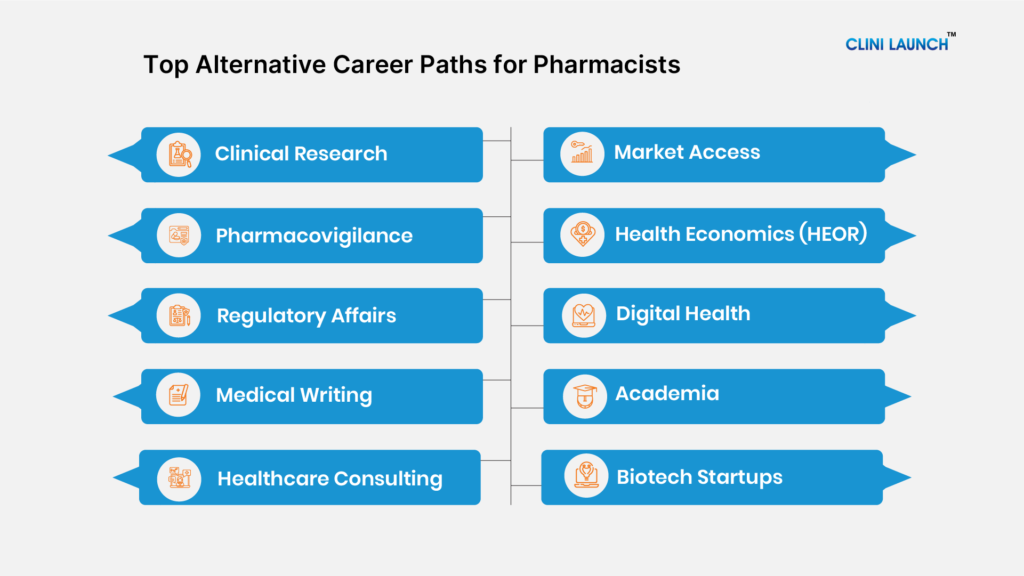
Alternative careers for pharma professionals include clinical research, pharmacovigilance, regulatory affairs, medical writing, healthcare consulting, digital health, and health economics. As the pharmaceutical industry evolves with AI, biotechnology, and global clinical trials, professionals with pharmacy or life science backgrounds can transition into diverse healthcare roles beyond traditional manufacturing and sales positions.
For decades, pharmaceutical careers followed a predictable path manufacturing, quality control, formulation, or medical sales. That structure is now rapidly evolving.
Industry-wide shifts such as mergers, automation, and AI integration are reshaping workforce demand. Between 2023 and 2024, major companies like Pfizer, Johnson & Johnson, and Bayer announced large-scale workforce reductions, signaling a transition in how pharmaceutical talent is utilized.
This transformation is driving strong interest in alternative careers for pharmacists, as professionals increasingly explore roles beyond traditional manufacturing and sales—seeking opportunities in clinical research, pharmacovigilance, regulatory affairs, data science, and healthcare technology.
At the same time, the broader healthcare ecosystem is expanding. The global clinical trials market is projected to reach USD 69.5 billion by 2028, driven by increased R&D outsourcing, advanced technologies, and global study expansion. This shift is not eliminating opportunities—it is redistributing them across emerging domains.
Many professionals are also actively searching for high paying jobs in pharmaceuticals and evaluating career options after pharmacy that go beyond traditional roles.
Pharma professionals today are finding increasing demand in areas such as clinical research, pharmacovigilance, regulatory affairs, medical writing, healthcare consulting, digital health, and health economics. Their foundational expertise spanning drug safety, clinical knowledge, and regulatory understanding is now being applied across a wider, more dynamic healthcare landscape. The traditional pharma job market, particularly for freshers and mid-career professionals, is no longer the reliable runway it once appeared to be.
This blog provides a research-backed overview of alternative career paths, highlighting where the opportunities are growing, what skills are required, and how professionals can strategically transition within the evolving pharmaceutical industry. These changes are encouraging professionals to explore alternative pharmacy careers aligned with modern healthcare demands.
What Are Alternative Careers for Pharmacists?
Alternative careers for pharmacists are non-traditional roles where pharmacy graduates apply their domain knowledge outside of core areas like production, quality control, or sales. These include specialized roles such as clinical research associate (CRA), drug safety associate (pharmacovigilance), regulatory affairs specialist, clinical data manager, and medical coder—focused on drug development, safety monitoring, compliance, and healthcare data. These evolving roles significantly expand pharmacy career opportunities, especially in emerging domains like clinical research, regulatory affairs, and healthcare analytics.
Why Alternative Career for Pharmacists Are Increasing in 2026
The pharmaceutical industry has long projected an image of stability, recession-resistant, science-driven, and perpetually in demand. Yet beneath that macro-level narrative, the ground-level reality for working professionals has grown considerably more complicated. Structural, technological, and economic forces are quietly but decisively narrowing the traditional pharma career corridor, making it not just worthwhile but genuinely necessary to look beyond conventional roles.
- Industry Consolidation and Job Market Pressure
One of the most influential factors in reshaping pharmaceutical careers is industry consolidation. Large pharmaceutical companies frequently merge or acquire smaller firms to strengthen their research pipelines, expand global market reach, or reduce operational costs. While these mergers often accelerate innovation and drug development capabilities, they can also lead to restructuring and workforce redistribution. This shift has also increased demand for specialized roles such as a pharmaceutical recruiter, who identifies talent for CROs, biotech firms, and regulatory organizations.
Industry consolidation has gradually shifted employment patterns toward specialized service sectors such as contract research organizations (CROs), regulatory consulting firms, and clinical data management companies. Many professionals with pharmaceutical backgrounds now find opportunities in organizations that support drug development rather than directly manufacturing medicines.
- Automation and AI Disrupting Conventional Roles
Artificial intelligence is no longer a distant disruption on the pharmaceutical horizon it is already embedded in core workflows. From AI-assisted drug discovery platforms to automated pharmacovigilance systems that process adverse event reports at scale, technology is methodically absorbing tasks that once defined entire job descriptions. The McKinsey Global Institute has noted that life sciences are among the sectors with the highest potential for generative AI to automate knowledge work including literature review, regulatory writing, data extraction, and safety signal detection.
Professionals aren’t being replaced; their roles are evolving. Value now lies in merging domain expertise with AI-generated outputs rather than resisting technology. This disruption acts as both a threat and a gateway to new opportunities.
- Patent Cliffs Narrowing Traditional Hiring
Another structural factor influencing pharma employment is the phenomenon known as the patent cliff. Pharmaceutical companies rely heavily on patented drugs for revenue generation. When patents expire, generic manufacturers can produce equivalent medicines, often leading to a sharp decline in revenue for the original product.
Companies are restructuring investments toward biologics, new drug discovery, and specialized therapies. Consequently, traditional manufacturing and product roles are shrinking as new opportunities emerge in clinical development, regulatory strategy, pharmacovigilance, and real-world evidence research.
According to IQVIA’s Global Medicine Outlook, a significant volume of branded drug revenue is expected to go off patent through the late 2020s, placing sustained financial pressure on R&D budgets and, consequently, on hiring within research, clinical, and medical affairs functions.
- Generational Shift in Career Expectations
Career expectations among newer professionals have also evolved. Many individuals entering the pharmaceutical field today seek roles that offer interdisciplinary exposure, intellectual diversity, and global collaboration. Normally, younger professionals prioritize purpose, flexibility, skill development, and impact institutional loyalty. Rather than remaining in a single functional domain for decades, professionals increasingly explore career paths that combine science with areas such as policy, communication, data science, or healthcare consulting.
- India-Specific Factors Affecting Pharma Careers
In India, several structural factors are shaping career decisions for pharmaceutical professionals. The country has one of the largest pharmaceutical manufacturing industries in the world, often referred to as the “pharmacy of the world” due to its extensive production of generic medicines. However, the rapid growth of the industry has also increased the competition for traditional roles. At the same time, India has become a global hub for clinical research services, pharmacovigilance operations, regulatory documentation, and healthcare data management. The Indian Pharmaceutical Alliance has highlighted the need for a more diversified talent pipeline that extends well beyond traditional manufacturing and sales roles.
For the Indian pharma professional, the message is clear: the domestic industry is not contracting, but it is restructuring and those who proactively diversify their skill sets will find themselves at a considerable advantage. This shift is accelerating the rise of alternative pharmacy careers across clinical research, regulatory, and digital health domains.
Global Medicine Spending & Usage Trends
According to Global Medicine Spending and Usage Trends, the overall global use of medicine has increased at a 3% compound annual growth rate (CAGR) since 2014, slowing from a 4% growth rate observed during 2009–2014.
Top 10 Alternative Careers for Pharmacists in the Evolving Healthcare Industry
Leveraging existing expertise—drug mechanisms, trial design, safety data, and regulatory logic—into diverse, high-value adjacent careers. Below is a breakdown of professional domains where pharma skills are in high demand outside traditional structures.
- Clinical Research and Drug Development
Pharma professionals are among the most naturally suited candidates for clinical research their degree already covers the foundational building blocks of drug development. Subjects like pharmacology, pathophysiology, biopharmaceutics, and clinical pharmacy directly mirror what clinical research demands on the ground. This has also increased visibility for clinical research jobs for pharmacists, as their academic background closely aligns with trial operations and drug development processes.
Pharma Background & Clinical Research Applications
| Your Pharma Background | How It Applies in Clinical Research |
|---|---|
| Pharmacology & Drug Mechanisms | Understanding trial drug profiles, dosing, and safety monitoring |
| Biopharmaceutics & Pharmacokinetics | Supporting ADME-related trial endpoints and patient data review |
| Clinical Pharmacy & Therapeutics | Protocol comprehension, patient eligibility screening |
| Regulatory & Quality Sciences | GCP compliance, regulatory documentation, IRB submissions |
| Research Methodology & Biostatistics | Clinical data management, SAP review, outcome analysis |
The global clinical trials market is projected to reach USD 69 billion by 2030 at a CAGR of 5.7% and pharma-trained professionals are stepping directly into roles like Clinical Research Associate, Trial Coordinator, and Clinical Data Manager without starting from scratch.
Artificial intelligence is being used in areas such as drug discovery, clinical trial design, and safety signal detection, creating roles that require both pharmaceutical knowledge and familiarity with AI-driven research tools.
A well-known example of large-scale clinical research collaboration is the RECOVERY Trial conducted during the COVID-19 pandemic, which identified the effectiveness of dexamethasone for severely ill patients.
Digital platforms and AI-powered patient recruitment tools are transforming how clinical trials are conducted and monitored globally.
- Pharmacovigilance and Drug Safety
Pharmacovigilance focuses on the monitoring, detection, assessment, and prevention of adverse drug reactions after medicines are approved for use. The global pharmacovigilance market was valued at USD 7.9 billion in 2023 and is expected to grow at a CAGR of 11.3% through 2030, driven by stricter regulatory mandates and the growing complexity of biological and specialty drugs.
Pharma Training & Pharmacovigilance Applications
| Your Pharma Training | How It Applies in Pharmacovigilance |
|---|---|
| Pharmacology & Toxicology | Identifying and assessing adverse drug reactions and safety signals |
| Pathophysiology | Evaluating clinical impact of reported drug-related adverse events |
| Regulatory & Quality Sciences | Preparing ICSRs, PSURs, and RMP documentation for global agencies |
| Clinical Pharmacy | Understanding drug-disease interactions in real patient populations |
| Research Methodology | Contributing to signal detection, literature screening, and risk evaluation |
A landmark case that reshaped global pharmacovigilance was the withdrawal of Vioxx (rofecoxib) in 2004, after post-marketing surveillance identified a significantly elevated cardiovascular risk. The case directly led to stricter post-approval safety monitoring requirements by the FDA and EMA — and permanently elevated the demand for trained drug safety professionals worldwide.
Also, the Drug Safety Research Unit (DSRU) in the UK employs professionals transitioning from clinical and industrial pharmacy backgrounds into post-marketing surveillance roles.
Automated safety monitoring systems are improving how adverse drug reactions are detected and analyzed, creating new roles in AI-supported pharmacovigilance and drug safety analytics.
- Regulatory Affairs and Compliance
Regulatory affairs professionals ensure that pharmaceutical products meet the legal, scientific, and ethical standards of global health authorities before reaching the market. The global regulatory affairs outsourcing market is projected to grow at a CAGR of 12.8% through 2030, reflecting the increasing complexity of drug approval pathways worldwide. A regulatory affairs pharmacist plays a key role in ensuring compliance with global drug approval standards.
Pharma Expertise & Regulatory Affairs Applications
| Your Pharma Expertise | How It Applies in Regulatory Affairs |
|---|---|
| Pharmaceutical Sciences & Drug Formulation | Supporting technical dossier preparation and product documentation |
| Quality Assurance & GMP | Ensuring compliance with FDA, EMA, and CDSCO regulatory standards |
| Pharmacology & Clinical Data Interpretation | Reviewing safety and efficacy data for regulatory submissions |
| Regulatory & Legal Frameworks | Preparing CTDs, NDAs, and regulatory response documents |
Professionals transitioning into a regulatory affairs pharmacist role work closely with agencies like FDA, EMA, and CDSCO.
A real example demonstrating the importance of regulatory science is the rapid global approval process for COVID-19 vaccines, where regulatory experts coordinated clinical data evaluation, emergency authorizations, and international compliance requirements. The demand for a regulatory affairs pharmacist is growing due to increasing global regulatory complexity.
- Medical Writing and Scientific Communication
Medical writing merges scientific expertise with communication and pharma professionals hold a natural edge here over generalists, given their fluency in clinical data, drug terminology, and regulatory language. The global medical writing market is projected to reach USD 6.3 billion by 2030, growing at a CAGR of 11.5%.
Pharma Foundation & Medical Writing Applications
| Your Pharma Foundation | How It Applies in Medical Writing |
|---|---|
| Clinical Pharmacology & Therapeutics | Writing clinical study reports, investigator brochures, and CSRs |
| Regulatory Sciences | Preparing CTD modules, NDAs, and regulatory response documents |
| Research Methodology | Structuring manuscripts, abstracts, and systematic reviews |
A widely cited example of medical writing in action is the publication of clinical trial results in peer-reviewed journals such as The New England Journal of Medicine, where scientific writers collaborate with researchers to present complex findings in a standardized format.
- Healthcare Consulting and Strategy
Healthcare consulting firms actively recruit pharma professionals precisely because they bring real industry experience regulatory fluency, clinical understanding, and scientific credibility that pure MBA hires cannot replicate quickly. The global healthcare consulting services market is projected to grow at a CAGR of 10.4% through 2030. Consulting firms often collaborate with a pharmaceutical recruiter to hire professionals with niche clinical and regulatory expertise.
Pharma Background & Healthcare Consulting Applications
| Your Pharma Background | How It Applies in Healthcare Consulting |
|---|---|
| Regulatory & Clinical Sciences | Advising clients on drug approval strategy and compliance |
| Pharmacoeconomics | Supporting pricing, market access, and reimbursement decisions |
| Drug Development Knowledge | Guiding pipeline strategy and lifecycle management projects |
Real-World Example: McKinsey’s Centre for US Health System Reform and Boston Consulting Group’s Global Health practice both publish case studies of projects led by former pharma professionals who transitioned into consulting — including work on pandemic preparedness, drug pricing policy, and healthcare access in emerging markets.
Patient advocacy organizations and health policy groups increasingly rely on scientific experts who understand treatment pathways, healthcare access challenges, and regulatory systems.
- Pharmaceutical Marketing and Market Access
Market access ensures a drug reaches patients at a price sustainable for healthcare systems — spanning HTA evaluations, payer negotiations, and reimbursement strategy. It demands a rare blend of scientific literacy, economic reasoning, and policy understanding that pharma professionals are uniquely positioned to offer.
Pharma Background & Market Access Applications
| Your Pharma Background | How It Applies in Market Access |
|---|---|
| Pharmacoeconomics | Supporting HTA submissions and cost-effectiveness analyses |
| Regulatory Sciences | Navigating reimbursement and compliance frameworks |
| Clinical Data Interpretation | Building evidence packages for payer negotiations |
A defining example is the UK’s NICE, which evaluates oncology drugs for public funding — a process entirely dependent on professionals who can bridge clinical evidence with economic value arguments.
- Health Economics and Outcomes Research (HEOR)
HEOR evaluates the clinical and economic value of healthcare interventions — and has become central to how drugs are priced and reimbursed globally. The global HEOR market is projected to grow at a CAGR of 10.1% through 2030, as payers increasingly demand evidence beyond clinical efficacy.
Conducting outcomes modelling and cost-effectiveness analyses
Building real-world evidence and comparative effectiveness studies
A real-world example is the use of HEOR studies to assess the cost-effectiveness of adjuvant immunotherapy in cancer treatments, which often costs hundreds of thousands of dollars per patient but may significantly improve survival outcomes.
Real-world evidence (RWE) uses patient data from electronic health records and healthcare systems to evaluate treatment effectiveness and safety outside clinical trials.
- Digital Health and HealthTech
Digital health combines medical science with AI, wearable devices, telemedicine, and health data analytics — and is one of the fastest-growing career frontiers for pharma professionals. The global digital health market size was estimated at USD 288.55 billion in 2024 and is projected to reach USD 946.04 billion by 2030, growing at a CAGR of 22.2% from 2025 to 2030. Roles like a clinical informatics specialist are emerging at the intersection of healthcare and technology. This growth is creating strong opportunities in health informatics careers for pharma professionals.
Designing clinical validation studies for digital therapeutics
Navigating FDA and EMA compliance for health tech products
A clinical informatics specialist works with electronic health records, clinical data systems, and decision-support tools.
The FDA Digital Health Center of Excellence actively guides the regulation of AI-driven health apps, wearables, and software-based therapies — a space where pharma professionals’ regulatory and clinical fluency gives them a direct competitive advantage over purely tech-trained candidates. As digital health expands, the demand for a clinical informatics specialist continues to grow globally.
- Academia, Education, and Training
Pharma professionals bring rare real-world clinical and regulatory depth into academic settings — making them highly effective as educators, researchers, and mentors in universities, research institutes, and professional training organizations.
Leading funded research programs and publishing scientific studies
Teaching pharmacology, therapeutics, and drug development courses
For example, academic researchers frequently contribute to major scientific discoveries through publicly funded research programs such as those supported by the National Institutes of Health (NIH).
- Entrepreneurship and Pharma Startups
The boom in biotech and health tech startups has opened a compelling path for pharma professionals ready to move beyond corporate structures. The global biotechnology market size was estimated at USD 1.55 trillion in 2023 and is projected to reach USD 3.88 trillion by 2030, growing at a CAGR of 13.96% from 2024 to 2030.
Pharma professionals entering this space bring something most startup founders lack — deep scientific credibility and regulatory literacy, two of the most critical assets for attracting investor confidence and achieving early-stage milestones.
How to Make the Transition A Practical Roadmap
Knowing where to go is only half the equation. The more pressing question for most pharma professionals is how to get there practically, without abandoning financial stability or starting over entirely. The transition doesn’t demand a dramatic leap; it demands a deliberate sequence of steps. Connecting with a pharmaceutical recruiter can significantly improve access to hidden job opportunities in emerging healthcare domains.
- Audit Your Transferable Skills
The first step is to evaluate which aspects of your current training are applicable beyond traditional pharmaceutical roles. Many competencies developed in pharmacy and life sciences programs are highly transferable.
For example:
- Understanding drug mechanisms and therapeutic pathways supports work in clinical research and pharmacovigilance.
- Knowledge of clinical trial design and research methodology aligns with roles in clinical data management and regulatory documentation.
- Familiarity with drug safety monitoring and regulatory guidelines is directly relevant for pharmacovigilance and regulatory affairs.
- Identify Skill Gaps and Bridge Them
Once you’ve identified your transferable strengths, pinpoint the specific competencies your target role requires:
- Clinical Research: Prioritize Good Clinical Practice (GCP) and trial operations.
- Healthcare Analytics: Master data analysis tools and healthcare-specific datasets.
Closing these specific gaps with targeted certifications is the final step in your career pivot.
- Build Your Network in the Target Domain
Accelerate your transition by engaging with professional networks and industry communities. These groups clarify role expectations and provide training to keep your skills current. Strategic networking turns cold applications into informed, warm introductions.
Training Institutions such as CliniLaunch Research Institute (CLRI) is related to clinical research, regulatory affairs, or health economics can also provide insight into evolving career paths.
Clinical Research
Build practical skills required for alternative career paths in the pharmaceutical and healthcare industries. This program introduces clinical trial processes, regulatory documentation, drug safety monitoring, and research data management used in global drug development and clinical research operations.

Opportunities in India Where the Demand Is Growing
India is no longer just the “pharmacy of the world it is rapidly becoming a global hub for clinical research, pharmacovigilance, regulatory documentation, and digital health, creating a vastly expanded opportunity landscape for pharma professionals.
Key drivers fueling this growth:
- Rapid expansion of CROs and CDMOs hiring pharma-trained professionals for clinical and regulatory roles
- Biotech and digital health startups scaling across Bengaluru, Hyderabad, and Pune
- Government-backed initiatives like the Ayushman Bharat Digital Mission building national digital health infrastructure
- India conducting 700+ CDSCO-registered clinical trials annually, driving sustained demand for research professionals
- IBEF data confirms India’s pharmaceutical R&D capabilities are expanding well beyond generic manufacturing
Alongside these trends, professionals often evaluate opportunities in the best paying pharma companies and top paying pharma companies, while also considering emerging roles in CROs, biotech firms, and digital health organizations.
The message for Indian pharma professionals is clear — the domestic industry is not contracting, it is restructuring, and those with diversified, cross-functional skill sets are best positioned to capitalize on this shift. India’s digital health expansion is accelerating demand for health informatics careers.
The Global Opportunity at a Glance
As the healthcare ecosystem continues to expand, alternative careers for pharmacists are no longer optional they are becoming a strategic career direction for long-term growth and stability. Today, alternative pharmacy careers offer more flexibility, global exposure, and interdisciplinary growth than traditional roles.
Conclusion
A pharmaceutical background opens doors to multiple alternative careers for pharmacists, extending far beyond traditional manufacturing or laboratory roles. It provides a strong scientific foundation that enables professionals to transition into clinical research, pharmacovigilance, regulatory affairs, healthcare analytics, and medical communication.
These alternative careers for pharmacists are gaining momentum as biotechnology, digital health, and expanding clinical infrastructure continue to reshape the healthcare landscape. Globally, health informatics careers are emerging as one of the fastest-growing pathways for healthcare professionals.
Understanding global frameworks like Good Clinical Practice (GCP) and drug safety monitoring systems such as the WHO Pharmacovigilance Programme can help professionals navigate these expanding career paths.
For individuals interested in building practical skills in emerging healthcare domains, training programs such as the Advanced Diploma in Clinical Research and Advanced Diploma in AI Integration in Drug Safety and Compliances, offered by CliniLaunch Research Institute aim to introduce learners to areas like clinical trials, drug safety monitoring, and regulatory processes that are increasingly relevant in today’s pharmaceutical industry.
Ultimately, alternative career paths are not a departure from pharmaceutical science, but a reflection of how widely its expertise can now be applied across the modern healthcare ecosystem.