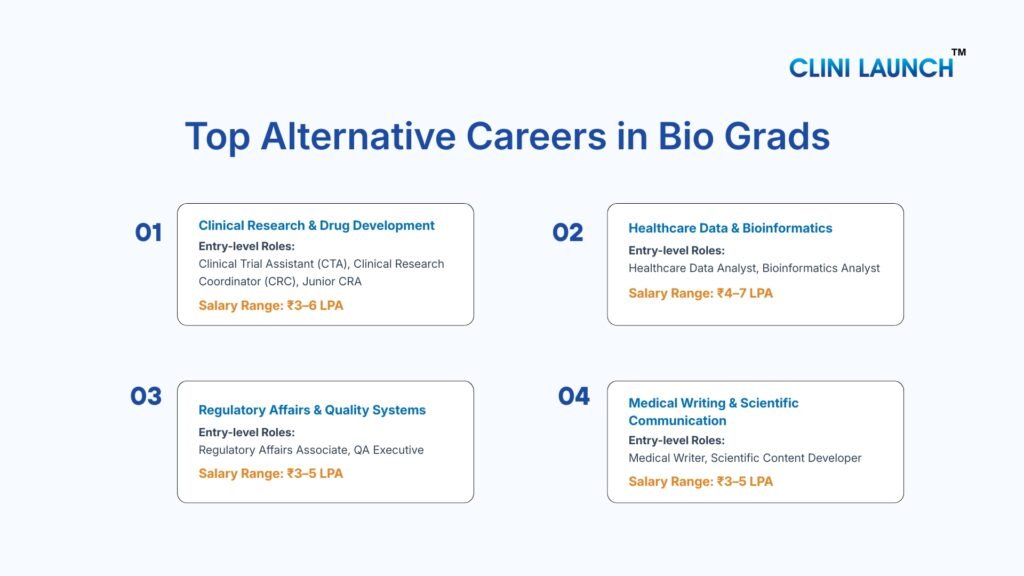
This Blog explores practical biomedical engineering career alternatives that align with how the healthcare and life sciences industry operates today. For many biomedical engineers, career realities differ from expectations set during their academic years. While the degree prepares graduates for innovation. While the degree builds strong foundations in innovation and medical technology, the availability of core roles remains limited across regions. This gap has led many graduates to actively explore alternative careers for biomedical engineers that better align with current industry demand. 

Even professionals working in core biomedical roles often experience slow growth, limited specialization, and reduced exposure to high-value areas. At the same time, the healthcare ecosystem is evolving rapidly, driven by digital platforms, data-intensive clinical systems, AI-enabled diagnostics, cloud infrastructure, and stricter regulations. As a result, choosing an alternative career for biomedical engineers has become a practical and sometimes necessary step to remain relevant and future ready. 

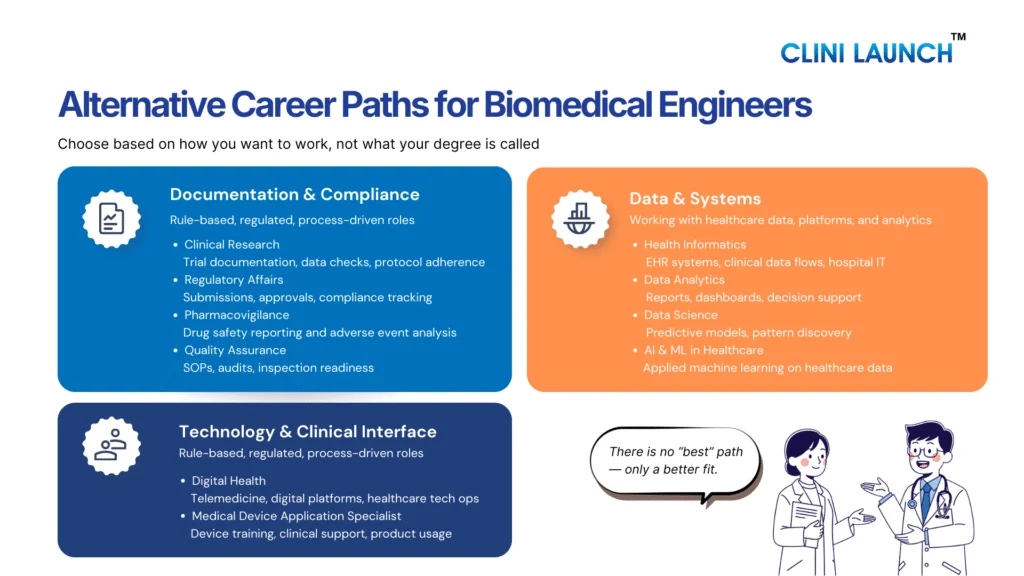
A 2021 BME Career Exploration study highlights this shift, showing that many graduates now transition into regulated, data-driven, and technology-enabled healthcare roles. These alternative career paths for biomedical engineers leverage core strengths such as systems thinking, analytical ability, and biological understanding, offering clearer growth pathways and long-term career stability. As a result, many graduates now actively consider non-core jobs for biomedical engineers that offer clearer growth, stability, and industry alignment. 

The sections below outline how each alternative career for biomedical engineers aligns with current healthcare industry needs, skill requirements, and long-term growth potential. Understanding how different roles evolve over time helps biomedical graduates evaluate long-term biomedical engineers’ career paths beyond traditional assumptions. 

The following sections outline structured healthcare careers for biomedical engineers that leverage medical knowledge, regulatory awareness, and system-based thinking. 

Below are some of the most practical and industry-relevant who want to work beyond traditional core engineering roles while staying connected to healthcare. 

  • Clinical Data Coordinator 
  • Clinical Data Associate 
  • Clinical Trial Assistant (CTA) 
  • Clinical Research Coordinator (CRC) 
  • Pharmacovigilance Associate / Drug Safety Associate 
  • Regulatory Affairs Assistant / Junior Regulatory Associate 
  • Clinical Operations Executive / Trial Operations Associate 
  • Medical Writing Associate (Junior / Trainee) 
  • EDC / Clinical Systems Support Associate 

These clinical research roles for biomedical engineers focus on trial execution, data integrity, and regulatory compliance across global studies.  

Clinical research focuses on executing and managing clinical trials that test the safety and effectiveness of drugs, devices, and therapies. The work is centered around patient data, documentation, timelines, and regulatory compliance. These roles ensure trials are conducted strictly as per protocol so that results are acceptable to regulators. This is structured, process-driven execution, not discovery research or analytics. 

Biomedical engineers fit well into clinical research because they are comfortable with structured data, medical terminology, and regulated workflows. The roles reward consistency, attention to detail, and protocol adherence rather than innovation or design. For BMEs who want to stay close to healthcare systems and real-world clinical impact, this is a practical and stable career path. 

  • Hospitals and academic research centers conducting sponsored trials 

Start by identifying one entry-level role and aligning your preparation toward it rather than applying broadly. Build a clear understanding of the clinical trial lifecycle, GCP principles, and role-specific workflows. For candidates without industry exposure, a structured program like  Advance Diploma in Clinical Research helps bridge the gap by providing domain context, practical workflows, and hiring alignment. If internships or site-level opportunities are accessible, they should be pursued alongside or immediately after training. Networking with professionals already working in CROs or trial sites helps clarify expectations early and avoid misaligned roles. 

Aspect Details
Domain Clinical Research
Core Focus Trial execution, data integrity, documentation, compliance
Entry-Level Roles CDM, CTA, CRC, PV, Regulatory, Clinical Ops, Medical Writing
Entry Salary (India) ₹2.5–4.5 LPA (average)
Hiring Organizations CROs, Pharma, Biotech, Hospitals
Key Skills Needed GCP basics, process discipline, clinical context
Career Growth Associate → Analyst → Manager
Long-Term Outlook Stable, compliance-driven, globally relevant
Advanced Diploma in

Clinical Research 

Develop industry-ready clinical research skills used across pharmaceutical companies, CROs, and healthcare organizations. Learn how clinical trials are designed, conducted, monitored, and regulated, while gaining hands-on exposure to real-world clinical research workflows and compliance standards. 

IN PARTNERSHIP WITH
4.8(3,235 ratings)

  • Medical Coder (ICD-10 / CPT – Trainee / Junior) 
  • Certified Professional Coder (CPC – Entry Level) 
  • Medical Coding Analyst (Junior) 
  • Healthcare Documentation Specialist 
  • Medical Billing & Coding Associate 
  • Revenue Cycle Management (RCM) Associate 

Medical coding jobs for biomedical engineers offer a structured, documentation-driven path within healthcare operations. Documentation-driven and compliance-focused roles represent some of the most accessible biomedical engineering jobs outside core engineering functions. 

Medical coding focuses on translating clinical documentation such as physician notes, discharge summaries, diagnostic reports, and procedure records into standardized medical codes used for billing, reimbursement, audits, and compliance. The work is documentation-heavy, rule-based, and governed by strict coding guidelines and payer regulations. Accuracy and consistency are critical, as coding errors directly affect revenue, audits, and legal compliance. This is operational healthcare work, not clinical decision-making or biomedical research. 

Biomedical engineers fit well into medical coding because they already understand medical terminology, human anatomy, disease processes, and clinical workflows. The role rewards attention to detail, structured interpretation of medical records, and adherence to classification standards rather than engineering design or innovation. For BMEs who prefer stable, desk-based healthcare roles with clear rules and measurable output, medical coding offers a predictable and scalable career path. 

Growth depends on coding accuracy, certification upgrades, specialty exposure (e.g., inpatient, surgical, risk adjustment), and audit experience. 

  • Hospitals and hospital networks 
  • Health insurance and payer organizations 
  • Medical auditing and compliance firms 

Start by deciding whether you want to pursue outpatient, inpatient, or specialty coding instead of treating medical coding as a single generic role. Build strong fundamentals in ICD-10-CM, CPT, and medical documentation standards, as accuracy and guideline interpretation matter more than speed at the entry level. For candidates without prior healthcare operations exposure, a structured program such as a Advanced Diploma in Medical Coding help bridge the gap by providing coding framework clarity, real-world chart interpretation practice, and alignment with hiring expectations. Entry-level production roles or internships are critical to gaining volume-based experience and improving productivity benchmarks. Networking with experienced coders and auditors helps candidates understand certification value, audit expectations, and long-term growth paths early. 

Aspect Details
Domain Medical Coding
Core Focus Clinical documentation coding, billing accuracy, compliance
Entry-Level Roles Medical Coder, Coding Analyst, RCM Associate
Entry Salary (India) ₹2.0–4.0 LPA (average)
Hiring Organizations Healthcare BPOs, Hospitals, Payers
Key Skills Needed Medical terminology, coding guidelines, accuracy
Career Growth Coder → Auditor → Manager
Long-Term Outlook Stable, compliance-driven, operations-focused

Advanced Diploma in

Clinical Research, Cybersecurity & Cloud Technology

Build industry-ready skills in medical coding used across hospitals, healthcare providers, insurance companies, and global healthcare services. Learn to accurately convert medical diagnoses, procedures, and services into standardized codes while ensuring compliance, accuracy, and reimbursement of integrity. 

IN PARTNERSHIP WITH
4.8(3,235 ratings)
  • Pharmacovigilance Associate / Drug Safety Associate 
  • Case Processing Associate 
  • Safety Data Associate 
  • Argus Safety / PV Systems Associate (Junior) 
  • Pharmacovigilance Executive 
  • Clinical Safety Coordinator 

Pharmacovigilance careers for biomedical engineer’s center on safety monitoring, adverse event reporting, and regulatory compliance.  

Pharmacovigilance focuses on monitoring, evaluating, and reporting the safety of drugs, vaccines, and medical products during clinical development and post-marketing use. The work involves adverse event processing, safety data review, and regulatory reporting to global health authorities. These roles ensure that safety risks are identified, documented, and communicated accurately across the product lifecycle. This is compliance-driven safety surveillance, not laboratory research or clinical decision-making. 

Biomedical engineers fit well into pharmacovigilance because they are familiar with medical terminology, disease mechanisms, and structured documentation. The role requires careful interpretation of clinical narratives, attention to detail, and adherence to regulatory standards rather than engineering design or experimentation. For BMEs who prefer analytical, documentation-focused healthcare roles with regulatory relevance, drug safety offers a stable and well-defined career path. 

Growth depends on case complexity exposure, regulatory knowledge, safety database experience, and therapeutic area specialization. 

  • CROs: IQVIA, ICON, Parexel 
  • Pharma / Biotech companies with in-house safety teams 
  • Pharmacovigilance service providers 

How to Get Started 

Begin by understanding core pharmacovigilance workflows such as adverse event reporting, case processing, MedDRA coding, and global regulatory requirements. Candidates should align their preparation toward specific entry-level roles rather than applying broadly. For those without prior industry exposure, a structured program like the Advanced Diploma in Clinical Research, where pharmacovigilance and drug safety are covered as a dedicated module, helps bridge the gap by providing regulatory context and practical workflow understanding. Entry-level roles in CROs or safety teams provide the exposure needed to build accuracy and long-term role clarity. 

Aspect Details
Domain Pharmacovigilance & Drug Safety
Core Focus Safety monitoring, case processing, regulatory reporting
Entry-Level Roles Drug Safety Associate, PV Executive, Case Processor
Entry Salary (India) ₹2.5–5.0 LPA (average)
Hiring Organizations CROs, Pharmaceutical companies, PV service providers
Key Skills Needed Medical terminology, documentation, compliance
Career Growth Associate → Scientist → Manager
Long-Term Outlook Stable, regulation-driven, globally essential
  • Regulatory Affairs Associate / Junior Regulatory Associate 
  • Regulatory Documentation Executive 
  • Regulatory Submissions Assistant 
  • Regulatory Operations Associate 
  • Regulatory Compliance Coordinator 

Regulatory affairs jobs after biomedical engineering focus on compliance, submissions, and interaction with health authorities. 

Regulatory affairs focus on ensuring that drugs, medical devices, and clinical studies comply with national and international regulatory requirements. The work involves preparing, reviewing, and maintaining regulatory documents, coordinating submissions, tracking approvals, and supporting interactions with health authorities. These roles ensure products and trials meet defined regulatory standards before and after approval. This is documentation- and compliance-driven work, not laboratory research or product development. 

Biomedical engineers fit well into regulatory affairs because they understand medical concepts, product lifecycles, and structured documentation requirements. The role rewards attention to detail, interpretation of guidelines, and consistency in regulatory communication rather than innovation or experimentation. For BMEs who prefer policy-aligned, process-oriented roles that influence product approvals and compliance, regulatory affairs offer a clear and stable career path. 

Growth depends on regulatory exposure, submission experience, product type (drug, device, biologic), and familiarity with global guidelines. 

  • Pharma & Biotech companies with regulatory teams 
  • CROs supporting regulatory submissions: IQVIA, Parexel 
  • Medical device companies 
  • Regulatory consulting and compliance firms 

Start by understanding regulatory fundamentals such as submission types, approval pathways, and global guidelines governing drugs and medical devices. Candidates should prepare specific entry-level roles rather than applying broadly across regulatory functions. For those without industry exposure, a structured program like the Advanced Diploma in Clinical Research, which includes regulatory affairs as a core module, helps build regulatory context, documentation familiarity, and workflow understanding. Entry-level roles in pharma companies or CRO regulatory teams provide practical exposure to submissions and compliance processes. Early networking with regulatory professionals helps clarify specialization paths and expectations. 

Aspect Details
Domain Regulatory Affairs
Core Focus Regulatory compliance, submissions, approvals
Entry-Level Roles Regulatory Associate, Documentation Executive
Entry Salary (India) ₹3.0–5.5 LPA (average)
Hiring Organizations Pharma, Biotech, CROs, Medical Device firms
Key Skills Needed Documentation, guideline interpretation, compliance
Career Growth Associate → Manager → Lead
Long-Term Outlook Stable, regulation-driven, globally relevant

Biomedical engineers fit well into quality assurance because they are trained to work with structured processes, technical documentation, and regulated environments. The role values attention to detail, risk awareness, and consistency in following procedures rather than innovation or design work. For BMEs who prefer governance-oriented roles that influence compliance and operational quality across healthcare systems, QA offers a stable and well-defined career option. 

Career Progression, Salary, and Companies 

Career progression (typical): 
QA Associate → Senior QA Associate → QA Manager → Quality Lead / Head 

Growth depends on audit exposure, regulatory knowledge, SOP management experience, and cross-functional coordination. 

Average entry-level salary (India): 
Most entry-level quality assurance roles start between ₹3.0–5.0 LPA, depending on organization, domain, and city. 

Companies you can apply to: 

  • CROs: IQVIA, Parexel 
  • Pharma & Biotech companies 
  • Medical device manufacturers 
  • Hospitals and research organizations with QA teams 

Outlook: 
Quality assurance remains stable as regulatory inspections; audits, and compliance requirements continue to intensify globally. Demand persists across clinical research, pharma, and healthcare operations. 

Begin by understanding quality fundamentals such as SOPs, GxP guidelines, deviation management, and audit processes. Candidates should align their preparation toward entry-level QA roles rather than applying broadly across departments. For those without industry exposure, a structured program like the Advanced Diploma in Clinical Research, which includes quality assurance as a core module, helps build compliance context, documentation familiarity, and workflow understanding. Entry-level roles in CROs or regulated organizations provide practical exposure to audits and quality systems. Early interaction with QA professionals helps clarify long-term specialization paths. 

Aspect Details
Domain Quality Assurance
Core Focus Compliance, audits, SOP adherence
Entry-Level Roles QA Associate, Compliance Executive
Entry Salary (India) ₹3.0–5.0 LPA (average)
Hiring Organizations CROs, Pharma, Medical Devices, Hospitals
Key Skills Needed Documentation, process discipline, GxP basics
Career Growth Associate → Manager → Lead
Long-Term Outlook Stable, audit-driven, globally relevant
  • Health Informatics Associate 
  • Clinical Informatics Coordinator 
  • Healthcare Data Analyst (Junior) 
  • EHR / EMR Support Analyst 
  • Health Information Management (HIM) Executive 
  • Clinical Systems Support Associate 

A health informatics career path combines healthcare data, clinical systems, and technology-enabled workflows. 

Health informatics focuses on managing, analyzing, and optimizing healthcare data generated from clinical systems such as electronic health records, hospital information systems, and clinical databases. The work involves data accuracy, system workflows, interoperability, reporting, and supporting clinicians and administrators in using health data effectively. These roles sit at the intersection of healthcare, IT systems, and data governance. This is systems and data coordination work, not clinical practice or biomedical research. 

Biomedical engineers fit well into health informatics because they understand clinical workflows, medical terminology, and system-based thinking. The role requires interpreting healthcare data, working with structured systems, and supporting technology-driven care delivery rather than engineering design or experimentation. For BMEs who want to work with healthcare data and digital systems while staying close to clinical environments, health informatics offers a practical and evolving career path. 

Career Progression, Salary, and Companies 

Career progression (typical): 
Health Informatics Associate → Informatics Analyst → Senior Analyst / Consultant → Informatics Manager 

Growth depends on system exposure, healthcare domain knowledge, data handling skills, and familiarity with clinical information systems. 

Average entry-level salary (India): 
Most entry-level health informatics roles start between ₹3.0–5.5 LPA, depending on organization, system complexity, and city. 

Companies you can apply to: 

  • Hospitals and healthcare networks using digital health systems 
  • Healthcare analytics and consulting firms 
  • CROs and pharma organizations with informatics teams 

Outlook: 
Health informatics continues to grow as healthcare systems digitize, and data-driven care becomes standard. Demand increases with expanding EHR adoption, interoperability requirements, and healthcare analytics needs. 

How to Get Started 

Begin by understanding healthcare data flows, EHR concepts, clinical documentation standards, and basic health data governance. Candidates should target specific entry-level informatics or clinical systems roles rather than applying broadly across IT or analytics positions. At CliniLaunch Research Institute, relevant programs such as the PG Diploma in AI/ML in Healthcare and clinical research programs that expose learners to healthcare data systems and clinical workflows help build foundational informatics understanding. Entry-level roles in hospitals, health IT teams, or healthcare analytics firms provide practical exposure to real-world systems and data environments. 

Aspect Details
Domain Health Informatics
Core Focus Healthcare data systems, EHRs, clinical workflows
Entry-Level Roles Informatics Associate, EHR Analyst
Entry Salary (India) ₹3.0–5.5 LPA (average)
Hiring Organizations Hospitals, Health IT firms, Analytics companies
Key Skills Needed Clinical data understanding, systems thinking
Career Growth Associate → Analyst → Manager
Long-Term Outlook Growing, data-driven, healthcare-focused
  • Digital Health Executive 
  • Health Technology Associate 
  • Clinical Digital Operations Associate 
  • Digital Health Project Coordinator 
  • Healthcare Technology Support Analyst 
  • Digital Health Data Associate (Junior) 

Digital health jobs for biomedical engineers involve supporting technology platforms used in modern healthcare delivery.  

Digital health focuses on the use of technology to improve healthcare delivery, patient monitoring, clinical workflows, and health data management. The work involves supporting digital platforms such as telemedicine systems, remote patient monitoring tools, clinical dashboards, and healthcare applications. These roles bridge healthcare operations and technology by ensuring digital tools are implemented, used, and maintained effectively. This is technology-enabled healthcare operations, not software development or clinical practice. 

Biomedical engineers fit well into digital health because they understand both healthcare systems and technology-driven workflows. The role values systems thinking, clinical context awareness, and the ability to work across medical and technical teams rather than pure coding or engineering design. For BMEs who want to be part of healthcare innovation without moving into core IT development roles, digital health offers a flexible and future-facing career path. 

Growth depends on platform exposure, healthcare domain knowledge, data handling skills, and cross-functional coordination. 

  • Digital health and health-tech companies 
  • Hospitals adopting telemedicine and digital care platforms 
  • Healthcare analytics and technology consulting firms 
  • Pharma and CROs implementing digital trial solutions 

How to Get Started 

Begin by understanding digital health fundamentals such as telemedicine workflows, healthcare data integration, digital clinical platforms, and patient engagement systems. Candidates should target entry-level digital health or healthcare technology coordination roles rather than generic IT positions. At CliniLaunch Research Institute, programs such as the PG Diploma in AI/ML in Healthcare and clinical research programs provide exposure to healthcare data, digital tools, and clinical workflows that are directly relevant to digital health roles. This combination helps learners understand how technology, data, and clinical operations intersect in real healthcare environments. Entry-level roles in health-tech companies or hospital digital teams provide practical exposure to digital healthcare systems. 

Aspect Details
Domain Digital Health
Core Focus Healthcare technology, digital platforms, workflows
Entry-Level Roles Digital Health Associate, Tech Support Analyst
Entry Salary (India) ₹3.0–6.0 LPA (average)
Hiring Organizations Health-tech firms, Hospitals, Consulting companies
Key Skills Needed Healthcare context, systems thinking, coordination
Career Growth Associate → Analyst → Manager
Long-Term Outlook Growing, technology-driven, healthcare-focused
  • Data Analyst (Junior) 
  • Healthcare Data Analyst 
  • Clinical Data Analyst (Non-statistical) 
  • Business / Reporting Analyst (Healthcare) 
  • Data Operations Associate 
  • Analytics Support Associate 

Healthcare data analytics careers focus on turning clinical and operational data into actionable insights.  

Data analytics focuses on collecting, cleaning, analyzing, and interpreting structured data to support decision-making. In healthcare and life sciences, this includes clinical data, operational metrics, patient outcomes, and business performance data. The work involves dashboards, reports, trend analysis, and data validation rather than predictive modeling or advanced research. These roles support operational and strategic decisions using existing data systems. This is applied data analysis, not core data science or algorithm development. 

Biomedical engineers fit well into data analytics because they are comfortable working with data, structured problem-solving, and interpreting technical information within a healthcare context. The role values analytical thinking, logical reasoning, and the ability to translate data into meaningful insights rather than deep programming or mathematical research. For BMEs who want to work with data while staying connected to healthcare and life sciences, data analytics offers a flexible and transferable career option. 

Growth depends on domain expertise, data handling skills, reporting accuracy, and exposure to real business or clinical datasets. 

Most entry-level data analytics roles start between ₹3.0–6.0 LPA, depending on industry, tools used, and organization. 

  • Healthcare and life sciences organizations 
  • Analytics and consulting firms 
  • Hospitals and health-tech companies 
  • CROs and pharma companies using data-driven operations 

Begin by understanding data analytics fundamentals such as data cleaning, basic statistics, reporting, and visualization. Candidates should focus on entry-level analyst roles rather than advanced data science positions. At CliniLaunch Research Institute, programs like the PG Diploma in AI/ML in Healthcare provide exposure to healthcare datasets, analytical tools, and applied use cases that are relevant to analytics roles. This foundation helps learners connect data analysis with real healthcare and clinical scenarios. Entry-level analysts or reporting roles provide the practical experience needed to grow within the analytics domain. 

How to Get Started 

Begin by understanding data analytics fundamentals such as data cleaning, basic statistics, reporting, and visualization. Candidates should focus on entry-level analyst roles rather than advanced data science positions. At CliniLaunch Research Institute, programs like the PG Diploma in AI/ML in Healthcare provide exposure to healthcare datasets, analytical tools, and applied use cases that are relevant to analytics roles. This foundation helps learners connect data analysis with real healthcare and clinical scenarios. Entry-level analysts or reporting roles provide the practical experience needed to grow within the analytics domain. 

Aspect Details
Domain Data Analytics
Core Focus Data analysis, reporting, decision support
Entry-Level Roles Data Analyst, Reporting Analyst
Entry Salary (India) ₹3.0–6.0 LPA (average)
Hiring Organizations Healthcare firms, Analytics companies
Key Skills Needed Data handling, analytical thinking, tools
Career Growth Analyst → Senior Analyst → Manager
Long-Term Outlook Stable, data-driven, cross-industry
  • Data Scientist (Junior) 
  • Associate Data Scientist 
  • Machine Learning Analyst (Entry-Level) 
  • Healthcare Data Scientist (Junior) 
  • AI/ML Analyst (Trainee) 
  • Applied Analytics Associate 

Data science represents one of the most advanced life sciences career options for biomedical engineers with analytical strengths.  

Data science focuses on using data to build predictive models, identify patterns, and support complex decision-making. In healthcare and life sciences, this includes working with clinical data, patient outcomes, operational datasets, and real-world evidence to generate insights using statistical methods and machine learning techniques. The work involves data preparation, model development, validation, and interpretation rather than routine reporting. This is applied to modeling and analytics, not pure software engineering or academic research. 

Biomedical engineers fit well into data science because they combine analytical thinking with a strong domain understanding of healthcare and biological systems. The role benefits from problem-solving ability, comfort with data-driven reasoning, and the capacity to interpret results within a medical or clinical context. While additional skills in programming and statistics are required, BMEs often adapt well because they already understand the complexity and variability of healthcare data. For those willing to build deeper analytical expertise, data science offers high-impact roles across healthcare and life sciences. 

Growth depends on model-building capability, domain expertise, problem complexity handled, and business or clinical impact of solutions. 

  • Healthcare and life sciences analytics firms 
  • Health-tech and AI-driven healthcare companies 
  • Pharma, biotech, and CROs using advanced analytics 
  • Consulting and data science service organizations 

Begin by building strong fundamentals in data handling, statistics, and programming before moving into machine learning concepts. Candidates should target junior or associate data science roles rather than expecting direct entry into advanced modeling positions. At CliniLaunch Research Institute, the PG Diploma in AI/ML in Healthcare provides exposure to healthcare datasets, applied machine learning workflows, and real-world use cases relevant to data science roles. This foundation helps learners connect algorithms with clinical and healthcare problems. Entry-level analytics or ML trainee roles provide the practical experience needed to progress within the data science domain. 

Aspect Details
Domain Data Analytics
Core Focus Data analysis, reporting, decision support
Entry-Level Roles Data Analyst, Reporting Analyst
Entry Salary (India) ₹3.0–6.0 LPA (average)
Hiring Organizations Healthcare firms, Analytics companies
Key Skills Needed Data handling, analytical thinking, tools
Career Growth Analyst → Senior Analyst → Manager
Long-Term Outlook Stable, data-driven, cross-industry
  • AI/ML Analyst (Healthcare – Junior) 
  • Healthcare Machine Learning Associate 
  • Clinical AI Analyst 
  • Healthcare Data Science Associate (AI-focused) 
  • AI Solutions Analyst (Healthcare) 
  • Applied AI Analyst (Life Sciences) 

AI and ML in healthcare careers apply machine learning models to clinical, imaging, and healthcare datasets.  

AI and ML in healthcare focus on applying machine learning models and data-driven algorithms to healthcare, clinical, and life sciences data. The work involves developing, testing, and validating models for use cases such as disease prediction, patient risk stratification, medical imaging support, clinical decision support, and operational optimization. These roles sit at the intersection of healthcare data, analytics, and applied machine learning. This is applied to AI work, not software engineering or academic research. 

Biomedical engineers fit well into AI and ML roles because they understand healthcare data complexity, clinical context, and biological variability. The role requires analytical thinking, problem formulation, and the ability to interpret model outputs in a medical or clinical setting rather than only focusing on algorithms. For BMEs willing to build strong foundations in data handling, statistics, and machine learning, AI and ML in healthcare offer high-impact and future-facing career opportunities. 

Growth depends on model deployment exposure, domain-specific use cases handled, and the ability to translate AI outputs into healthcare decisions. 

  • Pharma, biotech, and CROs using AI for trials and RWE 
  • Healthcare analytics and AI consulting firms 
  • Hospitals and research organizations adopting AI solutions 

Begin by building strong foundations in data analytics, statistics, and programming before moving into machine learning concepts and healthcare use cases. Candidates should target junior or associate AI/ML roles rather than advanced research positions initially. At CliniLaunch Research Institute, the PG Diploma in AI/ML in Healthcare provides structured exposure to healthcare datasets, applied machine learning workflows, and real-world clinical use cases. This helps learners understand how AI models are built, validated, and interpreted within healthcare environments. Entry-level analysts or AI trainee roles provide the practical experience required to progress in this domain. 

Aspect Details
Domain AI & ML in Healthcare
Core Focus Applied machine learning, healthcare data modeling
Entry-Level Roles AI/ML Analyst, Clinical AI Associate
Entry Salary (India) ₹5.0–9.0 LPA (average)
Hiring Organizations Health-tech companies, Pharmaceutical firms, Analytics companies
Key Skills Needed Machine learning fundamentals, data handling, healthcare context
Career Growth Analyst → Specialist → Lead
Long-Term Outlook Growing, skill-driven, high-impact

PG Diploma in

AI & ML in Healthcare 

Build future-ready skills at the intersection of artificial intelligence and healthcare. Learn how AI and machine learning are applied in clinical research, medical imaging, diagnostics, drug discovery, and healthcare data analytics to solve real-world healthcare problems. 

IN PARTNERSHIP WITH
4.8(3,235 ratings)

  • Application Specialist (Medical Devices – Junior) 
  • Clinical Application Executive 
  • Product Support Specialist (Medical Devices) 
  • Field Application Associate 
  • Technical Clinical Support Executive 
  • Device Training & Support Associate 

Medical device application specialist jobs combine clinical exposure with hands-on device support and training.  

Medical device application roles focus on supporting the clinical use, setup, and optimization of medical devices used in hospitals and diagnostic settings. The work involves product demonstrations, user training, troubleshooting, clinical workflow support, and coordination between clinicians and device companies. These roles ensure devices are used safely, effectively, and as intended in real-world healthcare environments. This is application and clinical support work, not device design or core R&D. 

Biomedical engineers fit well into application specialist roles because they understand medical devices, clinical environments, and technology–user interaction. The role values product knowledge, communication with clinicians, and practical problem-solving rather than engineering design or laboratory research. For BMEs who prefer hands-on clinical exposure and interaction with healthcare professionals, this path offers a direct connection to patient care through technology. 

Growth depends on device expertise, clinical exposure, communication skills, and territory or product responsibility. 

  • Diagnostic and imaging companies 
  • Medical equipment distributors and service partners 
  • Hospitals using advanced medical devices 

Begin by understanding basic medical device principles, clinical workflows, and user training requirements. Candidates should target application or clinical support roles rather than pure sales positions. At CliniLaunch Research Institute, exposure gained through the Advanced Diploma in Clinical Research helps learners understand clinical environments, regulatory expectations, and device usage within trials and healthcare settings. Entry-level roles with device companies or distributors to provide hands-on exposure to products and clinical users. 

Aspect Details
Domain Medical Devices & Applications
Core Focus Device usage, clinical support, user training
Entry-Level Roles Application Specialist, Clinical Support
Entry Salary (India) ₹3.0–6.0 LPA (average)
Hiring Organizations Medical device companies, Hospitals, Distributors
Key Skills Needed Device knowledge, clinical communication
Career Growth Associate → Specialist → Manager
Long-Term Outlook Stable, technology-driven, clinically relevant

Identifying the best careers after biomedical engineering requires clarity on industry expectations, role realities, and long-term skill relevance. For those navigating uncertainty after graduation or early in their careers, selecting an alternative career for biomedical engineers should be a structured decision based on role clarity, industry demand, and long-term relevance rather than short-term trends. 

Biomedical engineers, career growth today depends less on job titles and more on how well their skills align with evolving industry needs. Healthcare organizations increasingly seek professionals who understand systems, processes, data, and regulatory expectations. This creates meaningful opportunities beyond traditional roles for those willing to adapt and upskill with clarity. Making informed career choices, understanding role expectations early, and preparing with the right foundation can help biomedical engineers build stable and relevant careers in a changing healthcare landscape.


Functional Genomics in Healthcare

Functional genomics in healthcare exists because knowing what is written in DNA is no longer enough to understand how diseases behave in real patients. People with the same diagnosis and similar genetic reports often experience very different symptoms, disease progression, and treatment outcomes.

Traditional genetic testing identifies DNA variations, but it often cannot explain how those genes behave inside the body or why outcomes vary so widely. Clinical resources such as MedlinePlus from the U.S. National Library of Medicine highlight this limitation, which pushed healthcare toward approaches that study gene activity, biological pathways, and molecular behavior instead of DNA sequence alone.

This blog introduces what functional genomics is, why it became necessary in modern healthcare, and how it is applied today through real-world examples.

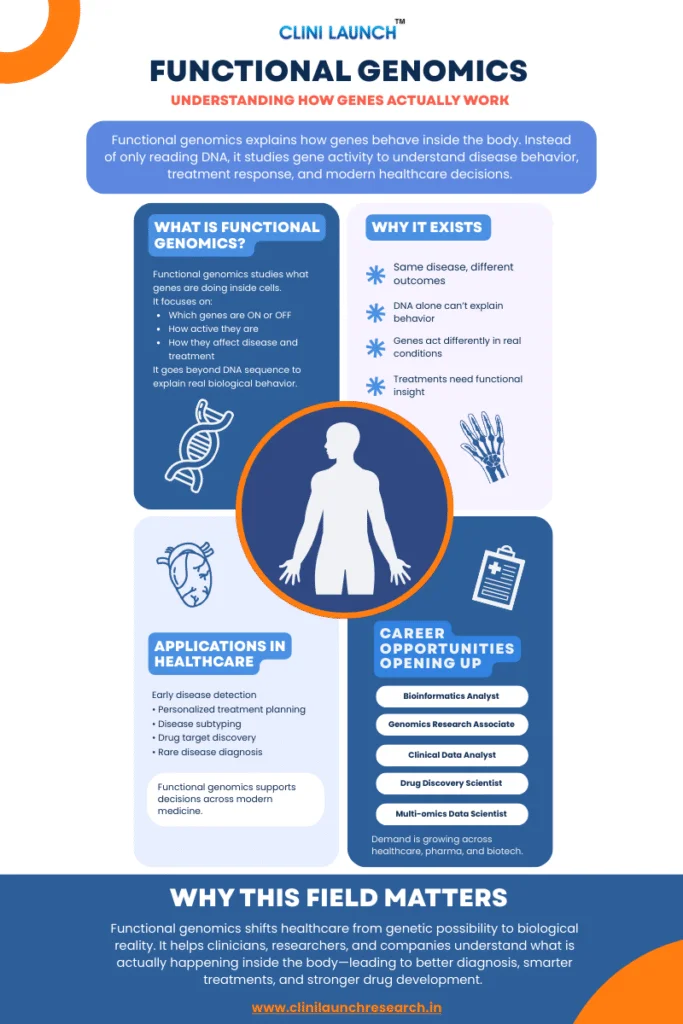
Functional genomics in healthcare studies how genes and their products (RNA and proteins) function in the body to explain disease behavior and treatment response. Instead of focusing only on DNA sequences, it analyzes gene expression, molecular pathways, and biological activity to improve diagnosis, therapy selection, and understanding of disease progression.

What Is Functional Genomics?

Functional genomics is the study of how genes function inside the body, not just what their DNA sequence looks like. Instead of focusing only on which genes are present, it examines how genes behave, when they are active, and how they influence biological processes in real conditions.

Genes are constantly being switched ON and OFF. Some activate only during illness or stress, while others remain silent. Functional genomics focuses on gene expression analysis to understand what is actually happening inside cells as diseases develop or respond to treatment.

Traditional Genomics vs Functional Genomics

Traditional genomics provides static information about DNA, which rarely changes. Functional genomics captures dynamic biological activity, showing how genes interact with proteins, pathways, and cellular systems over time.

In simple terms, traditional genomics tells us what could happen, while functional genomics explains what is happening right now. This distinction is critical for understanding complex diseases.

Case Study: Rheumatoid Arthritis and the Limits of Genetic Risk

Aspect Details
The Problem Thousands of genetic variants are linked to rheumatoid arthritis, yet many patients do not respond to treatment.
What Functional Genomics Revealed Analysis of DNA folding and gene regulation in immune cells identified which genes were actually affected.
What Changed New disease-driving pathways were identified that required activation rather than inhibition.
Why This Matters Functional genomics transformed genetic associations into actionable biology.

What Functional Genomics Is NOT

  • Not just DNA sequencing: It focuses on gene activity, not only DNA reading.
  • Not a single test: It combines multiple biological datasets.
  • Not limited to cancer: Used in autoimmune, neurological, metabolic, and rare diseases.
  • Not a replacement for clinicians: It supports medical decisions, not replaces them.
  • Not only experimental: Already used in diagnostics and treatment planning.
What Is the Need for Functional Genomics?

Modern healthcare reached a point where genetic information alone stopped being sufficient. DNA sequencing can identify mutations, but it often fails to explain disease behavior or treatment outcomes.

Diseases such as cancer and autoimmune disorders involve networks of genes and pathways that change over time. Functional genomics addresses this by focusing on gene activity rather than genetic potential.

Functional genomics is actively used in pharmaceutical research. Companies like AstraZeneca apply it to link genetic data with biological function and improve drug discovery outcomes.

Case Study: Genome-Scale Cancer Target Discovery
Aspect Details
The Problem Cancer drug development fails frequently and late in trials.
What Functional Genomics Revealed CRISPR screening identified genes cancers truly depend on.
What Changed Drug targets could be prioritized with higher success probability.
Why This Matters Functional genomics reduces wasted effort in drug discovery.

Professional Diploma in

Bioinformatics and Metabolomics

Build real-world skills in bioinformatics and metabolomics used across healthcare, pharma, and life sciences. Learn to analyze multi-omics data, identify biomarkers, and translate complex biological data into actionable insights using modern analytical pipelines. 

IN PARTNERSHIP WITH
4.8(3,235 ratings)
Functional genomics in healthcare

Applications of Functional Genomics in Healthcare

Functional genomics is applied wherever understanding biological activity matters more than simply knowing which genes exist. In healthcare, this shift has transformed how diseases are detected, classified, treated, and studied over time.

Early Disease Detection

Many diseases begin with molecular changes long before symptoms appear. Functional genomics helps detect these early signals by identifying abnormal patterns of gene activity and pathway disruption.

In cancers, altered gene expression can signal tumor development before it becomes visible on scans. In neurological conditions such as Alzheimer’s or Parkinson’s disease, early disruptions in neuronal signaling and metabolic pathways can be detected years before clinical diagnosis.

By detecting abnormal gene activity before symptoms appear, functional genomics strengthens molecular diagnostics and enables earlier, more accurate intervention.

Case Study: Gastric Cancer Drug Synergy Explained by Gene Function
Aspect Details
The Problem Gastric cancer is highly resistant to chemotherapy, and many drug combinations fail despite targeting known pathways.
What Functional Genomics Revealed Screening revealed that a drug combination worked because one drug blocked the cancer cell’s drug-efflux mechanism.
What Changed Because of It Researchers understood why the combination worked and identified patients most likely to benefit.
Why This Case Matters Functional genomics revealed what drugs were actually doing inside cells.
Personalized Treatment Planning

Patients with the same diagnosis often respond differently to the same treatment. Functional genomics explains this by revealing how active disease-related pathways are in individual patients.

In oncology, functional profiling identifies whether tumors are driven by growth signaling, immune evasion, or metabolic changes. In autoimmune diseases, it distinguishes inflammatory patterns that appear similar clinically but require different therapies.

By aligning treatment choices with biological behavior rather than labels, functional genomics reduces trial-and-error medicine.

Disease Subtyping and Risk Stratification

Many diseases that appear identical under standard testing are biologically different at the molecular level. Functional genomics enables disease subtyping based on gene activity rather than symptoms alone.

This is especially important in cancers, blood disorders, and neurological diseases, where molecular subtypes predict aggressiveness, recurrence risk, and long-term outcomes.

Drug Target Discovery and Validation

Targeting the wrong biological signal leads to failed therapies. Functional genomics helps identify which genes and pathways are actually driving disease.

By studying gene activity and pathway behavior, researchers validate whether targets play a causal role in disease progression. This improves target selection and reduces late-stage drug failures.

Understanding Rare and Undiagnosed Disorders

Rare genetic disorders often remain unexplained even after DNA sequencing. Functional genomics bridges this gap by showing how genetic changes disrupt biological pathways.

In inherited metabolic disorders, neuromuscular diseases, and rare epileptic syndromes, functional analysis clarifies whether a variant is harmful and how it affects the body.

Predicting Treatment Response and Resistance

Functional genomics predicts how patients respond to therapies by studying gene activity linked to drug metabolism, signaling pathways, and resistance mechanisms.

In cancer treatment, it explains why resistance develops and guides alternative strategies before disease progression worsens.

Case Study: Diagnosing Rare Diseases with RNA-Based Functional Genomics
Aspect Details
The Problem Many rare disease patients remain undiagnosed even after DNA sequencing.
What Functional Genomics Revealed RNA sequencing showed how variants affected gene expression and splicing.
What Changed Because of It Diagnostic accuracy improved for patients with no prior answers.
Why This Case Matters Functional genomics turns uncertain genetic data into diagnoses.
Monitoring Disease Progression and Treatment Effectiveness

Functional genomics is used to track how diseases evolve over time. Changes in gene expression can indicate whether a disease is progressing, stabilizing, or responding to therapy.

This allows clinicians to adjust treatment plans based on biological response rather than waiting for symptoms or imaging changes.

Beyond One-Time Testing
Functional genomics is increasingly used for continuous monitoring by tracking changes in biological activity over time. This supports dynamic care decisions based on molecular response rather than delayed clinical signs.
Supporting Systems Biology and Integrated Care

Functional genomics aligns with systems biology by integrating gene activity with broader biological networks. Instead of viewing genes in isolation, it models how genes, proteins, and pathways interact within the body.

This systems-level understanding supports more comprehensive disease models and improves how complex conditions are diagnosed and managed across healthcare settings.

Conclusion

Functional genomics has reshaped how healthcare understands disease. Instead of relying only on DNA sequences, it focuses on how genes behave in real biological conditions, helping explain differences in disease progression, treatment response, and clinical outcomes.

As medicine becomes more personalized and data-driven, understanding gene activity and biological pathways is no longer optional across healthcare and life sciences. Functional genomics now sits at the core of modern diagnosis, research, and drug development.

From a career perspective, this shift has created growing demand for professionals who can interpret functional genomic data in clinical research, molecular diagnostics, bioinformatics, and precision medicine roles.

At CliniLaunch, we help learners build this foundation through healthcare and life sciences programs aligned with real-world clinical and research needs. Functional genomics is not just an emerging concept—it reflects how modern medicine now approaches disease, through function rather than sequence.

Frequently Asked Questions (FAQs)

FAQs 1. How is functional genomics used in everyday clinical decision-making?

Functional genomics informs how diseases are classified, which diagnostic tests are ordered, and how treatments are prioritized by revealing pathway activity and gene expression patterns rather than relying only on DNA variants.

It supports oncologists, neurologists, and immunologists in choosing therapies that align with a patient’s real-time disease biology instead of static genetic risk alone.

2. What role does functional genomics play in molecular diagnostics and early disease detection?

Functional genomics enhances molecular diagnostics by detecting abnormal gene expression and pathway disruptions before symptoms or imaging changes appear.

This enables earlier risk assessment, more accurate disease classification, and improved use of tools such as RNA-seq–based panels and multi-omics signatures in cancer, neurological, and autoimmune conditions.

3. How does functional genomics support drug discovery, target validation, and biomarker discovery?

In drug discovery, functional genomics confirms which genes and pathways actually drive disease, reducing the risk of pursuing non-causal targets.

It also accelerates biomarker discovery by linking gene activity patterns with treatment response, resistance, and disease progression, leading to more efficient and better-stratified clinical trials.

4. What skills and careers are emerging around functional genomics in healthcare?

Emerging roles include bioinformatics analyst, multi-omics data scientist, clinical genomics researcher, and molecular diagnostics specialist.

Professionals in these roles require skills in genomic data analysis, systems biology, biomarker discovery, and AI-enabled interpretation of high-throughput biological data to translate functional genomics into clinical and pharmaceutical decisions.

5. How are AI and data science changing functional genomics in modern healthcare?

AI and data science are used to analyze large functional genomics datasets, identify complex gene expression patterns, and predict treatment response or resistance.

These approaches integrate genomics, transcriptomics, proteomics, and metabolomics into practical tools for precision medicine, clinical research, and hospital-level decision support by automating variant interpretation, risk prediction, and drug response modeling.

The dawn of the genomic era has ushered in an unmatched ability to peer into the very essence of life – our DNA. With the cost of genome sequencing plummeting, individuals and researchers alike are accumulating vast quantities of genetic raw data. However, possessing this information is merely the first step. The true power lies in genomic data interpretation – transforming a complex string of nucleotides into meaningful, actionable insights that can revolutionize healthcare, personalized medicine, and our understanding of human biology. 

This comprehensive guide will delve into the intricacies of interpreting DNA test results, exploring the methodologies, challenges, and groundbreaking advancements that shape the future of genomic science. We will illuminate how to interpret raw DNA data and navigate the exciting landscape of genetic data interpretation. 


Enroll Now: Bioinformatics Course 


Before we can even begin to discuss interpretation, it’s crucial to understand how genomic data is generated. The journey typically begins with a biological sample – be it blood, saliva, or tissue. 

1. DNA Extraction and Quantification: The first critical step involves isolating the DNA from the collected biological material. This process removes cellular debris and other contaminants, ensuring a pure DNA sample. Subsequently, the quantity and quality of the extracted DNA are assessed, as these factors directly impact the success of subsequent sequencing. 

2. Library Preparation: Isolated DNA is then fragmented into smaller, manageable pieces. Adapters, short synthetic DNA sequences, are tied to these fragments. These adapters serve as crucial anchors for binding to the sequencing platform and for identifying individual DNA fragments during the sequencing process. This “library” of prepared DNA fragments is now ready for sequencing. 

3. High-Throughput Sequencing Technologies: The past two decades have witnessed a revolution in sequencing technologies. 

  • Sanger Sequencing: While foundational and still used for targeted sequencing, Sanger sequencing is a low-throughput method. 
  • Next-Generation Sequencing (NGS) / Massively Parallel Sequencing: This encompasses a range of technologies (e.g., Illumina, PacBio, Oxford Nanopore) that allow for the simultaneous sequencing of millions to billions of DNA fragments. These platforms generate vast amounts of short “reads” – sequences of nucleotides corresponding to fragmented DNA. Key advantages of NGS include its high throughput, affordability, and ability to detect rare variants. 
  • Third-Generation Sequencing: Technologies like PacBio and Oxford Nanopore offer longer reads, which are particularly beneficial for resolving complex genomic regions, structural variants, and highly repetitive sequences. 

The output of these sequencing platforms is typically in the form of FASTQ files, which contain both the nucleotide sequences and their associated quality scores, indicating confidence in each base call. This genetic raw data is the raw material for all subsequent interpretative endeavors. 

Once the raw genomic data is generated, the real work of genomic data interpretation begins. This involves a multi-step bioinformatics pipeline designed to transform raw reads into interpretable genetic variations. 

1. Quality Control and Pre-processing: The initial FASTQ files often contain errors or low-quality reads that can skew downstream analyses. Quality control steps involve: 

  • Trimming Adapters: Removing the adapter sequences that were added during library preparation. 
  • Filtering Low-Quality Reads: Discarding reads with low quality scores, which could lead to inaccurate variant calls. 
  • Removing Duplicates: Identifying and removing PCR duplicates, which can artificially inflate read counts and lead to biased variant calling. 

2. Alignment and Read Mapping: The cleaned sequencing reads are then aligned to a reference genome. The human reference genome (e.g., GRCh38) serves as a template, allowing researchers to determine the precise chromosomal location of each read. This process, often performed using algorithms like BWA or Bowtie, identifies where each short read “maps” to the longer reference sequence. The output of this step is typically a BAM file, which contains the aligned reads and their mapping information. 

3. Variant Calling: This is a crucial step in interpreting DNA test results. Variant callers (e.g., GATK, FreeBayes, Samtools) analyze aligned reads to identify differences (variants) compared to the reference genome. These variants can include: 

  • Single Nucleotide Polymorphisms (SNPs): A change in a single nucleotide at a specific position. 
  • Insertions and Deletions (Indels): The addition or removal of one or more nucleotides. 
  • Structural Variants (SVs): Larger-scale genomic rearrangements, such as copy number variations (CNVs), inversions, and translocations. 

The output of variant calling is typically a VCF (Variant Call Format) file, which lists all identified variants along with their genomic coordinates, reference and alternate alleles, and various quality metrics. 

4. Variant Annotation: A VCF file, while informative, still requires further processing to understand the potential impact of each variant. Annotation tools (e.g., ANNOVAR, SnpEff, VEP) add functional and clinical information to each variant by querying various databases. This includes: 

  • Genomic Location: Whether the variant is in a gene, intergenic region, or regulatory element. 
  • Effect on Gene/Protein: If in a gene, whether it’s synonymous, missense, nonsense, or frameshift. 
  • Allele Frequencies: How common the variant is in different populations (e.g., gnomAD, 1000 Genomes Project). 
  • Clinical Significance: Whether the variant has been associated with diseases or traits in clinical databases (e.g., ClinVar, OMIM). 

This extensive annotation process transforms raw variant calls into a more interpretable dataset, laying the groundwork for in-depth genetic data interpretation. 

Once the raw data has been processed and annotated, the true challenge of genomic data interpretation begins. This involves leveraging a combination of computational tools, biological knowledge, and statistical approaches to extract meaningful biological and clinical insights. 

Given the sheer number of variants often identified in a genome (millions of SNPs), it’s imperative to prioritize those most likely to be functionally significant or clinically relevant. This can involve: 

  • Filtering Frequency: Removing common benign variants found in population databases. 
  • Filtering by Predicted Impact: Focusing on variants predicted to have a high impact on protein function (e.g., nonsense, frameshift, splice site variants). 
  • Filtering by Clinical Databases: Prioritizing variants previously reported in clinical databases with a known association to disease. 
  • Inheritance Patterns: Considering the mode of inheritance for suspected genetic conditions (e.g., autosomal dominant, recessive, X-linked). 
  • Gene Panels: For specific suspected conditions, targeted gene panels sequence only a subset of genes known to be associated with a particular disease. This simplifies interpretation by focusing on a limited number of genes. 
  • Whole Exome Sequencing (WES): Sequences all protein-coding regions of the genome (exons), which constitute about 1-2% of the total genome but contain ~85% of disease-causing mutations. WES offers a broader view than gene panels while being more cost-effective than whole genome sequencing. 
  • Whole Genome Sequencing (WGS): Sequences the entire genome, including both coding and non-coding regions. WGS provides the most comprehensive view, enabling the detection of structural variants and variants in regulatory regions, which are often missed by the WES. Interpreting raw DNA data from WGS requires advanced computational resources and sophisticated algorithms. 

Beyond individual variants, understanding the broader biological context is crucial. 

  • Gene Ontology (GO) and Pathway Analysis: These analyses identify over-represented biological processes, molecular functions, or cellular components among a set of genes or variants. For example, if many identified variants are genes involved in a specific metabolic pathway, it could suggest a dysregulation of that pathway. 
  • Protein-Protein Interaction Networks: Mapping genes with identified variants onto protein interaction networks can reveal how these genes might be functionally linked and contribute to disease mechanisms. 

The ultimate goal of genomic data interpretation in a clinical setting is to provide actionable insights for patient care. This involves: 

  • ACMG Guidelines: The American College of Medical Genetics and Genomics (ACMG) provides standardized guidelines for classifying the pathogenicity of genetic variants (e.g., pathogenic, likely pathogenic, variant of uncertain significance (VUS), likely benign, benign). This provides a framework for consistent interpretation. 
  • Phenotype-Driven Interpretation: Integrating patient phenotype (clinical presentation) with genomic findings is critical. A variant that might be benign in a healthy individual could be pathogenic in a patient presenting with specific symptoms. 
  • Multi-Disciplinary Team Review: Often, clinical genomic interpretation involves a team of experts, including geneticists, genetic counselors, bioinformaticians, and relevant clinicians, to ensure accurate and comprehensive reporting. 

While significant progress has been made, several challenges persist in genomic data interpretation: 

1. The “Variant of Uncertain Significance” (VUS) Conundrum: A major challenge is the identification of VUS, where there is insufficient evidence to classify a variant as clearly benign or pathogenic. This often necessitates further research, family studies, or functional assays to resolve their clinical significance. Interpreting DNA test results with numerous VUS can be perplexing for both clinicians and patients. 

2. Complex Disease Genetics: Many common diseases (e.g., heart disease, diabetes, cancer) are complex, meaning they are influenced by multiple genes and environmental factors. Identifying individual genetic contributions to these diseases can be challenging and requires sophisticated polygenic risk score models. 

3. Data Standardization and Interoperability: The lack of universal standards for data formats, annotation, and reporting can hinder data sharing and collaborative research. Efforts like GA4GH (Global Alliance for Genomics and Health) are working towards addressing these issues. 

4. Ethical, Legal, and Social Implications (ELSI): The rapid advancements in genomics raise important ELSI concerns, including data privacy, genetic discrimination, informed consent, and the responsible use of genomic information. 

Despite these challenges, the opportunities presented by genomic data interpretation are immense: 

  • Personalized Medicine: Tailoring medical treatments and preventative strategies based on an individual’s unique genetic makeup. 
  • Pharmacogenomics: Predicting an individual’s response to drugs based on their genetic variations, optimizing drug dosage and minimizing adverse effects. 
  • Rare Disease Diagnosis: Accelerating the diagnosis of rare genetic disorders, often ending diagnostic odysseys for affected individuals and families. 
  • Cancer Genomics: Identifying somatic mutations in tumors to guide targeted therapies and monitor treatment response. 
  • Preventative Healthcare: Identifying individuals at increased risk for certain diseases and implementing early screening or lifestyle interventions. 
  • Population Genomics and Public Health: Understanding disease prevalence, population substructure, and disease outbreaks at a genomic level. 

The complexity of interpreting raw DNA data necessitates a robust software ecosystem. Here are some categories of essential tools and platforms: 

  • BWA (Burrows-Wheeler Aligner): A widely used tool for aligning sequencing reads to a reference genome. 
  • GATK (Genome Analysis Toolkit): Developed by the Broad Institute, GATK is a comprehensive suite of tools for variant discovery and genotyping, offering robust algorithms for SNP and indel calling. 
  • FreeBayes: A Bayesian genetic variant detector designed to find small polymorphisms, especially those in challenging regions. 
  • Samtools/BCFtools: Essential utilities for manipulating sequence alignment data (BAM files) and variant call format files (VCF files). 
  • ANNOVAR: A versatile tool for annotating genetic variants, providing information on their genomic location, functional consequences, and conservation. 
  • SnpEff/SnpEff database: Predicts the effects of genetic variants on genes and proteins. 
  • VEP (Variant Effect Predictor): From Ensembl, VEP predicts the effects of variants on genes, transcripts, and proteins, integrating with a wide range of public databases. 
  • ClinVar: A public archive of human genetic variation and its relationship to health, crucial for clinical interpretation. 
  • gnomAD (Genome Aggregation Database): Provides allele frequencies of genetic variants from large-scale sequencing projects, essential for filtering common benign variants. 
  • IGV (Integrative Genomics Viewer): A desktop application for interactive exploration of large genomic datasets, allowing visualization of aligned reads, variant calls, and annotations. 
  • UCSC Genome Browser: A web-based genome browser providing a rich interface for visualizing genomic data and accessing a vast array of annotations. 
  • Ensembl Genome Browser: Like UCSC, Ensembl offers extensive genomic data, including gene models, regulatory features, and variant information. 
  • AWS Genomics (Amazon Web Services): Provides scalable cloud infrastructure and services for genomic data storage, processing, and analysis. Its offerings include robust computing resources, storage solutions (S3), and specialized services for genomics workflows. 
  • Google Cloud Life Sciences: Offers a similar suite of tools for genomics, including pipelines for common bioinformatics tasks and large-scale data management. 
  • DNAnexus/Seven Bridges Genomics: Commercial cloud-based platforms that provide comprehensive solutions for genomic data analysis, collaboration, and secure data management, often with pre-built pipelines for various applications. 

These platforms are instrumental in managing the immense computational demands of genetic raw data interpretation and providing a collaborative environment for researchers and clinicians. 

The field of genomic data interpretation is evolving at an exhilarating pace. Future directions include: 

  • Integration of Multi-Omics Data: Combining genomic data with other ‘omics’ data types, such as transcriptomics (gene expression), proteomics (protein levels), and metabolomics (metabolite profiles), to provide a more holistic understanding of biological systems and disease mechanisms. 
  • Artificial Intelligence and Machine Learning: AI and machine learning algorithms are increasingly being employed to identify complex patterns in genomic data, predict variant pathogenicity, and discover novel disease associations. Deep learning models are showing promise in deciphering non-coding variants and their regulatory roles. 
  • Long-Read Sequencing Advancements: Continued improvements in long-read sequencing technologies will enable more accurate detection of structural variants and the phasing of alleles, providing a more complete picture of an individual’s genome. 
  • Population-Specific Reference Genomes: Developing reference genomes that are more representative of diverse populations will improve the accuracy of variant calling and interpretation across different ethnic groups, addressing current biases. 
  • Democratization of Genomic Data Interpretation: User-friendly interfaces and automated interpretation pipelines will make genomic insights more accessible to a broader range of healthcare professionals and even individuals, empowering them with personalized health information.

The journey from a biological sample to actionable insights is complex, yet profoundly impactful. Genomic data interpretation stands as the hub in this process, transforming the vast, intricate language of DNA into a narrative of health, predisposition, and potential. From interpreting DNA test results for rare disease diagnosis to guiding personalized cancer therapies, the ability to interpret raw DNA data is revolutionizing medicine. 

As the volume and complexity of genomic data continues to expand, the demand for sophisticated bioinformatics solutions and expert interpretation will only intensify. This is where organizations like CliniLaunch excel. 

Are you navigating the complexities of genomic data? CliniLaunch offers cutting-edge bioinformatics services and expert consultations to help you unlock the full potential of your genetic insights. From comprehensive genomic analysis to tailored interpretation strategies, our team at CliniLaunch Research is dedicated to accelerating your research and clinical discoveries.


What Is Genomics Data Analysis: Meaning and Software 

What Is Genomics Data Analysis: Meaning and Software | BGO Software

What is Genomic Data? 

https://aws.amazon.com/what-is/genomic-data

Protein folder problem has a stretch of genomic DNA sequence, by using this, you can predict where the introns are, where transcription will begin and end, where translation will begin and end, and predict distal regulatory elements and methylation sites. With the new protein structure prediction tools, it may change, for this to predict a protein structure and how it can compare to the experimental structure of a reputed structural homolog. This blog outlines an overview of improved protein structure prediction and its definition, approaches, and how it works. 


Enroll Now: Bioinformatics course 

Understanding Protein Structure Prediction  

Large biomolecules from proteins carry out crucial functions within organisms, such as transporting molecules, acknowledging stimuli, offering structuring to cells, and creating metabolic reactions. A protein containing continuous long chains of amino acid linked through peptide bonds. Protein Sequence Analysis usually instant folds into the specific tertiary structure in a natural environment known as native structure where each atom occupies an individual position in the three-dimensional space of the molecule. Through many non-covalent activities, the main factors driving a protein to fold into its native structure are hydrophobic effects, hydrogen bonds, van der Waals forces, and ionic bonds.   

In some local regions, protein structures are characterized by a regular conformation shape. The regular, local protein secondary structure is formed by the hydrogen bonds among amide groups of residues. The most frequent secondary structure is the right-handed spiral 𝛼 – helix, in which the supporting amino group donates a hydrogen bond with another backbone carbonyl group, and the structure prediction from sequence distance between these two groups is 3.6 average amino acids. β strand is another common secondary structure which exhibits an almost fully extended shape. Several β parallel or antiparallel strands linked between hydrogen bonds form a β – sheet. For example, which one consists of three α – helices and three β strands, the accurate predicting protein structure of the secondary provides significant information of its tertiary structure.   

As protein functions are determined mainly by their tertiary structures, knowledge of the native structures of proteins is highly desirable. Also, experimentally, the native structures of proteins can be used in nuclear magnetic resonance, X-ray crystallography, and cryogenic electron microscopy. Still, there are experimental technologies that are usually costly and time-consuming, and they cannot step up with the quick collection of protein sequences.   

On the other hand, this structure determination technologies, the protein structure prediction approaches. For example, protein sequence analysis structure from protein sequences utilizing computing techniques is highly effective. Predicting protein structure purely from its sequence is practical as the structure information is necessary for embedding in the protein sequence. For example, unfolded protein usually refolds to its native structure under conditions when restoring the protein to an aqueous environment. 

Protein Structure Prediction

The precision prediction of protein structures depends heavily on a comprehensive understanding of the protein folding process and the relationship between native structures and protein sequences. The state of native structure of the protein takes the lowest free energy and nearly all extra fit perfectly with their local structural environments.  

The evolution history of a query protein, which is normally explained using the multiple sequence alignments (MSAs) of its homologies, offers ample information to gather its native structure. Particularly, the residues with analytic roles in stabilizing structure are partially covered, on the other hand the residues in contact lead to change during the evolutionary process. 

In different ways, the protein sequence and structure can be represented. It can also represent the sequences of homology proteins as MSAs or (PSSM) position sequence scoring matrix. Highlighting the correlations among residues for further processing MSAs into hidden profile Markov models or even conditional random fields. Likewise, a protein structure prediction from sequence can be illustrated using the coordinates of all its atoms, the torsion angles related with each Catom, or the distances between residue pairs.  

By effectively exploiting the sequence-structure relationship with most of the existing approaches managing structure prediction and the evolutionary information carried by the similar proteins of the target protein. The present approaches can be differentiated into template – based modeling (TBM), which requires template proteins. For example, the proteins with solved structures and free modeling are called ab initio approaches which do not depend on any templates. The TBM approaches can be differentiated into homology modeling and threading.

Protein structure prediction is to balance its amino acid sequence to other protein with a solved structure. This process is called homology-based structure prediction. If the sequences are alike, it stands to reason that their structures should also be similar. 

For instance, amino acid sequence homology between the template protein and your protein is comparatively very high, you can simply underlie the side and main chain atoms are known structure of your protein.  

A few differences in amino acid sequence, you can underlie the main chain atoms onto these regions and physically determine where the side atoms will end. Once you have an initial model based on sequence homology, you can filter it to ensure that the confirmation things like the bond angles and energy minimization of folds makes theoretical sense.  

Overlaying is not a process in threading, amino acid sequence to a homologous structure, but alternatively you take existing structures and see if your sequence could potentially match their folding. There are so many chances for protein conformations in nature, and even proteins that lack sequence homology to one another may have three-dimensional structures.  

For threading, you can pick several candidate templates and utilize them as an algorithm to determine which template results as the best fit, looking at suitable bond angles and the lowest energy score. The process is constant and is a good option if a protein structure with a homologous sequence does not exist.  

During the 14th critical assessment of critical assessment of structure prediction (CASP14) assessment in 2020. The next approach is made possible by modern computing power and AI is a huge splash. Particularly, DeepMind was co-developed with AlphaFold-2. This method initiated by running a multi-sequence alignment (MSA) that considers the evolutionary relationships between proteins and changes in individual amino acids.  

For an example, if a given residue has evolved, then another amino acid paired to that residue will also transform so that the protein’s overall structure is maintained in the variant. The arrangement and pairings are constantly passed through a machine learning algorithm AlphFold-2 is called as an Evo former. This algorithm identifies the best pair interactions and arranges the information to a third portion of the pipeline that creates a structure.  

The AlphaFold-2 development team ran the sequences of proteins with experimentally solved structures through the AI pipeline and found that the protein structure prediction was highly like the experimentally determined ones. From the CASP14 challenge, AlphaFold – 2 can predict the harmonization of backbone atoms in space with a precision of 0.96 Å root – mean – square deviation (RMSD) and an all-atom precision of 1.5 Å RMSD. From this aspect, the width of a carbon atom is 1.5 Å, and all atom accuracy of the next best approach entered in CAPS14 was 3.5 Å RMSD.  

The deviation of atomic coordinates by less than 1.5 Å would outcome as an actual and predicted structure that are very nearly overlaying upon each other.  

The field of protein structure prediction has undergone significant advancements, moving from traditional homology-based and threading methods to revolutionary AI-powered tools like AlphaFold 2. Understanding protein structure is crucial for deciphering its function, and while experimental techniques have limitations in terms of cost and scalability, computational approaches offer a powerful alternative. The development of methods that leverage evolutionary information and machine learning has dramatically improved the accuracy of predictions, bringing us closer to reliably determining the 3D structure of proteins directly from their amino acid sequences. This progress has profound implications for various biological and medical applications, including drug discovery and understanding disease mechanisms. 

Ready to delve deeper into the fascinating world of bioinformatics? Enroll in our comprehensive Bioinformatics course at Clinilaunch Research and gain the skills to harness the power of protein structure prediction and other advanced techniques. 

  1. What is Protein Structure Prediction? 

Protein structure prediction is the process of computationally determining the three-dimensional (3D) structure of a protein based on its amino acid sequence. This is important because a protein’s structure largely dictates its function within a biological system. 

  1. What are the main approaches to Protein Structure Prediction? 

The main approaches include: 

Homology-Based Structure Prediction: This method builds a model of the target protein based on the known structure of a homologous protein (a protein with a similar sequence). 

Threading: This approach involves fitting the amino acid sequence of the target protein onto a library of known protein folds to find the best match. 

Ab Initio/Free Modeling: These methods predict the protein structure from first principles, without relying on known structures. AlphaFold 2 is a prominent example of a modern, highly accurate ab initio method. 

  1. How does AlphaFold 2 work? 

AlphaFold 2 utilizes a deep learning algorithm that analyzes multiple sequence alignments (MSAs) to understand the evolutionary relationships between proteins and co-evolution of amino acid residues. This information is processed through a neural network architecture called the Evo former, which predicts residue pairings and ultimately generates a highly accurate 3D structure prediction. 

  1. Why is Protein Structure Prediction important? 

Knowledge of a protein’s 3D structure is essential for understanding its function, interactions with other molecules, and its role in biological processes. This information is crucial for various applications, including: 

Drug Discovery: Identifying potential drug targets and designing molecules that can interact with them. 

Understanding Disease Mechanisms: Elucidating how protein misfolding or mutations can lead to diseases. 

Biotechnology: Engineering proteins with novel functions for industrial or therapeutic purposes. 

  1. What is the significance of the Root Mean Square Deviation (RMSD) in the context of AlphaFold 2’s accuracy? 

The Root Mean Square Deviation (RMSD) is a measure of the average distance between the atoms of a predicted protein structure and the corresponding atoms in the experimentally determined structure. A lower RMSD value indicates a higher degree of accuracy. AlphaFold 2 achieved remarkably low RMSD values (around 0.96 Å for backbone atoms and 1.5 Å for all atoms in some cases), signifying a very high level of agreement between its predictions and experimental data. 


Protein Structure Prediction: Challenges, Advances, and the Shift of Research Paradigms 

https://academic.oup.com/gpb/article/21/5/913/7632861

A Beginner’s Guide to Protein Structure Prediction 

https://bitesizebio.com/74900/protein-structure-prediction

The next generation sequencing is projected to reach $97.8 billion by 2035 reported by Allied Market Research with 18.3% compound annual growth rate from 2024. With the increase in genetic disorder and cancer incidences in the global market, it is emphasized that there is an urgent need for advanced genomics technologies.  

NGS next generation sequencing is a high-throughput DNA sequencing technology allowing cost-effective sequencing of DNA or RNA. It enables the study of genetic variations and biological phenomena. This leads to advancements in research and clinical applications such as disease diagnosis and personalized medicine.  

Traditional Sanger sequencing, while ground-breaking in its time, was limited by its throughput and cost. NGS, also known as New Generation Sequencing or Next Generation DNA sequencing, overcomes these limitations by massively parallel sequencing of millions of DNA fragments simultaneously. This allows for rapid and cost-effective sequencing of entire genomes, transcriptomes, or targeted gene panels. 

NGS breaks down DNA or RNA into smaller fragments, attaches adapter sequences, and then amplifies and sequences these fragments in parallel. This high-throughput approach generates vast amounts of data, providing a comprehensive view of genetics.  


Enrol Now: PG Diploma in Bioinformatics 

The groundbreaking discovery of the DNA double helix structure, a cornerstone of modern biology, is credited to James Watson and Francis Crick in 1953. Their work, for which they received the 1962 Nobel Prize, was significantly informed by the crucial X-ray crystallography data provided by Rosalind Franklin. Franklin’s contributions, essential to understanding DNA’s molecular structure, were initially underappreciated, leading to her being referred to as ‘the dark lady of DNA’. Later in 1968, Robert Holley further advanced the field by becoming the first to sequence and RNA molecule. Together, these pivotal discoveries laid the foundation for the subsequent development of RNA sequencing technologies.  

Following are the most important defining moments for genomic DNA sequencing: 

  • 1972: Paul Berg‘s pioneering work established the foundational technique for isolating specific DNA segments, which was crucial for the emergence of contemporary genetic engineering. Prior to his breakthrough, scientists were limited to studying the DNA of viruses and phages. 
  • 1973: Walter Gilbert pioneered DNA sequencing by publishing the first nucleotide sequence, a 24-base-pair segment of the lac operator. 
  • 1977:Frederick Sanger achieved a landmark in genomics by determining the complete DNA sequence of the bacteriophage phi X174, a feat that marked the first fully sequenced genome. He also innovated ‘chain-termination sequencing’, a method that revolutionized DNA analysis. 
  • 1977: Walter Gilbert developed the chemical degradation method for DNA sequencing. 
  • 1986: A pivotal advancement in genomics occurred when Leroy Hood, working at Caltech, unveiled the initial semi-automated DNA sequence, a device that significantly propelled the ability to map and sequence genetic information. 
  • 1987: The ABI370, developed and sold by Applied Biosystems in the United States, revolutionized genetic research as the first automated DNA sequence, playing a crucial role in projects like the Human Genome Project. 
  • 1990: In a landmark collaborative effort, the Human Genome Project was launched, uniting scientists from the United States, United Kingdom, France, Germany, Japan, China, and India, with an anticipated duration of 15 years. 
  • 1998: Eric Kawashima, Laurent Farinelli, and Pascal Mayer, working at Glaxo Wellcome’s Geneva Biomedical Research Institute, pioneered a method for nucleic acid amplification, a key advancement for Next-Generation Sequencing (NGS). 
  • 2000: The Human Genome Project achieved a preliminary version of the complete human genome, largely thanks to breakthroughs in genomics, particularly in the analysis of DNA sequences. 


Next Generation Sequencing

The advent of Next-Generation Sequencing (NGS) is the early 2000s advanced DNA sequencing. Based on the traditional Sanger method, NGS offered an unprecedented combination of high-throughput data generation, speed, cost-effectiveness, and accuracy, fundamentally expanding the scope of genomic research.  

Following is the key revolutionary moment of next-generation sequencing:  

  • 2000: A pioneering step in next-generation sequencing (NGS) was taken by Lynx Therapeutics, who introduced Massively Parallel Signature Sequencing (MPSS). This foundational technology, later integrated into Illumina’s portfolio, marked the dawn of a new era in genomics. 
  • 2004: The landscape of DNA sequencing underwent a seismic shift with the commercialization of the Roche GS20 by 454 Life Sciences. This pyrosequencing platform, the first NGS system to reach the market, delivered an unprecedented 20 million base pairs, fundamentally transforming sequencing capabilities. 
  • 2008: The power of NGS was vividly demonstrated with the publication of the first study detailing the sequencing of a complete human genome. James Watson received his personal genome on a hard drive, a feat that cost approximately $1 million. This event heralded the widespread adoption of NGS for individual genome sequencing. 
  • 2014: Illumina achieved a significant milestone by launching the HiSeq X Ten Sequencer, claiming to have achieved the $1,000 genome. However, reaching this price point required substantial initial investments in the tens of millions. 
  • 2014: Illumina’s dominance in the DNA sequencing sector became undeniable, with the company controlling 70% of the sequencer market and contributing to over 90% of global DNA data production, effectively establishing a near-monopoly. 
  • 2018: Veritas Genetics made waves by offering whole genome sequencing for an astonishing $199, albeit to a limited group of 1,000 customers, showcasing the rapidly decreasing costs of genomic analysis. 
  • 2019: The National Human Genome Research Institute reported that the cost of sequencing a full human genome had fallen to $942, surpassing the predicted rate of cost reduction based on Moore’s Law. 
  • 2022: Ultima Genomics disrupted the short-read sequencing market by announcing the $100 genome, a remarkable achievement accomplished just eight years after Illumina’s HiSeq X Ten Sequencer breakthrough in 2014. 
  • 2022: In response to Ultima’s announcement, Illumina introduced the NovaSeq X Series, a platform designed to produce over 20,000 whole genomes annually, demonstrating the ongoing competitive innovation in the field. 

There are several platforms that exist within New Generation Sequencing Technologies, each with its unique strengths and applications. 

Here are some of the examples that include: 

Illumina sequencing is a widely used next-generation sequencing (NGS) technology determines DNA sequences by tracking the addition of labelled nucleotides as the DNA chain is copied in a massively parallel fashion, using a method called sequencing by synthesis (SBS). 

Oxford Nanopore sequencing is a technology that sequences DNA and RNA in real-time. It uses nanopores, which are tiny holes in a membrane, to analyze the current disruption caused by passing molecules. 

454 pyrosequencing, a next-generation sequencing technology developed by Roche, utilizes a sequencing-by-synthesis approach where DNA fragments are amplified on beads, then sequenced by detecting the release of pyrophosphate (PPi) upon nucleotide incorporation. 

Ion Torrent Sequencing is a next-generation sequencing (NGS) technology that uses semiconductor chips to detect hydrogen ions released during DNA polymerization, enabling rapid and accurate DNA sequencing for various applications.  

Imagine DNA polymerase, actively building a new strand of DNA. Each building block, a nucleotide (dNTP), carries a unique fluorescent beacon, a distinct color reveals its identity as it is added to the growing chain. This visual tracking of nucleotide incorporation is the essence of the process.  


Next-generation sequencing analysis involves the use of high-throughput sequencing technologies to rapidly analyse large amounts of DNA or RNA. It enables researchers to study genomes and identify genetic variations. The raw data generated by NGS platforms is just the beginning. It involves a series of computational steps to process, analyse and interpret the sequencing data. 

The journey from biological sample to meaningful data in next-generation sequencing (NGS) analysis unfolds in four distinct phases.  

Library preparation transforms the starting DNA or RNA into a sequence able form. This meticulous process involves fragmenting the nucleic acid, attaching adapter sequences for platform binding and identification, and amplifying the fragments to generate sufficient signal. Essentially, it’s the crucial step of preparing the genetic material for the high-throughput sequencing process that follows. 

Sequencing itself takes place, where the prepared library is subjected to the core chemistry of the NGS platform. Modern systems often employ sequencing-by-synthesis, where DNA strands are built one base at a time, and each incorporated base is detected through fluorescent or other signals. This allows for the simultaneous sequencing of millions of fragments, generating a vast amount of raw data. 

The initial processing of this raw data falls under primary data analysis. Here, the detected signals are translated into actual DNA sequences (base calling), and the quality of the sequencing data is assessed. Low-quality reads are filtered out, leaving a set of reliable sequence reads. This stage is critical for ensuring the accuracy of downstream analyses. 

Secondary and tertiary data analysis focuses on extracting biological insights from the processed sequence data. This involves aligning the reads to a reference genome, identifying genetic variations, quantifying gene expression, or performing other analyses depending on the experimental goal. This is where researchers answer their specific biological questions, making sense of the vast amounts of sequencing data generated. 

Overall, bioinformatics tools and pipelines are essential for handling the massive datasets generated by next generation sequencing. These tools enable researchers to extract meaningful biological insights from the complex sequencing data. 

Next generation sequencing has revolutionized various fields. It includes:  

Through next generation sequencing, researchers gain the power to simultaneously examine a vast number of gene i.e., ranging from hundreds to thousands across multiple samples. This technology’s strength lies in its ability to uncover and analyse a diverse spectrum of genomic features within a single experiment. Pinpointing individual base changes in single nucleotide variants (SNVs) to specifically detect larger alternatives like copy number variations, structural rearrangements, and even RNA fusions, next generation sequencing provides a comprehensive view of the genome.  

With the ability to analyse a set of complete RNA transcripts or the transcriptome revolutionizing numerous scientific domains. Transcriptomics pinpoints disease markers and accelerate pharmaceutical development explaining the complexities of organismal development while deciphering plant responses to environmental challenges. It provides a powerful lens for biological investigation.  

Next generation sequencing revolutionized cancer genomics. It provides and unprecedented level of detail into the genetic and epigenetic alterations driving malignancy. This technological lead has not only deepened our understanding of cancer’s fundamentals biology but also ushered in a new era of personalized medicine, transforming how we diagnose and treat cancer patients.  

Next-generation sequencing is revolutionizing infectious disease diagnostics, offering rapid and accurate pathogen identification, detection of antimicrobial resistance, and insights into disease transmission and virulence, surpassing traditional methods.  

Using next-generation sequencing for personalized medicine enables a rapid and accurate sequencing of DNA, leading to faster and more precise diagnoses, targeted therapies, and personalized treatments plans based on individual genetic profiles.  

Next-generation sequencing is revolutionizing agriculture by enabling rapid and cost-effective analysis of plant and animal genomes, facilitating the identification of genes and markers for desirable traits while also accelerating crops and livestock improvement. It is useful in improving crop yields and developing disease-resistant varieties. 

As next-generation sequencing technologies continue to rise, we can expect even greater advancements in throughput with accuracy and cost-effective methods. These methodologies will help researchers further expand the applications of NGS and it will help in acceleration of discoveries in various fields. The future scope of biological and medical research is intimately tied to the ongoing advancements within next-generation sequencing technologies, and the field of next generation sequencing analysis. As the technologies will improve, it will provide event more valuable analysis and insights useful for further weakening the complexities of life.  

Want to learn computational methods to analyse biological data? You can get deep insights with next-generation DNA sequencing, structural bioinformatics, and genomic data analysis with the best Post Graduate Diploma in Bioinformatics course online/offline offered by Clini Launch. Let’s kick start your career with bioinformatics training program and gain in-depth industry insights, hands-on practical learning experience and 100% placement support with real-world applications.  

Let’s empower you with vital computational tools to analyse biological data, merging technical proficiency with practical training. Prepare for certifications and pursue a rewarding career in the field of bioinformatics. Join Clini Launch


2025 and Beyond: The Future of Genomic Data Analysis and Innovations in Genomics Services 

https://blog.crownbio.com/2025-and-beyond-the-future-of-genomic-data-analysis-and-innovations-in-genomics-services#:~:text=NGS%20allows%20the%20sequencing%20of,more%20accessible%20to%20clinical%20settings.

Next-Generation Sequencing Technology: Current Trends and Advancements 

https://www.mdpi.com/2079-7737/12/7/997

Next generation sequencing technology: Advances and applications 

https://www.sciencedirect.com/science/article/pii/S092544391400180X

  • Clinical Research 
  • Bioinformatics 
  • Medical Coding 
  • Clinical SAS 
  • Biostatistics 
  • AI and ML in Healthcare 
  • Medical Scribe 
  • NCLEX-RN 
  • MBA in Heathcare 

We focus on core competencies such as: 

  • In-depth practical knowledge 
  • Exposure to live capstone projects 
  • Personalized coaching and mentoring 
  • Industry-specific knowledge and certifications 
  • Learn advance tools and techniques  
  • Attend webinars on recent topics and learn from industry experts  
  • Personalize resume building and interview preparation 


  • Cutting-edge knowledge in emerging healthcare fields 
  • Practical skills to apply in real-world scenarios 
  • Networking opportunities with top healthcare organizations 
  • Ongoing career support and guidance 

  1. https://teganalytics.com/now-hiring-iitians-top-reasons-why-teg-analytics-considers-to-hire-from-iits/ 
  1. https://pmc.ncbi.nlm.nih.gov/articles/PMC3043365/ Viraj Rajadhyaksha   


  • Detect disease outbreaks and respond promptly. 
  • Identify risk factors for various health conditions. 
  • Evaluate the effectiveness of health interventions and policies. 
  • Develop data-driven public health strategies. 
  • Reduce health disparities in vulnerable communities. 

Objectives of Clinical Epidemiology: 

Disease surveillance is a fundamental aspect of public health that involves the ongoing collection, analysis, and interpretation of health data. The CDC defines surveillance as an essential tool for controlling infectious diseases. 

Public health agencies monitor diseases such as: 

  • Tuberculosis, STDs, and vaccine-preventable illnesses. 
  • Foodborne infections (e.g., Salmonella, E. coli). 
  • Emerging infectious diseases such as COVID-19. 

By employing advanced data integration methods, epidemiologists can track disease progression and implement timely interventions. 

Key areas of study include: 

  • Diabetes epidemiology 
  • Maternal and reproductive health 
  • Mental health epidemiology 
  • Musculoskeletal disorders 

Infectious diseases remain a significant public health concern. Infectious disease epidemiology aims to control and eliminate diseases caused by bacteria, viruses, and parasites. Research areas include: 

  • Pharmacoepidemiology and antimicrobial resistance. 
  • Clinical trials for vaccine development. 
  • Global health initiatives to prevent pandemics. 

Injury epidemiology studies unintentional injuries (e.g., motor vehicle crashes, burns) and intentional injuries (e.g., violence, suicides). Public health initiatives focus on: 

  • Violence prevention programs 
  • Occupational safety regulations 
  • Emergency response planning 

Advancements in molecular and genetic epidemiology have revolutionized disease prevention. Researchers study genetic markers and molecular pathways to understand disease susceptibility. 

Key areas include: 

  • Human genetics and genetic epidemiology 
  • Pharmacogenomics and precision medicine 
  • Nutritional epidemiology 

  • Expanding cohort studies across the lifespan. 
  • Integrating big data science into epidemiology. 
  • Developing advanced data integration methods. 
  • Enhancing public health policies through research. 

Epidemiology remains at the forefront of public health, guiding policies and interventions to improve global health outcomes. Through clinical epidemiology and global health research, biostatistics, and advanced data integration methods, epidemiologists continue to tackle some of the world’s most pressing health challenges. By pursuing public health courses such as an MPH (Master of Public Health), aspiring professionals can contribute to a healthier future for all. 

The transformation of epidemiology in the 21st century will depend on integrating traditional methods with innovative technology, ensuring a data-driven approach to disease prevention and health promotion.  

At CliniLaunch we provide in-depth learning sessions with detailed curriculum for PG Diploma in Biostatics course. To learn more about such informative topics and modules visit our website and enroll today. 


  1. https://www.frontiersin.org/research-topics/68501/advancing-chronic-disease-research-through-systems-epidemiology-and-computational-methods  
  1. https://pmc.ncbi.nlm.nih.gov/articles/PMC7310786/ 
  1. https://en.wikipedia.org/wiki/Clinical_epidemiology#:~:text=Clinical%20epidemiology%20is%20a%20subfield,basic%20science%20of%20clinical%20medicine%22 
  1. https://www.sciencedirect.com/topics/medicine-and-dentistry/disease-surveillance 
  1. https://aacrjournals.org/cebp/article/22/4/508/69870/Transforming-Epidemiology-for-21st-Century  

Structural bioinformatics, a captivating and rapidly evolving discipline, is dedicated to understanding and predicting the intricate three-dimensional (3D) architectures of macromolecules such as proteins, RNA, and DNA. by leveraging cutting-edge computational techniques and algorithms, this field plays a crucial role in uncovering the relationship between molecular structure and function, offering profound insights into the molecular mechanisms that drive life processes. With numerous advances in structural biology and protein design, the year 2025 stands as a significant milestone for structural bioinformatics. This blog explores the latest methods and techniques that are transforming this field, including the growing importance of protein design and the structural biology of therapeutic proteins. 

structural bioinformatics

Structural bioinformatics bridges experimental and computational methods to study macromolecular 3D structures. By integrating experimental data and computational models, it addresses a variety of questions, such as identifying structural similarities, predicting molecular interactions, understanding protein folding, and exploring the evolution of macromolecular structures. The field is integral to advancing structural biology, which focuses on elucidating the detailed architecture of biomolecules. 

Structural bioinformatics has developed specialized methodologies to address biological challenges and derive novel insights from macromolecular data. The methods encompass protein structure prediction, protein docking, molecular dynamics simulations, and mutation analysis. These tools have become essential for answering fundamental questions about molecular behavior and designing new molecules for therapeutic and industrial applications. 

roteins are essential molecules in living organisms, performing functions such as defense, transport, catalysis, and structural support. Given their significance, numerous computational tools are now available for working with protein structural data. These tools cover a wide range of activities, including protein docking, molecular modeling, molecular dynamics simulations, prediction of binding sites, and mutation identification. However, one major challenge has been the dispersion of these tools across multiple web repositories, leading to efforts to centralize and streamline access to them. 

A significant area of research is the structural biology of monoclonal antibodies. By 2023, the Structural Antibody Database (SabDab) contained over 7,471 antibody structures and 7,151 antibody-antigen complex structures. These structures, determined through methods like X-ray crystallography and collaborative research efforts, have revealed the dynamic interplay between antibody structure and function. Researchers have focused on understanding the structural regions responsible for antigen binding, including the complementarity-determining region (CDR) loops and the supporting framework regions (FRs). Such insights are critical for designing more effective therapeutic antibodies. 


Enroll for Bioinformatics Program  


Protein structure prediction is one of the cornerstones of structural bioinformatics. Homology modeling, one of the most commonly used techniques, relies on sequence alignment and template structures from evolutionarily related proteins to construct accurate models. Threading, or fold recognition, identifies structural templates even when sequence similarity is low, providing models for proteins that may lack close homologs. Ab initio modeling predicts protein structures from physical principles and statistical potentials without the need for templates, making it particularly valuable for novel or disordered proteins. Machine learning techniques, including deep learning, have been integrated into these methods, leading to highly accurate predictions and improved speed in structural modeling. 

Sequence alignment is critical for identifying evolutionary and structural relationships between proteins or nucleic acids. Pairwise alignment methods, such as Needleman-Wunsch and Smith-Waterman algorithms, provide optimal sequence comparisons. MSA extends this by aligning multiple sequences to detect conserved regions indicative of functional or structural importance. Hidden Markov Models (HMMs) and profile-based methods have improved the sensitivity of sequence alignment, making them essential for predicting functional residues and inferring structural characteristics. 

Structural genomics aims to systematically determine the 3D structures of proteins on a genome-wide scale. High-throughput methods such as robotic crystallization, automated data collection, and structure determination pipelines have accelerated progress in this area. The Protein Structure Initiative (PSI) and other structural genomics large-scale efforts have yielded comprehensive structural datasets that inform drug discovery and protein function annotation. 

Read our blog post on: Global Clinical Trials: Unveiling India’s Booming Market Outlook for 2025!   

Molecular docking predicts the optimal binding orientation of a ligand within a protein’s active site. Rigid body docking methods assume static conformations, while flexible docking considers the dynamic nature of both the protein and ligand. Scoring functions, which estimate binding affinity, are key to evaluating docking accuracy. Recent advances incorporate ensemble docking and machine learning to improve prediction accuracy and accommodate receptor flexibility. 

Molecular dynamics (MD) simulations provide atomistic insights into biomolecular behavior over time by solving Newton’s equations of motion for each atom in the system. MD is widely used to study protein folding, ligand binding, conformational changes, and the effects of mutations. Enhanced sampling techniques, such as metadynamics and accelerated MD, have been developed to explore rare events and long timescale dynamics, offering deeper insights into protein function and stability. 

Cryo-EM has revolutionized structural biology by enabling the visualization of large macromolecular complexes at near-atomic resolution without the need for crystallization. Advances in direct electron detectors and image processing algorithms, such as single-particle reconstruction, have significantly improved resolution. Cryo-EM is now routinely used for studying membrane proteins, viral assemblies, and protein-protein interactions. 

X-ray crystallography remains the gold standard for high-resolution structure determination, providing detailed atomic-level information. Crystallization remains a bottleneck, but novel crystallization techniques and microfocus X-ray sources have improved success rates. NMR spectroscopy complements X-ray crystallography by characterizing proteins in solution, capturing dynamic information, and resolving flexible or disordered regions. NMR is particularly valuable for small to medium-sized proteins and protein-ligand interactions. 

Protein-protein interaction (PPI) prediction involves identifying potential binding interfaces and complexes. Computational docking, coupled with structural analysis and machine learning, has improved PPI predictions. Tools such as RosettaDock and HADDOCK enable flexible modeling of PPIs. In addition, co-evolution analysis and contact map prediction methods have enhanced the ability to predict interactions from sequence data alone. 

Structural databases are central to structural bioinformatics. The Protein Data Bank (PDB) is the primary repository for experimentally determined protein structures, offering access to structural coordinates and experimental metadata. Other specialized databases, such as the Structural Antibody Database (SabDab), focus on specific macromolecular categories, providing curated datasets for antibody and antigen structures. These databases serve as critical resources for training machine learning models, benchmarking algorithms, and informing protein design. 

Read our blog post on: Breakthrough AI in Clinical Practice: Balancing Innovation & Ethics 2025   

Protein design is a rapidly growing field within structural bioinformatics. By using computational tools to predict how amino acid changes affect protein structure and function, researchers can design new proteins with desired properties. Applications of protein design include developing therapeutic enzymes, creating biosensors, and engineering proteins for industrial applications. 

Machine learning and artificial intelligence (AI) have revolutionized protein design by enabling the generation of novel protein sequences that fold into stable 3D structures. These technologies are also being used to design proteins with enhanced stability, improved binding affinity, and new catalytic activities. In 2025, protein design continues to push the boundaries of what is possible in synthetic biology and therapeutic development. 

Structural bioinformatics plays a pivotal role in drug discovery by facilitating the identification of drug targets and the design of new therapeutic agents. By simulating protein-drug interactions, researchers can predict the binding affinity and specificity of potential drug candidates. This process accelerates lead optimization and reduces the cost and time required for drug development. 

Structural insights into drug resistance mechanisms are also critical for developing next-generation therapies. For example, understanding how mutations in drug target proteins alter their binding sites can guide the design of inhibitors that overcome resistance. 

Despite the rigorous testing involved in clinical trials, many drugs perform inconsistently in real-world settings. Variability in drug response among patients is often due to genetic differences that affect protein structure and function. Structural bioinformatics provides a framework for understanding these variations by examining how coding mutations impact protein-drug interactions. 

Advances in structural genomics have greatly expanded the availability of 3D structures for drug target proteins. By integrating these structural data with pharmacogenetic information, researchers can identify polymorphisms that correlate with differential drug responses. This knowledge is essential for the development of personalized medicine, where treatment strategies are tailored to the genetic profiles of individual patients. 


Enroll for Bioinformatics Program 


Small-molecule drugs, which account for the majority of new molecular entities approved by the US FDA, are highly diverse in structure. These drugs interact with their protein targets in specific ways, and mutations in the target proteins can lead to altered drug responses. Structural bioinformatics enables researchers to analyze how these mutations impact drug binding and efficacy, providing valuable insights for drug optimization. 

In addition to small-molecule drugs, structural bioinformatics also addresses the effects of mutations on therapeutic biologics, such as monoclonal antibodies and peptide-based drugs. By understanding the structural basis of these interactions, researchers can develop more effective and safer therapeutics. 


Over the past two decades, the number of proteins with known sequences has grown rapidly, while the number of proteins with known 3D structures has increased at a much slower pace. This imbalance has hindered our ability to fully understand protein molecular mechanisms and conduct structure-based drug design using newly identified sequences. To address this challenge, structural bioinformatics has naturally emerged as a critical field for bridging the gap. 

Three primary strategies have been developed in structural bioinformatics to predict protein 3D structures: the pure energetic approach, heuristic methods, and homology modeling. Each method has distinct underlying principles and has been applied to rapidly derive the structures of functionally significant proteins. These efforts have provided valuable insights into the molecular mechanisms of protein actions and accelerated the drug discovery process. 

Despite significant progress, each of these methods has limitations. Challenges remain in achieving accurate predictions for complex or disordered proteins, improving computational speed, and refining predictions with limited experimental data. Future advancements in structural bioinformatics will be essential for overcoming these challenges and continuing to enhance biomedical research and therapeutic development. 

Structural bioinformatics has made remarkable strides in 2025, driven by advances in computational methods, structural biology, and protein design. The integration of experimental and computational data has enhanced our ability to predict protein structures, design new molecules, and understand the molecular basis of drug response variability. As structural bioinformatics continues to evolve, it holds the promise of transforming fields such as drug discovery, personalized medicine, and synthetic biology. With ongoing innovations in protein design and the study of macromolecular structures, the future of structural bioinformatics is brighter than ever. 

To learn more about these emerging tools and techniques visit CliniLaunch and enroll for Bioinformatics course, which will provide you with a deeper knowledge of structural bioinformatics, sequence analysis, and genomic data analysis.  

Advancements in DNA sequencing, driven by machine learning and AI in biological research, have dramatically accelerated the process. Sequencing the human genome now takes a single day, a feat that previously required a decade using traditional methods.

According to Markets and Markets, the global artificial intelligence market in healthcare is forecasted to reach an impressive US$4.54 billion by 2029.

Are you interested in becoming a part of this transformative field of bioinformatics? 

This blog post briefly introduces how machine learning and artificial intelligence revolutionizing biological research, leading to unprecedented discoveries and accelerating scientific progress. 

According to a report from BMC Medicine, integrating ML and AI techniques in life-course epidemiology offers remarkable advancement opportunities. It is to understand the complexity between biological, environmental, and social factors shaping health trajectories across the life cycle. 

Machine learning and artificial intelligence technologies have been increasingly applicable in epidemiological studies. It demonstrates the ability of Machine Learning and AI in Biological Research to handle complex datasets, identification of intricate patterns and associations, integrate multimodal data types, enhance casual interface methods, and improve predictive models.   

Applications of Artificial Intelligence in Biology

AI algorithms are revolutionizing the analysis of massive artificial intelligence in biological datasets, offering unprecedented insights into the complexities of life. AI in bioinformatics excels at identifying intricate patterns within the vast expanse of genetic information in genomics. Machine learning models can analyze DNA sequences to pinpoint genetic variations associated with diseases, predict disease risk, and even personalize treatment plans. 

Artificial Intelligence is revolutionizing drug discovery by accelerating several key stages of the process. One significant way AI in bioinformatics contributes is by identifying potential drug targets. The algorithms can analyze vast amounts of biological data, such as genetic sequences, protein structures, and disease pathways, to pinpoint cellular processes or molecules that could be effectively targeted by drugs. This helps researchers focus their efforts on the most promising avenues for drug development. 

AI empowers personalized medicine by analyzing individual patient data, including genomics and medical history. This analysis allows AI to predict disease risks, identify optimal treatment options, and tailor treatment plans for each patient. By considering unique factors like genetic predispositions and individual responses to medications, AI helps healthcare providers make more informed decisions, leading to improved treatment outcomes, reduced side effects, and ultimately, better patient care. 

According to a report from Oxford Academic Journal, medical imaging analysis involves using advanced techniques to examine X-rays, MRIs, and other scans. This allows for the detection of diseases like cancer or heart conditions, monitoring their progression over time, and providing crucial guidance for surgical procedures presented by the National Library of Medicine. By analyzing these images, healthcare providers or professionals can make more informed decisions about patient care, leading to improved outcomes and potentially saving lives. 

Microscopic image analysis involves sophisticated techniques to examine cellular structures and activities. By employing advanced algorithms, researchers can automatically identify individual cells within an image, categorize them based on their morphological characteristics (size, shape, texture), and monitor dynamic processes like cell division, migration, and interactions. This automated analysis significantly accelerates research in various fields, including biology, medicine, and materials science, by providing rapid and objective insights into cellular behavior. 

Systems Biology is a field that aims to understand the intricate workings of biological systems by creating and simulating complex models, such as the human immune system (Bioinformatics Advanced). The system biology models incorporate various components, including cells, molecules, and their interactions, to predict how the system behaves under different conditions. By simulating the immune system’s response to various stimuli, including infections, vaccines, and diseases, researchers can gain valuable insights into its function and identify potential targets for therapeutic interventions. 

These approaches to applications of artificial intelligence in biology can accelerate drug discovery, personalize treatments, and ultimately improve human health. 

Artificial Intelligence in Biological Data

 Handling Big Data 

Modern biological experiments, such as high-throughput sequencing and proteomics, generate massive and complex datasets that are beyond the capacity of traditional data analysis methods. Artificial Intelligence in Biological Data plays a crucial role in handling this data deluge. AI algorithms, particularly deep learning models, excel at processing and analyzing large volumes of data, identifying intricate patterns, and extracting meaningful information. This enables researchers to gain deeper insights into biological systems and accelerate the pace of scientific discovery.    

Artificial Intelligence in Biological Data empowers researchers to effectively mine vast biological databases for valuable knowledge. AI algorithms, such as machine learning and data mining techniques, can identify hidden patterns, relationships, and anomalies within these datasets. This allows for the discovery of novel drug targets, the identification of biomarkers for diseases, and a better understanding of complex biological processes. By uncovering these hidden insights, Artificial Intelligence in Biological Data accelerates the development of new therapies and improves our understanding of life itself.    

Machine learning and AI in Biological research data enable the development of powerful predictive models that can forecast biological phenomena with unprecedented accuracy. These models can predict disease outbreaks, assess individual patient responses to drugs, and even model evolutionary trajectories. This predictive power has significant implications for personalized medicine, public health, and environmental conservation. By leveraging the capabilities of Artificial Intelligence in Biological Data, researchers can anticipate future events and develop proactive strategies to address critical challenges in healthcare and beyond. 

Artificial Intelligence and Bioinformatics

Bioinformatics serves as a crucial driver of artificial intelligence in biological data by providing the essential computational infrastructure and analytical tools. It generates massive datasets from biological experiments like genomics, proteomics, and metabolomics. Often complex and high-dimensional datasets require sophisticated computational methods for analysis and interpretation. Artificial intelligence and bioinformatics tools enable the extraction of meaningful information from this data, such as identifying patterns, predicting structures, and understanding biological processes. This curated and organized data then becomes the fuel for AI algorithms, allowing them to learn complex relationships, make accurate predictions, and ultimately accelerate biological discovery.    

Moreover, AI algorithms are significantly improving the accuracy and speed of sequence alignment and analysis, enabling researchers to rapidly identify homologous genes and understand evolutionary relationships.  

AI-powered methods are enabling more sophisticated gene prediction and annotation, leading to a more comprehensive understanding of the genetic code and its function. Perhaps most significantly, it enables the seamless integration of machine learning and artificial intelligence in biological research with diverse data types, such as genomics, proteomics, and metabolomics. This approach provides a more holistic view of biological systems, allowing researchers to uncover complex interactions and gain deeper insights into disease mechanisms and drug development. 

One of the major hurdles in leveraging machine learning and AI in biological research is the quality and accessibility of biological data. Biological datasets are often characterized by significant heterogeneity, noise, and missing values. Inconsistent data collection methods, experimental variations, and the complexity of biological systems contribute to these issues.  

Moreover, access to high-quality data can be restricted due to privacy concerns, proprietary interests, and limited data-sharing practices. Addressing these challenges requires robust data curation efforts, standardized data formats, and the development of innovative data integration and cleaning techniques.  

The ethical implications of machine learning and AI in biological research are profound. Concerns surrounding data privacy and security are paramount, especially when dealing with sensitive personal and genetic information algorithms can inadvertently perpetuate existing biases present in the training data, leading to unfair or discriminatory outcomes in areas such as drug discovery and personalized medicine. 

Furthermore, the responsible use of AI-powered technologies, such as gene editing tools, requires careful consideration of societal and ethical implications. Establishing clear ethical guidelines and frameworks for AI research in biology is crucial to ensure that these technologies are developed and deployed responsibly.     

The successful integration of machine learning and AI in biological research necessitates strong interdisciplinary collaboration. Biologists possess in-depth knowledge of biological systems and experimental design, while computer scientists and engineers bring expertise in AI algorithms, data science, and computational methods.  

By fostering collaborative research environments, researchers can leverage the strengths of each discipline to address complex biological questions and develop innovative solutions. This interdisciplinary approach will be crucial for overcoming the challenges associated with data quality, ethical considerations, and the development of robust AI-powered tools for biological discovery.   

Artificial intelligence and bioinformatics are revolutionizing biological research, offering unprecedented capabilities to analyze complex data, identify patterns, and accelerate discoveries. Its algorithms can sift through massive datasets of genomics, proteomic, and other biological information, uncovering hidden connections, and insights that would be impossible for human researchers to detect alone. This has led to significant advancements in areas such as drug discovery, personalized medicine, and the understanding of fundamental biological processes.  

In drug development, artificial intelligence and bioinformatics are accelerating the identification and new therapeautic development process. Its algorithms can predict the efficacy and safety of potential drug candidates, and optimize drug delivery and cost of bringing new medications to the market.  

Personalized medicine aims to tailor treatments to individuals based on their unique genetic makeup and other factors that are significantly impactful. By analyzing a patient’s genetic data, medical history, and lifestyle factors to predict their risk of developing certain diseases and to recommend the most effective treatment options. Applying this approach holds the promise of more effective and targeted treatments with fewer side effects.  

Moreover, AI in Bioinformatics is driving ground-breaking discoveries in our understanding of fundamental biological processes. Artificial intelligence-powered tools are enabling researchers to analyze complex biological systems, such as the human brain and the immune system, at an unprecedented level of detail. This may lead to new insights into the mechanisms of disease, aging, and other fundamental biological processes that pave the way for new therapies and interventions.  

The future of artificial intelligence and bioinformatics is incredibly promising. As AI technologies continue to advance, we can expect to see even more transformative breakthroughs in areas such as personalized medicine, drug development, and our understanding of fundamental biological processes. The integration of machine learning and AI in biological research is accelerating scientific discovery and holds the potential to revolutionize healthcare and improve human health on a global scale.  

In conclusion, you have the opportunity to learn more in the bioinformatics and artificial intelligence & machine learning course. CliniLaunch offers a one-stop solution for aspirants who want to train educate and grow their career in the field of healthcare. To learn more, visit: https://clinilaunchresearch.in/best-bioinformatics-courses/.


In this dynamic field of bioinformatics, from the last few years there are a lot of discoveries and breakthroughs which are going to revolutionize the way we understand biological data which is due to ongoing projects in bioinformatics. In 2024, bioinformatics innovations have categorically catalyzed the field of life science which is leading us to a better future. 

Bioinformatics is a dynamic field that integrates biology, computer science, and statistics to analyze and interpret complex biological data to be used in life Science, and healthcare. With the rise of technical advancement and sequencing technologies and the need for big data analysis, bioinformatics has become the most used cornerstone for modern biological and medical research.

In this blog you are going to explore top five ground breaking ongoing bioinformatics projects currently reshaping the future of life science, medical and healthcare innovation. Please scroll down to learn more about Bioinformatics projects and its usefulness in mankind!


The Human Cell Atlas (HCA)

Credit: Md Aayan Ansari (Graphic Designer)

The Human Cell Atlas (HCA), a bioinformatics project and international collaborative research consortium which is responsible for mapping all human cell types in the healthy body, across different times from development of embryo to adulthood, and eventually to old age to better understand human health and why sometimes it is not working properly and leading to diseases. Which is uncovering the intricate details of our life cycle and how it is reshaping our lives. This ambitious worldwide collaboration seeks to catalog every cell in the human body based on their gene expression profiles and other molecular characteristics. 

Worldwide HCA community has profiled more than nine million of cells from nearly 10,000 individuals, producing more than 190 HCA scientific publications. This data yields fundamental insights into human biology and its malfunctions in disease and they also promise to bridge the missing gap between genes and therapies. Below are the details for human cell atlas:

  • Significance: By creating a comprehensive human cell map, researchers can uncover insights into developmental biology, immune responses, and disease mechanisms for betterment of human health.
  • Data Scope: The project involves analyzing petabytes of single-cell RNA sequencing (scRNA-seq) and other omics data.
  • Applications: Potential applications include identifying new drug targets, improving cancer treatments, and advancing regenerative medicine.
  • Key Contributors: The Broad Institute, Wellcome Sanger Institute, and the Chan Zuckerberg Initiative.

Credit: Md Aayan Ansari (Graphic Designer)

The Earth BioGenome Project is a powerful advance in genome sequencing technology, informatics, and automation along with artificial intelligence. Among all this ongoing bioinformatics project, this one has driven humankind to the threshold of a new beginning in understanding, and conserving biodiversity. It is a massive effort to sequence the genomes of all known eukaryotic species. The aim of this bioinformatics project earth BioGenome Project is to provide a foundation for understanding biodiversity and evolution.

  • Significance: With over 1.5 million species to sequence, the EBP seeks to catalog life on Earth, enabling conservation efforts and sustainable development.
  • Data Challenges: Handling diverse genomes ranging from simple unicellular organisms to complex multicellular species requires robust bioinformatics pipelines.
  • Applications: Insights from the EBP could improve agriculture, identify new bioactive compounds, and aid in ecological restoration.
  • Global Collaboration: This global Collaboration involves institutions from over 40 countries.

The Cancer Genome Atlas is revolutionizing cancer research by analyzing genetic mutations across different cancer types. The Cancer Genome Atlas (TCGA) is a landmark initiative in cancer genomics that has provided a comprehensive molecular characterization of over 20,000 primary cancer and matched normal tissue samples across 33 cancer types. Launched in 2006 as a joint effort by the National Cancer Institute (NCI) and the National Human Genome Research Institute, the project unites researchers from a wide range of disciplines and institutions. This bioinformatics project has been pivotal in understanding the molecular basis of cancer.

  • Significance: Provides an extensive repository of genomic, transcriptomic, and epigenomic data for various cancers.
  • Data Scale: Covers over 11,000 patients across 33 tumor types.
  • Applications: Advances in personalized medicine, biomarker discovery, and treatment optimization.
  • Open Access: Data is publicly available, empowering researchers worldwide.

Credit: Md Aayan Ansari (Graphic Designer)

AlphaFold, an AI generated system developed by Google DeepMind, has transformed protein structure prediction. This AI-powered tool provides and predicts high-resolution 3D models of protein structures from its amino acid sequences, addressing one of biology’s grand challenges in recent times. 

Google DeepMind and EMBL’s European Bioinformatics Institute (EMBL-EBI) have collaborated to develop AlphaFold DB, offering free access to these predictions for the scientific community. The most recent update of the database includes more than 200 million records, covering a wide range of UniProt, the primary repository for protein sequences and annotations.

  • Significance: Understanding protein structure is crucial for studying their function and designing drugs.
  • Achievements: Predicted structures for over 200 million proteins, covering nearly all known proteins.
  • Applications: Drug discovery, enzyme engineering, and understanding disease mechanisms.
  • Integration: Data seamlessly integrates with platforms like UniProt and PDB.

The Human Microbiome Project focuses on understanding the role of microbial communities in human health and disease. The Project is supported by the National Institutes of Health (NIH) Common Fund. As trillions of microorganisms inhabit our bodies, the microbiome significantly impacts our physiology. The overall mission of this bioinformatics project HMP is to understand and learn how human microbiomes are impacting human health and its well being. 

  • Significance: Links between microbiome composition and conditions like obesity, diabetes, and autoimmune diseases are being uncovered.
  • Data Generation: Utilizes metagenomics, metabolomics, and transcriptomics to analyze microbial communities.
  • Applications: Development of probiotics, personalized nutrition, and microbiome-based therapies.
  • Outreach: Provides educational resources and tools for researchers and clinicians.

Apart from all the above ongoing bioinformatics project, there are a lot of other bioinformatics projects that are going on simultaneously such as AI driven drug discovery, Single cell omics, structural bioinformatics and many more. We will come up with a new blog related to all these projects very soon. You can visit our website to learn more about new projects and new technological advancements. 


Bioinformatics breakthrough projects, like AlphaFold DB, are transforming scientific research by providing critical insights into protein structures and biological data. These advancements accelerate discoveries in medicine, agriculture, and environmental science, helping researchers better understand diseases, develop targeted treatments, and improve crop resilience. By making vast datasets freely accessible, bioinformatics tools empower global collaboration, drive innovation, and support data-driven decision-making. Such projects play a crucial role in advancing human health, sustainability, and scientific progress, making complex biological information more understandable and actionable for the benefit of mankind.

Bioinformatics is at the forefront of modern science, driving breakthroughs in various domains. Here’s why studying bioinformatics is an excellent career choice and to work in academic institutions, biotech companies, or governmental organizations worldwide. Whether you aim to work in genomics, drug discovery, or computational biology, bioinformatics offers a promising and impactful career path. Equip yourself with the right skills and become a part of this transformative journey in science.

Ready to embark on a transformative journey in bioinformatics? Take the first step towards an impactful future in bioinformatics. Enroll today and join a community dedicated to scientific excellence and innovation. Visit Clinilaunch Research Institute to learn more and apply now!