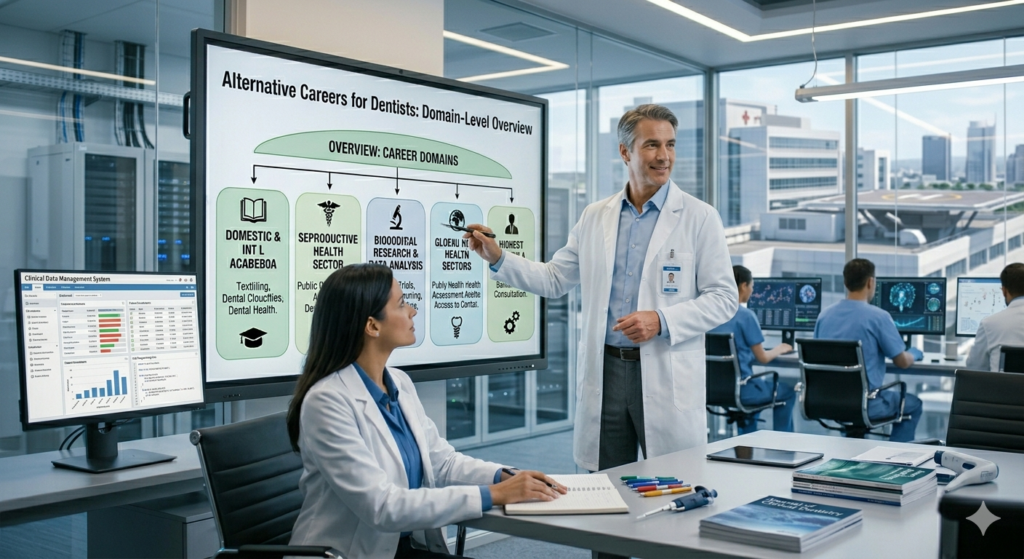
Alternative Careers for Dentists

Alternative careers for dentists include clinical research, medical writing, public health, healthcare management, and data analytics. These roles offer better work-life balance, stable income, and global opportunities beyond clinical practice.

These competencies are highly transferable and open up a wide range of careers for dentists beyond traditional clinical practice. If you’re exploring career options beyond clinical practice—whether for better work–life balance, income stability, or exposure to technology and leadership—this guide outlines structured, realistic pathways. 

According to the reports, India has over three lakh registered dentists, with high urban clustering Dental Council of India Annual Report. This density increases competition in metropolitan areas while rural regions remain underserved.  

In India, BDS graduates are increasingly shifting toward non-clinical and hybrid roles due to rising competition, evolving healthcare systems, and the growth of research, digital health, and corporate healthcare sectors.  

Simultaneously, the World Health Organization reports that nearly 3.7 billion people worldwide are affected by oral diseases under its Global Oral Health Action Plan. The implication is clear: oral healthcare demand is expanding globally, but opportunity is increasingly distributed across research, public health systems, digital platforms, industry ecosystems, and regulatory frameworks — creating diverse career options after dentistry beyond private clinics. 

Why Dentists Seek Alternative Careers 

  • Burnout & Schedule Strain: Clinical dentistry involves long procedures, physical strain, and high mental focus, leading many professionals to seek structured roles with predictable schedules. 
  • Market Saturation & Income Variability: Urban saturation increases competition and reduces income predictability, especially early in practice. Structured roles offer more stable salary growth. 
  • Technology & Scaled Impact: Digital technologies like CAD/CAM, AI diagnostics, and teledentistry are transforming oral healthcare, creating opportunities to work at a scale beyond individual patient care. 
  • Remote Work & Geographic Flexibility: Roles in telehealth, writing, regulatory work, and analytics allow flexible and location-independent careers.  
  • Income Diversification: Industry and corporate roles enable multiple income streams beyond clinical practice. 
  • Public Health Motivation: Those interested in population-level impact often move into public health, policy, and prevention programs. 

As a result, career options for dentists in India are expanding beyond traditional clinics into research organizations, healthcare companies, digital health startups, and corporate healthcare environments. 

Transferable Core Competencies Dentists Already Possess 

Dentists possess professional strengths that transition seamlessly into alternative domains: 

  • Clinical judgment & patient assessment  
  • Manual precision & attention to detail  
  • Infection control & regulatory awareness  
  • Documentation discipline 
  • Patient communication & consent handling  
  • Radiographic interpretation  
  • Materials science knowledge 

Core Bridging Skills You May Need 

Many professionals explore career options after BDS by adding complementary skills that allow them to apply their clinical knowledge in research, digital health, and healthcare industry roles. It means adding focused, complementary skills that allow you to apply your clinical knowledge in new environments. 

Good Clinical Practice (GCP) Certification 

Covers ethical guidelines, patient safety, and clinical trial protocols. Essential for research and regulatory roles. It covers informed consent, patient safety monitoring, protocol adherence, and documentation practices. If you are considering clinical research, medical affairs, or regulatory roles, GCP is often the minimum eligibility requirement and a strong starting point. 

Clinical Trial Operations & EDC Systems 

Focuses on study workflows, data handling, and platforms like Medidata Rave and Oracle Clinical. Required for CRC and CRA roles. 

Medical Writing & Literature Review  

Involves interpreting scientific data and preparing regulatory or publication documents. Key for writing and medical affairs roles. 

Data Analytics (Excel, SQL, R/Python) 

Enables analysis of clinical and operational data. Important for informatics, digital health, and analytics roles. 

CAD/CAM & 3D Printing Tools 

Covers scanning, design software, and 3D workflows. Essential for digital dentistry and lab-based roles. 

Business & Healthcare Management 

Builds skills in operations, finance, and strategy. Useful for management, administration, and entrepreneurial roles. 

Today, top non-clinical jobs for dentists in India include clinical research, medical writing, healthcare analytics, public health, and corporate healthcare roles. 

Top 9 Alternative Careers for Dentists 

These roles represent some of the most promising BDS career opportunities for dentists who want to expand beyond clinical practice while still using their healthcare expertise. 

1) Clinical Research 

(CRC / CRA / Clinical Project Manager) 

Clinical research professionals manage and monitor clinical trials for drugs and medical devices. They ensure patient safety, maintain data integrity, oversee regulatory documentation, coordinate with sponsors and CROs, and ensure compliance with global trial standards. 

Entry Requirements 

A dental degree provides strong clinical credibility. However, employers typically expect Good Clinical Practice (GCP) certification and structured clinical research training. Exposure to site-level study of coordination or hospital-based research improves employability. Familiarity with trial workflow significantly strengthens entry into CRC roles. 

Skills (Core + Advanced) 

  • Clinical judgment and endpoint understanding 
  • Informed consent management 
  • Protocol adherence and deviation handling 
  • Documentation accuracy and audit readiness 
  • EDC systems (Medidata Rave, Oracle Clinical) 
  • Adverse event and SAE reporting 
  • Basic biostatistics interpretation 
  • Risk management 
  • Project management (PMP advantageous) 
  • Pharmacovigilance knowledge 

Career Path 

Clinical Research Coordinator → Clinical Research Associate → Senior CRA → Clinical Project Manager → Clinical Operations Director 

2) Dental / Oral Public Health & Policy 

Public health dentistry focuses on population-level oral health improvement. Professionals design prevention programs, conduct epidemiological surveys, evaluate health outcomes, and contribute to policy development. 

Entry Requirements 

An MPH or public health diploma is typically required for structured roles. Experience in community screening programs, NGO projects, or district health initiatives strengthens eligibility. Knowledge of epidemiological methods is highly valued. 

Skills (Core + Advanced) 

  • Epidemiology and disease surveillance 
  • Community program design 
  • Data interpretation and statistical analysis 
  • Stakeholder engagement 
  • Grant writing 
  • Health economics 
  • Policy analysis 
  • Program monitoring and evaluation 

Career Path 

Public Health Dentist → Program Manager → Policy Advisor → State/National Health Leadership 

3) Dental Technology & CAD/CAM Specialist 

Digital dentistry integrates scanning, prosthetic design, and additive manufacturing into modern workflows. Specialists manage digital systems in clinics or labs and bridge clinical and production environments. 

Entry Requirements 

A dental degree combined with hands-on CAD/CAM training is essential. Laboratory exposure and digital case portfolio demonstration improve hiring probability. 

Skills (Core + Advanced) 

  • Intraoral scanning 
  • Prosthetic design principles 
  • Occlusion and functional analysis 
  • CAD software (Exocad / 3Shape) 
  • STL file handling 
  • 3D printing workflows 
  • Biomaterials understanding 
  • Manufacturing quality assurance 

Career Path 

Digital Dentistry Specialist → Lab Manager → Product Application Specialist → Director of Digital Solutions 

4) Medical Writing 

Medical writers prepare regulatory documents, scientific manuscripts, and educational content based on clinical data. 

Entry Requirements 

A dental degree provides subject authority. Formal medical writing training and a writing portfolio are typically required for structured roles. Knowledge of regulatory documentation strengthens positioning. 

Skills (Core + Advanced) 

  • Scientific interpretation 
  • Literature review (PubMed familiarity) 
  • Referencing accuracy 
  • Structured documentation 
  • Regulatory writing (ICH familiarity) 
  • Publication planning 
  • Data summarization 
  • Clarity in technical communication 

Career Path 

Medical Writer → Senior Medical Writer → Publication Lead → Medical Affairs Specialist 

5) Dental Products & Industry Roles 

Industry roles combine clinical credibility with strategic execution. Professionals train clinicians, support product launches, and manage commercial strategy. 

Entry Requirements 

A dental degree is highly valued. Strong communication skills are essential. For product management roles, an MBA or structured business training adds competitive advantage. 

Skills (Core + Advanced) 

  • Presentation and training skills 
  • Clinical product demonstration 
  • KOL engagement 
  • Market analysis 
  • Launch strategy planning 
  • Regulatory alignment 
  • Health economics understanding 
  • Sales performance tracking 

Career Path 

Clinical Specialist → Product Manager → Medical Affairs Lead → Commercial Head 

6) Dental Lab & Biomaterials R&D 

This pathway focuses on innovation in restorative materials and implant systems. 

Entry Requirements 

A dental degree with research exposure or biomaterials training is recommended. Postgraduate research experience significantly improves eligibility. 

Skills (Core + Advanced) 

  • Dental materials science 
  • Laboratory testing protocols 
  • Strength and biocompatibility analysis 
  • Documentation standards 
  • In vitro testing models 
  • Regulatory device approval processes 
  • Product validation studies 

Career Path 

R&D Scientist → Product Development Lead → Head of R&D 

7) Forensic Odontology 

Forensic odontologists support legal systems through dental identification and medico-legal analysis. 

Entry Requirements 

Specialized forensic odontology training is required. Collaboration with forensic medicine departments strengthens case exposure. 

Skills (Core + Advanced) 

  • Dental record comparison 
  • Radiographic analysis 
  • Bite-mark interpretation 
  • Medico-legal documentation 
  • Court testimony 
  • Advanced imaging analysis 

Career Path 

Forensic Consultant → Expert Witness → Academic Forensic Trainer 

8) Tele dentistry & Remote Care Leadership 

Teledentistry integrates digital consultation and remote care into oral health systems. 

Entry Requirements 

A dental degree combined with telehealth platform training is required. Familiarity with digital documentation systems improves positioning. 

Skills (Core + Advanced) 

  • Remote clinical assessment 
  • Patient communication 
  • Digital case documentation 
  • Telehealth compliance 
  • EHR integration 
  • Program management 

Career Path 

Tele-Dentist → Telehealth Program Manager → Director of Virtual Care 

9) Health Informatics & Dental Data Analytics 

This field focuses on analyzing clinical and operational data to improve outcomes and efficiency. 

Entry Requirements 

A dental degree plus structured data analytics training is typically required. Demonstrable analytical projects improve employability. 

Skills (Core + Advanced) 

  • Advanced Excel 
  • SQL querying 
  • Clinical variable interpretation 
  • Dashboard creation (Power BI/Tableau) 
  • R or Python basics 
  • Predictive modeling 
  • Data governance 

Career Path 

Clinical Informatics Analyst → Senior Analyst→ Head of Informatics 

Confused About Your Next Career Move After BDS?

Not sure whether Clinical Research, Medical Writing, Healthcare Analytics, or Public Health is the right path for you? Get expert guidance to choose the best non-clinical career option based on your skills and goals.

Alternative Career Paths for Dentists

Career Path Career Growth Path Avg Salary in India
Clinical Research CRC → CRA → Project Manager → Clinical Operations ₹3 – ₹8 LPA
Public Health & Policy Public Health Dentist → Program Manager → Policy Advisor ₹4 – ₹10 LPA
Dental Technology (CAD/CAM) Specialist → Lab Manager → Digital Solutions Lead ₹4 – ₹12 LPA
Medical Writing Writer → Senior Writer → Medical Affairs ₹4 – ₹10 LPA
Industry / Product Roles Clinical Specialist → Product Manager → Commercial Head ₹5 – ₹15 LPA
Biomaterials R&D R&D Scientist → Product Lead → R&D Head ₹4 – ₹12 LPA
Forensic Odontology Consultant → Expert Witness → Academic ₹3 – ₹8 LPA
Teledentistry & Remote Care Tele-Dentist → Program Manager → Virtual Care Director ₹4 – ₹10 LPA
Health Informatics & Analytics Analyst → Senior Analyst → Data Lead ₹5 – ₹12 LPA
Advanced Diploma in

AI & ML in Healthcare 

Build practical skills to apply artificial intelligence and machine learning in real healthcare and life sciences use cases. Learn how healthcare data is analyzed, models are built, and AI-driven insights are applied across research and healthcare systems. 

IN PARTNERSHIP WITH
4.8(2,300+ ratings) 

Salary Comparison of Alternative Careers for Dentists 

Understanding salary potential helps in choosing the right direction after BDS. While income varies based on experience, location, and specialization, structured roles often offer more predictable growth compared to early-stage clinical practice. 

Average Salary Range in India (Approximate) 

  • Average Salary Range in India (Entry to Mid-Level) 
  • Clinical Research (CRC/CRA): ₹3 – ₹8 LPA  
  • Medical Writing: ₹4 – ₹10 LPA  
  • Public Health & Policy: ₹4 – ₹10 LPA  
  • Healthcare Management / MBA Roles: ₹5 – ₹15 LPA  
  • Dental Technology (CAD/CAM): ₹4 – ₹12 LPA  
  • Health Informatics & Data Analytics: ₹5 – ₹12 LPA  
  • Pharmacovigilance & Drug Safety: ₹3 – ₹9 LPA  
  • Corporate / Product Roles: ₹5 – ₹15 LPA 

These roles offer structured salary progression, especially in corporate, research, and analytics domains. With experience and specialization, compensation can grow significantly faster than traditional clinic-based. 

Best Courses After BDS for Career Switch 

Choosing the right course after BDS depends on the career path you want to transition into. Instead of pursuing multiple degrees, focusing on targeted, industry-relevant training helps accelerate entry into new roles. 

Courses Based on Career Path 

  • Clinical Research: 
    GCP Certification, Clinical Research Training Programs  
  • Medical Writing: 
    Medical Writing Certification, Scientific Writing Programs  
  • Healthcare Management: 
    MBA in Healthcare / Hospital Administration  
  • Public Health: 
    MPH (Master of Public Health)  
  • Health Informatics & Data Analytics: 
    Data Analytics (Excel, SQL, Python), Healthcare Informatics Programs  
  • Digital Dentistry: 
    CAD/CAM Certification, Digital Workflow Training  
  • Pharmacovigilance & Regulatory Affairs: 
    Drug Safety Certification, Regulatory Affairs Courses  

The key is to choose a course aligned with a specific role rather than exploring multiple unrelated certifications. Focused upskilling improves employability and shortens transition time. 

Highest Paying Non-Clinical Jobs for Dentists 

Not all alternative careers offer the same earning potential. Some roles provide significantly higher income growth due to industry demand, scalability, and leadership opportunities. 

High-Paying Non-Clinical Roles 

  • Healthcare Management & MBA Roles 
    Leadership positions in hospitals and healthcare companies offer strong salary growth and long-term career progression.  
  • Health Informatics & Data Analytics 
    With the rise of digital health, professionals who can analyze healthcare data are in high demand and command premium salaries.  
  • Clinical Research (CRA → Project Management) 
    Mid-to-senior roles in clinical research, especially in global trials, offer strong compensation and international exposure.  
  • Medical Affairs & Corporate Roles 
    Positions in pharma and medical device companies combine scientific expertise with strategic decision-making.  
  • Product Management & Healthcare Consulting 
    These roles involve market strategy, innovation, and business growth, often leading to higher salary brackets.  
  • Digital Dentistry & Technology Specialists 
    Professionals working with advanced digital systems and workflows are increasingly valued in modern dental ecosystems.  

Higher-paying roles typically require a combination of domain expertise, technical skills, and strategic understanding of the healthcare industry. 

Transition from Clinical Practice: A Structured Roadmap 

Moving beyond traditional clinical dentistry does not mean walking away from your qualifications. It is strategically expanding the applications. A successful transition depends less on chance and more on clarity, preparation, and deliberate execution. 

Here is a structured approach that makes the shift practical and realistic. 

Step 1: Define Your Core Motivation 

Identify whether you want better work-life balance, income stability, leadership roles, or technology-driven work. 

Research across healthcare professions consistently shows that structured career planning reduces burnout-related exits and improves professional satisfaction (Bureau of Labor Statistics, Occupational Outlook Handbook). 

Step 2: Assess Your Existing Strengths 

Evaluate your clinical skills, research exposure, certifications, and professional experience to identify relevant transition advantages. 

Step 3: Select One Target Domain 

Choose a clear direction such as clinical research, medical writing, digital dentistry, or healthcare analytics. 

Step 4: Conduct a Skill Gap Analysis 

Once your target field is chosen, review multiple job descriptions in that domain. Identify recurring requirements, certifications, and technical skills. 

Examples: 
  • Clinical Research → GCP certification, trial operations knowledge 
  • Public Health → MPH or epidemiology background 
  • Digital Dentistry → CAD/CAM proficiency 
  • Medical Writing → Writing portfolio and regulatory familiarity 
  • Health Informatics → Excel, SQL, and analytics exposure 

Review job descriptions and identify required certifications, tools, and technical skills for your chosen domain. 

Step 5: Upskill Strategically (3–12 Months) 

Focus on targeted training such as GCP, CAD/CAM, medical writing, analytics, MPH, or MBA depending on your pathway. 

According to workforce data from Payscale, structured corporate roles often show more predictable salary progression compared to early-stage independent practice. 

Step 6: Build Demonstrable Evidence 

Create portfolios such as writing samples, research summaries, digital cases, dashboards, or project work. 

Step 7: Network with Intention 

Engage with: Industry professionals through conferences, LinkedIn, alumni groups, and healthcare organizations. 

Step 8: Pilot Before Committing Fully 

Gain practical exposure through internships, freelance work, part-time roles, or collaborations. 

Build Skills That Employers Actually Hire For

Move beyond traditional dentistry with practical training in Clinical Research, AI & ML in Healthcare, Medical Coding, and more. Learn industry-relevant skills designed for BDS graduates.

Market Opportunity: India and the Global Landscape 

Before making a strategic career shift, it is important to understand the direction in which the larger dental and healthcare markets are moving. Career opportunities expand when industries expand. Dentistry today operates within a growing global ecosystem shaped by digital transformation, research innovation, organized corporate networks, and rising healthcare investment. 

Global Dental Services: Sustained Expansion 

The global dental services market continues to show steady and sustained growth. According to Grand View Research, the dental services industry is projected to grow at a consistent compound annual growth rate (CAGR) through 2030, supported by aging populations, increased awareness of oral health, rising cosmetic dentistry demand, and expanded insurance penetration in emerging markets. 

While exact market valuations vary between publishers, most industry forecasts place the sector in the hundreds of billions of dollars, with projections indicating significant expansion by the early 2030s. 

This growth does more than increase demand for chairside dentists. As dental networks scale and modernize, they create demand for non-clinical professionals who support the system — including clinical research coordinators, digital workflow managers, product specialists, regulatory professionals, and healthcare data analysts. 

Teledentistry: A High-Growth Digital Segment 

Teledentistry has emerged as one of the fastest growing subsegments within oral healthcare. As remote consultations, AI-supported triage, and digital case monitoring gain traction; the infrastructure around virtual dental care is expanding rapidly. 

According to Grand View Research, the global teledentistry market was valued at approximately USD 2.02 billion in 2024 and is projected to grow at a CAGR exceeding 15% through 2030. Similarly, Market Research Future highlights strong double-digit growth driven by increasing rural access initiatives, integration with electronic health records (EHRs), and broader telehealth acceptance post-pandemic. 

This growth translates into professional opportunities beyond direct clinical care. Emerging roles include telehealth program leadership, digital compliance management, virtual care coordination, health informatics integration, and vendor-side product development. 

For dentists interested in flexible work models or digital healthcare ecosystems, this segment offers one of the most accessible entry points. 

Dental Implants and Device Innovation 

Implantology remains one of the most financially significant and steadily growing segments within dentistry. Industry analyses consistently report single-digit to high single-digit CAGR growth in the global dental implants market, depending on region and product category. 

India: Organized Consolidation and Healthcare Growth 

India’s dental ecosystem is undergoing structural change, creating new career options for dentists in India across corporate dental chains, research organizations, digital health companies, and healthcare administration roles. Organized dental chains and corporate clinic networks are expanding across metropolitan and tier-two cities. Consolidation increases demand not only for clinicians but also for operations managers, quality compliance officers, digital workflow specialists, and corporate trainers. 

Simultaneously, India’s broader healthcare sector continues to grow. According to Grand View Research, the Indian healthcare market is projected to expand steadily through 2032, driven by increasing private sector participation, Ayushman Bharat implementation, and digital health adoption. 

As dentistry integrates more closely with hospital systems and corporate healthcare structures, roles expand in administration, clinical research, informatics, compliance, and program management. 

Start Your Career Transition with Confidence

Take the next step toward a stable, high-growth healthcare career with expert mentorship, hands-on learning, and placement-focused support from CliniLaunch.

Conclusion 

Dentistry today extends far beyond chairside practice, opening new careers for dentists in research, digital health, healthcare analytics, industry leadership, and public health systems. As global dental markets expand driven by digital adoption, implant growth, research innovation, and organized healthcare systems opportunities are shifting into clinical research, digital health, industry, public health, analytics, and leadership roles. 

The core competencies developed through dental training remain powerful and transferable. What changes is how and where those skills are applied. 

Career diversification is not a leap into uncertainty. It is a structured transition built on clarity, focused upskilling, portfolio development, and strategic positioning. 

If you are ready to explore structured pathways into clinical research, regulatory roles, digital integration, or emerging healthcare domains, CliniLaunch Research Institute provides industry-aligned training designed specifically for healthcare professionals seeking career expansion. 

Frequently Asked Questions

1. What are the best alternative careers for dentists?
Dentists can transition into domains such as clinical research, pharmacovigilance, regulatory affairs, medical writing, healthcare management, and data-driven or corporate healthcare roles.
2. Can dentists move into non-clinical roles without leaving healthcare?
Yes. Many alternative careers allow dentists to stay connected to healthcare through research, compliance, documentation, strategy, and leadership roles without daily chairside practice.
3. Is clinical research a good career option for dentists?
Clinical research is one of the most structured non-chairside paths for dentists, offering roles in trial coordination, monitoring, management, and medical oversight.
4. Do dentists need additional qualifications to switch careers?
Some domains require domain-specific training or exposure, while others rely more on clinical knowledge, documentation skills, and structured learning rather than formal degrees.
5. What is the difference between a career domain and a job role?
A career domain is a broad field like clinical research or regulatory affairs, while job roles are specific positions within that domain, such as coordinator, analyst, or manager.
6. How should dentists choose the right alternative career path?
Dentists should first identify the type of work they prefer and then select a suitable career domain before targeting specific job roles.
7. What to do after BDS except practice?
You can move into clinical research, medical writing, healthcare analytics, public health, or corporate healthcare roles in India.
8. Which course is best after BDS?
It depends on your goal—GCP for research, MBA for management, MPH for public health, or data/AI courses for analytics roles.
9. Can dentists switch careers?
Yes, with focused upskilling, dentists can transition into research, analytics, regulatory, and healthcare industry roles.

Artificial intelligence for pharmacists uses intelligent systems to review prescriptions, detect drug interactions and dosage risks, and support safer medication decisions by helping pharmacists analyze information quickly while retaining full clinical responsibility. 

Pharmacy today is becoming more complex than it used to be. Patients often take multiple medicines at the same time; treatments are more specialized, and pharmacists are expected to check prescriptions quickly while still ensuring safety. Reviewing drug combinations, correct doses, and possible risks within a busy workflow is not always easy, especially when large amounts of information need to be considered at once. 

This is where AI in pharmacy is beginning to support pharmacists. Artificial intelligence in pharmacy does not replace professional judgment or decision-making. Instead, it helps by scanning information quickly, highlighting possible risks, and bringing attention to details that may need closer review. The pharmacist still makes the final decision, but the process becomes faster and more structured. 

For life science graduates entering pharmacy or healthcare roles, understanding how AI in pharmacy supports everyday pharmacy work is becoming increasingly important. As medicines and treatment approaches continue to evolve, pharmacists are expected not only to dispense medicines accurately but also to play a stronger role in medication safety. AI in drug discovery is gradually becoming one of the tools that helps make this possible. 

AI in pharmacy is becoming useful mainly at the point where pharmacists review prescriptions and ensure medication safety. In daily practice, pharmacists often need to check multiple factors at the same time, including drug combinations, dosing accuracy, therapy duration, and patient-related risks. When prescriptions are reviewed under time pressure, important details can sometimes be overlooked even with careful manual checking. 

Clinical decision support AI systems support this process by reviewing prescription information within seconds and highlighting situations that may require closer attention. Instead of replacing the pharmacist’s role, AI acts as an additional layer of review that helps organize information and reduce the chances of missing critical risks. This allows pharmacists to focus more on clinical judgment and communication rather than repetitive checking. 

In practice, AI in prescription analysis is most visible in three areas of routine pharmacy work. It helps identify potential drug interactions, detect unusual or unsafe dosing, and recognize therapy-related risks such as duplicate medicines or long-term safety concerns. These functions are not separate from normal pharmacy responsibilities; they strengthen the existing review process and make medication safety more consistent, especially in busy environments. Additionally, AI supports AI in medication management to improve overall workflow and patient safety. 

Prescription review is one of the most important responsibilities in pharmacy practice. Before medicines reach the patient, pharmacists must check whether the treatment is appropriate, safe, and free from avoidable risks. This includes reviewing drug combinations, confirming correct doses, and identifying therapy choices that may cause harm in certain patients. As prescriptions become more complex, completing this review accurately within a limited time can be challenging. 

AI in prescription analysis supports prescription review by quickly scanning prescription details and comparing them with available medical knowledge and safety guidelines. Instead of manually checking every possibility, pharmacists receive alerts when something appears unusual or potentially risky. This allows attention to be directed toward prescriptions that require closer evaluation, improving both speed and accuracy in routine workflows. 

One of the most common uses of AI in pharmaceuticals is detecting drug interactions. Some medicines can change how others work in the body, increasing the risk of side effects, or reducing treatment effectiveness. AI systems automatically review medicine combinations and flag interactions that may need monitoring or clarification before dispensing. This helps pharmacists identify risks early and prevent avoidable complications. 

AI also helps detect dosage-related problems. A dose that is too high or too low can be dangerous, especially for elderly patients, children, or individuals with kidney or liver conditions. By comparing prescribed doses with standard recommendations and known safety ranges, AI can highlight prescriptions that appear unusual. The pharmacist can then recheck the prescription or consult the prescriber if needed. Using data-driven comparison models like those used in predictive modeling in drug development, the system identifies unusual prescriptions quickly. 

Beyond individual medicines, AI can review the overall therapy plan. It may identify duplicate medicines from the same drug class, unnecessary overlaps in treatment, or long-term therapy risks that are not immediately obvious. By looking at the prescription rather than isolated drugs, AI helps pharmacists make safer and more informed decisions. 

In this way, AI does not replace professional judgments. It strengthens prescription review by acting as a safety layer that supports pharmacists in managing complexity while maintaining patient safety. 

PG Diploma in

Intelligent Healthcare Management (iHealth) Training 

Develop practical skills to manage healthcare operations using data-driven decision-making, digital tools, and intelligent systems. Learn how modern hospitals, healthcare organizations, and life-science teams optimize processes, quality, and outcomes through technology and analytics. 

IN PARTNERSHIP WITH
4.8(3,235 ratings)

Pharmacists are not directly involved in drug discovery, but changes in how medicines are developed still affect everyday pharmacy practice. AI driven drug discovery helps researchers identify drug targets, screen compounds, and evaluate potential treatments faster than traditional methods. Today, AI based drug discovery and machine learning in drug discovery platforms are transforming how treatments are identified in modern medicine. 

AI drug discovery also contributes to drug repurposing, where existing medicines are approved for new indications. For pharmacists, this means treatment options continue to evolve at a faster pace. Medicines may be introduced with more specific indications, complex dosing considerations, or new safety profiles that require careful review during prescription analysis. Understanding the pace of innovation in the AI in pharmaceutical industry helps explain why prescription review is becoming more complex over time. 

Understanding this shift helps explain why prescription review is becoming more complex over time. As drug development accelerates, the pharmacist’s role as the final safety checkpoint before medicines reach patients becomes even more important. AI therefore supports pharmacists not only at the prescription level but also indirectly by helping manage the growing complexity created by modern drug development. 

As AI becomes part of pharmacy workflows, the role of pharmacists is gradually shifting from routine checking toward deeper clinical involvement. Tasks that previously required repetitive manual verification, such as scanning for interactions or comparing doses with standard references, can now be supported by intelligent systems. This allows pharmacists to spend more time interpreting risks, counseling patients, and communicating with prescribers when changes are needed. 

In many healthcare settings globally, pharmacists are already taking on stronger responsibilities in medication review and treatment optimization. AI supports this transition by helping organize information and bringing potential concerns to attention early. Instead of increasing workload, the goal is to reduce cognitive pressure so pharmacists can focus on decision-making rather than data searching. 

In India, pharmacy practice has traditionally emphasized accurate dispensing and operational efficiency. However, with the gradual adoption of digital prescriptions, hospital information systems, and electronic records, opportunities for pharmacists to contribute more actively to medication safety are increasing. AI tools can support this shift by strengthening prescription review and helping pharmacists participate more confidently in clinical discussions. 

Rather than reducing the importance of pharmacists, AI increases the need for professional judgment. Alerts and recommendations still require interpretation, and patient-specific decisions cannot be automated. The pharmacist remains responsible for ensuring that treatment is safe, appropriate, and clearly understood by the patient. 

Pharmacy practice is gradually moving toward a model where safety, review, and clinical decision-making play a larger role than routine dispensing alone. As prescriptions become more complex and treatment options evolve faster, pharmacists are expected to manage increasing amounts of information while maintaining accuracy and patient safety. AI is becoming part of this transition by helping organize information, highlight risks, and support more consistent prescription review. The responsibility for decisions, however, continues to remain with the pharmacist. 

For life science graduates and pharmacy professionals, this shift means that understanding digital systems and AI-supported workflows is becoming increasingly relevant. Pharmacists who are comfortable working with decision-support tools are better prepared to interpret alerts, communicate risks clearly, and contribute more actively to patient care. Rather than changing the purpose of the profession, AI is strengthening the pharmacist’s role as the final safety checkpoint before medicines reach patients. 

To support this transition, CliniLaunch Research Institute offers the Intelligent Healthcare Management (iHealth) training program, designed to help healthcare and life science professionals understand how digital systems, healthcare data, and AI applications fit into modern healthcare operations. The program focuses on practical exposure to healthcare workflows, decision-making using data, and the operational side of intelligent healthcare systems, helping learners build confidence in working alongside evolving technologies. 

As healthcare continues to integrate intelligent systems into everyday practice, pharmacists who adapt early will be better positioned to handle complex therapies, support safer treatment decisions, and grow into more clinically involved roles within the healthcare ecosystem. 

AI for pharmacists refers to software systems that assist in reviewing prescriptions by identifying potential risks such as drug interactions, incorrect dosing, or duplicate therapies. It acts as a decision-support tool that helps pharmacists work more efficiently while maintaining patient safety. 

No. AI does not make final decisions or replace professional judgment. It highlights possible risks and organizes information, but pharmacists remain responsible for evaluating prescriptions, interpreting alerts, and ensuring safe medication use. 

AI helps by automatically reviewing medicine combinations, checking dose ranges against safety guidelines, and identifying therapy overlaps or long-term risks. This allows pharmacists to focus on clinical evaluation rather than manual checking. 

AI systems can quickly compare prescribed medicines against large medical databases and flag known interaction risks. However, pharmacists must still interpret whether the interaction is clinically significant for a specific patient. 

Pharmacy and healthcare workflows are becoming increasingly digital. Understanding how AI-supported systems work helps life science graduates adapt to modern healthcare environments and participate more effectively in medication safety and clinical decision-making. 

AI adoption varies across settings, but digital prescription systems, hospital information systems, and clinical decision-support tools are gradually becoming more common. AI is increasingly used to strengthen prescription review and reduce medication errors. 

Pharmacists do not need programming skills. More important skills include understanding digital workflows, interpreting AI-generated alerts, applying clinical judgment, and communicating medication risks clearly to patients and prescribers. 

Pharmacists are not involved in drug discovery itself, but AI-driven research leads to faster introduction of new medicines and new uses for existing drugs. This increases the importance of careful prescription review and staying updated with evolving therapies. 

The main benefit is reduced cognitive load. AI helps manage large amounts of prescription information quickly, allowing pharmacists to focus more on safety, patient counseling, and clinical decision-making. 

Pharmacists can prepare by developing digital literacy, understanding how decision-support systems function in healthcare settings, and gaining exposure to data-driven healthcare operations and modern medication safety practices.


Clinical Project Associate
A Clinical Project Associate (CPA) supports clinical trial operations by managing study documentation, coordinating project activities, supporting sites and vendors, and ensuring compliance with GCP and regulatory standards. The role serves as an entry point into clinical research operations and project management.

A Clinical Project Associate (CPA) supports the execution of clinical trials by assisting Clinical Project Managers with core operational tasks. The role primarily involves managing study documentation, tracking project timelines, coordinating activities across sites and teams, and supporting regulatory compliance throughout the clinical trial lifecycle.  

CPAs work across multiple phases of a clinical trial and support routine operational workflows that help maintain alignment with planned study processes. Their involvement spans different trial stages, ensuring continuity across ongoing activities. 

Over the past two decades, clinical research roles have become more complex, with greater emphasis on documentation control, timeline tracking, and regulatory compliance. These evolving demands closely align with the core responsibilities of Clinical Project Associates.  

A Clinical Project Associate (CPA) supports clinical trial operations by managing study documentation, coordinating project activities, supporting sites and vendors, and ensuring compliance with GCP and regulatory standards. The role serves as an entry point into clinical research operations and project management. 

A Clinical Project Associate is a central operational professional within the clinical trial team who ensures consistency, coordination, and control across trial activities. CPAs act as a link between project managers, clinical sites, vendors, and internal teams, enabling smooth communication and task execution. 

The importance of the CPA role lies in its ability to prevent delays, reduce errors, and maintain audit readiness. By keeping documentation accurate, timelines visible, and communication aligned, CPAs help ensure that clinical trials move efficiently from study start-up to close-out, supporting the timely development of new treatments. 

While both roles support clinical trials, Clinical Project Associates (CPAs) and Clinical Research Associates (CRAs) have different responsibilities. A CPA focuses on project coordination, documentation, timeline tracking, and operational support, working closely with project managers, sites, and vendors to keep studies organized and compliant. 

In contrast, a CRA is primarily responsible for site monitoring activities, including site visits, source data verification, and ensuring protocol adherence at investigational sites. CRAs work directly with trial sites, while CPAs operate more from a central, coordination-based role. 

In simple terms, CPAs manage trial operations from behind the scenes, while CRAs oversee trial conduct at the site level. 

A CPA is responsible for supporting the coordination and smooth execution of clinical trials, ensuring that operational tasks are completed efficiently, on schedule and in compliance with regulatory standards. CPA roles and responsibilities include supporting documentation, timelines, coordination, and compliance. Below are the core roles and responsibilities of a CPA: 

Clinical trials generate large volumes of documents, and even minor documentation errors can delay approvals or trigger audit findings. CPAs are responsible for ensuring that every document is accurate, complete, current, and compliant with regulatory standards. 

They help prepare, organize, and maintain essential study documents such as protocols, informed consent forms, investigator brochures, and regulatory submissions. By properly indexing and maintaining study master files, CPAs make sure that documents are easily retrievable during audits, inspections, or sponsor reviews. These clinical project associate duties form the foundation of trial documentation control. This process ensures effective project documentation management throughout the study. 

Task Explanation
Ensure Regulatory Compliance of Documents CPAs ensure clinical trial documents are accurate, complete, and compliant with GCP and regulatory standards.
Prepare and Organize Study Files CPAs prepare and organize study documents (e.g., protocols, consent forms) and ensure proper indexing and storage for easy audit access.
Trial Master File (TMF) Maintenance CPAs organize and index study documents to maintain the TMF and ensure readiness for audits and inspections.

Clinical trials run on strict timelines, and delays at any stage can impact costs, patient recruitment, and regulatory submissions. CPAs support project managers by tracking milestones, monitoring progress, and flagging risks early. 

They coordinate activities across teams, help organize meetings, and ensure that assigned tasks are completed as planned. When delays occur, CPAs assist in identifying the cause and work with the team to adjust timelines or re-prioritize activities. 

Task Explanation
Track Project Progress CPAs ensure project milestones are achieved on time and assist in adjusting plans if there are delays.
Monitor Project Timelines CPAs ensure tasks remain on schedule and adjust timelines when necessary to meet project goals.
Coordinate Team Activities CPAs organize team meetings and ensure activities align with project objectives and deadlines, keeping all team members on track.
Identify and Address Delays CPAs proactively identify delays and collaborate with the team to resolve issues quickly.

Clinical trial sites and vendors play a crucial role in study execution, and CPAs support their readiness and compliance. During site initiation, CPAs help ensure that all required documents, supplies, and systems are in place before patient enrolment begins. Vendor coordination is a core responsibility during trial execution. 

They also assist in tracking site performance metrics, monitoring protocol adherence, and identifying compliance issues. When deviations or gaps are observed, CPAs support follow-up actions and documentation. CPAs play a key role during study start up activities at trial sites. 

Task Explanation
Support Site Initiation and Setup CPAs prepare clinical trial sites with required documents, supplies, and equipment to ensure readiness for patient enrolment.
Monitor Site Performance and Compliance CPAs monitor site activities to ensure protocol compliance, track performance metrics, and address any non-compliance issues.

CPA may not be the right fit if you prefer working independently with minimal coordination, or if frequent follow-ups, timelines, and documentation feel draining. But if you’re organized, proactive, and enjoy keeping complex clinical work on track, this role can be a strong and rewarding starting point in the industry. 

Accurate and complete data is the foundation of every clinical trial outcome. CPAs assist in data collection, data entry, and verification, ensuring that trial data is consistent, traceable, and ready for analysis. These activities contribute to ongoing regulatory compliance support. 

They also support the preparation of progress reports, safety reports, and final study reports that are reviewed by sponsors and regulatory authorities. While they may not perform statistical analysis, CPAs ensure that data flows correctly from sites to databases and into reports without gaps or inconsistencies.

Task Explanation
Assist in Data Collection and Entry CPAs ensure accurate data collection, entry, and verification while maintaining data completeness and consistency.
Support Report Preparation CPAs assist in preparing progress, safety, and final study reports for review by sponsors and regulatory authorities.

Clinical trials involve multiple stakeholders project managers, monitors, investigators, sponsors, vendors, and internal teams. CPAs act as communication facilitators, ensuring that information flows clearly and on time. 

They organize meetings, circulate updates, track action items, and prepare status reports that help teams stay informed. By supporting internal communication, CPAs reduce confusion, prevent misalignment, and help teams respond quickly to changes or issues. 

Task Explanation
Cross-functional Team Coordination CPAs coordinate team communication by organizing meetings and sharing project information with stakeholders, sponsors, and site teams.
Support Internal Project Team CPAs support internal project teams with updates, status reports, and clear communication to ensure access to necessary project information.

CPAs play a supportive role in training site personnel and internal teams on study protocols, GCP requirements, and trial processes. This ensures that everyone involved understands their responsibilities and follows standardized procedures. This ensures consistent SOP adherence across study teams. 

In addition, CPAs are expected to continuously stay updated on regulatory changes, evolving trial methodologies, and industry best practices. This ongoing learning helps them maintain compliance and contribute effectively to trial execution. 

Task Explanation
Assist with Training Site Personnel CPAs train site staff and project teams on study protocols, GCP standards, and processes to ensure compliance and data accuracy.
Stay Updated with Industry Regulations CPAs stay informed about regulatory changes, trial methodologies, and industry standards to maintain ongoing compliance.
PG Diploma in

Clinical Research

Gain in-depth understanding of how clinical trials operate across pharma companies, CROs, and research sites. This program focuses on the practical execution of clinical studies, ethical conduct, documentation, and regulatory compliance across the clinical trial lifecycle. 

IN PARTNERSHIP WITH
4.8(3,235 ratings)

A Clinical Project Associate begins the day by checking project updates and understanding what needs to be completed to keep the clinical trial on track. They review timelines, follow up on pending tasks, and ensure that study activities are progressing as planned. 

As the day continues, the CPA focuses on organizing and updating study documents. Trial files are reviewed for accuracy, new documents are filed correctly, and everything is kept ready for audits and inspections. Documentation control remains a constant responsibility throughout the day. 

The CPA then supports coordination between teams by sharing updates, tracking action items, and assisting with meeting follow-ups. Communication with clinical sites and external partners helps ensure that study requirements are met and any issues are documented and addressed. 

Before the day ends, the CPA updates trackers and reports, ensuring that all activities are recorded and visible to the project team. By maintaining order, coordination, and compliance, the CPA helps the clinical trial move forward smoothly. 

A bachelor’s degree in life sciences, health sciences, pharmacy, nursing, or a related field is required for the role. A master’s degree, such as an MSc in Clinical Research or an MPH, is preferred for more advanced or competitive positions. Certifications or training in clinical research, project management, or regulatory compliance (e.g., GCP certification) are also valuable. Additionally, some prior experience in clinical trial operations, clinical research coordination, data management, or a related field is beneficial. 

This role requires strong organizational and communication skills, attention to detail, and basic project management abilities essential for clinical project associate jobs. Knowledge of ICH GCP guidelines with trial tools (CTMS, spreadsheets) are essential for compliance. Adaptability and problem-solving skills are also crucial for managing changing trial demands and operational issues. Familiarity with a clinical trial management system is beneficial. 

Clinical Project Associates (CPAs) play a vital role in the smooth execution of clinical trials. They manage key tasks such as documentation, project coordination, site management, and data handling, ensuring that trials stay on track and comply with regulatory standards. CPAs are essential to maintaining trial efficiency, reducing delays, and supporting the timely delivery of new treatments. Their contributions are indispensable for the successful progression of clinical research, making them integral to the overall success of clinical trials. 

If you’re interested in pursuing a career in clinical research and becoming a vital part of clinical trials, the PG Diploma in Clinical Research by Clinilaunch providing excellent opportunity to gain the knowledge and skills needed to succeed. 

Yes. CPAs often support more than one study simultaneously, depending on trial complexity and organization structure. This helps them gain broader exposure to different trial phases and processes. 

No. Many organizations hire freshers or trained candidates for CPA roles. Relevant training, understanding of clinical trial workflows, and documentation practices are often more important than prior experience. 

CPAs usually do not communicate directly with regulatory authorities. However, they support regulatory submissions and documentation that are reviewed by sponsors or regulatory teams. 

Yes. Many CPA roles are office-based or remote, especially in CROs and sponsor companies, as the work primarily involves coordination, documentation, and system-based activities. 

Performance is commonly assessed based on documentation accuracy, timeline adherence, task follow-up, communication quality, and audit readiness support rather than field-based activities. 

The CPA role is operational rather than purely administrative. It requires understanding clinical trial processes, regulatory expectations, and coordination of workflows, not just routine office work. 

No programming skills are required. Basic proficiency in spreadsheets, document management systems, and clinical trial tools is sufficient for most CPA roles. 

Yes. With experience, CPAs can move into regulatory affairs, trial operations, quality assurance support, or training roles within clinical research organizations. 

Core responsibilities remain similar, but the exact scope can vary between sponsors, CROs, and research sites depending on organizational structure and trial scale. 

Typically, professionals can progress to senior or coordination roles within 2–4 years, depending on performance, exposure to multiple studies, and organizational opportunities. 

The role of a Clinical Data Manager (CDM) is to make sure clinical trial data is accurate, complete, and compliant. Clinical Data Managers set up EDC systems, design CRFs, check data quality, manage queries, and support database lock so the data can be safely analyzed and reviewed by regulators. 

PG Diploma in

Clinical Research

Gain in-depth understanding of how clinical trials operate across pharma companies, CROs, and research sites. This program focuses on the practical execution of clinical studies, ethical conduct, documentation, and regulatory compliance across the clinical trial lifecycle. 

IN PARTNERSHIP WITH
4.8(3,235 ratings)

Medical coder roles and responsibilities vary by care setting. Inpatient coding covers full hospital stays, outpatient coding focuses on clinic visits and same-day services, emergency department coding handles urgent care encounters, and ancillary coding supports diagnostic and technical services. Each role differs in documentation depth, decision pressure, and compliance risk. 

Medical coding is often misunderstood as a single, routine job where professionals simply convert diagnoses and procedures into codes. In reality, medical coder roles and responsibilities vary significantly depending on where patient care takes place and the type of services delivered. Coding a full hospital admission is fundamentally different from coding a clinic visit, an emergency case, or a diagnostic service, and each carries its own level of complexity, accountability, and regulatory scrutiny. 

In real healthcare environments, medical coders play a critical role in ensuring accurate documentation, compliant billing, and smooth functioning of the healthcare revenue cycle. Their work directly affects reimbursement, audit outcomes, and the quality of healthcare data used for reporting and decision-making. Understanding how medical coding responsibilities change across inpatient, outpatient, emergency department, and ancillary settings is essential for anyone exploring medical coding as a career or trying to build realistic job readiness. 

This article breaks down who a medical coder is, the different types of medical coding roles that exist, the specific responsibilities attached to each role, and how these responsibilities translate into real day-to-day work inside healthcare organizations. 

A medical coder is a healthcare professional who reviews clinical documentation and converts it into standardized medical codes used for billing, compliance, and reimbursement. Their work directly affects claim accuracy, audit outcomes, and the healthcare revenue cycle. 

The duties of a medical coder include interpreting physician notes, discharge summaries, procedure reports, and diagnostic findings, then applying the correct codes based on official guidelines. This role requires accuracy and judgment, not data entry, because coding errors can lead to denials, compliance issues, and revenue loss. 

Medical coding is not a single role. Medical coder roles and responsibilities vary depending on where patient care takes place. Based on the care setting, medical coders typically work in: 

  • Inpatient (IP) medical coding – Hospital admissions 
  • Outpatient (OP) medical coding – Clinic visits and same-day services 
  • Emergency department (ED) coding – Urgent and unplanned care 
  • Ancillary medical coding – Diagnostic and technical services 

Each role differs in complexity, documentation depth, and work pace. Understanding these differences is essential before learning what responsibilities each role actually carries. 

Aspect Inpatient (IP) Outpatient (OP) Emergency Department (ED) Ancillary Services
Work pace Slower and methodical Steady and consistent Fast and time-sensitive Steady and task-focused
Complexity level High Moderate Moderate to high Moderate
Documentation depth Very detailed (entire hospital stay) Moderate (single visit or service) Brief and evolving Structured and report-based
Decision intensity High (multiple diagnoses and procedures) Moderate (rule-driven decisions) High (quick judgment required) Moderate (precision-based decisions)
Entry vs advanced suitability Better suited after experience Common entry point for beginners Entry to intermediate (with guidance) Entry to intermediate (with structured training)
Who this role fits best Detail-oriented, analytical learners Learners who prefer structure Those comfortable with pressure Coders who like precision and technical work
Advanced Diploma in

Medical Coding 

Build practical skills in medical coding and clinical documentation used across hospitals, healthcare providers, and global healthcare services. Learn how diagnoses, procedures, and services are translated into standardized medical codes while ensuring accuracy, compliance, and reimbursement integrity. 

IN PARTNERSHIP WITH
4.8(2,500 ratings)

Medical coder roles and responsibilities are defined by where care is delivered, not by job titles. Each role carries different decision pressure, documentation depth, and impact on the healthcare revenue cycle. Treating them as the same role is how beginners get blindsided later. 

Inpatient medical coding applies when a patient is formally admitted to the hospital, usually for 24 hours or more. Unlike other roles, inpatient coding covers the entire hospital stay, from admission through discharge. 

The coder is responsible for translating a complex clinical journey into codes that accurately reflect: 

  • Why the patient was admitted 
  • What conditions were treated 
  • What procedures were performed 
  • How severe the case was 

This role relies heavily on ICD 10 CM coding for diagnoses and ICD-10-PCS for inpatient procedures. 

  • Review the full medical record from admission to discharge 
  • Identify and assign the principal diagnosis 
  • Code all relevant secondary diagnoses, including complications and comorbidities 
  • Apply proper sequencing rules to reflect severity of illness 
  • Code inpatient procedures accurately 
  • Support correct DRG assignment and compliance 
A Clinical Data Coordinator supports clinical trials by reviewing and coordinating study data to ensure it is accurate, consistent, and inspection-ready. This role covers data review, query coordination, safety data alignment, documentation support, and database lock readiness across the trial lifecycle.
What qualifies as the principal diagnosis
Which secondary diagnoses are reportable
Whether conditions were present on admission or developed later
One wrong decision here doesn’t cause a minor denial. It can shift the DRG entirely and trigger audits.

Outpatient medical coding covers patient encounters where there is no overnight admission. These are high-volume, encounter-based services such as clinic visits, OPDs, and same-day procedures. 

Here, speed matters, but accuracy matters more because outpatient claims are aggressively reviewed by payers. 

This role uses ICD 10 CM coding, CPT coding, and HCPCS coding extensively. 

  • Code individual visits rather than full hospital stays 
  • Assign diagnosis codes that justify medical necessity 
  • Code procedures and services accurately 
  • Apply modifiers correctly 
  • Ensure diagnosis-to-procedure linkage 
  • Follow payer-specific outpatient coding rules 

Real-world Example:

A patient visits a clinic for diabetes follow-up and receives lab tests and medication management.
The outpatient coder must ensure:
The visit level matches documentation
Diagnosis codes support the services billed
Procedures are correctly linked
A missing linkage or incorrect modifier doesn’t look dramatic, but it leads to silent denials and rework.

Emergency department coding deals with urgent and unplanned care. Documentation is often brief, incomplete, and created while treatment is still happening. 

Despite short encounters, ED coding carries high audit risk because visit-level coding is heavily scrutinized. 

This role relies on ICD 10 CM coding, CPT coding, and HCPCS coding. 

  • Review triage notes, physician documentation, and treatment records 
  • Assign appropriate visit-level codes 
  • Code emergency procedures accurately 
  • Reflect the severity of the patient’s condition 
  • Work within tight turnaround times 
  • Maintain compliance despite limited documentation 
Real-world Example

A patient arrives with chest pain, undergoes rapid evaluation, tests rule out a heart attack, and is discharged.
The ED coder must decide:
What level of evaluation and management applies
Whether documentation supports the billed severity
Which diagnoses are reportable
Overcoding attracts audits. Undercoding loses revenue. There’s no comfort zone.

Ancillary medical coding focuses on diagnostic and technical services, not direct patient visits. This includes labs, radiology, pathology, anesthesia, and similar departments. 

This role is precision-driven and largely technical, relying heavily on CPT coding and HCPCS coding. 

  • Review test orders and diagnostic reports 
  • Code technical services accurately 
  • Apply modifiers where required 
  • Ensure services match physician orders 
  • Capture all billable services correctly 
Real-world Example:

A patient undergoes multiple lab tests and imaging services on the same day.
The ancillary coder must ensure:
Every test performed is captured
Modifiers reflect how services were delivered
Nothing billable is missed
Errors here don’t cause denials immediately. They cause revenue leakage, which is worse because it often goes unnoticed.

Across all four roles, medical coding job responsibilities directly affect: 

  • Claim outcomes 
  • Audit exposure 
  • Compliance standing 
  • Healthcare revenue cycle performance 

This is why medical coding accuracy and medical coding compliance are foundational expectations, not optional skills. Each role tests these skills differently. 

AI-augmented Medical Coding and

Revenue Intelligence Certification

Master the intersection of traditional medical coding and cutting-edge AI integration. This isn’t just about memorizing books; it’s about leveraging AI tools to automate workflows, enhance precision, and speed up the coding process in real-world clinical environments. Learn to manage complex data sets while maintaining the high compliance standards required by modern global healthcare systems. 

IN PARTNERSHIP WITH
4.8(3,235 ratings)

A medical coder’s day does not follow a single routine. What changes the day completely is which type of coding role the coder works in. While the core responsibility remains accuracy and compliance, the pace, decision pressure, and documentation depth vary sharply across inpatient, outpatient, emergency department, and ancillary medical coding. 

This section shows how the roles and responsibilities discussed above translate into actual day-to-day work. 

A medical coder does not “open random charts.” They open role-specific work queues. 

  • Inpatient coders start their day with discharge charts from recent hospital stays. These are fewer in number but heavy in documentation. 
  • Outpatient coders see long queues of clinic visits, OPD encounters, and same-day procedures. 
  • Emergency department coders receive time-sensitive emergency encounters that must be coded quickly. 
  • Ancillary coders work through structured queues of lab tests, imaging studies, pathology cases, or anesthesia records. 

Right from the first hour, the difference in medical coding job responsibilities is visible. 

The biggest chunk of a coder’s day is documentation review, but how deep that review goes depends on the role. 

  • In inpatient medical coding, coders read admission notes, progress notes, operative reports, and discharge summaries to understand how the patient’s condition evolved. 
  • In outpatient medical coding, coders review encounter notes and procedure documentation focused on that single visit. 
  • In emergency department coding, coders work with brief, evolving documentation created during urgent care. 
  • In ancillary medical coding, coders review test orders, technical reports, and diagnostic results rather than physician narratives. 

This is where clinical understanding matters. The responsibility is not to read everything, but to read what affects coding decisions. 

Real-world documentation is rarely perfect. A key part of daily work is spotting issues before codes are assigned. 

  • Inpatient coders look for missing specificity, unclear diagnoses, or sequencing issues. 
  • Outpatient and ED coders check whether documentation supports the level of service billed. 
  • Ancillary coders verify that services performed match physician orders and reports. 

This step protects medical coding compliance. Guessing is not allowed. If documentation does not support the service, the coder flags it. 

Once documentation is reviewed, the coder applies the appropriate codes. 

  • ICD 10 CM coding is used across all roles for diagnoses. 
  • ICD-10-PCS is applied by inpatient coders for hospital procedures. 
  • CPT coding and HCPCS coding dominate outpatient, emergency, and ancillary work. 

This is where medical coding accuracy becomes non-negotiable. Every incorrect code can lead to denials, audits, or revenue loss. Coders must balance correctness with productivity expectations specific to their role. 

Every coder works under pressure, but the pressure feels different in each role. 

  • Inpatient coders handle fewer charts but face high financial and audit impact. 
  • Outpatient coders manage high volumes with strict payer scrutiny. 
  • Emergency department coders work against turnaround time with limited documentation. 
  • Ancillary coders focus on precision to avoid missed charges and revenue leakage. 

Across all roles, the coder’s decisions directly affect the healthcare revenue cycle. This is why medical coding is not data entry; it is a judgment-driven role. 

Medical coding is not a single, uniform job. Across inpatient, outpatient, emergency department, and ancillary settings, medical coder roles and responsibilities differ in documentation depth, decision pressure, work pace, and compliance risk. What remains constant across all roles is the requirement for strong clinical understanding, high medical coding accuracy, and strict medical coding compliance. Coding decisions directly influence claim outcomes, audits, and the healthcare revenue cycle. 

As healthcare systems evolve, medical coders are expected to move beyond basic code assignment and develop a deeper understanding of workflows, documentation risks, and revenue impact. This shift is further accelerated by the use of automation and AI-driven tools across healthcare revenue cycle operations. 

To support learners at different stages, CliniLaunch Research Institute offers two structured learning paths. The Advanced Diploma in Medical Coding focuses on building strong fundamentals in coding guidelines, clinical documentation analysis, and role-based coding practices across inpatient, outpatient, emergency, and ancillary settings. For learners looking to work at the intersection of coding, data, and automation, the AI-augmented Medical Coding and Revenue Intelligence Course goes a step further by introducing AI-assisted workflows, compliance intelligence, and revenue-focused decision-making. 

Understanding how medical coding roles differ helps learners choose the right path, set realistic expectations, and build skills that remain relevant in modern healthcare environments. 

No. Medical coding requires interpreting clinical documentation, applying guidelines, and using judgment to ensure accuracy, compliance, and correct billing. 

The difference depends on where care is delivered. Inpatient covers hospital stays, outpatient handles clinic visits, ED focuses on urgent care, and ancillary coding supports diagnostic services. 

Outpatient coding is the most common starting point for beginners due to structured documentation and encounter-based workflows. 

No. All coders use ICD-10-CM, but inpatient coders also use ICD-10-PCS, while outpatient, ED, and ancillary coders mainly use CPT and HCPCS. 

Yes. With experience, coders can move into inpatient coding, QA, HCC, or CDI roles. 

Early role awareness reduces confusion during learning, helps choose the right path, and builds realistic career expectations. 

A Clinical Research Coordinator (CRC) supports the execution of clinical trials at the study site. They help coordinate patient visits, manage study documents, support informed consent, assist with data collection, and ensure the study follows the approved protocol and regulatory guidelines. 

Imagine a hub where scientific protocols, patient care, documentation, sponsor expectations, and compliance all intersect—that’s where a Clinical Research Coordinator (CRC) comes in. CRCs are the operational heart of clinical studies, ensuring that trials are conducted ethically, efficiently, and in strict accordance with regulations and protocols. Clinical trials are the backbone of modern medicine, and behind every successful trial is a skilled professional managing clinical research coordinator roles and responsibilities to keep studies on track. 

Research on clinical trial workforce trends shows that the number of registered clinical trials has increased by over 30%, leading to a growing demand for skilled coordinators. This rise highlights the critical role CRCs play in managing trial complexity and supporting timely, high-quality research outcomes. 

In this blog, you’ll discover Clinical Research Coordinator Roles and Responsibilities, what they do every day, and how they manage critical aspects like patient visits and study coordination. Whether you’re a student considering a career in clinical research, a team lead wanting to understand your CRC better, or a manager seeking to optimize your study operations, this guide offers practical clarity on clinical research coordinator roles and responsibilities. 

A Clinical Research Coordinator (CRC) supports the daily conduct of a clinical trial at the study site. They coordinate study activities, manage documentation, and ensure procedures are followed according to the approved protocol. While the principal investigator oversees medical decisions, the CRC handles site-level coordination, so the trial runs smoothly and in compliance. 

CRCs work closely with investigators, study staff, sponsors, and the ethics committee to keep communication clear and timely. They help track study timelines, support patient screening and recruitment, and maintain records, so data remains accurate and audit-ready an essential part of CRC responsibilities in clinical trials. 

By managing documentation flow, regulatory requirements, patient coordination, and day-to-day trial activities, the clinical research coordinator roles and responsibilities are central to consistent trial conduct and data accuracy. In many research settings, especially within CRC role in hospitals, CRCs support safety reporting compliance and essential documents maintenance, strengthening overall site operations. Evidence from clinical research settings shows that over 80% of sites report improved trial quality and execution when supported by a dedicated CRC, highlighting the importance of effective job role execution and strict ICH-GCP compliance at the site level. This highlights the importance of the clinical research coordinator job role in maintaining operational control and regulatory alignment at the study site. 

Clinical Research Coordinator Roles and Responsibilities

This section explains the clinical research coordinator roles and responsibilities across study start-up, conduct, and close-out phases, reflecting real-world expectations outlined in a standard clinical research coordinator for job description. 

The study start-up phase prepares the site before enrollment begins. During this stage, the CRC organizes site readiness and ensures alignment with protocol and compliance requirements. 

The CRC supports site readiness by coordinating internal activities, organizing study materials, and assisting with preparation for the Site Initiation Visit (SIV). This ensures the site understands study workflows and is operationally prepared before the trial begins. 

During start-up, the CRC assists with regulatory and ethics documentation by compiling required records, tracking submission status, and maintaining approval-related correspondence. This helps ensure that all necessary approvals are in place before participant enrollment. 

CRCs organize the trial master file, ISF, delegation logs, training records, and approvals—ensuring inspection of readiness from day one. This ensures documentation is complete, current, and inspection-ready from the start of the study. 

CRC Activity Purpose What It Ensures
Site readiness and study initiation support Prepare the site before trial initiation Operational readiness and clear workflows
Regulatory and ethics documentation support Complete required submissions and approvals Compliance before participant enrollment
Essential study documentation setup Organize ISF and key study records Inspection-ready documentation
What Happened Impact Why CRC Matters
Clinical research literature shows that protocol deviations—departures from the approved study procedures— frequently occur during the active conduct phase of clinical trials and can compromise both participant safety and the reliability of trial data. These deviations may include missed assessments, improper documentation, or procedures conducted outside the defined protocol. When protocol deviations are not properly identified, recorded, and managed, they can undermine the scientific validity of a trial, affect data integrity, and potentially jeopardize patient welfare. This can lead to increased monitoring findings, longer trial completion times, and difficulties during regulatory review if deviations are widespread or poorly documented. During the study conduct phase, Clinical Research Coordinators (CRCs) help minimize protocol deviations by ensuring daily trial activities strictly follow the approved protocol, supporting accurate record-keeping, and coordinating with monitors and investigators to address discrepancies quickly. Their ongoing oversight is key to maintaining data quality and overall study integrity.

CRCs support active trial execution and ensure ongoing compliance throughout the conduct phase. CRCs also support the clinical research coordinator for job description by assisting with adverse event reporting and serious adverse event reporting in coordination with the investigator and sponsor. 

The CRC coordinates participant visits according to the study schedule by arranging appointments, preparing visit-related materials, and supporting site staff during study procedures. This helps ensure visits are conducted on time and in line with protocol requirements. 

CRCs support the informed consent process and informed consent documentation, ensuring ethical participation and compliance. The CRC also assists with participant communication to support adherence to visit schedules and study requirements. 

CRCs maintain source documentation, complete case report forms, and support data entry and data accuracy. This helps maintain data quality and consistency throughout the study. 

CRCs support monitoring visit support, SDV activities, and maintain audit and inspection of readiness, ensuring study documents are available for review, and addressing follow-up actions. This helps maintain ongoing oversight and inspection of readiness during the study. 

CRC Activity Purpose What It Ensures
Patient visit coordination and study activities Manage scheduled study visits and protocol-required procedures Protocol-compliant and timely study visits
Informed consent and participant support Maintain valid, informed, and ongoing consent Ethical participant involvement and regulatory compliance
Data collection and documentation maintenance Record, verify, and manage study data accurately Data quality, traceability, and consistency
Monitoring visit and sponsor coordination Support sponsor monitoring, audits, and oversight activities Inspection readiness and timely issue resolution

What Happened Impact Why CRC Matters
During the conduct phase of clinical trials, loss to follow-up occurs when enrolled participants fail to return for scheduled study visits or withdraw prematurely. Clinical research methods literature indicates that approximately 20% of subjects may be lost to follow-up, which can introduce bias and misleading results, particularly when missing outcomes differ between treatment groups. High rates of loss to follow-up can distort treatment effect estimates, threaten the internal validity of trial results, and necessitate additional statistical adjustments or sensitivity analyses. These issues complicate data interpretation and may raise concerns during regulatory review and acceptance. Clinical Research Coordinators (CRCs) play a key role in minimizing loss to follow-up by maintaining participant engagement, proactively tracking visit schedules, following up with participants, and documenting reasons for missed visits. Their efforts help protect data completeness, reduce bias, and preserve the overall quality and validity of trial data.

The study close-out phase begins after the last participant completes the final study visit and continues until all study activities at the site are formally completed. During this stage, the Clinical Research Coordinator (CRC) supports the completion of site-level activities by ensuring documentation is finalized, data is resolved, and the site is ready for study closure and potential inspections. 

The CRC supports final study visits by coordinating end-of-study assessments, ensuring required procedures are completed, and confirming that participant records are properly closed. This helps ensure that all subject-related activities are completed in line with the protocol. 

During close-out, the CRC supports data cleaning by responding to outstanding data queries, verifying source documents, and assisting with final Case Report Form (CRF) completion. This helps ensure that data is accurate, complete, and ready for database locking. 

The CRC reviews the Investigator Site File (ISF) to ensure all required documents are complete, current, and properly filed. This includes confirming approvals, correspondence, and study records are ready for long-term storage according to regulatory requirements ensure records meet essential documents of maintenance standards. 

The CRC supports site close-out visits by coordinating with Clinical Research Associates (CRAs), making documents available for review, and addressing close-out findings. This helps ensure that all site responsibilities are formally completed and documented. 

CRC Activity Purpose What It Ensures
Final patient visit coordination Support completion of end-of-study and follow-up visits Proper subject closure in accordance with the protocol
Data cleaning and query resolution Address outstanding data issues and resolve queries Readiness for database lock and analysis
Essential document review (ISF) Verify completeness and accuracy of study documentation Inspection-ready study records
Close-out visit support and coordination Assist the CRA during site close-out activities Formal completion of site-level study activities
What Happened Impact Why CRC Matters
The U.S. FDA issued a warning letter to a clinical investigator for failing to retain required study records for the mandated retention period. Record retention is a critical responsibility during the study close-out and archiving phase, and failure to meet these requirements represents a significant regulatory non-compliance. Inadequate or missing record retention raises serious concerns regarding the validity, reliability, and integrity of site-level trial data. Such deficiencies can result in corrective and preventive actions (CAPAs), heightened regulatory scrutiny, and potential restrictions on future research activities. During the close-out phase, Clinical Research Coordinators (CRCs) help prevent record retention failures by reconciling essential documents, ensuring proper archiving, maintaining document traceability, and confirming that records remain accessible for inspections throughout the required retention period. Their oversight helps keep the site inspection-ready even after trial completion.

A Clinical Research Coordinator requires a strong foundation in clinical research and technical skills to support compliant trial execution. This includes understanding clinical trial protocols, ICH-GCP compliance, informed consent handling, source data verification, and proper management of essential study documents such as the Investigator Site File (ISF). These skills ensure trials are conducted ethically, data remains accurate, and sites remain inspection-ready throughout the study’s lifecycle. 

In addition to technical knowledge, CRCs need operational and professional skills to manage daily trial activities effectively. This includes coordinating study visits, working closely with investigators, CRAs, and study teams, resolving data queries, tracking timelines, and maintaining clear communication. Strong attention to detail, time management, and ethical awareness enable CRCs to handle multiple responsibilities while maintaining compliance and consistent trial performance. 

A CRC’s daily work directly affects trial quality, patient safety, and data integrity. From documentation to coordination, clinical research coordinator roles and responsibilities are central to ethical and efficient research execution. Every task, whether managing patient visits, maintaining documentation, or supporting compliance, directly affects the quality, safety, and credibility of a clinical trial. This makes the CRC role essential to ensuring that research studies are conducted responsibly and efficiently at the site level. 

For those exploring a career in clinical research, understanding the CRC role provides clarity on what real trial execution looks like beyond theory. To learn more about this role in depth, explore the skills that define the CRC blog on the CliniLaunch website, and for hands-on, job-ready training, consider enrolling in the Advanced Diploma in Clinical Research to build the skills required to succeed in this field. 

A Clinical Research Coordinator supports the day-to-day conduct of clinical trials at the site. They coordinate study activities, manage documentation, support patient visits, and ensure the trial follows the approved protocol and GCP requirements. 

A CRC coordinates patient visits, maintains study records, supports data entry, and works with investigators and monitors to keep the trial running smoothly and compliantly throughout its lifecycle. 

A CRC works at the study site handling daily trial execution, while a CRA works for the sponsor or CRO to monitor sites, review data, and ensure compliance across multiple sites. 

A CRC typically reports to the Principal Investigator (PI) at the site and works closely with Clinical Research Associates (CRAs) for study of coordination and monitoring activities. 

Most CRCs have a background in life sciences, pharmacy, nursing, or healthcare. Formal training in clinical research and GCP knowledge significantly improves eligibility and readiness for the role.

CRCs need strong protocol understanding, documentation skills, attention to detail, coordination ability, and clear communication skills to manage study activities and compliance effectively. 

CRCs support patient safety by ensuring informed consent is properly documented; adverse events are reported on time, and study procedures are followed as per protocol and ethical guidelines. 

A CRC supports the informed consent process by explaining study details and documenting consent, but the investigator retains final responsibility for ensuring consent is ethically and medically appropriate.

Yes, the CRC role offers hands-on exposure to clinical trials, strong demand across hospitals and research sites, and a solid foundation for long-term growth in clinical research. 

With experience, CRCs can progress to roles such as Senior CRC, CRA, Clinical Trial Manager, or Project Coordinator, depending on skills, exposure, and career interests. 

A Clinical Data Coordinator supports clinical trials by reviewing and coordinating study data to ensure it is accurate, consistent, and inspection-ready. This role covers data review, query coordination, safety data alignment, documentation support, and database lock readiness across the trial lifecycle.

The Clinical Data Coordinator is one of the most critical entry-level roles in clinical research for anyone aiming to build a non-laboratory career in healthcare. As clinical trials become increasingly data-driven, multi-site, and tightly regulated, this role exists to protect one thing the industry cannot afford to lose: data integrity. 

Every clinical trial generates massive volumes of patient data. That data must be accurate, consistent, traceable, and compliant with global regulatory standards. If it is not, the trial risks delays, audit findings, inspection observations, or outright failure. The clinical data coordinator plays a central role in preventing those outcomes by ensuring trial data is review-ready, compliant, and reliable throughout the study lifecycle. 

For students exploring a career in clinical research, understanding this role is often the first practical step toward entering the industry without working at the lab bench. 

A Clinical Data Coordinator (CDC) is a clinical research professional who supports clinical data management activities during a clinical trial. This role does not generate patient data. Instead, it focuses on reviewing, validating, and coordinating data collected from clinical sites to ensure it meets protocol, quality, and regulatory requirements. 

CDC works closely with clinical research associates, investigators, site teams, and data managers. Their job is to make sure data entered into electronic data capture systems is accurate, complete, consistent, and aligned with the study protocol. 

In practical terms, this role sits between data collection at the site level and centralized data management. By coordinating data flow across teams and systems, the clinical data coordinator ensures that issues are identified early, queries are handled properly, and patient safety data remains consistent across the trial. 

For beginners, this role offers structured exposure to how real clinical trials operate from a data quality, compliance, and regulatory perspective, making it a common and logical entry point into clinical research careers. 

Clinical trial protocol

The core responsibilities of a Clinical Data Coordinator focus on ensuring that clinical trial data is accurate, complete, traceable, and compliant throughout the study lifecycle. This role supports the smooth flow of data from clinical sites to central databases while maintaining regulatory alignment and database readiness. 

Below is a clear and beginner-friendly explanation of clinical data coordinator roles and responsibilities, supported by real-world, industry-based examples. 

Clinical trials follow a predefined data management plan that defines how data should be collected, reviewed, cleaned, and locked. The Clinical Data Coordinator supports this plan by ensuring that daily data workflows are executed consistently across the study. This includes coordinating data review cycles, tracking data-related issues, and working closely with central data management teams to resolve inconsistencies early rather than at the end of the trial. 

Case report forms are the primary tools used to capture patient data in a clinical trial. In most modern studies, this data is entered through electronic case report forms using electronic data capture systems. The Clinical Data Coordinator ensures that these forms are completed accurately and in line with the approved protocol. This involves reviewing form completeness, verifying required fields, coordinating updates after protocol amendments, and supporting corrections when inconsistencies are identified. Proper CRF and eCRF handling are essential for maintaining data consistency and accuracy across study sites. 

Advanced Diploma in

Clinical Research 

Build practical, industry-aligned skills to work across real clinical trial environments. Learn how clinical studies are planned, conducted, documented, and monitored, with a strong emphasis on ethics, patient safety, and regulatory compliance throughout the trial lifecycle. 

IN PARTNERSHIP WITH
4.8(3,235 ratings)

Although patient data is entered by clinical sites, the Clinical Data Coordinator plays a key role in reviewing and validating that data before it progresses through the data lifecycle. This includes checking entries in electronic data capture systems for missing, illogical, or inconsistent values and supporting structured data entry and validation of workflows. When recurring issues are identified, they are escalated to data managers to prevent systemic data quality problems. These activities contribute directly to early-stage data cleaning in clinical trials. 

When discrepancies or missing information are identified during data review, data queries are raised for clarification. The Clinical Data Coordinator supports query management by reviewing system-generated and manual queries, coordinating responses with site teams, and tracking query resolution status. Active involvement in ongoing data cleaning helps prevent query backlogs and reduces delays during database locks. 

Real-Life Case Study: How Query Backlogs Delay Database Lock

In a multi-site Phase III clinical trial, data queries were raised regularly for missing and inconsistent entries, but follow-ups with sites were delayed. As the study approached database lock, unresolved queries accumulated, slowing final data cleaning and putting the lock timeline at risk.

The Clinical Data Coordinator intervened by prioritizing high-impact queries, coordinating closely with sites and Clinical Research Associates, and enforcing structured tracking with clear timelines. This focused approach cleared the backlog, enabled database lock on schedule, and prevented delays to final analysis and regulatory activities.

Regulatory guidance from the U.S. FDA emphasizes timely data review, correction of discrepancies, and readiness of electronic source data before database lock and submission.

During monitoring visits, Clinical Research Associates perform source data verification by comparing site source documents with data entered the clinical database. The Clinical Data Coordinator supports this process by clarifying discrepancies raised during monitoring, coordinating corrections with sites, and ensuring related documentation is updated correctly. This support strengthens audit and inspection of readiness and improves overall trial quality. 

Clinical trial protocol

Patient safety data must be accurate, timely, and consistent across systems to meet regulatory expectations. The Clinical Data Coordinator supports patient safety data coordination by verifying adverse event entries, ensuring consistency between safety databases and case report forms, escalating missing or delayed safety data, and aligning safety information with regulatory reporting timelines. 

Real-Life Case Study: Inconsistent Patient Safety Data Across Systems

During routine data review in an ongoing clinical trial, inconsistencies were identified between adverse events recorded in case report forms and entries in the safety database. If left unresolved, these discrepancies could have resulted in compliance findings during regulatory inspection.

The Clinical Data Coordinator reviewed safety data entries, coordinated corrections with study sites, and ensured alignment between clinical and safety systems. As a result, patient safety data became consistent across platforms; regulatory reporting timelines were met, and inspection risk was reduced.

Regulatory inspection trend reports published by the U.S. Food and Drug Administration (FDA) and the European Medicines Agency (EMA) frequently cite safety data inconsistencies and documentation gaps as inspection observations.

All clinical trial data activities must align with ICH GCP compliance and applicable regulatory requirements. The Clinical Data Coordinator ensures protocol adherence during data review, proper documentation for audits, and compliance with regulatory expectations. The coordinator also supports sponsor reviews and inspections by maintaining inspection-ready data and documentation throughout the trial. 

Proper documentation is essential for trial transparency and regulatory inspections. The Clinical Data Coordinator supports trial master file activities by ensuring that data-related documents are filed correctly, version control is maintained, and documentation practices remain inspection-ready throughout the study. 

Real-Life Case Study: Preventing Audit Findings Through Proper Documentation

During a sponsor audit, missing data review documentation was identified for several completed study visits. Although the clinical data itself was accurate, incomplete documentation raised concerns about data traceability and inspection readiness.

The Clinical Data Coordinator reviewed filing practices, ensured missing documents were added to the trial master file, and standardized documentation workflows. The audit observations were resolved successfully, and improved documentation practices were applied to ongoing and future studies.

Regulatory inspection summaries published by the U.S. Food and Drug Administration (FDA) consistently highlight documentation gaps and incomplete records as common audit findings in clinical trials.

Before a clinical trial database can be locked, all data queries must be resolved, and final data reviews completed. The Clinical Data Coordinator supports database lock activities by tracking outstanding queries, confirming site responses, supporting final review cycles, and coordinating with data managers prior to lock approval. This ensures that the database is complete, accurate, and ready for submission. 

Some clinical trials require standardized coding of medical terms such as adverse events and medications. The Clinical Data Coordinator assists in medical coding coordination by supporting review of coded terms, coordinating corrections when inconsistencies are identified, and ensuring consistency across datasets used for analysis and reporting. 

Clinical trials depend on effective coordination across multiple teams. The Clinical Data Coordinator works closely with Clinical Research Associates, investigators, site staff, and data managers to resolve data-related issues, support site communication, and ensure smooth operational flow throughout the trial. 

Together, these responsibilities ensure that clinical trial data is reliable, audit-ready, and suitable for regulatory submission, reinforcing the Clinical Data Coordinator’s role as a critical link between clinical sites and data management teams. 

Key Skills and Career Growth for a Clinical Data Coordinator 

Key Skill Area What It Enables in the Role How This Skill Is Built Career Growth It Supports
Attention to Detail & Data Review Identifying missing, inconsistent, or incorrect data Regular data review, query checks, and CRF verification Progression to Senior Clinical Data Coordinator
Clinical Data Management Knowledge Working with CRFs, eCRFs, and data review cycles Exposure to data management plans and review workflows Transition into Clinical Data Analyst or Data Manager
Regulatory & ICH GCP Awareness Ensuring compliant data handling and audit readiness Working with protocols, GCP guidelines, and inspections Eligibility for lead and compliance-focused roles
Query Management & Issue Resolution Coordinating with sites and CRAs to close data queries Handling live queries and site clarifications Study-level ownership and senior coordinator roles
Problem-Solving Ability Identifying data issues and driving corrective actions Managing discrepancies and recurring data issues Readiness for complex trials and lead roles
Communication & Coordination Working with investigators, CRAs, and data teams Daily interaction with cross-functional teams Growth into Clinical Data Operations roles
Documentation & Process Tracking Maintaining inspection-ready records Managing trackers, TMF documents, and audit files Supports management and oversight responsibilities

Advanced Diploma in

Clinical SAS

Build practical skills in clinical data analysis and statistical reporting using SAS, aligned with regulatory standards used in clinical trials. Learn how clinical trial data is structured, analyzed, and converted into submission-ready outputs. 

IN PARTNERSHIP WITH
4.8(3,235 ratings)

The Clinical Data Coordinator role exists to keep a clinical trial under control. Modern trials involve multiple sites, large volumes of patient data, and strict regulatory oversight. When data is not reviewed, coordinated, and resolved in real time, problems surface late, during audits, inspections, or database lock. This role prevents that by acting as the link between sites, clinical teams, and data management. 

For beginners, the value of this role is exposure. You see how trials actually function, how data flows, where mistakes happen, and how those mistakes are corrected before they become regulatory issues. You are not isolated in one task; you are embedded in the operational backbone of a trial. 

To enter and succeed in this role, theoretical knowledge alone is not enough. What matters is practical familiarity with clinical trial workflows and regulatory expectations. Structured, industry-aligned training helps bridge that gap and prepares candidates to operate confidently in real clinical research environments.  

Clini Launch Research Institute offers an industry-aligned clinical research course that equips learners with the skills and hands-on exposure required to confidently begin a career as a Clinical Data Coordinator and grow within the clinical research industry. 

A Clinical Data Coordinator reviews and coordinates clinical trial data to ensure it is accurate, complete, and compliant with study protocols and regulatory guidelines. 

Yes. It is an entry-level role in clinical research and is suitable for life science graduates who want a non-laboratory career path. 

No. Data is entered by clinical sites. The coordinator reviews, validates, and resolves data issues. 

They commonly work with electronic data capture systems, clinical trial management systems, safety databases, and trial master file systems. 

With experience, professionals can progress into Senior Clinical Data Coordinator, Clinical Data Manager, or Clinical Data Operations roles. 

Preparation involves understanding clinical research processes, basic data management concepts, regulatory guidelines, and gaining practical exposure through structured training. 

Informed Consent in Clinical Trials
Informed consent in clinical trials is an ongoing process where participants are clearly informed about the study purpose, procedures, potential risks, expected benefits, and their right to withdraw from the study at any time without penalty.

Every clinical trial begins with a single non-negotiable requirement: informed consent. 
Before a participant can be screened, tested, or exposed to any study-related procedure, their voluntary and informed agreement must be obtained and documented. This is not an administrative formality. It is the ethical and legal foundation of clinical research. 

Without valid informed consent, a clinical trial cannot proceed, no matter how well designed the protocol is or how promising the investigational treatment may be. Failures in the consent process have repeatedly led to trial suspensions, regulatory action, and loss of public trust. This is why informed consent is treated as a core ethical responsibility in clinical research, not just a signed document. 

In clinical trials, the informed consent process means that a participant clearly understands what a study involves and agrees to take part voluntarily. Before joining a trial, the participant is informed about the study’s purpose, what procedures will take place, the possible risks and benefits, and their right to refuse or withdraw at any time. Only after this information is clearly understood can a participant make an informed decision to participate. 

In simple terms, this explains the informed consent process and how it is applied in real clinical trial settings as an ongoing communication process rather than just a signed form. 

Many people think informed consent is just signing a form. This is not true. Informed consent is an ongoing process. It starts when the study is first explained and continues throughout the trial. Participants should always be kept informed. If anything changes in the study or new risks are found, the participant must be told again and given a chance to decide whether they still want to continue. 

For informed consent to be valid in a clinical trial, it must meet three essential requirements. If even one of these is missing, the consent is considered incomplete. These requirements are central to the informed consent definition used in ethical clinical research. 

informed consent process in clinical research

Consent must be given freely and without pressure. 
The participant should never feel forced, rushed, or afraid to say no. 

This means: 

  • Participation is optional 
  • Saying no will not affect medical care 
  • The participant can leave the study at any time 

For example, a participant should not feel that joining the trial is the only way to receive treatment or medical attention. True consent exists only when the decision is made by choice. 

The information shared must be easy to understand. 
Using complex medical terms or speaking too fast can prevent real understanding. 

This means: 

  • Information should be explained in simple language 
  • Medical jargon should be avoided or clearly explained 
  • The participant should be encouraged to ask questions 

Understanding is not assumed just because someone signs a form. Researchers must make sure the participants truly understand what the study involves. 

The participants must receive complete and honest information about the study. 

This includes: 

  • Why the study is being done 
  • What will happen during the study 
  • Possible risks and side effects 
  • Possible benefits (or lack of direct benefit) 
  • Other treatment options available 

Consent is considered informed only when the participant has enough information to make a thoughtful and confident decision. 

Advanced Diploma in

Clinical Research 

Build industry-ready skills to work across real clinical trial environments, from study initiation to close-out. Learn how clinical research actually operates in hospitals, CROs, pharma companies, and research organizations, with a strong focus on compliance, documentation, and trial execution. 

IN PARTNERSHIP WITH
4.8(3,235 ratings)

For informed consent to be valid, participants must be clearly told about certain essential information before they agree to join a clinical trial. This ensures they can decide with confidence, clarity, and without pressure. 

Participants must be told: 

  • Why the study is being done and what question it aims to answer 
  • How long the study will last, including follow-up periods 
  • What exactly will happen to them, such as clinic visits, tests, treatments, or sample collection 

This helps participants understand the level of involvement required and decide whether the study fits their personal and medical situation. 

Participants must be informed about: 

  • Possible risks and side effects, even if they are uncommon 
  • Any physical, emotional, or practical discomfort they may experience 
  • Possible benefits, if any, and whether there may be no direct benefit to them 

Risks must be explained honestly and clearly so participants can balance potential harm against possible benefits before deciding. 

Participants must be told: 

  • Other available treatment or care options 
  • That choosing not to participate will not affect their access to medical care 

This ensures participants do not feel pressured to join the study or believe it is their only option. 

Participants must understand: 

  • How their personal and medical information will be collected and stored 
  • Who may access their data, such as researchers or regulatory authorities 
  • How their identity will be protected as far as possible 

These build trust and reassure participants that their personal information will be handled responsibly. 

Participants must be told: 

  • Whether there are any costs related to participating in the study 
  • If compensation or reimbursement is provided for time or travel 
  • What medical care or compensation is available if a study-related injury occurs 

Clear communication in this area helps prevent confusion or disputes later. 

Participants must be clearly told that: 

  • Participation in the study is completely voluntary 
  • They can refuse to participate without giving a reason 
  • They can withdraw from the study at any time without losing medical care or benefits 

This reinforces participant’s autonomy and ensures they remain in control of their decision. 

Participants must be given: 

  • Contact details of the study investigator or study team 
  • Information on whom to contact for general questions 
  • Emergency contact details for urgent situations 

This ensures participants know where to seek help or clarification at any stage of the study. 

In real clinical trials, informed consent is not a one-time formality. It is a structured, step-by-step process designed to protect participants before they join a study and while the study is ongoing. Regulatory authorities such as the U.S. Food and Drug Administration clearly state that informed consent must be obtained before any study-related activity begins and must continue throughout the trial. This section shows informed consent processes in real clinical trials, beyond theory and documentation. 

informed consent process in clinical research

In clinical trials, informed consent must be obtained before: 

  • Any screening tests 
  • Any study-related examination 
  • Any trial medication or intervention 
  • Any data or sample collection 

The study team explains the study in detail, answers questions, and ensures the participant understands the information. Only after this discussion does the participant sign the informed consent form. If any study procedure happens before consent, the consent is considered invalid. 

When Consent Comes Too Late: India’s 2010 Clinical Trial Crisis
In the early 2010s, serious concerns emerged in India regarding how clinical trials were conducted. Reports indicated that some participants were enrolled without fully understanding the study, and in certain cases, informed consent was obtained only after study-related procedures had already begun.

These concerns reached the Supreme Court of India through a public interest litigation filed by Swasthya Adhikar Manch, an organization advocating for patient rights. The court examined whether trial participants were adequately informed before being exposed to investigational drugs or procedures.

The findings were significant. In 2013, the Supreme Court halted approvals for new clinical trials until stricter safeguards were established. A key issue identified was the failure to obtain valid informed consent prior to any study procedure.

This case reinforced a fundamental principle of clinical research: consent obtained after a procedure is not considered valid informed consent.

The outcome reshaped India’s clinical trial oversight framework and demonstrated how failures in informed consent can lead to major legal and regulatory intervention.

In real consent discussions, participants are first given key information that directly affects their decision, such as: 

  • Why the study is being conducted 
  • What will happen to them 
  • Major risks and possible benefits 
  • The voluntary nature of participation 

This information is presented before lengthy technical details, so participants can quickly understand what truly matters and decide whether they want to continue learning about the study. 

When Key Information Is Not Told First: The Coventry Chapati Study
Another important lesson in informed consent comes from the United Kingdom. In a nutrition study conducted in Coventry, South Asian women were given chapatis containing a radioactive iron isotope to examine iron absorption. Although consent documentation existed, later reviews identified a serious ethical failure.

Many participants were not clearly informed at the outset that radioactive material was involved. The true nature of the study and its potential risks were not explained in a manner the participants could easily understand. Critical information was either minimized or not communicated clearly at the beginning of the consent process.

This study later became widely cited in bioethics discussions because it demonstrated that informed consent fails when key information is hidden, delayed, or deprioritized—even if a consent form is signed.

The Coventry Chapati Study reinforced a fundamental principle of ethical research: participants must receive the most important information first—study purpose, procedures, and risks—before secondary details or paperwork.

The case continues to be referenced as a clear example of why transparency at the very start of the informed consent process is essential.

Informed consent does not end once the form is signed. During the study: 

  • Participants may ask questions at any time 
  • New risks or safety findings must be shared 
  • Protocol changes may require re-consent 
  • Participants must be free to reconsider and withdraw 

This ensures that consent remains informed and voluntary throughout the study, not just at the beginning. 

When Consent Is Treated as a One-Time Event: HIV Trials in Uganda
A different type of informed consent failure was observed in HIV clinical trials conducted in Uganda. In these studies, participants signed informed consent forms correctly at the time of enrollment, and on paper, the consent process appeared compliant with regulatory requirements.

However, follow-up assessments of participant understanding revealed significant gaps over time. Many participants did not fully understand the study as it progressed. Some were unclear about their right to withdraw, while others misunderstood ongoing study procedures and expectations.

Contributing factors included language barriers, low literacy levels, and long study durations. Without repeated explanations and reinforcement, participant understanding gradually declined. Researchers concluded that a single consent discussion at the beginning of the trial was insufficient.

This led to an important principle in modern clinical research: informed consent is an ongoing process. Participants must be given continuous opportunities to ask questions, receive updates, and reconfirm their willingness to participate—especially when new information or changes arise during the study.

In clinical trials, informed consent must be documented properly to show that a participant understood the study and agreed to take part before any study procedure began. Proper documentation supports the informed consent form and compliance with ethics committee (IEC/IRB) requirements. 

This signed document is the official proof of consent. 
It confirms that consent was taken correctly and on time. 

  • Used when a participant cannot read or understand the consent form 
  • A translator explains the study in the participant’s language 
  • A witness confirms the explanation and signs 

This ensures that consent is truly understood. 
It protects participants from agreeing without understanding. 

  • Consent is taken digitally using a tablet or computer 
  • May include videos or simple explanations 
  • Digital signatures and timestamps are recorded 

This helps reduce paperwork errors and improves understanding. 
It makes the consent process clearer and more reliable. 

Advanced Diploma in

Medical Coding

Develop skills in clinical documentation, medical records analysis, and compliance practices that support ethical patient care and informed consent processes across healthcare and research settings. This program focuses on accuracy, standards, and real-world documentation workflows. 

IN PARTNERSHIP WITH
4.8(2,500 ratings)

In real clinical trials, informed consent does not always happen in a simple situation where an adult participant reads a form and signs it. Certain special situations require extra care to protect participants and ensure that consent remains ethical, valid, and fair. 

Sometimes, a participant is unable to give informed consent on their own, such as: 

  • When the participant is unconscious 
  • When there is severe cognitive impairment 
  • When the participant is critically ill 

In these situations, consent is obtained from a Legally Authorized Representative (LAR) usually a close family member or legal guardian, as permitted by law. Guidance from the U.S. Department of Health and Human Services makes it clear that this option is used only when the participant truly cannot decide for themselves. 

The LAR is expected to act in the best interest of the participant, not for convenience or speed. 

Children cannot legally provide informed consent on their own. When clinical research involves minors: 

  • Consent must be obtained from a parent or legal guardian 
  • The child’s assent (agreement) should also be sought, when appropriate 

Assent means explaining the study to the child in age-appropriate, simple language and respecting their willingness or refusal to participate. Ethical guidance from the U.S. Department of Health and Human Services emphasizes that children should be involved in the decision as much as they are able to understand. 

Some participants may be considered vulnerable, such as: 

  • Economically disadvantaged individuals 
  • Patients’ dependent on doctors, caregivers, or institutions 
  • Individuals with limited education or low health literacy 

In these cases, extra safeguards are required to ensure participation is truly voluntary. Guidance from the U.S. Food and Drug Administration stresses that consent must not be influenced by fear, authority, financial pressure, or promises of better care. 

Participants must clearly understand that saying “no” will not affect their treatment or benefits. 

In rare situations, informed consent requirements may be waived or altered, such as: 

  • Certain minimal-risk research 
  • Emergency situations where immediate medical action is required 

These exceptions are strictly controlled and allowed only with ethics committee approval and under regulations outlined in the eCFR. Consent is not ignored; it is adjusted only when participant’s safety or urgent public health needs require it. 

Informed consent is an ongoing process, not a one-time event. If: 

  • The study protocol changes 
  • New risks are identified 
  • New information affects participant safety 

Participants must be informed again, and re-consent may be required. Guidance from the ICH makes it clear that participants have the right to reconsider their participation when new information emerges. 

Key Takeaway for Beginners
Informed consent is about protecting people, not paperwork.

Even in special or complex situations, consent is never skipped. Instead, it is adapted to ensure fairness, understanding, and respect. This may involve consent from a legally authorized representative, support through a child’s assent, additional safeguards for vulnerable participants, adjustments in emergency settings, or repeating consent after study changes.

Regardless of the situation, the objective remains the same: participants must always have a meaningful choice about whether to take part in the research.

In clinical research, informed consent usually fails not because of bad intent, but because of small, routine mistakes. For beginners, it’s important to recognize these mistakes early, because even simple errors can make consent ethically invalid and create serious regulatory issues. Many of these mistakes arise from misunderstanding the difference between consent and informed consent. 

One of the most common consent mistakes is explaining the study using complex medical or scientific language that participants cannot easily understand. 

This typically happens when: 

  • Consent forms are written like scientific or regulatory documents 
  • Medical terms are not explained in simple language 
  • The study is explained quickly without checking understanding 

Regulatory expectations under the eCFR require that consent information be understandable to the participant. If a participant does not truly understand what they are agreeing to, the consent is not considered informed even if the form has been signed. 

  1. Coercion, Pressure, or Misleading Promises 

Another serious mistake is influencing participants through pressure, authority, or misleading information, rather than allowing them to decide freely. 

This can occur when: 

  • Doctors or study staff unintentionally pressure participants 
  • Participants fear losing medical care if they refuse 
  • Benefits are exaggerated or described as guaranteed 

Guidance from the U.S. Food and Drug Administration clearly states that informed consent must be voluntary and free from coercion or undue influence. If a participant agrees because they feel pressured or misled, the consent is no longer voluntary and therefore not valid. 

Consent can also fail due to documentation and version-control errors, even when the study has been explained properly. 

Common examples include: 

  • Missing participant or investigator signatures 
  • Missing dates on the consent form 
  • Use of an outdated or unapproved consent version 

Regulations require that only the current, ethics committee approved consent form is used. Even when participant’s understanding is adequate, incorrect or incomplete documentation can lead to serious findings during audits and may invalidate the participant’s consent. 

In clinical research, informed consent is not handled by a single role. Different professionals interact with the consent process at different stages of a trial. For some roles, consent knowledge is part of daily responsibilities; for others, it is essential for verification, documentation, and oversight. In all cases, gaps in consent understanding can lead to ethical and compliance issues. 

Role How the Role Interacts with Informed Consent
Clinical Research Coordinator (CRC) Explains the study to participants, ensures the correct consent version is used, confirms that informed consent is obtained before any study procedure, and manages re-consent when required.
Clinical Research Associate (CRA) Reviews informed consent forms during monitoring visits, checks signatures, dates, and version control, and verifies that consent was obtained before study-related procedures.
Research Nurse Supports consent discussions with clinical explanations, identifies participant confusion or concerns, and flags situations where re-consent may be necessary.
Clinical Trial Assistant (CTA) Maintains and files informed consent documents, tracks approved consent versions, and supports audits and inspections related to consent records.

Informed consent failures are rarely caused by one individual. A single consent issue often results from multiple small gaps across roles incomplete explanations, missed checks, or documentation errors. When consent knowledge is shared and understood across the team, participant rights are better protected and trial integrity is maintained. 

Informed consent is where ethical intent is tested in real clinical practice. It is the point at which regulations, human judgment, communication skills, and accountability intersect. When handled correctly, it protects participants and preserves the credibility of the research. When handled poorly, it exposes trials to ethical failure, regulatory action, and lasting damage to public trust. 

For anyone entering clinical research, informed consent is not just a topic to understand, but a responsibility to uphold. It shapes how studies are conducted, how participants are treated, and how confidently a trial can stand up to scrutiny. This is why we at CliniLaunch Research Institute treat this as a foundational competency in our clinical research training programs and not as a procedural checklist. 

Learning the informed consent process early builds the mindset required for ethical decision-making, regulatory compliance, and participant-centered research—skills that define competent clinical research professionals across roles and settings. 

3. Who is responsible for obtaining informed consent in a clinical trial? 
Informed consent is usually obtained by the investigator or trained study staff responsible for explaining the study to participants. 

A clinical trial protocol is a structured plan that defines how a clinical study is designed, conducted, monitored, and analyzed. It outlines objectives, participant eligibility, study design, safety measures, and statistical methods to ensure ethical, reliable, and consistent trial execution.

Every clinical trial operates within a clinical trial protocol, even though most beginners only encounter it as a document to be followed. In reality, the protocol is what turns a research idea into a controlled, ethical, and measurable clinical study. Without it, trials would vary from site to site, decisions would be inconsistent, and patient safety would be difficult to protect. 

For anyone entering clinical research, understanding how trials are structured is more important than memorizing regulations or job titles. The protocol sits at the center of that structure. It connects scientific objectives with real-world execution and ensures that everyone involved is working from the same plan. 

This blog explains what a clinical trial protocol is, why it exists, and how it shapes the way clinical research is planned, conducted, and evaluated in practice. 

A clinical trial protocol is the written plan that explains how a clinical study will be carried out from start to finish. It defines what the study is trying to answer, who can participate, what procedures will be performed, how safety will be monitored, and how results will be analyzed. 

Clinical trial protocols exist because clinical research cannot rely on informal decision-making. Studies involve human participants, medical interventions, and regulatory oversight. The protocol establishes clear rules before the trial begins so that actions taken during the study are consistent, justified, and defensible. 

By setting these rules in advance, the protocol serves two critical purposes. First, it protects participants by defining eligibility criteria, visit schedules, and safety assessments. Second, it protects the scientific integrity of the study by ensuring that data is collected and analyzed in a structured and reliable way. 

In practice, the clinical trial protocol acts as both a scientific blueprint and an operational guide, making it possible for clinical trials to be ethical, reproducible, and acceptable to regulators. 

A clinical trial protocol is used by everyone involved in a clinical study: 

  • Investigators and doctors use it to understand how the study should be conducted and how participants should be treated. 
  • Clinical Research Coordinators (CRCs) follow the protocol to schedule visits, perform procedures, and collect data correctly. 
  • Clinical Research Associates (CRAs) use it to check whether the trial is being conducted according to plan. 
  • Data management and statistics teams rely on the protocol to know what data to collect and how it should be analyzed. 
  • Ethics committees and regulators, such as the FDA and ICH-GCP, review the protocol to ensure the study is ethical, safe, and scientifically sound. 

In simple terms, the protocol in clinical trials acts as a shared guidebook for all stakeholders. 

Clinical trial protocol

A clinical trial protocol contains clearly defined sections that explain why a study is conducted, how it will be carried out, and how safety and results will be evaluated. Each section plays a specific role in ensuring that the trial is ethical, consistent, and scientifically reliable. 

This is the identity card of the study. It includes the official study title, protocol number, trial phase, sponsor name, investigator details, and version history. 

Why it matters: 
These details establish investigator responsibilities, trace accountability, and ensure that every site, auditor, and regulator is working from the same approved version. Any mismatch here is a compliance problem, not a clerical error. 

This section answers a simple but brutal question: Why does this study deserve to exist? 

It summarizes current medical knowledge, gaps in evidence, and limitations of existing treatments. The scientific rationale justifies exposing real humans to risk and effort. Without a solid rationale, the study fails both scientifically and ethically. 

This is where a clinical trial protocol definition moves beyond theory and proves relevance with data and prior research. 

For example, the AURORA cardiovascular outcomes trial was conducted because patients on long-term dialysis had high cardiovascular risk, yet there was insufficient evidence that statins reduced events in this population. 

Here, the protocol stops being philosophical and becomes measurable. 

  • Objectives state what the study is trying to prove. 
  • Endpoints define how that proof will be measured. 

Primary and secondary endpoints are clearly separated to avoid post-hoc manipulation. This clarity protects the study from biased interpretation and supports regulatory compliance during review. 

A weak endpoint definition is one of the fastest ways to kill a study’s credibility. 

For example, In the West of Scotland Coronary Prevention Study (WOSCOPS), primary endpoint was the first occurrence of myocardial infarction or death from coronary heart disease. 

This is the engineering core of the protocol. 

The study design and methodology section explains: 

  • Trial type (randomized, controlled, open-label, etc.) 
  • Treatment arms and comparators 
  • Randomization and blinding methods 
  • Duration and follow-up structure 

Good clinical trial protocol design ensures results are scientifically valid and defensible. Poor design guarantees wasted time, money, and participants. 

This section defines who gets in and who stays out

Clear inclusion and exclusion criteria protect participants and prevent noise in the data. They also directly affect how widely the results can be applied in real clinical practice. 

Eligibility criteria are a core part of risk benefit assessment. Enrolling the wrong population can expose patients to unnecessary risk or dilute meaningful outcomes. 

For example, many clinical trials historically exclude pregnant women because of safety concerns for the fetus and the mother, and regulators have published guidance discussing when and how pregnant and breastfeeding women should be included in trial design

This is the operational playbook for trial sites. 

It lays out: 

  • Visit timelines 
  • Assessments and lab tests 
  • Treatment administration 
  • Follow-up requirements 

A well-written schedule ensures consistency across sites and supports accurate data collection and management. Ambiguity here leads to protocol deviations, not flexibility. 

This section defines how participant safety is actively protected, not just promised. 

It explains: 

  • Adverse event reporting 
  • Serious adverse event escalation 
  • Stopping rules and discontinuation criteria 
  • Ongoing safety review processes 

This is where ethical considerations in clinical trials meet legal obligation. Continuous safety monitoring is mandatory under global clinical trial protocol guidelines, especially for studies conducted under regulatory frameworks like INDs. 

For example, during clinical trials conducted under an Investigational New Drug (IND) application, the sponsor (the organization running the trial) must report to the FDA any serious and unexpected suspected adverse reactions within specific time frames (e.g., within 7–15 days depending on severity). 

Clinical trials live or die by data integrity. 

This section details: 

  • How data is recorded (eCRFs, source documents) 
  • Review and verification processes 
  • Monitoring and quality control activities 
  • Data correction and audit trails 

Without rigorous controls, even a perfectly designed trial becomes unusable. Regulators care as much about how data was collected as they do about the results themselves. 

This is where math prevents false conclusions. 

The protocol defines: 

  • Sample size calculation 
  • Statistical tests and assumptions 
  • Power (typically 80–90%) 
  • Significance thresholds 

Predefining statistics protects the study from selective analysis and supports transparent interpretation. Changing numbers later is not “optimization”; it’s a red flag. 

For example, The WOSCOPS trial used predefined statistical power calculations to ensure sufficient participants were enrolled to detect meaningful treatment effects. 

No participant enters a trial without this section being rock solid. The protocol explains the informed consent process, confidentiality safeguards, and participant rights. Consent is not a formality. It is an ongoing ethical obligation backed by global standards like ICH GCP. This section anchors the entire study in human protection, reinforcing that compliance exists to serve people, not paperwork. 

For example, Under ICH Good Clinical Practice (GCP) standards, a participant cannot be enrolled in a clinical trial unless informed consent has been obtained and properly documented. This requirement ensures that participants clearly understand the purpose of the study, potential risks and benefits, and their right to withdraw at any time, forming the global ethical foundation for clinical research

Advanced Diploma in

Clinical Research 

Build industry-ready skills to work across real clinical trial environments, from study initiation to close-out. Learn how clinical research actually operates in hospitals, CROs, pharma companies, and research organizations, with a strong focus on compliance, documentation, and trial execution. 

IN PARTNERSHIP WITH
4.8(3,235 ratings)

In a clinical trial, multiple documents are used at different stages of the study. While the clinical trial protocol sets the overall direction, other documents support communication, execution, analysis, and compliance. Understanding how these documents differ helps clarify who uses what and at which point in the trial

The clinical trial protocol is a technical document created for scientific and regulatory review. It defines the study framework and governs how the trial must be conducted. 

The Informed Consent Form exists to support participant decision-making. Its role is ethical rather than operational; it ensures participants understand the study before agreeing to take part. 

The protocol focuses on trial conduct, while the Investigator Brochure focuses on knowledge transfer. The IB equips investigators with background information needed to use the investigational product safely, but it does not dictate how the study itself is running. 

The protocol establishes the analytical intent of the study on what outcomes matter and why. The SAP translates that intent into executable statistical instructions, ensuring that analysis of decisions is locked before results are examined. 

The protocol defines what should be observed in a participant. CRFs exist only to capture those observations in a structured, auditable way. If the protocol changes, CRFs must be updated to remain aligned. 

Amendments reflect controlled evolution of the study plan, while deviations represent exceptions that occur during real-world execution. Both are tracked to assess their impact on safety and data integrity under ICH Good Clinical Practice. 

Clinical trial protocol
Document When It Is Used Primary Owner What It Enables
Clinical Trial Protocol Before and throughout the trial Sponsor Regulatory approval and trial governance
Informed Consent Form (ICF) Before participant enrollment Investigator / IRB Ethical enrollment of participants
Investigator Brochure (IB) Before site initiation and during trial Sponsor Investigator training and product safety awareness
Statistical Analysis Plan (SAP) Before database lock Biostatistics team Predefined, unbiased data analysis
Case Report Forms (CRFs) During participant visits Data management Standardized data capture
Protocol Amendment When trial design needs revision Sponsor Controlled updates to study conduct
Protocol Deviation When protocol is not followed Site / Monitor Documentation of execution gaps

Understanding how protocols translate into statistical plans and analysis is essential for roles that work closely with trial data and reporting. 

Advanced Diploma in

Clinical SAS

Build practical skills in clinical data analysis and reporting using SAS, aligned with regulatory standards used in clinical trials. Learn how clinical trial data is cleaned, analyzed, and presented for regulatory submissions and study reporting. 

IN PARTNERSHIP WITH
4.8(3,235 ratings)

People new to clinical research often misunderstand what a clinical trial protocol actually does. These misconceptions usually come from seeing the protocol as a static or purely regulatory document, rather than a practical guide used throughout a trial. 

Many believe the protocol exists only to satisfy regulators. 

In reality, the protocol guides daily trial activities such as participant visits, safety assessments, dosing decisions, and data collection. 

It’s commonly assumed that protocols are fixed and cannot be modified. 

In practice, protocols can be updated through approved amendments when scientific, operational, or safety-related changes are needed. 

Another misconception is that the protocol is relevant only during inspections. 

In reality, investigators, Clinical Research Coordinators, monitors, data managers, and statisticians rely on the protocol to perform their roles consistently. 

Case Study 1: When the Protocol Made the Call

During a clinical trial, a participant developed unexpected safety symptoms after dosing, leaving the site team unsure whether treatment should continue. Instead of relying on judgment, the team followed the clinical trial protocol, which had already defined stopping rules and reporting timelines. Treatment was discontinued and the event was reported as outlined in FDA IND safety reporting requirements.

Deviations are often viewed as signs of poor-quality trials. 

In real-world settings, deviations are expected. What matters is how they are documented, assessed, and managed. 

Some assume participants are given the full protocol. 

In reality, participants interact only with the Informed Consent Form, which explains the study in plain language. The protocol remains a technical document used by the research team. 

Protocols and Standard Operating Procedures are often confused. 

SOPs describe how an organization operates in general, while the protocol defines how one specific clinical trial must be conducted. 

Case Study 2: A Missed Visit That Didn’t Break the Trial

In another study, a participant missed a scheduled visit due to illness, raising concerns about protocol compliance. The team reviewed the protocol, documented the deviation, completed follow-up assessments, and allowed the participant to continue as described in standard clinical study conduct practices outlined by ClinicalTrials.gov.

Clinical trial protocols form the backbone of how clinical research is planned, executed, and evaluated. They bring together scientific intent, participant safety, regulatory expectations, and operational clarity into a single framework that guides decisions throughout the life of a trial. 

For anyone building a career in clinical research, protocol knowledge goes beyond understanding procedures; it reflects the ability to think critically, act responsibly, and respond correctly when real-world challenges arise. Strong protocol understanding supports ethical conduct, improves cross-functional collaboration, and ensures consistency across trial sites. 

At CliniLaunch Research Institute, we approach protocol knowledge in our clinical research training programs as a critical capability to develop, not just a document to follow. Ultimately, mastering the protocol is what enables clinical research professionals to contribute meaningfully to high-quality, credible research and build sustainable careers in the field. This is why understanding what is clinical trial protocol is foundational for anyone serious about a career in clinical research. 

A clinical trial protocol is a detailed plan that explains how a clinical study will be conducted, including who can participate, what treatment is given, how safety is monitored, and how results are analyzed. 

A protocol is required to ensure the trial is scientifically sound, ethically conducted, and safe for participants. It prevents decisions from being made midway and ensures consistency across all study sites. 

Clinical trial protocols are developed collaboratively by sponsors, investigators, statisticians, and regulatory experts to ensure scientific validity, feasibility, and regulatory compliance. 

Yes. A protocol can be modified through approved protocol amendments if new safety, scientific, or operational information arises. Any change must be reviewed and approved before implementation. 

When a protocol is not followed, it is documented as a protocol deviation. Deviations are reviewed to assess their impact on participant safety and data quality and do not automatically invalidate a study. 

The protocol is a technical document used by the research team, while the informed consent form is written for participants to help them understand the study and voluntarily agree to participate. 

Protocol knowledge helps professionals make correct decisions, handle real-world trial situations, and communicate effectively across teams. It is a core skill evaluated in clinical research roles. 

Yes, at a basic level. Understanding concepts like sample size, endpoints, and statistical power helps professionals understand why trials are designed in a certain way and how results are interpreted. 

No. While protocols follow standard guidelines such as ICH Good Clinical Practice, each protocol is customized based on the study objective, population, and treatment being evaluated. 

Site monitoring in clinical trials is the process of overseeing study conduct at investigator sites to ensure protocol compliance, patient safety, data accuracy, and regulatory compliance. It is primarily carried out by Clinical Research Associates through planned monitoring visits across the trial lifecycle.

Site monitoring in clinical trials is a critical control mechanism that ensures a study is conducted exactly as approved. It exists to confirm that clinical trial activities follow the protocol, meet regulatory compliance requirements, and uphold ethical standards throughout the trial lifecycle. 

At the center of this process is the Clinical Research Associate (CRA), who serves as the operational link between the sponsor and the investigator site. Through structured site monitoring visits, the CRA verifies that patient safety is protected, trial data is accurate and traceable, and essential documents are properly maintained. 

Errors in trial conduct or documentation, if left undetected, can compromise data integrity, delay regulatory submissions, or raise serious compliance concerns during inspections. For this reason, site monitoring in clinical trials is not a routine formality. It is a safeguard that supports clinical trial oversight and ensures that studies generate reliable and credible results. 

This blog explains what site monitoring in clinical trials involves, the different types of clinical trial monitoring used in practice, and the step-by-step site monitoring process followed from site setup to study close-out, supported by a real-world case example. 

Clinical trial monitoring is a systematic process used to ensure that a clinical study is conducted, recorded, and reported in accordance with the approved protocol, Good Clinical Practice (GCP), regulatory requirements, and ethical principles. 

In practical terms, clinical trial monitoring functions as an ongoing quality control activity. It focuses on verifying that participant rights and safety are protected, that adverse event reporting is accurate and timely, and that trial data reflects what actually occurred at the site. This includes reviewing source documents, confirming protocol compliance, and ensuring that deviations are identified, documented, and addressed appropriately. 

An important aspect of site monitoring in clinical trials is its role in maintaining regulatory inspection readiness. Well-monitored sites are more likely to demonstrate compliance because essential documents, such as the Investigator Site File and Trial Master File, are kept current and complete. Through regular monitoring, sponsors gain confidence that the trial is being conducted as intended and that the data generated can withstand regulatory review. 

What is site monitoring

Clinical trials differ in complexity, risk profile, geographic spread, and data volume. For this reason, site monitoring in clinical trials is not performed using a single fixed approach. Instead, different types of clinical trial monitoring are applied based on study needs, regulatory expectations, and risk assessment outcomes. 

Each monitoring method serves a specific purpose, and in practice, most trials use a combination rather than relying on only one approach. 

On-site monitoring is the traditional and most direct form of site monitoring in clinical trials. In this approach, the Clinical Research Associate conducts monitoring visits by physically visiting the investigator site. These visits allow the CRA to directly observe trial conduct and verify that study procedures are being followed exactly as described in the protocol. 

During an on-site monitoring visit, the CRA reviews source documents to perform source data verification, checks informed consent documentation, assesses adverse event reporting, and evaluates drug accountability and storage conditions. Essential documents maintained in the Investigator Site File are also reviewed to confirm regulatory compliance. 

Because the CRA is present at the site, on-site monitoring allows for immediate clarification of issues and direct interaction with site staff. However, it is time-intensive and contributes significantly to monitoring-related costs in clinical trials. 

Remote site monitoring allows the CRA to conduct monitoring activities without physically visiting the site. Instead, monitoring is performed using secure electronic systems such as Electronic Data Capture platforms, electronic Trial Master Files, and Clinical Trial Management Systems. 

Through remote monitoring, the CRA can review trial data, track protocol deviations, assess documentation completeness, and follow up on monitoring findings in a timely manner. This approach improves efficiency, reduces travel requirements, and allows more frequent data review compared to traditional on-site visits. 

Remote site monitoring is particularly effective for ongoing data checks and document reviews. However, it has limitations when it comes to verifying physical processes, investigational product handling, and site facilities. 

Centralized monitoring is a data-focused approach in which study data from all participating sites is reviewed centrally by the sponsor or contract research organization. Using statistical tools and data analytics, centralized monitoring helps identify trends, outliers, missing data, or unusual patterns that may indicate quality or compliance issues. 

This method supports early risk detection across multiple sites and enhances overall clinical trial oversight. Centralized monitoring is especially useful in large, multi-center studies where consistent site-level issues may not be immediately visible through individual monitoring visits. 

While centralized monitoring strengthens trial-level oversight, it does not replace site-level verification and is typically used alongside on-site or remote monitoring. 

Risk-based monitoring is an approach that focuses monitoring efforts on the aspects of a trial that pose the greatest risk to participant safety and data integrity. Instead of applying the same level of monitoring to all sites and activities, RBM uses predefined risk assessments and ongoing data evaluation to guide monitoring intensity. 

Under risk-based monitoring, high-risk processes such as informed consent, primary endpoint data, and safety reporting receive greater attention, while lower-risk activities may be monitored less frequently. This approach allows resources to be used more effectively while maintaining regulatory compliance. 

RBM typically combines centralized monitoring, remote monitoring, and targeted on-site monitoring as part of a structured site monitoring plan. 

Hybrid monitoring combines elements of on-site and remote monitoring. In this approach, critical activities such as source data verification, informed consent verification, and drug accountability are performed during on-site visits, while routine data reviews and document checks are handled remotely. 

Hybrid monitoring provides a balanced approach, maintaining oversight of high-risk areas while improving efficiency. As clinical trials increasingly adopt digital systems, hybrid monitoring has become a widely used model in modern studies. 

Monitoring Type Where It Happens Key Activities Strengths Limitations
On-Site Monitoring At the clinical trial site SDV, IP checks, IC review, facility observation Most comprehensive; direct oversight Time-consuming; travel cost
Remote Monitoring Off-site (online review) EDC review, document checks, communication Fast, cost-effective, continuous access Limited ability to verify physical processes
Centralized Monitoring Sponsor/CRO central systems Data analytics, trend checks, anomaly detection Early detection of deviations across sites Does not replace site-level verification
Risk-Based Monitoring (RBM) Combination of methods Risk assessment, targeted checks Optimizes resources; focuses on critical risks Requires strong data systems & planning
Hybrid Monitoring Mix of on-site + remote Critical tasks on-site, routine tasks remote Balanced efficiency and quality Coordination needed between monitoring types

The site monitoring process in clinical trials follows a structured sequence of visits conducted across the study lifecycle. Each stage serves a distinct purpose, but together they ensure protocol compliance, patient safety monitoring, and data integrity from study start to closure. 

The Clinical Research Associate is responsible for planning, executing, documenting, and following up on these monitoring activities as part of ongoing clinical trial oversight. 

The Pre-Study Visit is conducted before a site is authorized to participate in a clinical trial. Its primary objective is to assess whether the site is capable of conducting the study in accordance with the protocol and regulatory requirements. 

During the PSV, the CRA evaluates the site’s infrastructure, including clinical facilities, investigational product storage areas, and data handling systems. The qualifications and experience of the investigator and site staff are reviewed to ensure they are appropriate for the study. The CRA also assesses whether the site can manage essential documents, adverse event reporting, and patient records in a compliant manner. 

This visit plays a preventive role. By identifying gaps early, the CRA can guide the site on corrective actions before trial initiation, reducing the risk of compliance issues later in the study. 

What is site monitoring

The Site Initiation Visit formally marks the transition from site preparation to active trial conduct. At this stage, the CRA ensures that the site fully understands the study requirements and is ready to enroll participants. 

During the SIV, the CRA reviews the approved protocol in detail with the site team, explaining study objectives, eligibility criteria, visit schedules, and safety reporting expectations. Training is provided on informed consent procedures, data entry into the EDC system, and handling of investigational products. The CRA also confirms that all essential documents are in place and that the site monitoring plan is clearly understood. 

A well-executed SIV establishes consistency in trial conduct and reduces the likelihood of protocol deviations during enrollment and follow-up. 

Routine monitoring visits are conducted at regular intervals throughout the trial and represent the core of site monitoring in clinical trials. These visits allow the CRA to verify that the study continues to be conducted as approved. 

During routine monitoring visits, the CRA reviews participant eligibility, confirms that informed consent was obtained correctly, and monitors patient safety through adverse event reporting. Data entered into the CRF or EDC system is compared with source documents as part of source data verification. The CRA also reviews the Investigator Site File to ensure that essential documents remain current and complete. 

Any issues identified during these visits are documented as monitoring findings. The CRA works with the site to resolve these issues and, where necessary, supports corrective and preventive actions to prevent recurrence. 

The Close-Out Visit is conducted once all trial activities at the site have been completed. The purpose of this visit is to ensure that the site has fulfilled all protocol, regulatory, and documentation requirements before the study is formally closed. 

During the close-out visit, the CRA confirms that all data queries have been resolved and that the study data is complete and accurate. Essential documents are reviewed to ensure proper archiving, and regulatory compliance is verified. The CRA also ensures that investigational products are returned or destroyed according to the protocol and applicable regulations. 

This final monitoring stage ensures that the site is prepared for audits or inspections and that the study can progress confidently toward analysis and reporting.  

This case illustrates how effective site monitoring in clinical trials directly protects data quality and scientific validity. 

During a routine monitoring visit, the Clinical Research Associate observed that a study participant scheduled for a Day 5 visit arrived nearly two hours later than planned. Despite the delay, the site staff proceeded with dosing and pharmacokinetic (PK) or pharmacodynamic (PD) sample collection without documenting the deviation or questioning its impact. 

At first glance, the situation appeared operationally minor. However, in clinical trials involving PK or PD assessments, sample timing is critical. Even small deviations can significantly affect data interpretation. 

When the CRA later reviewed the source documents, a serious discrepancy became evident. The visit was documented as if it had occurred exactly according to the protocol-defined schedule. There was no record of the delayed arrival, no protocol deviation reported, and the PK or PD sample times were recorded based on planned rather than actual collection times. 

This meant that the recorded data did not accurately reflect what occurred at the site. Because PK analyses depend on precise timing relative to dosing, the inaccurate documentation had the potential to distort the participant’s concentration profile and compromise the scientific integrity of the dataset. 

Having directly observed the deviation, the CRA escalated the issue to the Principal Investigator and the sponsor. The CRA ensured that the source documents were corrected to reflect the actual visit and sample collection times and that a formal protocol deviation was documented. 

In addition, the CRA supported corrective and preventive actions. These included targeted protocol and GCP retraining for the site staff and the introduction of a checklist to reinforce real-time documentation during critical visits. These actions were aimed at preventing similar issues in future visits. 

What is site monitoring

Because the issue was identified and addressed promptly, inaccurate PK data was prevented from entering the final analysis. The CRA’s intervention preserved the reliability of the study data and supported regulatory compliance. 

This case highlights the value of routine monitoring visits and demonstrates how vigilant site monitoring helps protect patient safety, data integrity, and overall trial credibility. It also reinforces why site monitoring is a critical safeguard rather than a procedural formality. 

Site monitoring is one of the most operationally critical functions in clinical trials. It is where protocol design, regulatory expectations, and real-world site execution intersect. Understanding how site monitoring works—across different monitoring types and visit stages—provides a practical view of how clinical trials are actually controlled and safeguarded. 

For individuals looking to enter clinical research, this knowledge is not optional. Roles such as Clinical Research Coordinator, Clinical Trial Assistant, and Clinical Research Associate all require a working understanding of site monitoring, protocol compliance, essential documentation, and patient safety oversight. 

At CliniLaunch Research Institute, the PG Diploma in Clinical Research is designed to build this exact operational understanding. The program focuses on real clinical trial workflows, including site monitoring processes, CRA responsibilities, regulatory compliance, and inspection readiness—preparing learners to function confidently in entry-level and growing clinical research roles. 

For those aiming to move from academic knowledge to industry-ready capability, structured training aligned with real trial operations makes the difference. 

The sponsor, often with input from the CRO, defines the site monitoring plan. This plan outlines the monitoring approach, visit frequency, and responsibilities based on study risk and complexity. 

Yes. Some form of site monitoring is required for all interventional clinical trials. The method may vary, but oversight of site activities is always expected by regulators. 

In some studies, monitoring may rely more on remote or centralized methods. However, critical activities such as informed consent and investigational product handling usually still require on-site verification at some stage. 

Unresolved monitoring findings can lead to protocol deviations, regulatory observations, delayed approvals, or rejection of trial data during inspections. 

Monitoring findings are recorded in a monitoring visit report. The site is required to respond, and corrective and preventive actions are tracked until closure. 

No. Site monitoring is a routine oversight activity. Audits and regulatory inspections are independent reviews conducted by sponsors or authorities to assess overall compliance. 

The CRA leads monitoring activities, but investigators and site staff are responsible for correcting issues and maintaining compliance at the site. 

Most academic programs focus on theory, while site monitoring involves operational decision-making, documentation control, and real-time risk management that are learned through practice. 

Enroll Form