Healthcare Skills Required in 2026
Healthcare professionals in 2026 need clinical knowledge, digital health skills, healthcare data literacy, compliance awareness, communication abilities, and AI readiness. These skills help professionals work effectively in modern healthcare and clinical research environments.
Healthcare systems are becoming more technology-driven, data-intensive, and compliance-focused than ever before. From electronic health records and AI-enabled systems to digital clinical operations, healthcare organizations now expect professionals to work efficiently in fast-evolving environments.
At the same time, many freshers and career switchers still assume that learning a few tools or theoretical concepts is enough to become job ready. In reality, healthcare employers expect much more than task-based knowledge.
Why Healthcare Skills Are Evolving in 2026
Today’s healthcare industry demands professionals who understand workflows, compliance, documentation accuracy, patient data handling, and technology-enabled decision-making. This shift is changing the type of skills required across healthcare, clinical research, medical coding, healthcare analytics, and healthcare operations roles.
Healthcare employers are increasingly prioritizing practical healthcare skills, digital literacy, analytical thinking, ethical awareness, and operational understanding alongside domain knowledge. Professionals are now expected to adapt to AI-assisted healthcare systems, digital platforms, and data-driven healthcare environments.
According to the World Health Organization, the global healthcare workforce could face a shortage of nearly 10 million professionals by 2030, increasing the need for highly skilled and job-ready healthcare talent.
To understand these changing expectations clearly, healthcare skills can be divided into three major
Key Categories of Healthcare Skills
Skills for healthcare today can broadly be grouped into three categories. Foundational Skills help professionals understand clinical workflows and healthcare systems. Advanced Skills focus on operational efficiency, compliance, and coordination. AI-driven Skills relate to working with emerging healthcare technologies and automated systems. The growing adoption of digital health technologies such as telemedicine, electronic health records, and AI-assisted diagnostics is transforming healthcare delivery worldwide.
Top Skills Required for the Healthcare Industry in 2026
Healthcare today demands more than academic knowledge. These skills represent what recruiters commonly expect professionals to understand to work confidently, accurately, and effectively within modern healthcare environments.
A. Foundational Healthcare Skills
Basic health care skills form the foundation for working in healthcare environments. These skills help professionals understand clinical language, documentation processes, and communication standards required in healthcare settings.
Real Workflow Examples
- Clinical documentation and patient data handling
- Medical coding and insurance claims
- Adverse event reporting
- Billing and compliance workflows
Healthcare Tools/Entities
- EDC and CTMS platforms
- EHR/EMR systems
- ICD, CPT, and HCPCS coding
- Pharmacovigilance databases
Industry Context
- Hospitals and CROs
- Pharmaceutical companies
- Healthcare BPOs and insurers
- Digital health organizations
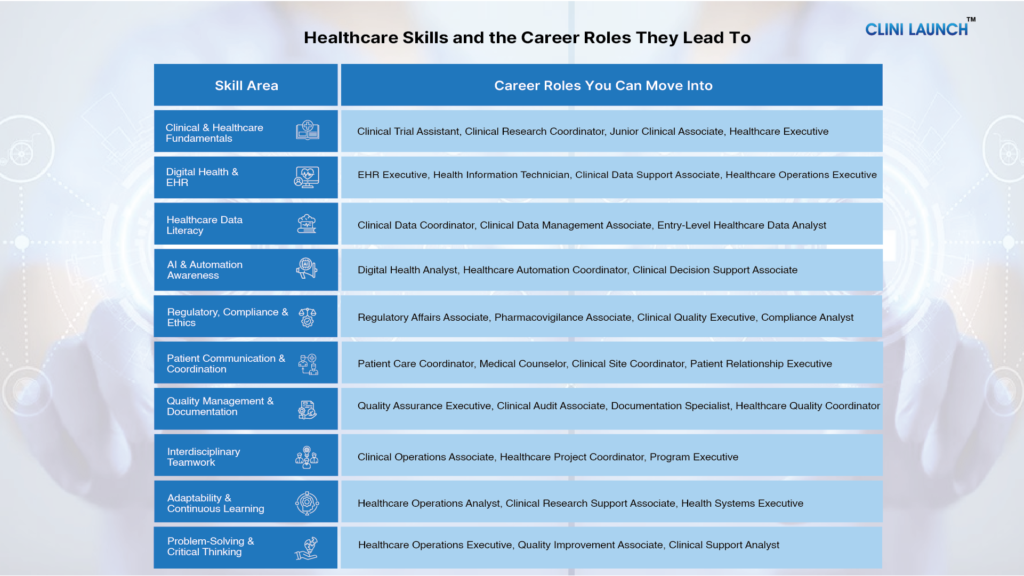
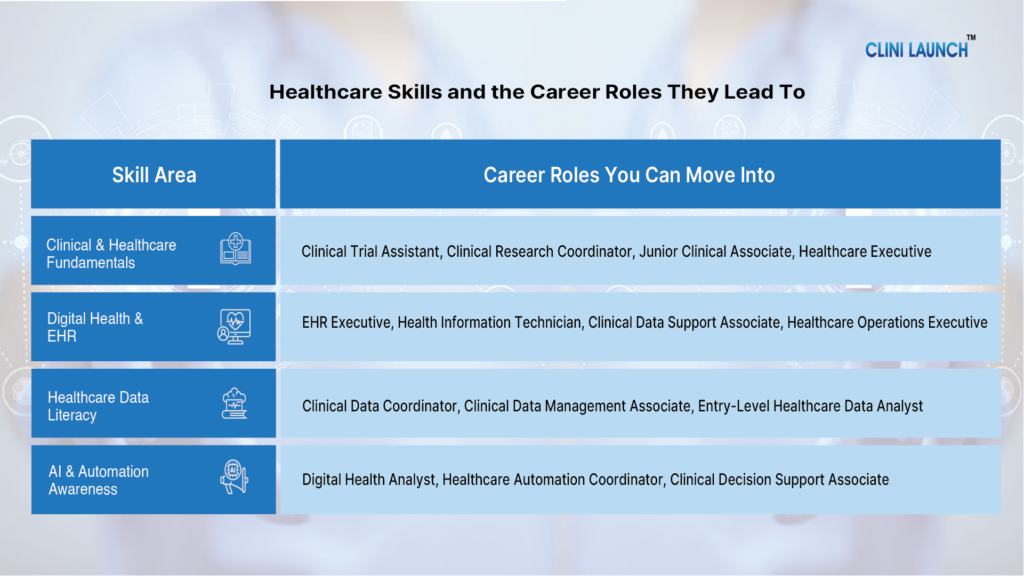
1.Clinical & Healthcare Fundamentals
Clinical and healthcare fundamentals refer to a basic understanding of medical terminology, disease concepts, patient care processes, clinical workflows, and healthcare documentation. These skills help professionals understand clinical language, patient records, SOAP notes, and ICD coding practices used across healthcare environments without directly providing patient care.
A strong foundation in healthcare fundamentals helps professionals interpret clinical instructions accurately, maintain documentation quality, and avoid miscommunication with doctors, coders, clinical research teams, and healthcare operations staff.
- Clinical Trial Assistant
- Clinical Research Coordinator
- Healthcare Executive / Coordinator
- Patient Care Coordinator
- Medical Records Executive
- Junior Clinical Associate
2. Digital Health & EHR Skills
Digital health and EHR skills allow professionals to work confidently with electronic health records, telemedicine platforms, healthcare automation systems, and digital healthcare technologies used across hospitals and clinical environments. These skills focus on accurate data entry, EHR interoperability, navigation of digital systems, and adherence to standardized digital workflows rather than technical system development.
They play an important role in maintaining accurate patient records, supporting audits, improving care continuity, and enabling efficient healthcare operations across modern health informatics environments. These are critical digital skills for health professionals working in technology-enabled healthcare systems.
Career Roles Linked to This Skill
- EHR Executive
- Health Information Technician
- Clinical Data Support Associate
- Healthcare Operations Executive
- Clinical Research Coordinator
3. Healthcare Data Literacy & Basic Analytics
Healthcare data literacy and basic analytics refer to the ability to understand, interpret, and work with healthcare-related data such as patient records, clinical reports, healthcare dashboards, trial data, quality metrics, and operational dashboards. These skills focus on clinical reporting, validating data accuracy, identifying patterns or inconsistencies, and using healthcare analytics to support informed decisions rather than performing advanced statistical analysis.
They help professionals generate operational insights, improve reporting accuracy, identify data gaps early, and support better decision-making across healthcare and clinical environments.
Career Roles Linked to This Skill:
- Clinical Data Coordinator
- Clinical Data Management Associate
- Healthcare Data Analyst (Entry Level)
- Quality Metrics Executive
- Population Health Analyst (Junior)
4. Patient Communication & Coordination Skills
Patient communication and coordination skills focus on clear interaction with patients, caregivers, and healthcare teams during care delivery. This skill focuses on explaining processes, handling queries, documenting interactions, and ensuring smooth coordination between clinical and non-clinical teams. Reduces delays, misunderstandings, and service gaps during patient care coordination.
Career Roles Linked to This Skill:
- Patient Care Coordinator
- Medical Counselor
- Healthcare Support Executive
- Clinical Site Coordinator
- Patient Relationship Executive
These basic health care skills are essential for entry-level roles across healthcare domains. These skills for healthcare are not just theoretical concepts but are aligned with real-world expectations shaped by healthcare industry trends 2026.
B) Advanced Healthcare Skills
Advanced healthcare skills help professionals work efficiently in modern healthcare environments that use digital systems, healthcare analytics, compliance processes, and technology-driven workflows. These skills support healthcare coordination, documentation, patient data handling, and operational efficiency. Why are advanced healthcare skills important today? Healthcare industries are rapidly adopting AI, analytics, and digital health technologies. Why is compliance important in healthcare? Compliance helps maintain patient safety, protect healthcare data, and ensure accurate healthcare processes.
Learn industry-ready healthcare and clinical research skills through practical training programs.
5. Regulatory, Compliance & Ethical Knowledge
Regulatory, compliance, and ethical knowledge in healthcare refers to understanding the rules, guidelines, and standards that govern patient safety, data privacy, clinical practices, and research activities. This skill focuses on adhering to healthcare regulations, maintaining ethical conduct, and ensuring that clinical and operational processes meet required quality and legal standards. Prevents compliance errors that can lead to audits, penalties, or trial disruptions.
Career Roles Linked to This Skill:
- Regulatory Affairs Associate
- Pharmacovigilance Associate
- Clinical Quality Executive
- Compliance Analyst (Healthcare)
- Clinical Audit Coordinator
6. Quality Management & Documentation Skills
Quality management and documentation ensure healthcare activities follow standardized procedures and maintain accurate records for audits and compliance. This skill focuses on proper documentation, process adherence, and continuous quality monitoring rather than direct patient care. Maintains audit-ready records and ensures healthcare processes meet quality standards.
Career Roles Linked to This Skill:
- Clinical Quality Associate
- Quality Assurance Executive
- Documentation Specialist (Healthcare)
- Clinical Audit Associate
- Healthcare Quality Coordinator
7. Interdisciplinary Teamwork & Collaboration
Interdisciplinary teamwork and collaboration refer to the ability to work effectively within multidisciplinary healthcare teams, including clinical, research, administrative, and technical professionals. These skills focus on hospital coordination, shared responsibility, clear communication, and aligning efforts to support patient care, research outcomes, and healthcare operations management. Strong collaboration helps prevent workflow breakdowns across clinical, research, and operational healthcare environments.
Career Roles Linked to This Skill:
- Clinical Operations Associate
- Healthcare Project Coordinator
- Multidisciplinary Care Coordinator
- Clinical Research Associate (Entry Level)
- Healthcare Program Executive
8. Problem-Solving & Critical Thinking in Healthcare
Problem-solving and critical thinking in healthcare refer to the ability to assess situations, identify issues, evaluate available information, and make informed decisions within clinical and operational contexts. This skill focuses on logical reasoning, attention to detail, and sound judgment rather than clinical decision-making or treatment. Supports safe and timely decisions during workflow disruptions or unexpected situations.
Career Roles Linked to This Skill:
- Healthcare Operations Executive
- Clinical Research Coordinator
- Quality Improvement Associate
- Healthcare Project Analyst
- Clinical Support Analyst
C) AI-Driven Healthcare Skills:
AI-driven healthcare skills reflect the growing use of AI-supported systems, AI-assisted diagnostics, digital platforms, and automated workflows across healthcare environments. As AI adoption increases, professionals also need awareness of AI ethics, data privacy, bias risks, and the importance of human oversight in healthcare decision-making. While AI tools support faster analysis and automation, healthcare professionals remain responsible for validating outputs, maintaining compliance, and ensuring patient safety.
9. AI & Automation Awareness in Healthcare
AI and automation awareness in healthcare refers to understanding how artificial intelligence–driven tools and automated systems are used to support clinical decisions, documentation, diagnostics, and operational workflows. This skill focuses on the ability to work alongside AI-enabled systems, interpret outputs responsibly, and follow ethical and regulatory boundaries, rather than developing or programming AI solutions. Helps professionals use AI-supported outputs responsibly without misinterpretation or over-reliance.
Career Roles Linked to This Skill:
- Healthcare AI Operations Analyst
- Clinical Decision Support Associate
- Digital Health Analyst
- Healthcare Automation Coordinator
- Medical AI Validation Associate
10. Adaptability & Continuous Learning Mindset
Adaptability and continuous learning in healthcare refer to the ability to adjust to changing clinical practices, technologies, regulations, and workflows while actively updating one’s knowledge and skills. This skill focuses on being open to learning new tools, processes, and standards rather than remaining limited to a single role or function. Allows professionals to stay effective as systems, tools, and regulations change.
Career Roles Linked to This Skill:
- Healthcare Operations Analyst
- Clinical Operations Associate
- Program Coordinator (Healthcare)
- Health Systems Executive
- Clinical Research Support Associate
Understanding individual healthcare skills is important, but employers also expect professionals to apply them within real healthcare environments.
Gain practical exposure to clinical workflows, healthcare systems, compliance, and AI-driven healthcare environments.
How Structured Training Helps Build Healthcare Skills
Building healthcare skills today requires more than theoretical knowledge. Professionals are expected to understand clinical workflows, digital healthcare systems, compliance practices, and healthcare operations through practical exposure and industry-oriented learning.
Structured training programs help learners develop these skills through hands-on practice, workflow-based learning, case studies, and healthcare tools exposure. Programs in areas such as clinical research, healthcare analytics, medical coding, pharmacovigilance, and digital healthcare operations help learners build job-ready healthcare skills.
Clinical Research
Build industry-ready skills to work across real clinical trial environments. Learn how clinical studies are designed, conducted, documented, and monitored, with a strong focus on ethics, patient safety, and global regulatory compliance.

These healthcare skills not only improve job readiness but also open pathways to multiple career roles across healthcare and clinical research. Digital health technologies such as telemedicine, electronic health records, and AI-assisted diagnostics are transforming how healthcare services are delivered.
Career roles associated with the Skills
Developing healthcare skills opens pathways to a wide range of entry-level and mid-level roles across clinical research, healthcare operations, digital health, and healthcare data management.
| Skill Area | Example Career Roles |
| Clinical Research Skills | Clinical Research Coordinator, Clinical Trial Assistant, CRA |
| Medical Coding & Documentation | Medical Coder, HCC Coding Analyst, Healthcare Documentation Specialist |
| Healthcare Data & Analytics | Healthcare Data Analyst, Clinical Data Coordinator, Healthcare Reporting Associate |
| Pharmacovigilance & Drug Safety | Drug Safety Associate, Pharmacovigilance Executive |
| Digital Health & Operations | Healthcare Operations Associate, EHR Coordinator, Digital Health Executive |
| AI & Healthcare Technology | Healthcare AI Support Associate, Health Informatics Associate |
What Healthcare Employers expect from Healthcare Professionals in 2026
Healthcare employers increasingly expect professionals to apply these skills within real clinical and operational workflows. Healthcare work today is highly interconnected, regulated, and outcome driven. Professionals must follow defined documentation processes, comply with regulatory standards, and coordinate effectively with multiple teams.
When these skills are applied correctly, they help improve accuracy, reduce operational and compliance risks, and support safe and efficient healthcare delivery. Candidates who understand how these skills fit into real healthcare workflows are better prepared to meet day-to-day job expectations and adapt to healthcare workplace demands. Healthcare organizations specifically look for professional skills for healthcare that align with real workflow execution.
Importance of Upskilling and Reskilling in Healthcare
Healthcare systems are constantly evolving due to new technologies, regulatory updates, and changing patient care models. Professionals must regularly update their skills to remain effective in healthcare roles. Many learners today rely on healthcare eLearning platforms, online healthcare certification programs, and healthcare upskilling programs to gain flexible and practical industry knowledge.
Upskilling refers to improving existing capabilities such as clinical documentation, digital health system usage, or healthcare data understanding. Reskilling involves learning entirely new competencies that support healthcare career transition into emerging areas such as digital health, healthcare analytics, clinical research, and healthcare operations.
Practical Ways Healthcare Professionals Can Upskill
Professionals can strengthen healthcare skills through several approaches:
• Structured training programs
• Hands-on exposure to healthcare systems and workflows
• Certifications in clinical research or digital health
• Continuous learning through workshops and online learning platforms
• Mentorship and guided industry training
These approaches help learners gain both theoretical understanding and practical exposure. Structured skills for health eLearning programs help bridge the gap between theory and practice.
Despite the growing demand for healthcare professionals, many organizations report difficulty finding candidates with the right combination of clinical knowledge, digital skills, and compliance awareness.
Healthcare Skill Shortage and Workforce Demand
Healthcare organizations worldwide are experiencing a growing shortage of professionals who understand both clinical workflows and healthcare technologies. As healthcare systems become more data-driven and digitally connected, the demand for trained professionals continues to increase.
Many employers report difficulty finding candidates who combine clinical knowledge, documentation accuracy, digital health familiarity, and regulatory awareness.
Healthcare Career Opportunities in India and Globally
India’s healthcare sector is expanding rapidly due to increasing investments in hospitals, clinical research, digital health platforms, and healthcare technology startups. This growth is creating new opportunities for professionals trained in healthcare operations, clinical research, and healthcare data management. The healthcare sector in India continues to grow with rising investments in hospitals, diagnostics, and digital healthcare infrastructure. Industry insights from McKinsey & Company and Deloitte healthcare reports also highlight the increasing role of digital transformation, healthcare analytics, and technology-enabled healthcare delivery across global healthcare systems.
Globally, countries such as the United States, the United Kingdom, Germany, and Singapore are experiencing strong demand for healthcare professionals with skills in clinical documentation, regulatory compliance, healthcare analytics, and digital healthcare operations. According to the World Health Organization, the growing healthcare workforce demand is also increasing the need for skilled healthcare professionals worldwide.
Key Takeaways for Freshers and Career Switchers
For freshers and professionals transitioning into healthcare, the most important step is building foundational healthcare knowledge combined with practical exposure to healthcare workflows. Understanding how clinical processes, digital systems, compliance standards, and communication practices work together helps professionals become job-ready faster.
Healthcare Career Growth After Building These Skills
Healthcare career growth is built through continuous learning, practical exposure, and gradual progression across clinical, operational, research, and digital healthcare environments. With strong foundational skills in clinical processes, compliance, communication, digital health systems, and healthcare data handling, professionals can build stable long-term careers while adapting to changing healthcare technologies and industry expectations.
As healthcare systems continue evolving, employers increasingly value professionals who can work confidently within real healthcare workflows and regulated environments. Developing practical, industry-relevant skills helps improve employability, supports career growth, and creates opportunities across areas such as clinical research, healthcare operations, digital health, medical coding, and healthcare analytics.
For learners looking to build these capabilities with structured guidance and practical exposure, industry-oriented training can help make the transition into healthcare careers more clear and career-focused. CliniLaunch Research Institute offers healthcare and clinical research programs designed around real workflows, compliance practices, and job-ready learning aligned with modern healthcare industry needs.
Discover the best healthcare career path based on your background, interests, and future goals.