Biotechnology careers include roles in bioinformatics, clinical research, regulatory affairs, biostatistics, manufacturing, and R&D. These biotechnology careers offer strong salary potential, diverse career paths, and global opportunities, with growing demand driven by AI, data analytics, and advancements in drug development and healthcare innovation.
Start Your Career →Biotechnology careers are growing rapidly as biotechnology is one of the fastest-expanding global industries. The global biotechnology market was valued at approximately USD 1.55 trillion in 2023 and is projected to reach nearly USD 3.88 trillion by 2030, growing at an estimated ~14% CAGR (2024–2030) according to industry analyses from Grand View Research.
India’s biotechnology market has grown rapidly, expanding from US$ 30.2 billion in 2015 to over US$ 70 billion by 2020, contributing to a bioeconomy valued at around US$ 130 billion in 2024. The sector is projected to grow steadily at about 13% CAGR, with long-term estimates suggesting it could reach US$ 270–300 billion by 2030, positioning India as a rising global biotechnology leader.
Additionally, multinational pharmaceutical companies such as Sanofi have expanded R&D and global capability operations in India, especially in Hyderabad. This signals a shift toward higher-value roles including bioinformatics, regulatory strategy, data science, and advanced clinical operations.
Biotechnology is no longer limited to laboratory research; it now integrates AI, data analytics, regulatory science, and global manufacturing systems, creating diverse biotechnology career options across research, data science, manufacturing, and clinical development.
Clinical Research
Build practical, industry-aligned skills to work across real clinical trial environments. Learn how clinical studies are planned, conducted, documented, and monitored, with a strong emphasis on ethics, patient safety, and regulatory compliance throughout the trial lifecycle.

Top Biotechnology Career Options in the Industry
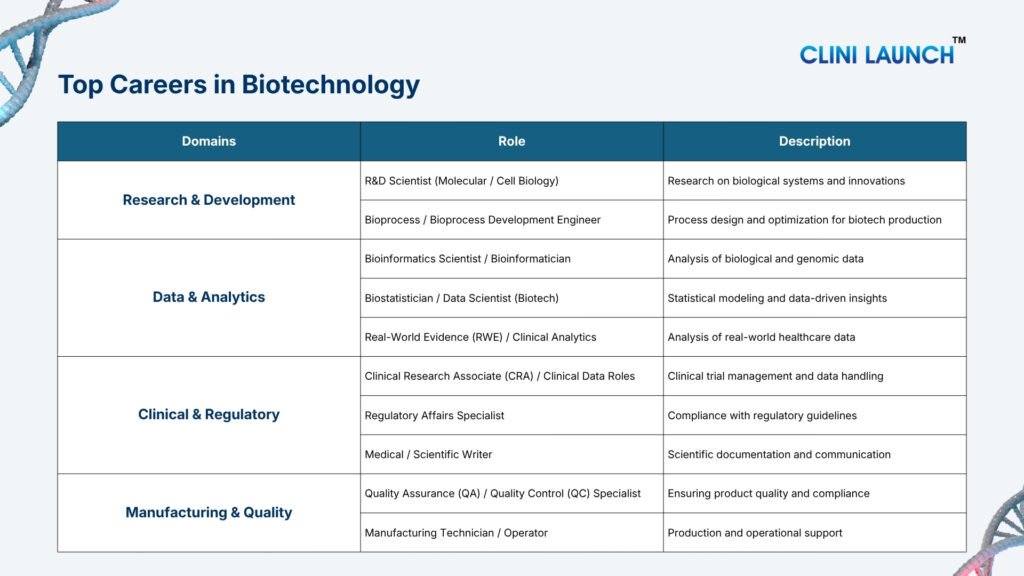
Biotechnology careers are structured around how biological products are developed, tested, and approved. These roles span research, data, clinical development, manufacturing, and regulatory systems.
The following career options represent key functions across the biotech lifecycle, from discovery to commercialization.
1. Bioinformatics Scientist / Bioinformatician
Bioinformatics combines biology with data science to analyze complex genomic datasets used in research and drug development.
This role is rapidly growing as healthcare and life sciences increasingly rely on data-driven insights for precision medicine.
What You Do:
- Analyze DNA, RNA, and protein data
- Build genomic data pipelines
- Perform sequence alignment and variant analysis
- Support precision medicine research
Core Skills:
- Python, R, Linux
- BLAST, BWA
- Statistical analysis
Advanced Skills:
- Machine learning
- Cloud computing
Career Path:
Analyst → Scientist → Senior Scientist → Director
2. Bioprocess / Bioprocess Development Engineer
Bioprocess engineers scale lab discoveries into commercial production for biologics, vaccines, and enzymes.
They play a critical role in ensuring that innovative therapies can be manufactured efficiently on a large scale.
What You Do:
- Optimize cell culture and fermentation
- Manage purification processes
- Improve yield and product quality
- Support scale-up from lab to manufacturing
Core Skills:
- Bioreactors
- Fermentation
- Process control
Advanced Skills:
- GMP compliance
- Process optimization
Career Path:
Engineer → Lead → Manager → Technical Director
3. Clinical Research Associate (CRA) / Clinical Data Roles
These roles ensure clinical trials are conducted safely, ethically, and in compliance with regulations.
They act as a bridge between research, patient care, and regulatory systems in drug development.
What You Do:
- Monitor clinical trial sites
- Verify and validate data
- Ensure GCP compliance
- Manage trial documentation
Core Skills:
- GCP knowledge
- EDC systems
- Documentation
Advanced Skills:
- Risk-based monitoring
- Multi-site coordination
Career Path:
CRA → Senior CRA → Project Manager → Head
4. Biostatistician / Data Scientist (Biotech)
These professionals analyze clinical and research data to support decision-making and regulatory approvals.
Their work is essential for validating scientific findings and ensuring accuracy in clinical outcomes.
What You Do:
- Design statistical studies
- Analyze clinical data
- Interpret results for research
- Support regulatory submissions
Core Skills:
- R / SAS
- Statistical modeling
- Data analysis
Advanced Skills:
- Machine learning
- Predictive analytics
Career Path:
Statistician → Senior → Lead → Chief Data Officer
5. Regulatory Affairs Specialist
Regulatory professionals ensure biotech products meet global compliance standards and gain approvals.
They help companies navigate complex regulatory pathways across different countries and markets.
What You Do:
- Prepare regulatory submissions (IND, NDA)
- Ensure compliance with FDA, EMA, CDSCO
- Manage documentation and approvals
- Coordinate with regulatory authorities
Core Skills:
- CTD documentation
- Regulatory frameworks
- Submission management
Advanced Skills:
- Regulatory strategy
- Audit readiness
Career Path:
Specialist → Manager → Head → Director
6. Quality Assurance (QA) / Quality Control (QC) Specialist
QA/QC professionals ensure product safety, consistency, and compliance in biotech manufacturing.
They act as quality gatekeepers, ensuring that every product meets strict industry standards.
What You Do:
- Conduct quality audits
- Manage SOPs and documentation
- Perform testing and validation
- Handle deviations and CAPA
Core Skills:
- GMP / GLP
- Documentation
- Analytical testing
Advanced Skills:
- Quality systems
- Inspection readiness
Career Path:
Analyst → Lead → Manager → Head
7. R&D Scientist (Molecular / Cell Biology)
R&D scientists drive innovation by researching disease mechanisms and developing new therapies.
They form the foundation of scientific discovery in biotechnology and life sciences.
What You Do:
- Conduct lab experiments (PCR, ELISA, cell culture)
- Design and optimize assays
- Analyze experimental data
- Support drug discovery research
Core Skills:
- Molecular biology techniques
- Experimental design
- Data analysis
Advanced Skills:
- Translational research
- Biomarker development
Career Path:
Research Associate → Scientist → Senior Scientist → Head of R&D
8. Medical / Scientific Writer
Medical writers convert complex scientific data into clear, structured documents for regulatory and research purposes.
They play a key role in communicating scientific findings to regulators, researchers, and healthcare professionals.
What You Do:
- Write clinical study reports and protocols
- Prepare regulatory documents
- Develop scientific content and publications
- Interpret research data
Core Skills:
- Scientific writing
- Literature review
- Data interpretation
Advanced Skills:
- Regulatory documentation
- Medical communications
Career Path:
Writer → Senior Writer → Lead → Head
9. Manufacturing Technician / Operator
These professionals handle day-to-day biotech production processes in manufacturing facilities.
They ensure that production runs smoothly while maintaining strict safety and quality standards.
What You Do:
- Operate production equipment
- Follow SOPs and GMP guidelines
- Maintain aseptic conditions
- Support batch production
Core Skills:
- GMP knowledge
- Equipment handling
- Documentation
Advanced Skills:
- Process optimization
- Equipment validation
Career Path:
Technician → Senior → Supervisor → Operations Manager
10. Real-World Evidence (RWE) / Clinical Analytics
RWE professionals analyze real-world healthcare data to evaluate treatment outcomes and support decision-making.
Their insights help improve healthcare strategies and demonstrate the real-world impact of treatments.
What You Do:
- Analyze patient data (EHR, claims)
- Design observational studies
- Generate clinical insights
- Support regulatory and market decisions
Core Skills:
- Epidemiology
- R / SAS
- Data analysis
Advanced Skills:
- Causal inference
- HEOR
- Machine learning
Career Path:
Analyst → Senior Analyst → Scientist → Director
Biostatistics
Build strong foundations in statistical methods used in clinical research and healthcare studies. Learn how clinical trial data is analyzed, interpreted, and validated to support evidence-based decisions and regulatory submissions.
Duration: 6 months
Highest Paying Biotechnology Jobs
Understanding biotechnology jobs salary is important when choosing a specialization, as roles combining data, research, and regulatory expertise often offer higher earning potential compared to traditional lab-based positions. Some biotechnology careers offer significantly higher salary potential based on specialization, experience, and industry demand. Roles that combine science with data, regulation, or leadership tend to command the highest compensation.
- Bioinformatics Scientist / Data Scientist: ₹6–25 LPA (higher with experience)
- Biostatistician: ₹5–20 LPA
- Regulatory Affairs Specialist: ₹6–18 LPA
- Clinical Research Roles (CRA / CDM): ₹4–14 LPA
- R&D Scientist: ₹5–18 LPA
Senior leadership roles such as Head of R&D, Regulatory Director, or Chief Data Officer can reach significantly higher compensation levels depending on experience and organization scale.
Which Biotechnology Career is Right for You?
Biotech Career Matchmaker
- The Researcher (Lab-Focused): If you love experimentation, aim for R&D Scientist or Bioprocess Engineer roles in drug discovery and cell biology.
- The Analyst (Data & Tech): If you gravitate toward patterns and AI, investigate Bioinformatics, Biostatistics, or Clinical Data Analysis.
- The Coordinator (Process-Driven): For those who excel at documentation and precision, Regulatory Affairs, Medical Writing, or Quality Assurance (QA/QC) are excellent fits.
- The Clinical Specialist (Operations): If you want to stay near healthcare without the lab bench, Clinical Research Associate (CRA) or Data Management (CDM) roles bridge the gap between trials and hospitals.
- The Producer (Operations): If you enjoy large-scale logistics, focus on Manufacturing and Bioprocess Operations.
Quick Tip: Most of these roles now overlap with digital tools. Even in the lab, gaining basic data literacy or familiarity with electronic lab notebooks (ELN) will give you a significant edge.
How to build a career in the Biotechnology industry?
Biotechnology graduates can enter multiple career paths across research, clinical development, regulatory affairs, and manufacturing by building the right combination of technical skills and practical exposure. A career in biotechnology requires a combination of scientific foundations, technical skills, and practical exposure, especially for those seeking jobs for biotechnology graduates in research, clinical development, regulatory affairs, and biotech manufacturing. To improve job readiness, many learners pursue biotechnology courses after graduation in areas such as clinical research, bioinformatics, biostatistics, and regulatory affairs.
Step 1: Build Domain Foundations
Pursue a degree in molecular biology, microbiology, biotechnology, or related life sciences. Focus on core concepts such as genetics, cell biology, immunology, and basic laboratory techniques.
Step 2: Add Technical Specialization
Choose a specialization based on your career goal:
- Bioinformatics: Python/R, genomics tools, Linux
- Clinical Research: GCP certification, EDC platforms
- Biostatistics: SAS/R, statistical modeling
- Regulatory Affairs: CTD documentation, global regulatory frameworks
Step 3: Gain Industry Exposure
Strengthen your profile through internships, capstone projects, and GMP lab exposure to understand real-world biotech operations and compliance standards.
India vs Global: Where the Opportunity is
Biotechnology is expanding worldwide, but the type of opportunities and growth dynamics differ between established global markets and rapidly emerging ecosystems like India.
Global Landscape
Globally, biotechnology continues to grow at a strong pace, supported by advances in biologics, gene and cell therapies, precision medicine, and AI-driven drug discovery. Mature markets such as the United States and parts of Europe lead in high-end R&D, translational science, and innovation-focused biotech startups. Career opportunities in these regions are often concentrated in advanced research, regulatory strategy, clinical development leadership, and data-driven drug discovery roles.
India’s Growth Advantage
The scope of biotechnology in India is expanding rapidly due to increasing investments, global collaborations, and the growth of biopharma, clinical research, and healthcare technology sectors. India is evolving from a generics and manufacturing-focused base into a broader biotech innovation ecosystem, creating expanding career opportunities in biotechnology in India across research services, biopharma production, clinical trials, and data-driven healthcare. Growth is being driven by expanding biopharma production, vaccine leadership, global capability centers, clinical research services, and strong IT-biotech integration. With projections targeting US$ 270–300 billion by 2030, India is generating increasing demand in bioinformatics, regulatory affairs, clinical analytics, and advanced biotech operations.
What this means for the Professionals
Global markets provide exposure to cutting-edge innovation and frontier research, while India offers high-growth opportunities, expanding leadership roles, and strong demand across both operational and specialized biotechnology functions.
Conclusion
The future of biotechnology careers is strongly driven by advancements in AI, data analytics, precision medicine, and global healthcare innovation. Building a career in biotechnology requires more than knowing job titles or career options; it involves understanding how different roles function and identifying highest paying biotechnology jobs aligned with your skills and specialization. What matters is understanding how these roles operate inside real laboratories, manufacturing facilities, and quality systems, and developing the skills that align with those expectations.
At CliniLaunch Research Training Institute focuses on bridging the gap between academic learning and how biotechnology and life sciences roles actually function in industry. Through hands-on training, role-specific skill building, and expert guidance, CliniLaunch supports learners who want clarity, confidence, and a practical foundation to begin or progress in jobs in the biotechnology industry.
Frequently Asked Questions (FAQs)
What are the best biotechnology careers for freshers?
Freshers can start with roles such as Clinical Research Coordinator, QA/QC Analyst, Medical Writer, Bioinformatics Analyst, and Manufacturing Technician.
Which biotechnology jobs have the highest salary in India?
High-paying biotechnology jobs include Bioinformatics Scientist, Biostatistician, Regulatory Affairs Specialist, and R&D Scientist.
What skills are required to build a career in biotechnology?
Key skills include laboratory techniques, data analysis, bioinformatics tools, regulatory knowledge, and problem-solving abilities.
Can biotechnology graduates work in clinical research?
Yes, biotechnology graduates can work in clinical research roles such as CRA, Clinical Data Manager, and Pharmacovigilance professionals.
What are the future career opportunities in the biotechnology industry?
Future opportunities include bioinformatics, AI-driven drug discovery, clinical analytics, regulatory science, and biologics manufacturing.
Is biotechnology a good career option in India?
Yes, biotechnology is a promising career in India due to rapid industry growth and increasing demand.
What are the top biotechnology companies hiring graduates?
Top companies include Biocon, Serum Institute of India, Dr. Reddy’s Laboratories, Cipla, Syngene, Pfizer, and Novartis.
What courses can help build a career in the biotechnology industry?
Courses in clinical research, bioinformatics, biostatistics, regulatory affairs, and AI in healthcare help improve job readiness.
How can freshers get a job in the biotechnology industry?
Freshers can gain internships, certifications, and hands-on training to improve employability.
What are the different career options in biotechnology?
Careers include R&D, bioinformatics, clinical trials, regulatory affairs, manufacturing, QA/QC, and medical writing.