
Clinical research careers are no longer limited to labs or paperwork. They support how new medicines, vaccines, and medical devices are tested before reaching patients. Every approved treatment goes through clinical studies, making this field a vital part of modern healthcare.
By 2026, clinical research has become more global, digital, and data-driven. Trials now run across countries, use online systems instead of paper, and collect data from hospitals, labs, and real-world patient sources. Because of this shift, the industry needs professionals who understand how trials actually work, how data is handled safely, and how regulatory standards are followed in practice.
As the industry evolves, clinical research career paths have also expanded. Some roles are already well-established and in high demand today, forming the core of clinical trial operations. At the same time, new roles are emerging that combine clinical research with technology, analytics, and digital systems.
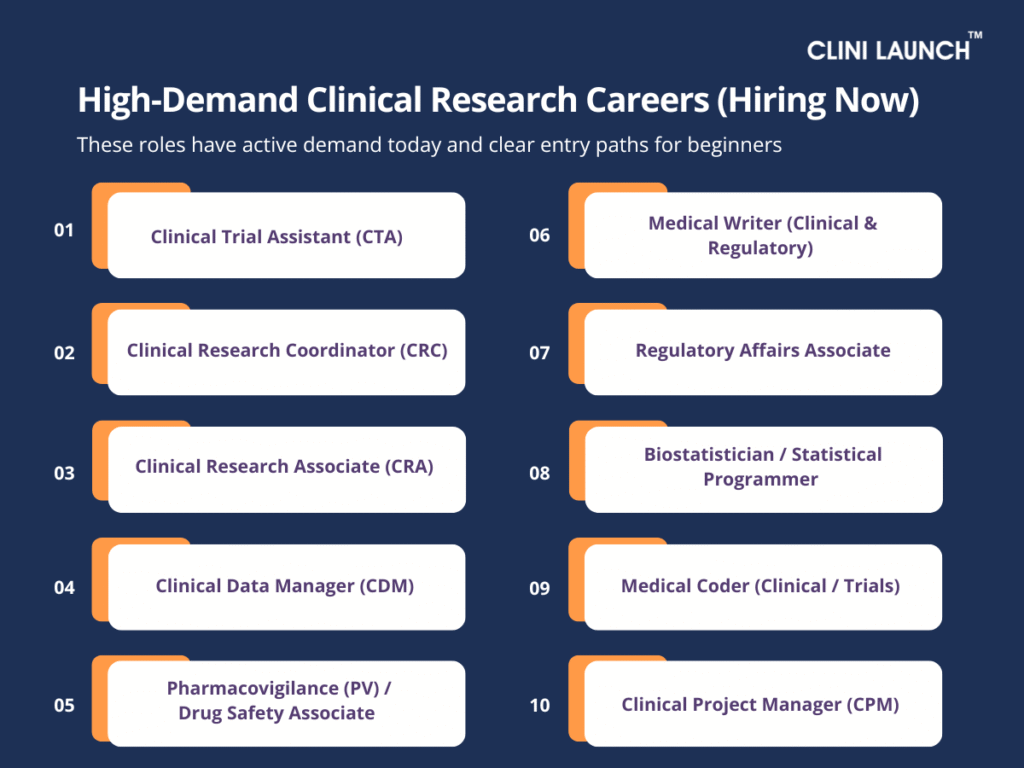
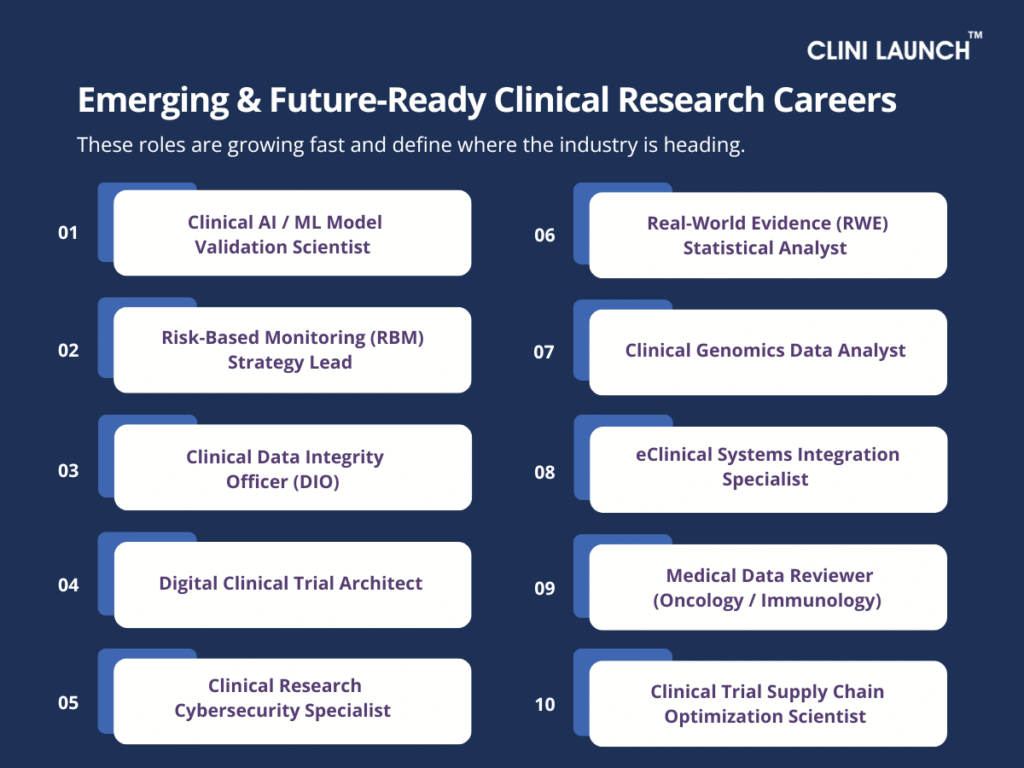
Clinical research jobs are not a single job anymore, but a connected career ecosystem. To make this easier to understand, this guide is divided into two parts: high-demand clinical research careers that are actively hiring, and emerging roles that reflect where the industry is heading. For beginners, this approach helps clarify where to start and how career paths can grow over time.
Top 10 High-Demand Careers in Clinical Research
Clinical Research Associate (CRA)
A Clinical Research Associate (CRA) ensures that clinical trials are conducted correctly. While scientists design studies and doctors treat patients, CRAs make sure every step of the trial follows the approved plan and global guidelines. As clinical trials expand worldwide and India grows as a key research hub, this role has become one of the most in-demand careers in clinical research.
For beginners, the CRA role offers early exposure to how real clinical studies run in hospitals and research centers. It is often the first role where professionals see the full trial process, from reviewing patient data to supporting regulatory compliance.
What a CRA Does
CRAs work closely with research sites to review patient records, check trial documents, and confirm that study procedures are followed correctly. They coordinate with investigators, site teams, and sponsors to keep studies organized, compliant, and inspection-ready. Over time, CRAs gain exposure to different therapeutic areas such as oncology and cardiology.
Clinical Research Associate (CRA) — Salary, Scope, Skills & Role Fit Snapshot
| Category | Details |
|---|---|
| Average Salary (India) | ₹4.5 – ₹8 LPA for entry-level roles; increases with monitoring experience |
| Senior / Lead CRA Salary | ₹12 – ₹20 LPA in India; global roles can exceed ₹90 Lakh per year |
| Growth Outlook (Next 5 Years) | ~30% growth driven by increasing trial volumes and digital monitoring |
| Key Skills Gained | Clinical monitoring, protocol compliance, source data verification, stakeholder communication, attention to detail |
| Career Progression | Lead CRA, Clinical Trial Manager (CTM), Clinical Project Manager (CPM), QA Auditor, Regulatory or PV roles |
| Who This Role Fits Best | Beginners who want hands-on exposure to trial execution, are comfortable with structured processes, and want strong global career mobility |
| Key Benefits | Global demand, exposure to advanced therapies, strong career mobility, performance-based incentives |
| Why This Role Matters | Builds deep clinical operations knowledge and opens multiple long-term career paths |
Clinical Research
Master the detailed processes involved in designing, conducting, monitoring, and managing clinical trials. This program equips you with expertise in ethical, regulatory, and scientific aspects of research, preparing you for senior roles in pharmaceutical companies and CROs.

Clinical Research Coordinator (CRC)
A Clinical Research Coordinator (CRC) works at hospitals and research sites where clinical trials are conducted. While sponsors and CROs manage studies at a higher level, CRCs handle the day-to-day activities that keep trials running smoothly at the site.
For beginners, the CRC role offers direct exposure to real clinical environments. It is often the first role where professionals interact with patients, investigators, and clinical trial protocols in a practical setting.
Why This Role Exists
Clinical trials depend heavily on accurate execution at the hospital or research site. Patient visits, data collection, and documentation must be done correctly and on time. CRCs exist to ensure that these activities are carried out as per the study protocol and ethical requirements. They help maintain consistency, accuracy, and patient safety at the site level, which is essential for successful trials.
What a CRC Does
CRCs coordinate daily trial activities at the research site. They assist with patient screening and enrollment, schedule study visits, collect trial data, and maintain study documents. They work closely with investigators, nurses, and CRAs to ensure smooth communication and proper documentation.
Clinical Research Coordinator (CRC) — Salary, Scope, Skills & Role Fit Snapshot
| Category | Details |
|---|---|
| Average Salary (India) | ₹2.5 – ₹4.5 LPA for entry-level roles; rises with site experience |
| Senior / Lead CRC Salary | ₹5 – ₹8 LPA in India; global site roles can reach ₹50–60 Lakh per year |
| Growth Outlook (Next 5 Years) | 25–30% growth due to increasing site-based trials |
| Key Skills Gained | Patient coordination, site documentation, protocol execution, clinical communication |
| Career Progression | CRA, Site Manager, Clinical Trial Manager, Project Coordinator |
Clinical Data Manager (CDM)
A Clinical Data Manager ensures that data collected during clinical trials is accurate, complete, and ready for analysis. While trial teams focus on patients and site activities, CDMs manage the data systems that turn trial information into reliable evidence.
For beginners, the CDM role offers a structured, system-driven entry into clinical research. It is well suited for those who prefer working with data and digital tools rather than patient-facing or site-based work.
Why This Role Exists
Clinical trials generate large volumes of data from multiple sites and sources. This data must be clean, consistent, and traceable before it can be analyzed or submitted to regulators. CDMs exist to ensure data quality and integrity throughout the study. They play a critical role in making sure trial results are trustworthy and usable for scientific and regulatory decisions.
What a CDM Does
CDMs design and manage data collection systems, review trial data for errors, and resolve discrepancies with study teams. They work closely with CRAs, statisticians, programmers, and clinical teams.
Clinical Data Manager (CDM) — Salary, Scope, Skills & Role Fit Snapshot
| Category | Details |
|---|---|
| Average Salary (India) | ₹4 – ₹7 LPA for entry-level roles; increases with EDC experience |
| Senior / Lead CDM Salary | ₹12 – ₹18 LPA in India; global roles can reach ₹80 Lakh–₹1 Cr per year |
| Growth Outlook (Next 5 Years) | 30%+ growth driven by digital trials and data-driven research |
| Key Skills Gained | Data quality management, EDC systems, discrepancy resolution, data standards, analytical thinking |
| Career Progression | Lead CDM, Data Quality Manager, Clinical Database Designer, Biostatistics, Clinical Analytics |
| Who This Role Fits Best | Beginners who prefer data-focused work, structured systems, and minimal site or patient interaction |
| Key Benefits | Strong career stability, global relevance, high demand for technical expertise |
| Why This Role Matters | Ensures trial data is reliable for scientific and regulatory decisions |
Pharmacovigilance (PV) Associate / Drug Safety Associate
A Pharmacovigilance (PV) Associate, also known as a Drug Safety Associate, focuses on monitoring the safety of medicines during clinical trials and after they are approved. While clinical teams study how well a drug works, PV professionals ensure that any side effects are identified, documented, and reported correctly.
For beginners, this role offers a clear and stable entry to pharmacovigilance careers. It is well suited for those who prefer structured processes and want to work in roles directly connected to patient safety.
Why This Role Exists
No medicine is completely risk-free. As drugs are tested and later used by larger patient populations, safety information continues to emerge. PV roles exist to track this information and ensure that potential risks are understood and communicated.
What a PV Associate Does
PV Associates review safety reports from clinical trials, healthcare professionals, and patients. They document adverse events, code medical terms using standard systems, and ensure reports are submitted to regulatory authorities on time.
Pharmacovigilance (PV) Associate — Salary, Scope, Skills & Role Fit Snapshot
| Category | Details |
|---|---|
| Average Salary (India) | ₹3 – ₹5 LPA for entry-level roles; increases with safety case experience |
| Senior / Specialist Salary | ₹6 – ₹12 LPA in India; global PV roles can exceed ₹70–80 Lakh per year |
| Growth Outlook (Next 5 Years) | 25–35% growth driven by post-marketing surveillance and global compliance |
| Key Skills Gained | Adverse event analysis, medical terminology, regulatory compliance, safety documentation |
| Career Progression | Safety Specialist, Aggregate Report Writer, Signal Detection Analyst, Medical Writing, Regulatory roles |
| Who This Role Fits Best | Beginners who want to work in drug safety, prefer structured workflows over site travel, and are comfortable reviewing medical information and safety data |
| Key Benefits | Strong job stability, continuous global demand, specialization opportunities |
| Why This Role Matters | Direct impact on patient safety across the entire drug lifecycle |
AI in Drug Safety & Compliance
Gain in-depth expertise in pharmacovigilance, regulatory reporting, and risk management across the drug lifecycle, enhanced by the integration of Artificial Intelligence tools.
Medical Writer (Clinical & Regulatory)
A Medical Writer (Clinical & Regulatory) creates the documents required to run, evaluate, and approve clinical trials. While clinical teams generate data, medical writers turn that information into clear, structured documents.
This role combines scientific understanding with communication skills and does not require site travel or patient-facing work.
Why This Role Exists
Regulators cannot evaluate a drug unless clinical data is presented clearly and accurately. Medical writers ensure trial documentation meets global regulatory standards.
What a Medical Writer Does
Medical Writers develop documents such as clinical trial protocols, investigator brochures, informed consent forms, clinical study reports (CSRs), and regulatory submission dossiers. They interpret clinical and statistical outputs and ensure consistency with international guidelines. They work closely with clinical operations, biostatistics, pharmacovigilance, and regulatory teams to align scientific content with regulatory expectations across different regions. Over time, this role provides exposure to multiple therapeutic areas and global submission pathways.
Medical Writer (Clinical & Regulatory) — Salary, Scope, Skills & Role Fit Snapshot
| Category | Details |
|---|---|
| Average Salary (India) | ₹4 – ₹7 LPA for entry-level writers; increases with document complexity and experience |
| Senior / Specialist Salary | ₹10 – ₹18 LPA in India; international roles can exceed ₹80 Lakh–₹1 Cr per year |
| Growth Outlook (Next 5 Years) | 30%+ growth driven by increasing global trials and regulatory submissions |
| Key Skills Gained | Scientific writing, data interpretation, regulatory documentation, guideline compliance, attention to detail |
| Career Progression | Senior Medical Writer, Scientific Writer, Regulatory Strategist, Medical Affairs, Publications roles |
| Who This Role Fits Best | Beginners who enjoy writing, are comfortable interpreting scientific data, and prefer desk-based roles over site or patient work |
| Key Benefits | Strong global demand, remote-work opportunities, blend of science and communication |
| Why This Role Matters | Enables regulatory approvals by translating clinical data into compliant, decision-ready documents |
Regulatory Affairs Associate
A Regulatory Affairs (RA) Associate ensures that clinical trials and medical products meet all regulatory requirements before and after approval.
This role offers a clear entry into the compliance and approval side of clinical research.
Why This Role Exists
Every drug or medical device must be reviewed and approved by regulatory authorities. Regulatory Affairs ensures compliance throughout the product lifecycle.
What a Regulatory Affairs Associate Does
Regulatory Affairs Associates support the preparation and submission of regulatory documents for clinical trials and approvals. They coordinate with clinical, safety, manufacturing, and quality teams to compile dossiers and respond to regulatory queries. They also track regulatory changes, support labeling updates, and assist with post-approval activities. Over time, this role provides strong exposure to global regulatory frameworks and approval pathways.
Regulatory Affairs Associate — Salary, Scope, Skills & Role Fit Snapshot
| Category | Details |
|---|---|
| Average Salary (India) | ₹3.5 – ₹6 LPA for entry-level roles; increases with submission experience |
| Senior / Specialist Salary | ₹8 – ₹15 LPA in India; global roles can exceed ₹70–90 Lakh per year |
| Growth Outlook (Next 5 Years) | 25–35% growth driven by new drug approvals, biosimilars, and evolving regulations |
| Key Skills Gained | Regulatory documentation, guideline interpretation, submission management, compliance tracking |
| Career Progression | Regulatory Specialist, CMC Regulatory Expert, Labeling Manager, QA or Compliance roles |
| Who This Role Fits Best | Beginners who prefer structured, rule-driven work and want to be involved in product approvals rather than site activities |
| Key Benefits | Long-term career stability, global relevance, involvement in product launch pathways |
| Why This Role Matters | Enables safe and timely market access by ensuring regulatory compliance |
Biostatistician / Statistical Programmer
A Biostatistician or Statistical Programmer works with clinical trial data to determine whether a treatment is safe and effective. While trials generate large amounts of data, these professionals turn that data into meaningful results that support scientific conclusions and regulatory decisions.
For beginners with a strong interest in numbers, logic, and data analysis, this role offers a high-impact entry into clinical research. It is well suited for those who prefer analytical work over site-based or patient-facing roles.
Why This Role Exists
Clinical trial data must be analyzed correctly to prove that a treatment works and is safe. Regulators rely heavily on statistical evidence when approving new drugs. Biostatisticians and statistical programmers exist to ensure analyses are accurate, reproducible, and compliant with global standards. Their work directly influences study outcomes, approvals, and scientific credibility.
What a Biostatistician / Statistical Programmer Does
Biostatisticians design statistical analysis plans, select appropriate methods, and interpret trial results. Statistical programmers prepare analysis-ready datasets, generate tables, figures, and listings, and ensure data follows regulatory standards. They work closely with clinical teams, medical writers, and regulatory groups to support submissions and publications. Over time, this role provides deep exposure to clinical data, trial design, and advanced analytics.
Biostatistician / Statistical Programmer — Salary, Scope, Skills & Role Fit Snapshot
| Category | Details |
|---|---|
| Average Salary (India) | ₹5 – ₹9 LPA for entry-level roles; increases with statistical and CDISC expertise |
| Senior / Lead Salary | ₹15 – ₹25 LPA in India; global roles can exceed ₹1 Cr per year |
| Growth Outlook (Next 5 Years) | 30%+ growth driven by digital trials, complex datasets, and advanced analytics |
| Key Skills Gained | Statistical analysis, programming (SAS/R/Python), data modeling, regulatory data standards |
| Career Progression | Lead Statistician, Statistical Team Manager, Clinical Data Science, AI-driven analytics roles |
| Who This Role Fits Best | Beginners who enjoy mathematics, programming, and structured problem-solving over site or patient work |
| Key Benefits | High earning potential, strong global mobility, exposure to advanced analytics |
| Why This Role Matters | Provides the statistical evidence required for regulatory approvals and clinical decisions |
Biostatistics
Master the development and application of statistical methods to health data, enabling you to analyze complex biomedical and public health information. This course is for professionals seeking rewarding careers in healthcare data analysis and research.
Clinical Trial Assistant (CTA)
A CTA supports clinical trial teams by handling documentation, coordination, and operational tasks that keep studies running smoothly. While CRAs and project managers oversee trial execution, CTAs esnsure that records, trackers, and communications stay organized and up to date. For beginners, this role is one of the most common entry points into clinical research. It offers early exposure to how trials are managed across sponsors, CROs, and research sites, without requiring prior field experience.
Why This Role Exists
Clinical trials involve large volumes of documents, timelines, and coordination across teams. Missing or outdated records can delay studies or create compliance risks. The CTA role exists to keep trial operations organized and audit-ready. CTAs form the operational backbone of clinical teams, ensuring that workflows remain structured and reliable.
What a CTA Does
CTAs support trial teams by maintaining the Trial Master File (TMF), tracking study activities, coordinating meetings, and assisting with site start-up tasks. They work closely with CRAs, project managers, regulatory teams, and site staff to ensure documentation is complete and compliant. Over time, this role provides broad visibility into all stages of a clinical trial, from start-up to close-out.
Clinical Trial Assistant (CTA) — Salary, Scope, Skills & Role Fit Snapshot
| Category | Details |
|---|---|
| Average Salary (India) | ₹2.5 – ₹4 LPA for entry-level roles; increases with documentation and system experience |
| Senior / Lead Salary | ₹5 – ₹8 LPA in India; global CTA/Specialist roles can reach ₹40–50 Lakh per year |
| Growth Outlook (Next 5 Years) | 20–30% growth driven by global outsourcing and digital trial operations |
| Key Skills Gained | Clinical documentation, trial coordination, TMF management, process organization |
| Career Progression | CRA, Study Coordinator, Clinical Operations Specialist, Project Manager roles |
| Who This Role Fits Best | Beginners who want a structured entry into clinical research, prefer organized desk-based work, and want exposure to multiple trial functions |
| Key Benefits | Strong entry-level opportunity, broad clinical operations exposure, clear career ladder |
| Why This Role Matters | Keeps trials organized, compliant, and operationally efficient from start to finish |
Medical Coder (Clinical Trials / Healthcare)
A Medical Coder converts clinical information into standardized medical codes used across healthcare and clinical research. While doctors and trial teams generate clinical data, coders ensure that this information is recorded accurately and consistently using global coding systems. For beginners, this role offers a clear and stable entry into healthcare and clinical research. It is especially suitable for those who prefer detail-oriented, desk-based work rather than site visits or patient interaction.
Why This Role Exists
Clinical trials and healthcare systems generate vast amounts of medical data. Without standardized coding, this data cannot be analyzed, shared, or reviewed reliably. Medical coders exist to ensure consistency, accuracy, and compliance across clinical data, safety reporting, and regulatory submissions. Accurate coding directly impacts data quality, patient safety analysis, and regulatory outcomes.
What a Medical Coder Does
Medical Coders review clinical documents such as diagnoses, procedures, lab results, medical histories, and adverse event reports. They convert this information into standardized codes using systems like ICD, CPT, SNOMED CT, and MedDRA. They work closely with clinical operations, safety teams, data management, and regulatory groups to ensure data is correctly classified and compliant. Over time, this role provides strong exposure to medical terminology, clinical workflows, and global data standards.
Medical Coder (Clinical Trials / Healthcare) — Salary, Scope, Skills & Role Fit Snapshot
| Category | Details |
|---|---|
| Average Salary (India) | ₹2.5 – ₹4.5 LPA for entry-level roles; increases with coding expertise |
| Senior / Specialist Salary | ₹5 – ₹10 LPA in India; global roles can exceed ₹40–60 Lakh per year |
| Growth Outlook (Next 5 Years) | 25–35% growth driven by digital health records, outsourcing, and trial volume |
| Key Skills Gained | Medical coding, medical terminology, data accuracy, compliance awareness |
| Career Progression | Quality Analyst, Coding Auditor, Clinical Data Reviewer, Safety Coding Specialist, CDM or PV roles |
| Who This Role Fits Best | Beginners who prefer detail-focused work, are comfortable reviewing medical records, and want a stable, non-site-based healthcare role |
| Key Benefits | High job stability, global demand, remote-work opportunities |
| Why This Role Matters | Ensures clinical data is accurate, consistent, and usable for research and safety decisions |
Medical Coding
Learn to transform complex healthcare data into universal alphanumeric codes for diagnoses and procedures. This training provides comprehensive knowledge of medical terminology, anatomy, and coding systems to prepare you for industry certification (CPC/CCS).
Salary Data Source & Disclaimer
Salary figures mentioned in this article are derived from consolidated insights across Glassdoor, AmbitionBox, PayScale, Indeed India, LinkedIn Jobs, and verified industry hiring patterns from clinical research organizations (CROs), pharmaceutical companies, and biotech sponsors.
Salary ranges are indicative and may differ based on skill depth, years of experience, geographic location, therapeutic expertise, and global project exposure.
Emerging and Future-Ready Careers in Clinical Research
Clinical Research Cybersecurity Specialist
As clinical trials move online using cloud systems, remote tools, and wearable devices, keeping patient data safe has become critical. This role focuses on protecting trial systems from data leaks, cyberattacks, and misuse while ensuring digital platforms meet privacy and regulatory rules. Demand is growing because modern trials rely on many connected systems and regulators now closely review how data is stored and shared. People in this role usually come from IT security or clinical technology backgrounds and help ensure trials run safely without digital disruptions.
Quick Summary
| Aspect | Snapshot |
|---|---|
| Why this role exists | Clinical trials now run on digital systems that handle sensitive patient data |
| Core focus | Securing trial platforms, protecting data, meeting privacy regulations |
| What’s driving demand | Cloud trials, remote monitoring, stricter data protection laws |
| Who this role is for | Professionals from IT security, cloud, or clinical IT backgrounds |
| Career nature | Specialist, high-impact, behind-the-scenes role |
| Future relevance | Will grow as trials become more digital and automated |
Clinical Research, Cybersecurity & Cloud Technology
Master core clinical research principles combined with cutting-edge expertise in data security, cloud technology, and digital compliance. This program prepares you to secure data integrity and optimize digital workflows in clinical trials.
Clinical AI/ML Model Validation Scientist
As AI tools are increasingly used in clinical trials for patient selection, imaging analysis, and safety monitoring, someone must ensure these models are accurate, unbiased, and safe to use. This role exists to test and validate AI models before they influence clinical or regulatory decisions. Demand is rising because regulators now require transparency and proof that AI systems behave reliably across different patient groups. Professionals in this role usually come from data science, biostatistics, or clinical programming backgrounds and work at the intersection of AI, clinical data, and regulation.
Quick Summary
| Aspect | Snapshot |
|---|---|
| Why this role exists | AI models must be validated before regulators accept their outputs |
| Core focus | Testing AI accuracy, bias, reliability, and reproducibility |
| What’s driving demand | AI adoption in trials + regulatory scrutiny |
| Who this role is for | Data scientists, statisticians, ML engineers |
| Career nature | Specialist, high-impact, regulatory-facing |
| Future relevance | Will grow as AI becomes embedded in trials |
Clinical Data Integrity Officer (DIO)
Modern clinical trials rely on digital systems rather than paper, which makes data accuracy and traceability more complex. This role exists to ensure that clinical data remains complete, reliable, and compliant across all digital systems used in a trial. Demand is increasing because regulators now closely examine audit trails, system validations, and data integrity during inspections. Professionals typically move into this role from data management, quality assurance, or compliance and act as guardians of trust in digital trials.
Quick Summary
| Aspect | Snapshot |
|---|---|
| Why this role exists | Digital trials create higher data integrity risks |
| Core focus | Data accuracy, traceability, audit readiness |
| What’s driving demand | Regulatory focus on ALCOA+ and digital systems |
| Who this role is for | CDM, QA, compliance professionals |
| Career nature | Governance and oversight role |
| Future relevance | Will become standard in digital trials |
Risk-Based Monitoring (RBM) Strategy Lead
Traditional on-site monitoring is no longer efficient for large, global clinical trials. This role focuses on designing smarter monitoring strategies using data and risk indicators to identify issues early. Demand exists because regulators now expect risk-based approaches instead of blanket site visits. Professionals usually reach this role after experience as CRAs or clinical operations leads and influence how trials are monitored globally.
Quick Summary
| Aspect | Snapshot |
|---|---|
| Why this role exists | Traditional monitoring is costly and inefficient |
| Core focus | Data-driven monitoring strategies |
| Who this role is for | Senior CRAs, CTMs, clinical operations professionals |
| Future relevance | Central to modern trial oversight |
Medical Data Reviewer – Oncology/Immunology
Oncology and immunology trials generate complex data that automated systems cannot fully interpret. This role exists to medically review trial data and identify meaningful clinical patterns, safety concerns, or inconsistencies. Demand is growing because precision medicine trials require deeper medical judgment. Professionals in this role are typically clinicians or experienced clinical scientists working closely with safety and clinical teams.
| Aspect | Snapshot |
|---|---|
| Why this role exists | Complex data needs expert medical interpretation |
| Core focus | Medical review of trial and biomarker data |
| What’s driving demand | Growth in oncology and immunotherapy |
| Who this role is for | Clinicians, clinical scientists |
| Career nature | Highly specialized medical role |
| Future relevance | Critical in precision medicine trials |
Digital Clinical Trial Architect (DCT Architect)
As trials move toward decentralized and hybrid models, someone must design how all digital tools work together. This role focuses on building and aligning systems like eConsent, ePRO, telemedicine, wearables, and EDC into a single trial workflow. Demand exists because poorly designed digital trials increase errors and site burden. Professionals often come from clinical operations or eClinical system backgrounds and shape the digital backbone of modern trials.
Quick Summary
| Aspect | Snapshot |
|---|---|
| Why this role exists | Digital tools must work as one system |
| Core focus | Designing end-to-end digital trial workflows |
| What’s driving demand | Decentralized and hybrid trials |
| Who this role is for | Clinical ops, eClinical experts |
| Career nature | Strategy + technology role |
| Future relevance | Will define how trials are built |
Genomics & Precision Medicine Analyst
Clinical Genomics Data Analyst
Many modern trials depend on genomic and biomarker data to select patients and measure response. This role exists to analyze and interpret genomic data within a clinical trial context. Demand is rising due to precision medicine and biomarker-driven studies. Professionals usually come from bioinformatics or genomics backgrounds and work closely with clinical and translational research teams.
Quick Summary
| Aspect | Snapshot |
|---|---|
| Why this role exists | Genomic data drives modern trials |
| Core focus | Interpreting sequencing and biomarker data |
| Who this role is for | Precision oncology and rare disease research |
| Future relevance | Bioinformaticians, genomics analysts |
Real-World Evidence (RWE) Statistician
Clinical trials alone no longer provide enough evidence. This role focuses on analyzing real-world data from healthcare systems to understand how treatments perform outside controlled trials. Demand is growing because regulators increasingly accept real-world evidence for approvals and safety monitoring. Professionals typically come from biostatistics or epidemiology backgrounds.
Quick Summary
| Aspect | Snapshot |
|---|---|
| Why this role exists | Regulators demand post-approval effectiveness data |
| Core focus | Real-world data analytics and outcome studies |
| Who this role is for | Statisticians, epidemiologists, data scientists |
| Future relevance | Rapidly expanding across pharma and biotech |
Clinical Trial Supply Chain Optimization Scientist
Clinical trials depend on timely delivery of investigational products, especially for biologics and personalized therapies. This role uses data and forecasting to prevent shortages and waste. Demand is growing as trials become global and decentralized. Professionals usually come from supply chain or operations research backgrounds.
Quick Summary
| Aspect | Snapshot |
|---|---|
| Why this role exists | Supply failures delay trials |
| Core focus | Forecasting and supply optimization |
| What’s driving demand | Complex therapies and global trials |
| Who this role is for | Supply chain, analytics professionals |
| Career nature | Operational and analytical |
| Future relevance | Increasingly important in advanced trials |
Conclusion:
Clinical research today offers two clear career paths: roles that are in high demand right now and roles that are shaping how trials will be run in the future. Core positions such as Clinical Research Associate, Clinical Data Manager, Pharmacovigilance Associate, Medical Writer, Regulatory Affairs, and Clinical Trial Assistant continue to form the backbone of clinical operations. At the same time, digital trials, AI adoption, real-world data, genomics, and decentralized models are creating newer, specialized roles that require deeper technical and system-level expertise.
Together, these roles reflect how the industry is evolving—from execution-focused trial management to data-driven, technology-enabled research. For learners and professionals, this means there is no single “right” entry point. Some careers begin in core clinical roles and grow into leadership or specialization, while others transition directly into advanced digital and analytics-driven positions.
CliniLaunch Research Institute supports both paths through its range of healthcare and life sciences programs. Whether you are starting with foundational clinical roles or preparing for emerging digital and data-centric careers, CliniLaunch provides industry-aligned training, practical exposure, and expert guidance to help you build skills that matter.
Clinical research will keep changing. Those who build strong foundations and adapt to new demands will shape its future—rather than struggle to keep up with it.
Frequently Asked Questions (FAQs)
Which clinical research career is best for beginners?
Roles like Clinical Trial Assistant (CTA), Clinical Research Coordinator (CRC), and Pharmacovigilance Associate are considered ideal entry points. They provide structured exposure to trial processes and strong learning opportunities.
Is clinical research a good career in India?
Yes. India continues to be a global hub for clinical trials, data management, pharmacovigilance, and regulatory operations, offering strong domestic and international career opportunities.
Do clinical research jobs require a medical degree?
No. While some roles benefit from medical knowledge, most clinical research positions are open to life sciences, pharmacy, biotechnology, nursing, and even data science graduates.
Which clinical research role has the highest salary?
Senior roles in biostatistics, AI/ML validation, global regulatory affairs, and clinical project management typically command the highest salaries.
How can I start a career in clinical research?
Start by understanding core clinical trial processes, regulatory guidelines, and selecting a specialization. Structured diploma or postgraduate programs aligned with industry requirements can help accelerate entry into the field.