Alternative Careers for Dentists
Alternative careers for dentists include clinical research, medical writing, public health, healthcare management, and data analytics. These roles offer better work-life balance, stable income, and global opportunities beyond clinical practice.
These competencies are highly transferable and open up a wide range of careers for dentists beyond traditional clinical practice. If you’re exploring career options beyond clinical practice—whether for better work–life balance, income stability, or exposure to technology and leadership—this guide outlines structured, realistic pathways.
According to the reports, India has over three lakh registered dentists, with high urban clustering Dental Council of India Annual Report. This density increases competition in metropolitan areas while rural regions remain underserved.
In India, BDS graduates are increasingly shifting toward non-clinical and hybrid roles due to rising competition, evolving healthcare systems, and the growth of research, digital health, and corporate healthcare sectors.
Simultaneously, the World Health Organization reports that nearly 3.7 billion people worldwide are affected by oral diseases under its Global Oral Health Action Plan. The implication is clear: oral healthcare demand is expanding globally, but opportunity is increasingly distributed across research, public health systems, digital platforms, industry ecosystems, and regulatory frameworks — creating diverse career options after dentistry beyond private clinics.
Why Dentists Seek Alternative Careers
- Burnout & Schedule Strain: Clinical dentistry involves long procedures, physical strain, and high mental focus, leading many professionals to seek structured roles with predictable schedules.
- Market Saturation & Income Variability: Urban saturation increases competition and reduces income predictability, especially early in practice. Structured roles offer more stable salary growth.
- Technology & Scaled Impact: Digital technologies like CAD/CAM, AI diagnostics, and teledentistry are transforming oral healthcare, creating opportunities to work at a scale beyond individual patient care.
- Remote Work & Geographic Flexibility: Roles in telehealth, writing, regulatory work, and analytics allow flexible and location-independent careers.
- Income Diversification: Industry and corporate roles enable multiple income streams beyond clinical practice.
- Public Health Motivation: Those interested in population-level impact often move into public health, policy, and prevention programs.
As a result, career options for dentists in India are expanding beyond traditional clinics into research organizations, healthcare companies, digital health startups, and corporate healthcare environments.
Transferable Core Competencies Dentists Already Possess
Dentists possess professional strengths that transition seamlessly into alternative domains:
- Clinical judgment & patient assessment
- Manual precision & attention to detail
- Infection control & regulatory awareness
- Documentation discipline
- Patient communication & consent handling
- Radiographic interpretation
- Materials science knowledge
Core Bridging Skills You May Need
Many professionals explore career options after BDS by adding complementary skills that allow them to apply their clinical knowledge in research, digital health, and healthcare industry roles. It means adding focused, complementary skills that allow you to apply your clinical knowledge in new environments.
Good Clinical Practice (GCP) Certification
Covers ethical guidelines, patient safety, and clinical trial protocols. Essential for research and regulatory roles. It covers informed consent, patient safety monitoring, protocol adherence, and documentation practices. If you are considering clinical research, medical affairs, or regulatory roles, GCP is often the minimum eligibility requirement and a strong starting point.
Clinical Trial Operations & EDC Systems
Focuses on study workflows, data handling, and platforms like Medidata Rave and Oracle Clinical. Required for CRC and CRA roles.
Medical Writing & Literature Review
Involves interpreting scientific data and preparing regulatory or publication documents. Key for writing and medical affairs roles.
Data Analytics (Excel, SQL, R/Python)
Enables analysis of clinical and operational data. Important for informatics, digital health, and analytics roles.
CAD/CAM & 3D Printing Tools
Covers scanning, design software, and 3D workflows. Essential for digital dentistry and lab-based roles.
Business & Healthcare Management
Builds skills in operations, finance, and strategy. Useful for management, administration, and entrepreneurial roles.
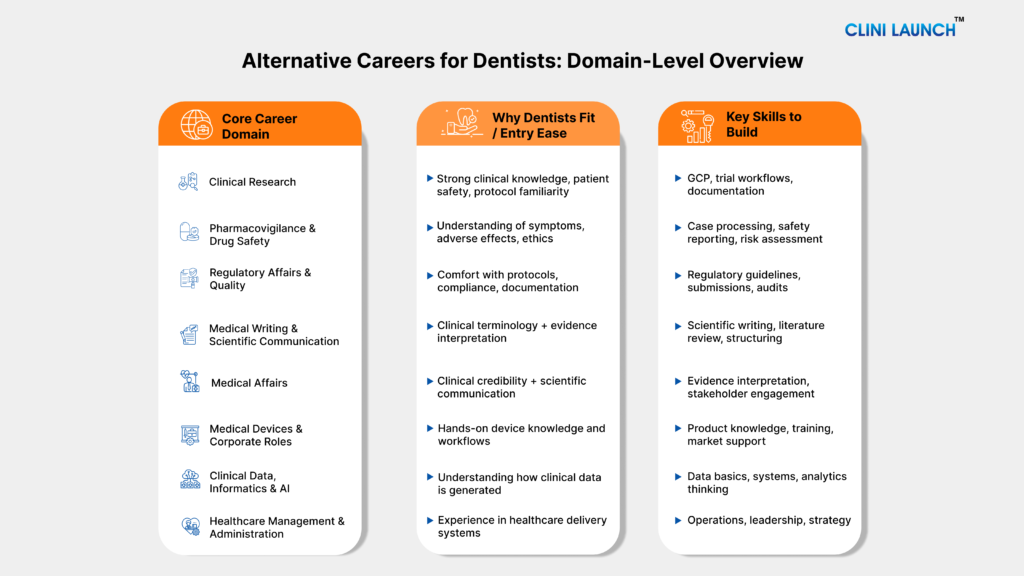
Today, top non-clinical jobs for dentists in India include clinical research, medical writing, healthcare analytics, public health, and corporate healthcare roles.
Top 9 Alternative Careers for Dentists
These roles represent some of the most promising BDS career opportunities for dentists who want to expand beyond clinical practice while still using their healthcare expertise.
1) Clinical Research
(CRC / CRA / Clinical Project Manager)
Clinical research professionals manage and monitor clinical trials for drugs and medical devices. They ensure patient safety, maintain data integrity, oversee regulatory documentation, coordinate with sponsors and CROs, and ensure compliance with global trial standards.
Entry Requirements
A dental degree provides strong clinical credibility. However, employers typically expect Good Clinical Practice (GCP) certification and structured clinical research training. Exposure to site-level study of coordination or hospital-based research improves employability. Familiarity with trial workflow significantly strengthens entry into CRC roles.
Skills (Core + Advanced)
- Clinical judgment and endpoint understanding
- Informed consent management
- Protocol adherence and deviation handling
- Documentation accuracy and audit readiness
- EDC systems (Medidata Rave, Oracle Clinical)
- Adverse event and SAE reporting
- Basic biostatistics interpretation
- Risk management
- Project management (PMP advantageous)
- Pharmacovigilance knowledge
Career Path
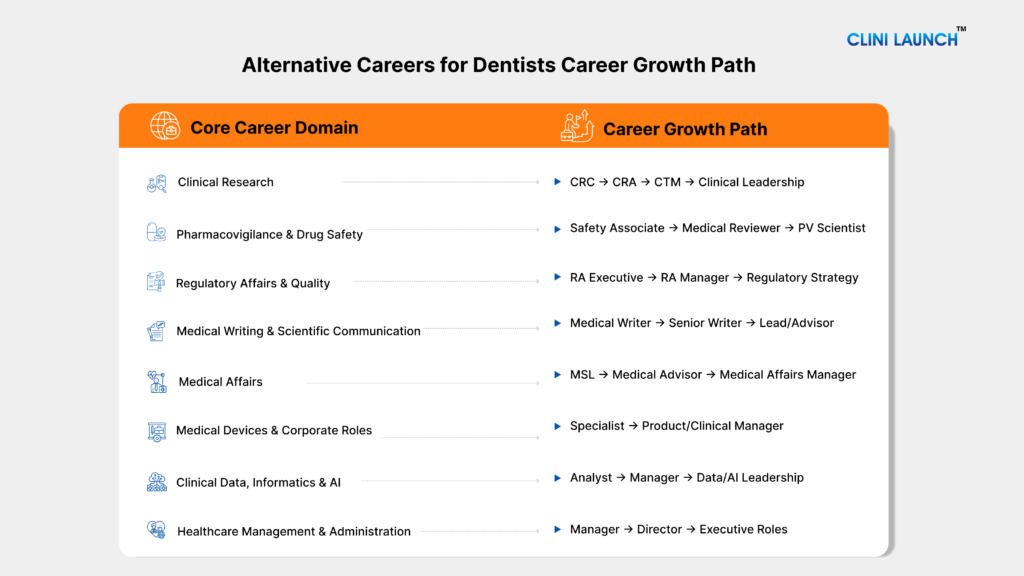
Clinical Research Coordinator → Clinical Research Associate → Senior CRA → Clinical Project Manager → Clinical Operations Director
2) Dental / Oral Public Health & Policy
Public health dentistry focuses on population-level oral health improvement. Professionals design prevention programs, conduct epidemiological surveys, evaluate health outcomes, and contribute to policy development.
Entry Requirements
An MPH or public health diploma is typically required for structured roles. Experience in community screening programs, NGO projects, or district health initiatives strengthens eligibility. Knowledge of epidemiological methods is highly valued.
Skills (Core + Advanced)
- Epidemiology and disease surveillance
- Community program design
- Data interpretation and statistical analysis
- Stakeholder engagement
- Grant writing
- Health economics
- Policy analysis
- Program monitoring and evaluation
Career Path
Public Health Dentist → Program Manager → Policy Advisor → State/National Health Leadership
3) Dental Technology & CAD/CAM Specialist
Digital dentistry integrates scanning, prosthetic design, and additive manufacturing into modern workflows. Specialists manage digital systems in clinics or labs and bridge clinical and production environments.
Entry Requirements
A dental degree combined with hands-on CAD/CAM training is essential. Laboratory exposure and digital case portfolio demonstration improve hiring probability.
Skills (Core + Advanced)
- Intraoral scanning
- Prosthetic design principles
- Occlusion and functional analysis
- CAD software (Exocad / 3Shape)
- STL file handling
- 3D printing workflows
- Biomaterials understanding
- Manufacturing quality assurance
Career Path
Digital Dentistry Specialist → Lab Manager → Product Application Specialist → Director of Digital Solutions
4) Medical Writing
Medical writers prepare regulatory documents, scientific manuscripts, and educational content based on clinical data.
Entry Requirements
A dental degree provides subject authority. Formal medical writing training and a writing portfolio are typically required for structured roles. Knowledge of regulatory documentation strengthens positioning.
Skills (Core + Advanced)
- Scientific interpretation
- Literature review (PubMed familiarity)
- Referencing accuracy
- Structured documentation
- Regulatory writing (ICH familiarity)
- Publication planning
- Data summarization
- Clarity in technical communication
Career Path
Medical Writer → Senior Medical Writer → Publication Lead → Medical Affairs Specialist
5) Dental Products & Industry Roles
Industry roles combine clinical credibility with strategic execution. Professionals train clinicians, support product launches, and manage commercial strategy.
Entry Requirements
A dental degree is highly valued. Strong communication skills are essential. For product management roles, an MBA or structured business training adds competitive advantage.
Skills (Core + Advanced)
- Presentation and training skills
- Clinical product demonstration
- KOL engagement
- Market analysis
- Launch strategy planning
- Regulatory alignment
- Health economics understanding
- Sales performance tracking
Career Path
Clinical Specialist → Product Manager → Medical Affairs Lead → Commercial Head
6) Dental Lab & Biomaterials R&D
This pathway focuses on innovation in restorative materials and implant systems.
Entry Requirements
A dental degree with research exposure or biomaterials training is recommended. Postgraduate research experience significantly improves eligibility.
Skills (Core + Advanced)
- Dental materials science
- Laboratory testing protocols
- Strength and biocompatibility analysis
- Documentation standards
- In vitro testing models
- Regulatory device approval processes
- Product validation studies
Career Path
R&D Scientist → Product Development Lead → Head of R&D
7) Forensic Odontology
Forensic odontologists support legal systems through dental identification and medico-legal analysis.
Entry Requirements
Specialized forensic odontology training is required. Collaboration with forensic medicine departments strengthens case exposure.
Skills (Core + Advanced)
- Dental record comparison
- Radiographic analysis
- Bite-mark interpretation
- Medico-legal documentation
- Court testimony
- Advanced imaging analysis
Career Path
Forensic Consultant → Expert Witness → Academic Forensic Trainer
8) Tele dentistry & Remote Care Leadership
Teledentistry integrates digital consultation and remote care into oral health systems.
Entry Requirements
A dental degree combined with telehealth platform training is required. Familiarity with digital documentation systems improves positioning.
Skills (Core + Advanced)
- Remote clinical assessment
- Patient communication
- Digital case documentation
- Telehealth compliance
- EHR integration
- Program management
Career Path
Tele-Dentist → Telehealth Program Manager → Director of Virtual Care
9) Health Informatics & Dental Data Analytics
This field focuses on analyzing clinical and operational data to improve outcomes and efficiency.
Entry Requirements
A dental degree plus structured data analytics training is typically required. Demonstrable analytical projects improve employability.
Skills (Core + Advanced)
- Advanced Excel
- SQL querying
- Clinical variable interpretation
- Dashboard creation (Power BI/Tableau)
- R or Python basics
- Predictive modeling
- Data governance
Career Path
Clinical Informatics Analyst → Senior Analyst→ Head of Informatics
Confused About Your Next Career Move After BDS?
Not sure whether Clinical Research, Medical Writing, Healthcare Analytics, or Public Health is the right path for you? Get expert guidance to choose the best non-clinical career option based on your skills and goals.
Alternative Career Paths for Dentists
| Career Path | Career Growth Path | Avg Salary in India |
|---|---|---|
| Clinical Research | CRC → CRA → Project Manager → Clinical Operations | ₹3 – ₹8 LPA |
| Public Health & Policy | Public Health Dentist → Program Manager → Policy Advisor | ₹4 – ₹10 LPA |
| Dental Technology (CAD/CAM) | Specialist → Lab Manager → Digital Solutions Lead | ₹4 – ₹12 LPA |
| Medical Writing | Writer → Senior Writer → Medical Affairs | ₹4 – ₹10 LPA |
| Industry / Product Roles | Clinical Specialist → Product Manager → Commercial Head | ₹5 – ₹15 LPA |
| Biomaterials R&D | R&D Scientist → Product Lead → R&D Head | ₹4 – ₹12 LPA |
| Forensic Odontology | Consultant → Expert Witness → Academic | ₹3 – ₹8 LPA |
| Teledentistry & Remote Care | Tele-Dentist → Program Manager → Virtual Care Director | ₹4 – ₹10 LPA |
| Health Informatics & Analytics | Analyst → Senior Analyst → Data Lead | ₹5 – ₹12 LPA |
AI & ML in Healthcare
Build practical skills to apply artificial intelligence and machine learning in real healthcare and life sciences use cases. Learn how healthcare data is analyzed, models are built, and AI-driven insights are applied across research and healthcare systems.

Salary Comparison of Alternative Careers for Dentists
Understanding salary potential helps in choosing the right direction after BDS. While income varies based on experience, location, and specialization, structured roles often offer more predictable growth compared to early-stage clinical practice.
Average Salary Range in India (Approximate)
- Average Salary Range in India (Entry to Mid-Level)
- Clinical Research (CRC/CRA): ₹3 – ₹8 LPA
- Medical Writing: ₹4 – ₹10 LPA
- Public Health & Policy: ₹4 – ₹10 LPA
- Healthcare Management / MBA Roles: ₹5 – ₹15 LPA
- Dental Technology (CAD/CAM): ₹4 – ₹12 LPA
- Health Informatics & Data Analytics: ₹5 – ₹12 LPA
- Pharmacovigilance & Drug Safety: ₹3 – ₹9 LPA
- Corporate / Product Roles: ₹5 – ₹15 LPA
These roles offer structured salary progression, especially in corporate, research, and analytics domains. With experience and specialization, compensation can grow significantly faster than traditional clinic-based.
Best Courses After BDS for Career Switch
Choosing the right course after BDS depends on the career path you want to transition into. Instead of pursuing multiple degrees, focusing on targeted, industry-relevant training helps accelerate entry into new roles.
Courses Based on Career Path
- Clinical Research:
GCP Certification, Clinical Research Training Programs
- Medical Writing:
Medical Writing Certification, Scientific Writing Programs
- Healthcare Management:
MBA in Healthcare / Hospital Administration
- Public Health:
MPH (Master of Public Health)
- Health Informatics & Data Analytics:
Data Analytics (Excel, SQL, Python), Healthcare Informatics Programs
- Digital Dentistry:
CAD/CAM Certification, Digital Workflow Training
- Pharmacovigilance & Regulatory Affairs:
Drug Safety Certification, Regulatory Affairs Courses
The key is to choose a course aligned with a specific role rather than exploring multiple unrelated certifications. Focused upskilling improves employability and shortens transition time.
Highest Paying Non-Clinical Jobs for Dentists
Not all alternative careers offer the same earning potential. Some roles provide significantly higher income growth due to industry demand, scalability, and leadership opportunities.
High-Paying Non-Clinical Roles
- Healthcare Management & MBA Roles
Leadership positions in hospitals and healthcare companies offer strong salary growth and long-term career progression.
- Health Informatics & Data Analytics
With the rise of digital health, professionals who can analyze healthcare data are in high demand and command premium salaries.
- Clinical Research (CRA → Project Management)
Mid-to-senior roles in clinical research, especially in global trials, offer strong compensation and international exposure.
- Medical Affairs & Corporate Roles
Positions in pharma and medical device companies combine scientific expertise with strategic decision-making.
- Product Management & Healthcare Consulting
These roles involve market strategy, innovation, and business growth, often leading to higher salary brackets.
- Digital Dentistry & Technology Specialists
Professionals working with advanced digital systems and workflows are increasingly valued in modern dental ecosystems.
Higher-paying roles typically require a combination of domain expertise, technical skills, and strategic understanding of the healthcare industry.
Transition from Clinical Practice: A Structured Roadmap
Moving beyond traditional clinical dentistry does not mean walking away from your qualifications. It is strategically expanding the applications. A successful transition depends less on chance and more on clarity, preparation, and deliberate execution.
Here is a structured approach that makes the shift practical and realistic.
Step 1: Define Your Core Motivation
Identify whether you want better work-life balance, income stability, leadership roles, or technology-driven work.
Research across healthcare professions consistently shows that structured career planning reduces burnout-related exits and improves professional satisfaction (Bureau of Labor Statistics, Occupational Outlook Handbook).
Step 2: Assess Your Existing Strengths
Evaluate your clinical skills, research exposure, certifications, and professional experience to identify relevant transition advantages.
Step 3: Select One Target Domain
Choose a clear direction such as clinical research, medical writing, digital dentistry, or healthcare analytics.
Step 4: Conduct a Skill Gap Analysis
Once your target field is chosen, review multiple job descriptions in that domain. Identify recurring requirements, certifications, and technical skills.
Examples:
- Clinical Research → GCP certification, trial operations knowledge
- Public Health → MPH or epidemiology background
- Digital Dentistry → CAD/CAM proficiency
- Medical Writing → Writing portfolio and regulatory familiarity
- Health Informatics → Excel, SQL, and analytics exposure
Review job descriptions and identify required certifications, tools, and technical skills for your chosen domain.
Step 5: Upskill Strategically (3–12 Months)
Focus on targeted training such as GCP, CAD/CAM, medical writing, analytics, MPH, or MBA depending on your pathway.
According to workforce data from Payscale, structured corporate roles often show more predictable salary progression compared to early-stage independent practice.
Step 6: Build Demonstrable Evidence
Create portfolios such as writing samples, research summaries, digital cases, dashboards, or project work.
Step 7: Network with Intention
Engage with: Industry professionals through conferences, LinkedIn, alumni groups, and healthcare organizations.
Step 8: Pilot Before Committing Fully
Gain practical exposure through internships, freelance work, part-time roles, or collaborations.
Build Skills That Employers Actually Hire For
Move beyond traditional dentistry with practical training in Clinical Research, AI & ML in Healthcare, Medical Coding, and more. Learn industry-relevant skills designed for BDS graduates.
Market Opportunity: India and the Global Landscape
Before making a strategic career shift, it is important to understand the direction in which the larger dental and healthcare markets are moving. Career opportunities expand when industries expand. Dentistry today operates within a growing global ecosystem shaped by digital transformation, research innovation, organized corporate networks, and rising healthcare investment.
Global Dental Services: Sustained Expansion
The global dental services market continues to show steady and sustained growth. According to Grand View Research, the dental services industry is projected to grow at a consistent compound annual growth rate (CAGR) through 2030, supported by aging populations, increased awareness of oral health, rising cosmetic dentistry demand, and expanded insurance penetration in emerging markets.
While exact market valuations vary between publishers, most industry forecasts place the sector in the hundreds of billions of dollars, with projections indicating significant expansion by the early 2030s.
This growth does more than increase demand for chairside dentists. As dental networks scale and modernize, they create demand for non-clinical professionals who support the system — including clinical research coordinators, digital workflow managers, product specialists, regulatory professionals, and healthcare data analysts.
Teledentistry: A High-Growth Digital Segment
Teledentistry has emerged as one of the fastest growing subsegments within oral healthcare. As remote consultations, AI-supported triage, and digital case monitoring gain traction; the infrastructure around virtual dental care is expanding rapidly.
According to Grand View Research, the global teledentistry market was valued at approximately USD 2.02 billion in 2024 and is projected to grow at a CAGR exceeding 15% through 2030. Similarly, Market Research Future highlights strong double-digit growth driven by increasing rural access initiatives, integration with electronic health records (EHRs), and broader telehealth acceptance post-pandemic.
This growth translates into professional opportunities beyond direct clinical care. Emerging roles include telehealth program leadership, digital compliance management, virtual care coordination, health informatics integration, and vendor-side product development.
For dentists interested in flexible work models or digital healthcare ecosystems, this segment offers one of the most accessible entry points.
Dental Implants and Device Innovation
Implantology remains one of the most financially significant and steadily growing segments within dentistry. Industry analyses consistently report single-digit to high single-digit CAGR growth in the global dental implants market, depending on region and product category.
India: Organized Consolidation and Healthcare Growth
India’s dental ecosystem is undergoing structural change, creating new career options for dentists in India across corporate dental chains, research organizations, digital health companies, and healthcare administration roles. Organized dental chains and corporate clinic networks are expanding across metropolitan and tier-two cities. Consolidation increases demand not only for clinicians but also for operations managers, quality compliance officers, digital workflow specialists, and corporate trainers.
Simultaneously, India’s broader healthcare sector continues to grow. According to Grand View Research, the Indian healthcare market is projected to expand steadily through 2032, driven by increasing private sector participation, Ayushman Bharat implementation, and digital health adoption.
As dentistry integrates more closely with hospital systems and corporate healthcare structures, roles expand in administration, clinical research, informatics, compliance, and program management.
Start Your Career Transition with Confidence
Take the next step toward a stable, high-growth healthcare career with expert mentorship, hands-on learning, and placement-focused support from CliniLaunch.
Conclusion
Dentistry today extends far beyond chairside practice, opening new careers for dentists in research, digital health, healthcare analytics, industry leadership, and public health systems. As global dental markets expand driven by digital adoption, implant growth, research innovation, and organized healthcare systems opportunities are shifting into clinical research, digital health, industry, public health, analytics, and leadership roles.
The core competencies developed through dental training remain powerful and transferable. What changes is how and where those skills are applied.
Career diversification is not a leap into uncertainty. It is a structured transition built on clarity, focused upskilling, portfolio development, and strategic positioning.
If you are ready to explore structured pathways into clinical research, regulatory roles, digital integration, or emerging healthcare domains, CliniLaunch Research Institute provides industry-aligned training designed specifically for healthcare professionals seeking career expansion.