
Pharmacovigilance Jobs in Hyderabad offer excellent career opportunities across pharmaceutical companies, biotechnology firms, and global CROs. This guide explains the top pharmacovigilance job roles, salary ranges, hiring companies, required skills, career progression, and eligibility to help freshers and healthcare professionals build a successful career in drug safety and regulatory compliance.
Introduction
Hyderabad has emerged as one of India’s leading destinations for pharmacovigilance careers. Known as the country’s pharmaceutical hub, the city is home to global pharmaceutical companies, Contract Research Organizations (CROs), biotechnology firms, and healthcare research organizations that continuously recruit drug safety professionals.
As new medicines are developed and approved, monitoring their safety remains a critical responsibility. This is where pharmacovigilance plays an essential role. From collecting adverse drug reaction reports to evaluating safety data and ensuring regulatory compliance, pharmacovigilance professionals help protect millions of patients worldwide.
India’s growing commitment to drug safety is reflected in the expansion of the Pharmacovigilance Programme of India (PvPI), which now operates through 250+ Adverse Drug Reaction (ADR) Monitoring Centres across the country. This nationwide network strengthens medicine safety surveillance and underscores the increasing need for trained pharmacovigilance professionals across pharmaceutical companies, CROs, hospitals, and research organizations.
The growing focus on patient safety, stricter global regulations, and increasing clinical research activities have significantly expanded career opportunities in this field. Today, life science graduates, pharmacists, nurses, doctors, and biotechnology professionals have multiple career paths to explore within pharmacovigilance not just a single job role.
If you’re looking for Pharmacovigilance jobs in Hyderabad, understanding the available roles, hiring companies, and required skills can help you make an informed career decision.
In this guide, we’ll explore the top pharmacovigilance job roles in Hyderabad, leading employers, salary expectations, and the career opportunities available in one of India’s fastest-growing pharmaceutical ecosystems.
What are the best Pharmacovigilance Jobs in Hyderabad?
Hyderabad is a growing hub for pharmacovigilance and life sciences, offering opportunities in roles such as Drug Safety Associate, Pharmacovigilance Associate, Clinical Safety Associate, Medical Reviewer, and Safety Data Analyst. Professionals with skills in adverse event reporting, ICSR processing, MedDRA coding, and regulatory guidelines can explore career opportunities in pharmaceutical companies, CROs, and healthcare organizations.
Why Hyderabad is a Hub for Pharmacovigilance Jobs
Hyderabad is often referred to as the Pharma Capital of India because of its strong presence in pharmaceuticals, biotechnology, vaccine manufacturing, and clinical research. The city is home to renowned pharmaceutical companies, global CROs, and the internationally recognized Genome Valley, creating a thriving ecosystem for drug safety and regulatory operations.
Organizations such as Dr. Reddy’s Laboratories, Aurobindo Pharma, Bharat Biotech, Biological E., IQVIA, Parexel, ICON plc, Novartis, Med Genome, Sai Life Sciences, Eurofins, and Vimta Labs regularly hire pharmacovigilance professionals for roles in adverse event reporting, medical review, signal detection, regulatory compliance, and drug safety operations.
With increasing outsourcing of global pharmacovigilance activities to India, Hyderabad continues to generate excellent career opportunities for both fresh graduates and experienced professionals.
Pharmacovigilance Career Levels: Entry-Level, Mid-Level & Senior Roles
Pharmacovigilance offers a structured career path with opportunities to progress from case processing and drug safety operations to medical review, signal detection, risk management, and leadership. While fresh graduates typically begin with operational roles, experienced professionals move into specialized and strategic positions as they gain domain expertise and regulatory knowledge.
Pharmacovigilance Career Progression
| Career Level | Typical Experience | Common Job Roles | Average Salary |
|---|---|---|---|
| Entry-Level | 0–2 Years | Drug Safety Associate, Pharmacovigilance Associate, Case Processing Associate, Medical Information Associate | ₹3–5 LPA |
| Mid-Level | 2–6 Years | Drug Safety Scientist, Signal Detection Specialist, Risk Management Associate, Pharmacovigilance Quality Associate, Compliance Specialist | ₹6–12 LPA |
| Senior & Leadership | 6+ Years | Pharmacovigilance Manager, Project Manager, Global Safety Lead, Drug Safety Physician, Head of Pharmacovigilance, Qualified Person for Pharmacovigilance (QPPV) | ₹12–35+ LPA |
Salary ranges vary depending on the employer, specialization, location, regulatory expertise, and years of experience. Professionals in multinational pharmaceutical companies and global CROs generally earn higher compensation than those in smaller organizations.
Entry-Level Pharmacovigilance Jobs
Entry-level roles are ideal for fresh graduates in pharmacy, life sciences, biotechnology, nursing, and allied healthcare disciplines. These positions focus on learning the fundamentals of drug safety, adverse event reporting, medical coding, and regulatory compliance.
Common Roles
- Drug Safety/ Pharmacovigilance Associate
- Case Processing Associate
- Pharmacovigilance Officer
- Key Responsibilities
- Processing Individual Case Safety Reports (ICSRs)
- Recording and validating adverse drug reactions (ADRs)
- Performing MedDRA coding
- Preparing safety narratives
- Conducting literature screening
- Maintaining pharmacovigilance databases
- Supporting regulatory reporting activities
Average Salary
Freshers generally earn ₹3–5 LPA, depending on the company, city, and skill set. Candidates with hands-on training in ICSR processing, MedDRA coding, and pharmacovigilance databases often have a competitive advantage during recruitment.
Mid-Level Pharmacovigilance Jobs
After gaining practical experience, professionals move into analytical and specialized roles that require stronger scientific knowledge, medical judgment, and regulatory expertise.
Common Roles
- Drug Safety Scientist
- Signal Detection Specialist
- Risk Management Associate
- Pharmacovigilance Quality Associate
- Compliance Specialist
Key Responsibilities
- Reviewing and evaluating complex safety cases
- Preparing PSURs, PBRERs, DSURs, and other aggregate reports
- Identifying emerging safety signals
- Conducting benefit-risk assessments
- Developing Risk Management Plans (RMPs)
- Ensuring compliance with global pharmacovigilance regulations
- Supporting audits and regulatory inspections
Average Salary
Mid-level professionals typically earn ₹6–12 LPA, with higher salaries for specialists in signal detection, medical review, aggregate reporting, and quality compliance.
Senior & Leadership Pharmacovigilance Jobs
Senior roles focus on strategy, leadership, and global drug safety governance. These professionals oversee pharmacovigilance operations, lead cross-functional teams, interact with regulatory authorities, and ensure compliance across international markets.
Common Roles
- Pharmacovigilance Manager
- Pharmacovigilance Project Manager
- Global Safety Lead
- Drug Safety Physician
- Head of Pharmacovigilance
- Qualified Person for Pharmacovigilance (QPPV)
Key Responsibilities
- Leading pharmacovigilance teams
- Managing global safety operations
- Overseeing regulatory submissions and inspections
- Developing pharmacovigilance strategies
- Monitoring product benefit-risk profiles
- Driving quality and compliance initiatives
- Mentoring and managing multidisciplinary teams
Average Salary
Senior pharmacovigilance professionals generally earn ₹12–35+ LPA, while highly specialized leadership roles such as QPPV, Global Safety Lead, and Head of Pharmacovigilance can command significantly higher compensation in multinational organizations due to their strategic and regulatory responsibilities.
Advance Your Pharmacovigilance Career with Industry-Focused Training
Pharmacovigilance Certification Program
By CLRI & NST – Global Career-Focused Learning
Designed For:
Life science graduates, pharmacy professionals, healthcare professionals, and working professionals looking to build or advance their career in drug safety.
Learn Key Industry Skills:
Adverse Event (AE) & SAE Reporting
ICSR Processing & Case Management
MedDRA Coding & WHO Drug Dictionary
Signal Detection & Risk Assessment
Medical Review & Aggregate Reporting
Pharmacovigilance Databases & Regulatory Guidelines
Program Highlights:
Practical, industry-aligned curriculum
Global pharmacovigilance concepts and practices
Hands-on exposure to essential safety processes
Career guidance and placement mentorship support
Certification from CLRI & NST
Build the skills required to move from entry-level safety roles to advanced pharmacovigilance opportunities in global organizations.
Explore the Pharmacovigilance Program Today
Top Skills Recruiters look for in Pharmacovigilance Professionals
In pharmacovigilance hiring, recruiters look beyond academic qualifications and focus on practical skills that help professionals manage drug safety operations effectively. While several technical and soft skills are valuable, the following capabilities are highly preferred by employers when evaluating candidates for pharmacovigilance roles:
1. Individual Case Safety Report (ICSR) Processing
ICSR processing is one of the most critical skills in pharmacovigilance. Professionals must understand case intake, data review, assessment, coding, narrative writing, and submission processes to ensure accurate safety reporting.
2. MedDRA Coding
Knowledge of MedDRA terminology is essential for accurately coding adverse events and maintaining consistency in global safety databases.
3. Pharmacovigilance Databases (Oracle Argus Safety, ARISg, Veeva Vault Safety)
Hands-on familiarity with industry-standard safety databases helps professionals efficiently manage safety cases and understand real-world pharmacovigilance workflows.
4. Signal Detection & Risk Assessment
The ability to identify potential safety signals, analyze safety trends, and support risk assessment activities is increasingly important as organizations focus on proactive drug safety monitoring.
5. Aggregate Report Writing (PSUR, PBRER, DSUR)
Professionals involved in regulatory reporting must understand how to compile and interpret safety data for periodic reports required by global regulatory authorities.
6. Adverse Event (AE) & Serious Adverse Event (SAE) Reporting
A strong understanding of AE and SAE identification, documentation, and reporting requirements is fundamental for every pharmacovigilance professional.
7. ICH Guidelines & Good Pharmacovigilance Practices (GVP)
Knowledge of regulatory guidelines helps professionals ensure compliance with global drug safety standards and reporting requirements.
8. Medical Review & Scientific Documentation
The ability to review clinical information, interpret medical data, and prepare accurate safety documentation is important for advanced pharmacovigilance roles.
Beyond Technical Skills: What Makes Candidates Stand Out?
Along with technical expertise, recruiters value professionals who demonstrate analytical thinking, attention to detail, problem-solving ability, communication skills, and regulatory compliance awareness.
As pharmacovigilance continues to evolve with changing regulations, advanced safety systems, and technology-driven processes, continuous upskilling and reskilling have become essential for career growth. At CLRI, our pharmacovigilance programs focus on industry relevance, practical learning, skill development, career readiness, and continuous improvement to help learners build the capabilities required for real-world drug safety roles.
Why Companies Reject Freshers in Pharmacovigilance?
Many freshers assume that having a life science degree is enough to secure a pharmacovigilance job. However, recruiters often look for candidates who can demonstrate practical understanding along with academic knowledge. The gap between classroom learning and industry expectations is one of the major reasons why many freshers struggle during hiring processes.
Here are some common reasons recruiters reject fresher candidates:
1. Poor Communication Skills
Pharmacovigilance professionals need to document safety information accurately, prepare case narratives, and communicate with internal teams. Limited communication skills can affect a candidate’s ability to handle safety-related documentation and discussions.
2. Lack of MedDRA Knowledge
Understanding medical terminology and coding systems is essential in drug safety. Candidates without knowledge of MedDRA may find it difficult to perform adverse event coding and maintain data accuracy.
3. No Practical Database Exposure
Recruiters prefer candidates who understand how pharmacovigilance workflows operate using industry-standard safety databases. Lack of exposure to tools such as Oracle Argus Safety, ARISg, or Veeva Vault Safety can make candidates less job-ready.
4. Weak Understanding of GVP Guidelines
Good Pharmacovigilance Practices (GVP) guidelines form the foundation of global drug safety operations. Candidates who are unfamiliar with regulatory expectations may struggle to understand compliance requirements.
5. No Real Case Study Experience
Theoretical knowledge alone may not demonstrate practical ability. Working on adverse event scenarios, ICSR processing exercises, and safety documentation examples helps candidates understand real-world pharmacovigilance responsibilities.
6. Generic Resumes
A resume that only highlights academic qualifications without showcasing relevant skills, tools, certifications, projects, or practical exposure often fails to attract recruiter attention.
To improve their chances, freshers should focus on building industry-relevant skills, gaining practical exposure, and developing a resume that reflects their understanding of real pharmacovigilance processes. Continuous upskilling and hands-on learning can help bridge the gap between academic knowledge and industry requirements.
Who Can Apply for Pharmacovigilance Jobs?
One of the biggest advantages of pharmacovigilance is that it welcomes professionals from diverse healthcare and life sciences backgrounds.
Typical eligibility includes:
- B.Pharm
- M.Pharm
- Pharm.D
- B.Sc. Life Sciences
- M.Sc. Biotechnology
- Microbiology
- Biochemistry
- Zoology
- Nursing
- MBBS
- BDS
Professionals from clinical research, medical coding, healthcare, and regulatory affairs can also transition into pharmacovigilance with the right industry training.
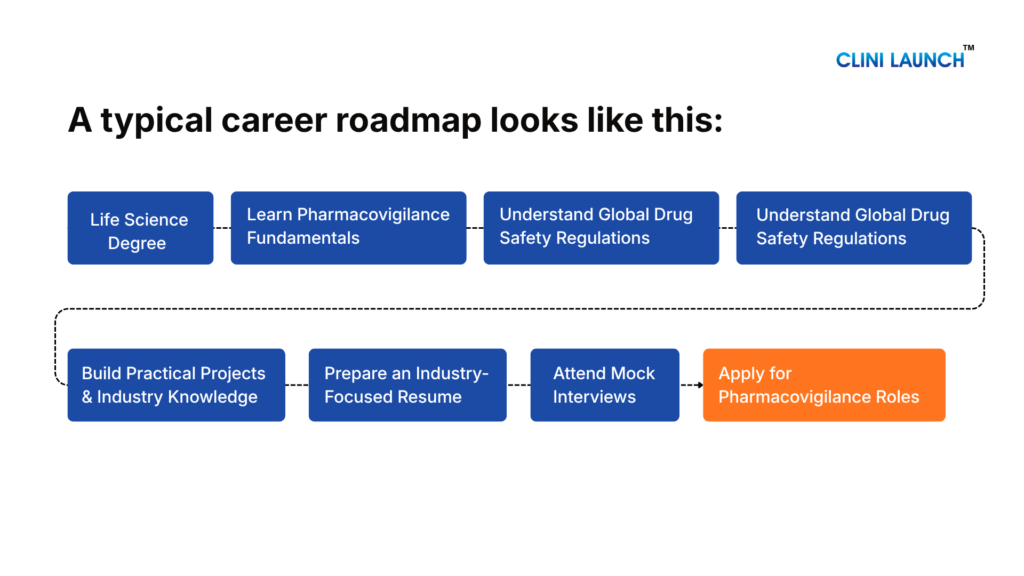
How to Build a Career in Pharmacovigilance
Breaking into pharmacovigilance requires more than a degree. Candidates who can demonstrate practical understanding of drug safety workflows and regulatory compliance knowledge has better prospects of getting hired.
A typical career roadmap looks like this:
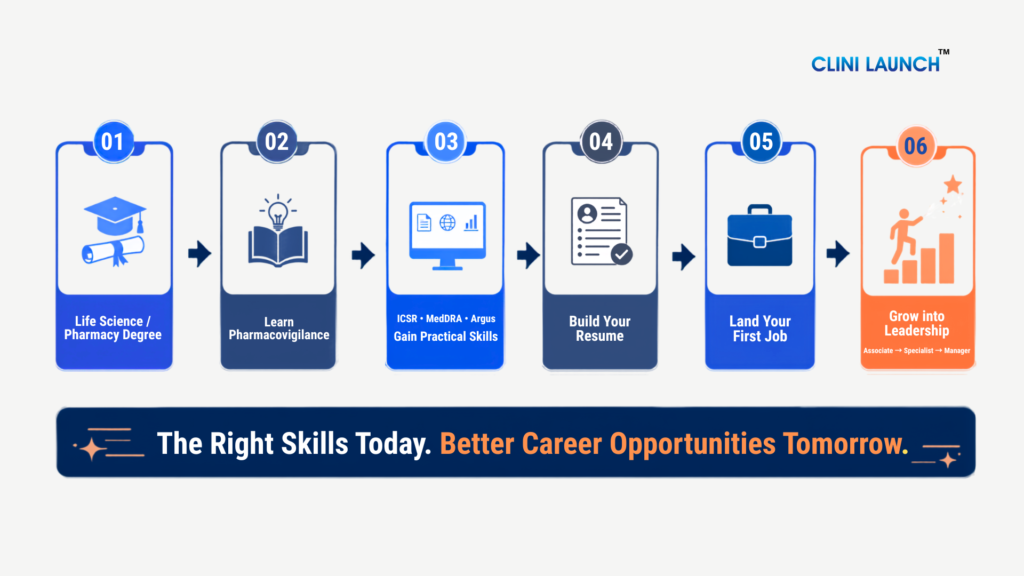
Building practical skills before applying can significantly improve your confidence during interviews and your chances of securing your first opportunity. Since pharmacovigilance roles continue to evolve with changing regulations, safety systems, and industry practices, continuous upskilling and reskilling have become essential for career growth.
At CLRI, our internship-focused learning approach helps learners gain practical exposure to real-world pharmacovigilance processes while strengthening their technical and professional skills. These experiences are designed to bridge the gap between academic knowledge and industry expectations, helping aspiring professionals become more career-ready for pharmacovigilance opportunities.
Why Many Freshers Don’t Get Shortlisted
Every year, thousands of graduates apply for pharmacovigilance jobs, yet many struggle to receive interview calls. In most cases, the challenge isn’t a lack of vacancies—it’s the gap between academic learning and industry expectations.
Common reasons include:
- Limited understanding of pharmacovigilance workflows
- No exposure to ICSR processing
- Lack of knowledge of global regulatory guidelines
- Weak resume and LinkedIn profile
- No practical project experience
- Poor interview preparation
Addressing these gaps through structured learning and hands-on training can make a significant difference when competing for entry-level roles.
Conclusion
Pharmacovigilance has evolved into one of the most promising career paths within the pharmaceutical and healthcare industry. As drug development accelerates and global regulations become more rigorous, organizations continue to invest in professionals who can ensure medicine safety and regulatory compliance throughout a product’s lifecycle.
For those exploring Pharmacovigilance jobs in Hyderabad, the city offers access to a thriving pharmaceutical ecosystem, global CROs, biotechnology companies, and healthcare organizations that regularly recruit professionals across entry-level, specialized, and leadership roles.
Whether you’re a fresh graduate beginning your career or a healthcare professional planning a career transition, success in pharmacovigilance depends on building the right combination of scientific knowledge, practical exposure, and industry-relevant skills.
Choosing a structured training program, working on real-world case studies, understanding global drug safety regulations, and preparing interviews can help you stand out in an increasingly competitive job market.
With continuous learning and the right career guidance, pharmacovigilance offers not only excellent job opportunities but also a rewarding career dedicated to improving patient safety on a global scale.
FAQs
1. Is Pharmacovigilance a stressful career?
Pharmacovigilance can be challenging, especially when handling safety reports, regulatory timelines, and large volumes of data. However, with proper training, process knowledge, and attention to detail, professionals can effectively manage responsibilities and build a rewarding career in drug safety.
2. Can I work remotely in Pharmacovigilance?
Yes, several pharmacovigilance roles offer remote or hybrid work opportunities, especially for experienced professionals. Roles involving case processing, safety data review, and documentation may have flexible work options depending on the organization and project requirements.
3. Which certification is best for Pharmacovigilance?
A good pharmacovigilance certification should provide practical knowledge of ICSR processing, MedDRA coding, safety databases, regulatory guidelines, and real-world case management. Industry-focused training with hands-on exposure can help candidates become more job-ready.
4. Is Pharmacovigilance better than Clinical Research?
Both fields offer strong career opportunities in life sciences. Clinical research focuses on clinical trials and drug development, while pharmacovigilance focuses on monitoring drug safety after approval and throughout the product lifecycle. The better choice depends on your interests and career goals.
5. How do I get a Pharmacovigilance job in Hyderabad?
To enter pharmacovigilance roles in Hyderabad, candidates should build knowledge of drug safety processes, gain practical exposure through training or internships, learn industry tools, and develop skills required for roles such as Drug Safety Associate, Pharmacovigilance Associate, and Safety Data Analyst.
6. Which Pharmacovigilance role is best for freshers?
Freshers commonly begin their careers as Drug Safety Associates, Pharmacovigilance Associates, Clinical Safety Associates, or Case Processing Associates. These roles help professionals develop foundational skills in adverse event reporting, case processing, and regulatory compliance.
7. What qualifications are required for Pharmacovigilance?
Candidates with backgrounds in pharmacy, life sciences, biotechnology, medicine, nursing, and related healthcare fields can pursue pharmacovigilance careers. Additional training in safety processes, regulations, and databases can improve job readiness.
8. Which software should I learn for Pharmacovigilance?
Professionals can benefit from learning industry-used pharmacovigilance systems such as Oracle Argus Safety, Veeva Vault Safety, and ARISg, along with understanding coding dictionaries such as MedDRA and WHO Drug Dictionary.
9. Is Pharmacovigilance a stable career?
Yes, pharmacovigilance continues to be an important function in the pharmaceutical and healthcare industry due to increasing focus on drug safety, regulatory compliance, and post-market surveillance. Professionals with relevant skills and industry knowledge can explore long-term career growth opportunities.