The healthcare sector has always played a critical role in society, but today the healthcare workforce is evolving rapidly as hospitals, research organizations, and digital health companies adapt to rising patient and technology demands.   

In recent years, healthcare employment trends have shifted significantly as organizations invest more in digital health systems, healthcare analytics, AI-driven operations, and interdisciplinary talent. From the impact of the COVID-19 pandemic to the rapid rise of artificial intelligence, the recruitment landscape looks very different today. These changes are reshaping the future healthcare workforce and creating new opportunities across clinical, research, and healthcare technology careers. 

India’s healthcare sector is expanding rapidly as clinical research, digital health systems, and healthcare services continue to grow. The workforce has already crossed 6 million professionals, making healthcare one of the largest employment sectors in the country. However, demand for specialized and interdisciplinary skills continues to rise. 

The future of healthcare industry careers is increasingly driven by artificial intelligence, digital health systems, healthcare analytics, and precision medicine. As organizations adopt technology-enabled healthcare models, demand is growing for professionals who can work across clinical care, healthcare data, research, and digital health environments. These changes highlight key trends in healthcare industry, in 2026, particularly in how organizations hire and build future-ready teams. The future of healthcare industry careers is increasingly driven by artificial intelligence, digital health systems, healthcare analytics, and precision medicine. 

For those looking to align with these shifts, gaining practical exposure through programs like the Advanced Diploma in Clinical Research and exploring training opportunities at CliniLaunch Research Institute can help build relevant, job-ready skills. 

This blog explores the major hiring trends shaping the healthcare industry and how they are influencing career opportunities in the coming years. 

Key Factors Driving Healthcare Industry Trends in 2026 

Several structural, technological, and workforce-related changes are reshaping healthcare hiring globally. These healthcare industry trends in 2026 are driven by healthcare digital transformation, AI-powered systems, evolving patient care models, and rising demand for interdisciplinary professionals. 

As healthcare organizations adopt digital healthcare systems and value-based care approaches, workforce requirements are shifting toward professionals with clinical, analytical, regulatory, and technology-oriented skills. 

Key factors include: 

  • Adoption of Digital Health Technologies: Healthcare organizations are rapidly adopting digital technologies such as artificial intelligence, Internet of Things (IoT), big data analytics, and cloud-based systems to support clinical operations and managerial processes. Research on digital transformation in healthcare highlights that these technologies are significantly reshaping healthcare management systems and increasing the need for professionals with advanced digital and data skills. 
  • Growth of Healthcare Data: Healthcare systems are increasingly generating large volumes of structured and unstructured data from sources such as clinical trials, patient records, medical devices, and biomedical research. The growing use of big data analytics in healthcare is enabling hospitals and medical facilities to make more data-driven decisions across clinical, administrative, and operational processes, which is increasing demand for professionals who can analyze, interpret, and manage complex healthcare datasets. 
  • Expansion of Global Drug Development: Pharmaceutical and biotechnology companies are conducting clinical trials and regulatory submissions across multiple countries. This has increased hiring in areas such as clinical research, pharmacovigilance, and regulatory affairs. 
  • Aging Populations and Rising Healthcare Demand: As populations age and healthcare needs grow, healthcare systems are expanding services and infrastructure, which increases demand for skilled healthcare professionals across multiple disciplines. 
  • Increasing Regulatory and Compliance Requirements: Healthcare organizations must comply with strict regulatory standards and safety guidelines on drugs, driving demand for professionals who understand regulatory frameworks, clinical documentation, and compliance processes. 

Together, these factors are shaping hiring priorities across healthcare organizations and creating demand for a more interdisciplinary healthcare workforce. 

1. Growing Demand for Clinical and Allied Healthcare Professionals 

One of the most consistent global healthcare hiring trends is the rising demand for frontline clinical professionals. Hospitals and healthcare systems across many countries continue to face shortages of registered nurses, particularly intensive care units, emergency departments, and specialized areas such as oncology and surgical nursing. 

Clinicians are in high demand across many healthcare settings, particularly in underserved and rural regions where access to care remains limited. According to the World Health Organization, the global healthcare system could face a shortage of around 10–11 million health workers by 2030, highlighting the sifgnificant health system disruptions and the availability of trained professionals. Healthcare systems are responding by expanding medical education programs, increasing international recruitment, investing in workforce training, and integrating technology to support clinical staff. These healthcare staffing trends reflect the growing need for scalable workforce strategies and skilled healthcare professionals across multiple care settings. 

As healthcare systems expand services and patient volumes increase, organizations are also hiring allied health professionals such as respiratory therapists, surgical technologists, patient care technicians, and rehabilitation specialists to strengthen clinical care delivery. This rising demand is also creating significant growth in allied healthcare careers across hospitals, rehabilitation centers, and community healthcare settings. 

2. Expansion of Digital Health, Healthcare Analytics, and Data Roles 

Healthcare organizations are rapidly expanding their digital and data capabilities. The growing use of electronic health records, digital patient management systems, and telemedicine platforms has significantly increased demand for professionals in health informatics, healthcare analytics, and digital health operations. The rise of digital platforms reflects the latest trends in healthcare, particularly in data-driven roles. 

For example, recent healthcare surveys show that about 95% of office-based physicians in the United States had adopted electronic health record (EHR) systems by 2024, highlighting how digital systems have become central to modern healthcare operations.  As healthcare becomes increasingly data-driven, professionals who can combine healthcare data analytics and AI skills with clinical understanding are becoming indispensable. 

Platforms such as Epic and Cerner are widely used across hospital systems worldwide, increasing demand for professionals who can manage health information systems, maintain data quality, and integrate clinical data across digital healthcare platforms. 

The expansion of digital health systems has created new roles that combine healthcare expertise with data and technology skills. Key roles include: 

  • Health Informatics Specialist – Manages electronic health records and improves clinical data systems. 
  • Healthcare Data Analyst – Analyzes patient and healthcare data to support evidence-based decisions. 
  • Clinical Data Manager – Ensures the quality, accuracy, and compliance of clinical trial data. 
  • Digital Health Product Manager – Oversees the development of telemedicine and digital health solutions. 
  • Healthcare AI Specialist – Develops AI models for diagnostics, predictive analytics, and clinical decision support. 
  • EHR Implementation Specialist – Supports hospitals in deploying and optimizing systems such as Epic or Cerner. 

3. Pharmaceutical and Biotechnology Hiring Trends in 2026 

The pharmaceutical and biotechnology sectors continue to drive hiring across research and drug development roles. Global drug development programs, particularly in areas such as oncology, rare diseases, and advanced therapies, have increased demand for clinical research professionals, including clinical research associates and clinical trial managers.  

The rapid expansion of mRNA vaccine development and targeted cancer therapies has significantly increased the number of global clinical trials. Recent analyses of global registries have identified more than 550 clinical trials investigating mRNA-based therapeutics, many of them focusing on oncology and infectious diseases. This surge in advanced immunotherapies is driving demand for specialized professionals who can manage complex research programs across multiple regions. 

Regulatory affairs specialists and pharmacovigilance professionals are also seeing strong hiring demand as pharmaceutical companies navigate complex global regulatory approvals and post-marketing safety monitoring requirements. Regulatory experts play a critical role in preparing drug approval submissions, coordinating with regulatory authorities, and ensuring compliance with international safety standards. 

Large-scale genomic projects such as population genome sequencing initiatives are generating vast biological datasets, increasing the need for experts who can analyze and interpret genomic information for clinical and research applications. These developments highlight key healthcare industry trends influencing hiring across pharmaceutical and biotech sectors. 

4. Rising Demand for AI and Data Science Roles in Healthcare 

Artificial intelligence and advanced analytics are increasingly reshaping many areas of healthcare operations. These developments are key indicators of healthcare trends in 2026, where AI-driven roles are becoming central. AI-driven tools are now widely used in medical imaging analysis, predictive healthcare analytics, and drug discovery.  

For example, the U.S. Food and Drug Administration reported that it had authorized over 500 AI-enabled medical devices by 2024, many of them designed for radiology and diagnostic imaging.  

As these technologies expand, organizations are actively recruiting professionals who can work at the intersection of healthcare and advanced analytics. Roles such as healthcare data scientists, machine learning engineers, clinical AI specialists, and AI-driven research analysts are becoming more common within healthcare organizations. 

For instance, AI systems are now being used to assist radiologists in detecting early-stage cancers in imaging scans, improving diagnostic accuracy while reducing the time required to analyze complex medical images. 

5. Growing Demand in Long-Term and Community Care 

Another significant hiring trend is the rapid expansion of long-term and community-based healthcare services. As populations age and chronic disease management become more complex, healthcare systems are expanding their workforce in rehabilitation services, senior care facilities, and home healthcare support. 

Roles such as certified nursing assistants, personal care aides, occupational therapists, and physical therapists are increasingly in demand to support patients who require long-term care outside hospital settings. Population ageing is a major driver of this demand. Global demographic projections indicate that by 2080, people aged 65 and older are expected to outnumber children under 18, increasing the need for long-term care services, rehabilitation support, and community-based healthcare programs. 

6. Expansion of Public Health and Population Health Roles 

Public health systems have also seen renewed hiring in recent years. Governments and healthcare organizations are strengthening their workforce by recruiting epidemiologists, biostatisticians, and public health program managers to support disease surveillance and population health planning. Global demand for such professionals is rising as health systems expand their workforce capacity, especially with projections showing a shortage of around 11 million health workers worldwide by 2030. This expansion is also aligned with the latest trends in healthcare focusing on population health. These developments are part of larger global healthcare trends focused on strengthening healthcare systems. Patient-centered care prioritizes individual needs and long-term wellness, shaping modern healthcare delivery.  

  • Population health analytics uses data to identify health trends and improve public health initiatives.  
  • Population health management focuses on prevention and early intervention to improve community health outcomes. 

At the community level, home healthcare services are also expanding rapidly. Roles such as home health aides, community health workers, and care navigators are becoming increasingly important as healthcare systems shift toward patient-centered and home-based care models. Employment of home health and personal care aides is projected to grow about 17% from 2024 to 2034, reflecting rising demand for community-based healthcare services. 

Following global public health emergencies in recent years, many countries have expanded investments in epidemiology and disease surveillance programs to strengthen preparedness for future health crises. 

To meet these evolving healthcare workforce demands, many professionals are pursuing specialized training in clinical research, healthcare analytics, and digital health technologies. 

Advanced Diploma in

Clinical Research

Build industry-ready skills aligned with the fastest-growing hiring trends in the healthcare industry. This program prepares learners to work across clinical research, healthcare data systems, and digital health environments by combining scientific knowledge with practical exposure to healthcare analytics, regulatory processes, and modern research workflows.

IN PARTNERSHIP WITH
4.8(2,300+ ratings) 

Emerging Healthcare Roles Shaping the Future Workforce 

Healthcare employment is evolving rapidly as emerging technologies such as artificial intelligence, Internet of Things (IoT)–enabled wearable sensors, and blockchain become increasingly integrated into healthcare management systems. These technologies are transforming healthcare delivery by enabling more personalized, data-driven healthcare services and continuous patient monitoring. 

As healthcare systems adopt connected devices, digital health platforms, and advanced data systems, organizations are increasingly seeking professionals who can work across healthcare, data management, and digital technology environments. This shift is creating new roles focused on managing digital health systems, analyzing health data, and supporting technology-enabled healthcare services. Several emerging healthcare roles are being created as technologies such as AI, genomics, and digital therapeutics become integrated into healthcare systems. These roles are defining the future of the healthcare industry driven by technology and innovation. 

AI-Driven Healthcare Roles 

Artificial intelligence in modern healthcare is increasingly being used in diagnostics, medical imaging, and predictive healthcare analytics. This shift is creating roles such as AI Clinical Liaisons, who help integrate AI tools into clinical workflows, and Clinical AI Ethics Officers, who ensure that AI applications remain transparent, unbiased, and compliant with healthcare regulations. In imaging-focused specialties, radiomics specialists use AI-based analysis to improve disease detection and diagnostic accuracy. 

Genomics and Precision Medicine Roles 

Advances in genomic sequencing are accelerating the adoption of personalized medicine. Genetic counselors help patients understand genetic testing results, while pharmacogenomics specialists tailor drug therapies based on individual genetic profiles. Genomic data curators support these efforts by managing large genomic datasets and maintaining data quality and regulatory compliance. 

Digital Therapeutics and Connected Health Roles 

The growth of digital therapeutics and remote patient monitoring is creating new roles that support technology-enabled care. Digital therapeutics clinical advocates help integrate software-based treatments into care pathways, while RPM program managers oversee remote monitoring systems that track patient health through connected devices. In parallel, health data coaches assist patients in interpreting wearable health data and translating it into lifestyle improvements. 

Healthcare Operations and Sustainability Roles 

Operational transformation and Sustainability in healthcare is also generating new roles. Revenue cycle AI analysts use advanced analytics to optimize billing systems and reduce claim denials, while healthcare sustainability officers focus on improving environmental efficiency in hospital operations and supply chains. 

As healthcare technologies continue to evolve, many future roles will require interdisciplinary skills that combine clinical knowledge, digital literacy, and data-driven decision making. By 2030, many healthcare job roles are expected to evolve as technology reshapes how healthcare services are delivered. 

Artificial Intelligence (AI)

AI Clinical Liaison

Helps integrate AI tools into clinical workflows and supports healthcare teams in using AI systems effectively.

Medical Imaging AI

Radiomics Specialist

Uses AI-based imaging analysis to improve disease detection and diagnostic accuracy.

Genomics & Precision Medicine

Pharmacogenomics Specialist

Tailors drug therapies based on a patient’s genetic profile.

Genomic Data Systems

Genomic Data Curator

Manages genomic datasets while ensuring data quality and regulatory compliance.

Digital Therapeutics

Digital Therapeutics Clinical Advocate

Supports the integration of software-based treatments into patient care pathways.

Remote Patient Monitoring (RPM)

RPM Program Manager

Oversees connected health systems that track patient health remotely.

Wearable Health Technology

Health Data Coach

Helps patients interpret wearable health data and improve lifestyle habits.

Healthcare Automation & Analytics

Revenue Cycle AI Analyst

Uses analytics and AI tools to optimize billing systems and reduce claim denials.

Sustainable Healthcare Operations

Healthcare Sustainability Officer

Focuses on environmental efficiency and sustainability in healthcare systems and supply chains.

Healthcare Workforce Challenges in 2026 

Despite strong hiring demand, healthcare employers continue to face several workforce challenges

Persistent talent shortages: Many healthcare organizations struggle to recruit qualified professionals, particularly in critical clinical roles such as nursing and in specialized fields like clinical research, regulatory affairs, and healthcare analytics. 

Skills gaps: Rapid digital transformation has widened the gap between academic training and industry needs. Employers increasingly seek professionals who combine healthcare knowledge with skills in data analysis, digital systems, and regulatory processes. 

Retention and Workforce Burnout: High workloads and demanding clinical environments contribute to burnout, making employee retention difficult. As a result, organizations are focusing more on workforce development, continuous training, and supportive work environments to retain skilled professionals. 

Upskilling and Career Readiness for the Future Healthcare Workforce 

As healthcare technologies continue to evolve, digital transformation is increasingly reshaping healthcare operations through innovations such as information technology systems, telemedicine platforms, wearable devices, and Internet of Things (IoT) applications, creating a growing need for professionals who can adapt to technology-driven healthcare environments and emerging digital health systems. Upskilling plays a crucial role in preparing professionals for the future of the healthcare industry. 

Upskilling and Reskilling in Healthcare are becoming increasingly important as healthcare organizations adopt data-driven and technology-enabled systems. Upskilling helps professionals already working in healthcare to strengthen capabilities in areas such as healthcare analytics, digital health platforms, clinical research systems, and regulatory compliance. At the same time, reskilling enables individuals from related scientific or technical backgrounds to transition into healthcare roles experiencing growing demand, including clinical research, healthcare informatics, bioinformatics, and healthcare data analysis. 

As healthcare systems expand to improve service coverage and ensure equitable access to healthcare, the need for a well-trained and capable health workforce continues to grow. Global health organizations emphasize that the healthcare workforce development requires investment in training, workforce development, and effective recruitment strategies to address shortages and uneven distribution of health workers across regions. Practical exposure through industry-focused training, certifications, internships, and skill-development programs plays an important role in preparing professionals to contribute effectively to evolving healthcare systems and workforce needs. 

India is emerging as a major global healthcare and pharmaceutical hub, accounting for about 20% of the world’s generic medicines by volume (IBEF), while major healthcare markets such as the United States, Europe, and Singapore continue expanding biotechnology, digital health, and clinical research ecosystems.

As healthcare roles evolve across research, technology, and clinical systems, professionals must develop a combination of scientific and technical competencies. 

Skills, Training, and Professional Development for Future Healthcare Careers 

The future healthcare workforce will increasingly rely on professionals who possess both scientific expertise and technology-oriented competencies, supported by continuous training, industry certifications, and professional networking. These skill requirements are directly aligned with current healthcare industry trends. 

  • Key skills shaping modern healthcare careers  

Data Analytics: Ability to interpret clinical and research data to support evidence-based healthcare decisions. 

Artificial Intelligence and Machine Learning: Understanding AI-driven tools used in diagnostics, predictive analytics, and drug discovery. 

Regulatory Knowledge: Familiarity with healthcare regulations, compliance systems, and global approval frameworks. 

Clinical Research Processes: Knowledge of clinical trial design, study documentation, and patient safety monitoring. 

Scientific Communication: Capability to present scientific findings clearly through reports, publications, and regulatory documentation. 

Healthcare Informatics: Understanding digital health systems such as electronic health records and healthcare data platforms. 

  • Professional Training Programs 

Structured training programs help professionals develop practical skills in areas such as clinical research, healthcare data analysis, bioinformatics, and digital health technologies. 

  • Industry Certifications 

Certifications demonstrate specialized expertise in areas such as clinical research, regulatory affairs, bioinformatics tools, and healthcare data analysis, helping professionals strengthen their credibility in the job market. 

  • Professional Networking and Collaboration 

Networking through scientific conferences, research communities, and professional associations helps professionals stay updated with industry trends and connect with potential employers or research collaborators. 

Advanced Diploma in

AI & ML in Healthcare 

Build future-ready skills at the intersection of healthcare, artificial intelligence, and data science. This program prepares learners to apply AI and machine learning techniques to healthcare data, supporting innovations in medical diagnostics, predictive analytics, clinical decision support, and healthcare research. By combining foundational AI concepts with healthcare applications, the course equips professionals to work in emerging roles within digital health and medical technology environments. 

IN PARTNERSHIP WITH
4.8(2,300+ ratings) 

Forces Shaping the Future of Healthcare Careers 

The future of healthcare employment is influenced not only by technological innovation but also by demographic changes, evolving healthcare delivery models, and expanding global research ecosystems. These broader structural forces are shaping workforce demand and creating new career pathways across healthcare, life sciences, and health technology sectors. These structural changes are key indicators of global healthcare trends influencing workforce demand. 

1. Aging Population and Chronic Disease Burden 

Global demographic shifts are increasing demand for healthcare services. According to the World Health Organization, the global population aged 60 years and older is expected to nearly double by 2050, increasing the need for healthcare professionals across clinical care, rehabilitation services, and long-term care systems. As chronic diseases become more prevalent, healthcare systems require a larger and more specialized workforce. 

2. Expansion of Global Clinical Research 

The growth of international clinical trials and drug development programs is increasing demand for professionals in clinical research, data management, regulatory affairs, and pharmacovigilance. Pharmaceutical companies and clinical research organizations are expanding research activities across multiple countries to accelerate drug development and regulatory approvals. 

3. Shift Toward Preventive and Community-Based Healthcare 

Healthcare systems are increasingly strengthening primary health care approaches that bring services closer to communities and focus on health promotion and disease prevention. This people-centered model supports integrated care throughout a person’s life and helps improve access to essential health services. 

Primary health care is also recognized as a key pathway for achieving universal health coverage and strengthening health system resilience, which expands opportunities in public health, community health programs, and preventive healthcare services. 

4. Healthcare Workforce Shortages and Talent Gaps 

Many countries are facing shortages of trained healthcare professionals. Global health organizations estimate that the world could face a shortage of millions of healthcare workers by 2020-2030, highlighting the urgent need for workforce development, training programs, and interdisciplinary healthcare professionals. 

Together, these structural changes indicate that the future healthcare workforce will require professionals who can combine healthcare knowledge with research skills, digital literacy, and interdisciplinary collaboration. 

As we move forward, healthcare trends in 2026 will continue to influence hiring, skills, and career opportunities globally. Understanding the latest trends in healthcare helps professionals stay competitive in a changing job market. 

Conclusion 

The healthcare industry is undergoing a profound transformation of digital technologies, advanced research models, and data-driven healthcare systems to reshape how care is delivered and managed. Understanding these trends in the healthcare industry is essential for professionals aiming to build long-term, future-ready careers. As this transformation accelerates, career opportunities are expanding beyond traditional clinical roles into interdisciplinary domains that combine life sciences, data analytics, digital health technologies, and regulatory expertise. The future of the healthcare industry will depend on professionals who can adapt to technology-driven environments. 

This shift highlights the growing importance of specialized skills, practical training, and industry-oriented programs that prepare professionals for careers in clinical research, healthcare data systems, and biotechnology innovation. Employers increasingly seek professionals who can navigate complex healthcare ecosystems while adapting to emerging technologies such as artificial intelligence, healthcare informatics, and precision medicine. 

For aspiring professionals and experienced practitioners alike, preparing for the future of healthcare means staying informed about industry trends and building competencies that align with evolving workforce demands. Professionals who invest in industry-focused training and exposure through institutions such as CliniLaunch Research Institute will be better positioned to lead and innovate in the next generation of healthcare careers. 

Healthcare Careers FAQ Section

Frequently Asked Questions (FAQs)

Which healthcare careers are most in demand in 2026?
Roles related to digital health, healthcare data analytics, bioinformatics, clinical research, and AI-assisted diagnostics are expected to see the fastest growth as healthcare becomes more technology-driven.
Is AI replacing healthcare jobs?
AI is transforming healthcare roles rather than replacing them entirely. While automation is improving efficiency in diagnostics, documentation, and analytics, healthcare organizations still require professionals who can combine clinical knowledge with AI and digital healthcare skills.
Are healthcare careers limited to doctors and nurses?
No. Modern healthcare careers also include roles in clinical research, pharmacovigilance, healthcare analytics, regulatory affairs, bioinformatics, and digital health technologies.
Why are interdisciplinary skills becoming important in healthcare careers?
Healthcare increasingly integrates biology, data science, and digital technologies, requiring professionals who can combine scientific knowledge with analytical and technological skills.
Which industries outside hospitals hire healthcare professionals?
Pharmaceutical companies, biotechnology firms, clinical research organizations (CROs), health technology companies, and healthcare analytics firms hire healthcare professionals.
Which healthcare technology careers have high salaries?
Healthcare technology careers such as healthcare data analyst, clinical data manager, bioinformatics specialist, AI healthcare specialist, and health informatics professional are seeing strong demand and competitive salary growth.
How can life science graduates enter the healthcare industry?
Life science graduates can enter digital healthcare careers through specialized training in clinical research, healthcare analytics, bioinformatics, pharmacovigilance, and digital health technologies.
Is global mobility possible in healthcare careers?
Yes. Many healthcare roles, especially in clinical research, biotechnology, and pharmaceutical industries, offer opportunities to work in international markets.
What is the role of digital health in modern healthcare systems?
Digital health technologies such as telemedicine, electronic health records, and remote patient monitoring improve healthcare accessibility and efficiency.
Why is continuous learning important for healthcare professionals?
Rapid technological advancements in healthcare require professionals to continuously upgrade their skills to stay relevant in the evolving healthcare workforce.
Life Science Industry Skills 2026

Top Life Science Industry Skills Required in 2026

The life science industry in 2026 requires practical skills such as clinical research knowledge, laboratory techniques, bioinformatics, regulatory awareness, data analysis, and digital tool proficiency. Employers increasingly prefer professionals who combine scientific knowledge with real-world workflow understanding and adaptability.

Introduction to Biotechnology and Its Applications 

Biotechnology is transforming healthcare, agriculture, and pharmaceuticals, creating diverse biotechnology jobs across industries. Today, careers for biotechnology professionals extend beyond traditional laboratory research into areas that combine biology, technology, and healthcare systems. 

Biotechnology applications include drug discovery, vaccine development, clinical research, agriculture, industrial biotechnology, and sustainable manufacturing. Because biotechnology intersects with data and digital technologies, biotechnology graduates can also explore domains such as bioinformatics, healthcare analytics, and regulatory affairs. 

Biotechnology Industry Growth in India 

India’s biotechnology and healthcare sector is rapidly expanding, creating demand for professionals in bioinformatics, clinical research, healthcare analytics, and AI-driven healthcare systems. Growth in genomics, vaccine manufacturing, biologics, and digital health is increasing opportunities across the industry. Major biotech hubs like Bengaluru and Hyderabad continue to attract pharmaceutical companies, CROs, startups, and research organizations. 

Table of Contents 

  1. Bioinformatics Careers  
  1. Clinical Research Careers  
  1. Pharmacovigilance Careers  
  1. Healthcare Analytics Careers  
  1. Regulatory Affairs Careers  
  1. Medical Writing Careers  
  1. AI & ML Careers in Healthcare  
  1. Biotechnology Salary & Career Growth  
  1. Future Scope of Biotechnology in India 

Why Biotechnology Engineers Explore Multiple Career Paths 

As biotechnology graduates enter the workforce, many realize that career opportunities extend beyond traditional laboratory roles. Several industry realities influence this shift. 

• Specialized research facilities and manufacturing plants operate with limited team sizes 
• Companies expect professionals who already understand regulated environments 
• Many roles require industry exposure beyond academic training 
• Biotechnology is increasingly integrating with data systems and digital technologies 
• Professionals often seek roles with wider industry exposure and faster learning opportunities 

Major Career Domains for Biotechnology Engineers 

Below are some of the most practical and industry-relevant career options for biotechnology engineers who want to move beyond traditional core lab or engineering roles while still staying closely connected to healthcare and life sciences. 

1. Bioinformatics Careers for Biotechnology Engineers 

Bioinformatics combines biotechnology with computational analysis to study biological data like genomic sequences and proteins. Many biotech graduates enter this field through biotechnology engineering courses, bioinformatics courses, and practical training programs. The growth of genomics research and AI-driven healthcare is also increasing demand for genomics careers, computational biology jobs, and bioinformatics professionals in India. 

Bioinformatics combines biotechnology with computational analysis, creating opportunities in genomics careers, biotechnology research, and computational biology jobs. Many learners also explore bioinformatics courses and bioinformatics salary in India while building careers in this growing field. 

Typical roles include Bioinformatics Analyst, Genomics Data Analyst, and Computational Biologist. 

Typical entry salary: ₹3–7 LPA depending on skill depth, tools, and organization type. 

The following table summarizes the skills, tools, and hiring environments associated with common entry-level roles in this domain. 

Career Preparation Overview- 

Target Roles Skills to Develop Tools to Learn Hiring Companies Salary Range 
Bioinformatics Analyst Biological data interpretation Python, R, BLAST Pharma, CROs, research labs ₹3–7 LPA 
Computational Biologist Modeling & analytics thinking Python, MATLAB, Bioconductor Biotech firms, R&D centers ₹4–8 LPA 
Genomics Data Analyst Sequence analysis NGS pipelines, Linux Genomics companies ₹3–6 LPA 
Research Data Associate Data cleaning & reporting Excel, SQL, scripting Clinical & academic research ₹3–5 LPA 
Bioinformatics Programmer Automation mindset Python, APIs Health-tech & startups ₹4–9 LPA 
Advanced Diploma in

Bioinformatics

Develop in-depth skills to analyze, manage, and interpret large-scale biological data used in genomics, clinical research, and drug discovery. This program focuses on applying computational methods and analytical pipelines to transform complex biological data into actionable research insights.

IN PARTNERSHIP WITH
4.8(2,300+ ratings) 

2. Bioprocess and Biomanufacturing Careers 

Bioprocess and biomanufacturing careers focus on producing vaccines, biologics, enzymes, and therapeutic products. Biotechnology graduates are well suited for these roles because of their knowledge of fermentation technology, bioreactor systems, and pharmaceutical manufacturing. Growing demand for vaccine manufacturing, biologics manufacturing, and fermentation technology jobs is creating stable biotechnology career opportunities. Common roles include Production Executive, Bioprocess Engineer, and Manufacturing Associate. 

Typical entry salary: ₹2.5–6 LPA depending on plant scale, automation level, and location. 

Career Preparation Overview- 

Target Roles Skills to Develop Tools to Learn Types of Companies Salary Range 
Production Executive GMP discipline, SOP adherence Batch records, process controls Pharma manufacturers ₹2.5–5 LPA 
Bioprocess Engineer Scale-up understanding Bioreactor systems Biologics firms ₹3–6 LPA 
Manufacturing Associate Aseptic handling Cleanroom protocols Vaccine producers ₹2.5–4.5 LPA 
Process Technician Equipment operation Filtration, purification setups CMOs ₹3–5 LPA 
Plant Trainee Documentation & compliance Manufacturing workflows Industrial biotech ₹2.5–4 LPA 

3. Quality Control & Quality Assurance Careers 

Quality Control (QC) and Quality Assurance (QA) professionals ensure pharmaceutical and biotechnology products meet safety and regulatory standards. Biotechnology graduates often enter this field because their laboratory training supports analytical testing, documentation, and compliance. QC and QA roles are closely linked to pharmaceutical quality control, GMP careers, and quality assurance jobs in pharma. 

                  
                    Quality Control 
                                 Quality Assurance 
    Testing and product analysis Compliance and process monitoring  

Typical entry roles include QC Analyst, QA Executive, Validation Associate, and Quality Control Microbiologist. 

Typical entry salary: ₹2.5–5.5 LPA depending on facility type and regulatory exposure. 

Career Preparation Overview- 

Target Roles Skills to Develop Tools to Learn Types of Companies Salary Range 
QC Analyst Testing accuracy, reporting HPLC, GC, basic lab systems Pharma manufacturers ₹2.5–5 LPA 
QA Executive Compliance mindset SOP management, audits Biologics & devices ₹3–5.5 LPA 
QC Microbiologist Sterility & microbial testing Environmental monitoring Vaccine & sterile plants ₹2.5–4.5 LPA 
Documentation Executive Record control Quality management systems CMOs ₹2.5–4 LPA 
Validation Associate Process verification Qualification protocols Regulated facilities ₹3–5.5 LPA 

4. Regulatory Affairs Careers 

Regulatory affairs professionals ensure pharmaceutical and biotechnology products meet regulatory standards before and after market approval. Biotechnology graduates often enter this field because of their knowledge of drug development, documentation, and regulatory submissions. In India, the Central Drugs Standard Control Organisation manages approvals, creating demand for CDSCO jobs and regulatory affairs certification programs. Globally, opportunities also extend to FDA compliance careers. Common entry roles include Regulatory Affairs Executive, Regulatory Submission Coordinator, and Documentation Associate. 

Typical entry salary: ₹3–6 LPA depending on product portfolio and market exposure. 

Career Preparation Overview- 

Target Roles Skills to Develop Tools to Learn Types of Companies Salary Range 
RA Executive Regulatory knowledge eCTD basics, submission workflows Pharma companies ₹3–6 LPA 
Submission Coordinator Document management Publishing systems CROs ₹3–5.5 LPA 
Documentation Associate Technical writing Regulatory templates Biologics firms ₹3–5 LPA 
Compliance Officer Audit readiness Regulatory databases Medical device firms ₹3–6 LPA 
Labeling Associate Detail orientation Label review systems Global pharma ₹3–5 LPA 
Advanced Diploma in

Clinical Research

Build industry-ready skills to work across real clinical trial environments. Learn how clinical studies are designed, conducted, documented, and monitored, with a strong focus on ethics, patient safety, and global regulatory compliance. 

IN PARTNERSHIP WITH
4.8(2,500+ ratings) 

5. Pharmacovigilance & Drug Safety Careers 

Pharmacovigilance professionals monitor medicine safety through adverse event reporting and drug safety databases. Biotechnology graduates often enter this field because their knowledge of biology and pharmacology supports safety assessment and reporting. Growing demand for pharmacovigilance jobs for freshers has increased opportunities across CROs and pharma companies. Common tools include Oracle Argus Safety, ARISg, and MedDRA. Common entry roles include Drug Safety Associate, PV Case Processor, and Safety Data Associate. 

Typical entry salary: ₹2.8–6 LPA depending on organization scale and process complexity. 

Career Preparation Overview- 

Target Roles Skills to Develop Tools to Learn Types of Companies Salary Range 
Drug Safety Associate Case assessment Safety databases Pharma & PV providers ₹3–6 LPA 
PV Case Processor Attention to detail Workflow systems BPS & CROs ₹2.8–5 LPA 
Safety Data Associate Medical terminology Reporting platforms Global safety centers ₹3–5.5 LPA 
Junior Reviewer Evaluation mindset Narrative writing Pharma companies ₹3.5–6 LPA 
PV Executive Timeline discipline Compliance tracking Outsourcing firms ₹3–5 LPA 

6. Healthcare Data Analytics Careers 

Healthcare data analysts work with clinical and laboratory data to support research and healthcare decision-making. Biotechnology graduates often enter this field because their background in biology and statistics helps them interpret healthcare data. Growing demand for healthcare analytics courses, healthcare data analyst jobs, and AI in healthcare analytics is making this a fast-growing biotech career domain. Common roles include Healthcare Data Analyst, Clinical Data Analyst, and Research Data Analyst. 

Typical entry salary: ₹3–8 LPA depending on technical depth and organization type  

Career Preparation Overview- 

Target Roles  Skills to Develop  Tools to Learn  Types of Companies  Salary Range  
Healthcare Data Analyst Data interpretation Excel, SQL Hospitals, health-tech ₹3–7 LPA 
Clinical Data Analyst Dataset validation EDC systems CROs & pharma ₹3–6.5 LPA 
Research Data Analyst Statistical thinking R, Python Research institutes ₹3–7 LPA 
Biostat Associate Quantitative methods SAS, R Pharma companies ₹4–8 LPA 
Reporting Executive Visualization Power BI, Tableau Analytics firms ₹3–6 LPA 

7. Medical Writing Careers 

Medical writers create scientific and regulatory documents used in pharmaceutical research, clinical trials, and healthcare communication. Biotechnology graduates often enter this field because their research and literature review skills support medical and regulatory writing. Growing opportunities exist in scientific writing jobs, freelance medical writing, and remote healthcare communication roles. Common entry roles include Medical Writer, Scientific Writer, and Regulatory Writing Associate. 

Typical entry salary: ₹3–7.5 LPA depending on writing specialization and organization type. 

Career Preparation Overview- 

Target Roles Skills to Develop Tools to Learn Types of Companies Salary Range 
Medical Writer Scientific communication Reference databases Pharma & CROs ₹3–7.5 LPA 
Scientific Writer Data interpretation Literature tools Publishing firms ₹3–6.5 LPA 
Regulatory Writer Structured documentation Templates & guidelines Regulatory services ₹4–7.5 LPA 
Doc Specialist Accuracy & formatting Document systems Biotech companies ₹3–6 LPA 
Content Analyst Medical understanding Editing platforms Med-com agencies ₹3–6 LPA 

8. Clinical Data Management Careers 

Clinical data management professionals collect and validate clinical trial data for regulatory analysis. Biotechnology graduates often enter this field through clinical data management courses focused on tools like Medidata Rave, Oracle Clinical, and REDCap. Common entry roles include Clinical Data Coordinator, Data Management Associate, and Junior Clinical Data Analyst, making it a popular option for CDM jobs for freshers. 

Typical entry salary: ₹3–6.5 LPA depending on systems knowledge and sponsor exposure. 

Career Preparation Overview- 

Target Roles Skills to Develop Tools to Learn Types of Companies Salary Range 
Data Coordinator Query handling EDC systems CROs & pharma ₹3–6 LPA 
DM Associate Data review CDISC basics Clinical service firms ₹3–5.5 LPA 
Junior Analyst Validation logic SQL, Excel Trial analytics teams ₹3.5–6.5 LPA 
DB Support System navigation Database tools Tech vendors ₹3–5.5 LPA 
Validation Associate Detail orientation Workflow platforms Global trials ₹3–6 LPA 

9. Clinical Research Careers 

Clinical research professionals support the planning, coordination, and monitoring of clinical trials that evaluate medical products. Biotechnology graduates often pursue this field because their knowledge of research documentation and biological systems supports clinical trial management activities. India’s clinical research sector, guided by the Indian Council of Medical Research, continues to grow across major CRO hubs in Bangalore, Hyderabad, and Pune. Common entry opportunities include CRA jobs, CRC jobs, Clinical Trial Assistant, Clinical Research Coordinator, and Site Management Associate roles. 

Typical entry salary: ₹2.8–6.5 LPA depending on therapeutic area and sponsor exposure. 

Career Preparation Overview- 

Target Roles Skills to Develop Tools to Learn Types of Companies Salary Range 
CTA Documentation flow Trial management systems CROs & pharma ₹3–6 LPA 
Research Coordinator Site communication Patient tracking tools Hospitals ₹2.8–5.5 LPA 
Site Associate Regulatory awareness eTMF basics Site networks ₹3–6 LPA 
Trial Executive Timeline control Study dashboards Global trials ₹3–6.5 LPA 
Start-Up Associate Approval processes Submission portals CROs ₹3–6.5 LPA 

10. Lab Informatics & Digital Laboratory Careers 

Lab informatics professionals manage digital systems used to organize laboratory data during research and manufacturing. Biotechnology graduates are well suited for this field because they understand laboratory workflows and scientific data management. Common areas include LIMS software, ELN systems, and digital laboratory management platforms, with roles such as LIMS Associate, Lab Systems Coordinator, and Informatics Support Analyst. 

Typical entry salary: ₹3–8 LPA depending on technical and system exposure. Career 

 Preparation Overview- 

Target Roles  Skills to Develop  Tools to Learn  Types of Companies  Salary Range  
LIMS Associate Workflow understanding LIMS platforms Pharma & biotech ₹3–6.5 LPA 
Systems Coordinator Data organization Integration basics CROs ₹3–7 LPA 
Informatics Analyst Troubleshooting SQL, reporting tools Tech vendors ₹4–8 LPA 
App Support User coordination Ticketing systems Diagnostics firms ₹3–6 LPA 
Digital Lab Analyst Process mapping Automation tools Global labs ₹3.5–7.5 LPA 

11. Medical Coding & Healthcare Documentation Careers 

Medical coding professionals convert clinical information into standardized codes used for billing and healthcare analytics. Biotechnology graduates often enter this field because their knowledge of anatomy and medical terminology supports accurate documentation. Common areas include ICD-10 coding, CPT coding, and medical coding certification programs, with roles such as Medical Coder, Coding Analyst, and Healthcare Documentation Specialist. 

Typical entry salary: ₹2.5–5 LPA 

Career Preparation Overview- 

Target Roles Skills to Develop Tools to Learn Types of Companies Salary Range 
Medical Coder Medical terminology ICD-10, CPT coding systems Healthcare BPOs ₹2.5–4.5 LPA 
Coding Analyst Accuracy & classification Coding software Hospitals ₹3–5 LPA 
Documentation Specialist Record interpretation EHR systems Insurance companies ₹3–4.5 LPA 
Billing Associate Claims processing Billing platforms Medical billing firms ₹2.5–4 LPA 
Coding Quality Analyst Audit & compliance Coding audit tools Healthcare analytics ₹3–5 LPA 

12. AI & Machine Learning Careers in Healthcare 

AI and machine learning professionals analyze healthcare and biological data for diagnostics, AI drug discovery, and clinical decision-making. Growing demand for machine learning in biotechnology is increasing AI healthcare jobs across healthcare, pharma, and research industries. Common roles include Healthcare AI Analyst, AI Research Associate, and Junior Healthcare Data Scientist. AI-powered biotechnology careers are expected to grow significantly over the next decade. 

Typical entry salary: ₹4–10 LPA 

Career Preparation Overview- 

Target Roles Skills to Develop Tools to Learn Types of Companies Salary Range 
Healthcare AI Analyst Data analysis & modeling Python, ML libraries Health-tech companies ₹4–8 LPA 
AI Research Associate Algorithm understanding TensorFlow, PyTorch Research labs ₹5–9 LPA 
Healthcare Data Scientist Statistical modeling Python, R Pharma analytics teams ₹5–10 LPA 
ML Engineer (Healthcare) Model development Python, Scikit-learn AI startups ₹6–10 LPA 
Digital Health Analyst Data interpretation SQL, visualization tools Digital health platforms ₹4–8 LPA 

This content is reviewed with insights from industry experts and supported by real industry statistics to provide accurate career guidance for biotechnology graduates. References from organizations such as the Central Drugs Standard Control Organisation (CDSCO), Indian Council of Medical Research (ICMR), and Department of Biotechnology help reflect current trends, regulatory frameworks, and the evolving biotechnology and healthcare landscape in India. 

Career Path and Progression for Biotechnology Professionals 

Careers for biotechnology professionals often evolve through structured stages as professionals gain technical expertise and industry exposure. While the exact progression varies across domains, most life science careers follow a similar growth pattern. 

Entry-Level Roles 

Professionals typically begin in operational or analytical positions such as: 

  • Bioinformatics Analyst 
  • Clinical Data Associate 
  • Drug Safety Associate 
  • Clinical Trial Assistant 
  • QC Analyst 
  • Regulatory Affairs Executive 

These roles focus on learning industry systems, documentation standards, and operational workflows. 

Mid-Level Roles 

After gaining experience, professionals move into roles with greater responsibility such as: 

  • Senior Analyst 
  • Project Coordinator 
  • Regulatory Specialist 
  • Clinical Data Manager 
  • Medical Writer 
  • Process Development Scientist 

At this stage, professionals begin managing processes, supervising teams, and contributing to strategic decisions. 

Senior-Level Roles 

With several years of industry experience, professionals may progress into leadership positions including: 

  • Clinical Project Manager 
  • Director of Regulatory Affairs 
  • Head of Pharmacovigilance 
  • Bioprocess Development Lead 
  • Bioinformatics Research Scientist 

These roles involve overseeing large projects, regulatory strategy, and cross-functional collaboration. 

Best Biotechnology Career Based on Your Interest 

  • Data and analytics → Bioinformatics  
  • Documentation and compliance → Regulatory Affairs  
  • Patient interaction and clinical trials → Clinical Research  
  • Technology and automation → AI & Healthcare Analytics  
  • Laboratory testing and standards → QC & QA  
  • Manufacturing and production → Bioprocess & Biomanufacturing  
  • Healthcare records and coding → Medical Coding  
  • Digital laboratory systems → Lab Informatics 
Career Salary Range Technical Skills Coding Needed 
Clinical Research ₹2.5–5 LPA Clinical trials, documentation, regulations No 
Clinical Data Management ₹3–6 LPA Medidata Rave, data validation, databases Basic 
Medical Coding ₹2–4.5 LPA ICD-10, CPT coding, medical terminology No 
Bioinformatics ₹4–8 LPA Genomics, data analysis, bioinformatics tools Yes 
AI & ML in Healthcare ₹5–12 LPA Python, ML models, healthcare analytics Yes 
QC & QA ₹2.5–5 LPA GMP, documentation, analytical testing No 
Bioprocess & Biomanufacturing ₹3–6 LPA Fermentation, bioreactors, manufacturing No 
Lab Informatics ₹3–6 LPA LIMS software, ELN systems, data workflows Basic 

Growth Potential Across Biotechnology Career Domains 

Different biotechnology career domains offer varying growth trajectories depending on industry demand, regulatory complexity, and technological advancement. 

High-growth domains include: 

  • Bioinformatics and computational biology, driven by genomics and personalized medicine 
  • Clinical research and clinical data management, supported by increasing global clinical trials 
  • Healthcare data analytics, due to expanding healthcare datasets and digital platforms 
  • Pharmacovigilance, as global drug safety monitoring requirements increase 
  • Lab informatics, as laboratories adopt digital systems such as LIMS and ELN platforms 

Emerging Areas in Biotechnology  

Biotechnology is expanding into technology-driven fields as healthcare becomes more digital and data-focused. This growth is creating new careers that combine biology with computing, analytics, and engineering. 

Some of the most promising future-facing domains include: 

• Artificial Intelligence in Drug Discovery 
• Precision Medicine and Genomics 
• Digital Health Platforms 
• Healthcare Data Science 
• Cloud-Based Clinical Research Systems 
• Real-World Evidence and Health Analytics 

Biotechnology & Healthcare Industry Growth Statistics 

  • India’s biotechnology industry is expected to grow significantly by 2030, driven by genomics, biomanufacturing, and digital healthcare expansion.  
  • The healthcare AI market is rapidly growing due to AI-driven diagnostics, automation, and drug discovery technologies.  
  • Clinical trial activities are increasing across major CRO hubs like Bangalore, Hyderabad, and Pune, creating demand for clinical research and clinical data management professionals. 

Career Opportunities for Biotechnology Professionals: India and Global Scenario 

Biotechnology is a global industry with opportunities across pharmaceutical companies, research organizations, healthcare institutions, and life science firms. In India, major biotech hubs include Bengaluru, Hyderabad, Pune, and Ahmedabad, which support clinical research, vaccine manufacturing, and biotechnology startups. Globally, strong opportunities exist in the United States, Europe, Singapore, and Australia for professionals skilled in genomics, drug discovery, regulatory affairs, and digital healthcare. 

Upgrade Your Biotechnology Career with Practical Training

Conclusion:  

Biotechnology careers are no longer limited to laboratory research. Biotechnology graduates can now work across clinical research, healthcare analytics, regulatory affairs, bioinformatics, digital health, and computational biology. These are not backup career options, but growing industry pathways connected to modern healthcare and life sciences. 

With the right skills, training, and guidance, biotechnology professionals can build future-ready careers that combine science, technology, and healthcare innovation while offering strong growth and global opportunities. 

To prepare for these expanding opportunities, structured pathways like the Advanced Diploma in Clinical Research and the Advanced Diploma in Bioinformatics at CliniLaunch Research Institute help biotechnology engineers build the practical skills employers look for. Whether you are starting with a biotechnology degree or transitioning from biotech engineering, choosing the right biotechnology training and skill path is critical. Industry-aligned biotechnology engineering courses play a key role in helping learners move from academic knowledge to real-world biotechnology jobs. 

Biotechnology Career FAQ Section

Frequently Asked Questions (FAQs)

Which biotechnology career has the highest salary?
AI & ML in Healthcare, Bioinformatics, and Biotech Data Science roles often offer some of the highest salary growth in biotechnology careers.
Is biotechnology a good career in India?
Yes. Biotechnology is a growing field in India with opportunities across healthcare, pharmaceuticals, clinical research, AI, and biomanufacturing industries.
Which biotech field is best for the future?
AI in healthcare, bioinformatics, genomics, clinical research, and biologics manufacturing are considered strong future-focused biotechnology fields.
Can biotechnology students work in AI and healthcare analytics?
Yes. Biotechnology graduates can enter AI and healthcare analytics by learning data analysis, machine learning, and healthcare technologies.
What are the best biotechnology jobs for freshers?
Clinical Research Coordinator, Medical Coder, QC Analyst, Clinical Data Associate, and Bioinformatics Associate are popular biotechnology jobs for freshers.
Is bioinformatics better than clinical research?
Both fields offer strong opportunities. Bioinformatics is more data and technology focused, while clinical research focuses on clinical trials and healthcare studies.
Which software tools are used in biotechnology careers?
Common tools include Medidata Rave, Oracle Clinical, REDCap, LIMS software, Python, and bioinformatics analysis platforms.
Can biotechnology graduates work in pharma companies?
Yes. Biotechnology graduates can work in pharmaceutical companies across clinical research, QA/QC, manufacturing, pharmacovigilance, medical coding, and data management roles.
Which biotechnology course is best after graduation?
Popular choices include Clinical Research, Bioinformatics, AI & ML in Healthcare, Clinical Data Management, Medical Coding, and Bioprocess Technology courses.
What is the future scope of biotechnology in India?
The future scope of biotechnology in India is strong due to growth in healthcare innovation, genomics, vaccine manufacturing, AI-driven healthcare, and pharmaceutical research.

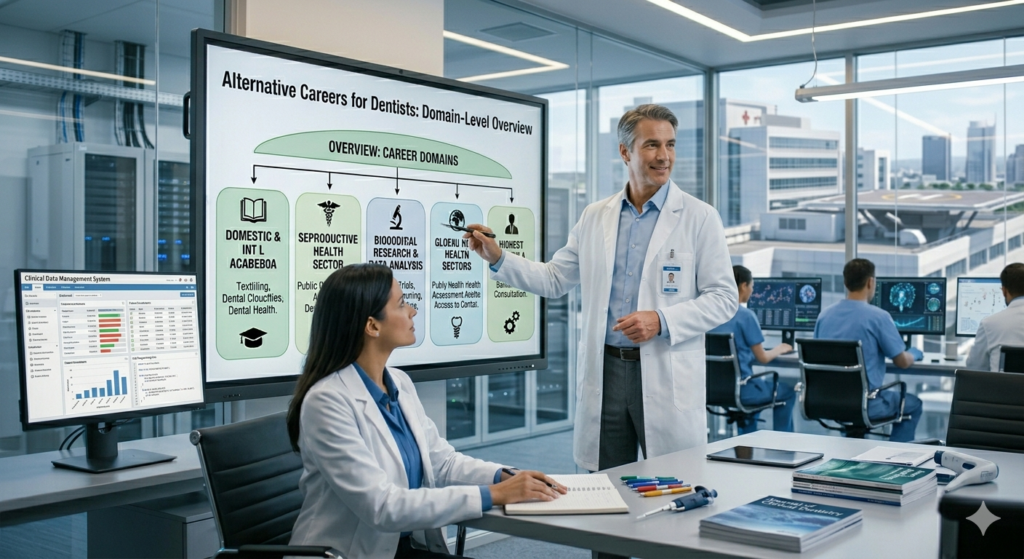
Alternative Careers for Dentists

Alternative careers for dentists include clinical research, medical writing, public health, healthcare management, and data analytics. These roles offer better work-life balance, stable income, and global opportunities beyond clinical practice.

These competencies are highly transferable and open up a wide range of careers for dentists beyond traditional clinical practice. If you’re exploring career options beyond clinical practice—whether for better work–life balance, income stability, or exposure to technology and leadership—this guide outlines structured, realistic pathways. 

According to the reports, India has over three lakh registered dentists, with high urban clustering Dental Council of India Annual Report. This density increases competition in metropolitan areas while rural regions remain underserved.  

In India, BDS graduates are increasingly shifting toward non-clinical and hybrid roles due to rising competition, evolving healthcare systems, and the growth of research, digital health, and corporate healthcare sectors.  

Simultaneously, the World Health Organization reports that nearly 3.7 billion people worldwide are affected by oral diseases under its Global Oral Health Action Plan. The implication is clear: oral healthcare demand is expanding globally, but opportunity is increasingly distributed across research, public health systems, digital platforms, industry ecosystems, and regulatory frameworks — creating diverse career options after dentistry beyond private clinics. 

Why Dentists Seek Alternative Careers 

  • Burnout & Schedule Strain: Clinical dentistry involves long procedures, physical strain, and high mental focus, leading many professionals to seek structured roles with predictable schedules. 
  • Market Saturation & Income Variability: Urban saturation increases competition and reduces income predictability, especially early in practice. Structured roles offer more stable salary growth. 
  • Technology & Scaled Impact: Digital technologies like CAD/CAM, AI diagnostics, and teledentistry are transforming oral healthcare, creating opportunities to work at a scale beyond individual patient care. 
  • Remote Work & Geographic Flexibility: Roles in telehealth, writing, regulatory work, and analytics allow flexible and location-independent careers.  
  • Income Diversification: Industry and corporate roles enable multiple income streams beyond clinical practice. 
  • Public Health Motivation: Those interested in population-level impact often move into public health, policy, and prevention programs. 

As a result, career options for dentists in India are expanding beyond traditional clinics into research organizations, healthcare companies, digital health startups, and corporate healthcare environments. 

Transferable Core Competencies Dentists Already Possess 

Dentists possess professional strengths that transition seamlessly into alternative domains: 

  • Clinical judgment & patient assessment  
  • Manual precision & attention to detail  
  • Infection control & regulatory awareness  
  • Documentation discipline 
  • Patient communication & consent handling  
  • Radiographic interpretation  
  • Materials science knowledge 

Core Bridging Skills You May Need 

Many professionals explore career options after BDS by adding complementary skills that allow them to apply their clinical knowledge in research, digital health, and healthcare industry roles. It means adding focused, complementary skills that allow you to apply your clinical knowledge in new environments. 

Good Clinical Practice (GCP) Certification 

Covers ethical guidelines, patient safety, and clinical trial protocols. Essential for research and regulatory roles. It covers informed consent, patient safety monitoring, protocol adherence, and documentation practices. If you are considering clinical research, medical affairs, or regulatory roles, GCP is often the minimum eligibility requirement and a strong starting point. 

Clinical Trial Operations & EDC Systems 

Focuses on study workflows, data handling, and platforms like Medidata Rave and Oracle Clinical. Required for CRC and CRA roles. 

Medical Writing & Literature Review  

Involves interpreting scientific data and preparing regulatory or publication documents. Key for writing and medical affairs roles. 

Data Analytics (Excel, SQL, R/Python) 

Enables analysis of clinical and operational data. Important for informatics, digital health, and analytics roles. 

CAD/CAM & 3D Printing Tools 

Covers scanning, design software, and 3D workflows. Essential for digital dentistry and lab-based roles. 

Business & Healthcare Management 

Builds skills in operations, finance, and strategy. Useful for management, administration, and entrepreneurial roles. 

Today, top non-clinical jobs for dentists in India include clinical research, medical writing, healthcare analytics, public health, and corporate healthcare roles. 

Top 9 Alternative Careers for Dentists 

These roles represent some of the most promising BDS career opportunities for dentists who want to expand beyond clinical practice while still using their healthcare expertise. 

1) Clinical Research 

(CRC / CRA / Clinical Project Manager) 

Clinical research professionals manage and monitor clinical trials for drugs and medical devices. They ensure patient safety, maintain data integrity, oversee regulatory documentation, coordinate with sponsors and CROs, and ensure compliance with global trial standards. 

Entry Requirements 

A dental degree provides strong clinical credibility. However, employers typically expect Good Clinical Practice (GCP) certification and structured clinical research training. Exposure to site-level study of coordination or hospital-based research improves employability. Familiarity with trial workflow significantly strengthens entry into CRC roles. 

Skills (Core + Advanced) 

  • Clinical judgment and endpoint understanding 
  • Informed consent management 
  • Protocol adherence and deviation handling 
  • Documentation accuracy and audit readiness 
  • EDC systems (Medidata Rave, Oracle Clinical) 
  • Adverse event and SAE reporting 
  • Basic biostatistics interpretation 
  • Risk management 
  • Project management (PMP advantageous) 
  • Pharmacovigilance knowledge 

Career Path 

Clinical Research Coordinator → Clinical Research Associate → Senior CRA → Clinical Project Manager → Clinical Operations Director 

2) Dental / Oral Public Health & Policy 

Public health dentistry focuses on population-level oral health improvement. Professionals design prevention programs, conduct epidemiological surveys, evaluate health outcomes, and contribute to policy development. 

Entry Requirements 

An MPH or public health diploma is typically required for structured roles. Experience in community screening programs, NGO projects, or district health initiatives strengthens eligibility. Knowledge of epidemiological methods is highly valued. 

Skills (Core + Advanced) 

  • Epidemiology and disease surveillance 
  • Community program design 
  • Data interpretation and statistical analysis 
  • Stakeholder engagement 
  • Grant writing 
  • Health economics 
  • Policy analysis 
  • Program monitoring and evaluation 

Career Path 

Public Health Dentist → Program Manager → Policy Advisor → State/National Health Leadership 

3) Dental Technology & CAD/CAM Specialist 

Digital dentistry integrates scanning, prosthetic design, and additive manufacturing into modern workflows. Specialists manage digital systems in clinics or labs and bridge clinical and production environments. 

Entry Requirements 

A dental degree combined with hands-on CAD/CAM training is essential. Laboratory exposure and digital case portfolio demonstration improve hiring probability. 

Skills (Core + Advanced) 

  • Intraoral scanning 
  • Prosthetic design principles 
  • Occlusion and functional analysis 
  • CAD software (Exocad / 3Shape) 
  • STL file handling 
  • 3D printing workflows 
  • Biomaterials understanding 
  • Manufacturing quality assurance 

Career Path 

Digital Dentistry Specialist → Lab Manager → Product Application Specialist → Director of Digital Solutions 

4) Medical Writing 

Medical writers prepare regulatory documents, scientific manuscripts, and educational content based on clinical data. 

Entry Requirements 

A dental degree provides subject authority. Formal medical writing training and a writing portfolio are typically required for structured roles. Knowledge of regulatory documentation strengthens positioning. 

Skills (Core + Advanced) 

  • Scientific interpretation 
  • Literature review (PubMed familiarity) 
  • Referencing accuracy 
  • Structured documentation 
  • Regulatory writing (ICH familiarity) 
  • Publication planning 
  • Data summarization 
  • Clarity in technical communication 

Career Path 

Medical Writer → Senior Medical Writer → Publication Lead → Medical Affairs Specialist 

5) Dental Products & Industry Roles 

Industry roles combine clinical credibility with strategic execution. Professionals train clinicians, support product launches, and manage commercial strategy. 

Entry Requirements 

A dental degree is highly valued. Strong communication skills are essential. For product management roles, an MBA or structured business training adds competitive advantage. 

Skills (Core + Advanced) 

  • Presentation and training skills 
  • Clinical product demonstration 
  • KOL engagement 
  • Market analysis 
  • Launch strategy planning 
  • Regulatory alignment 
  • Health economics understanding 
  • Sales performance tracking 

Career Path 

Clinical Specialist → Product Manager → Medical Affairs Lead → Commercial Head 

6) Dental Lab & Biomaterials R&D 

This pathway focuses on innovation in restorative materials and implant systems. 

Entry Requirements 

A dental degree with research exposure or biomaterials training is recommended. Postgraduate research experience significantly improves eligibility. 

Skills (Core + Advanced) 

  • Dental materials science 
  • Laboratory testing protocols 
  • Strength and biocompatibility analysis 
  • Documentation standards 
  • In vitro testing models 
  • Regulatory device approval processes 
  • Product validation studies 

Career Path 

R&D Scientist → Product Development Lead → Head of R&D 

7) Forensic Odontology 

Forensic odontologists support legal systems through dental identification and medico-legal analysis. 

Entry Requirements 

Specialized forensic odontology training is required. Collaboration with forensic medicine departments strengthens case exposure. 

Skills (Core + Advanced) 

  • Dental record comparison 
  • Radiographic analysis 
  • Bite-mark interpretation 
  • Medico-legal documentation 
  • Court testimony 
  • Advanced imaging analysis 

Career Path 

Forensic Consultant → Expert Witness → Academic Forensic Trainer 

8) Tele dentistry & Remote Care Leadership 

Teledentistry integrates digital consultation and remote care into oral health systems. 

Entry Requirements 

A dental degree combined with telehealth platform training is required. Familiarity with digital documentation systems improves positioning. 

Skills (Core + Advanced) 

  • Remote clinical assessment 
  • Patient communication 
  • Digital case documentation 
  • Telehealth compliance 
  • EHR integration 
  • Program management 

Career Path 

Tele-Dentist → Telehealth Program Manager → Director of Virtual Care 

9) Health Informatics & Dental Data Analytics 

This field focuses on analyzing clinical and operational data to improve outcomes and efficiency. 

Entry Requirements 

A dental degree plus structured data analytics training is typically required. Demonstrable analytical projects improve employability. 

Skills (Core + Advanced) 

  • Advanced Excel 
  • SQL querying 
  • Clinical variable interpretation 
  • Dashboard creation (Power BI/Tableau) 
  • R or Python basics 
  • Predictive modeling 
  • Data governance 

Career Path 

Clinical Informatics Analyst → Senior Analyst→ Head of Informatics 

Confused About Your Next Career Move After BDS?

Not sure whether Clinical Research, Medical Writing, Healthcare Analytics, or Public Health is the right path for you? Get expert guidance to choose the best non-clinical career option based on your skills and goals.

Alternative Career Paths for Dentists

Career Path Career Growth Path Avg Salary in India
Clinical Research CRC → CRA → Project Manager → Clinical Operations ₹3 – ₹8 LPA
Public Health & Policy Public Health Dentist → Program Manager → Policy Advisor ₹4 – ₹10 LPA
Dental Technology (CAD/CAM) Specialist → Lab Manager → Digital Solutions Lead ₹4 – ₹12 LPA
Medical Writing Writer → Senior Writer → Medical Affairs ₹4 – ₹10 LPA
Industry / Product Roles Clinical Specialist → Product Manager → Commercial Head ₹5 – ₹15 LPA
Biomaterials R&D R&D Scientist → Product Lead → R&D Head ₹4 – ₹12 LPA
Forensic Odontology Consultant → Expert Witness → Academic ₹3 – ₹8 LPA
Teledentistry & Remote Care Tele-Dentist → Program Manager → Virtual Care Director ₹4 – ₹10 LPA
Health Informatics & Analytics Analyst → Senior Analyst → Data Lead ₹5 – ₹12 LPA
Advanced Diploma in

AI & ML in Healthcare 

Build practical skills to apply artificial intelligence and machine learning in real healthcare and life sciences use cases. Learn how healthcare data is analyzed, models are built, and AI-driven insights are applied across research and healthcare systems. 

IN PARTNERSHIP WITH
4.8(2,300+ ratings) 

Salary Comparison of Alternative Careers for Dentists 

Understanding salary potential helps in choosing the right direction after BDS. While income varies based on experience, location, and specialization, structured roles often offer more predictable growth compared to early-stage clinical practice. 

Average Salary Range in India (Approximate) 

  • Average Salary Range in India (Entry to Mid-Level) 
  • Clinical Research (CRC/CRA): ₹3 – ₹8 LPA  
  • Medical Writing: ₹4 – ₹10 LPA  
  • Public Health & Policy: ₹4 – ₹10 LPA  
  • Healthcare Management / MBA Roles: ₹5 – ₹15 LPA  
  • Dental Technology (CAD/CAM): ₹4 – ₹12 LPA  
  • Health Informatics & Data Analytics: ₹5 – ₹12 LPA  
  • Pharmacovigilance & Drug Safety: ₹3 – ₹9 LPA  
  • Corporate / Product Roles: ₹5 – ₹15 LPA 

These roles offer structured salary progression, especially in corporate, research, and analytics domains. With experience and specialization, compensation can grow significantly faster than traditional clinic-based. 

Best Courses After BDS for Career Switch 

Choosing the right course after BDS depends on the career path you want to transition into. Instead of pursuing multiple degrees, focusing on targeted, industry-relevant training helps accelerate entry into new roles. 

Courses Based on Career Path 

  • Clinical Research: 
    GCP Certification, Clinical Research Training Programs  
  • Medical Writing: 
    Medical Writing Certification, Scientific Writing Programs  
  • Healthcare Management: 
    MBA in Healthcare / Hospital Administration  
  • Public Health: 
    MPH (Master of Public Health)  
  • Health Informatics & Data Analytics: 
    Data Analytics (Excel, SQL, Python), Healthcare Informatics Programs  
  • Digital Dentistry: 
    CAD/CAM Certification, Digital Workflow Training  
  • Pharmacovigilance & Regulatory Affairs: 
    Drug Safety Certification, Regulatory Affairs Courses  

The key is to choose a course aligned with a specific role rather than exploring multiple unrelated certifications. Focused upskilling improves employability and shortens transition time. 

Highest Paying Non-Clinical Jobs for Dentists 

Not all alternative careers offer the same earning potential. Some roles provide significantly higher income growth due to industry demand, scalability, and leadership opportunities. 

High-Paying Non-Clinical Roles 

  • Healthcare Management & MBA Roles 
    Leadership positions in hospitals and healthcare companies offer strong salary growth and long-term career progression.  
  • Health Informatics & Data Analytics 
    With the rise of digital health, professionals who can analyze healthcare data are in high demand and command premium salaries.  
  • Clinical Research (CRA → Project Management) 
    Mid-to-senior roles in clinical research, especially in global trials, offer strong compensation and international exposure.  
  • Medical Affairs & Corporate Roles 
    Positions in pharma and medical device companies combine scientific expertise with strategic decision-making.  
  • Product Management & Healthcare Consulting 
    These roles involve market strategy, innovation, and business growth, often leading to higher salary brackets.  
  • Digital Dentistry & Technology Specialists 
    Professionals working with advanced digital systems and workflows are increasingly valued in modern dental ecosystems.  

Higher-paying roles typically require a combination of domain expertise, technical skills, and strategic understanding of the healthcare industry. 

Transition from Clinical Practice: A Structured Roadmap 

Moving beyond traditional clinical dentistry does not mean walking away from your qualifications. It is strategically expanding the applications. A successful transition depends less on chance and more on clarity, preparation, and deliberate execution. 

Here is a structured approach that makes the shift practical and realistic. 

Step 1: Define Your Core Motivation 

Identify whether you want better work-life balance, income stability, leadership roles, or technology-driven work. 

Research across healthcare professions consistently shows that structured career planning reduces burnout-related exits and improves professional satisfaction (Bureau of Labor Statistics, Occupational Outlook Handbook). 

Step 2: Assess Your Existing Strengths 

Evaluate your clinical skills, research exposure, certifications, and professional experience to identify relevant transition advantages. 

Step 3: Select One Target Domain 

Choose a clear direction such as clinical research, medical writing, digital dentistry, or healthcare analytics. 

Step 4: Conduct a Skill Gap Analysis 

Once your target field is chosen, review multiple job descriptions in that domain. Identify recurring requirements, certifications, and technical skills. 

Examples: 
  • Clinical Research → GCP certification, trial operations knowledge 
  • Public Health → MPH or epidemiology background 
  • Digital Dentistry → CAD/CAM proficiency 
  • Medical Writing → Writing portfolio and regulatory familiarity 
  • Health Informatics → Excel, SQL, and analytics exposure 

Review job descriptions and identify required certifications, tools, and technical skills for your chosen domain. 

Step 5: Upskill Strategically (3–12 Months) 

Focus on targeted training such as GCP, CAD/CAM, medical writing, analytics, MPH, or MBA depending on your pathway. 

According to workforce data from Payscale, structured corporate roles often show more predictable salary progression compared to early-stage independent practice. 

Step 6: Build Demonstrable Evidence 

Create portfolios such as writing samples, research summaries, digital cases, dashboards, or project work. 

Step 7: Network with Intention 

Engage with: Industry professionals through conferences, LinkedIn, alumni groups, and healthcare organizations. 

Step 8: Pilot Before Committing Fully 

Gain practical exposure through internships, freelance work, part-time roles, or collaborations. 

Build Skills That Employers Actually Hire For

Move beyond traditional dentistry with practical training in Clinical Research, AI & ML in Healthcare, Medical Coding, and more. Learn industry-relevant skills designed for BDS graduates.

Market Opportunity: India and the Global Landscape 

Before making a strategic career shift, it is important to understand the direction in which the larger dental and healthcare markets are moving. Career opportunities expand when industries expand. Dentistry today operates within a growing global ecosystem shaped by digital transformation, research innovation, organized corporate networks, and rising healthcare investment. 

Global Dental Services: Sustained Expansion 

The global dental services market continues to show steady and sustained growth. According to Grand View Research, the dental services industry is projected to grow at a consistent compound annual growth rate (CAGR) through 2030, supported by aging populations, increased awareness of oral health, rising cosmetic dentistry demand, and expanded insurance penetration in emerging markets. 

While exact market valuations vary between publishers, most industry forecasts place the sector in the hundreds of billions of dollars, with projections indicating significant expansion by the early 2030s. 

This growth does more than increase demand for chairside dentists. As dental networks scale and modernize, they create demand for non-clinical professionals who support the system — including clinical research coordinators, digital workflow managers, product specialists, regulatory professionals, and healthcare data analysts. 

Teledentistry: A High-Growth Digital Segment 

Teledentistry has emerged as one of the fastest growing subsegments within oral healthcare. As remote consultations, AI-supported triage, and digital case monitoring gain traction; the infrastructure around virtual dental care is expanding rapidly. 

According to Grand View Research, the global teledentistry market was valued at approximately USD 2.02 billion in 2024 and is projected to grow at a CAGR exceeding 15% through 2030. Similarly, Market Research Future highlights strong double-digit growth driven by increasing rural access initiatives, integration with electronic health records (EHRs), and broader telehealth acceptance post-pandemic. 

This growth translates into professional opportunities beyond direct clinical care. Emerging roles include telehealth program leadership, digital compliance management, virtual care coordination, health informatics integration, and vendor-side product development. 

For dentists interested in flexible work models or digital healthcare ecosystems, this segment offers one of the most accessible entry points. 

Dental Implants and Device Innovation 

Implantology remains one of the most financially significant and steadily growing segments within dentistry. Industry analyses consistently report single-digit to high single-digit CAGR growth in the global dental implants market, depending on region and product category. 

India: Organized Consolidation and Healthcare Growth 

India’s dental ecosystem is undergoing structural change, creating new career options for dentists in India across corporate dental chains, research organizations, digital health companies, and healthcare administration roles. Organized dental chains and corporate clinic networks are expanding across metropolitan and tier-two cities. Consolidation increases demand not only for clinicians but also for operations managers, quality compliance officers, digital workflow specialists, and corporate trainers. 

Simultaneously, India’s broader healthcare sector continues to grow. According to Grand View Research, the Indian healthcare market is projected to expand steadily through 2032, driven by increasing private sector participation, Ayushman Bharat implementation, and digital health adoption. 

As dentistry integrates more closely with hospital systems and corporate healthcare structures, roles expand in administration, clinical research, informatics, compliance, and program management. 

Start Your Career Transition with Confidence

Take the next step toward a stable, high-growth healthcare career with expert mentorship, hands-on learning, and placement-focused support from CliniLaunch.

Conclusion 

Dentistry today extends far beyond chairside practice, opening new careers for dentists in research, digital health, healthcare analytics, industry leadership, and public health systems. As global dental markets expand driven by digital adoption, implant growth, research innovation, and organized healthcare systems opportunities are shifting into clinical research, digital health, industry, public health, analytics, and leadership roles. 

The core competencies developed through dental training remain powerful and transferable. What changes is how and where those skills are applied. 

Career diversification is not a leap into uncertainty. It is a structured transition built on clarity, focused upskilling, portfolio development, and strategic positioning. 

If you are ready to explore structured pathways into clinical research, regulatory roles, digital integration, or emerging healthcare domains, CliniLaunch Research Institute provides industry-aligned training designed specifically for healthcare professionals seeking career expansion. 

Frequently Asked Questions

1. What are the best alternative careers for dentists?
Dentists can transition into domains such as clinical research, pharmacovigilance, regulatory affairs, medical writing, healthcare management, and data-driven or corporate healthcare roles.
2. Can dentists move into non-clinical roles without leaving healthcare?
Yes. Many alternative careers allow dentists to stay connected to healthcare through research, compliance, documentation, strategy, and leadership roles without daily chairside practice.
3. Is clinical research a good career option for dentists?
Clinical research is one of the most structured non-chairside paths for dentists, offering roles in trial coordination, monitoring, management, and medical oversight.
4. Do dentists need additional qualifications to switch careers?
Some domains require domain-specific training or exposure, while others rely more on clinical knowledge, documentation skills, and structured learning rather than formal degrees.
5. What is the difference between a career domain and a job role?
A career domain is a broad field like clinical research or regulatory affairs, while job roles are specific positions within that domain, such as coordinator, analyst, or manager.
6. How should dentists choose the right alternative career path?
Dentists should first identify the type of work they prefer and then select a suitable career domain before targeting specific job roles.
7. What to do after BDS except practice?
You can move into clinical research, medical writing, healthcare analytics, public health, or corporate healthcare roles in India.
8. Which course is best after BDS?
It depends on your goal—GCP for research, MBA for management, MPH for public health, or data/AI courses for analytics roles.
9. Can dentists switch careers?
Yes, with focused upskilling, dentists can transition into research, analytics, regulatory, and healthcare industry roles.

With CROs expanding rapidly and hiring across clinical operations, data management, pharmacovigilance, and regulatory roles, the fact that only 54.8% of Indian graduates are employable (India Skills Report 2025) shows why specialized, industry-aligned training has become essential for anyone aiming to enter the clinical research field. That means if you’re among the many freshers entering the pharma and life-science pipeline, you’re competing not just against peers — but against a tough skills gap that rejects nearly half the graduates on technical readiness alone. 

India produces a large number of pharmacy and life-science graduates every year, yet many still struggle to secure industry-aligned roles due to rising skill expectations and limited practical exposure. Most hiring managers report that candidates lack practical exposure, tool proficiency, and an understanding of real-world workflows; the very things industry projects depend on. 

As a result, companies prefer candidates who show hands-on skills rather than just theoretical knowledge, making job readiness more important than ever. This gap between academic learning and industry expectations is the main reason freshers face repeated rejections despite having strong degrees. 

If you want to build a stable career in the pharmaceutical industry skills in clinical research, pharmacovigilance, regulatory, QA, lab analysis or data management, you must have the pharma skills employers demand. In this blog, we will break down the Top 10 pharma industry Skills that make you truly employable in today’s rapidly evolving pharma industry. 

GCP and ethical guidelines form the foundation of every clinical trial, ensuring participant safety and reliable data. Today’s recruiters expect candidates to understand informed consent, protocol compliance, investigator responsibilities, and the global ICH-GCP framework that governs clinical operations. 

One analysis of clinical trials found that 17% of failed Phase III trials, among the ones studied, they failed because of safety issues. Since GCP guidelines are designed to protect patient safety and ensure ethical conduct, this stat indirectly underscores how critical GCP/ethical compliance is for trial success. 

You can start by learning the core principles and improve by reviewing real protocols, analyzing ethical scenarios, and completing recognized GCP certifications. Adding mock ICF reviews or deviation analysis projects to your resume instantly strengthens credibility in clinical roles. 

Skill GCP & Ethical Guidelines 
What It Includes ICH-GCP rules, informed consent, protocol adherence, ethics. 
Roles Requiring This Skill CRA, CTA, Site Coordinator, PV Associate, QA Associate. 
Industries Hiring Pharma, CROs, Hospitals, Research Institutes. 
How to Adopt / Fast-Track Take GCP certification, review protocols/ICFs, and join mock audits. 
Course Name Advanced Diploma in Clinical Research 
Duration 6 Months 
Description Become a job-ready Clinical Research Associate with hands-on trial management, monitoring practice, EDC tools, and GCP compliance training. NSDC & Brit Qualis accredited. 
Skills You Build GCP, Ethical Guidelines, Clinical Trial Management, Protocol Handling, Regulatory Affairs, EDC Tools, Clinical Data Management Basics, Medical Writing, Site Coordination 

2. Pharmacovigilance Case Processing 

Pharmacovigilance is the science of detecting, assessing, and preventing adverse drug reactions. Case processing skills involve triaging reports, coding events with MedDRA, writing narratives, and ensuring regulatory timelines are met. 

Pharmacovigilance (PV) professionals—especially those skilled in Case Processing—continue to be in high demand as the global PV market grows steadily. With the industry valued at USD 7.95 billion in 2024 and projected to reach USD 11.78 billion by 2030 (CAGR ~6.5%), companies worldwide are expanding their safety teams to handle rising volumes of adverse event reports, regulatory expectations, and AI-enabled safety workflows. This growth makes PV Case Processing one of the most sought-after skills for freshers entering drug safety and clinical research. 

You can begin with understanding AE/SAE fundamentals and progressively build expertise through hands-on practice with sample cases. Creating example narratives, mock ICSRs, or MedDRA-coded datasets demonstrates job readiness and gives your resume a clear edge. 

Skill Pharmacovigilance Case Processing 
What It Includes AE/SAE handling, MedDRA coding, narratives, regulatory reporting. 

Roles Requiring This Skill 
Drug Safety Associate, PV Analyst, Case Processor. 
Industries Hiring CROs, Pharma safety teams, PV outsourcing firms. 
How to Adopt / Fast-Track Learn PV workflow, practice mock ICSRs, study MedDRA terms. 

CDM focuses on collecting, cleaning, validating, and locking clinical trial data. Recruiters expect familiarity with CRF design, query management, discrepancy resolution, and data validation workflows. 
Start with the basics of (Electronic Data Capture) EDC structure and gradually practice by designing sample CRFs, running mock data cleaning cycles, or working on dataset checks. Projects such as creating a mini data validation plan or sample queries show strong practical understanding. 

Skill Clinical Data Management 
What It Includes CRF design, data cleaning, queries, EDC operations. 
Roles Requiring This Skill CDM Associate, Data Coordinator, EDC Specialist. 
Industries Hiring CROs, Pharma, EDC vendors. 
How to Adopt / Fast-Track Practice CRF creation, mock data cleaning, EDC demos. 

Regulatory Affairs ensures that drugs meet global requirements before reaching the market. This includes understanding CTD/eCTD formats, submission processes, labeling rules, and region-specific guidelines. 

For Regulatory Affairs (relating to “Regulatory Affairs Knowledge”): a market-analysis report expects the global regulatory-affairs market to grow at a CAGR of ~7.17% between 2025 and 2030.  
You can begin by studying regulatory pathways (USFDA, EMA, CDSCO) and then expand by preparing mock submission modules or product information briefs. Adding small regulatory intelligence projects helps showcase initiative and applied knowledge. 

Skill Regulatory Affairs 
What It Includes CTD/eCTD formats, submissions, regulatory pathways. 
Roles Requiring This Skill Regulatory Associate, Documentation Specialist. 
Industries Hiring Pharma, Biotech, CROs. 
How to Adopt / Fast-Track Study guidelines (USFDA/EMA/CDSCO), practice mock submissions. 

Quality Assurance ensures that pharma processes follow GxP standards (GCP, GLP, GMP). Skills here include audit readiness, SOP interpretation, CAPA  (Corrective and Preventive Action) understanding, and documentation accuracy. 

Analyses of FDA enforcement show quality/system issues are among the most common citations; historical analyses report quality-system issues ≈ 34% of citations in some multi-year reviews — highlighting QA/GxP importance. See FDA warning letters / inspection trend analyses. 

You can build this skill by reviewing common audit findings, practicing SOP writing, and analyzing sample deviations. Creating mock CAPA responses or quality checklists adds strong weight to a beginner’s profile. 


Skill Quality Assurance & GxP 
What It Includes Quality Assurance & GxP 
GCP/GLP/GMP basics, SOPs, audits, CAPA handling. 
Roles Requiring This Skill QA Associate, Compliance Officer. 
Industries Hiring Pharma, CROs, Manufacturing, Research Labs. 
How to Adopt / Fast-Track Learn audit findings, write SOP samples, practice CAPA responses. 

Analytical skills are essential for QC, QA, and R&D roles, involving techniques like HPLC, GC, spectroscopy, titration, and method validation. Employers look for candidates who understand lab safety, instrument handling, and data recording. 

The global healthcare analytical testing / analytical services market is expanding — projected to grow (example: from US$7.48B in 2025 to US$12.48B by 2030), implying steady demand for QC/analytical technicians. 
 
Begin with wet-lab fundamentals and grow by performing mock experiments, interpreting chromatograms, or reviewing raw lab data sheets. Documenting mini-projects, such as simulated HPLC runs, makes your profile more practical and industry-aligned. 

Skill Analytical Lab Skills 
What It Includes HPLC, GC, titration, spectroscopy, method validation. 
Roles Requiring This Skill QC Analyst, QA Analyst, Lab Technician. 
Industries Hiring pharma manufacturing, QC labs, R&D labs. 
How to Adopt / Fast-Track Practice basic lab techniques, analyze chromatograms, review COAs. 
Skill Scientific & Medical Writing 
What It Includes Protocols, CSRs, summaries, and literature review. 
Roles Requiring This Skill Medical Writer, Scientific Writer. 
Industries Hiring CROs, Pharma, Medical communication agencies. 
How to Adopt / Fast-Track Rewrite articles, create summary sheets, build writing samples. 

Data analysis skills help professionals make sense of clinical, lab, or safety data. This includes understanding statistics, identifying trends, performing basic analysis, and drawing meaningful conclusions. 

The clinical analytics (healthcare analytics) market is expanding rapidly — projected to reach ~US$81.3 billion by 2030, reflecting strong demand for data analysts in pharma/clinical research. 
You can begin with Excel or basic statistical concepts and advance to analyzing trial datasets or lab results. Building small projects — such as summarizing AE patterns or visualizing lab values — shows your ability to convert data into insights. 

Skill Data Analysis 
What It Includes Statistics, trends, charts, clinical/lab data insights. 
Roles Requiring This Skill Data Analyst, CDM Analyst, Biostatistics Intern. 
Industries Hiring Pharma, CROs, Healthcare analytics firms. 
How to Adopt / Fast-Track Use Excel/R/Python basics, analyze mock datasets, create dashboards. 

EDC tools are central to modern clinical trials, allowing teams to capture and manage patient data digitally. Recruiters value candidates who understand page structures, visit logs, audit trails, and query flows. 
Start by learning the basic layout of popular EDC platforms and progress to designing mock casebook pages or simulating query cycles. Even basic EDC practice projects demonstrate readiness for CDM, CRA, and CTA roles. 

Skill EDC Tool Proficiency 
What It Includes Medidata, Oracle Clinical, Rave, eCRF navigation, queries. 
Roles Requiring This Skill CDM Associate, CRA, CTA. 
Industries Hiring CROs, Pharma, EDC vendors. 
How to Adopt / Fast-Track Explore EDC demos, practice mock eCRFs, study query lifecycle. 

Communication is essential for working with investigators, sites, sponsors, and internal teams. It includes clarity in emails, documentation accuracy, professionalism, and the ability to explain findings. 
Begin by improving written communication, practicing structured email formats, and participating in mock meetings. Adding a few communication-focused examples — such as drafted email templates or meeting summaries — shows employers that you can collaborate effectively. 

Skill Communication Skills 
What It Includes Email writing, documentation clarity, teamwork, professionalism. 
Roles Requiring This Skill CRA, CTA, PV Associate, CDM Associate, QA roles. 
Industries Hiring Pharma, CROs, Hospitals, Research units. 
How to Adopt / Fast-Track Practice structured emails, mock meetings, document formatting. 

Breaking into the pharma industry is no longer just about having a degree — it’s about having the right industry-aligned skills that employers rely on every single day. As we’ve seen, the demand for clinical research professionals, pharmacovigilance specialists, regulatory associates, data managers, QA experts, and analysts is rising faster than ever. But with nearly half of India’s graduates lacking job-ready skills, the real advantage goes to those who intentionally build the competencies that matter. 

If you master even a few of the top 10 pharma skills, you immediately stand out from thousands of candidates. These in-demand pharmaceutical industry skills don’t just boost employability; they unlock global opportunities, higher salaries, and long-term career growth in one of the world’s most stable industries. 

At CliniLaunch, every program is built to help you master the exact skills required in pharmaceutical industry. Whether it’s GCP, pharmacovigilance case processing, regulatory documentation, data management, analytics, or EDC tool proficiency, our courses give you hands-on, industry-aligned training that employers look for in job-ready candidates. 

Factors Influencing Healthcare Management
Modern Hospital Administration
Visionary Healthcare Leadership

top healthcare management companies

  • Job Roles: HR recruiter, Associate Consultant, Management positions. 
  • Specialty MBA Placed: Hospital Administration, Healthcare Operations. 
  • Experience Level: Entry-level to senior management. 
  • Salary Range: ₹6 LPA – ₹18 LPA. 

To learn more, enroll for MBA in healthcare management 

  • Job Roles: Hospital Administrator, Healthcare Consultant, Operations Manager. 
  • Specialty MBA Placed: Healthcare Management, Operations Management. 
  • Experience Level: 2-10 years. 
  • Salary Range: ₹8 LPA – ₹20 LPA. 

3. Novartis 

5. Thermo Fisher Scientific 

  • Job Roles: Sales and Business Development, Market Research Analyst. 
  • Specialty MBA Placed: Healthcare Operations, Business Analytics. 
  • Experience Level: 3-10 years. 
  • Salary Range: ₹9 LPA – ₹25 LPA. 
  • Job Roles: Business Development Manager, Operations Manager. 
  • Specialty MBA Placed: Digital Health Management, Business Strategy. 
  • Experience Level: 1-7 years. 
  • Salary Range: ₹7 LPA – ₹18 LPA. 

7. IN-Med Prognostics 

  • Job Roles: Market Analyst, Healthcare Operations Manager. 
  • Specialty MBA Placed: Healthcare Analytics, Operations Management. 
  • Experience Level: 2-8 years. 
  • Salary Range: ₹8 LPA – ₹22 LPA. 

8. MediLocker 

  • Job Roles: Strategic Planning, Business Development. 
  • Specialty MBA Placed: Healthcare IT Strategy, Business Operations. 
  • Experience Level: 2-10 years. 
  • Salary Range: ₹9 LPA – ₹20 LPA. 

  •  Job Roles: Healthcare Operations Lead, Data Analytics Manager. 
  • Specialty MBA Placed: Supply Chain Management, Healthcare Analytics. 
  • Experience Level: 3-12 years. 
  • Salary Range: ₹12 LPA – ₹40 LPA. 

Read our blog post on Executive MBA in Healthcare Management: 5 Effective Advantages | 2025 

  • Job Roles: Healthcare Strategy Manager, Business Consultant. 
  • Specialty MBA Placed: Healthcare Policy, Business Strategy. 
  • Experience Level: 2-15 years. 
  • Salary Range: ₹10 LPA – ₹35 LPA. 

  1. Pre-placement Interviews: Understanding employer expectations. 
  1. Skill Development: Emphasis on analytical and leadership skills. 
  1. Mock Interviews & Group Discussions: Real-time simulation. 
  1. Networking & Mentorship: Connecting with alumni and industry experts. 
  1. Internships: Gaining hands-on experience in healthcare management. 
  • Employment Rates: 90%+ placement within 3 months post MBA graduation. 
  • Salary Hikes: Significant salary hike compared to pre-MBA earnings. 

Read the blog post: MBA Healthcare management 

Read the blog post: MBA Healthcare management 

Enroll Form