Top Life Science Industry Skills Required in 2026
The life science industry in 2026 requires practical skills such as clinical research knowledge, laboratory techniques, bioinformatics, regulatory awareness, data analysis, and digital tool proficiency. Employers increasingly prefer professionals who combine scientific knowledge with real-world workflow understanding and adaptability.
Introduction to Biotechnology and Its Applications
Biotechnology is transforming healthcare, agriculture, and pharmaceuticals, creating diverse biotechnology jobs across industries. Today, careers for biotechnology professionals extend beyond traditional laboratory research into areas that combine biology, technology, and healthcare systems.
Biotechnology applications include drug discovery, vaccine development, clinical research, agriculture, industrial biotechnology, and sustainable manufacturing. Because biotechnology intersects with data and digital technologies, biotechnology graduates can also explore domains such as bioinformatics, healthcare analytics, and regulatory affairs.
Biotechnology Industry Growth in India
India’s biotechnology and healthcare sector is rapidly expanding, creating demand for professionals in bioinformatics, clinical research, healthcare analytics, and AI-driven healthcare systems. Growth in genomics, vaccine manufacturing, biologics, and digital health is increasing opportunities across the industry. Major biotech hubs like Bengaluru and Hyderabad continue to attract pharmaceutical companies, CROs, startups, and research organizations.
Table of Contents
- Bioinformatics Careers
- Clinical Research Careers
- Pharmacovigilance Careers
- Healthcare Analytics Careers
- Regulatory Affairs Careers
- Medical Writing Careers
- AI & ML Careers in Healthcare
- Biotechnology Salary & Career Growth
- Future Scope of Biotechnology in India
Why Biotechnology Engineers Explore Multiple Career Paths
As biotechnology graduates enter the workforce, many realize that career opportunities extend beyond traditional laboratory roles. Several industry realities influence this shift.
• Specialized research facilities and manufacturing plants operate with limited team sizes
• Companies expect professionals who already understand regulated environments
• Many roles require industry exposure beyond academic training
• Biotechnology is increasingly integrating with data systems and digital technologies
• Professionals often seek roles with wider industry exposure and faster learning opportunities
Major Career Domains for Biotechnology Engineers
Below are some of the most practical and industry-relevant career options for biotechnology engineers who want to move beyond traditional core lab or engineering roles while still staying closely connected to healthcare and life sciences.
1. Bioinformatics Careers for Biotechnology Engineers
Bioinformatics combines biotechnology with computational analysis to study biological data like genomic sequences and proteins. Many biotech graduates enter this field through biotechnology engineering courses, bioinformatics courses, and practical training programs. The growth of genomics research and AI-driven healthcare is also increasing demand for genomics careers, computational biology jobs, and bioinformatics professionals in India.
Bioinformatics combines biotechnology with computational analysis, creating opportunities in genomics careers, biotechnology research, and computational biology jobs. Many learners also explore bioinformatics courses and bioinformatics salary in India while building careers in this growing field.
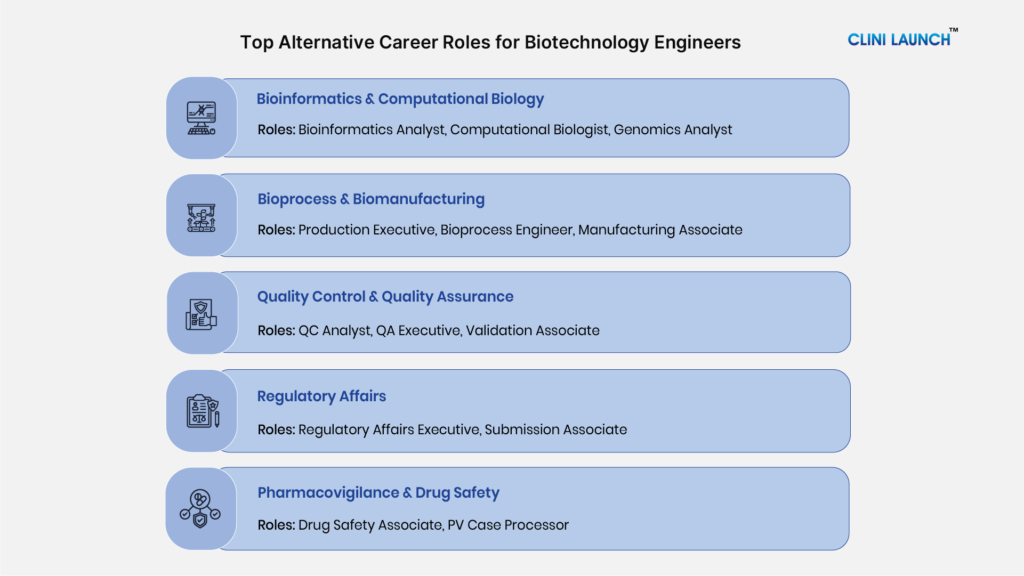
Typical roles include Bioinformatics Analyst, Genomics Data Analyst, and Computational Biologist.
Typical entry salary: ₹3–7 LPA depending on skill depth, tools, and organization type.
The following table summarizes the skills, tools, and hiring environments associated with common entry-level roles in this domain.
Career Preparation Overview-
| Target Roles | Skills to Develop | Tools to Learn | Hiring Companies | Salary Range |
| Bioinformatics Analyst | Biological data interpretation | Python, R, BLAST | Pharma, CROs, research labs | ₹3–7 LPA |
| Computational Biologist | Modeling & analytics thinking | Python, MATLAB, Bioconductor | Biotech firms, R&D centers | ₹4–8 LPA |
| Genomics Data Analyst | Sequence analysis | NGS pipelines, Linux | Genomics companies | ₹3–6 LPA |
| Research Data Associate | Data cleaning & reporting | Excel, SQL, scripting | Clinical & academic research | ₹3–5 LPA |
| Bioinformatics Programmer | Automation mindset | Python, APIs | Health-tech & startups | ₹4–9 LPA |
Bioinformatics
Develop in-depth skills to analyze, manage, and interpret large-scale biological data used in genomics, clinical research, and drug discovery. This program focuses on applying computational methods and analytical pipelines to transform complex biological data into actionable research insights.

2. Bioprocess and Biomanufacturing Careers
Bioprocess and biomanufacturing careers focus on producing vaccines, biologics, enzymes, and therapeutic products. Biotechnology graduates are well suited for these roles because of their knowledge of fermentation technology, bioreactor systems, and pharmaceutical manufacturing. Growing demand for vaccine manufacturing, biologics manufacturing, and fermentation technology jobs is creating stable biotechnology career opportunities. Common roles include Production Executive, Bioprocess Engineer, and Manufacturing Associate.
Typical entry salary: ₹2.5–6 LPA depending on plant scale, automation level, and location.
Career Preparation Overview-
| Target Roles | Skills to Develop | Tools to Learn | Types of Companies | Salary Range |
| Production Executive | GMP discipline, SOP adherence | Batch records, process controls | Pharma manufacturers | ₹2.5–5 LPA |
| Bioprocess Engineer | Scale-up understanding | Bioreactor systems | Biologics firms | ₹3–6 LPA |
| Manufacturing Associate | Aseptic handling | Cleanroom protocols | Vaccine producers | ₹2.5–4.5 LPA |
| Process Technician | Equipment operation | Filtration, purification setups | CMOs | ₹3–5 LPA |
| Plant Trainee | Documentation & compliance | Manufacturing workflows | Industrial biotech | ₹2.5–4 LPA |
3. Quality Control & Quality Assurance Careers
Quality Control (QC) and Quality Assurance (QA) professionals ensure pharmaceutical and biotechnology products meet safety and regulatory standards. Biotechnology graduates often enter this field because their laboratory training supports analytical testing, documentation, and compliance. QC and QA roles are closely linked to pharmaceutical quality control, GMP careers, and quality assurance jobs in pharma.
| Quality Control | Quality Assurance |
| Testing and product analysis | Compliance and process monitoring |
Typical entry roles include QC Analyst, QA Executive, Validation Associate, and Quality Control Microbiologist.
Typical entry salary: ₹2.5–5.5 LPA depending on facility type and regulatory exposure.
Career Preparation Overview-
| Target Roles | Skills to Develop | Tools to Learn | Types of Companies | Salary Range |
| QC Analyst | Testing accuracy, reporting | HPLC, GC, basic lab systems | Pharma manufacturers | ₹2.5–5 LPA |
| QA Executive | Compliance mindset | SOP management, audits | Biologics & devices | ₹3–5.5 LPA |
| QC Microbiologist | Sterility & microbial testing | Environmental monitoring | Vaccine & sterile plants | ₹2.5–4.5 LPA |
| Documentation Executive | Record control | Quality management systems | CMOs | ₹2.5–4 LPA |
| Validation Associate | Process verification | Qualification protocols | Regulated facilities | ₹3–5.5 LPA |
4. Regulatory Affairs Careers
Regulatory affairs professionals ensure pharmaceutical and biotechnology products meet regulatory standards before and after market approval. Biotechnology graduates often enter this field because of their knowledge of drug development, documentation, and regulatory submissions. In India, the Central Drugs Standard Control Organisation manages approvals, creating demand for CDSCO jobs and regulatory affairs certification programs. Globally, opportunities also extend to FDA compliance careers. Common entry roles include Regulatory Affairs Executive, Regulatory Submission Coordinator, and Documentation Associate.
Typical entry salary: ₹3–6 LPA depending on product portfolio and market exposure.
Career Preparation Overview-
| Target Roles | Skills to Develop | Tools to Learn | Types of Companies | Salary Range |
| RA Executive | Regulatory knowledge | eCTD basics, submission workflows | Pharma companies | ₹3–6 LPA |
| Submission Coordinator | Document management | Publishing systems | CROs | ₹3–5.5 LPA |
| Documentation Associate | Technical writing | Regulatory templates | Biologics firms | ₹3–5 LPA |
| Compliance Officer | Audit readiness | Regulatory databases | Medical device firms | ₹3–6 LPA |
| Labeling Associate | Detail orientation | Label review systems | Global pharma | ₹3–5 LPA |
Clinical Research
Build industry-ready skills to work across real clinical trial environments. Learn how clinical studies are designed, conducted, documented, and monitored, with a strong focus on ethics, patient safety, and global regulatory compliance.
5. Pharmacovigilance & Drug Safety Careers
Pharmacovigilance professionals monitor medicine safety through adverse event reporting and drug safety databases. Biotechnology graduates often enter this field because their knowledge of biology and pharmacology supports safety assessment and reporting. Growing demand for pharmacovigilance jobs for freshers has increased opportunities across CROs and pharma companies. Common tools include Oracle Argus Safety, ARISg, and MedDRA. Common entry roles include Drug Safety Associate, PV Case Processor, and Safety Data Associate.
Typical entry salary: ₹2.8–6 LPA depending on organization scale and process complexity.
Career Preparation Overview-
| Target Roles | Skills to Develop | Tools to Learn | Types of Companies | Salary Range |
| Drug Safety Associate | Case assessment | Safety databases | Pharma & PV providers | ₹3–6 LPA |
| PV Case Processor | Attention to detail | Workflow systems | BPS & CROs | ₹2.8–5 LPA |
| Safety Data Associate | Medical terminology | Reporting platforms | Global safety centers | ₹3–5.5 LPA |
| Junior Reviewer | Evaluation mindset | Narrative writing | Pharma companies | ₹3.5–6 LPA |
| PV Executive | Timeline discipline | Compliance tracking | Outsourcing firms | ₹3–5 LPA |
6. Healthcare Data Analytics Careers
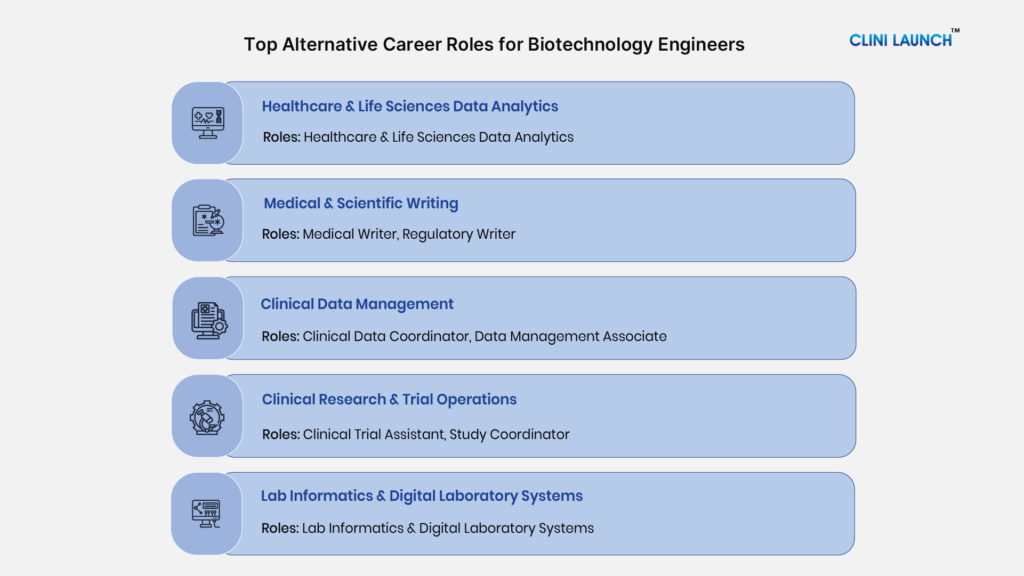
Healthcare data analysts work with clinical and laboratory data to support research and healthcare decision-making. Biotechnology graduates often enter this field because their background in biology and statistics helps them interpret healthcare data. Growing demand for healthcare analytics courses, healthcare data analyst jobs, and AI in healthcare analytics is making this a fast-growing biotech career domain. Common roles include Healthcare Data Analyst, Clinical Data Analyst, and Research Data Analyst.
Typical entry salary: ₹3–8 LPA depending on technical depth and organization type
Career Preparation Overview-
| Target Roles | Skills to Develop | Tools to Learn | Types of Companies | Salary Range |
| Healthcare Data Analyst | Data interpretation | Excel, SQL | Hospitals, health-tech | ₹3–7 LPA |
| Clinical Data Analyst | Dataset validation | EDC systems | CROs & pharma | ₹3–6.5 LPA |
| Research Data Analyst | Statistical thinking | R, Python | Research institutes | ₹3–7 LPA |
| Biostat Associate | Quantitative methods | SAS, R | Pharma companies | ₹4–8 LPA |
| Reporting Executive | Visualization | Power BI, Tableau | Analytics firms | ₹3–6 LPA |
7. Medical Writing Careers
Medical writers create scientific and regulatory documents used in pharmaceutical research, clinical trials, and healthcare communication. Biotechnology graduates often enter this field because their research and literature review skills support medical and regulatory writing. Growing opportunities exist in scientific writing jobs, freelance medical writing, and remote healthcare communication roles. Common entry roles include Medical Writer, Scientific Writer, and Regulatory Writing Associate.
Typical entry salary: ₹3–7.5 LPA depending on writing specialization and organization type.
Career Preparation Overview-
| Target Roles | Skills to Develop | Tools to Learn | Types of Companies | Salary Range |
| Medical Writer | Scientific communication | Reference databases | Pharma & CROs | ₹3–7.5 LPA |
| Scientific Writer | Data interpretation | Literature tools | Publishing firms | ₹3–6.5 LPA |
| Regulatory Writer | Structured documentation | Templates & guidelines | Regulatory services | ₹4–7.5 LPA |
| Doc Specialist | Accuracy & formatting | Document systems | Biotech companies | ₹3–6 LPA |
| Content Analyst | Medical understanding | Editing platforms | Med-com agencies | ₹3–6 LPA |
8. Clinical Data Management Careers
Clinical data management professionals collect and validate clinical trial data for regulatory analysis. Biotechnology graduates often enter this field through clinical data management courses focused on tools like Medidata Rave, Oracle Clinical, and REDCap. Common entry roles include Clinical Data Coordinator, Data Management Associate, and Junior Clinical Data Analyst, making it a popular option for CDM jobs for freshers.
Typical entry salary: ₹3–6.5 LPA depending on systems knowledge and sponsor exposure.
Career Preparation Overview-
| Target Roles | Skills to Develop | Tools to Learn | Types of Companies | Salary Range |
| Data Coordinator | Query handling | EDC systems | CROs & pharma | ₹3–6 LPA |
| DM Associate | Data review | CDISC basics | Clinical service firms | ₹3–5.5 LPA |
| Junior Analyst | Validation logic | SQL, Excel | Trial analytics teams | ₹3.5–6.5 LPA |
| DB Support | System navigation | Database tools | Tech vendors | ₹3–5.5 LPA |
| Validation Associate | Detail orientation | Workflow platforms | Global trials | ₹3–6 LPA |
9. Clinical Research Careers
Clinical research professionals support the planning, coordination, and monitoring of clinical trials that evaluate medical products. Biotechnology graduates often pursue this field because their knowledge of research documentation and biological systems supports clinical trial management activities. India’s clinical research sector, guided by the Indian Council of Medical Research, continues to grow across major CRO hubs in Bangalore, Hyderabad, and Pune. Common entry opportunities include CRA jobs, CRC jobs, Clinical Trial Assistant, Clinical Research Coordinator, and Site Management Associate roles.
Typical entry salary: ₹2.8–6.5 LPA depending on therapeutic area and sponsor exposure.
Career Preparation Overview-
| Target Roles | Skills to Develop | Tools to Learn | Types of Companies | Salary Range |
| CTA | Documentation flow | Trial management systems | CROs & pharma | ₹3–6 LPA |
| Research Coordinator | Site communication | Patient tracking tools | Hospitals | ₹2.8–5.5 LPA |
| Site Associate | Regulatory awareness | eTMF basics | Site networks | ₹3–6 LPA |
| Trial Executive | Timeline control | Study dashboards | Global trials | ₹3–6.5 LPA |
| Start-Up Associate | Approval processes | Submission portals | CROs | ₹3–6.5 LPA |
10. Lab Informatics & Digital Laboratory Careers
Lab informatics professionals manage digital systems used to organize laboratory data during research and manufacturing. Biotechnology graduates are well suited for this field because they understand laboratory workflows and scientific data management. Common areas include LIMS software, ELN systems, and digital laboratory management platforms, with roles such as LIMS Associate, Lab Systems Coordinator, and Informatics Support Analyst.
Typical entry salary: ₹3–8 LPA depending on technical and system exposure. Career
Preparation Overview-
| Target Roles | Skills to Develop | Tools to Learn | Types of Companies | Salary Range |
| LIMS Associate | Workflow understanding | LIMS platforms | Pharma & biotech | ₹3–6.5 LPA |
| Systems Coordinator | Data organization | Integration basics | CROs | ₹3–7 LPA |
| Informatics Analyst | Troubleshooting | SQL, reporting tools | Tech vendors | ₹4–8 LPA |
| App Support | User coordination | Ticketing systems | Diagnostics firms | ₹3–6 LPA |
| Digital Lab Analyst | Process mapping | Automation tools | Global labs | ₹3.5–7.5 LPA |
11. Medical Coding & Healthcare Documentation Careers
Medical coding professionals convert clinical information into standardized codes used for billing and healthcare analytics. Biotechnology graduates often enter this field because their knowledge of anatomy and medical terminology supports accurate documentation. Common areas include ICD-10 coding, CPT coding, and medical coding certification programs, with roles such as Medical Coder, Coding Analyst, and Healthcare Documentation Specialist.
Typical entry salary: ₹2.5–5 LPA
Career Preparation Overview-
| Target Roles | Skills to Develop | Tools to Learn | Types of Companies | Salary Range |
| Medical Coder | Medical terminology | ICD-10, CPT coding systems | Healthcare BPOs | ₹2.5–4.5 LPA |
| Coding Analyst | Accuracy & classification | Coding software | Hospitals | ₹3–5 LPA |
| Documentation Specialist | Record interpretation | EHR systems | Insurance companies | ₹3–4.5 LPA |
| Billing Associate | Claims processing | Billing platforms | Medical billing firms | ₹2.5–4 LPA |
| Coding Quality Analyst | Audit & compliance | Coding audit tools | Healthcare analytics | ₹3–5 LPA |
12. AI & Machine Learning Careers in Healthcare
AI and machine learning professionals analyze healthcare and biological data for diagnostics, AI drug discovery, and clinical decision-making. Growing demand for machine learning in biotechnology is increasing AI healthcare jobs across healthcare, pharma, and research industries. Common roles include Healthcare AI Analyst, AI Research Associate, and Junior Healthcare Data Scientist. AI-powered biotechnology careers are expected to grow significantly over the next decade.
Typical entry salary: ₹4–10 LPA
Career Preparation Overview-
| Target Roles | Skills to Develop | Tools to Learn | Types of Companies | Salary Range |
| Healthcare AI Analyst | Data analysis & modeling | Python, ML libraries | Health-tech companies | ₹4–8 LPA |
| AI Research Associate | Algorithm understanding | TensorFlow, PyTorch | Research labs | ₹5–9 LPA |
| Healthcare Data Scientist | Statistical modeling | Python, R | Pharma analytics teams | ₹5–10 LPA |
| ML Engineer (Healthcare) | Model development | Python, Scikit-learn | AI startups | ₹6–10 LPA |
| Digital Health Analyst | Data interpretation | SQL, visualization tools | Digital health platforms | ₹4–8 LPA |
This content is reviewed with insights from industry experts and supported by real industry statistics to provide accurate career guidance for biotechnology graduates. References from organizations such as the Central Drugs Standard Control Organisation (CDSCO), Indian Council of Medical Research (ICMR), and Department of Biotechnology help reflect current trends, regulatory frameworks, and the evolving biotechnology and healthcare landscape in India.
Career Path and Progression for Biotechnology Professionals
Careers for biotechnology professionals often evolve through structured stages as professionals gain technical expertise and industry exposure. While the exact progression varies across domains, most life science careers follow a similar growth pattern.
Entry-Level Roles
Professionals typically begin in operational or analytical positions such as:
- Bioinformatics Analyst
- Clinical Data Associate
- Drug Safety Associate
- Clinical Trial Assistant
- QC Analyst
- Regulatory Affairs Executive
These roles focus on learning industry systems, documentation standards, and operational workflows.
Mid-Level Roles
After gaining experience, professionals move into roles with greater responsibility such as:
- Senior Analyst
- Project Coordinator
- Regulatory Specialist
- Clinical Data Manager
- Medical Writer
- Process Development Scientist
At this stage, professionals begin managing processes, supervising teams, and contributing to strategic decisions.
Senior-Level Roles
With several years of industry experience, professionals may progress into leadership positions including:
- Clinical Project Manager
- Director of Regulatory Affairs
- Head of Pharmacovigilance
- Bioprocess Development Lead
- Bioinformatics Research Scientist
These roles involve overseeing large projects, regulatory strategy, and cross-functional collaboration.
Best Biotechnology Career Based on Your Interest
- Data and analytics → Bioinformatics
- Documentation and compliance → Regulatory Affairs
- Patient interaction and clinical trials → Clinical Research
- Technology and automation → AI & Healthcare Analytics
- Laboratory testing and standards → QC & QA
- Manufacturing and production → Bioprocess & Biomanufacturing
- Healthcare records and coding → Medical Coding
- Digital laboratory systems → Lab Informatics
| Career | Salary Range | Technical Skills | Coding Needed |
| Clinical Research | ₹2.5–5 LPA | Clinical trials, documentation, regulations | No |
| Clinical Data Management | ₹3–6 LPA | Medidata Rave, data validation, databases | Basic |
| Medical Coding | ₹2–4.5 LPA | ICD-10, CPT coding, medical terminology | No |
| Bioinformatics | ₹4–8 LPA | Genomics, data analysis, bioinformatics tools | Yes |
| AI & ML in Healthcare | ₹5–12 LPA | Python, ML models, healthcare analytics | Yes |
| QC & QA | ₹2.5–5 LPA | GMP, documentation, analytical testing | No |
| Bioprocess & Biomanufacturing | ₹3–6 LPA | Fermentation, bioreactors, manufacturing | No |
| Lab Informatics | ₹3–6 LPA | LIMS software, ELN systems, data workflows | Basic |
Growth Potential Across Biotechnology Career Domains
Different biotechnology career domains offer varying growth trajectories depending on industry demand, regulatory complexity, and technological advancement.
High-growth domains include:
- Bioinformatics and computational biology, driven by genomics and personalized medicine
- Clinical research and clinical data management, supported by increasing global clinical trials
- Healthcare data analytics, due to expanding healthcare datasets and digital platforms
- Pharmacovigilance, as global drug safety monitoring requirements increase
- Lab informatics, as laboratories adopt digital systems such as LIMS and ELN platforms
Emerging Areas in Biotechnology
Biotechnology is expanding into technology-driven fields as healthcare becomes more digital and data-focused. This growth is creating new careers that combine biology with computing, analytics, and engineering.
Some of the most promising future-facing domains include:
• Artificial Intelligence in Drug Discovery
• Precision Medicine and Genomics
• Digital Health Platforms
• Healthcare Data Science
• Cloud-Based Clinical Research Systems
• Real-World Evidence and Health Analytics
Biotechnology & Healthcare Industry Growth Statistics
- India’s biotechnology industry is expected to grow significantly by 2030, driven by genomics, biomanufacturing, and digital healthcare expansion.
- The healthcare AI market is rapidly growing due to AI-driven diagnostics, automation, and drug discovery technologies.
- Clinical trial activities are increasing across major CRO hubs like Bangalore, Hyderabad, and Pune, creating demand for clinical research and clinical data management professionals.
Career Opportunities for Biotechnology Professionals: India and Global Scenario
Biotechnology is a global industry with opportunities across pharmaceutical companies, research organizations, healthcare institutions, and life science firms. In India, major biotech hubs include Bengaluru, Hyderabad, Pune, and Ahmedabad, which support clinical research, vaccine manufacturing, and biotechnology startups. Globally, strong opportunities exist in the United States, Europe, Singapore, and Australia for professionals skilled in genomics, drug discovery, regulatory affairs, and digital healthcare.
Upgrade Your Biotechnology Career with Practical Training
Conclusion:
Biotechnology careers are no longer limited to laboratory research. Biotechnology graduates can now work across clinical research, healthcare analytics, regulatory affairs, bioinformatics, digital health, and computational biology. These are not backup career options, but growing industry pathways connected to modern healthcare and life sciences.
With the right skills, training, and guidance, biotechnology professionals can build future-ready careers that combine science, technology, and healthcare innovation while offering strong growth and global opportunities.
To prepare for these expanding opportunities, structured pathways like the Advanced Diploma in Clinical Research and the Advanced Diploma in Bioinformatics at CliniLaunch Research Institute help biotechnology engineers build the practical skills employers look for. Whether you are starting with a biotechnology degree or transitioning from biotech engineering, choosing the right biotechnology training and skill path is critical. Industry-aligned biotechnology engineering courses play a key role in helping learners move from academic knowledge to real-world biotechnology jobs.