
AI ethics in healthcare ensures artificial intelligence is used safely, fairly, and responsibly in medical settings. Healthcare AI ethics focuses on protecting patient privacy, preventing algorithmic bias, maintaining transparency, and ensuring human oversight and accountability in AI-supported diagnosis and treatment.
Artificial intelligence is transforming modern medicine through medical imaging, disease prediction, clinical decision support, and drug discovery. AI ethics in healthcare ensures these innovations support patient safety, privacy, fairness, and accountability while improving clinical workflows.
However, AI ethics in healthcare also addresses risks arising from biased recommendations, inaccurate predictions, and poorly validated systems. A 2019 study published in PubMed, titled Dissecting Racial Bias in an Algorithm Used to Manage the Health of Populations, demonstrated how a widely used healthcare algorithm underestimated the health needs of Black patients by predicting healthcare costs rather than actual illness severity. Understanding healthcare AI ethics is essential to ensure responsible AI adoption and protect patient well-being.
AI ethics in healthcare requires transparency, responsible data use, human oversight, and clear accountability to ensure that AI systems support not compromise patient well-being. For beginners exploring healthcare AI, understanding ethical AI healthcare practices provides a foundation in AI governance, regulatory compliance, clinical data management, and emerging career opportunities in the field.
According to a 2025 WHO/Europe report, 64% of surveyed countries in the WHO European Region were already using AI-assisted diagnostics, demonstrating how rapidly this technology is entering clinical practice.
What is AI Ethics in Healthcare?
AI ethics in healthcare refers to the principles and practices that guide the safe, fair, transparent, and responsible use of artificial intelligence in medical settings. It ensures that responsible AI supports patient well-being while respecting human rights, privacy, and clinical accountability.
According to the World Health Organization (WHO), healthcare AI ethics places human rights and safety at the center of medical technology. Its guidance identifies six core principles, including human autonomy, equity, and transparency, to prevent AI from reinforcing existing healthcare inequalities.
Research indexed by the National Institutes of Health (NIH) also highlights the importance of ethical AI healthcare practices in managing human-AI clinical decisions. These include preventing algorithmic discrimination, protecting patient data, and establishing accountability for AI-supported outcomes.
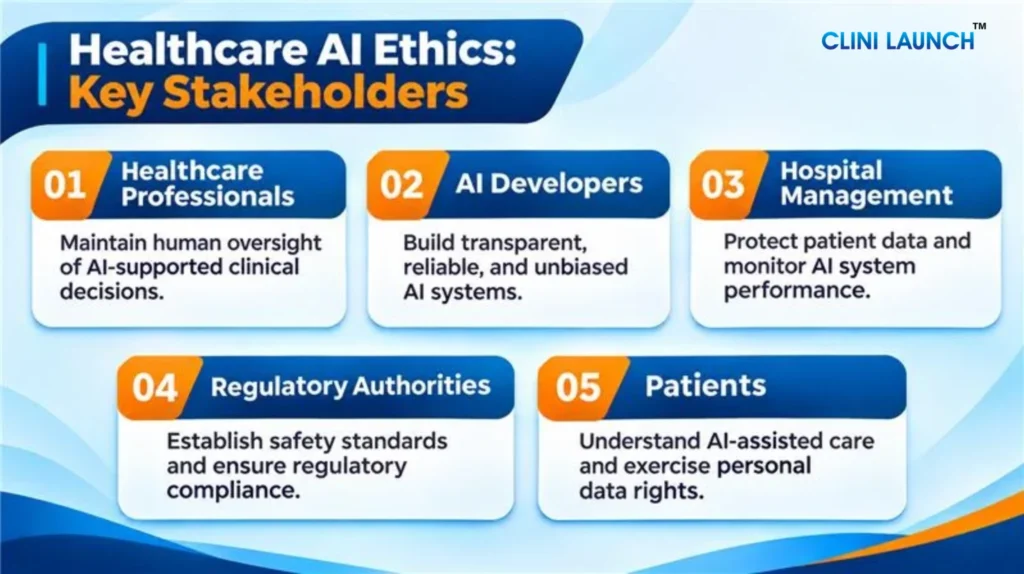
Healthcare AI Ethics: Key Stakeholders
Implementing ethical AI healthcare practices requires shared responsibility among the people and organizations involved in developing, deploying, regulating, and using medical technologies. Each stakeholder plays a distinct role in ensuring that AI systems support clinical decisions while protecting patient safety, privacy, fairness, and accountability.
1. Healthcare Providers and Clinicians
Doctors, nurses, radiologists, and other medical professionals evaluate AI-generated recommendations and apply their clinical expertise to patient care. Their involvement ensures that AI supports medical decisions without replacing human judgment.
Key Responsibilities:
- Preventing Automation Bias: Use AI as a clinical decision-support tool rather than relying blindly on its recommendations.
- Ensuring Informed Consent: Explain when AI is involved in patient assessments, diagnosis, or treatment recommendations.
- Maintaining Clinical Accountability: Evaluate AI-generated outputs and retain appropriate responsibility for clinical decisions.
2. Data Scientists and AI Developers
Data scientists, machine learning engineers, and technology providers develop and maintain healthcare AI systems. Their work influences the accuracy, fairness, and transparency of these technologies, making their contribution essential to ethical AI healthcare practices.
Key Responsibilities:
- Reducing Algorithmic Bias: Use diverse and representative datasets to minimise biased predictions across patient populations.
- Improving Transparency: Apply Explainable AI (XAI) techniques to help clinicians understand AI-generated recommendations.
- Ensuring Data Security: Protect sensitive patient information during AI development, testing, and deployment.
- Validating AI Performance: Regularly evaluate models for accuracy, reliability, and potential bias.
3. Hospital Administrators and Ethics Committees
Hospital administrators and institutional ethics committees oversee AI implementation, data governance, and ethical practices within healthcare organizations. They help maintain healthcare AI ethics beyond the development stage.
Key Responsibilities:
- Protecting Patient Data: Implement encryption, access controls, and appropriate data anonymization measures to safeguard electronic health records (EHRs).
- Establishing AI Governance: Develop policies for AI procurement, implementation, clinical use, and risk management.
- Monitoring AI Performance: Conduct regular evaluations to identify inaccurate predictions, performance deterioration, and potential bias.
- Ensuring Ethical Oversight: Review AI-supported research and assess concerns involving patient rights, privacy, and informed consent.
4. Regulatory Authorities and Policymakers
Organizations such as the US Food and Drug Administration (FDA), European Medicines Agency (EMA), and national health authorities establish requirements for healthcare AI technologies. Their oversight helps strengthen responsible AI adoption through safety standards and accountability.
Key Responsibilities:
- Establishing Regulatory Standards: Define requirements for developing, testing, and approving AI-enabled medical devices.
- Defining Accountability: Clarify responsibilities when AI-related errors affect patient care.
- Ensuring Safety and Compliance: Establish assessment and monitoring requirements to support regulatory compliance and responsible AI use.
5. Patients and the Public
Patients are central to AI ethics in healthcare because their personal information and treatment outcomes are directly affected by AI applications.
Key Responsibilities:
- Understanding AI-Assisted Care: Seek information about AI involvement in diagnosis and treatment.
- Exercising Data Rights: Understand applicable rights concerning the collection, storage, and use of personal health information.
- Participating in Informed Decisions: Discuss AI-supported recommendations with healthcare professionals and seek clarification when needed.
Challenges of Ethical AI in Healthcare: Risks to Consider
Although artificial intelligence can improve healthcare efficiency and support clinical decisions, its use also raises ethical concerns that directly affect patient safety, privacy, fairness, and trust. From protecting confidential medical records to deciding who is responsible for an AI-assisted misdiagnosis, healthcare organizations must address these risks before relying on AI ethics in healthcare in critical clinical settings.
- Data Privacy & Security: Medical algorithms require access to massive volumes of sensitive health metrics to operate effectively. However, aggregating this information creates high-stakes targets for cybercriminals. According to historical tracking from the federal HHS OCR HIPAA Breach Portal, large-scale cybersecurity incidents have compromised over one billion total healthcare records. The scale of this issue is accelerating rapidly; recent federal breach registries analyzed in the Insurance Business Magazine Data Vendor Risk Report confirm that hacking and advanced IT incidents accounted for more than 80% of all large healthcare data breaches reported.
- Algorithmic Bias & Inequity: If an algorithm is trained on data skewed toward specific demographics, it inherently outputs skewed medical decisions. This risk is incredibly high in specialized clinical fields; data published in the AIPRM AI Bias Global Index reveals that over 83% of neuroimaging-based AI models designed for psychiatric diagnoses exhibit a high risk of bias. These data omissions lead to immediate drops in diagnostic accuracy for minority demographics.
- The Black-Box Problem: Deep learning models may generate clinical recommendations without clearly explaining how they reached a conclusion. This makes it difficult for clinicians to verify AI outputs and identify model drift, where performance deteriorates after deployment.
- Accountability and Legal Liability: When AI-generated recommendations contribute to medical errors, determining responsibility can be challenging. Accountability may involve the healthcare professional, hospital, or AI developer, depending on their respective roles and responsibilities.
- Automation Bias and Skill Atrophy: Over-reliance on AI recommendations can cause clinicians to overlook their own clinical observations. Prolonged dependence on automated systems may also weaken diagnostic skills and reduce the ability to identify errors.
- Erosion of Human Compassion: True medical treatment relies on deep interpersonal trust and empathetic engagement. If diagnostic reports, triage decisions, and physician-patient messaging are fully outsourced to automated architectures, the humanistic perspective of medicine breaks down. Patients are increasingly uncomfortable with this dynamic; public opinion metrics tracked in the Nature Medicine Algorithmic Bias Study report that 60% of patients feel highly uncomfortable with AI influencing final diagnostic decisions.
AI Ethics in Healthcare: Key Regulatory Bodies and Frameworks and Their Roles
Regulatory authorities and international organizations help ensure that artificial intelligence is developed and used responsibly in healthcare. They establish guidelines, safety requirements, and data protection standards to address risks involving patient privacy, algorithmic bias, clinical accuracy, and accountability. These frameworks support responsible AI adoption and strengthen healthcare AI ethics, with requirements varying according to an AI system’s intended use and potential risks to patients.
The EU AI Act: High-Risk Healthcare Systems
The European Union’s AI Act establishes requirements for AI systems based on their risk. AI used as a medical device may be classified as high-risk when it falls within the relevant regulated-product provisions and requires third-party conformity assessment under applicable medical-device legislation. High-risk systems are subject to requirements covering risk management, data quality, technical documentation, transparency, human oversight, accuracy, and cybersecurity.
For healthcare organizations and developers, this means that AI tools must be evaluated not only for technical performance but also for their potential effects on patient safety and fundamental rights. The exact obligations depend on the system’s classification and applicable implementation timeline.
NIST AI Risk Management Framework (RMF): Putting Safety into Practice
The NIST AI Risk Management Framework provides a practical, voluntary approach to identifying and managing AI risks. Its four core functions — Govern, Map, Measure, and Manage, help organizations establish accountability, understand how and where AI is used, evaluate its performance and risks, and respond to issues throughout the system lifecycle.
In healthcare, these principles can support activities such as validating diagnostic algorithms, testing performance across patient groups, documenting limitations, assigning human oversight, and monitoring systems after deployment. Although the framework is not itself a healthcare regulation, it can help organizations structure their AI governance practices and complement applicable legal requirements.
The Foundation of Privacy Law: HIPAA and GDPR
Healthcare AI relies on sensitive patient information, making data protection laws central to its responsible use. In the United States, the Health Insurance Portability and Accountability Act (HIPAA) establishes privacy and security requirements for protected health information handled by covered entities and their business associates. Its application depends on the organization, information, and activity involved; it does not automatically cover every company’s developing or using responsible AI.
In the European Union, the General Data Protection Regulation (GDPR) governs the processing of personal data, including health data, which receives special protection. Organizations must establish an appropriate legal basis for processing, apply relevant safeguards, and meet app licable transparency, security, and data-subject rights requirements.
For ethical AI healthcare developers and providers, these laws make privacy considerations part of the entire AI lifecycle from collecting and preparing training data to deploying models and sharing results. Compliance requires more than securing databases: organizations must also consider data minimization, access controls, retention, transparency, and whether the intended use of patient information is legally permitted.
Regulating AI ethics in healthcare requires a combination of medical-device oversight, risk-management frameworks, and privacy protections. By aligning development and deployment with applicable regulations and recognized risk-management practices, healthcare organizations can support innovation while safeguarding patient safety, confidentiality, and trust.
Case Study 1: Google DeepMind & Royal Free NHS Trust
The development of the “Streams” smartphone app, designed to alert clinicians about acute kidney injury (AKI) risks, triggered a massive regulatory and legal fallout in the United Kingdom regarding data ethics.
- The Issue: The Royal Free London NHS Foundation Trust transferred vast quantities of un-anonymized medical data to Google DeepMind to build and test the clinical application. However, this massive data transfer occurred entirely without the explicit knowledge, consent, or opt-out options of the patients involved.
- The Quantitative Impact: The UK Information Commissioner’s Office (ICO) launched an official investigation and ruled that the data-sharing arrangement breached patient privacy laws. The tech firm was granted access to 1.6 Million Identifiable Patient Records annually via University of Cambridge. The scale of data collection was deemed highly excessive because only a small fraction roughly 20% of Hospital Admissions via Pharmaphorum—involve acute kidney injuries, yet the records of all patients (including routine visits, overdoses, and abortions) were shared indiscriminately.
Case Study 2: AI for Diabetic Retinopathy Screening
In contrast to data privacy and bias failures, the global deployment of autonomous AI systems for early diabetic retinopathy (DR) detection represents a highly successful blueprint for targeted clinical AI.
- The Solution: By analyzing digital fundus photographs without requiring an on-site ophthalmologist, autonomous diagnostic software has effectively democratized vision-saving screenings in low-resource and high-income settings alike.
- The Quantitative Impact: Comprehensive real-world validation studies across diverse continents demonstrate that automated systems reliably detect referable diabetic retinopathy with an outstanding 94% Diagnostic Sensitivity via Ophthalmology Advisor and an 89% specificity rate. The local impacts are even more stark in developing medical infrastructures; for example, the Artificial Intelligence Diabetic Retinopathy Screening System (AIDRSS) deployed across India achieved a perfect 100% Sensitivity for Vision-Threatening DR via PMC across test groups, successfully preventing irreversible blindness for vulnerable populations.
AI & ML in Healthcare
Explore how artificial intelligence is transforming pharmaceutical research, from identifying potential drug targets to predicting molecular properties and evaluating drug safety. Develop relevant knowledge in machine learning, healthcare data analysis, and predictive modelling to understand how AI-driven technologies support data-informed research and healthcare innovation.
View CourseConclusion
AI ethics in healthcare is essential to ensuring that technological innovation supports safe, fair, and responsible patient care. While AI is transforming diagnostics, clinical decision-making, and drug discovery, challenges involving data privacy, algorithmic bias, transparency, and accountability highlight the need for responsible AI adoption. For beginners exploring this field, developing knowledge of healthcare processes, clinical research, data management, AI fundamentals, and regulatory frameworks can provide a strong foundation for understanding ethical AI healthcare practices and emerging career opportunities.
At CliniLaunch Research Institute, aspiring healthcare professionals can build relevant industry knowledge through training in Clinical Research, Clinical SAS, Biostatistics, Bioinformatics, and AI & ML in Healthcare. With industry-oriented learning and career-focused guidance, CLRI helps learners develop skills relevant to the evolving healthcare and life sciences sectors, preparing them to explore opportunities in healthcare AI governance, clinical validation, compliance, and data privacy.
FAQs:
What is AI ethics in healthcare?
AI ethics in healthcare refers to the principles that ensure artificial intelligence is used safely, fairly, transparently, and responsibly in medical settings while protecting patient rights and well-being.
Why is healthcare AI ethics important?
Healthcare AI ethics helps protect patient privacy, reduce algorithmic bias, improve clinical accountability, and ensure AI-supported decisions prioritize patient safety.
What are the main ethical challenges of AI in healthcare?
The main challenges include data privacy and security, algorithmic bias, lack of transparency, legal liability, automation bias, and the risk of reduced human interaction in patient care.
What is ethical AI in healthcare?
Ethical AI in healthcare involves developing and using AI systems that respect patient autonomy, promote fairness, protect sensitive information, and support evidence-based clinical decisions.
How can healthcare organizations implement responsible AI?
Healthcare organizations can implement responsible AI by validating AI systems, using representative datasets, protecting patient information, monitoring performance, and maintaining appropriate human oversight.
How does algorithmic bias affect AI ethics in healthcare?
Algorithmic bias can lead to inaccurate diagnoses or unequal treatment recommendations for underrepresented patient groups. Diverse training data and regular performance evaluations can help reduce these disparities.
Which regulations support responsible AI in healthcare?
Regulations and frameworks supporting responsible AI include the EU AI Act, applicable U.S. FDA medical-device requirements, HIPAA in the United States, GDPR in the European Union, and the NIST AI Risk Management Framework.
What career opportunities are available in AI ethics in healthcare?
Career opportunities include healthcare AI governance specialist, clinical AI validation analyst, AI compliance specialist, medical-device regulatory affairs professional, and healthcare data privacy specialist. These roles help ensure AI systems meet ethical, safety, and regulatory requirements.