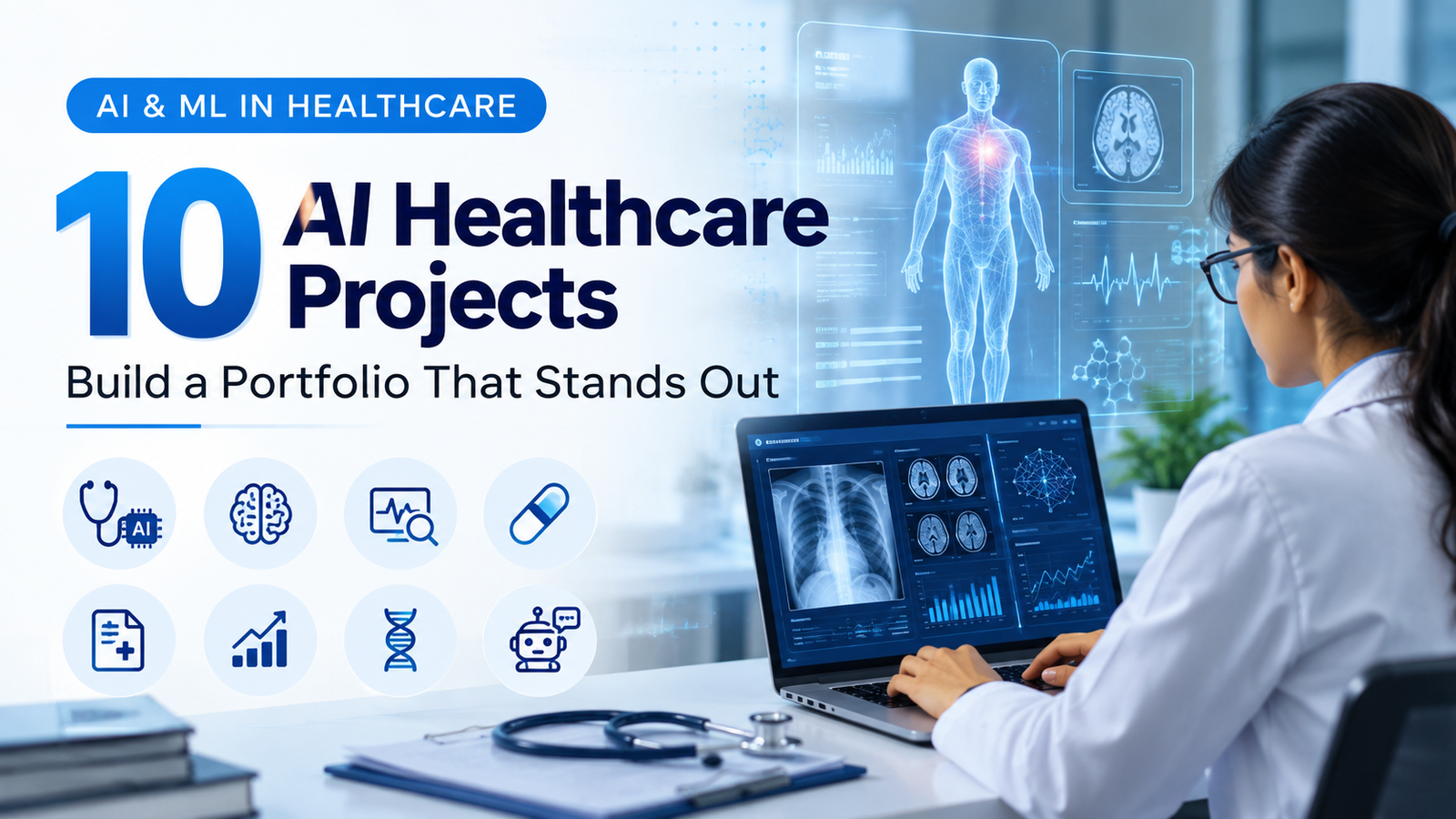
An AI healthcare portfolio showcases your ability to apply AI and machine learning to real healthcare challenges. It should include projects in areas like medical imaging, NLP, predictive analytics and generative AI, while demonstrating skills in healthcare data handling, model evaluation and responsible AI development.
For students and freshers aiming for a career in healthcare AI, AI healthcare projects can help demonstrate the ability to apply AI skills to real healthcare challenges. Employers look beyond knowledge of Python, machine learning, or deep learning and value candidates who can build meaningful solutions.
Healthcare organizations are increasingly using AI for medical diagnosis, drug discovery, clinical decision support, disease monitoring, and automation, creating opportunities across roles such as Healthcare AI Engineer, Clinical AI Analyst, and Healthcare Data Scientist.
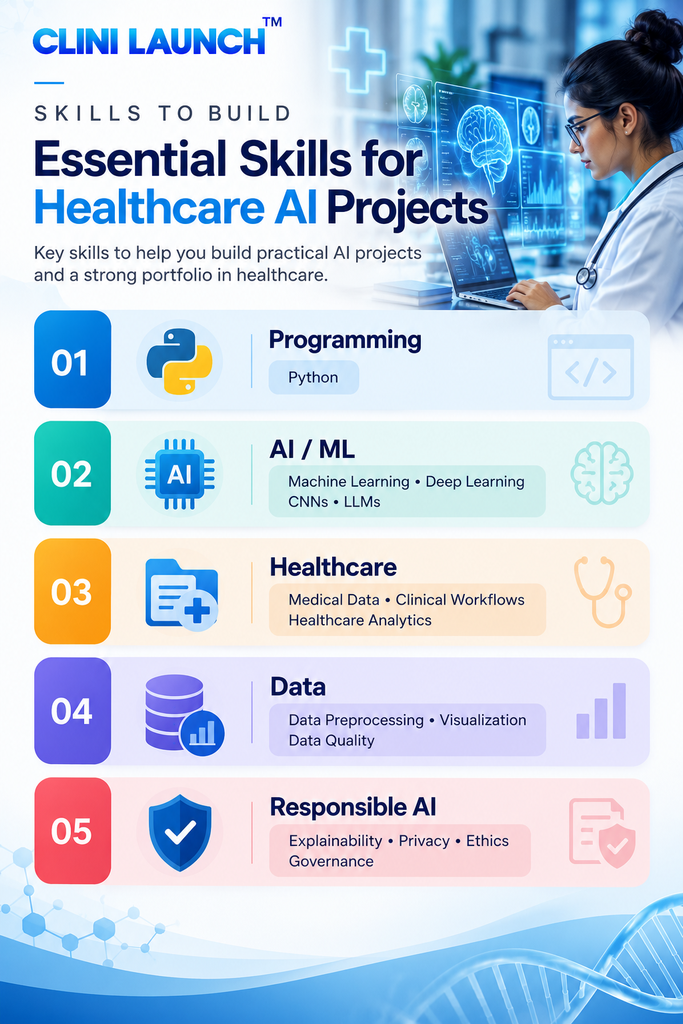
A strong healthcare AI portfolio should go beyond generic machine learning projects. It should showcase skills in handling medical data, understanding clinical workflows, applying relevant evaluation metrics, building explainable AI systems, and following responsible AI practices.
In this guide, we explore 10 AI healthcare projects across beginner and advanced levels to help you build a portfolio that demonstrates both technical expertise and healthcare understanding.
Recent guidance from the WHO also highlights the importance of safety, ethics and governance as AI becomes more widely used in healthcare.
Why Healthcare AI Portfolios Are More Challenging
A healthcare AI portfolio is different from a typical machine learning portfolio because healthcare problems require more than just building a model and achieving a high accuracy score. AI solutions in healthcare must work with complex medical data, support real clinical needs, and follow strict standards around safety, privacy and ethics.
- Healthcare Data Is More Complex Than Traditional Datasets
Most beginner healthcare AI projects use simple CSV datasets, but healthcare AI involves specialized formats such as DICOM for medical images, FHIR for exchanging electronic health information and unstructured clinical text from medical records. Understanding these formats helps demonstrate that you can work with real-world healthcare data environments.
For example, an AI project analyzing X-rays requires handling medical images, while a clinical prediction model may require working with patient histories, lab reports and electronic health records.
- Accuracy and Explainability Matter More
In healthcare, a model’s output can influence clinical decisions, making accuracy, reliability and explainability critical. A model that misses a disease case (false negative) can create serious risks, which is why healthcare AI projects often focus on sensitivity, validation and explainable AI (XAI) techniques.
A more responsive framework, developed in consultation with clinicians, MedTech companies and regulators, can help India adopt AI-enabled technologies faster while maintaining patient safety and clinical standards.
- Ethics, Privacy and Compliance Are Essential
Healthcare data contains highly sensitive patient information, so AI developers must understand basic compliance principles. Regulations such as HIPAA in the United States and GDPR in Europe focus on protecting personal health data, ensuring secure handling and maintaining patient privacy.
As AI becomes more common in healthcare, privacy-preserving approaches and responsible AI practices are gaining attention. Recent research and industry discussions highlight the growing importance of secure data practices while developing AI-powered healthcare solutions.
AI healthcare workflows should perform reliably in real clinical environments. For example, a 2026 study analyzing deployed clinical AI systems found that performance observed during validation may change after real-world implementation, highlighting the need for ongoing monitoring and evaluation. (PLOS Digital Health, 2026)
Building an AI Healthcare Portfolio – Types of Projects to Include
A strong AI healthcare portfolio should not contain random machine learning healthcare projects. The projects you choose should reflect areas where healthcare organizations are actively applying AI and should demonstrate skills relevant to specific roles.
| AI Healthcare Project Area | Skills You Demonstrate | Healthcare Applications | Related Job Roles |
| Computer Vision (CV) | Deep Learning, CNNs, Medical Image Processing, Image Classification, Segmentation | X-ray analysis, MRI/CT scan analysis, Disease detection, Medical image interpretation | Medical AI Engineer, Computer Vision Engineer, AI Research Associate |
| Natural Language Processing (NLP) | NLP, Language Models, Text Classification, Information Extraction, Clinical Text Processing | Clinical notes analysis, EHR processing, Medical report summarization, Biomedical research analysis | Healthcare NLP Engineer, Clinical Data Scientist, Medical AI Analyst |
| Predictive Analytics | Machine Learning, Data Analysis, Feature Engineering, Risk Prediction, Model Evaluation | Patient risk prediction, Readmission prediction, Disease progression analysis, Healthcare operations analytics | Healthcare Data Scientist, Clinical AI Analyst, Healthcare Analytics Specialist |
| Generative AI & LLM-Based Projects | Large Language Models, RAG Systems, Prompt Engineering, AI Application Development | Medical assistants, Clinical documentation support, Medical literature search, Automated medical coding | Healthcare AI Engineer, Generative AI Developer, AI Solutions Specialist |
Including projects from these areas helps you build a portfolio aligned with real healthcare AI applications. A well-balanced portfolio demonstrates that you understand not only AI techniques but also how these technologies are applied to solve healthcare challenges.
Healthcare Data Fundamentals
Gain industry-ready skills to secure real-world systems. Learn ethical hacking, network defense, and threat detection with a strong focus on hands-on labs, compliance, and globally recognized certification standards.
View CourseTop 10 AI Healthcare Projects for Your Portfolio
- Pneumonia Classification from Chest X-Rays (Computer Vision)
This project focuses on building a deep learning model to classify chest X-ray images and identify patterns associated with pneumonia. It helps you understand medical image processing, convolutional neural networks (CNNs), image classification and evaluation techniques used in healthcare AI.
Chest X-ray analysis is one of the widely researched areas in medical AI, with studies exploring deep learning models for detecting pneumonia and other abnormalities from radiology images. The CheXNet research from Stanford demonstrated how deep learning models can be trained on large chest X-ray datasets to detect pneumonia-related patterns.
- Categorizing Unstructured Clinical Notes Using NLP (BioBERT)
Healthcare records contain large amounts of unstructured text, including clinical notes, medical reports and patient histories. In this project, you can build an NLP model using healthcare-focused language models like BioBERT to classify and extract information from medical text.
This project demonstrates your ability to work with clinical language data and apply natural language processing techniques in healthcare settings.
- Cardiovascular Disease Risk Predictor (Tabular Data/XGBoost)
This project involves creating a machine learning model that predicts cardiovascular disease risk using structured healthcare data. It helps you understand feature selection, model evaluation and predictive analytics using patient health information.
Tree-based machine learning models such as XGBoost are widely used for prediction tasks because of their performance with structured datasets.
- Brain Tumor Segmentation on MRI Scans (U-Net & MONAI)
This project focuses on segmenting brain tumor regions from MRI images using deep learning architectures such as U-Net. It introduces more advanced medical imaging concepts like image segmentation, annotation and model evaluation.
Frameworks like MONAI are designed specifically to support deep learning workflows for healthcare imaging applications.
- Clinical Voice-to-Text Transcriber (Whisper API & NER)
Healthcare professionals generate large amounts of clinical documentation, making speech recognition an important area for automation. This project involves converting medical conversations into text and extracting important information using Named Entity Recognition (NER).
It helps demonstrate skills in speech processing, NLP pipelines and healthcare documentation workflows.
- Hospital Readmission Predictor Dashboard (Streamlit & SHAP)
This project combines predictive analytics with data visualization by creating a dashboard that estimates patient readmission risks. Adding explainability tools like SHAP helps users understand which factors influence model predictions.
Explainable AI techniques are increasingly important for making healthcare AI systems more transparent and easier to interpret.
- Synthetic Medical Patient Record Generator (Privacy-Focused GANs)
Healthcare AI development often requires large datasets, but accessing real patient information can be challenging due to privacy concerns. This project explores generating synthetic medical records using techniques such as Generative Adversarial Networks (GANs).
Synthetic data can support AI development while reducing risks associated with using sensitive healthcare information.
- Medical Literature RAG Chatbot (LangChain & Vector Databases)
This project focuses on building a healthcare-focused chatbot that retrieves information from medical literature instead of relying only on pre-trained knowledge. Using Retrieval-Augmented Generation (RAG) helps improve accuracy and reduce incorrect responses.
RAG-based systems are increasingly used to improve the reliability of domain-specific AI applications.
- AI Medical Coding Automation (LLMs & ICD-10 Mapping)
Medical coding involves converting clinical documentation into standardized codes used for healthcare billing and records. This project explores how large language models can assist in mapping medical text to coding systems such as ICD-10.
It demonstrates your understanding of healthcare workflows, clinical terminology and language model applications.
- Real-Time Skin Lesion Detection App (Edge AI Using TensorFlow Lite)
This project focuses on deploying an AI model that can detect skin lesions through a mobile or edge device. It combines computer vision with model optimization techniques for real-time healthcare applications.
TensorFlow Lite enables machine learning models to run efficiently on mobile and embedded devices.
AI Healthcare Projects – What Your Portfolio Must Include
A strong AI healthcare portfolio should demonstrate more than your ability to build machine learning models. It should show that you understand how healthcare AI systems are evaluated, interpreted, and developed responsibly while considering clinical requirements and patient safety.
1. Focus on Healthcare-Specific Performance Metrics
Healthcare AI projects require better evaluation methods that go beyond basic accuracy. Metrics such as Sensitivity (Recall), Specificity and F1-score help measure how effectively a model identifies medical conditions and performs across different prediction outcomes. These metrics are widely used in medical AI studies to assess diagnostic performance and reliability.
Key Healthcare AI Performance Metrics
| Metric | What It Measures | Why It Matters in Healthcare AI |
| Sensitivity (Recall) | Ability to correctly identify positive cases | Helps detect patients with a disease and reduce missed diagnoses |
| Specificity | Ability to correctly identify negative cases | Helps reduce false alarms and unnecessary medical interventions |
| Precision | Accuracy of positive predictions | Ensures predicted disease cases are more likely to be correct |
| F1-Score | Balance between precision and sensitivity | Useful when healthcare datasets have fewer positive cases |
| AUC-ROC | Ability of the model to distinguish between outcomes | Evaluates overall classification performance across different thresholds |
| Calibration | How closely predicted risks match actual outcomes | Helps build reliable AI systems for clinical decision support |
2. Include Explainable AI (XAI) Techniques
Explainable AI is becoming increasingly important in healthcare because transparency and interpretability are essential for building trustworthy AI systems.
Recruiters Look Beyond: “Did the Model Predict Correctly?”
They also want to know:
“Can you explain why the model made that prediction?”
Techniques such as SHAP (SHapley Additive Explanations) and Grad-CAM (Gradient-weighted Class Activation Mapping) help explain AI predictions by identifying important features or areas influencing model decisions.
3. Demonstrate Compliance and Privacy Awareness
Healthcare AI Is Not Only About Building Models — It Is Also About Protecting Data. Healthcare projects involve sensitive patient information, which makes privacy and responsible data handling essential.
Understanding frameworks such as HIPAA (US) and GDPR (Europe) demonstrate awareness of healthcare data protection requirements. The World Health Organization has highlighted the importance of governance and safety while implementing AI technologies in healthcare.
Conclusion
AI skills are becoming increasingly valuable across healthcare and life sciences, creating demand for professionals who can combine domain knowledge with emerging technologies. Building practical projects can help learners demonstrate their ability to apply AI concepts in industry-focused scenarios.
At CliniLaunch Research Institute, we help learners develop this combination through structured training, hands-on projects, and practical exposure to healthcare AI applications. Our approach focuses on building the technical and domain skills needed to work on technology-driven healthcare solutions.
Frequently Asked Questions
1. What are beginner-friendly AI healthcare projects?
Beginner projects include chest X-ray classification, disease prediction, patient risk analysis, and clinical text classification models.
2. Why build AI projects in healthcare?
AI healthcare projects help learners gain practical skills and understand real-world healthcare technology applications.
3. Which healthcare AI projects are suitable for machine learning beginners?
Beginners can explore disease prediction, medical image classification, cardiovascular risk prediction, and patient readmission prediction projects.
4. What skills are needed for machine learning healthcare projects?
Skills include Python, machine learning, data preprocessing, model evaluation, visualization, and healthcare data understanding.
5. Which AI projects are suitable for life science graduates?
Life science graduates can explore medical imaging, drug discovery, bioinformatics, clinical NLP, and healthcare analytics projects.
6. How do AI healthcare projects strengthen portfolios?
They demonstrate practical problem-solving skills, healthcare understanding, AI expertise, and ability to develop industry-focused solutions.
7. What advanced AI projects can be built in healthcare?
Advanced projects include RAG chatbots, medical coding automation, image segmentation, and synthetic healthcare data generation.
8. Where can learners build AI healthcare projects?
Learners can build AI healthcare projects through programs combining healthcare knowledge, AI skills, and practical project experience.