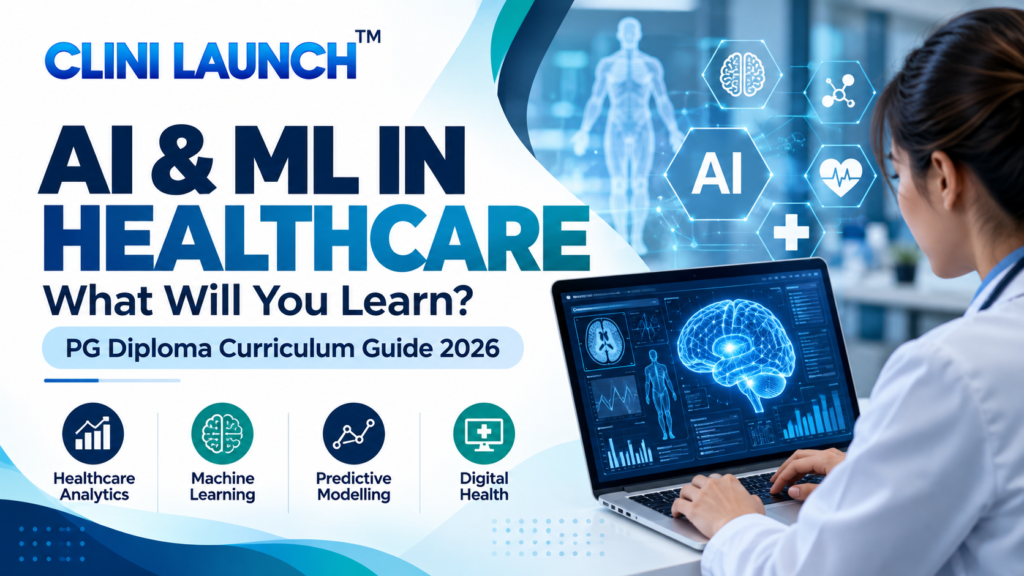
An AI & ML Healthcare Course Curriculum covers artificial intelligence, machine learning, healthcare analytics, and digital health applications. A PG Diploma in AI ML Healthcare includes modules such as healthcare data analytics, EHR, biostatistics, predictive modelling, data visualization, digital health, and wearable technology. It helps professionals develop skills to apply AI solutions in clinical decision-making, healthcare analytics, and digital healthcare innovation.
Healthcare is increasingly relying on artificial intelligence, machine learning, and data analytics to improve clinical decision-making, streamline hospital operations, and support data-driven care. As digital health records and AI-assisted technologies become more prominent, healthcare organizations need professionals who can understand both these technologies and the complexities of healthcare data. An AI & ML Healthcare PG Diploma helps bridge this gap by combining technical knowledge with healthcare-specific applications, data privacy considerations, and responsible AI practices.
A 2024 report by Government of India emphasizes the importance of developing AI-ready talent to support innovation across industries, including healthcare.
As healthcare continues to integrate AI into clinical and operational workflows, understanding how these technologies work in real-world settings is becoming increasingly important. An AI & ML Healthcare PG Diploma provides a structured learning pathway to develop this understanding. Let’s explore the curriculum, key subjects, and practical skills covered in the program.
Growing Scope of AI-Driven Healthcare Careers
Healthcare AI is expanding beyond research environments into practical applications such as medical imaging, clinical decision support, remote monitoring, and personalized healthcare. This highlights the increasing use of AI-enabled medical technologies and digital health solutions in healthcare delivery.
With healthcare organizations investing in AI healthcare course adoption, professionals who understand both machine learning techniques and healthcare workflows can contribute to building safer, smarter, and more efficient healthcare systems. A AI and ML healthcare course curriculum provides the foundation required to explore careers at the intersection of technology, medicine, and innovation.
AI is already influencing healthcare workflows in India. According to the Philips Future Health Index findings reported in 2026, 71% of surveyed healthcare professionals in India reported that AI increased their capacity to see more patients, showing the growing role of AI in supporting healthcare delivery.
How an AI & ML Healthcare PG Diploma Prepares You for the Industry
An AI & ML Healthcare PG Diploma helps learners connect technical concepts with healthcare applications, while developing an understanding of medical data, responsible AI, and the practical considerations involved in implementing AI solutions in healthcare settings.
1. Understand the complexity of healthcare data
Healthcare data includes clinical records, medical images, laboratory results, and other information that may be difficult to analyze using conventional methods alone. Specialized training helps learners understand how AI and ML approaches can be applied to different healthcare data types.
2. Explore AI applications in clinical and hospital settings
AI can support applications such as medical image analysis, patient risk prediction, clinical decision support, resource planning, and administrative automation. Understanding these use cases helps learners connect technical concepts with healthcare needs.
3. Understand AI in digital healthcare systems
Initiatives such as India’s Ayushman Bharat Digital Mission are advancing the digitization and exchange of health information. Learners can benefit from understanding how structured health data, analytics, and machine learning relate to the development of connected healthcare systems.
4. Recognize healthcare data privacy and regulatory requirements
Healthcare AI requires careful handling of sensitive information, model validation, and attention to bias and explainability. Specialized learning helps learners recognize why these considerations matter when developing or evaluating AI solutions in clinical environments.
5. Build a foundation for interdisciplinary career pathways
Combining AI and ML knowledge with healthcare applications can help learners explore relevant areas such as healthcare analytics, clinical data science, digital health, and healthcare AI implementation, depending on their prior qualifications and technical proficiency.
Core Technical Modules in AI and ML healthcare Course Curriculum
An AI & ML Healthcare PG Diploma is structured to build expertise across healthcare data, artificial intelligence, machine learning, and digital health technologies. As healthcare organizations increasingly rely on electronic health records (EHRs), medical devices, and real-time patient data, professionals need the ability to analyze complex healthcare information and convert it into meaningful clinical and operational insights. According to the Organisation for Economic Co-operation and Development (OECD), the widespread adoption of EHR systems has significantly increased the availability of digital healthcare data, creating a need for skilled healthcare data professionals.
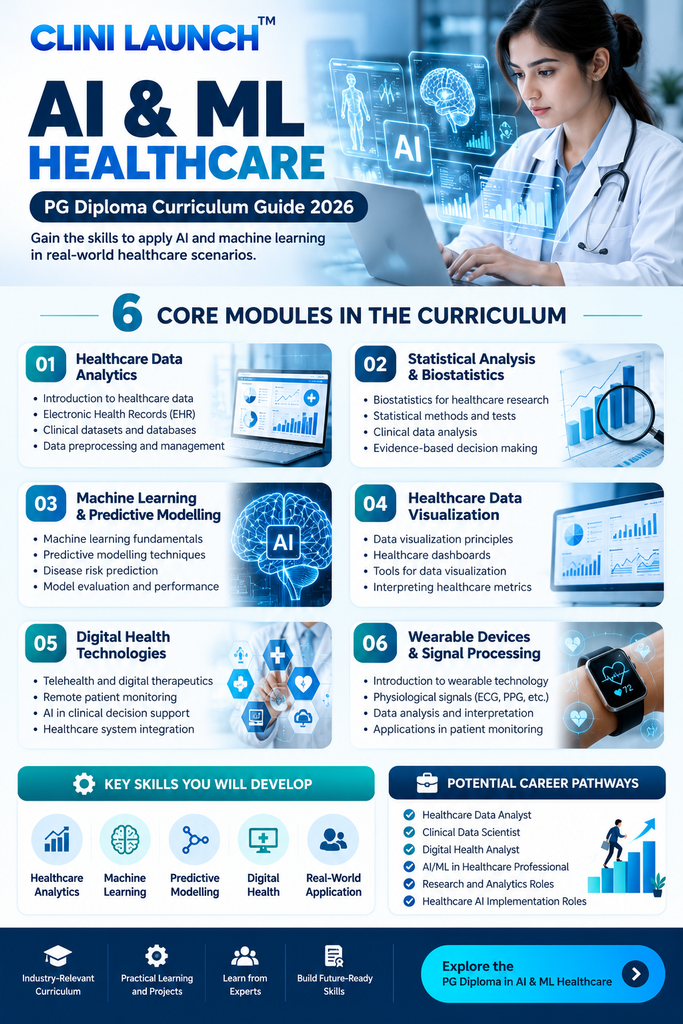
The core technical AI ML healthcare syllabus of this program introduces learners to the complete healthcare AI workflow, from understanding healthcare datasets and applying statistical methods to developing predictive models, creating data visualizations, and exploring emerging digital health innovations.
| Core Module | Key Learning Areas | Healthcare Applications |
| Fundamentals of Healthcare Analytics and Data | Learn healthcare data types, Electronic Health Records (EHRs), clinical datasets, and healthcare database structures. Understand how healthcare information is collected, stored, and managed. | Analyzing patient records, clinical data, and healthcare operations data to support better decision-making. |
| Statistical Analysis and Business Insights in Healthcare | Apply biostatistics, data analysis methods, and statistical techniques to identify patterns and interpret healthcare outcomes. | Supporting evidence-based decisions, improving hospital operations, and evaluating healthcare performance. |
| Predictive Modelling and Machine Learning in Healthcare | Build machine learning models using regression, classification, and advanced algorithms to identify trends and predict outcomes. | Predicting disease risks, patient deterioration, readmission probability, and treatment outcomes. Research published in highlights the growing application of machine learning models in healthcare prediction and decision-support systems. |
| Healthcare Data Visualization and Emerging AI Trends | Convert complex healthcare metrics into interactive dashboards using tools such as Tableau and Power BI. Explore recent developments in healthcare AI and analytics. | Creating healthcare dashboards, tracking clinical indicators, and helping healthcare leaders make data-driven decisions. The emphasizes the importance of digital technologies and data-driven healthcare systems. |
| Digital Health – Introduction | Understand the foundations of digital healthcare, including telehealth, digital therapeutics, remote monitoring, and connected healthcare ecosystems. | Supporting virtual consultations, remote care delivery, and technology-enabled patient engagement. The recognize digital health as an important component of modern healthcare transformation. |
| Wearable Devices and Physiological Signal Processing | Learn how healthcare professionals analyze continuous data streams from wearable devices, including ECG, PPG, heart rate, and other physiological signals. | Enabling remote patient monitoring, early detection of health risks, and personalized healthcare interventions. The highlights the increasing role of wearable and digital health technologies in healthcare delivery. |
By covering these technical foundations, an AI & ML Healthcare PG Diploma helps professionals understand how healthcare data moves from collection → analysis → prediction → clinical application. This combination of AI skills and healthcare knowledge prepares professionals to contribute to areas such as healthcare analytics, clinical AI solutions, digital health platforms, and intelligent healthcare management.
Career Opportunities with a PG Diploma AI ML Healthcare
The combination of artificial intelligence, machine learning, and healthcare expertise is creating new career pathways across hospitals, pharmaceutical companies, health-tech organizations, and research institutions. As healthcare moves toward data-driven decision-making, organizations are looking for professionals who can analyze healthcare data, develop AI-based solutions, and support digital transformation initiatives.
A PG Diploma in AI & ML Healthcare prepares professionals for diverse roles where they can contribute to areas such as healthcare analytics, clinical AI applications, medical technology, and digital health product development.
High-Demand Career Roles After PG diploma AI ML healthcare
| Career Role | Key Responsibilities | Skills Required | Work Areas |
| Health Data Analyst | Analyze healthcare datasets, identify trends, create reports, and support data-driven healthcare decisions. | Healthcare analytics, SQL, statistics, data visualization, Power BI/Tableau | Hospitals, health-tech companies, insurance providers, research organizations |
| Clinical AI Engineer | Develop and implement AI/ML models for healthcare applications such as diagnostics, risk prediction, and clinical decision support. | Machine learning, Python, healthcare data processing, model development | AI healthcare companies, medical technology firms, research institutions |
| Digital Health Product Manager | Manage the development of digital healthcare solutions by connecting healthcare requirements with technology teams. | Healthcare domain knowledge, product strategy, communication, user research | Digital health startups, healthcare platforms, technology companies |
| Bio-Signal Analytics Specialist | Analyze physiological data from medical devices and wearables, including ECG, PPG, and remote monitoring signals. | Signal processing, machine learning, wearable technology, data analysis | Medical device companies, remote monitoring platforms, healthcare research labs |
AI and ML Healthcare
Develop expertise in healthcare artificial intelligence, machine learning, data analytics, and AI-driven healthcare solutions through industry-focused training. This program helps learners understand healthcare data, build analytical capabilities, and apply AI techniques across areas such as clinical research, medical diagnostics, healthcare analytics, and digital health innovation.
View CourseConclusion
Artificial Intelligence and Machine Learning are transforming healthcare by supporting data-driven decision-making, predictive analysis, personalized care, and efficient hospital operations. As healthcare organizations adopt these technologies, professionals need to understand both AI techniques and their applications in healthcare. Specialized training helps bridge this gap by connecting technical knowledge with clinical and operational requirements.
At CliniLaunch Research Institute, the AI & ML Healthcare PG Diploma is designed to help learners develop an understanding of healthcare analytics, machine learning, predictive modelling, and emerging digital health technologies. By combining technical learning with healthcare-focused applications, the program helps learners build a foundation for exploring opportunities in healthcare analytics, digital health, and AI-enabled healthcare innovation.
FAQs
1. What is included in the AI and ML healthcare course curriculum?
The curriculum covers healthcare analytics, AI fundamentals, machine learning, predictive modelling, data visualization, digital health technologies, and clinical applications.
2. What topics are covered in a PG Diploma AI ML Healthcare program?
Topics may include healthcare data management, biostatistics, machine learning, predictive analytics, medical data analysis, digital health, and healthcare innovation.
3. How is an AI healthcare course different from a regular AI and ML program?
An AI healthcare course applies AI and ML concepts to clinical data analysis, patient risk prediction, medical imaging, and healthcare operations.
4. What skills can I learn from an AI ML healthcare syllabus?
You can develop skills in healthcare analytics, Python programming, statistical analysis, machine learning, predictive modelling, and data visualization.
5. Who can enroll in an AI healthcare diploma program?
Healthcare professionals, life science graduates, biotechnology and pharmacy graduates, healthcare managers, and technology professionals may be eligible, depending on admission criteria.
6. Does the AI and ML healthcare course curriculum include practical projects?
Practical components may include healthcare dataset analysis, predictive modelling, visualization exercises, and applied projects, depending on the program curriculum.
7. What career opportunities are available after completing a PG Diploma AI ML Healthcare program?
Potential pathways include healthcare analytics, health data analysis, digital health, clinical data science, and AI-focused roles, depending on skills and experience.
8. Why is learning AI and ML healthcare syllabus important for future healthcare careers?
It helps learners understand AI applications in diagnosis, patient monitoring, predictive analytics, and healthcare operations as digital adoption expands.