
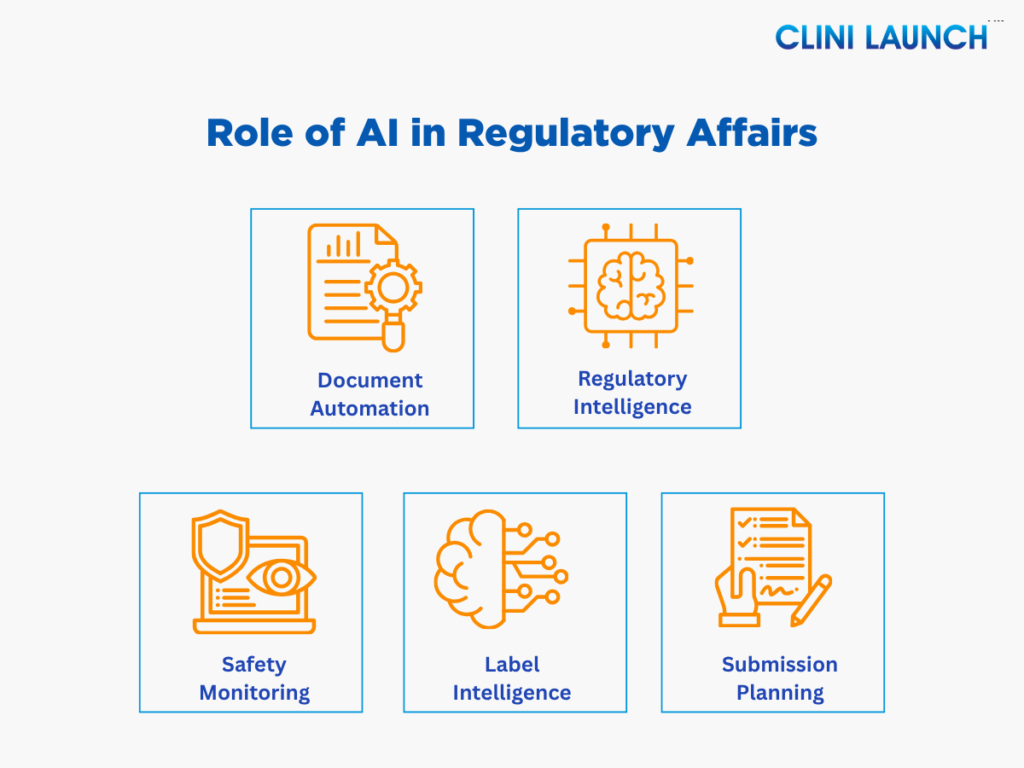
AI in regulatory affairs plays key roles in automating documentation, tracking global regulations, monitoring safety data, and supporting submission planning. It shifts regulatory affairs from reactive compliance to proactive, data-driven decision-making, helping organizations manage growing regulatory complexity with greater speed and confidence.
AI in Regulatory Affairs at a Glance
| Aspect | AI Impact |
| Documentation | Automated documentation and validation |
| Compliance | Real-time compliance monitoring |
| Regulatory Intelligence | AI-powered monitoring of regulatory updates |
| Submission Planning | Predictive planning and timeline insights |
| Safety Monitoring | AI-driven safety signal detection |
Artificial intelligence is transforming healthcare from drug discovery and clinical trials to pharmacovigilance and precision medicine. As AI adoption grows, regulatory affairs is also evolving. The pharmaceutical AI market is projected to exceed $18 billion by 2030, reflecting rapid adoption across research, development, and regulatory functions. Meanwhile, regulatory complexity continues to rise, with the FDA’s Center for Drug Evaluation and Research (CDER) receiving more than 310,000 electronic regulatory submissions in 2024. At the same time, regulatory agencies worldwide continue to approve thousands of medicines, biologics, and medical devices each year, increasing the volume of documentation and compliance activities organizations must manage. AI in regulatory affairs helps automate documentation, monitor regulatory changes, strengthen compliance, and improve submission planning. As regulatory demands continue to grow, AI is becoming essential for faster, more informed regulatory decision-making. To understand how AI is applied in real-world healthcare and regulatory environments, explore our Advanced Certificate in Healthcare AI & Analytics from CliniLaunch Research Institute.
Why Regulatory Affairs Needs AI
For decades, regulatory affairs relied on manual documentation, paper-based submissions, and human-intensive review a system that was slow, costly, and increasingly unsustainable.
A typical NDA submission contains anywhere from a huge number of pages of clinical, preclinical, and manufacturing data all compiled and cross-referenced manually. The operational burden was enormous:
- Version control failures — data scattered across disconnected systems and spreadsheets
- High error rates — the FDA issued Complete Response Letters (CRLs) to nearly 17% of NDA submissions due to data inconsistencies
- Slow timelines — a standard submission cycle took 12 to 18 months, often longer for multi-market filings
- High cost — FDA Review and submission costs alone run $2–3 million per NDA application— and addressing regulatory concerns post-submission can escalate costs considerably.
- Siloed teams — clinical, pharmacovigilance, and medical writing functions worked in isolation, creating redundancies and delays
According to the FDA’s Electronic Submissions Gateway (ESG) statistics, CDER alone received over 310,000 regulatory submissions in 2024 (a number that has more than doubled since 2014 and continues to grow year on year).
The reality is clear: growing data volumes, multiplying global regulations, and shrinking timelines have created an efficiency gap that manual processes can no longer close and that gap is exactly where AI is stepping in.
Evolution of Regulatory Affairs
Role of AI in Regulatory Affairs
AI performs multiple functional roles across the workflow, each addressing a specific operational challenge. At a deeper level, AI functions as an operational layer embedded within regulatory workflows, augmenting how data is interpreted, decisions are made, and submissions are executed. Each role it performs is tied to a specific challenge in regulatory affairs from managing data overload to ensuring compliance across global markets.
1. Intelligent Document Management and Dossier Automation
Quick Answer: AI automates document preparation, validation, and review, improving accuracy and reducing submission time.
AI plays the role of an intelligent document processor by performing gap analysis and formatting reducing dossier preparation time by up to 70% (Veeva Systems). NLP engines scan thousands of pages for inconsistencies and errors that human reviewers miss under deadline pressure.
- Companies using platforms like Veeva Vault RIM have reduction in document preparation time, especially in eCTD submissions.
- AI-assisted authoring tools can reduce manual review cycles by nearly 30–40%, improving submission consistency.
This is especially valuable in large-scale submissions where maintaining consistency across thousands of pages is critical for regulatory acceptance.
For example, during large-scale global submissions, pharmaceutical companies use AI-powered platforms to automatically compile and validate thousands of documents across regions, significantly reducing manual coordination efforts and submission errors.
Case Study: GE Healthcare & Veeva Vault RIM
Challenge: Managing regulatory submissions across 130 global markets with manual, time-consuming workflows.
Solution: Adopted Veeva Vault RIM to automate document management and regulatory workflows.
Result: Regulatory activity record creation dropped from hours to just 5 minutes, while automated reporting saved 200+ hours annually, improving submission efficiency and reducing manual effort.
2. Regulatory Intelligence and Literature Review
Quick Answer: AI tracks global regulatory updates in real time, helping teams stay compliant with evolving guidelines.
AI continuously monitors global agencies — FDA, EMA, PMDA, CDSCO for guideline updates in real time, mapping changes directly to a company’s active submissions and pipelines. What once took a team days now takes minutes.
- AI-driven regulatory intelligence tools can process thousands of global guideline updates annually, helping teams stay aligned across regions like FDA, EMA, and PMDA.
- Some pharma companies report 50% faster regulatory impact analysis using AI-based monitoring systems.
This ensures that organizations remain aligned with evolving global requirements, particularly in multi-region submissions where regulatory variations can impact approval timelines.
In highly regulated environments, even minor changes in guidelines can impact submission strategies. AI systems not only track these updates but also contextualize them against ongoing projects, enabling regulatory teams to assess impact instantly and adjust documentation or strategy without delays.
Case Study: Moderna Strengthens Regulatory Intelligence
Challenge: Keeping pace with rapidly evolving global regulatory requirements across multiple health authorities.
Solution: Moderna established a structured Regulatory Intelligence (RI) program that continuously monitors guidance from agencies such as the FDA and EMA, enabling faster assessment of regulatory changes.
Result: The program improved regulatory decision-making, strengthened compliance, and allowed teams to respond more quickly to evolving global requirements.
3. Pharmacovigilance and Safety Signal Detection
Quick Answer: AI analyzes safety data to identify adverse event signals faster and support timely regulatory action.
The FDA’s FAERS database receives over 2 million adverse event reports annually. AI processes this data at scale using industry-standard systems such as Oracle Argus Safety, MedDRA for adverse event coding, and E2B(R3) reporting standards to detect safety signals, patterns, and causality associations faster and more accurately than manual case review.
- AI-based safety systems enable faster and earlier detection of safety signals compared to traditional manual methods, improving the speed and accuracy of risk identification.
This is crucial in early risk identification, where faster signal detection can directly influence patient safety outcomes and regulatory actions.
Case Study: UCB Improves Safety Signal Detection with AI
Challenge: UCB needed to process growing volumes of global safety reports while improving the speed and consistency of adverse event detection.
Solution: UCB implemented Accenture INTIENT™ Pharmacovigilance, an AI-powered platform that automates safety case processing and analyzes structured and unstructured safety data.
Result: The platform accelerated adverse event processing, improved reporting accuracy and consistency, and enabled faster identification of potential safety signals while supporting regulatory compliance.
4. Labelling and Label Intelligence
Quick Answer: AI compares and validates product labels to ensure consistency across global regulatory markets.
Why labeling matters: Accurate and consistent drug labels are essential for regulatory compliance, patient safety, and meeting country-specific regulatory requirements.
AI compares label content against source documents, flags inconsistencies, and tracks label variations across global markets, replacing months of manual cross-referencing across multiple regulatory jurisdictions.
- Global pharmaceutical companies manage multiple country-specific label variations due to differences in regulatory requirements, languages, and safety updates, making consistency and comparison of a complex process.
- AI reduces manual label reconciliation efforts by automating comparison and consistency checks across multiple regional labels, a process that becomes increasingly complex in global submissions with frequent updates.
This becomes essential in global markets, where even minor inconsistencies in labeling can lead to compliance issues or delays in approval.
Case Study: Major Pharma Company Improves Label Intelligence with AI
Challenge: Comparing multilingual drug labels across global health authorities was slow, manual, and prone to inconsistencies.
Solution: The company implemented IQVIA’s Labeling Intelligence Hub, an AI-powered platform for label comparison, text mining, and regulatory label monitoring.
Result: Reduced label comparison time by over 95% and saved the equivalent of nine full-time employees (FTEs) in manual effort, improving consistency and regulatory efficiency.
5. Submission Planning and Compliance Tracking
Quick Answer: AI predicts timelines, identifies compliance gaps, and supports more efficient submission planning.
AI supports submission planning and compliance tracking by mapping regulatory pathways, predicting agency timelines, and identifying potential gaps before filing. By analyzing historical submission data, it enables more proactive regulatory strategies and helps teams anticipate agency queries, reducing the likelihood of delays and resubmissions.
- AI models trained on historical submission data can help predict regulatory review timelines with improved accuracy, reducing unexpected delays.
This improves submission predictability, helping organizations better prepare regulatory queries and avoid costly delays.
Case Study: Biotech Leader Streamlines Submission Planning
Challenge: Rapid global expansion made it difficult to manage regulatory submissions, health authority interactions, and compliance using spreadsheets, emails, and disconnected systems.
Solution: The company implemented Veeva Vault RIM to automate submission planning, centralize regulatory data, and track compliance activities in real time.
Result: Auto-generated submission plans, end-to-end process visibility, and centralized tracking improved submission planning, reduced manual coordination, and strengthened regulatory compliance across global markets.
Summary: Core Roles AI Plays in Regulatory Affairs
AI as a document automation engine – streamlining dossier creation, formatting, and review
AI as a regulatory intelligence system – tracking global guidelines and aligning submissions in real time
AI as a compliance monitoring layer – continuously evaluating safety data and regulatory obligations
AI as a decision-support tool – assisting teams with risk assessment, submission strategy, and planning
At a functional level, AI performs multiple roles within regulatory workflows.
AI vs Traditional Regulatory Affairs
Regulatory affairs is shifting from manual, document-heavy work to AI-driven, data-centric workflows. The difference between the two approaches is clear:
| Aspect | Traditional Approach | AI-Driven Approach | Human + AI Approach |
| Document Work | Manual creation and review | Automated drafting and validation | AI drafts, experts review and approve |
| Regulatory Updates | Periodic manual tracking | Real-time global monitoring | AI tracks updates, professionals assess impact |
| Data Handling | Fragmented systems | Centralized, structured data processing | AI organizes data, humans interpret insights |
| Safety Monitoring | Manual adverse event review | AI-based signal detection at scale | AI detects signals, experts validate risks |
| Submission Planning | Experience-based estimates | Predictive timelines and risk insights | AI predicts outcomes, teams refine strategy |
| Error Detection | Human review cycles | AI-based inconsistency flagging | AI identifies issues, humans make final decisions |
Traditional regulatory work depends heavily on manual effort and is slower to scale. AI introduces speed, consistency, and predictive capabilities that improve overall efficiency.
Even with these advancements, human expertise remains essential for judgment, compliance decisions, and final regulatory approval.
Healthcare AI & Analytics
Learn how AI and data analytics are applied in healthcare and clinical research through real-world use cases like predictive analytics and decision support. For those looking to build skills in this domain, an AI in regulatory affairs course can help bridge the gap between regulatory knowledge and emerging technologies.
View CourseBenefits of AI in Regulatory Compliance
AI is not eliminating regulatory professionals; it is reshaping what they are expected to do, and for students entering the field, this distinction matters enormously.
What gets automated: Routine tasks like dossier formatting, guideline tracking, adverse event data entry, label cross-referencing are increasingly handled by AI, removing the most repetitive layers of regulatory work.
What gets elevated: Strategic regulatory thinking, agency negotiations, risk-based decision-making, and scientific judgment, capabilities that algorithms cannot replicate are becoming the core value a professional brings.
AI is reshaping regulatory affairs by automating routine processes while enabling professionals to focus on higher-value, strategic responsibilities. As AI adoption in regulatory affairs grows, roles are becoming more data-driven and technology-enabled.
1. Faster Regulatory Workflows
AI automates dossier formatting, guideline tracking, and label cross-referencing, reducing manual effort and accelerating workflows.
Example: AI can automatically organize eCTD submission documents, reducing manual preparation time.
2. Improved Accuracy and Compliance
AI detects inconsistencies, strengthens compliance monitoring, and improves submission quality.
Example: AI flags missing documents or inconsistent data before regulatory submission.
3. Better Decision-Making
By automating routine tasks, AI enables professionals to focus on regulatory strategy, risk assessment, and scientific judgment.
Example: Teams can use AI insights to prioritize high-risk submissions and regulatory actions.
4. Increased Productivity
AI streamlines regulatory operations, helping teams manage higher submission volumes more efficiently.
Example: A single regulatory team can manage more submissions without increasing manual workload.
5. New Career Opportunities
AI is creating roles such as Regulatory Data Scientist, AI Compliance Analyst, and Digital Regulatory Strategist, expanding career opportunities.
Example: Pharmaceutical companies increasingly hire professionals with both regulatory and AI skills.
6. Future-Ready Skills
Professionals with regulatory expertise and AI literacy are better prepared for evolving, technology-driven regulatory roles.
Example: Learning AI tools alongside regulatory knowledge improves long-term career prospects.
New roles emerging: Hybrid profiles are already appearing across leading pharma organizations:
- Regulatory Data Scientist — interprets AI-generated regulatory insights
- AI Compliance Analyst — validates AI tool outputs against GxP standards
- Digital Regulatory Strategist — aligns AI capabilities with global submission strategy
A 2023 LinkedIn Workforce Report noted a 34% rise in regulatory affairs job postings requiring data analytics or AI literacy which is a trend that is only accelerating.
What this means for you: The professionals who will thrive are those who combine regulatory domain expertise with digital fluency and not one or the other. AI handles the volume; you bring the judgment.
This evolution also introduces a shift in mindset from process execution to problem-solving. Regulatory professionals are increasingly expected to interpret AI-driven insights, validate outputs, and integrate them into regulatory strategies, making adaptability and analytical thinking critical competencies.
This is not a threat to the profession. It is an upgrade and the best time to prepare for it is now.
AI Tools used in Regulatory Affairs
Understanding the tools used in regulatory affairs is essential as the field evolves with data and AI integration. These platforms support everything from document management to regulatory intelligence and compliance tracking.
| Tool / Platform | Category | Description |
| Veeva Vault RIM | Regulatory Information Management System (RIMS) | Centralized platform for managing regulatory documents, submissions, and global compliance data. |
| ArisGlobal (LifeSphere / mARC) | Regulatory Content Management | Supports structured content authoring, submission automation, and lifecycle tracking. |
| CARA (Computer-Assisted Regulatory Affairs) | Regulatory Intelligence | Tracks global regulatory updates and helps align submissions with current guidelines. |
| Regulatory Genome Project / AI-native tools | AI-driven Regulatory Intelligence | Use AI to interpret and map global regulatory requirements for faster decision-making. |
| IBM Watson / AWS HealthLake | NLP / ML Platforms | Processes large volumes of clinical and regulatory data for insights and automation support. |
| FDA & EMA Digital Initiatives | Agency Systems | AI-supported modernization efforts for regulatory review, submissions, and compliance monitoring. |
Challenges in Adopting AI in Regulatory Affairs
Implementing AI in regulatory affairs comes with practical challenges, especially at the adoption level. One of the key issues is integration with legacy systems, as many organizations still rely on outdated, non-compatible platforms.
- Integration with legacy systems – Outdated and fragmented systems make AI integration complex and often require infrastructure upgrades.
- Regulatory uncertainty – Evolving AI regulations create challenges around validation, governance, and compliance.
- Data privacy & security – AI systems must protect sensitive clinical data while meeting data protection requirements.
- Skill gap – Limited professionals have expertise in both regulatory affairs and AI, making upskilling essential.
- High implementation cost – AI adoption requires significant investment in technology, infrastructure, and workforce training.
- Ethical concerns – AI must be used responsibly to ensure fair and transparent regulatory decisions.
- Bias in AI models – Poor-quality training data can lead to biased outputs and inaccurate recommendations.
- AI hallucinations – Generative AI may produce incorrect regulatory content, requiring human review.
- AI validation – AI systems must be validated to ensure reliable and compliant performance.
- Explainable AI – Regulators, including the FDA, emphasize transparent AI outputs that can be understood and justified.
Future of AI in Pharma Compliance
The current adoption of AI in regulatory affairs is just the beginning; what comes next is a shift from AI as a support tool to AI as core regulatory infrastructure.
Predictive decision-making — AI will anticipate agency queries and recommend submission strategies before a dossier is filed. Reactive compliance becomes proactive intelligence.
Real-time monitoring — continuous surveillance of post-market obligations and evolving global guidelines, replacing periodic manual audits.
Global harmonization — AI will adapt a single core dossier across multiple regional formats simultaneously and collapsing months of work into days.
Generative AI & LLMs – Large Language Models will assist with drafting regulatory documents, summarizing guidance, and accelerating literature reviews.
AI Copilots & AI Agents – Intelligent assistants will automate routine regulatory tasks, coordinate workflows, and support submission planning.
Digital Twins – Virtual models of products and processes will help simulate regulatory scenarios before submission.
Autonomous submissions – Future AI systems may automate parts of the submission lifecycle while remaining under human oversight.
Human-AI collaboration as the norm — Human–AI collaboration is set to become the norm, with the prediction that AI will increasingly be embedded across workflows and “touch all IT work by 2030.” The focus will shift from whether to use AI to how effectively professionals can work alongside it.
Career Scope in Regulatory Affairs with AI
AI is expanding regulatory careers from routine compliance roles to more strategic, technology-enabled positions. While manual documentation is becoming increasingly automated, professionals are expected to interpret AI insights, manage digital regulatory systems, and support data-driven decision-making.
Emerging Career Opportunities:
- Regulatory Affairs Specialist – Uses AI tools to prepare submissions, monitor regulatory updates, and improve compliance workflows.
- Regulatory Intelligence Analyst – Analyzes global regulatory changes using AI-powered monitoring platforms.
- AI Compliance Analyst – Validates AI-generated outputs and ensures they meet regulatory and GxP requirements.
- Regulatory Data Scientist – Combines regulatory expertise with data analytics to support submission planning and risk assessment.
- Digital Regulatory Strategist – Integrates AI technologies into regulatory operations and global submission strategies.
Professionals who build expertise in both regulatory affairs and AI will be better positioned for career growth as the industry continues to adopt intelligent regulatory technologies.
Conclusion
Regulatory affairs is entering a phase where expertise is no longer defined only by knowledge of guidelines, but by the ability to navigate complexity using data and technology. As regulatory environments become more dynamic and globally interconnected, the role itself is evolving beyond traditional boundaries.
AI is not replacing regulatory professionals; it is reshaping the skillset required to succeed in this field. The value now lies in combining regulatory understanding with the ability to interpret data, adapt to intelligent systems, and make informed, strategic decisions in a fast-changing environment.
For those looking to build or grow in this domain, the shift is clear: staying relevant will require continuous learning, digital awareness, and the ability to work alongside evolving technologies.
Professionals who combine regulatory expertise with AI literacy will have a competitive advantage in the next decade, positioning themselves for technology-driven roles in the evolving pharmaceutical industry.
If you’re looking to build expertise at the intersection of healthcare, data, and AI, explore our Advanced Certificate in Healthcare AI & Analytics at CliniLaunch Research Institute.
Frequently Asked questions (FAQs)
What is the role of AI in regulatory affairs?
AI supports regulatory affairs by automating documentation, tracking regulatory updates, monitoring compliance, and improving submission planning, enabling faster and more accurate regulatory workflows.
How is AI used in regulatory affairs?
AI is used for document automation, regulatory intelligence, safety signal detection, label management, compliance monitoring, and predictive submission planning.
Can AI replace regulatory affairs professionals?
No. AI automates repetitive tasks, but regulatory professionals remain essential for scientific judgment, compliance decisions, and interactions with regulatory authorities.
What are the benefits of AI in regulatory affairs?
AI improves efficiency, reduces manual errors, strengthens compliance, accelerates submissions, and supports better regulatory decision-making.
What challenges does AI face in regulatory affairs?
Key challenges include legacy system integration, regulatory uncertainty, data privacy concerns, workforce skill gaps, and implementation costs.
Do regulatory authorities accept AI-generated submissions?
AI-assisted submissions are accepted only after appropriate human review and validation to ensure they meet regulatory requirements.
What AI tools are used in regulatory affairs?
Common tools include regulatory information management systems (RIMS), regulatory intelligence platforms, document automation tools, and AI-powered compliance solutions.
How does AI improve regulatory compliance?
AI continuously monitors regulatory updates, detects inconsistencies, identifies compliance risks, and helps organizations maintain alignment with evolving regulatory requirements.
Is AI the future of regulatory affairs?
AI is expected to become an integral part of regulatory operations by supporting predictive decision-making, continuous compliance monitoring, and global submission management.
What skills are needed to work with AI in regulatory affairs?
Professionals should combine regulatory knowledge with AI awareness, data interpretation skills, and familiarity with digital regulatory tools.
Will AI replace regulatory affairs jobs?
No. AI automates repetitive regulatory tasks, but professionals remain essential for scientific judgment, regulatory strategy, compliance decisions, and interactions with health authorities.
Is AI approved by the FDA?
The FDA does not approve AI as a standalone technology. Instead, AI used in regulated processes must meet applicable regulatory requirements and be appropriately validated for its intended use.
Which AI tools are used by pharmaceutical companies for regulatory affairs?
Pharmaceutical companies use tools such as Veeva Vault RIM, Oracle Argus Safety, ArisGlobal LifeSphere, IBM Watson, and AI-powered regulatory intelligence platforms to support documentation, compliance, and submission workflows.
Can freshers learn AI in regulatory affairs?
Yes. Freshers can build a career by combining regulatory affairs fundamentals with AI, data analytics, and digital regulatory tools through industry-focused training and practical learning.
What programming language is useful for AI in regulatory affairs?
Python is the most widely used programming language for AI, data analysis, automation, and machine learning applications in regulatory affairs and the pharmaceutical industry.
Is ChatGPT used in regulatory affairs?
Yes. ChatGPT can assist with literature reviews, document drafting, content summarization, and regulatory research. However, all AI-generated content must be reviewed and validated by regulatory professionals before use.