Every few months, a fresh headline declares that artificial intelligence is about to make an entire profession obsolete. Medical coding after AI has become one of the most searched, most debated questions among students and career switchers eyeing healthcare. If software can scan a discharge summary and suggest an ICD-10 code in seconds, what does that actually mean for someone about to starting a medical coding career?
While AI is transforming repetitive coding tasks, industry evidence suggests it is not replacing medical coders. Research by American Health Information Management Association (AHIMA) shows that AI adoption is increasing in healthcare workflows, but human expertise remains essential for complex coding, auditing, compliance checks, and claim reviews. The future of medical coding is shifting from manual entry to AI-assisted validation and oversight.
This blog breaks down what’s actually happening in the industry, what the numbers say about medical coding after AI, and how you can position yourself to thrive rather than compete with a machine.
What is AI Medical Coding?
AI medical coding uses artificial intelligence technologies such as natural language processing (NLP) and machine learning to analyze clinical documentation and suggest appropriate medical codes. Unlike traditional computer-assisted coding (CAC) systems, modern AI tools can interpret physician notes, understand clinical context, and recommend ICD-10, CPT, and HCPCS codes for human review.
The global AI in medical coding market was valued at roughly $3.12 billion in 2025 and is projected to reach $3.56 billion in 2026, growing at a 14%. Other estimates forecast the market reaching $10.39 billion by 2035, driven by healthcare organizations seeking faster reimbursement and reduced administrative workload.
Where AI Adds Real Value in Medical Coding
- High-volume, template-driven encounters routine outpatient visits, standard lab orders, common diagnostic codes
- First-pass code suggestions that a human then reviews and finalizes
- Flagging documentation gaps before a claim is even submitted
- Bulk auditing of historical claims for compliance risk
According to Mordor Intelligence, U.S. hospital billing-automation adoption increased from 36% in 2023 to 61% in 2024, highlighting the growing role of AI-assisted coding workflows.
However, lower workload does not mean fewer jobs. AI handles repetitive coding tasks, while skilled coders remain essential for complex cases, accuracy, and compliance.
Where Human Expertise Remains Essential in AI Medical Coding
- Ambiguous or conflicting clinical documentation that requires reading between the lines
- Complex multi-condition cases — oncology, cardiology, and surgical coding with layered comorbidities
- Payer-specific nuance — modifiers, bundling/unbundling rules, and NCCI edits that shift by insurer
- Physician intent — what the doctor meant versus what was literally typed
This is exactly why the U.S. Bureau of Labor Statistics, while acknowledging automation, does not forecast a shrinking workforce. Its official projections note that rising AI adoption “may affect demand,” but the broader occupational outlook is one of expansion, not elimination.
Medical Coding After AI: How Demand is Changing
AI is creating new opportunities in medical coding, especially in the U.S. healthcare market. According to U.S. Bureau of Labor Statistics (BLS) data, coding and health information roles continue to grow, increasing demand for professionals with coding and technology skills.
| What’s Growing | The Number | What It Means |
|---|---|---|
| Medical records specialist roles (2024–2034) | 7% growth | Continued demand for certified coding professionals |
| Health information technologist & registrar roles (2024–2034) | 15% growth | Faster growth in analytical and AI-supported healthcare roles |
| Coders with 3+ AAPC certifications | $81,227 average salary | Advanced credentials can improve earning potential |
As routine coding tasks become automated, opportunities are expanding in areas such as auditing, compliance, documentation review, and AI-assisted coding oversight. The future belongs to professionals who combine certification, domain knowledge, and the ability to work alongside emerging technologies.
Coders with 3+ AAPC credentials earn roughly 21% more than those with one certification. In an AI-driven workplace, credentials demonstrate readiness for advanced roles.
Why Medical Coding After AI Is Still Worth Learning
Absolutely — but the medical coder of 2026 will do more than assign codes. They will review AI-generated suggestions, validate clinical information, ensure compliance, and apply human judgment where technology falls short.
Future-Proof Skills Every Medical Coder Needs in the AI Era
- Certification depth, not just breadth — CPC as a foundation, followed by CCS, CIC, or CPMA certifications to build specialization and career growth.
- Ability to work with AI tools — Understanding AI-assisted coding workflows and reviewing machine-generated suggestions will become an essential skill.
- Specialty coding knowledge — Expertise in oncology, cardiology, and surgical coding remains valuable due to complex documentation and clinical decision-making.
- Denial management and appeals expertise — Professionals who understand payer rules and claim challenges will help improve reimbursement accuracy.
- Audit and compliance skills — Knowledge of NCCI edits, LCD/NCD guidelines, and regulatory requirements helps ensure accurate AI-assisted coding.
- Clinical documentation improvement (CDI) skills — The ability to identify documentation gaps and improve clinical records will become increasingly important in AI-driven healthcare workflows.
- Healthcare data and technology awareness — Familiarity with electronic health records (EHRs), coding software, and digital healthcare platforms can improve career opportunities.
India’s Medical Coding Growth in the AI Era
India’s medical coding sector is expanding as global healthcare providers outsource revenue cycle operations and adopt AI-assisted coding workflows. This shift is increasing demand for certified coders who can combine coding expertise with technology skills.
- Medical coding salaries have grown 35% in three years due to outsourcing and AI adoption.
- CPC-certified freshers earn ₹25,000–₹35,000/month, compared to ₹18,000–₹25,000 for non-certified entrants.
- Specialty coders earn ₹8–15 LPA, while Certified Professional Medical Auditors can earn ₹12–20 LPA with growing AI-driven compliance needs.
The future of medical coding after AI belongs to professionals who can work alongside technology while managing accuracy and compliance.
Real-world signal: The 2024 Change Healthcare cyberattack disrupted claims processing across thousands of healthcare organizations. It highlighted a key lesson: automation needs skilled human oversight to remain reliable and resilient.
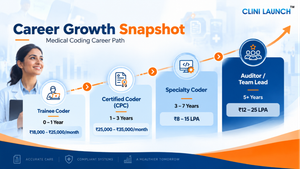
Career Progression & Salary Potential in AI-Enabled Healthcare Roles
Medical coding is evolving with AI, creating opportunities in coding, auditing, compliance, and healthcare technology roles. Professionals with certifications and AI skills can progress into higher-value positions.
| Career Stage | Typical Experience | India Salary Range |
|---|---|---|
| Trainee / Junior Medical Coder | 0–1 year | ₹18,000–₹25,000/month |
| Certified Professional Coder (CPC) | 1–3 years | ₹25,000–₹35,000/month |
| Specialty Medical Coder (Inpatient / Oncology / Cardiology) | 3–7 years | ₹8–15 LPA |
| Clinical Documentation Improvement (CDI) Specialist / Medical Coding Auditor | 5+ years | ₹12–20 LPA |
| Coding Manager / Revenue Cycle Manager | 7+ years | ₹15–25 LPA |
AI is reshaping medical coding careers by increasing the need for professionals who can validate information, ensure compliance, and manage complex healthcare workflows.
Advanced Diploma in Medical Coding
Master medical coding, documentation, ICD-10-CM, CPT, HCPCS, and compliance skills. Prepare for roles in hospitals, healthcare BPOs, insurance companies, and revenue cycle management.
View CourseMedical Coding After AI: The Skills Employers Will Value Next
Employers aren’t hiring for “code lookup” anymore. Job listings in India’s coding market already expect familiarity with AI-assisted coding platforms as standard, alongside denial management and payer-rule literacy. Two shifts are worth tracking as you plan your training path:
- Coding is merging with revenue cycle intelligence. Coders fluent in claim denials, appeals, and reimbursement logic are becoming the ones AI tools report to, not the ones they replace.
- The auditor and compliance layer is growing rapidly. As hospitals adopt AI coding, professionals are needed to ensure accuracy and regulatory compliance.
Entry-level roles aren’t disappearing. Growth and higher pay will favor coders with certifications, specializations, and AI skills.
AI-augmented medical coding and Revenue Intelligence Certificate Course
Learn medical coding, documentation, ICD-10-CM, CPT, HCPCS, auditing, and compliance skills for AI-enabled healthcare workflows.
View CourseMedical Coding After AI: Why It Remains a Smart Career Choice
AI is transforming medical coding, but it is not replacing skilled professionals. The future belongs to coders who can combine certification, clinical knowledge, compliance expertise, and AI-assisted workflows to improve accuracy and efficiency.
For students and career switchers, medical coding after AI represents an evolving career opportunity rather than a declining field. Professionals who learn to work alongside AI will be better positioned for roles in coding, auditing, documentation improvement, and healthcare compliance.
Considering a career in medical coding? CliniLaunch Research Institute’s certification-track programs on Advanced Diploma in Medical Coding or AI-augmented medical coding certifications course are designed to help learners build these future-ready skills and stay relevant as healthcare continues to evolve.
Frequently Asked Questions (FAQs)
1. Will AI completely replace medical coders in the future?
No. Medical coding after AI will focus on collaboration between professionals and technology. AI automates routine tasks, but coders are still required for complex cases, validation, and compliance.
2. Is medical coding a good career choice for life science graduates?
Yes. Healthcare and life science graduates can build careers in medical coding with the right skills, certifications, and knowledge of AI-assisted workflows.
3. Do I need programming skills to work in medical coding after AI?
No. Programming is not required for medical coding careers, but familiarity with AI medical coding tools can improve career opportunities.
4. Which certifications help medical coders grow professionally?
Certifications like CPC, CCS, and CPMA help professionals improve credibility and explore advanced roles in coding, auditing, and compliance.
5. How can beginners prepare for medical coding careers?
Beginners should learn medical terminology, anatomy, ICD-10-CM, CPT, HCPCS, healthcare compliance, and understand how automation is changing coding workflows.
6. Are medical coding jobs available for freshers in India?
Yes. Freshers can begin with trainee coding jobs and grow through certifications, practical experience, and AI-enabled healthcare skills.
7. What is the future scope of medical coding after AI?
The future scope includes opportunities in specialty coding, auditing, clinical documentation improvement (CDI), denial management, compliance, and healthcare data roles.
8. How can AI skills benefit medical coding professionals?
AI skills help coders review automated suggestions, improve accuracy, adapt to modern workflows, and work effectively with AI medical coding systems.