AI tools in clinical trials are used to improve protocol design, optimize site selection, accelerate patient recruitment, and enable real-time monitoring. They enhance data quality, reduce costs and timelines, and support faster, data-driven decision-making, making clinical research more efficient, scalable, and patient-centric.
Clinical trials remain the most expensive and time-consuming stage of drug development, accounting for nearly 60–70% of total costs and often facing delays due to recruitment challenges, protocol changes, and complex data management. The uses of AI tools in clinical trials such as AI-based patient matching platforms, predictive analytics, electronic data capture (EDC) systems, and automated data review solutions is improving trial efficiency. By enabling up to 3x faster patient recruitment, reducing protocol amendments by 30–50%, and cutting data cleaning efforts by ~40%, AI is making clinical trials faster, smarter, and more data-driven.
What makes this shift significant is the scale of adoption. The global AI in clinical trials market grew from $7.73 billion in 2024 to $9.17 billion in 2025, and is projected to reach nearly $21.8 billion by 2030, reflecting how quickly the industry is embracing AI-driven approaches.
AI has emerged as a game changer, streamlining clinical trial processes through predictive analytics, real-time monitoring, adaptive designs, and digital twins. These innovations reduce costs, accelerate drug development, and improve ethical standards by minimizing placebo use and enhancing patient selection. AI optimizes protocol design, speeds up recruitment, and ensures data integrity, improving overall trial efficiency and success.
In this blog, we will explore how AI is applied across different stages of clinical trials, examine real-world use cases from leading organizations, analyze key benefits and measurable impact, and address the limitations, challenges, and future trends shaping AI-driven clinical research.
How AI Tools are Used in Clinical Trials?
AI tools are now embedded across the clinical trial lifecycle, transforming how studies are designed, executed, and analyzed. The uses of AI tools in clinical trials includes predictive analytics, natural language processing (NLP), AI-based patient recruitment platforms, risk-based monitoring systems, and automated data analysis tools that help researchers make faster and more accurate decisions.
By leveraging real-world and historical data, AI improves protocol design, identifies suitable participants, enables real-time trial monitoring, and enhances data quality. From NLP-driven safety monitoring to predictive models for trial optimization, AI is shifting clinical research from manual, reactive processes to intelligent, data-driven systems—making trials more efficient, scalable, and reliable.
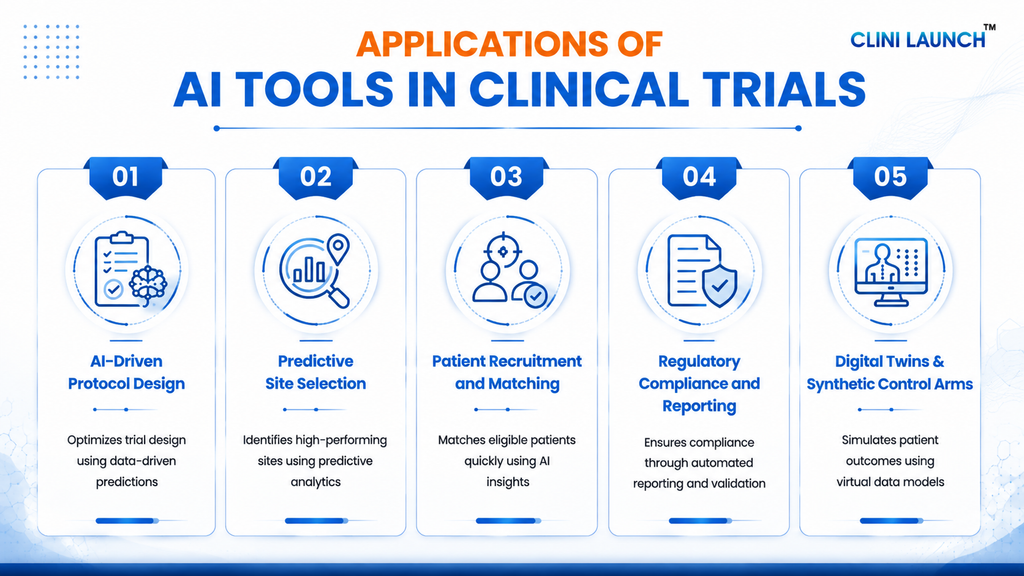
1. AI-Driven Protocol Design:
Protocol design is the blueprint of a clinical trial that outlines what the study aims to prove, who can participate, how the trial will be conducted, and what outcomes will be measured. It ensures the trial runs in a structured, consistent, and reliable way from start to finish. The biggest challenge in protocol design is predicting how a trial will perform in real-world conditions. Limited data, reliance on assumptions, and complex eligibility criteria often lead to poor recruitment, protocol amendments, delays, increased costs, and sometimes trial failure.
AI-driven protocol design uses machine learning to analyze historical trial data, real-world evidence, and past protocol outcomes to build more effective study plans. It tests multiple scenarios to predict risks like low recruitment or deviations. This shifts protocol design from assumption-based planning to data-driven decision-making, reducing amendments, improving efficiency, and increasing the likelihood of trial success.
Case Study: AI-Driven Protocol Design in Clinical Trials Bristol Myers with Faro Health
Background
Bristol-Myers Squibb partnered with Faro Health to transform protocol design across its global clinical trial portfolio. The goal was to shift from traditional document-based protocols to a structured, AI-enabled system that supports scalable, data-driven trial planning.
Problem Statement
Traditional protocol design relied heavily on manual documentation, fragmented data, and assumptions drawn from limited past trials. As a result, this approach often led to inconsistencies in trial planning, frequent protocol amendments, delays in trial startup, and inefficiencies in collaboration across teams and systems.
Solution Implementation
Faro Health introduced its AI-powered Study Designer platform, converting protocol content into structured, machine-readable data. The platform demonstrates the uses of AI tools in clinical trials by enabling automated drafting, built-in compliance checks, scenario simulations, and benchmarking against industry standards.
Clinical teams could design, test, and refine protocols within a unified digital environment, replacing disconnected workflows and improving consistency across trial elements.
Outcome
The implementation resulted in faster protocol development, improved study design quality, and reduced need for amendments. BMS reported accelerated timelines, better alignment with industry standards, and more patient-centric trial designs.
Overall, the shift enabled more efficient, data-driven clinical trials with higher chances of success and better operational scalability.
2. Predictive Site Selection:
Predictive site selection uses data-driven methods to identify the most suitable clinical trial sites, including hospitals, research centers, and investigators, where a study has a higher chance of success. It evaluates factors such as patient access, site capabilities, protocol compliance, and data quality to support faster enrollment and efficient trial execution.
Traditional site selection methods often depend on historical experience and limited feasibility assessments, making it difficult to accurately predict site performance. This can lead to recruitment challenges, protocol deviations, delays, and increased operational costs.
AI-powered predictive site selection improves this process by applying machine learning algorithms to analyze historical trial data, real-world patient information, site performance metrics, and operational factors. These insights help sponsors identify high-performing sites, optimize recruitment strategies, reduce trial delays, and improve overall clinical trial outcomes.
Case Study: AI-Driven Predictive Site Selection & Enrollment Optimization in Clinical Trial Medidata Solutions
Background
Medidata Solutions developed AI-powered solutions to improve clinical trial planning, particularly in site selection and patient enrollment. The goal was to help sponsors move from experience-based site selection to a data-driven approach that improves recruitment outcomes and trial efficiency.
Problem Statement
Traditional site selection relied on historical relationships, limited feasibility data, and investigator reputation. This often resulted in poor prediction of site performance, leading to slow patient recruitment, underperforming sites, protocol deviations, delays in timelines, and increased operational costs. Sponsors frequently had to add or replace sites mid-study, impacting overall trial success.
Solution Implementation
Medidata introduced AI-driven site selection and enrollment optimization tools that analyze large-scale data, including historical clinical trial performance, real-world patient data, and geographic disease distribution. The platform evaluates factors such as patient availability, past enrollment rates, site performance metrics, and competing trials.
Using predictive analytics and simulation models, the system forecasts which sites are most likely to meet enrollment targets and timelines. This enables sponsors to prioritize high-performing sites and optimize study planning before trial initiation.
Outcome
The implementation led to improved identification of high-performing sites, more accurate enrollment forecasting, and reduced dependency on underperforming locations. Sponsors experienced faster patient recruitment, fewer delays, and minimized need for mid-study site changes.
Overall, AI-driven predictive site selection enhanced trial efficiency, reduced costs, and increased the probability of successful and timely clinical trial completion.
3. Patient Recruitment and Matching
Patient recruitment and matching is the process of identifying and enrolling the right participants for a clinical trial based on predefined eligibility criteria. It ensures that suitable patients are selected efficiently, improving trial timelines, data quality, and overall study success. However, traditional recruitment faces major challenges such as limited patient visibility, manual screening, and difficulty in matching patients accurately to trial criteria. This often leads to slow enrollment, high screening failure rates, lack of diversity, delays, and increased trial costs.
AI-driven patient recruitment and matching uses machine learning to analyze electronic health records, clinical data, and genomic information to identify eligible participants more precisely. It matches patient profiles with trial requirements and predicts suitability at scale. This shifts recruitment from manual, assumption-based processes to a data-driven approach, accelerating enrollment, reducing screening failures, improving participant diversity, and ensuring the right patients are enrolled, ultimately leading to faster trials and better-quality outcomes..
Case Study: AI-Driven Patient Recruitment and Matching in Clinical Trials
Background
CurexBio highlights the growing need to improve patient recruitment strategies in clinical trials. With increasing trial complexity and stricter eligibility criteria, sponsors are adopting AI-driven approaches to enhance patient identification and enrollment efficiency.
Problem Statement
Traditional patient recruitment relies on manual screening, limited outreach, and fragmented patient data. This makes it difficult to identify eligible participants on time, often leading to slow enrollment, high screening failure rates, lack of diversity, and delays in trial completion. Many trials struggle to meet recruitment targets, impacting timelines and increasing costs.
Solution Implementation
The uses of AI tools in clinical trials are improving patient recruitment and matching by enabling faster and more accurate participant identification. AI-driven patient recruitment and matching uses machine learning and advanced data analytics to process electronic health records, clinical data, and patient databases. It identifies eligible participants by matching patient profiles with trial criteria in real time.
These systems also leverage digital channels, predictive analytics, and patient-centric strategies to improve outreach and engagement. By automating patient identification and enabling precise matching, AI reduces manual effort and enhances recruitment accuracy.
Outcome
The implementation of AI-driven recruitment strategies leads to faster patient enrollment, reduced screening failures, and improved participant diversity. Trials benefit from shorter recruitment timelines, better quality data, and improved overall efficiency.
Overall, AI transforms patient recruitment from a slow, manual process into a scalable, data-driven approach, significantly increasing the success rate of clinical trials.
4. Regulatory Compliance and Reporting
Regulatory compliance and reporting in clinical trials ensure that studies follow guidelines like ICH-GCP and that all data is accurately documented and submitted to regulatory authorities. It is essential for patient safety, data integrity, and approval readiness. The main challenge in traditional systems is manual documentation and fragmented reporting, which leads to delays, errors, compliance gaps, and increased administrative burden.
AI-driven regulatory compliance and reporting use automation and machine learning to continuously monitor trial data, detect errors, and generate regulatory reports in real time. This improves accuracy, reduces delays, minimizes compliance risks, and makes the overall reporting process faster and more efficient.
Case Study: AI-Driven Regulatory Compliance and Reporting in Clinical Trials
Background
Regulatory compliance is a critical requirement in clinical trials to ensure adherence to laws, ethical standards, and reporting guidelines such as ICH-GCP. As highlighted in industry cases shared by TechClass, non-compliance in regulated industries can lead to severe financial penalties, legal actions, and reputational damage, emphasizing the importance of accurate and timely reporting in high-stakes environments like clinical research.
Problem Statement
The uses of AI tools in clinical trials are helping transform compliance and reporting processes. Traditional clinical trial compliance and reporting rely heavily on manual documentation, fragmented systems, and human oversight, often leading to reporting delays, data inconsistencies, audit failures, and increased risk of non-compliance. Inaccurate or late submissions can result in regulatory warnings, trial suspension, financial penalties, and loss of trust from regulatory authorities.
Solution Implementation
AI-driven regulatory compliance and reporting use machine learning and automation to continuously monitor trial data and ensure adherence to regulatory standards. These systems automatically validate data entries, detect compliance gaps, and generate real-time reports for regulatory submissions.
AI also helps streamline audit preparation by organizing documentation, tracking protocol deviations, and ensuring all required data is consistently updated across systems. This reduces dependency on manual processes and minimizes the risk of human error.
Outcome
The implementation leads to improved reporting accuracy, faster regulatory submissions, and reduced compliance risks. Trials benefit from better audit readiness, fewer errors, and lower administrative burden.
5. Digital Twins & Synthetic Control Arms
Digital twins and synthetic control arms use virtual patient models and historical data to simulate potential outcomes in clinical trials. A digital twin is a data-driven representation of an individual patient created using clinical, genetic, and real-world data, while synthetic control arms use previously collected patient information as an alternative or supplement to traditional control groups. This approach supports better trial design, reduces patient burden, and improves clinical decision-making.
Traditional trials often face challenges such as limited patient availability, dependence on placebo groups, and ethical concerns, particularly in rare or serious diseases. These limitations can result in slower recruitment, increased costs, and difficulties in generating reliable comparisons.
The uses of AI tools in clinical trials enables the development of advanced digital twins and synthetic control arms by analyzing historical trial data, real-world evidence, and patient-level information. AI in clinical trials helps predict patient responses, create virtual comparators, and optimize trial designs. By reducing dependency on large control groups, these AI-driven approaches support faster recruitment, cost-efficient studies, improved patient participation, and scientifically reliable outcomes.
Case Study: AI-Driven Digital Twins & Synthetic Control Arms in Clinical Trials
Background
IntuitionLabs highlights the growing adoption of digital twins in clinical trials. These are high-fidelity computational models of individual patients used to simulate treatment responses. With increasing trial complexity and ethical concerns around control groups, the industry is exploring AI-driven virtual controls to make trials more efficient and patient-centric.
Problem Statement
Traditional clinical trials rely on randomized control groups, including placebo arms, which can be difficult to recruit and raise ethical concerns especially in serious or rare diseases. Limited patient availability, high costs, and long timelines further delay trials. Additionally, traditional models struggle to fully capture real-world patient variability and predict outcomes accurately.
Solution Implementation
AI-driven digital twins use machine learning and real-world data to create virtual replicas of patients that simulate how they would respond to standard treatments or placebo. These digital twins act as synthetic control arms, reducing or even replacing the need for traditional control groups.
The system uses historical clinical data, real-world evidence, and patient-level datasets to model outcomes and run simulations. It also aligns with regulatory frameworks, as agencies like the FDA are developing guidelines to ensure transparency, validation, and reliability of AI models in clinical trials.
Outcome
The implementation enables reduced reliance on placebo groups, faster patient recruitment, and more ethical trial designs. Trials become more efficient with improved statistical power, better prediction of outcomes, and reduced costs.
Overall, digital twins and synthetic control arms transform clinical trials into more data-driven, efficient, and patient-centric systems, accelerating drug development while maintaining scientific and regulatory standards.
AI-Augmented Medical Coding & Revenue Intelligence Certificate
Learn how artificial intelligence enhances medical coding accuracy and optimizes revenue cycle processes in healthcare. This program focuses on real-world applications such as AI-assisted coding, claims analysis, denial management, and revenue intelligence used in modern healthcare systems.
View CourseBenefits of using AI in clinical trials
The uses of AI tools in clinical trials are transforming healthcare research by improving speed, accuracy, and efficiency across every stage. From faster patient recruitment to real-time data analysis, AI helps reduce timelines by 30–50%, lower costs by up to 40%, and enhance decision-making—making clinical research more reliable and scalable.
- Faster Trial Timelines:
AI identifies eligible patients up to 3x faster, significantly accelerating recruitment timelines and improving trial start efficiency. It reduces protocol amendments by 30–50%, lowering rework, minimizing delays, and cutting associated operational costs. Real-time data monitoring detects anomalies instantly, helping reduce data cleaning efforts by up to 40% and prevent costly delays in trial execution.
- Improved Data Integrity:
Data integrity is maintained through validation techniques, regular audits, strong security measures, and reliable backup systems throughout the data lifecycle. Machine learning in clinical research further strengthens data quality by identifying inconsistencies, detecting errors, and improving data validation processes. These practices ensure accurate, reliable, and consistent data for better analysis and decision-making.
- Data-Driven Decision Making:
Data-driven decision-making uses AI and analytics on real-time and historical data to improve clinical trial planning, forecasting, and risk management. The article reports measurable efficiency gains—such as reduced timelines and improved prediction accuracy—typically in the double-digit percentage range, depending on the application. This leads to faster, more reliable, and evidence-based decisions, improving overall clinical and operational outcomes.
- Cost Efficiency:
AI-driven clinical development improves cost efficiency by optimizing trial design, operations, and data workflows. AI in clinical data management helps automate data validation, detect inconsistencies, and improve data quality while reducing manual efforts. With 10–20% improvements in patient enrollment and fewer protocol amendments, AI streamlines clinical processes. According to McKinsey & Company, AI can accelerate clinical timelines by up to 6 months per asset, reducing overall development costs. Automation and advanced analytics can reduce process costs by up to 50% by minimizing manual effort, streamlining workflows, and improving execution efficiency across clinical trials.
- Enhanced Patient Recruitment:
AI-powered recruitment tools significantly enhance enrollment, with studies showing up to 65% improvement in patient recruitment rates by efficiently matching eligible participants to trials.
Predictive analytics and automated matching improve recruitment speed and precision, helping reduce delays and ensuring more efficient and timely trial enrollment overall.
Conclusion
AI is becoming a core part of clinical trials, with the uses of AI tools in clinical trials including protocol optimization, faster patient recruitment, predictive analytics, automated data review, and real-time monitoring. It helps reduce costs, timelines, and operational inefficiencies while improving data quality and decision-making. Despite challenges like data privacy and regulatory compliance, AI works best alongside human expertise. Ultimately, it empowers clinical professionals and enables organizations to conduct faster, more efficient, and patient-centric trials.
For developing practical skills and gaining industry-relevant knowledge can unlock diverse career opportunities and long-term growth in the healthcare and pharmaceutical sectors. At CliniLaunch Research Institute, we offer life science programs designed to prepare individuals for successful careers in pharma and healthcare industries.
Frequently asked questions
1. What are the uses of AI tools in clinical trials?
AI tools in clinical trials are used for protocol design, predictive site selection, patient recruitment, data management, real-time monitoring, and regulatory reporting to improve trial efficiency and decision-making.
2. How is AI used in clinical trials?
AI in clinical trials helps analyze large datasets, predict trial outcomes, optimize recruitment strategies, automate data review, and support faster, more accurate clinical research decisions.
3. How do AI tools help in drug development?
AI tools in drug development support faster decision-making by analyzing clinical data, predicting treatment outcomes, optimizing trial designs, and improving the efficiency of the drug development process.
4. How does AI improve patient recruitment in clinical trials?
AI patient recruitment in clinical trials uses machine learning to analyze patient data, identify eligible participants, and match suitable candidates with trial requirements, reducing recruitment delays.
5. What is the role of AI in clinical data management?
AI in clinical data management helps automate data validation, detect inconsistencies, improve data quality, and support accurate analysis by reducing manual data review efforts.
6. How is machine learning used in clinical research?
Machine learning in clinical research analyzes historical and real-world data to identify patterns, predict outcomes, optimize trial processes, and improve patient selection and monitoring.
7. Can AI replace clinical research professionals?
No. AI supports clinical research professionals by automating repetitive tasks, improving data analysis, and enabling better decision-making, while human expertise remains essential for ethics, oversight, and interpretation.
8. What are the uses of AI tools in clinical trials?
The uses of AI tools in clinical trials include improving protocol design, optimizing patient recruitment, predicting trial outcomes, automating data analysis, and enhancing regulatory reporting. AI helps researchers conduct faster, more efficient, and data-driven clinical studies.
9. How is AI used in clinical trials?
AI in clinical trials is used to analyze large datasets, identify suitable trial sites, monitor patient responses, and support real-time decision-making. It helps reduce delays, improve data quality, and streamline different stages of the clinical research process.
10. How do AI tools support drug development?
AI tools in drug development help researchers analyze biological and clinical data, predict treatment responses, optimize trial designs, and accelerate decision-making during the drug development process.
11. How does AI improve patient recruitment in clinical trials?
AI patient recruitment in clinical trials uses machine learning algorithms to analyze patient records, identify eligible participants, and match suitable candidates with study requirements, helping reduce recruitment timelines and improve trial efficiency.
12. Why are the uses of AI tools in clinical trials important for the future of research?
The uses of AI tools in clinical trials are transforming clinical research by improving accuracy, reducing operational challenges, and enabling more patient-centric studies. AI supports researchers while allowing faster and more reliable clinical trial outcomes.