AI is transforming drug development by accelerating target discovery, virtual screening, toxicity prediction, clinical trials, and drug repurposing through machine learning. This reduces research timelines, improves accuracy, lowers development costs, and enables faster, personalized pharmaceutical innovation across the healthcare industry.
Drug development today is like searching for a life-saving needle in a massive digital maze where millions of biological signals, compounds, and patient variables are scattered across disconnected systems. Traditional research methods often take years of testing, billions of dollars in investment, and still face high failure rates in late-stage trials. As diseases become more complex and healthcare data rapidly expands, pharmaceutical companies are increasingly turning towards AI in Drug development to make drug discovery faster, smarter, and more precise.
For students and early-career professionals, this shift is creating entirely new career opportunities across clinical research, bioinformatics, pharmacovigilance, AI-driven drug discovery, and healthcare analytics. In this blog, we explore how AI is transforming different stages of drug development, its benefits and limitations, implementation challenges, future trends like generative AI and digital twins, India’s growing role in AI healthcare innovation, and the emerging skills and career paths shaping the future pharmaceutical industry.
Challenges in Traditional Drug Development Process
Traditional drug development faces challenges across discovery, preclinical research, clinical trials, regulatory approvals, and post-market safety monitoring, making the process time-consuming, expensive, highly regulated, and uncertain with frequent late-stage failures. The following sections explore these challenges across each stage of the drug development lifecycle.
Drug Discovery Challenges
Traditional drug discovery faces major challenges, including uncertain target identification and poor prediction of human outcomes. The discovery phase alone can take 3–6 years and involves screening thousands to millions of compounds, requiring significant laboratory resources and investment. Despite costs reaching approximately $100–500 million, many drug candidates still fail in later stages, making the process slow, expensive, and inefficient.
A strong example of traditional drug discovery limitations is BIA 10-2474, developed by Bial. The drug targeted the FAAH enzyme, considered a valid pathway, and early studies suggested safety. However, incomplete understanding of the target and off-target effects went unnoticed. In first-in-human trials, it caused severe neurological damage and one death, leading to immediate termination.
Preclinical Research Challenges
Preclinical testing faces challenges in reliability, translation, and regulatory readiness. Model limitations reduce the accuracy of toxicity and long-term safety prediction, while animal studies often fail to reflect human biology, leading to clinical failures. Strict International Council for Harmonisation guidelines add compliance complexity. This phase typically takes 3–6 years, requires significant resources, and raises ethical concerns related to animal testing.
A real-world example of preclinical limitations is TGN1412, a monoclonal antibody developed by TeGenero. Despite appearing safe in animal studies, it revealed a critical gap in translation and reliability. When tested in humans, it caused a severe immune reaction within hours, highlighting how preclinical models can fail to predict human outcomes and making early-stage validation a major challenge in traditional drug development.
Clinical Trial Challenges
Clinical trials face challenges in patient recruitment and retention due to strict eligibility criteria and long study durations, increasing dropout rates. Patient variability and complex protocols make safety and efficacy evaluation difficult, especially in multi-site studies. High attrition rates, data management issues, and strict regulatory requirements further increase complexity. This phase typically takes 6–8 years and can cost over $1 billion, making it lengthy, expensive, and uncertain.
A real-world example of clinical trial challenges is Torcetrapib, developed by Pfizer to raise “good” cholesterol (HDL). Despite promising early results, Phase III trials were halted after increased deaths, and cardiovascular events were observed. After investing approximately $800 million over 15 years, the drug failure highlights how late-stage trials can expose serious safety risks, making drug development both costly and time-intensive.
Regulatory Approval Challenges
Traditional drug development faces major regulatory approval challenges because regulatory agencies require extensive evidence proving a drug’s safety, efficacy, quality, and long-term risk profile before approval. The process often involves large-scale documentation, multi-phase clinical trials, strict compliance requirements, manufacturing validation, pharmacovigilance planning, and repeated regulatory reviews. Delays commonly occur due to incomplete data, inconsistent trial results, protocol deviations, patient safety concerns, or changing global regulatory expectations. Since drug development generates massive amounts of clinical and operational data, managing accuracy, transparency, and compliance across every stage becomes highly complex and time-consuming, increasing both development costs and approval timelines.
Post-Market Surveillance
Post-market surveillance faces challenges in ensuring long-term drug safety in real-world settings. Detecting rare or delayed adverse effects is difficult, as they often appear after widespread use. Underreporting, complex real-world data, regulatory reporting requirements, and global monitoring further complicate signal detection and safety assessment. In addition, causality assessment and benefit–risk re-evaluation make this stage continuous, resource-intensive, and critical.
A notable example is rofecoxib, developed by Merck & Co. After approval, post-market data revealed an increased risk of cardiovascular events, which was not fully evident in clinical trials. The drug was withdrawn globally, highlighting how serious safety risks can emerge only after widespread real-world use.
Role of AI in Drug Development
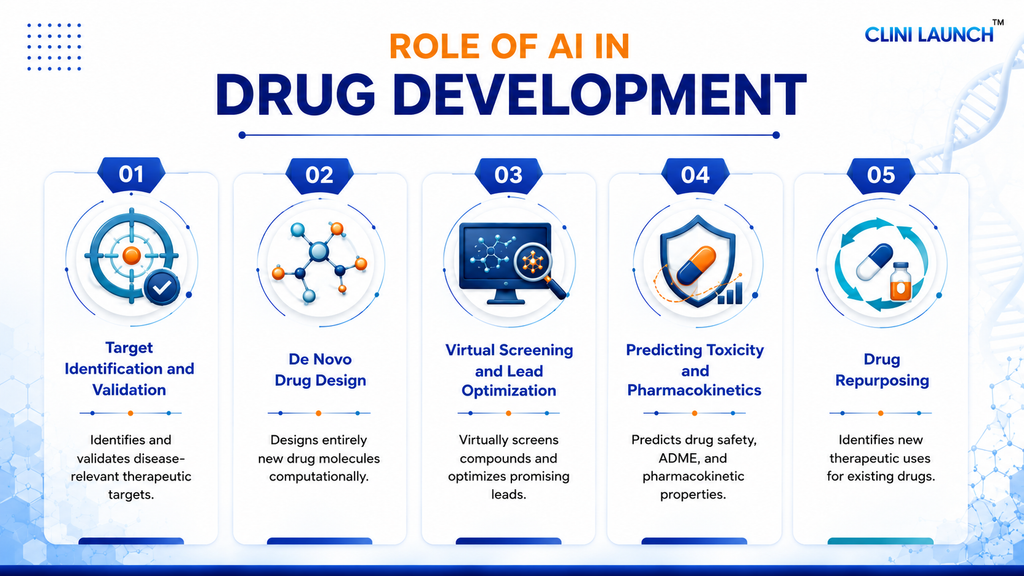
Artificial Intelligence is transforming drug development by improving speed, accuracy, and decision-making across multiple stages. The following sections explore how AI supports target identification, drug design, virtual screening, toxicity prediction, clinical trials, and drug repurposing.
Target Identification and Validation
Target Identification and Validation (TIDV) is a critical stage in drug development, and AI is improving early decision-making by analyzing complex biological data more efficiently. Traditionally, this phase relied on trial-and-error methods and faced difficulty linking targets with disease outcomes, leading to high failure rates. AI addresses these challenges by integrating genomic, proteomic, and clinical datasets to identify patterns, map disease pathways, and prioritize relevant targets. Companies like Insilico Medicine have used AI to accelerate target discovery and improve early-stage success rates.
De Novo Drug Design
De novo drug design is a key stage in drug development where new molecules are created to interact with validated biological targets. Traditionally, this process faced challenges such as limited chemical exploration, trial-and-error screening, and difficulty predicting efficacy and safety, leading to long timelines and high failure rates. AI improves this process through generative models that design and optimize molecules using large datasets. Exscientia demonstrated this impact when its AI-designed drug DSP-1181 reached clinical trials in just 12 months compared to the traditional 4–5 years.
Virtual Screening and Lead Optimization
Virtual screening and lead optimization are important stages in drug development where potential drug candidates are identified and refined, and AI improves these processes through speed and precision. Traditionally, challenges included screening large chemical libraries, low hit rates, and optimizing molecules for safety and efficacy. AI addresses these issues by analyzing compound datasets, predicting binding affinities, and optimizing molecular structures using machine learning. Atomwise’s AtomNet platform uses deep learning to screen millions of compounds with high precision, accelerating viable hit identification and improving early-stage drug discovery decisions.
Predicting Toxicity and Pharmacokinetics
Predicting toxicity and pharmacokinetics is a critical stage in drug development where AI improves early safety and efficacy assessment. Traditionally, this phase faced challenges such as poor prediction of adverse effects, late-stage failures, and difficulty modeling complex biological interactions. AI addresses these issues by analyzing chemical, biological, and clinical datasets to predict toxicity and ADME properties more accurately. The process includes data integration, predictive modeling, risk assessment, and validation. DeepMind’s AlphaFold has advanced protein structure prediction, enabling deeper insights into molecular interactions and supporting better analysis of drug behavior and safety.
Enhanced Clinical Trials
Enhanced clinical trials are a crucial stage in drug development where AI improves efficiency and reliability. Traditionally, trials faced challenges such as slow patient recruitment, high dropout rates, protocol deviations, and large volumes of unstructured data, causing delays and increased costs. AI addresses these issues through intelligent patient matching, outcome prediction, optimized site selection, and real-time risk monitoring. The process includes recruitment, trial optimization, data monitoring, and adaptive decision-making. AI-powered platforms like TrialMatchAI can automate patient matching with over 90% accuracy, improving trial participation and early decision-making in clinical research.
Drug Repurposing
Drug repurposing is a critical phase in drug development where existing drugs are identified for new therapeutic uses, and AI is accelerating this process with greater precision. Traditionally, challenges included limited understanding of disease pathways, manual data analysis, and difficulty identifying drug–disease relationships. AI addresses these issues by analyzing biomedical data such as molecular interactions, clinical records, and scientific literature to uncover hidden connections. The process involves data integration, pattern recognition, candidate prioritization, and validation. AI models like TxGNN have predicted potential therapies across thousands of diseases, including conditions without existing treatments.
Implementation Challenges
While AI is transforming drug development with speed and precision, its real-world implementation presents significant challenges beyond algorithms. Integrating AI into regulated healthcare environments requires addressing compliance, data integrity, and validation issues to ensure reliable, safe, and consistent outcomes across the drug development lifecycle.
Regulatory Frameworks
AI-driven drug development requires new regulatory frameworks due to its dynamic, data-dependent nature and direct impact on patient safety. Unlike traditional systems, AI introduces challenges such as lack of transparency, data bias, and difficulty in validating complex models, making regulatory approval more demanding. Regulators address this by focusing on model validation, reproducibility, and performance benchmarking to ensure reliability. Organizations such as U.S. Food and Drug Administration and European Medicines Agency are evolving guidelines to govern AI use in healthcare. Regulatory guidance emphasizes data governance, model design and development practices, risk-based performance assessment, and life cycle management for AI systems in drug development.
Data Scarcity and Quality
Data scarcity and quality are critical challenges in AI-driven drug development, directly affecting model accuracy and reliability. Key challenges include data fragmentation across sources (data silos), poor data quality due to missing values, noise, and inconsistencies, and bias from imbalanced datasets, all of which reduce prediction accuracy and fairness. The limited availability of high-quality labeled data further restricts the development of robust models that generalize across diverse populations. As highlighted in research, biomedical data used in AI-driven drug discovery is often fragmented, inconsistent, and biased, posing challenges to model performance. AI addresses these issues through preprocessing, integration, and advanced learning techniques, but ensuring consistent, high-quality data remains essential.
Lack of Experimental Validation
Lack of experimental validation is a critical challenge in AI-driven drug development, as computational predictions must be confirmed through laboratory and clinical testing. Key challenges include the lack of biological validation, creating a gap between in silico predictions and real-world outcomes, and the complexity of biological systems that makes accurate verification difficult. Additionally, limited experimental resources such as time, cost, and lab capacity restrict large-scale validation, increasing the risk of unreliable conclusions. As highlighted in research, AI models often face limitations due to small datasets, experimental data errors, and lack of experimental validation, affecting reliability. The process requires in vitro studies, in vivo testing, and clinical validation to confirm safety and efficacy.
Future Trends That are Shaping AI in Drug Development
AI is moving beyond support functions and becoming a core driver of innovation in drug development. Future advancements will focus on deeper automation, smarter data use, and stronger collaboration across the pharmaceutical ecosystem.
Generative AI for Drug Design
Generative AI is expected to play a major role in transforming drug development by accelerating molecule discovery, predicting drug behavior, and improving precision medicine approaches. According to McKinsey & Company, generative AI could significantly improve early-stage drug discovery productivity and reduce lead identification timelines from months to weeks. Future advancements may also include autonomous AI research systems, AI-driven personalized therapies, and virtual molecular simulations that reduce dependence on traditional trial-and-error research methods. As pharmaceutical companies continue investing in AI-powered R&D platforms, drug development is expected to become faster, more data-driven, and more efficient in the coming years.
Digital Twin Technology
Digital Twin Technology is expected to transform healthcare and drug development by creating virtual replicas of patients, organs, and clinical systems for real-time simulation and predictive analysis. The technology can support predictive analytics, personalized treatment planning, and optimized clinical operations through real-time data integration and virtual simulations. Digital twins can transform healthcare by enabling personalized, predictive, preventive, and participatory medicine. Future advancements may enable researchers to simulate disease progression, predict treatment responses, and improve clinical trial efficiency before real-world implementation. As AI, IoT, and healthcare analytics continue to evolve, Digital Twin Technology is expected to make healthcare more predictive, precise, and patient-centric in the coming years.
Personalized Drug Development for Individual Patients
The future of personalized drug development is expected to revolutionize healthcare by enabling highly targeted therapies based on an individual patient’s genetic makeup, lifestyle, and biological response patterns. AI, genomics, and big data analytics are increasingly driving the shift toward more predictive and patient-specific treatment models. Looking ahead, precision medicine is set to transform medicine and healthcare by using genomics, artificial intelligence, and big data. Future advancements may support faster biomarker discovery, customized drug formulations, and more effective therapies for complex diseases such as cancer and rare genetic disorders. As precision medicine technologies continue to evolve, future healthcare is expected to become more proactive, predictive, and personalized.
Quantum Computing with AI for Drug Discovery
Emerging advancements in Quantum Computing and Artificial Intelligence are expected to redefine the future of drug discovery by enabling faster and more accurate analysis of highly complex molecular interactions. AI-integrated quantum systems may help researchers simulate biological processes, optimize compound selection, and accelerate pharmaceutical research beyond the limitations of classical computing methods. Quantum computing holds great potential in drug discovery and development, offering accelerated, more accurate, and lower-cost research. Future developments may support rapid lead optimization, improved prediction of drug behavior, and more efficient personalized therapy development. As quantum technologies and AI models continue to evolve, drug development is expected to become more precise, data-driven, and computationally advanced in the coming years.
Advanced Diploma in AI Integration in Drug Safety & Compliance
Learn how artificial intelligence is applied in pharmacovigilance, drug safety monitoring, and regulatory compliance. This program focuses on real-world workflows such as adverse event processing, signal detection, and AI-driven safety data analysis used in global healthcare environments.
View CourseRole of India in AI Drug Development
India is strengthening its position in AI-driven healthcare through national frameworks, AI validation platforms, and pharmaceutical research initiatives. This section explores how SAHI, BODH, and NIPER are supporting responsible AI adoption and innovation in drug development.
SAHI (Strategy for AI in Healthcare for India)
Before SAHI, India lacked a unified framework for the ethical and regulated use of AI in healthcare, creating challenges in data standardization, validation, clinical reliability, and regulatory alignment. To address these gaps, SAHI was introduced as a national roadmap for responsible AI adoption in healthcare. The framework promotes safer and more compliant AI integration while encouraging alignment with global standards such as CDISC and international regulatory expectations. It also supports faster, technology-driven, and globally acceptable healthcare innovation and drug development in India.
BODH Platform (IIT Kanpur)
The BODH Platform (Benchmarking Open Data in Healthcare), developed with support from Indian Institute of Technology Kanpur in collaboration with the National Health Authority (NHA), is a national platform designed to benchmark, validate, and evaluate AI models used in healthcare. It helps assess the accuracy, reliability, fairness, and clinical performance of healthcare AI systems before deployment. The platform also supports privacy-preserving federated learning and standardized AI evaluation. Working alongside SAHI, BODH promotes transparency, regulatory readiness, and responsible AI adoption across India’s healthcare ecosystem.
NIPER AI Innovation in Drug Repurposing
National Institute of Pharmaceutical Education and Research is advancing AI-enabled drug discovery and drug repurposing through initiatives focused on machine learning, pharmacoinformatic, molecular modeling, predictive analytics, and bioinformatics. During the national D3NM-5 conference on “Next-Generation Therapeutics,” experts highlighted the growing role of AI, CRISPR technologies, and precision medicine in accelerating therapeutic development. These efforts aim to reduce drug development timelines, lower research costs, improve precision medicine approaches, and strengthen India’s transition toward innovation-driven and globally competitive pharmaceutical research ecosystems.
Steps to Prepare for AI Roles in Drug Development
As AI adoption grows across pharmaceutical and healthcare industries, professionals need a combination of life sciences, clinical research, data analytics, and AI-related technical skills. This section explores the career paths, companies, salaries, and essential skills shaping future AI healthcare roles.
Companies Driving AI Innovation in Drug Development
Pharmaceutical, biotechnology, CRO, and healthcare technology companies are rapidly integrating AI into drug discovery, clinical trials, safety monitoring, and healthcare analytics. These organizations are creating new career opportunities for professionals with combined expertise in life sciences, clinical research, data analytics, and AI-driven healthcare technologies.
AI in Pharmaceutical Companies
- Pharmaceutical companies use AI across drug development to accelerate R&D, optimize clinical trials, predict drug success, and improve real-time safety and efficacy analysis.
- AI-driven pharma hiring in India is accelerating, with 1,200+ AI-related roles frequently listed on LinkedIn and Indeed, spanning drug development analytics, clinical data, and healthcare AI.
- The AI-driven pharma market is projected to grow from $6.63 billion in 2025 to $154.10 billion by 2034, reflecting rapid adoption across drug development processes.
- Industry leaders such as Pfizer, Novartis, and Roche are actively deploying AI across their pipelines
AI in Biotechnology Companies
- Biotechnology companies use AI for genomic analysis, protein structure prediction, novel target identification, and generative modeling to accelerate early-stage drug discovery and innovation.
- Specialized hiring demand is evident, with 235+ Machine Learning Scientist roles in healthcare on LinkedIn and Indeed, signaling strong opportunities in bioinformatics and computational biology.
- The AI in drug discovery market is expected to reach approximately $6.89 billion by 2029, driven by advancements in computational biology and AI platforms.
- Key innovators include Insilico Medicine, BenevolentAI, and Exscientia.
AI in Contract Research Organizations (CROs)
- CROs use AI to optimize clinical trials through patient recruitment, trial monitoring, risk prediction, and centralized management of large-scale clinical research data.
- This domain shows steady demand, with 200+ healthcare-focused data scientist and clinical analytics roles on LinkedIn and Indeed, especially in clinical trial operations and data management
- The CRO sector is expanding through increased outsourcing and AI integration, with the market projected to grow from ~$93 billion in 2026 to ~$140 billion by 2031.
- Major players include IQVIA, Parexel, and ICON plc.
AI in Healthcare & HealthTech Companies
- Healthcare and HealthTech companies use AI-powered platforms, electronic health records, and real-world evidence to improve drug safety, clinical insights, and patient outcome monitoring.
- This domain leads in hiring volume, with 3,254+ AI healthcare roles in India on LinkedIn and Indeed, driven by rapid digital health adoption and data-driven systems expansion.
- The healthcare analytics market growing from $55.52 billion in 2025 to $166.65 billion by 2030, driven by increasing adoption of AI, digital health systems, and data-driven decision-making
- Prominent organizations include Cerner, Optum, and Philips.
Entry-Level Salary Trends in Drug Development
| Role | Use of AI | Key Skills Required | Experience | Salary Range (India) |
|---|---|---|---|---|
| Junior AI Drug Discovery Analyst | Supports molecule screening, target identification, and predictive modeling | Python, basic ML, cheminformatics, data handling | 0–1 year | ₹3.5 – ₹6 LPA |
| Bioinformatics Associate (AI-Integrated) | Applies AI to genomics, proteomics, and biomarker discovery | Bioinformatics tools, Python/R, genomics, data analysis | 0–2 years | ₹3 – ₹5.5 LPA |
| Clinical Data Analyst (AI-Based) | Uses AI for clinical trial data cleaning, trend analysis, and patient insights | SQL, Excel, Python, clinical data understanding | 0–2 years | ₹3 – ₹6 LPA |
| AI/ML Research Assistant (Drug Discovery) | Assists in training and validating ML models for drug discovery workflows | Python, ML basics, statistics, data preprocessing | 0–1 year | ₹4 – ₹7 LPA |
| Life Sciences Data Analyst (AI Focus) | Analyzes biomedical datasets to support R&D decision-making | Python, SQL, data visualization, life science knowledge | 0–2 years | ₹3.5 – ₹6.5 LPA |
| AI Pharmacovigilance Associate | Uses AI for adverse event detection, signal analysis, and safety monitoring | Pharmacovigilance basics, MedDRA, AI tools, data review | 0–2 years | ₹3 – ₹5 L |
Key Skills for Entry-Level
Building a career in AI-driven drug development requires a combination of life sciences knowledge, clinical research understanding, data analytics, and AI-related technical skills to support modern pharmaceutical and healthcare innovation.
AI & Technical Skills for AI Drug Development
- Python Programming
Used for analyzing biomedical data, building AI models, and automation workflows.
- NumPy & Pandas
Used for cleaning, transforming, and structuring clinical and biological datasets.
- SQL & Database Handling
Supports querying and managing large clinical, patient, and research databases.
- Machine Learning Fundamentals
Build predictive models for drug response, toxicity, and clinical outcomes.
- Deep Learning Basics
Enables molecular modeling, protein prediction, and medical imaging analysis applications.
- Data Visualization (Power BI / Tableau)
Converts complex clinical data into interactive dashboards for decision-making.
- Statistics for Healthcare Data
Ensures validation using hypothesis testing, probability, and experimental design method
Domain skills for AI Drug Development
- Clinical Research Fundamentals
Understanding clinical trial lifecycles, study designs, trial phases, protocols, and operational workflows.
- Clinical Data Management (CDM Skills)
Managing CRFs, clinical databases, data entry workflows, query management, and reconciliation processes.
- Clinical Data Handling & Quality Control
Performing data cleaning, validation checks, discrepancy resolution, and clinical quality assurance activities.
- ICH-GCP & Regulatory Compliance
Applying ICH-GCP principles, ethical guidelines, compliance standards, and regulatory documentation practices.
- Pharmacovigilance Basics
Understanding adverse event reporting, drug safety monitoring, case processing, and pharmacovigilance workflows.
- Clinical Data Interpretation
Interpreting clinical datasets, laboratory reports, patient outcomes, and study-related medical information.
- AI Awareness in Clinical Research
Understanding AI applications in clinical data review, automation, analytics, and trial optimization.
Conclusion
AI is transforming drug development into a faster, more data-driven, and efficient process. From target identification and drug repurposing to clinical trials and safety monitoring, AI is improving research accuracy, reducing timelines, and supporting better scientific decision-making across the pharmaceutical lifecycle. Although challenges related to regulation, data quality, validation, and implementation remain, advancements in AI, genomics, and computational research continue to drive innovation. With initiatives such as SAHI, BODH, and NIPER-led research, India is also strengthening its role in AI-enabled pharmaceutical development. Professionals with combined expertise in life sciences and AI are expected to see growing opportunities.
If you’re looking to build expertise in clinical trials, research operations, and regulatory processes, explore our Certification in Clinical Research course at CliniLaunch Research Institute.
Frequently Asked Questions (FAQs)
1. Can life science students build a career in AI-driven drug development?
Yes. Life science graduates can enter pharmaceutical careers by building knowledge in clinical research, bioinformatics, healthcare analytics, and AI. AI in Drug Development combines expertise with data skills, creating opportunities for professionals who understand biological processes and technologies.
2. What skills should students learn for AI-based pharmaceutical careers?
Students should develop Python, SQL, machine learning fundamentals, clinical research, bioinformatics, healthcare data analysis, and pharmacovigilance skills. AI in Pharmaceutical Research also benefits from data interpretation, statistics, regulatory awareness, and practical understanding of modern pharmaceutical research and development.
3. Is coding mandatory to work in AI drug development?
No. Advanced coding is not mandatory for every role. Basic Python and data-handling knowledge can help, while entry-level positions combine life sciences expertise with clinical skills. AI Applications in Drug Development require collaboration between domain specialists and technical teams.
4. What career opportunities are available in AI-driven drug development?
Students can explore roles such as AI Drug Discovery Analyst, Clinical Data Analyst, Bioinformatics Associate, AI Pharmacovigilance Associate, Healthcare Data Analyst, and AI/ML Research Assistant. Artificial Intelligence in Drug Discovery is creating opportunities across computational research and safety.
5. Which industries hire professionals for AI-integrated drug development roles?
Pharmaceutical companies, biotechnology firms, Contract Research Organizations (CROs), healthcare analytics companies, and HealthTech organizations hire professionals with life sciences and technology knowledge. AI in Drug Development supports roles across drug discovery, clinical operations, safety monitoring, and research analytics.
6. How is AI changing the future of pharmaceutical careers?
AI is reshaping pharmaceutical careers by increasing demand for professionals who work with data, predictive models, automation, and personalized medicine. AI in Drug Development encourages collaboration between scientists, clinicians, data analysts, and technology specialists across pharmaceutical development workflows.
7. Is AI replacing pharmaceutical and clinical research jobs?
No. AI is transforming pharmaceutical and clinical research rather than eliminating professionals completely. AI in Drug Development can automate repetitive analysis and support decision-making, while skilled researchers remain essential for scientific interpretation, validation, regulatory judgment, and patient-focused decisions.
8. What is the salary range for entry-level AI healthcare roles in India?
Entry-level AI-integrated healthcare and pharmaceutical roles in India commonly offer approximately ₹3 LPA to ₹7 LPA, depending on skills, domain knowledge, expertise, role, and employer. AI in Drug Development can create opportunities, but salaries can vary across employers.
9. Can freshers from biotechnology or pharmacy backgrounds enter this field?
Yes. Freshers from biotechnology, pharmacy, life sciences, microbiology, biochemistry, and related backgrounds can transition into AI-driven pharmaceutical careers through upskilling. Machine Learning in Drug Discovery is one area, while candidates can build pathways through clinical research and pharmacovigilance.
10. Why should students learn AI in healthcare and drug development now?
Learning AI now can help students prepare for changing pharmaceutical workflows and emerging roles. AI in Clinical Trials can support patient recruitment, trial optimization, data monitoring, and predictive analysis. AI in Drug Development makes awareness valuable for careers.