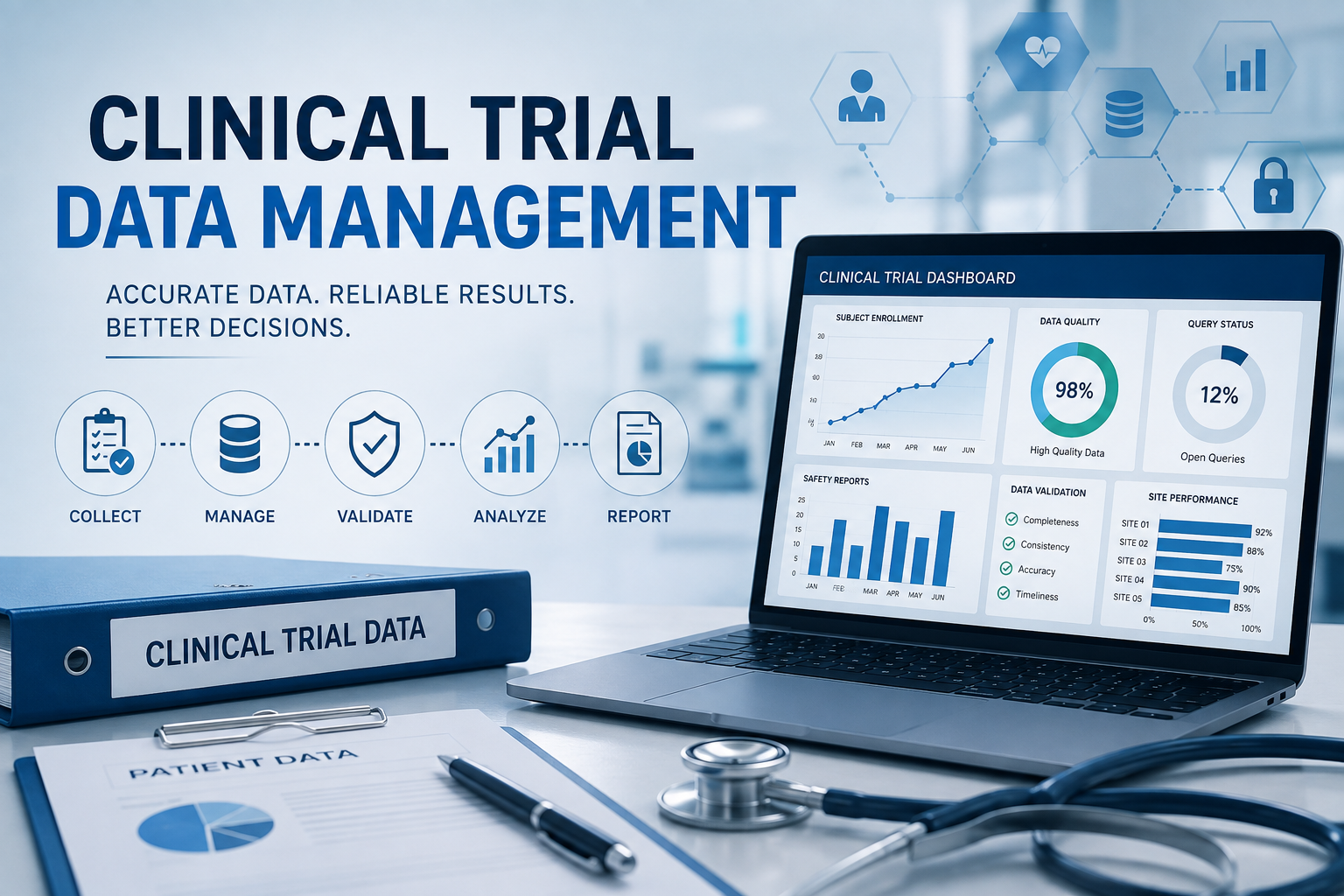
Clinical trial data management is a critical function in clinical research that focuses on collecting, processing, and validating data generated during clinical studies to ensure it is accurate, reliable, and suitable for analysis. Its primary objective is to produce high-quality datasets that can support the reporting of clinical trials and meet regulatory requirements.
It involves structured activities such as data collection, validation, cleaning, and database management, ensuring that the final data used for statistical analysis is consistent and error-free. By maintaining data integrity throughout the trial lifecycle, clinical trial data management plays a key role in generating credible evidence for drug development, regulatory submissions, and informed medical decision-making.
Clinical Trial Data Management: An Overview
Clinical trials now draw evidence from multiple systems rather than a single case report form. A participant’s record may combine electronic data capture (EDC) assessments, laboratory results, imaging, wearable-device readings, mobile-app entries, and patient-reported outcomes. Each source has different formats, timing, and potential errors. Clinical trial data management brings these streams into a controlled framework, ensuring data are complete, consistent, traceable, and reliable enough to support study conclusions. As decentralized and hybrid trials expand, sponsors are also exploring artificial intelligence and automation for anomaly detection, query prioritization, medical coding, and risk-based oversight. Recent developments show how quickly this is advancing: in December 2025, the FDA qualified AIM-NASH, its first AI drug-development tool, for use in MASH clinical trials to assist pathologists in assessing liver-biopsy images. Human pathologists remain responsible for reviewing and accepting or rejecting the AI-generated assessments.
Modern CDM therefore extends beyond correcting discrepancies before database lock. It involves determining what data are needed, where they originate, how they are transferred, and how changes are documented. Teams reconcile information across systems, apply consistent terminology, monitor data quality throughout the trial, and maintain audit trails suitable for inspection. CDISC standards support alignment across data collection, analysis, and regulatory submission, while privacy, cybersecurity, access control, and computerized-system validation influence how data are handled. The FDA and EMA’s January 2026 Guiding Principles of Good AI Practice in Drug Development further emphasize human oversight, risk-based validation, data governance, clear context of use, and lifecycle management for AI. This article explores the key stages of CDM, the role of EDC platforms, integrations, standards, automation, common data-quality challenges, and the skills and career paths involved.
What is Clinical Data Management and Why It Matters
Clinical Data Management (CDM) is the systematic process of collecting, validating, cleaning, and managing clinical trial data to ensure it remains accurate, complete, consistent, traceable, and analysis-ready throughout the study lifecycle.
Why CDM Matters:
- Ensures Data Quality: Identifies errors, inconsistencies, and missing data.
- Protects Data Integrity: Maintains reliable and traceable data from collection to database lock.
- Supports Regulatory Compliance: Helps ensure data meets GCP and regulatory expectations.
- Reduces Rework: Early validation and query resolution minimize downstream corrections.
- Enables Faster Analysis: Clean, finalized datasets support efficient statistical analysis.
- Improves Decision-Making: Reliable data supports accurate conclusions on treatment safety and efficacy.
- Reduces Operational Risk: Standardized processes improve consistency across sites, systems, and stakeholders.
The Economics of Clinical Data Management:
Effective CDM can directly influence clinical trial timelines and operational costs by reducing data errors, rework, and delays. A 2024 analysis by the Tufts Center for the Study of Drug Development (CSDD) estimated the mean direct cost of conducting a clinical trial at approximately $40,000 per day, with Phase III trials averaging $55,716 per day. This highlights the financial impact of preventing avoidable delays.
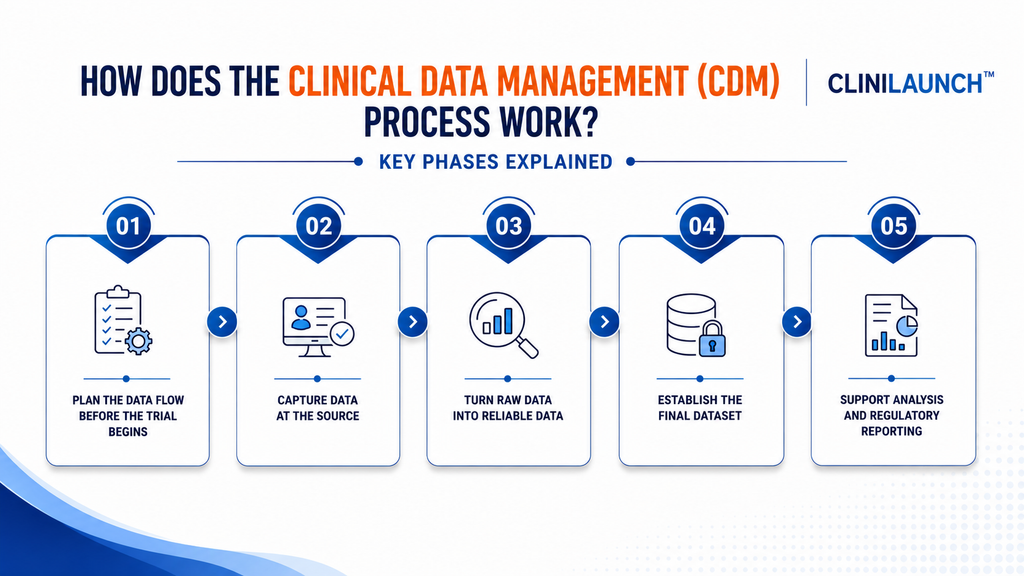
How Does the Clinical Data Management (CDM) Process Work? Key Phases Explained
Clinical Data Management (CDM) moves clinical trial data phases through a controlled lifecycle from study planning and data capture to cleaning, database lock, and reporting. Each phase builds on the previous one, transforming raw clinical information into a reliable dataset that can support statistical analysis and regulatory decision-making.
1. Plan the Data Flow Before the Trial Begins
CDM starts before the first patient is enrolled. The team develops the Data Management Plan (DMP), establishes data standards, defines responsibilities, and determines how data will be collected and reviewed. Case Report Forms (CRFs) are designed around the study protocol and planned endpoints, while EDC systems, validation rules, and workflows are configured to support consistent data capture.
2. Capture Data at the Source
Once the trial begins, clinical information flows from research sites into validated Electronic Data Capture (EDC) systems and other data sources. Patient information, laboratory results, assessments, and clinical observations are recorded according to predefined procedures. Consistent data entry at this stage creates a stronger foundation for subsequent review and reduces avoidable downstream corrections.
3. Turn Raw Data into Reliable Data
Data management teams continuously review incoming data for missing information, inconsistencies, outliers, and potential errors. Automated edit checks identify issues while manual review addresses more complex discrepancies. When clarification is required, queries are raised with investigators or site teams, tracked, and resolved. This iterative process progressively improves the quality and completeness of the dataset.
4. Establish the Final Dataset
After data review is complete and outstanding queries have been resolved, the database moves toward database lock. The finalized dataset is reviewed according to the study’s procedures and locked to prevent unauthorized changes. This creates a controlled, analysis-ready dataset and marks a major transition from data management to statistical analysis.
5. Support Analysis and Regulatory Reporting
The locked dataset is transferred for statistical analysis and becomes the foundation for clinical study reports and regulatory submissions. CDM teams support final data preparation and ensure the dataset remains traceable and suitable for its intended use. At this stage, effective CDM connects the quality of data collected throughout the trial with the credibility of the study’s final conclusions.
Professional Program in Clinical Research
Build practical skills required for alternative career paths in the pharmaceutical and healthcare industries. This program introduces clinical trial processes, regulatory documentation, drug safety monitoring, and research data management used in global clinical research operations.
View CourseReal-World Case Studies in Clinical Data Management
Clinical trial data can encounter problems long before the final analysis. The following examples show how seemingly small data issues can affect comparability, statistical interpretation, study timelines, and regulatory confidence.
1. Data Inconsistency
Real-World Example for the Impact of Data Inconsistency
Multi-center trials generate data across different investigators, sites, systems, and patient populations. Even when the same protocol is followed, differences in how information is recorded or interpreted can create inconsistencies between sites. The NCBI highlights the importance of standardized data collection and quality-control procedures when combining information from multiple centers, particularly where variations in data collection can affect the comparability of results.
Takeaway: Inconsistency is not simply a data-entry problem. If data cannot be interpreted consistently across sites, its value for pooled analysis can be compromised.
2. Missing Data Impacting Analysis
Real-World Example for the Impact of Missing Data
Missing data becomes particularly important when absent information is related to a participant’s treatment response, safety, or likelihood of completing the trial. Data quality must be monitored throughout the clinical trial, from data entry and validation to discrepancy resolution, to ensure the final dataset is reliable.
Research from the National Research Council panel further emphasizes that substantial missing data can undermine the scientific credibility of causal conclusions and cannot simply be “fixed” through statistical methods after the fact.
Takeaway: The goal is not merely to identify missing fields at the end of a study. Missingness needs to be anticipated, documented, minimized, and evaluated throughout trial conduct.
3. Query Backlog Delaying Database Lock
Real-World Example for the Impact of Unresolved Queries
As clinical trials progress, discrepancies can accumulate across multiple data sources. If clarification requests remain unresolved queries, the final dataset cannot be confidently considered complete. This creates a direct connection between data-review workload and study timelines.
The importance of timely data review is reflected in current ICH GCP guidance, which calls for processes that support timely data capture, verification, validation, review, correction of errors, and finalization of datasets before analysis.
Takeaway: A growing query backlog is more than an administrative issue. It can become a downstream bottleneck that affects dataset readiness and the transition to statistical analysis.
4. Regulatory Audit Readiness
Real-World Example for Data Integrity and Traceability
Regulatory scrutiny extends beyond whether the final numbers appear correct. FDA guidance states that electronic clinical-trial records should allow reconstruction of how data were created, modified, or deleted. Audit trails should capture relevant information such as the person making a change, the date and time, and, where appropriate, the reason for the change.
The current ICH E6(R3) GCP guidance similarly emphasizes traceable data changes, review of relevant metadata and audit trails, and documented data corrections and transfers.
Takeaway: Audit readiness is ultimately about being able to answer a simple question for every important data point: What happened, who changed it, when, and can the change be verified?
Skills Required for Clinical Trial Data Management
Clinical Data Management requires a balance of technical expertise, regulatory understanding, and attention to detail to ensure high-quality, reliable clinical trial data.
1. Data Management & Analytical Skills
Ability to review, clean, and validate data to ensure accuracy and consistency across datasets. Strong analytical thinking helps identify discrepancies and patterns in data.
2. Knowledge of Clinical Research Processes
Understanding how clinical trials operate—from protocol design to database lock—is essential for managing data effectively across all study phases.
3. Familiarity with CDM Tools & Systems
Hands-on experience with Electronic Data Capture (EDC) systems, clinical databases, and tools like Medidata Rave or Oracle Clinical is important for data handling and validation.
4. Query Management Skills
Ability to generate, track, and resolve data queries efficiently while coordinating with clinical sites to ensure timely data cleaning.
5. Regulatory & Compliance Knowledge
Strong understanding of guidelines like International Council for Harmonisation GCP to ensure data is audit-ready and compliant with global standards.
6. Attention to Detail
Precision is critical in identifying even small inconsistencies that could impact study outcomes or regulatory submissions.
7. Communication & Coordination Skills
Ability to work with cross-functional teams, including investigators, statisticians, and monitors, to resolve data issues and maintain workflow.
8. Problem-Solving Ability
Quickly identifying root causes of data discrepancies and implementing corrective actions is essential for maintaining timelines.
9. Time Management & Workflow Handling
Managing multiple datasets, queries, and deadlines efficiently to ensure smooth progress toward database lock.
Conclusion
Clinical Data Management is not just a support function—it is the backbone that ensures clinical trial data is accurate, consistent, and reliable from start to finish. From structured processes and lifecycle phases to real-world challenges like data inconsistency, missing data, and query backlogs, CDM plays a critical role in maintaining data integrity at every stage.
As clinical trials become more complex and data-driven, the importance of strong CDM practices continues to grow. It directly impacts the speed of analysis, regulatory approvals, and ultimately the success of a study. By combining the right processes, tools, and skills, CDM enables confident decision-making and ensures that clinical For freshers, developing practical skills and gaining industry-relevant knowledge can unlock diverse career opportunities and long-term growth in the healthcare and pharmaceutical sectors. At CliniLaunch Research Institute, we offer life science programs designed to prepare individuals for successful careers in pharma and healthcare industries.
research outcomes are both credible and compliant.
Frequently Asked Questions
1. What is clinical trial data management?
Clinical trial data management (CDM) involves collecting, cleaning, validating, and managing clinical trial data to ensure it is accurate, consistent, and ready for analysis.
2. Why is clinical data management important?
It ensures data integrity, supports regulatory compliance, reduces errors, and enables reliable analysis for decision-making in clinical trials.
3. What are the key steps in the CDM process?
Study setup, CRF design, data collection, data validation, query management, database lock, and data analysis support.
4. What is database lock in clinical trials?
Database lock is the stage where all data is finalized and no further changes are allowed before statistical analysis begins.
5. What is query management in CDM?
It is the process of identifying, tracking, and resolving data discrepancies by communicating with clinical trial sites.
6. What tools are used in clinical data management?
Common tools include Electronic Data Capture (EDC) systems like Medidata Rave and Oracle Clinical.
7. What is data validation in clinical trials?
Data validation involves checking for errors, inconsistencies, and missing values using automated and manual methods.
8. How does CDM ensure regulatory compliance?
By following guidelines like International Council for Harmonisation GCP and maintaining audit-ready datasets.
9. What are the common challenges in CDM?
Data inconsistency, missing data, query backlogs, and audit readiness issues.
10. What skills are required for clinical data management?
Data analysis, attention to detail, knowledge of clinical research, query management, and regulatory understanding.