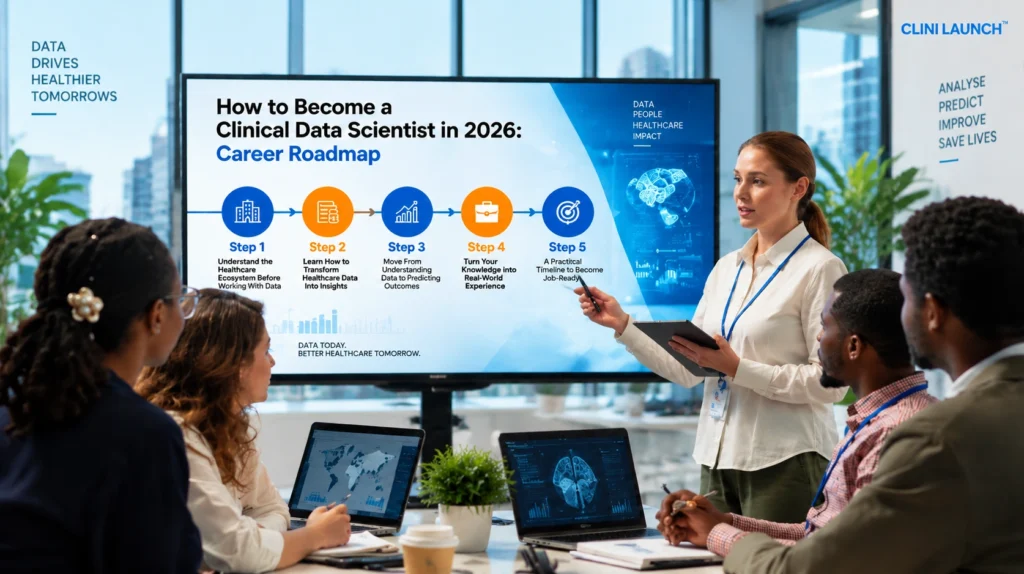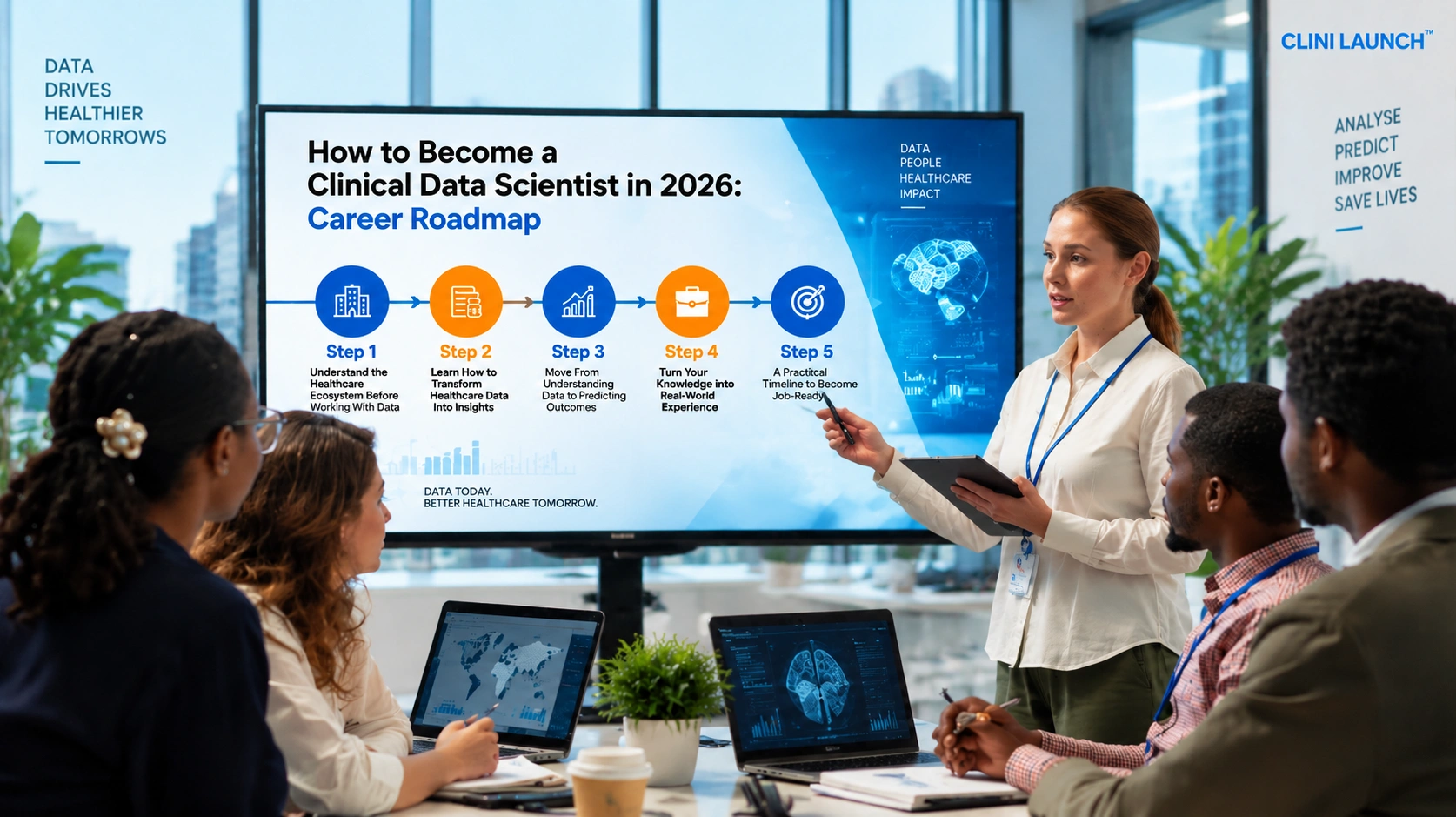
A Clinical Data Scientist combines clinical research, analytics, and technology to transform healthcare data into meaningful insights. In 2026, aspiring professionals can enter this field by building expertise in clinical research, statistics, programming, data analysis, and AI-driven healthcare solutions through a structured career roadmap.
A Clinical Data Scientist career offers one of the most promising opportunities for professionals looking to combine clinical research expertise with data science and healthcare analytics. The demand for Clinical Data Scientists is increasing. The stakes in modern medicine have never been higher. As the global clinical data analytics market surges toward a projected $9.0 billion valuation by 2033 [Grand View Research Report], the pharmaceutical industry faces immense pressure to accelerate drug development pipelines.
With clinical trials becoming more complex and healthcare data expanding across multiple sources, organizations need professionals who can transform complex datasets into actionable insights. A Clinical Data Scientist in 2026 goes beyond traditional statistical programming, using predictive analytics, machine learning, and Generative AI to optimize trials and support faster decision-making. Employers now seek professionals with a hybrid skill set combining clinical research knowledge with expertise in statistics, R, Python, SQL, and healthcare data structures.
In this blog, we explore what a Clinical Data Scientist does, the skills required for the role, and a realistic roadmap to build a successful career in clinical data science.
What Does a Clinical Data Scientist Do in Modern Healthcare?
A Clinical Data Scientist transforms complex healthcare data into actionable insights that support clinical research, patient safety, and better healthcare decisions. Their key responsibilities include:
- Managing and integrating healthcare data: Combining information from clinical trials, EHRs, genomics, laboratory systems, and digital health platforms to create reliable, analysis-ready datasets.
- Generating insights and predictive models: Applying statistics, analytics, machine learning, and AI to identify trends, predict treatment responses, detect risks, and support personalized healthcare.
- Improving clinical research outcomes: Analyzing safety data, trial performance, and patient outcomes to enable faster and more informed decisions.
- Ensuring data quality and compliance: Maintaining accurate, standardized, and traceable datasets while following regulatory requirements and healthcare data standards.
- Bridging clinical and technical expertise: Translating complex healthcare data into practical solutions that improve research efficiency and patient outcomes.
Professional Program in Clinical Research
Build expertise in clinical trial operations, regulatory guidelines, data management, and research methodologies through industry-focused training. This program prepares learners for real-world clinical research workflows including trial management, protocol execution, regulatory compliance, and global research practices.
View CourseClinical Data Scientist vs Other Healthcare Data Roles
Healthcare data holds answers to complex medical questions, but different experts unlock its value in different ways. A Clinical Data Scientist career focuses on using analytics and AI to discover deeper insights, while other roles apply data for research, reporting, and healthcare management. Each role plays a unique part in turning information into impact.
| Role | Primary Focus | How They Use Data |
| Clinical Data Scientist | Predictive analytics and AI-driven healthcare insights | Builds machine learning models to identify patterns, predict patient outcomes, improve clinical trial decisions, and support personalized medicine. |
| Healthcare Data Analyst | Business intelligence and operational improvement | Analyzes historical healthcare data using tools like SQL, Tableau, or Power BI to identify trends, improve workflows, and support hospital decision-making. |
| Health Informaticist | Healthcare systems and data management | Designs and manages health information systems, ensures EHR data quality, and supports data governance, interoperability, and compliance. |
| Biostatistician | Statistical analysis in clinical research | Applies mathematical and statistical methods to clinical trial data to evaluate treatment effectiveness, safety, and research outcomes. |
Clinical Data Scientist Career Roadmap – 2026
Healthcare is generating more data than ever before — from clinical trials and electronic health records to genomics and digital health platforms. But data alone cannot improve patient outcomes. It requires skilled professionals who can understand the medical context, analyze complex datasets, and convert information into meaningful healthcare decisions.
This is where Clinical Data Scientists play a critical role.
A Clinical Data Scientist combines clinical knowledge, statistical analysis, data science, and artificial intelligence to uncover patterns hidden within healthcare data. They help researchers identify treatment outcomes, improve clinical trial efficiency, predict potential risks, and support evidence-based medical decisions.
A clinical question may begin with a simple challenge:
- Why does one patient respond differently to the same treatment?
- Can potential safety concerns be identified before they become serious?
- How can clinical trials generate faster and more reliable insights?
By using data, analytics, and AI in healthcare, Clinical Data Scientists help transform these questions into actionable solutions.
Clinical Data Scientist – Eligibility
Clinical Data Science is a multidisciplinary career that welcomes professionals from both technology and healthcare backgrounds. The ideal candidate is someone who can connect two worlds — understanding the complexity of healthcare while applying the power of data and AI.
1. Technology and Data Professionals
Professionals from backgrounds such as:
- Computer Science
- Data Science
- Statistics
- Mathematics
- Engineering
already have strong foundations in programming, analytics, and machine learning.
To transition into Clinical Data Science, they need to develop knowledge of:
- Clinical research workflows
- Medical terminology
- Healthcare data systems
- Regulations such as HIPAA and data privacy standards
Their technical expertise, combined with healthcare understanding, enables them to build solutions that address real clinical challenges.
2. Healthcare and Life Science Professionals
Professionals from:
- Biotechnology
- Pharmacy
- Medicine
- Nursing
- Bioinformatics
- Life Sciences
already understand biological systems, patient care, and healthcare processes.
To move into Clinical Data Science roles, they need to strengthen their skills in:
- Python/R programming
- SQL and data handling
- Statistical analysis
- Machine learning concepts
Their clinical background helps them interpret healthcare data with the right medical perspective.
3. The Ideal Skill Combination
A successful Clinical Data Scientist career is built on the combination of three essential capabilities:
Healthcare Expertise + Data Analytics + AI Skills
Professionals should understand:
- How clinical trials generate and manage data
- How healthcare datasets are structured and analyzed
- How predictive models can support better medical decisions
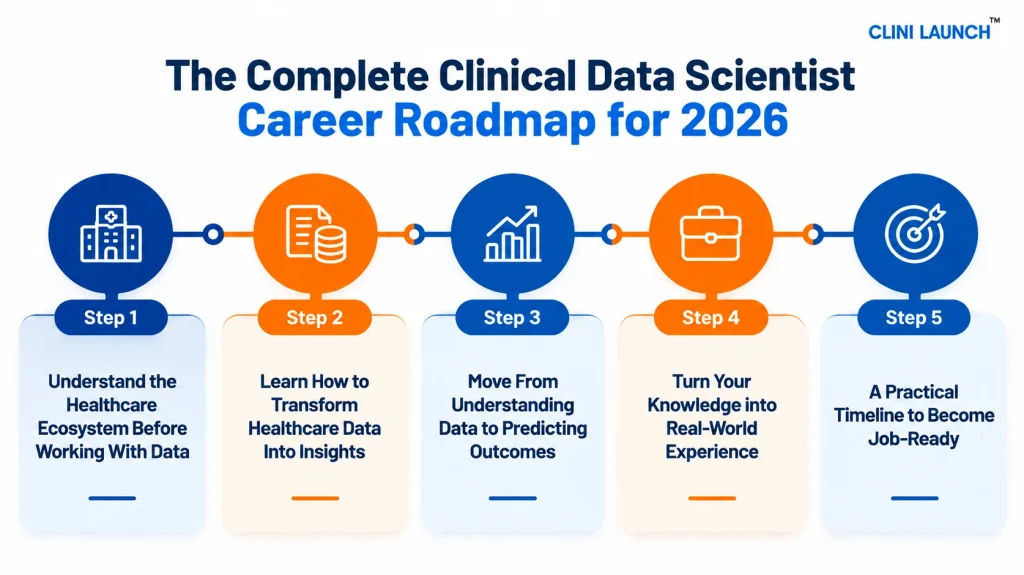
How to Become a Clinical Data Scientist in 2026
Becoming a Clinical Data Scientist is not about mastering every programming language or AI technology at once. It is about building skills step-by-step and learning how to apply technology to solve healthcare problems.
The journey involves understanding healthcare data, developing analytical capabilities, applying AI techniques, and gaining practical experience.
Step 1: Understand the Healthcare Ecosystem Before Working With Data
Before analyzing healthcare datasets, you need to understand where the data originates and what it represents.
Start by learning:
- Clinical trial phases and drug development
- Patient data collection processes
- Clinical research workflows
- Medical terminology
- Regulatory frameworks such as ICH-GCP
Healthcare data is not just rows and columns. Every data point represents a patient journey, treatment decision, or clinical outcome. Understanding this context allows Clinical Data Scientists to generate accurate and meaningful insights.
Step 2: Learn How to Transform Healthcare Data Into Insights
Once you understand the healthcare ecosystem, the next step is learning how to manage and analyze complex healthcare datasets.
Clinical Data Scientists work with information from sources such as clinical trials, electronic health records, laboratory systems, and healthcare databases.
Key skills to develop include:
- SQL for extracting and managing data
- Python or R for analysis and automation
- Statistics for interpreting clinical outcomes
- Data visualization for communicating insights
The objective is not simply to analyze data but to answer important healthcare questions using evidence-based insights.
Step 3: Move From Understanding Data to Predicting Outcomes
Healthcare is moving beyond traditional analysis toward predictive and personalized approaches.
This is where AI and machine learning become valuable. Clinical Data Scientists use these technologies to identify patterns, forecast outcomes, and support proactive healthcare decisions.
Develop expertise in:
- Machine learning fundamentals
- Predictive modelling
- Healthcare AI applications
- Patient outcome prediction
- Risk assessment models
Step 4: Turn Your Knowledge Into Real-World Experience
Technical knowledge becomes valuable when it can solve practical healthcare challenges.
Build experience through:
- Clinical trial data analysis projects
- Healthcare dashboards
- Patient safety analytics
- Predictive healthcare models
- Real-world clinical datasets
A strong portfolio demonstrates your ability to apply data science concepts to real healthcare scenarios and prepares you for industry opportunities.
The future of healthcare will depend on professionals who can understand both medicine and technology. By combining clinical expertise with analytics and AI skills, Clinical Data Scientists can play a key role in shaping smarter, data-driven healthcare systems.
Step 5:
Become a Clinical Research Data Scientist – Practical Timeline
Becoming a Clinical Research Data Scientist requires combining clinical knowledge, data skills, and practical experience. A focused 6–12 month roadmap can help professionals from healthcare, life sciences, and technology backgrounds build the foundation for entry-level opportunities.
Months 1–3: Build Clinical Understanding
Learn how healthcare data is created and used through:
- Clinical trial processes
- Research workflows
- Healthcare data concepts
- Medical terminology
Months 4–6: Develop Data Skills
Build the ability to analyze clinical datasets through:
- Python/R programming
- SQL and database management
- Statistics and data analysis
- Data visualization
Months 7–9: Apply Skills Through Projects
Gain practical experience with:
- Clinical data analysis
- Healthcare dashboards
- Patient safety analytics
- Predictive models
Months 10–12: Prepare for Industry Roles
Get career-ready by focusing on:
- Healthcare-focused portfolio projects
- Resume and LinkedIn optimization
- Interview preparation
- Applying for Clinical Data Analyst and Clinical Research Data Scientist roles
By combining clinical expertise with data science skills, professionals can build the capabilities needed to support modern clinical research and healthcare decisions.
Clinical Data Scientist Salary and Career Growth in India (2026)
A Clinical Data Scientist career evolves from analysing clinical data to creating insights that influence healthcare decisions. With growing expertise, professionals move into higher-impact roles with better career opportunities.
The table below showcases common career pathways and Clinical data scientist salary rages in India.
| Role | Typical Experience Level | Approximate Salary Range |
| Clinical Data Associate | Entry Level (0–2 years) | ₹3–6 LPA |
| Clinical Data Analyst | 1–3 years | ₹4–8 LPA |
| Clinical SAS Programmer | 1–4 years | ₹5–10 LPA |
| Healthcare Data Analyst | 2–5 years | ₹6–12 LPA |
| Clinical Data Scientist | 2–5 years | ₹7–15 LPA |
| Senior Clinical Data Scientist | 5–8 years | ₹12–20+ LPA |
| Clinical Data Science Lead / Manager | 8+ years | ₹20–30+ LPA |
Conclusion
Building a successful Clinical Data Scientist career in 2026 requires more than technical knowledge. It requires the ability to combine clinical understanding, analytical thinking, and healthcare innovation. From learning clinical research fundamentals to developing data skills and gaining practical experience, the journey focuses on transforming complex healthcare data into meaningful insights that support better decisions.
CliniLaunch Research Institute helps aspiring professionals build this future-ready foundation through structured training in clinical research, healthcare analytics, and emerging technologies. With industry-aligned learning, practical exposure, and career-focused guidance, learners can develop the skills needed to move confidently toward opportunities in Clinical Data Science and the evolving healthcare data landscape.
Frequently Asked Questions
What is a Clinical Data Scientist and what do they do?
A Clinical Data Scientist combines clinical research, data analytics, programming, and AI to analyze healthcare data and generate insights that support medical decisions. A Clinical Research Data Scientist works with clinical trials, electronic health records, and healthcare datasets to identify patterns, predict outcomes, and improve research processes.
How can I start a Clinical Data Scientist career in 2026?
To build a Clinical Data Scientist career, professionals need skills in clinical research, statistics, programming, data analysis, and healthcare AI. The learning path includes understanding healthcare workflows, developing technical skills, and gaining practical experience through real-world healthcare projects.
What is the average Clinical Data Scientist Salary in India?
The Clinical Data Scientist Salary in India depends on experience, technical skills, and industry exposure. Entry-level professionals can start with clinical data and analytics roles, while experienced Clinical Data Scientists can progress into senior and leadership positions.
Is Clinical Data Science a good career option for healthcare and life science professionals?
Yes. A Healthcare Data Scientist Career is suitable for professionals from biotechnology, pharmacy, medicine, nursing, bioinformatics, and life sciences. With skills in programming, analytics, and AI, they can transition into Clinical Data Scientist roles.
How is Data Science in Clinical Research changing healthcare?
Data Science in Clinical Research helps analyze complex healthcare datasets, identify treatment patterns, predict outcomes, and improve clinical trial decisions. AI and analytics allow Clinical Data Scientists to support faster and smarter healthcare decisions.