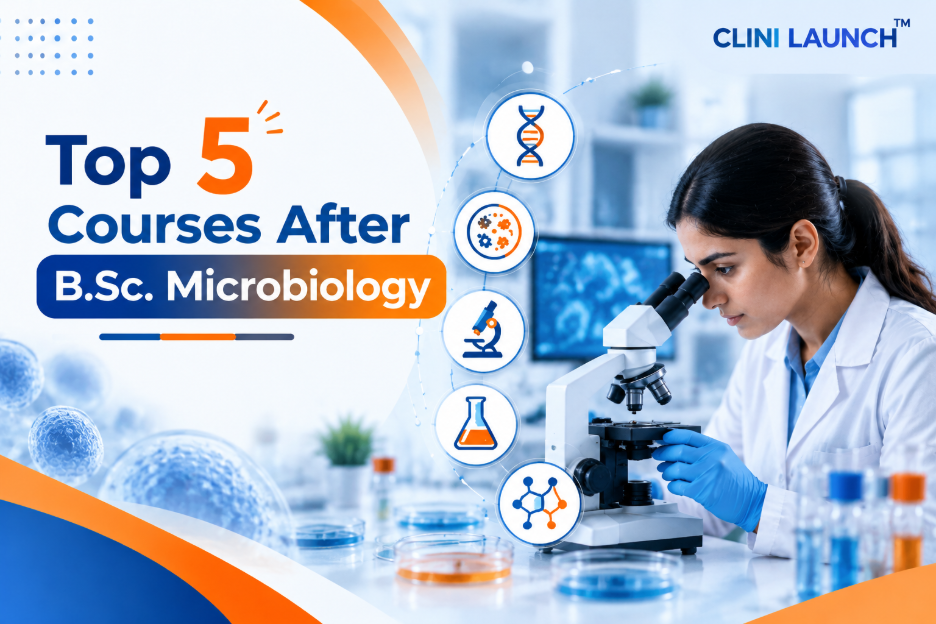
The best courses after BSc Microbiology include Bioinformatics, Medical Microbiology, Clinical Research, Bioprocess Technology, and Molecular Biology. These specialized pathways help graduates develop industry-ready skills and explore diverse careers across healthcare, biotechnology, research, diagnostics, and pharmaceutical industries.
A BSc Microbiology degree builds a strong foundation in microorganisms, disease biology, and laboratory science. However, the life sciences industry is rapidly moving toward specialized fields driven by technology and healthcare innovation.
According to the World Health Organization (WHO), antimicrobial resistance (AMR) directly caused around 1.27 million deaths globally in 2019, increasing the demand for experts in diagnostics, infection control, and medical microbiology.
At the same time, advancements in genomics, biologics, and precision medicine are creating new opportunities in bioinformatics, clinical research, pharmacovigilance, and biotechnology. With over 500,000 clinical studies registered on ClinicalTrials.gov, the need for skilled professionals in clinical trial management and regulatory fields continues to grow.
For microbiology graduates, choosing the best courses after BSc Microbiology can open diverse microbiology career options beyond traditional laboratory roles and help build industry-ready expertise.
The Shift from Traditional to Specialized Life Sciences
Traditional wet-lab roles are evolving. Today, pharmaceutical giants, diagnostic networks, and research institutes demand multidisciplinary expertise. Blending biological fundamentals with data analytics, regulatory intelligence, or molecular engineering drastically improves career outcomes.
The biological sciences ecosystem values specialized skills over generic academic qualifications. Broad degrees lack the practical depth required by modern Contract Research Organizations (CROs) and biotech enterprises.
Precision Bioinformatics
Learn genomic analysis, bioinformatics tools, and computational biology skills for careers in biotechnology, healthcare, and life sciences.
View CourseTop 5 Courses After BSc Microbiology for Career Growth
For graduates exploring microbiology career options, we have listed the top best courses after BSc Microbiology across healthcare, research, biotechnology, and emerging life science fields.
1. M.Sc. in Bioinformatics/Computational Biology
This domain represents the fusion of microbiological genomic data with data science. Instead of analyzing a single culture on a petri dish, you learn to process massive data sequences from Next-Generation Sequencing (NGS) and microbial multi-omics.
Duration: 2 Years (4 Semesters)
- Core Departments Involved: Department of Computational Biology, Department of Bioinformatics & Data Science.
- What You Will Learn: Python/R programming for biological data, structural bioinformatics, metabolic pathway modeling, and molecular docking for computer-aided drug design.
- Trend & Market Data: The global bioinformatics market is valued at USD 18.63 Billion and is projected to expand to USD 34.41 Billion by 2031, progressing at a massive compound annual growth rate (CAGR) of 13.1%. Furthermore, global life science metrics indicate that over 62% of federally funded research initiatives now require core computational coding proficiencies.
- Top Job Roles: Genomic Data Analyst, Biostatistician, Computational Drug Discovery Specialist.
2. Post-Graduate Diploma / M.Sc. in Clinical Research & Regulatory Affairs
If pure bench research loses its appeal, this track shifts your focus to managing human clinical trials and steering new microbiological formulations through complex global regulatory clearance systems. It stands out as one of the best courses after BSc microbiology for those seeking dynamic, corporate-facing roles.
Duration: 1 Year (2 Semesters)
- Core Departments Involved: Department of Clinical Research, Faculty of Pharmacy.
- What You Will Learn: Clinical trial design (Phases I–IV), ICH-GCP guidelines, pharmacovigilance, clinical data management, and patent/IPR filings for biological drugs.
- Trend & Market Data: Data from global healthcare research bodies underlines that commercialization timelines depend entirely on trial execution. According to data from Grand View Research, the clinical trials market in India alone is expanding at an 8.0% CAGR, fueled by global CRO outsourcing. Interpharma Health Panorama 2024 reports that over 48% of pharmaceutical research spending goes toward clinical trials.
- Top Job Roles: Clinical Research Associate (CRA), Regulatory Affairs Manager, Drug Safety Pharmacovigilance Officer.
3. M.Sc. in Medical Microbiology & Diagnostic Pathology
This clinical specialization focuses specifically on human-pathogen interactions, the isolation of infectious strains, and tracking antimicrobial resistance (AMR) mechanisms, which is a major global healthcare priority.
Duration: 2 Years (4 Semesters)
- Core Departments Involved: Department of Medical Microbiology, Department of Clinical Pathology, or Hospital-attached Medical Colleges.
- What You Will Learn: Advanced bacteriology, clinical virology, diagnostic immunology, serology, and molecular diagnostics (such as advanced qPCR and CRISPR-based pathogen detection).
- Trend & Market Data: The necessity of this course is driven by the global surge in antimicrobial resistance. Studies highlighted by the World Health Organization (WHO) confirm that modern chronic hospital infections are increasingly polymicrobial, driven by resistant strains like MRSA (Methicillin-resistant S. aureus) and Pseudomonas aeruginosa. This creates an immediate demand for diagnostic masters who can map out empirical antibiotic selection models.
- Top Job Roles: Medical Microbiologist, Infection Control Officer, Diagnostic Molecular Specialist.
4. Professional Program in Precision Bioinformatics – CliniLaunch Research Institute
A broad biotechnology degree covers fundamentals. CliniLaunch’s Precision Bioinformatics Program adds expertise in genomics, AI-driven healthcare analytics, and computational biology for precision medicine careers.
Duration: 6 Months (Hybrid Format)
- Core Departments Involved: Bioinformatics, Computational Biology, Genomics, Clinical Data Science.
- What You Will Learn: Genomics, transcriptomics, variant analysis, clinical data standards, AI/ML integration, and pipeline development.
- Trend & Market Data: Growth in precision medicine, genomic research, and AI-based drug discovery is driving demand for bioinformatics skills.
- Top Job Roles: Bioinformatics Analyst, Genomics Data Scientist, Clinical Bioinformatics Specialist, Computational Biologist.
5. M.Sc. in Molecular Biology & Human Genetics
This course focuses on the internal mechanics of cellular life, examining how microbes alter host genetics, genetic editing mechanisms, and the therapeutic applications of synthetic biological circuits.
Duration: 2 Years (4 Semesters)
- Core Departments Involved: Department of Molecular Biology, Center for Human Genetics.
- What You Will Learn: Recombinant DNA technology, gene silencing techniques, CRISPR-Cas9 genome editing protocols, and cellular signaling networks.
- Trend & Market Data: Industrial hiring surveys mapped by Research.com show that graduates specializing in molecular and cellular tracks exhibit a 25% higher post-graduation research placement rate in premier industrial R&D units compared to candidates with general biological science degrees.
- Top Job Roles: R&D Geneticist, Molecular Biologist, Synthetic Biology Scientist.
Compare the top career-focused courses after BSc Microbiology to find the right specialization for your future.
| Course | Duration | Key Skills Covered | Career Roles |
| M.Sc. Bioinformatics & Computational Biology | 2 Years | Python/R, NGS, Genomics, Molecular Modelling | Genomic Data Analyst, Biostatistician, Drug Discovery Specialist |
| PG Diploma / M.Sc. Clinical Research & Regulatory Affairs | 1–2 Years | Clinical Trials, ICH-GCP, Pharmacovigilance, Data Management | CRA, Regulatory Affairs Associate, Drug Safety Officer |
| M.Sc. Medical Microbiology & Diagnostic Pathology | 2 Years | Diagnostics, Immunology, Virology, Molecular Testing | Medical Microbiologist, Infection Control Officer |
| Precision Bioinformatics Program – CliniLaunch | 6 Months | Genomics, Transcriptomics, AI/ML, Variant Analysis, Pipelines | Bioinformatics Analyst, Genomics Data Scientist, Clinical Bioinformatics Specialist |
| M.Sc. Molecular Biology & Human Genetics | 2 Years | Gene Editing, Recombinant DNA, Genomics | Molecular Biologist, Geneticist, R&D Scientist |
Strategic Course Comparison Matrix
Selecting the right program requires matching your personal strengths with industry requirements.
| Specialized Track | Best Suited For | Key Skills Needed | Career Sectors |
| Bioinformatics | Coding & biological data enthusiasts | Python/R, Statistics, Data Analysis | AI-Genomics, Biopharma, Research Labs |
| Clinical Research & Regulatory Affairs | Trial management & healthcare systems | Communication, GCP, Regulatory Knowledge | CROs, Pharma, Clinical Platforms |
| Medical Microbiology | Diagnostic & hospital-focused roles | Pathogenesis, Immunology, Lab Skills | Hospitals, Diagnostics, Epidemiology |
| Bioprocess Technology | Manufacturing & production systems | Fermentation, Bioprocessing, GMP | Vaccines, Biotech, Enzyme Industry |
| Molecular Biology | Genetic research & advanced techniques | Molecular Tools, Cell Biology, Precision Lab Skills | Gene Therapy, Stem Cells, R&D Labs |
Accelerating Your Career with Industry Alignment
While academic degrees build theoretical understanding, bridge programs offered by institutes like CliniLaunch Research Institute help align academic training with industry expectations. Specialized certifications in clinical research, pharmacovigilance, and clinical data management reduce onboarding time for top-tier employers.
Key Factors When Choosing Your Master’s Track
- Verify Industrial Accreditations: Ensure the curriculum includes practical training in ICH-GCP, GMP, or biological data platforms.
- Evaluate Lab Infrastructure: Look for institutes offering direct exposure to wet-lab instrumentation or high-performance computing clusters.
- Assess Sector Growth: Focus on specialized fields like pharmacovigilance and computational biology that offer resilient, long-term microbiology career options.
Making an informed choice after your BSc in Microbiology will set the trajectory for your professional growth. By targeting high-growth sectors, you position yourself at the forefront of modern biological and medical advancements.
Conclusion: Choosing the Right Course After BSc Microbiology
A BSc Microbiology degree offers diverse career opportunities across healthcare, biotechnology, and research. Choosing the right specialization in clinical research, pharmacovigilance, bioinformatics, or molecular biology can help graduates build industry-ready skills.
At CliniLaunch Research Institute, programs like the Professional Program in Precision Bioinformatics Course help learners gain practical knowledge aligned with evolving life science careers.
With the right specialization and industry exposure, microbiology graduates can move beyond traditional roles and build future-ready careers.
Frequently Asked Questions (FAQs)
What can I do after completing a BSc Microbiology degree?
After BSc Microbiology, graduates can explore careers in clinical research, pharmacovigilance, biotechnology, bioinformatics, medical microbiology, and molecular biology based on their interests and career goals.
Which course is best after BSc Microbiology for a high-growth career?
The best course depends on your career direction. Programs in clinical research, bioinformatics, and healthcare technology offer strong opportunities by combining biological knowledge with industry-relevant skills.
Can a microbiology graduate enter the clinical research field?
Yes. A microbiology graduate can pursue clinical research by learning clinical trial processes, ICH-GCP guidelines, regulatory requirements, and pharmacovigilance practices.
Is bioinformatics a good career option after BSc Microbiology?
Yes. Bioinformatics is an emerging field where microbiology knowledge is combined with data analysis, genomics, and computational biology for research and drug discovery.
Are there career opportunities in pharmacovigilance after microbiology?
Yes. Microbiology graduates can build careers in pharmacovigilance by developing skills in drug safety monitoring, adverse event reporting, and regulatory compliance.
Should I choose a research-based or industry-focused course after BSc Microbiology?
It depends on your goals. Research-focused pathways suit those interested in scientific discovery, while industry-oriented courses like clinical research and bioprocess technology prepare graduates for corporate roles.
What skills should I develop after BSc Microbiology to improve career opportunities?
Along with biological knowledge, skills in clinical documentation, regulatory guidelines, data analysis, laboratory techniques, and industry tools can improve career readiness.
Can BSc Microbiology graduates work in healthcare and pharmaceutical companies?
Yes. With the right specialization, microbiology graduates can work in pharmaceutical companies, CROs, diagnostic laboratories, biotechnology firms, and healthcare organizations.