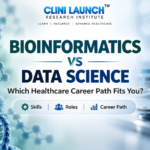
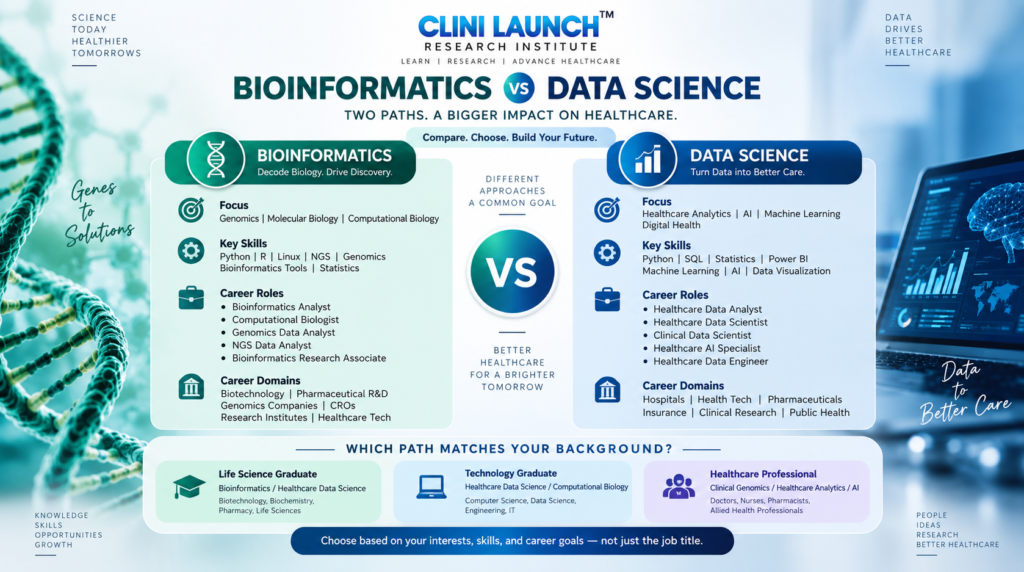
Bioinformatics and Healthcare Data Science are two emerging career paths that combine life sciences with technology. Bioinformatics focuses on analyzing biological data such as genes, proteins, and genomic sequences for applications like precision medicine and drug discovery. Data science uses analytics, AI, and machine learning to analyze healthcare data and improve clinical, operational, and patient outcomes.
Bioinformatics vs Data science is a common career dilemma among life science graduates in India. Many students with backgrounds in biotechnology, biochemistry, pharmacy, or healthcare often struggle to decide between these two career paths. While bioinformatics focuses on analyzing biological information like genes, proteins, and molecular data, healthcare data science applies analytics, AI, and machine learning to solve larger healthcare challenges. Understanding the skills, career opportunities, and industry applications of both fields can help students make a more informed career choice.
Bioinformatics career scope is expanding as life sciences demand computational expertise; McKinsey & Company reports digital R&D skills grew 2–3X, while only 4% talent across the globe possess rare molecular data skills.
On the other hand, healthcare data science is gaining importance as Gartner highlights the need for healthcare CIOs to modernize data architectures and expand clinical analytics capabilities, creating demand for skilled professionals.
With both fields emerging as promising career options, students need more clarity on the practical differences between these pathways before making a career decision. This article provides a detailed comparison of Bioinformatics vs Data science, covering daily responsibilities, technical skills, career opportunities, job market trends, and salary potential. By the end, you will have a clearer understanding of which career path aligns better with your interests, educational background, and long-term professional goals.
According to the National Human Genome Research Institute (NHGRI), advances in genomics have generated enormous amounts of biological data, creating a growing need for professionals who can manage and interpret complex genomic information.
Bioinformatics vs. Data science: Comparing the Two Healthcare Career Paths
When evaluating these two career paths, the key question is not which field is better, but which pathway aligns with your interests, academic foundation, and career aspirations. Factors such as the type of work you want to pursue, the skills you want to build, and the industries you want to work in play an important role in making this decision.
BIRAC’s India BioEconomy Report 2026 highlights India’s $195.3B bioeconomy growth, driven by 11,800+ biotech startups.
Bioinformatics Career Path in India
Bioinformatics Career Scope:
India’s bioinformatics landscape is moving from traditional wet-lab research toward data-driven computational biology, creating opportunities in genomics, precision medicine, and AI-powered drug discovery. The demand is shifting toward professionals who can analyze genomic sequences, build computational models, and work with large biological datasets.
- Government Initiatives: BioE3 Policy strengthens India’s bioeconomy through Bio-AI hubs, multi-omics research, and computational innovation.
- Growth of AI-Driven Genomics: The industry’s expansion into the areas of genomic testing and AI-based analysis is strengthening precision medicine, increasing the need for professionals skilled in genomic data interpretation and computational biology.
- Rise of Computational Drug Discovery: The adoption of AI laboratories and molecular modelling approaches in pharmaceutical research is creating demand for bioinformatics professionals who can support areas such as molecular docking, predictive modelling, and drug discovery.
- AI Bioinformatics: Biopharmaceutical companies are integrating AI-driven approaches into research and development, making skills in structural biology, machine learning, and biological data analysis increasingly valuable for future bioinformatics careers.
MarketsandMarkets forecasts India’s bioinformatics market to reach $1.18B at a 15.7% CAGR, up from $568.3M.
Bioinformatics Job Opportunities in India
Bioinformatics professionals can explore diverse roles across biotechnology companies, pharmaceutical R&D organizations, genomics companies, CROs, research institutes, and healthcare technology firms. Popular career roles include:
| Role | What They Do | Average Bioinformatics Salary in India* |
| Bioinformatics Analyst | Analyzes genomic, DNA, RNA, and protein sequence datasets using computational tools. | ₹3–6 LPA |
| Computational Biologist | Develops models to study biological systems, biomarkers, and molecular interactions. | ₹5–10 LPA |
| Structural Bioinformatics Scientist | Studies protein structures, molecular interactions, and drug–target relationships. | ₹6–12 LPA |
| Genomics Data Analyst | Processes sequencing data to identify genetic variations and biological patterns. | ₹4–8 LPA |
| Bioinformatics Research Associate | Performs biological data analysis and supports computational research workflows. | ₹3–7 LPA |
| NGS Data Analyst | Processes next-generation sequencing data and manages genomic analysis pipelines. | ₹4–9 LPA |
| Bioinformatics Software Developer | Builds computational tools, databases, and automated bioinformatics pipelines. | ₹5–12 LPA |
NITI Aayog highlights AI-native biology and computational modelling as key to shortening discovery cycles in India’s bioeconomy.
Bioinformatics Skills
Modern bioinformatics roles require a combination of biological knowledge, computational expertise, and data analysis capabilities. As research shifts toward genomics, multi-omics, and AI-driven discovery, professionals need skills that enable them to process complex biological datasets and translate them into meaningful scientific insights.
| Skill Area | Skills & Tools |
| Programming & Computational Foundations | Python, R Programming, Linux/Unix, Bash scripting, SQL, Database Management |
| NGS & Omics Analysis | BLAST, GATK, SAMtools, BCFtools, FASTA, FASTQ, BAM |
| Statistics & Visualization | Bioconductor, ggplot2, Matplotlib, Seaborn, Statistical Analysis |
| AI & Structural Bioinformatics | Machine Learning, Deep Learning, TensorFlow, PyTorch, PyMOL, AlphaFold-based approaches |
| Biological Databases | NCBI, Ensembl, UniProt, TCGA |
Fortune Business Insights projects bioinformatics services growth from $7.82B to $22.03B, driven by NGS adoption.
Bioinformatics Courses and Learning Pathway
Who Can Build a Career in Bioinformatics?
Bioinformatics welcomes candidates from life sciences, computer science, and healthcare backgrounds. While each background offers a different advantage, professionals need to develop complementary skills in biology, programming, and data analysis.
- Life Science Graduates: Biotechnology, Biochemistry, Microbiology, Genetics, and Pharmacy graduates can transition by learning programming, statistics, and computational biology.
- Technology Graduates: Computer Science, IT, and Data Science graduates can enter by building knowledge of genetics, molecular biology, and biological datasets.
- Healthcare Professionals: Medical and allied health graduates can move into clinical genomics and precision medicine by developing computational skills.
InsightsIAS reports India’s GCC expansion into R&D is increasing demand for computational biologists, bioinformatics analysts, and digital health professionals.
Bioinformatics Courses in India
For graduates in India, starting a career in bioinformatics usually begins with choosing the right learning pathway. A biotechnology, microbiology, biochemistry, or pharmacy graduate may need to strengthen programming, statistics, and computational biology skills, while a computer science graduate may need to build expertise in genetics, molecular biology, and biological data analysis. Depending on their goals, candidates can choose from undergraduate and postgraduate degrees, specialized diplomas, or industry-focused certifications to develop skills required for roles in genomics, drug discovery, healthcare research, and biotechnology R&D.
| Course Type | Duration | Suitable For |
| B.Sc in Bioinformatics / Biotechnology with Bioinformatics Specialization | 3 years | Students after 12th science interested in life sciences and computational biology |
| B.Tech in Bioinformatics / Biotechnology | 4 years | Students looking for an engineering-oriented approach to biological data |
| M.Sc / M.Tech in Bioinformatics or Computational Biology | 2 years | Biotechnology, life science, pharmacy, and technology graduates |
| Ph.D. in Bioinformatics / Computational Biology | 3–5 years | Candidates aiming for research scientist and academic careers |
| PG Diploma / Advanced Diploma in Bioinformatics | 6 months–2 years | Graduates seeking faster transition into bioinformatics roles |
| Online Certifications in Bioinformatics & Genomic Data Science | Few weeks–12 months | Students and professionals upgrading specific skills |
BioSpace reports the bioinformatics ecosystem reaching $47.48B, increasing demand for AI-skilled bioinformatics scientists.
Healthcare Data Science Career Path in India
Data science Career Scope:
India’s healthcare data science landscape is evolving with the integration of artificial intelligence, big data analytics, digital health platforms, and advanced healthcare technologies. The increasing availability of electronic health records, clinical datasets, and real-world healthcare data is creating opportunities for professionals who can combine healthcare knowledge with data science expertise. The demand is growing for skilled professionals who can analyze healthcare data, develop predictive models, improve patient outcomes, and support data-driven healthcare decisions.
- Government Initiatives: The Ayushman Bharat Digital Mission (ABDM) establishes a unified national digital health infrastructure, registering hundreds of millions of unique ABHA health IDs and digital medical records to build a secure, interconnected ecosystem for big data analytics.
- Explosive Market Growth: Driven by hospital automation and insurance technology adoption, India’s healthcare analytics market is expanding rapidly at an estimated CAGR of over 20%, creating an unprecedented volume of high-paying roles for data experts in private hospital networks, diagnostics, and tech startups.
- Predictive Hospital Operations: Major corporate hospital chains and diagnostic networks are integrating predictive modeling to optimize resource allocation, forecast ICU bed occupancy, manage medical supply chains, and reduce patient readmission rates through machine learning.
- Clinical Data and Claims Analytics:
The growth of the health insurance sector is accelerating the use of data science for automated transactions. Government frameworks like the National Health Claims Exchange (NHCX) are standardizing healthcare information exchange, making health-domain data engineers highly sought after for processing digital health claims analytics and secure data sharing.
Deloitte India reports 47% of hospital CXOs see AI and GenAI as key transformation drivers, increasing demand for healthcare data professionals.
Healthcare Data Science Job Opportunities in India
Healthcare Data Science professionals can explore career opportunities across hospitals, pharmaceutical companies, clinical research organizations (CROs), healthcare technology companies, diagnostics companies, insurance firms, and research institutions. With the growth of healthcare analytics, artificial intelligence, and digital transformation, popular career roles include:
| Role | What They Do | Average Healthcare Data Science Salary in India |
| Healthcare Data Analyst | Analyzes healthcare datasets, patient information, and operational metrics using analytics tools to generate insights and support healthcare decision-making. | ₹4–8 LPA |
| Healthcare Data Scientist | Develops statistical models and machine learning algorithms to analyze healthcare data, predict outcomes, and solve complex healthcare challenges. | ₹6–15 LPA |
| Clinical Data Scientist | Works with clinical trial and healthcare datasets to identify trends, validate findings, and support research and evidence-based healthcare decisions. | ₹5–12 LPA |
| Healthcare Business Intelligence Analyst | Creates dashboards, reports, and analytics solutions using healthcare data to improve hospital operations, resource management, and business performance. | ₹5–10 LPA |
| Healthcare AI Specialist | Develops AI and machine learning models for applications such as medical imaging, disease prediction, clinical decision support, and healthcare automation. | ₹6–15 LPA |
| Clinical SAS Programmer | Uses SAS programming and statistical methods to analyze clinical trial data and prepare reports for regulatory submissions. | ₹4–10 LPA |
| Healthcare Data Engineer | Designs and manages healthcare data pipelines, databases, and infrastructure to ensure efficient collection, storage, and processing of healthcare information. | ₹6–14 LPA |
| Clinical Research Data Analyst | Analyzes clinical research data, supports trial reporting, and ensures accurate interpretation of healthcare study results. | ₹4–9 LPA |
Grand View Research projects healthcare analytics reaching $81.9B, increasing demand for professionals who convert healthcare data into insights.
Healthcare AI & Analytics
Build expertise in healthcare AI, data analytics, and digital transformation to support smarter healthcare decision-making. Learn AI applications, healthcare data insights, responsible AI practices, and analytics-driven strategies to prepare for roles in healthcare technology, hospitals, life sciences, and AI-enabled healthcare organizations.
View CourseHealthcare Data Science Skills
Modern data science roles require a combination of healthcare domain knowledge, data analytics expertise, programming abilities, and artificial intelligence skills. As healthcare organizations adopt digital health platforms, electronic health records, predictive analytics, and AI-driven solutions, professionals need skills that help them analyze complex healthcare data, generate meaningful insights, and support better clinical and operational decisions.
| Skill Area | Skills & Tools |
| Healthcare Data Analytics & BI | Power BI, Tableau, Excel, SQL, Healthcare Analytics, Data Visualization, Dashboard Development |
| Programming & Data Science Foundations | Python, R Programming, SQL, Statistics, Data Processing, Pandas, NumPy, Jupyter Notebook |
| Clinical Data Management & Statistics | Clinical Data Management (CDM), SAS Programming, Statistical Analysis, CDISC Standards (SDTM, ADaM), Clinical Data Validation |
| AI, Machine Learning & Predictive Analytics | Machine Learning, Deep Learning, TensorFlow, PyTorch, Scikit-learn, Predictive Modelling, Healthcare AI Applications |
| Healthcare Systems & Data Management | Electronic Health Records (EHR), Electronic Medical Records (EMR), Hospital Information Systems (HIS), Healthcare Databases, Health Data Standards |
Fortune Business Insights projects the analytics market at $36.03B, highlighting continued demand for healthcare analytics professionals.
Healthcare Data Science Courses and Learning Pathway
Who Can Build a Career in Healthcare Data Science?
For graduates in India, entering data science requires combining healthcare knowledge with data and technology skills. Life science, nursing, pharmacy, or medical graduates may need to build skills in Python, SQL, statistics, and machine learning, while technology or statistics graduates may need knowledge of medical terminology, EHRs, and healthcare systems. Depending on their goals, candidates can choose from university degrees, specialized diplomas, or industry-focused certifications for careers in hospital analytics, pharma, health tech, and public health.
- Life Science Graduates: Biotechnology, Bioinformatics, Biochemistry, Microbiology, Genetics, and Pharmacy graduates can transition into data science by learning programming, statistics, data analytics, and machine learning techniques.
- Technology Graduates: Computer Science, IT, Data Science, and Engineering graduates can enter healthcare data science by developing knowledge of healthcare systems, clinical data, medical terminology, and healthcare applications.
Healthcare Data Fundamentals
Build a strong foundation in healthcare data, analytics, and digital health systems to understand how healthcare information is created, structured, and managed. Learn healthcare data types, standards, quality practices, compliance basics, and foundational analytics to support data-driven decision-making in healthcare and life sciences organizations.
View CourseHealthcare Professionals: Medical, Nursing, Allied Health, and Pharmacy professionals can build careers in healthcare analytics and AI-driven healthcare by gaining skills in data management, statistical analysis, and digital health technologies.
Pharmabiz reports 86% of pharma CXOs expect growth, increasing demand for healthcare data scientists in digital transformation.
Healthcare Data Science Courses in India
For graduates in India, entering data science requires combining healthcare knowledge with data and technology skills. Life science, nursing, pharmacy, or medical graduates may need to build skills in Python, SQL, statistics, and machine learning, while technology or statistics graduates may need knowledge of medical terminology, EHRs, and healthcare systems. Depending on their goals, candidates can choose from university degrees, specialized diplomas, or industry-focused certifications for careers in hospital analytics, pharma, health tech, and public health.
| Course / Pathway Type | Duration | Suitable For |
| M.Sc. / M.S. in Health Informatics & Analytics | 2 years | Life Science, Nursing, Pharmacy, or IT graduates. |
| M.Sc. in Digital Health | 2 years | Science and Technology graduates aiming for digital health-tech and startup roles. |
| M.Tech in Medical Informatics / Clinical AI Track | 2 years | Engineering, Computer Science, and Data Science graduates. |
| Executive PG Diploma in Healthcare Analytics / Management | 1 year | Working clinicians, hospital administrators, or tech professionals looking to pivot. |
| Ph.D. in Biostatistics / Public Health Informatics | 3–5 years | Postgraduates in Mathematics, Statistics, or Public Health. |
| Applied Industry Bootcamps & Professional Health Data Certifications | 3–12 months | Practicing Data Analysts looking to build immediate domain specialization. |
Bioinformatics vs Data Science: Career Factors to Consider
For graduates evaluating these two career paths, the decision often comes down to practical career outcomes rather than just the subject area. Factors such as the type of roles available, salary expectations, industry opportunities, skill requirements, and long-term growth potential can significantly influence the choice. The comparison below provides a side-by-side view of Bioinformatics and Data Science across key career parameters to help understand how each pathway can shape future opportunities.
| Career Decision Factor | Bioinformatics | Healthcare Data Science |
| Average Entry-Level Salary in India | ₹3–6 LPA (Bioinformatics Analyst, Research Associate, Genomics Analyst roles) | ₹4–8 LPA (Healthcare Data Analyst, Clinical Data Analyst, BI Analyst roles) |
| Typical Time to Become Job-Ready | 6–18 months with focused training after a life science degree | 6–12 months with focused training in data analytics, Python, SQL, and healthcare applications |
| Primary Career Domains | Genomics, precision medicine, computational biology, drug discovery | Healthcare analytics, clinical AI, hospital intelligence, digital health |
| Common Entry-Level Roles | Bioinformatics Analyst, NGS Analyst, Genomics Data Analyst, Research Associate | Healthcare Data Analyst, Clinical Data Analyst, Healthcare BI Analyst, Junior Data Scientist |
| Major Hiring Industries | Biotechnology companies, pharma R&D, genomics companies, CROs, research institutes | Hospitals, health-tech companies, pharma, insurance, CROs, healthcare analytics firms |
| Growth Path | Analyst → Computational Biologist → Bioinformatics Scientist → Research/R&D Lead | Analyst → Data Scientist → Senior Data Scientist → Analytics/AI Lead |
Clinical Research, Cybersecurity & Cloud Technology
Gain practical skills in clinical research workflows, digital trial processes, clinical data management, cybersecurity, and cloud-based healthcare systems. Prepare roles in clinical research, pharma companies, CROs, healthcare technology, and data security teams.
View CourseConclusion
Bioinformatics and Healthcare Data Science are both shaping the future of healthcare, but they offer different career experiences. Bioinformatics is ideal for those interested in genetics, molecular research, and discovering the biological reasons behind diseases, while Data Science suits professionals who want to use analytics, AI, and data-driven solutions to improve healthcare delivery.
At CliniLaunch Research Institute, you can build skills across Bioinformatics, Healthcare Data Science, Clinical Research, Pharmacovigilance, and other life science domains through career-focused training designed to help you develop relevant industry skills and move toward your chosen career path.
Frequently Asked Questions
What is the difference between Bioinformatics and Data Science Career Paths?
Bioinformatics focuses on biological data, while Data Science applies analytics across healthcare, business, and technology domains.
What is the average Bioinformatics Salary in India?
Bioinformatics salaries in India typically range from ₹3–12 LPA based on experience, skills, and specialization.
What is a Data Scientist Salary in India?
Data Scientist salaries in India vary based on expertise, with experienced professionals earning significantly higher packages.
What skills are required for Bioinformatics?
Bioinformatics requires programming, genomics, NGS analysis, statistics, biological databases, and computational biology skills.
What skills are required for Data Science?
Data Science requires Python, SQL, statistics, machine learning, data visualization, and analytical problem-solving skills.
What courses are available for Bioinformatics?
Bioinformatics courses cover genomics, programming, NGS, molecular biology, data analysis, and computational research methods.
What courses are available for Data Science?
Data Science courses teach programming, machine learning, statistics, AI, databases, and predictive analytics techniques.
How is AI used in Bioinformatics?
AI in Bioinformatics supports protein prediction, drug discovery, genomics analysis, and biological data interpretation.