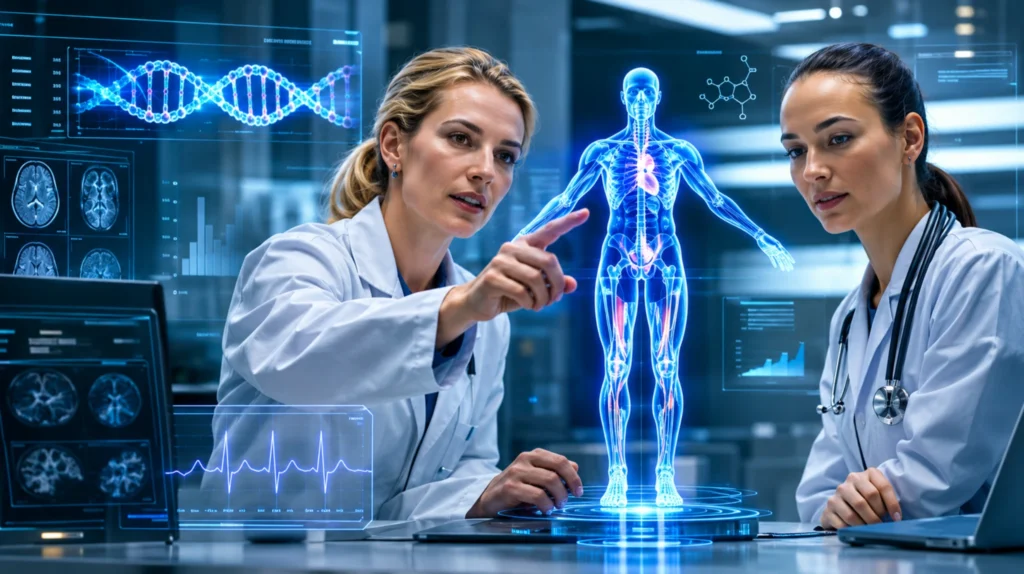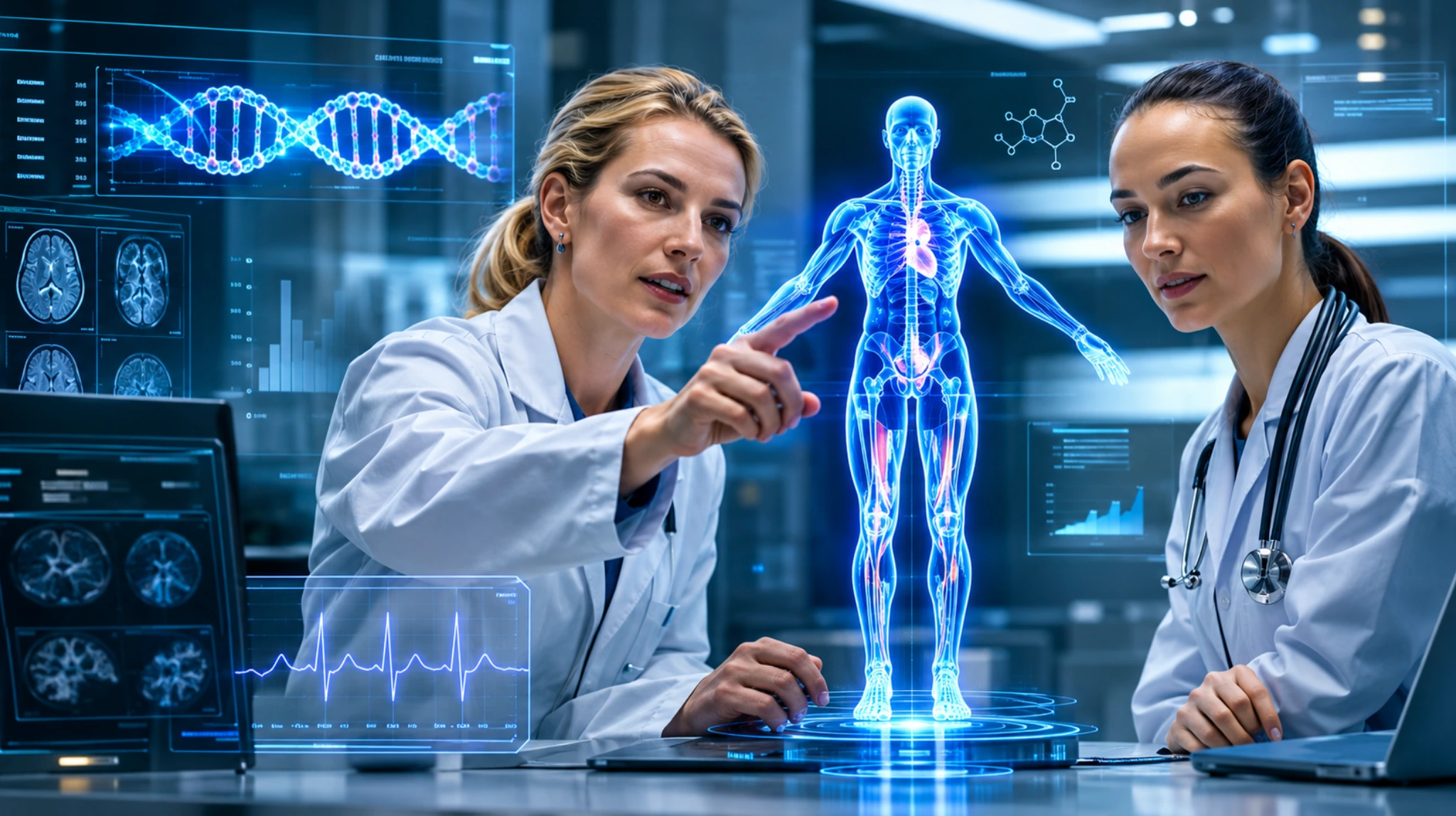
Digital twins in healthcare are virtual models of patients, organs, medical devices, or hospital systems that use real-world data to simulate conditions, support personalized treatment, improve surgical planning, and optimize healthcare operations.
Imagine a living, breathing virtual replica of yourself that maps your DNA, tracks your real-time organ functions, and predicts how your body might respond to a specific drug before you take it. This is no longer just a concept from science fiction; it is an emerging possibility in digital twins in healthcare. By combining patient data, advanced simulations, and artificial intelligence, this technology is opening new possibilities for personalized treatment, disease prediction, and proactive patient care.
Originally introduced in 2002 by Dr. Michael Grieves for product lifecycle management, digital twin technology gained prominence through NASA’s use of virtual models to simulate and troubleshoot spacecraft operations. Today, the concept has expanded beyond manufacturing into modern medicine, with healthcare digital twins being explored in areas such as surgical planning, medical research, and hospital management.
The velocity of this technology adoption is underscored by massive growth and major regulatory backing across the sector. A comprehensive industry report highlights that the global market for medical virtual replicas is skyrocketing, with a projected compounded annual growth rate of 67% Growth from 2023 to 2028. This momentum is further validated by a landmark report from the National Academies of Sciences, Engineering, and Medicine, which officially established foundational directives for the implementation of digital twins in clinical applications.
“A digital twin couples computational models with a physical counterpart to create a system that is dynamically updated through bidirectional data flows as conditions change. Going beyond traditional simulation and modeling, digital twins could enable improved medical decision-making at the individual patient level.”
– Foundational Research Gaps and Future Directions for Digital Twins, NASEM
What are Digital Twins in Healthcare?
A digital twin in healthcare is a dynamic virtual representation of a physical entity, such as a patient, human organ, medical device, or hospital workflow. Unlike a one-time MRI or CT scan, which captures information at a particular point in time, a digital twin evolves as new real-world data become available, reflecting changes in the physical counterpart.
According to the National Academies of Sciences, Engineering, and Medicine (NASEM), a true digital twin connects computational models with their physical counterparts through bidirectional data flows. This means information from the physical entity updates its virtual model, while insights from the model can support decisions affecting the physical entity.
Digital twins are gaining prominence in healthcare as advances in artificial intelligence (AI), machine learning, medical imaging, and connected health devices make complex simulations increasingly practical. Their applications are expanding across personalised medicine, surgical planning, chronic disease management, clinical research, and hospital operations, creating new opportunities to improve patient care and healthcare decision-making.
Digital Twins in Healthcare Vs. Traditional Medical Simulation
Digital twins and traditional medical simulations both use computer-generated models to understand biological processes and explore clinical outcomes. However, digital twins in healthcare differ from conventional simulations in their data connections, functionality, and ability to reflect real-world changes.
| Comparison Factor | Traditional Medical Simulation | Digital Twins in Healthcare |
| Data Source | Uses predefined parameters, historical datasets, or fixed inputs. | Incorporates real-world data from its physical counterpart. |
| Model Updates | Generally remains unchanged unless manually updated or reconfigured. | Evolves as new data become available. |
| Real-Time Connectivity | Does not necessarily maintain a continuous connection with a physical entity. | Maintains a data connection with the physical counterpart. |
| Primary Purpose | Models specific scenarios to explore possible clinical outcomes. | Monitors changing conditions and supports ongoing analysis and predictions. |
| Example | A 3D anatomical model used to study organ structures before surgery. | A virtual heart model updated with patient-specific data to explore potential treatment responses. |
How Do Digital Twins in Healthcare Work?
Digital twins in healthcare rely on a continuous process of data collection, integration, and simulation to transform biological and operational data into actionable clinical insights. This process involves three interconnected phases.
1. Data Collection (Wearables, EHRs, and Imaging)
The first step in digital twins in healthcare involves collecting real-time and historical data through the Internet of Medical Things (IoMT). Connected devices such as continuous glucose monitors, smartwatches, and clinical sensors capture vital signs, including heart rate, oxygen saturation (SpO2), and body temperature.
This information is combined with Electronic Health Records (EHRs), genomic data, and diagnostic imaging (MRI and CT scans) to build comprehensive patient profiles for healthcare digital twins.
2. Data Integration and Processing (Cloud and Edge Computing)
Collected data is aggregated and standardised using interoperability protocols such as HL7 FHIR. Processing takes place across two environments:
- Edge Computing: Processes patient data close to its source, reducing network delays.
- Cloud Infrastructure: Provides scalable storage and computing resources for AI and machine learning models.
A cloud-based digital twin framework has demonstrated a 32% reduction in telemetry latency and a reported 52% improvement in system response times, with up to 98% real-time diagnostic accuracy.
3. Dynamic Simulation and Feedback Loops
In this stage, predictive algorithms use integrated data to create a dynamic connection between the physical entity and its virtual counterpart. Healthcare professionals can run virtual simulations to explore disease progression, assess treatment responses, and plan surgical interventions.
Research involving virtual anatomical replicas has reported a 13% reduction in cardiac arrhythmia recurrence rates, alongside up to 97% accuracy in forecasting neurodegenerative changes. Insights from these simulations can support clinical decisions, including treatment adjustments and preventive care.
Applications of Digital Twin in Healthcare
Digital twins in healthcare are transforming clinical workflows by turning raw medical data into interactive, predictive assets. The technology is driving major improvements across five core digital twin healthcare applications.
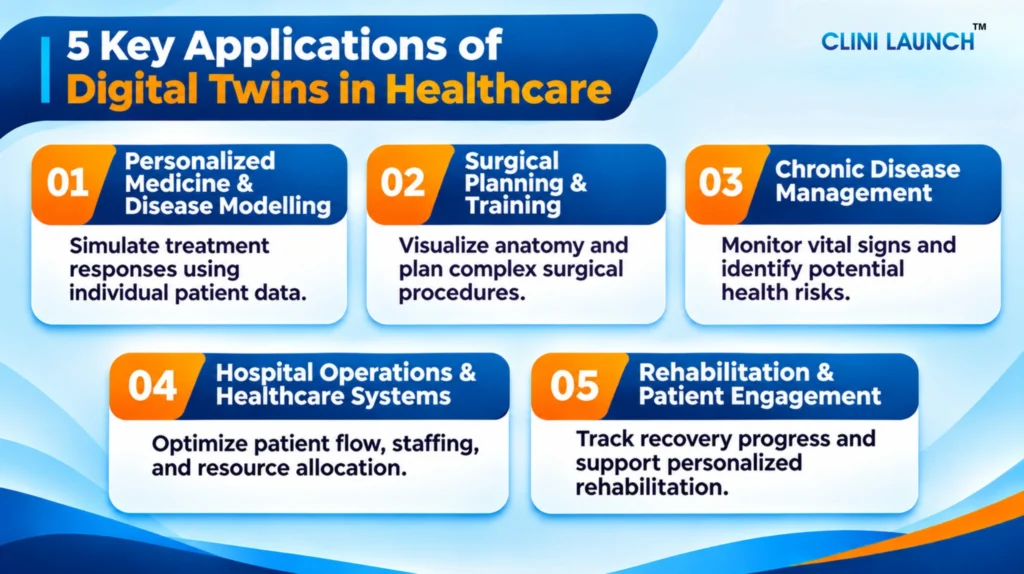
1. Personalized Medicine and Disease Modelling
Digital twins help doctors tailor treatments to individual genetic and physiological profiles. Clinicians can simulate drug dosages and chemotherapy responses to explore personalised treatment options. The software segment is projected to hold 77.5% of the digital twin healthcare market.
2. Surgical Planning and Training
Surgeons use virtual organ models to study patient anatomy, plan complex procedures, and anticipate potential complications before surgery. Cardiology Holds the Largest Segment Share at 24.8% of the Market.
3. Chronic Disease Management
Digital twins in healthcare use wearable data to monitor conditions such as diabetes, hypertension, and heart failure. Changes in vital signs can alert medical teams to potential health risks. Patient digital twins account for 28.6% of the system marketplace.
4. Hospital Operations and Healthcare Systems
Hospital administrators use facility twins to simulate patient admissions, emergency room traffic, and bed availability, helping optimise staffing and resource allocation. Process and system applications account for 59.4% of total market revenue.
5. Rehabilitation and Patient Engagement
Digital twins help track post-surgery recovery and physical therapy by simulating muscle recovery and joint movements. Early research indicates that 61.5% of the general population welcomes personal digital twins for managing treatment and rehabilitation.
Benefits of Digital Twins in Healthcare
The use of digital twins in healthcare offers benefits across the medical spectrum, supporting patients, healthcare providers, and clinical researchers through improved treatment planning, patient monitoring, and more efficient clinical workflows.
1. For Patients: Proactive Care and Fewer Adverse Reactions
Healthcare digital twins analyze data from connected wearables to identify early signs of health deterioration. They can also simulate how a patient’s body might respond to different treatments, helping healthcare professionals personalize care and assess potential adverse reactions. Patient-centric simulations are already showing profound therapeutic value: in targeted oncology and clinical settings, leveraging virtual anatomical replicas to customize planning has generated up to a 45% Improvement in Patient Treatment Outcomes.
2. For Providers: Reduced Diagnostic Errors and Optimized Resource Allocation
Healthcare digital twins analyse patient vitals and historical health records to identify patterns and support clinical decision-making. At the operational level, process twins help hospitals monitor patient flow, anticipate ER surges, and optimise staff scheduling. The practical impact on clinical settings is immense; healthcare systems utilizing comprehensive digital twins have documented a 52% Reduction in Diagnostic Errors alongside a 28% drop in hospital readmission rates, ensuring maximum patient throughput and minimal clinical strain.
3. For Researchers: Accelerated Clinical Trials and Lower Drug Discovery Costs
Digital twins in healthcare enable in silico clinical trials, where virtual patient models simulate responses to drug candidates, including potential benefits and adverse reactions. Researchers can use these simulations to explore treatment outcomes, support trial design, and investigate virtual control groups. This digital shift slashes traditional R&D overhead; industry reports indicate that deploying whole-body virtual simulations within automated pipelines can drive up to a 70% Reduction in Drug Discovery Costs, while compressing late-stage trial development timelines by nearly 50%.
Case Study: Digital Twins in Healthcare at Cleveland Clinic Abu Dhabi
Background
Cleveland Clinic Abu Dhabi reportedly faced operational challenges in managing patient flow, staff allocation, and hospital infrastructure across its 364-bed facility and 13 operating theatres. Fluctuating emergency department arrivals, surgical scheduling delays, and complex staff movements created bottlenecks. Traditional tracking systems offered limited visibility into future resource requirements, making it difficult to anticipate demand and plan resources efficiently.
Implementation
The hospital adopted a facility and process digital twin by integrating a Building Information Model (BIM) with data from its central management systems. The implementation involved:
- Integrating data from Electronic Health Records (EHRs) and bed management systems.
- Using IoT-enabled tracking to monitor medical equipment, staff, and patient movement.
- Creating a 3D virtual representation of hospital operations using AI-powered simulations.
How Digital Twins Helped
The digital twin enabled administrators to simulate patient pathways, anticipate bottlenecks, and run what-if scenarios for staff allocation and operating room scheduling. This helped teams plan resource requirements and optimise hospital workflows.
Outcomes
The implementation reportedly delivered the following improvements:
- 30% reduction in emergency department waiting times.
- 23% improvement in overall energy efficiency.
- 18% increase in operating room productivity.
Synergy with Emerging Tech: Combining Digital Twins with Generative AI (GenAI)
The fusion of healthcare digital twins and Generative AI (GenAI) marks a major paradigm shift in intelligent healthcare systems. While traditional digital twins provide the structural, real-time framework using historical datasets, integrating GenAI adds powerful predictive, self-learning, and adaptive capabilities. Together, they transform static data into proactive clinical intelligence.
1. Synthetic Data Generation for Rare Diseases
A primary challenge in medical research is the lack of diverse datasets, particularly for rare and orphan diseases. GenAI solves this data scarcity problem by creating highly realistic synthetic medical data, such as simulated genomic sequences and synthetic patient records.
By training on minimal real-world data points, generative models fill critical informational gaps. This allows healthcare digital twins to simulate complete disease pathways without exposing real patient identities. Building these synthetic data ecosystems expands clinical testing capabilities dramatically; industry analysis indicates that utilizing GenAI models to generate synthetic control groups and simulated patient scenarios drives a massive 77.5% Growth in the Software-Led Medical Simulation Market as researchers scale virtual trial populations safely.
2. Enhancing Predictive Simulations via GenAI Models
Traditional healthcare digital twins rely heavily on historical rules and physics-based models to project health trajectories. GenAI expands these capabilities by dynamically synthesizing billions of crosscuttings with “what-if” scenarios, ranging from lifestyle modifications to complex pharmacological combinations.
These advanced models analyze multi-modal patient biometrics and project disease progression with unmatched precision. Cardiologists and pulmonologists use these models to anticipate exactly how a heart failure or chronic lung patient will react to medication changes. This continuous, intelligent simulation layer enables highly autonomous medical decision-making. In global healthcare operations, this level of AI-driven scenario planning has established a dominant standard, with specialized systemic analytics and forecasting pipelines controlling a 59.4% Total Market Revenue Share for Process and System Optimization.
3. Conversational AI Interfaces for Patient-Twin Interaction
Historically, interacting with a digital twin required steep technical expertise in data science and biomedical engineering. Multimodal Large Language Models (LLMs) act as a natural language bridge, letting clinicians and patients interact directly with a virtual replica using everyday speech.
Physicians can type conversational prompts to ask their patients’ digital twins questions and receive immediate, easy-to-understand diagnostic summaries. Similarly, patient-facing applications leverage these interfaces to transform complex biometric trends from wearables into highly clear, actionable advice on diet or medication compliance.
AI & ML in Healthcare
Explore how artificial intelligence is transforming pharmaceutical research, from identifying potential drug targets to predicting molecular properties and evaluating drug safety. Develop relevant knowledge in machine learning, healthcare data analysis, and predictive modelling to understand how AI-driven technologies support data-informed research and healthcare innovation.
View CourseConclusion
Innovations such as digital twins, artificial intelligence, and machine learning are changing how healthcare professionals approach patient care, medical research, and hospital management. As these technologies become increasingly integrated into healthcare, understanding their applications is becoming an important part of professional development.
For aspiring healthcare and life sciences professionals, upskilling in emerging technologies can help build relevant industry knowledge and prepare them for evolving roles. Developing an understanding of healthcare data, AI, and machine learning can provide a foundation for exploring these technology-driven areas.
At CliniLaunch Research Institute, the AI & ML in Healthcare Program introduces learners to the applications of artificial intelligence and machine learning across healthcare domains. Explore the program to understand how emerging technologies are shaping modern healthcare.
FAQs
What are digital twins in healthcare?
Digital twins in healthcare are virtual models of patients, organs, devices, or hospital systems that use real-world data.
How do healthcare digital twins work?
Healthcare digital twins combine patient data, imaging, and sensor inputs with AI and simulations to analyse conditions and predict outcomes.
What are the major digital twin healthcare applications?
Major digital twin healthcare applications include personalised medicine, surgical planning, chronic disease management, clinical research, and hospital operations.
How are digital twins used in personalised medicine?
Digital twins simulate individual treatment responses using patient-specific data, helping healthcare professionals explore therapies and personalise treatment decisions.
What role does AI play in healthcare digital twins?
AI helps healthcare digital twins analyse patient data, identify patterns, detect anomalies, and predict potential health outcomes.
What are the benefits of digital twins in healthcare?
Digital twins in healthcare support personalised treatment, disease monitoring, clinical decision-making, and more efficient healthcare operations.
What are the challenges of implementing digital twins in healthcare?
Key challenges include data privacy, cybersecurity, interoperability, implementation costs, data accuracy, and clinical validation.
What is the future of digital twins in healthcare?
Digital twins in healthcare may advance personalised medicine, AI-driven disease prediction, virtual treatment testing, and precision healthcare.