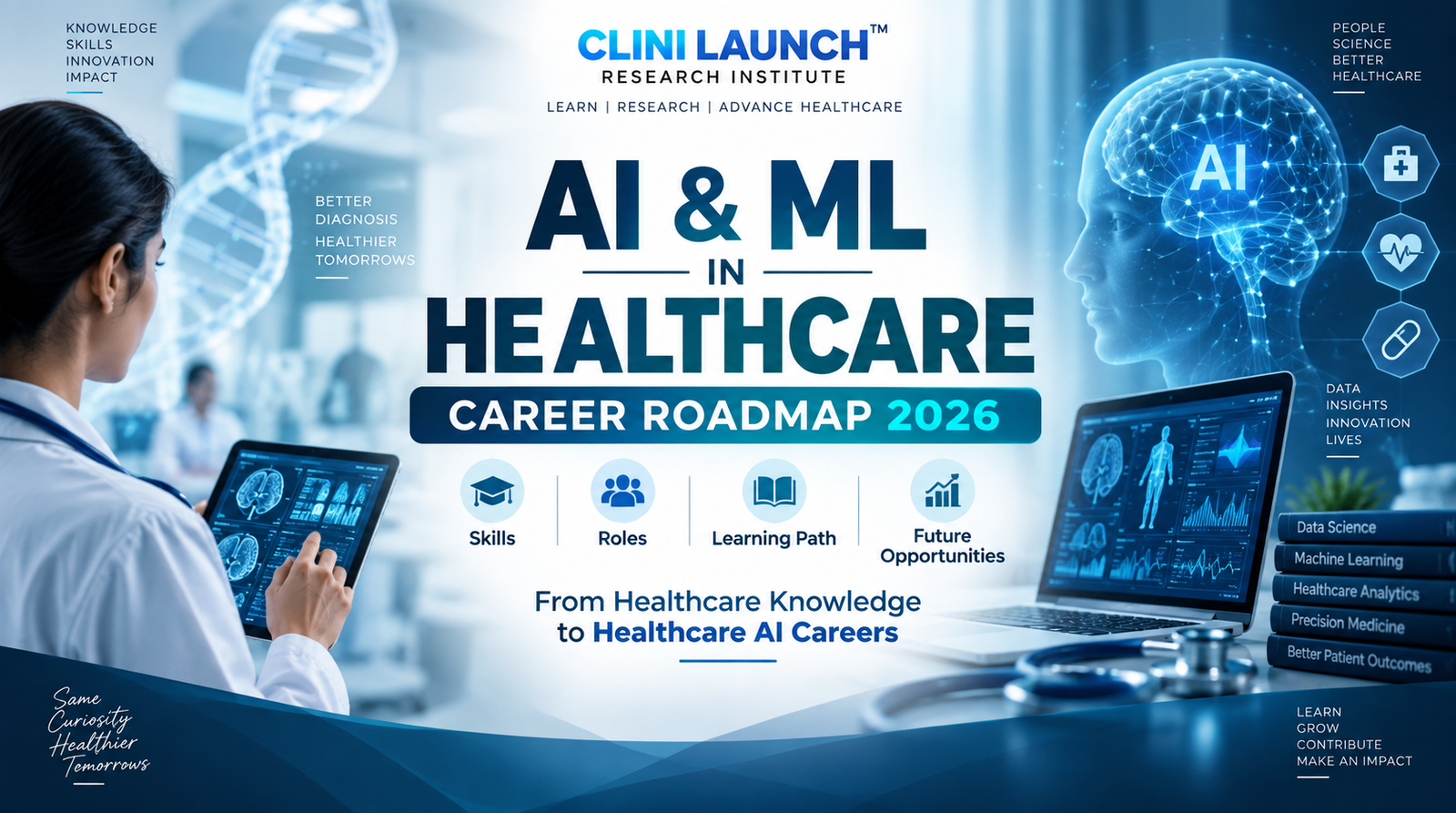
Explore a career in healthcare AI by building expertise in machine learning, Python, healthcare data analytics, and clinical applications. Understand emerging roles, essential skills, and a structured learning path to enter the rapidly evolving AI-driven healthcare industry.
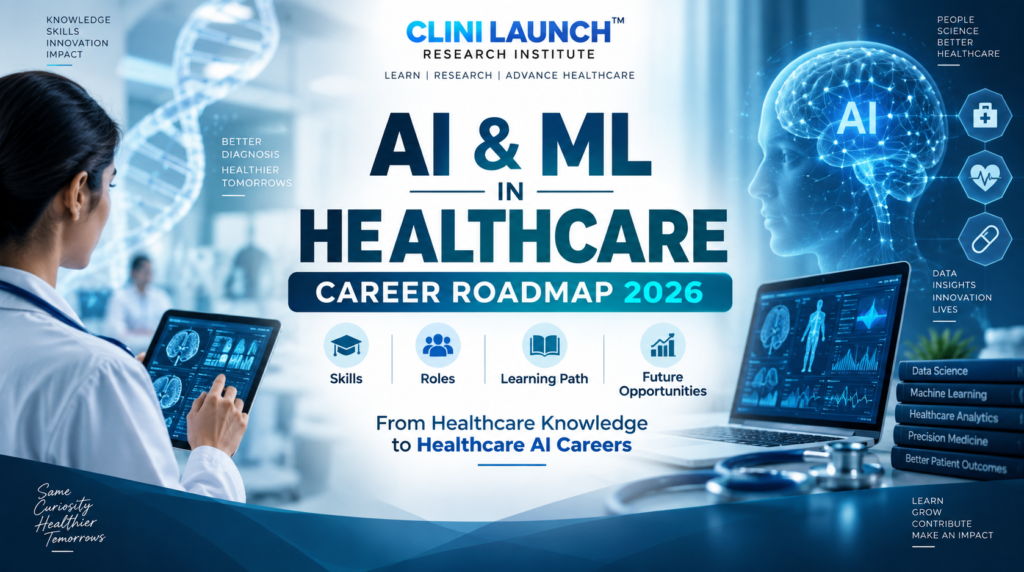
An AI and ML in healthcare career combines healthcare knowledge, data analytics, and artificial intelligence to solve problems in clinical research, diagnostics, healthcare operations, and digital health. This 2026 career roadmap covers key roles, required skills, tools, learning paths, and career opportunities.
For professionals from healthcare, life sciences, data, and technology backgrounds, AI and machine learning are opening a new set of career pathways within the healthcare industry.
Healthcare organizations are increasingly using AI and machine learning across clinical research, medical imaging, healthcare analytics, drug discovery, patient monitoring, and digital health. According to McKinsey, 85% of healthcare service and technology leaders are either running live Generative AI applications or actively exploring them. As these technologies become part of healthcare workflows, organizations need professionals who can understand healthcare data, work with AI technologies, and apply them to real-world healthcare problems.
This is creating opportunities across roles such as healthcare data analyst, clinical data scientist, machine learning engineer, medical AI ML healthcare career specialist, and digital health professional. However, entering this field requires more than learning AI tools alone.
This guide explores the AI and ML in healthcare career roadmap for 2026, including career options, eligibility, essential skills, key tools, learning stages, practical projects, and future opportunities.
AI & ML in Healthcare: How it is Driving Transformation
As Dr. Kaveh Safavi, Senior Managing Director of Global Health at Accenture, highlights that AI has evolved from a standalone digital tool to becoming an integral part of healthcare infrastructure. AI is reshaping clinical workflows, reducing administrative burden, and accelerating research and discovery.
Artificial Intelligence and Machine Learning are helping healthcare move from reactive models toward more predictive, personalized, and data-driven approaches. By analyzing diverse datasets such as electronic health records (EHRs), medical images, genomic information, clinical trial data, and real-time patient data, AI systems can identify patterns and generate insights that support healthcare delivery and research.
These capabilities can help organizations identify health risks earlier, inform treatment planning, improve research efficiency, and support operational decision-making.
Key Areas Where AI Is Driving Healthcare Transformation
- Clinical Decision Support – AI helps healthcare professionals analyze medical data and support evidence-based decisions.
Real-world example: Mayo Clinic’s AI-powered ECG research uses deep learning models trained on ECG data to identify patients at risk of hidden heart conditions.
- Predictive Healthcare – AI analyzes patient data, electronic health records, and disease patterns to predict potential health risks and support early intervention.
- Real-world example: The Epic Sepsis Model uses predictive analytics within electronic health records to help identify patients at risk of sepsis and support clinical response.
- Precision Medicine – AI supports personalized treatment by analyzing genomic, clinical, and biological data to understand individual patient characteristics.
Real-world example: Programs such as the NIH All of Us Research Program collect diverse health and genomic data to support research into personalized healthcare approaches.
- Healthcare Automation – AI improves healthcare workflows by reducing administrative burden and automating documentation processes.
Real-world example: Microsoft Nuance Dragon Ambient experience (DAX) uses ambient AI to capture clinical conversations and generate medical notes, helping healthcare professionals spend more time with patients.
- Healthcare Research & Innovation – AI accelerates biomedical research by analyzing complex biological data and supporting drug safety and drug discovery discovery.
Real-world example: DeepMind AlphaFold predicts protein structures using AI, helping researchers better understand biology and support scientific discovery.
As healthcare continues to become more data-driven, AI and ML are evolving from supportive technologies into essential tools for building smarter, more efficient, and patient-focused healthcare systems.
Why Choose an AI and ML in Healthcare Career in 2026?
An AI and ML in Healthcare career brings together healthcare, data, and artificial intelligence to address real-world challenges. It is a relevant pathway for professionals who want to build technology skills while applying their healthcare or life sciences knowledge to practical applications.
Why consider this career path?
- Combine healthcare expertise with AI and data skills
- Work with clinical, medical, and healthcare datasets
- Apply machine learning to real healthcare problems
- Explore applications across clinical research, diagnostics, digital health, and healthcare analytics
- Build skills that can support multiple technology-focused healthcare roles
The World Economic Forum’s Future of Jobs Report 2025 identifies AI and big data and technological literacy among the fastest-growing skills through 2030.
For professionals from life sciences, healthcare, and technology backgrounds, AI and ML can provide a way to extend existing expertise into emerging healthcare applications and explore roles such as Healthcare AI Specialist, Clinical Data Scientist, Healthcare Data Analyst, AI Research Associate, Machine Learning Engineer, and Digital Health Analyst.
AI and ML in Healthcare Career Roadmap: 2026
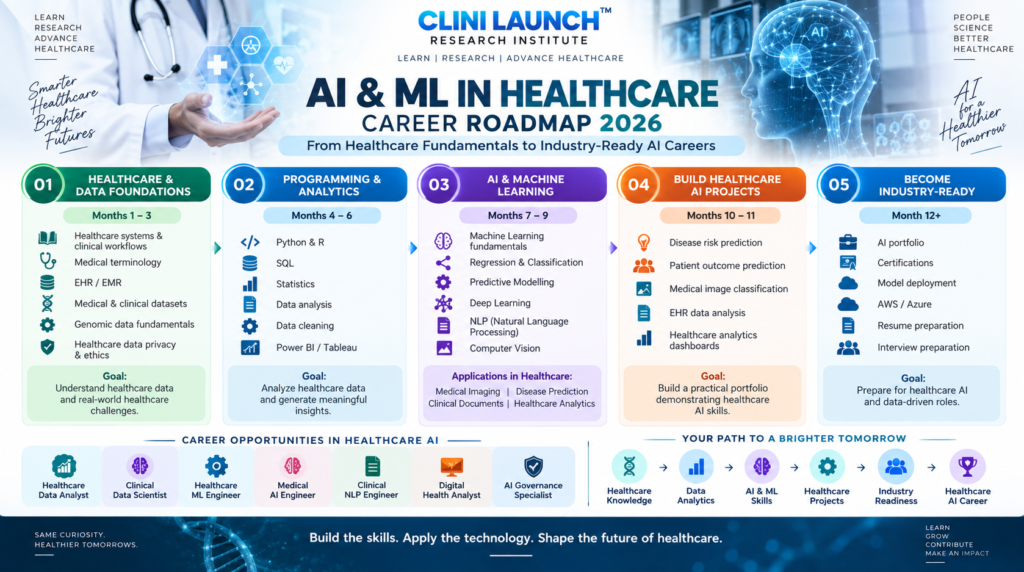
Building an AI and ML in Healthcare career requires a combination of healthcare knowledge, data skills, artificial intelligence expertise, and practical application. The journey moves from understanding healthcare data to developing AI-driven solutions for real-world healthcare challenges.
Stage 1: Build Healthcare & Data Foundations
Months 1–3: Begin by understanding the healthcare ecosystem and the role of data in healthcare AI.
Develop knowledge of:
- Healthcare systems and clinical workflows
- Medical terminology
- Electronic Health Records (EHR/EMR)
- Clinical and medical imaging datasets
- Genomic data fundamentals
- Healthcare data privacy
Ability to understand healthcare challenges and work with healthcare data effectively.
Stage 2: Develop Programming & Analytics Skills
Months 4–6: Build the technical foundation required to manage, analyze, and interpret healthcare datasets.
Develop skills in:
- Python and R programming
- SQL and database management
- Statistics and data analysis
- Data cleaning and transformation
- Visualization tools such as Power BI and Tableau
Ability to extract insights from healthcare data and support data-driven decisions.
Stage 3: Learn AI & Machine Learning for Healthcare
Months 7–9: Understand how AI technologies are applied across healthcare domains.
Learn:
- Machine learning algorithms
- Predictive modelling
- Regression and classification
- Deep learning and neural networks
- Natural Language Processing (NLP)
- Computer Vision
Applications include:
- Medical image analysis
- Clinical document analysis
- Disease prediction
- Healthcare analytics
Ability to develop AI solutions for healthcare applications.
Stage 4: Build Healthcare AI Projects
Month10: Apply AI knowledge through practical projects using healthcare datasets.
Project areas include:
- Disease risk prediction
- Patient outcome prediction
- Medical image classification
- EHR data analysis
- Healthcare analytics dashboards
Build a portfolio demonstrating practical healthcare AI skills.
Stage 5: Become Industry-Ready
Months 10–12: Prepare for AI healthcare career roles by strengthening technical and professional capabilities.
Focus areas:
- AI portfolio development
- Relevant certifications
- Model deployment basics
- Cloud platforms such as AWS and Azure
- Resume and interview preparation
Develop readiness for roles such as AI Healthcare jobs such as Data Analyst, Clinical Data Scientist, Healthcare ML Engineer, and Digital Health Analyst.
AI & ML Healthcare Career Journey
Healthcare Knowledge → Data Analytics → AI & ML Skills → Healthcare Projects → Industry Readiness → Healthcare AI Careers
This roadmap enables professionals from healthcare, life sciences, and technology backgrounds to build the skills required to apply artificial intelligence in modern healthcare.
AI and ML Healthcare
Develop expertise in healthcare artificial intelligence, machine learning, data analytics, and AI-driven healthcare solutions through industry-focused training. This program helps learners understand healthcare data, build analytical capabilities, and apply AI techniques across areas such as clinical research, medical diagnostics, healthcare analytics, and digital health innovation.
View CourseAI and ML in Healthcare Career Opportunities, Roles & Salary Outlook in 2026
AI & ML healthcare careers are emerging at the intersection of medicine, data, and technology. As healthcare organizations adopt intelligent systems, they need professionals who can interpret healthcare data, develop AI solutions, and translate technology into meaningful healthcare outcomes.
From clinical analytics to medical AI systems, career opportunities are expanding across research, diagnostics, healthcare operations, and digital health.
| Role | Primary Responsibility | Key Skills | Salary Range (India 2026) |
| Healthcare Data Analyst | Analyze healthcare data and create insights through reports and dashboards. | SQL, Python, Statistics, Power BI | ₹4–15 LPA |
| Clinical Data Scientist | Analyze clinical datasets and develop predictive healthcare insights. | Python/R, ML, Statistics, Clinical Research | ₹8–30 LPA |
| Healthcare ML Engineer | Build and deploy machine learning models for healthcare applications. | Python, Deep Learning, TensorFlow, Cloud | ₹8–35 LPA |
| Clinical NLP Engineer | Develop AI models to analyze medical text and clinical documents. | NLP, LLMs, Python | ₹10–35 LPA |
| Medical AI Engineer | Create AI solutions for medical imaging and diagnostic support. | Computer Vision, Deep Learning, Medical Imaging | ₹10–40 LPA |
| Healthcare AI Architect | Design scalable AI infrastructure and healthcare AI systems. | MLOps, Cloud, AI Architecture | ₹25–60+ LPA |
| Healthcare AI Compliance Lead | Manage AI governance, privacy, and regulatory requirements. | AI Governance, Data Privacy, Healthcare Regulations | ₹12–40 LPA |
Indicative salary ranges in India; actual compensation varies by experience, location, company, technical skills, and role specialization.
Career Progression
Entry Level (0–3 Years)
Healthcare Data Analyst → Clinical Data Analyst → AI Associate
Mid Level (3–8 Years)
Clinical Data Scientist → ML Engineer → Healthcare AI Specialist
Senior Level (8+ Years)
AI Architect → Healthcare AI Leader → AI Strategy Roles
Future Scope of AI & ML in Healthcare Beyond 2026
The future of healthcare AI career path will move beyond individual tools toward connected, intelligent ecosystems. AI will enable healthcare organizations to make better use of complex medical data, support clinical decision-making, personalize treatment approaches, and improve healthcare delivery.
1. AI-Driven Personalized Healthcare
AI will transform personalized medicine by combining multiple sources of patient data, including:
- Genomic information
- Electronic Health Records (EHRs)
- Clinical history
- Lifestyle and behavioral data
By analyzing these diverse datasets, AI can help identify patient-specific patterns and support more targeted healthcare approaches.
Real-world example:
The NIH All of Us Research Program is creating a large-scale health database combining genomic, clinical, and lifestyle information to support research in precision medicine.
2. Real-Time Healthcare Intelligence
Healthcare is moving toward proactive monitoring through AI-powered analysis of continuous health data from:
- Wearable devices
- Remote monitoring systems
- Connected healthcare platforms
These technologies can help identify health changes earlier and support timely healthcare interventions.
Real-world example:
The FDA Digital Health and Artificial Intelligence Resources highlights the role of AI-enabled digital health technologies in healthcare monitoring and decision support.
3. Generative AI in Healthcare
Generative AI is expanding healthcare capabilities beyond automation by supporting:
- Clinical documentation
- Medical research assistance
- Healthcare knowledge discovery
- Patient communication
These applications can help healthcare professionals improve workflows and access relevant information more efficiently.
Real-world example:
Microsoft Nuance Dragon Ambient eXperience (DAX) uses AI to convert patient conversations into structured clinical notes, helping reduce documentation workload.
4. AI-Connected Healthcare Systems
Future healthcare ecosystems will integrate AI with:
- Electronic Health Records (EHRs)
- Clinical decision-support systems
- Healthcare data platforms
This integration will help healthcare organizations create more connected workflows and use data more effectively for clinical and operational decisions.
Real-world example:
Clinical decision-support systems analyze patient information and medical knowledge resources to provide healthcare professionals with data-driven insights.
The National Academy of Medicine Clinical Decision Support Systems Resource explains the role of these technologies in supporting healthcare decisions.
5. Growth of AI-Ready Healthcare Careers
As AI becomes more integrated into healthcare, professionals will need a combination of healthcare knowledge, data skills, and AI expertise. Future roles will require specialists who can develop, evaluate, and implement AI solutions responsibly in healthcare environments.
Emerging roles include:
- Medical AI Engineers – Build AI solutions for healthcare applications.
- Clinical Data Scientists – Analyze healthcare data and develop predictive models.
- AI Governance Specialists – Ensure AI systems are safe, transparent, and compliant.
Real-world example:
Healthcare organizations are adopting AI governance frameworks to monitor AI performance, manage risks, and ensure responsible implementation. The WHO Ethics and Governance of Artificial Intelligence for Health Report highlights the importance of transparency, accountability, and human oversight in healthcare AI.
Conclusion
The AI and ML healthcare career landscape is evolving beyond automation. It is creating a new generation of healthcare professionals who can combine clinical understanding, data intelligence, and artificial intelligence to solve complex healthcare challenges. The ability to interpret healthcare data, uncover meaningful insights, and apply AI-driven solutions will become a defining skill in the future healthcare workforce.
For aspiring healthcare, life science, and technology professionals, developing this unique combination of skills can unlock opportunities in the growing healthcare AI ecosystem. Clinilaunch Research Institute helps professionals build industry-relevant expertise in healthcare AI, analytics, and emerging technologies through structured learning and practical exposure. By connecting healthcare knowledge with technological innovation, professionals can prepare to contribute to the future of smarter, more personalized, and data-driven healthcare
Frequently Asked Questions
What is an AI healthcare career?
An AI healthcare career combines healthcare knowledge, data analytics, and artificial intelligence to develop solutions for clinical research, diagnostics, patient care, and healthcare operations. Professionals work with healthcare data, machine learning models, and AI technologies to improve decision-making and healthcare outcomes.
What skills are required for AI ML healthcare careers?
AI ML healthcare careers require skills in Python, data analytics, machine learning, statistics, healthcare data management, and understanding of clinical workflows. Knowledge of tools like SQL, Power BI, TensorFlow, and healthcare datasets can also help professionals build practical AI solutions.
Is machine learning in healthcare a good career option in 2026?
Machine learning in healthcare offers growing career opportunities as healthcare organizations adopt AI for predictive analytics, medical research, diagnostics, and decision support systems. Professionals with healthcare knowledge combined with AI and data skills can explore roles across hospitals, pharma, research organizations, and digital health companies.
What career opportunities are available in AI ML healthcare jobs?
AI ML healthcare jobs include roles such as Healthcare Data Analyst, Clinical Data Scientist, Healthcare ML Engineer, Medical AI Engineer, Clinical NLP Engineer, and Digital Health Analyst. These professionals work on healthcare analytics, AI model development, medical data processing, and intelligent healthcare solutions.
What is the Healthcare AI career path for beginners?
A Healthcare AI career path usually starts with learning healthcare fundamentals, programming, data analytics, and machine learning concepts. Beginners can then gain practical experience through healthcare AI projects, clinical datasets, and applications like medical imaging, predictive analytics, and healthcare automation.
How can I start an AI career roadmap in healthcare?
To start an AI career roadmap in healthcare, begin by understanding healthcare systems and data, followed by learning Python, statistics, machine learning, and AI tools. Building hands-on projects in areas like clinical analytics, medical AI, and healthcare data science can help develop practical industry skills.