
In clinical research, ALCOA+ principles in clinical research provide a framework for ensuring that every data point contributes reliably to evaluating a treatment’s safety and effectiveness. From participant baseline profiles and laboratory results to sample collection timestamps and adverse event records, clinical trial data must be documented and maintained with accuracy and consistency.
But how do researchers apply these principles to ensure that every clinical trial record remains trustworthy, traceable, and verifiable throughout the study?
In modern drug development, collecting data is only half of the battle. Ensuring its absolute integrity throughout its entire lifecycle is what determines whether a trial stands up to scrutiny or faces systemic failure. As detailed in a foundational data framework published by the National Institutes of Health (NIH) Book Archive, maintaining data integrity is a baseline ethical imperative “essential for advancing scientific, engineering, and medical knowledge and for maintaining public trust in the research enterprise.” When data quality compromises a trial, the consequences are severe: public safety is threatened, and millions in research capital are wasted on unverifiable conclusions.
This reality shifts the focus from simply collecting clinical trial data to ensuring its integrity throughout its lifecycle. This is where ALCOA+ principles in clinical research become essential. They provide the foundation for maintaining reliable clinical trial records and ensuring that research data can withstand regulatory scrutiny.
Let’s understand what ALCOA+ means, explore its nine principles, and examine how they help maintain data integrity clinical trials.
What is ALCOA+?
ALCOA+ is a global data integrity framework that governs how clinical trial data must be generated, documented, and maintained to ensure its reliability. The ALCOA+ principles in clinical research extend beyond the original five principles (Attributable, Legible, Contemporaneous, Original, and Accurate) by adding four essential requirements: Complete, Consistent, Enduring, and Available. Together, these principles address data integrity challenges across both paper-based and electronic systems, including EDC, eSource, and eCOA.
Far from being just a documentation guideline, this framework supports regulatory compliance, including FDA 21 CFR Part 11 requirements for electronic records and signatures and ICH GCP guidelines. In clinical trials, failure to maintain these standards can result in data integrity concerns, regulatory inspection findings, and questions about the reliability of study results. Whether a coordinator records a participant’s blood pressure, a laboratory technician uploads molecular test results, or a wearable device captures patient vitals, following ALCOA+ principles is essential for maintaining data integrity clinical trials and ensuring that records can withstand regulatory scrutiny.
The high stakes of these guidelines are starkly illustrated by real-world regulatory actions. The U.S. FDA issued an “Unacceptable Studies” notification against contract research organization Synapse Labs, completely rejecting all clinical study data generated by the facility. Inspectors discovered severe compromises to Attributable, Contemporaneous, and original records—including shared investigator logins and unrecorded data modifications. Because the electronic audit trails lacked integrity, the data was permanently invalidated, forcing sponsors to abandon or re-run multi-million-dollar trials.
What are the ALCOA+ Principles in Clinical Research?
The nine ALCOA+ principles guide clinical research professionals in recording and maintaining accurate, reliable, and traceable clinical trial data. Understanding ALCOA plus clinical research requirements is essential for maintaining data integrity and ensuring that clinical trial records remain trustworthy throughout the study.
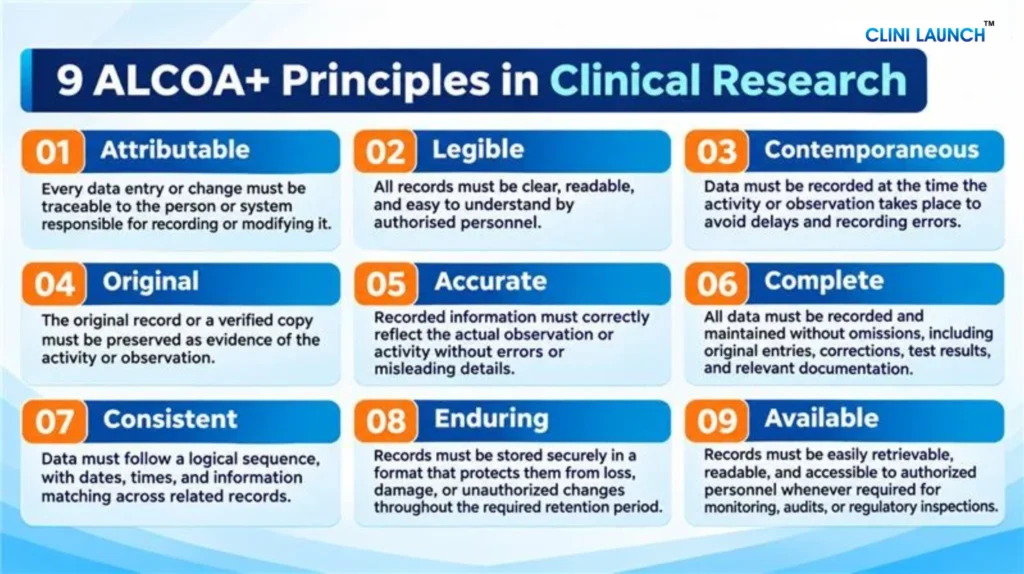
- Attributable: Every data entry must be traceable to the person or system responsible for recording it. This helps identify who documented the information and when it was entered.
Example: The clinical research coordinator’s name or user ID is recorded when entering a patient’s blood pressure.
- Legible: All records must be clear, readable, and easy to understand. Proper documentation ensures that other authorized professionals can review the information without confusion.
Example: A blood test result is documented clearly without unclear handwriting.
- Contemporaneous: Data must be recorded at the time the activity or observation takes place. Delayed documentation can lead to forgotten details or recording errors.
Example: A patient’s blood pressure is recorded immediately after measurement.
- Original: The original record or a verified copy must be preserved as evidence of the activity or observation. This helps maintain the authenticity and traceability of clinical trial information.
Example: The original laboratory report is retained as a source record.
- Accurate: Recorded information must correctly reflect the actual observation or activity. It should not contain incorrect values, misleading details, or unauthorized changes.
Example: If the measured blood pressure is 120/80 mmHg, the same reading must be documented without errors.
- Complete: All data must be recorded and maintained without missing information. This includes original entries, corrections, test results, and retesting details. This ensures that the entire record is available for review.
- Example: All blood test results, including repeat tests and corrected entries, are documented and retained without omission.
- Consistent: Data must follow a logical sequence, with dates, times, and recorded information matching across related documents. This helps avoid discrepancies and confusion during data review.
- Example: The sample collection date and time match across the sample tracking log and laboratory records.
- Enduring: Records must be stored securely in a format that protects them from loss, damage, or unauthorized changes throughout the required retention period.
- Example: Clinical trial records are securely archived with appropriate backups to ensure they remain intact and accessible over time.
- Available: Records must be easy to retrieve, read, and access by authorized personnel whenever needed for monitoring, audits, or regulatory inspections.
- Example: An authorized auditor can retrieve a participant’s laboratory reports from the clinical trial database during an inspection.
How Do ALCOA+ Principles in Clinical Research Support Audit Trails?
While daily documentation records the baseline clinical story, an electronic audit trail is the automated safety net that proves it is true. Regulated by FDA 21 CFR Part 11 and EMA Guidelines, an audit trail is a secure, time-stamped electronic record that allows for the absolute reconstruction of events.
ALCOA+ principles directly govern how audit trails support data integrity clinical trials by ensuring that every data entry and modification is traceable, accurate, and properly documented.
- Attributable & Contemporaneous (via Metadata): When data is entered or edited in an Electronic Data Capture (EDC) system, the software automatically captures the unique user ID (Attributable) and a timestamp (Contemporaneous). These details help establish who made the entry and when.
- Original & Accurate (via Change Histories): If an investigator corrects a data entry error (e.g., changing a lab value from 12.0 to 1.2), the system preserves the original value and records the corrected entry. It also captures the reason for the change, helping maintain a complete and traceable record.
- Enduring & Available (for Inspectors): Regulatory inspectors do not just review final spreadsheets; they may examine the underlying system logs to verify that records have not been improperly deleted or backdated. Securely maintained audit trails help ensure that clinical trial records remain accessible and verifiable throughout the required retention period.
Understanding ALCOA plus clinical research requirements is therefore essential for professionals involved in clinical documentation, electronic data capture, and clinical data management.
How are ALCOA+ Principles Applied in Real Clinical Trials?
To understand how ALCOA plus clinical research principles apply in day-to-day operations, let’s examine two practical workflows that are closely scrutinized during regulatory inspections: biological specimen management and clinical trial safety reporting.
Scenario 1: Biospecimen Chain-of-Custody & Laboratory Analytics
In multi-center clinical trials, biological specimens (like blood or tissue) are primary source data. According to clinical methodology studies indexed on PubMed Central, proper specimen management is vital; any breakdown in tracking directly compromises the validity of the trial’s efficacy endpoints.
How ALCOA+ is Applied:
- Attributable & Original: At the exact time of venipuncture, the phlebotomist scans the participant’s unique barcode. The Laboratory Information Management System (LIMS) records the digital signature, timestamp, and primary sample ID, preserving the original source information. This demonstrates how ALCOA+ principles in clinical research help maintain sample traceability and reliable documentation.
- Contemporaneous & Accurate: As outlined in regulatory NCI Best Practices for Biospecimen Resources, processing factors like cold-chain storage temperatures (-80°C) must be logged automatically via calibrated dataloggers. Manually backdating or writing down temperature logs hours after the transfer directly violates the Contemporaneous requirement.
- Complete & Available (+): When the sample arrives at the central laboratory, any discrepancy—such as a torn barcode label or a transport delay causing a temperature spike—must be thoroughly logged in a system deviation report. This ensures that the dataset remains Complete and Consistent for future regulatory auditors.
Why it matters:
A broken link in the bioanalytical chain makes it impossible to verify if a lab result truly belongs to the specific participant or if the sample degraded during transport. Strict adherence to ALCOA+ ensures that the bioanalytical data submitted to regulators is scientifically valid and statistically sound.
Scenario 2: Documenting and Tracking Adverse Events (AEs)
Accurately capturing safety data is a fundamental ethical requirement under international Good Clinical Practice (GCP) guidelines. Data published in the Journal of Clinical Oncology and indexed on PubMed highlights that a drug safety profile relies entirely on the absolute precision of how Adverse Events (AEs) are recorded at the site level.
How ALCOA+ is Applied in this Scenario:
Accurate: When a participant reports a symptom, such as a localized rash or severe headache, the study coordinator must document the participant’s exact description. The investigator must ensure that the recorded information accurately reflects the reported event without altering or omitting relevant details. This supports data integrity clinical trials.
Contemporaneous: Personnel must record the date and time when a symptom started, along with when it was reported to the research site, in the source document. Delayed entries can introduce recall errors and affect the reliability of safety data.
Consistent & Enduring (+): If a mild headache escalates into a Serious Adverse Event (SAE) requiring hospitalization, the relevant clinical records must be updated across applicable systems. The source documents at the research site, Electronic Data Capture (EDC) system, and sponsor’s safety database must maintain consistent information and be securely retained for future verification.
Why It Matters:
If adverse event documentation lacks integrity, important safety signals may be overlooked. This can put clinical trial participants at risk and compromise the reliability of safety assessments.
Understanding ALCOA plus clinical research requirements helps professionals maintain accurate safety records and support reliable clinical trial outcomes.
Why Are the ALCOA+ Principles in Clinical Research Important?
Explore how ALCOA+ principles maintain data integrity, support patient safety, and ensure regulatory compliance in clinical research.
- Protects Patient Safety: Clinical trials involve testing treatments on people. Accurate and complete data helps researchers identify side effects, monitor patient health, and make informed decisions about treatment safety.
- Supports Regulatory Compliance: Regulatory authorities such as the FDA, EMA, and MHRA review clinical trial records to ensure that data is properly documented and reliable. Following ALCOA principles help organizations maintain records that are ready for audits and inspections.
- Improves Data Reliability: Clinical trial results must be supported by accurate and traceable records. ALCOA principles help researchers verify the information and ensure that study findings are based on reliable data.
- Supports Electronic Data Management: Modern clinical trials use electronic systems, wearable devices, and digital platforms to collect information. ALCOA principles help ensure that electronic records are accurately documented, traceable, and properly maintained.
Understanding ALCOA+ principles in clinical research becomes easier when we examine how they are applied in everyday clinical research activities. From collecting biological samples to documenting adverse events, every activity generates clinical trial data that must be properly recorded, verified, and maintained to ensure data integrity clinical trials.
Conclusion
Understanding ALCOA plus clinical research requirements is an essential part of building a strong foundation in the clinical research industry. However, working in this field requires more than knowledge of data integrity. Professionals must also understand clinical trial processes, Good Clinical Practice (GCP), regulatory requirements, clinical documentation, patient safety, and clinical data management.
Developing knowledge of these fundamentals helps aspiring professionals understand how clinical trials are planned, conducted, documented, and monitored in real-world settings.
At CliniLaunch Research Institute, our Clinical Research training programs are designed to build industry-relevant knowledge through structured learning, practical exposure, and expert guidance. Whether you are starting your career or looking to advance your existing skills, explore our Clinical Research courses to develop the knowledge and competencies required to pursue opportunities in the clinical research industry.
Frequently Asked Questions
What is the full form of ALCOA?
ALCOA stands for Attributable, Legible, Contemporaneous, Original, and Accurate, forming the foundation of clinical trial data integrity.
What are the nine ALCOA+ principles in clinical research?
The nine principles are Attributable, Legible, Contemporaneous, Original, Accurate, Complete, Consistent, Enduring, and Available.
When were ALCOA and ALCOA+ principles introduced?
ALCOA emerged in the early 1990s, while ALCOA+ gained prominence around 2010 to address evolving data integrity requirements.
How do ALCOA+ principles support FDA and EMA regulatory compliance?
ALCOA plus clinical research requirements help organisations maintain reliable documentation, traceability, and regulatory compliance throughout clinical trials.
What is an audit trail in clinical research?
An audit trail records who changed data, what changed, when, where, and why, supporting data integrity clinical trials.
What are common data integrity errors in clinical trials?
Common errors include missing data, incorrect entries, delayed documentation, duplicate records, unauthorised changes, and incomplete audit trails.
Why are ALCOA+ principles important in clinical research?
ALCOA+ principles in clinical research help protect participant safety, improve data reliability, and support regulatory inspections.
How does Clinical Data Management support ALCOA+ principles?
Clinical Data Management uses validation checks, audit trails, and controlled access to maintain accurate, complete, and traceable records.