Artificial intelligence (AI) in drug discovery uses machine learning, deep learning, and predictive analytics to identify potential drug targets, design molecules, predict drug efficacy and toxicity, and accelerate preclinical research. By analyzing large biological and chemical datasets, AI helps pharmaceutical researchers prioritize promising drug candidates, reduce early-stage research costs, and improve efficiency.
The integration of AI in drug discovery is transforming pharmaceutical research by helping scientists analyse complex biological data, identify potential drug candidates, and predict their properties. Traditionally, bringing a new drug to market has required billions of dollars, partly because many drug candidates fail during clinical trials. According to McKinsey, only around 13% of drug candidates entering Phase I trials successfully progress to approval, contributing to a capitalised cost of approximately $4 billion per successful new molecular entity. AI can help researchers identify promising candidates earlier and improve the efficiency of early-stage drug development.
By automating target identification and structure-based molecular design, AI in drug discovery can help researchers identify promising biological targets, design new chemical compounds, and predict their properties. Instead of physically screening millions of molecules in a laboratory, AI-powered algorithms can simulate and evaluate potential candidates computationally. Deloitte’s research highlights the potential impact of these approaches, reporting that AI can reduce initial drug discovery timelines by a factor of 15 and cut early-stage discovery costs by up to 70%, helping researchers move from initial discovery to promising drug candidates more efficiently.
This blog explores how artificial intelligence drug discovery is transforming pharmaceutical research, from identifying drug targets and designing molecules to predicting drug efficacy and toxicity. Through real-world case studies, discover how AI pharmaceutical research improves research efficiency, supports drug development, and helps researchers make informed decisions.
AI Pharmaceutical Research: Predicting Drug Efficacy and Toxicity
Machine learning (ML) supports drug discovery by simulating how compounds may behave in the human body before laboratory testing. By analysing molecular and toxicology data, ML models help researchers predict drug properties in two key areas:
- Efficacy Assessment: Predicting whether a compound can interact with its target and produce the desired therapeutic effect.
- Toxicity Screening: Identifying potential safety risks, including liver injury and cardiotoxicity, before human testing.
These predictive models help researchers evaluate potential drug candidates more efficiently. By applying ML algorithms to analyze complex chemical and biological data concurrently, companies can confidently prioritize high-potential molecules for further testing and development.
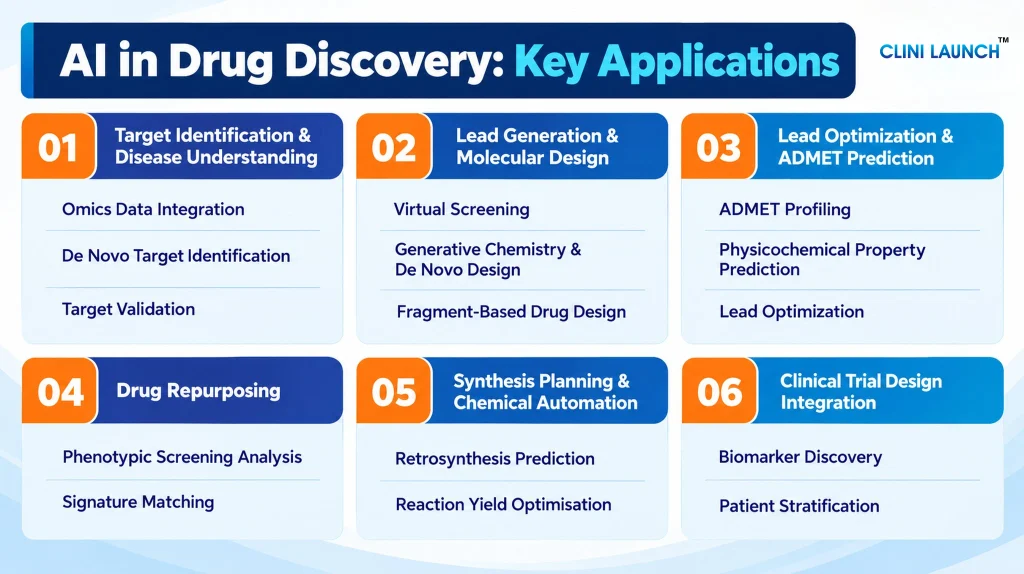
Artificial Intelligence Drug Discovery: Key Applications
Artificial intelligence drug discovery supports multiple stages of pharmaceutical research, from identifying disease targets and designing molecules to optimizing drug candidates, repurposing medicines, and supporting clinical trials.
Phase 1: Target Identification and Disease Understanding
AI helps researchers understand the biological mechanisms behind a disease and identify potential targets for new treatments. Its applications include:
1. Omics Data Integration
AI analyses genomic, transcriptomic, and proteomic data to identify genes, proteins, and biological patterns associated with a disease. Combining these datasets helps researchers understand disease mechanisms and identify potential drug targets.
2. De Novo Target Identification
Machine learning algorithms analyse biological networks and molecular relationships to identify previously unexplored disease pathways and potential drug targets. This can help researchers investigate new therapeutic approaches beyond established targets.
3. Target Validation
AI models analyse biological data and predict how changes to a potential drug target may affect disease-related processes. These predictions help researchers assess whether targeting a particular protein or biological mechanism warrants further experimental investigation.
Phase 2: Lead Generation and Molecular Design
Once a drug target is identified and validated, AI helps researchers identify promising compounds and design molecules that may interact with the target. Key applications include:
1. Virtual Screening (In Silico Testing)
AI-powered virtual screening evaluates large libraries of chemical compounds to predict which molecules are most likely to bind to a target protein. This helps researchers prioritise promising candidates for laboratory testing and reduces reliance on extensive physical screening.
2. Generative Chemistry and De Novo Design
Generative AI models can design new chemical structures based on specific drug-target requirements and desired molecular properties. Researchers can use these models to explore potential compounds that may not exist in conventional chemical libraries, although laboratory testing is needed to confirm their suitability.
3. Fragment-Based Drug Design
AI analyses small chemical fragments and predicts how they could be combined or modified to create larger molecules with desirable properties. This helps researchers explore potential drug candidates with improved binding affinity and selectivity for a specific biological target.
Phase 3: Lead Optimization and ADMET Prediction
AI helps researchers assess whether promising drug candidates have the properties needed for further development. By predicting safety risks and chemical characteristics, these models support the selection and refinement of potential drug candidates.
1. ADMET Profiling
AI models predict a compound’s absorption, distribution, metabolism, excretion, and toxicity (ADMET) properties. These predictions help researchers assess how a drug may move through the body, how it may be processed, and whether it could pose potential safety risks.
2. Physicochemical Property Prediction
AI predicts properties such as solubility, chemical stability, and molecular characteristics that influence how a drug behaves. These insights help researchers assess whether a compound may be suitable for formulation as a tablet, capsule, or injection.
3. Lead Optimization
Machine learning models help researchers refine promising drug candidates by predicting how changes to their molecular structures may affect potency, selectivity, stability, and toxicity. This supports the development of compounds with more desirable properties for further testing.
Phase 4: Drug Repurposing
AI helps researchers identify new uses for existing medicines, potentially reducing the time and resources required to discover treatments for different diseases.
1. Phenotypic Screening Analysis
AI analyses cellular images, biological responses, and patient outcome data to identify patterns suggesting that an existing drug may have therapeutic effects beyond its original purpose. Researchers can investigate these findings to determine whether the medicine could be useful for another condition.
2. Signature Matching
AI compares disease-associated gene expression patterns with the molecular signatures of existing drugs to identify potential treatment opportunities. This approach helps researchers find medicines that may influence disease-related biological processes and warrant further investigation for new therapeutic uses.
Phase 5: Synthesis Planning and Chemical Automation
After designing a promising molecule, researchers must determine how to synthesise it efficiently in the laboratory. AI supports this process by predicting chemical reactions and identifying suitable manufacturing conditions.
1. Retrosynthesis Prediction
AI models work backwards from a target molecule to identify possible starting materials and sequences of chemical reactions needed to produce it. This helps chemists evaluate alternative synthesis routes based on factors such as complexity, feasibility, and cost.
2. Reaction Yield Optimization
Machine learning models analyze experimental data to predict how reaction conditions, including temperature, pressure, and catalyst selection, may affect chemical yield. These predictions help researchers identify suitable conditions and improve the efficiency of laboratory synthesis.
Phase 6: Clinical Trial Design Integration
AI can also support the transition from preclinical research to clinical development by helping researchers identify relevant biomarkers and patient groups for evaluating potential treatments.
1. Biomarker Discovery
AI analyses molecular, genetic, and clinical datasets to identify biomarkers associated with disease progression or treatment response. These biomarkers can help researchers monitor biological changes and assess whether a potential drug is producing the intended effects during clinical trials.
2. Patient Stratification
Machine learning models analyze genetic profiles and other patient characteristics to identify subgroups that may respond differently to a treatment. This helps researchers design clinical trials with more relevant participant groups and investigate which patients are most likely to benefit from potential therapy.
AI in Drug Discovery: Process and Cost Savings
- Substantial Preclinical Cost Reductions: Leading industry projections from early drug R&D analyses indicate that AI integration yields significant financial efficiency, offering 25 to 50 percent in cost savings up to the preclinical stage by mitigating physical wet-lab testing errors.
- Mitigation of Operational R&D Expenses: On a macro level, real-world implementations across pharmaceutical pipelines show consistent 20 to 40 percent reductions in operational R&D costs. This is heavily supported by AI in drug discovery ability to compress information and operational latencies, which typically make up about 40% of the entire development pipeline.
- Enhanced Hit Rates and Safety Profile Predictions: Deep learning models accelerate early-stage virtual screening for billion-compound libraries. These workflows improve target identification hit rates by 30 to 50 percent while optimizing safer, more developable molecules.
- Escalated Return on Investment (ROI): Fueled by the economic benefits of algorithmic efficiency, the global AI in drug discovery market value is estimated at $5.09 billion. The technology generates substantial financial ROI via structural proteome coverage improvements and multi-billion dollar cross-industry licensing partnerships.
Case Study 1: Insilico Medicine and Rentosertib (ISM001-055)
The Challenge
Developing treatments for complex diseases such as idiopathic pulmonary fibrosis (IPF) traditionally requires extensive laboratory testing and trial-and-error experimentation. As illustrated by the following Insilico Medicine case study, AI can help researchers identify promising biological targets and design potential drug candidates more efficiently.
The Solution: Generative AI in Drug Discovery
Insilico Medicine used its generative AI platform, Pharma.AI, to identify a novel biological target and design small-molecule inhibitors for IPF. This application of artificial intelligence drug discovery supported target identification, molecular design, binding affinity prediction, toxicity assessment, and pharmacokinetic modelling.
Generative AI helped researchers explore molecular structures tailored to the identified target. Instead of synthesising thousands of compounds, researchers synthesised and tested just 78 molecules to identify a promising lead candidate.
The Results
- Reduced Experimental Screening: AI-guided molecular design helped narrow the selection to 78 synthesised and tested molecules.
- Clinical Progress: Following positive Phase IIa results reported in Nature Medicine, rentosertib advanced into Phase III clinical development.
How AI Pharmaceutical Research Supports Drug Development
This case illustrates how AI pharmaceutical research can support biological target identification and molecular design while reducing reliance on extensive experimental screening. However, laboratory testing and clinical trials remain essential to establish a drug’s safety and efficacy.
Case Study 2: Schrödinger and Zasocitinib (TAK-279)
The Challenge
Developing selective treatments for autoimmune diseases is challenging because related proteins can have similar structures. For example, targeting tyrosine kinase 2 (TYK2) without affecting related Janus kinases (JAKs) requires precise molecular design. As this Schrödinger case study illustrates, traditional screening methods can be time-consuming and may struggle to predict molecular binding behavior accurately.
The Solution: Physics-Enabled Machine Learning
Physics-based modelling combined with machine learning helps researchers evaluate molecular interactions and identify promising drug candidates. By analysing physical chemistry data, these methods assess protein–ligand binding energies, molecular stability, target selectivity, solubility, and metabolic properties.
This application of artificial intelligence drug discovery enables researchers to virtually screen large compound libraries and prioritise candidates with desirable molecular characteristics before laboratory testing.
The Results
- Efficient Virtual Screening: Computational modelling helps researchers evaluate large numbers of compounds and prioritise candidates for further testing.
- Improved Selectivity Assessment: Predicting interactions with TYK2 and related proteins helps researchers assess potential off-target effects.
- Clinical Progress: The drug candidate zasocitinib (TAK-279) advanced into Phase III clinical development.
How AI Pharmaceutical Research Supports Molecular Design
This case study demonstrates how AI pharmaceutical research combines machine learning and physics-based modelling to support molecular design and target selectivity. However, computational predictions require laboratory experiments and clinical studies to establish a drug’s safety and efficacy.
Explore AI and Healthcare Programs at
PG Diploma in AI & ML in Healthcare
Explore how artificial intelligence is transforming pharmaceutical research, from identifying potential drug targets to predicting molecular properties and evaluating drug safety. Develop relevant knowledge in machine learning, healthcare data analysis, and predictive modelling to understand how AI-driven technologies support data-informed research and healthcare innovation.
Conclusion
Artificial intelligence is reshaping drug discovery through target identification, molecular design, virtual screening, and drug efficacy and toxicity prediction. Applying these technologies effectively requires skills in machine learning, healthcare data analysis, predictive modelling, and molecular data interpretation. Developing these capabilities helps professionals understand AI-driven pharmaceutical research and contribute to data-informed drug development.
As AI adoption grows in healthcare, practical AI skills and specialized training are becoming increasingly valuable for life sciences professionals. CliniLaunch Research Institute supports learning in healthcare and emerging technologies, helping professionals understand how AI and machine learning can be applied to pharmaceutical research. Combining technical knowledge with pharmaceutical expertise remains essential to validate AI-generated predictions and translate computational insights into safe, effective treatments.
Frequently Asked Questions
1. What is AI in drug discovery?
AI uses machine learning and deep learning to identify drug targets, analyse molecules, predict drug properties, and prioritise promising candidates.
2. How does artificial intelligence transform drug discovery?
Artificial intelligence analyses chemical and biological data, predicts molecular interactions, and supports virtual screening to improve early-stage drug discovery efficiency.
3. What are the main applications of AI in pharmaceutical research?
Applications include target identification, molecular design, virtual screening, efficacy prediction, toxicity assessment, biomarker discovery, and biological data analysis.
4. How does machine learning help predict drug efficacy and toxicity?
Machine learning analyses molecular and biological data to predict drug-target interactions and potential toxicity risks, helping researchers prioritise compounds for laboratory testing.
5. Can AI reduce the time and cost of drug discovery?
AI can reduce early-stage research time and costs through automated data analysis, virtual screening, and prioritisation of promising drug candidates.
6. What technologies are used in AI-driven drug discovery?
Key technologies include machine learning, deep learning, generative AI, natural language processing, molecular docking, molecular dynamics, Python, PyTorch, and TensorFlow.
7. What are the challenges of using AI in pharmaceutical research?
Challenges include limited or biased data, model reliability, interpretability, regulatory considerations, workflow integration, and the need for experimental validation.
8. How do AI researchers and pharmaceutical scientists collaborate in drug discovery?
AI researchers develop predictive models, while pharmaceutical scientists validate findings through pharmacology, medicinal chemistry, toxicology, and laboratory experiments.