AI pharmacovigilance tools use artificial intelligence and NLP to automate drug safety workflows like adverse event detection, signal management, literature review, and regulatory reporting, helping pharma companies improve speed, accuracy, and compliance.
Pharmacovigilance is the science of monitoring, assessing, and preventing adverse drug reactions to improve patient safety throughout a product’s lifecycle. Traditionally, pharmacovigilance teams relied heavily on manual processes such as case intake, literature review, signal detection, and regulatory reporting. As safety data volumes increased globally, artificial intelligence began supporting these workflows through automation, helping teams process larger volumes of data more efficiently while still requiring human medical oversight for critical safety decisions.
The old way of doing pharmacovigilance manual case entry, spreadsheet-based signal detection, siloed reporting, and fragmented safety case processing is simply not built for the pace and scale of modern drug safety monitoring. The FDA received over 2.3 million adverse event reports in 2023 alone. From automated case processing to NLP-powered literature mining, modern AI drug safety software is rewriting the rulebook on how pharmacovigilance teams work.
At CliniLaunch Research Institute, the Advance Diploma AI Integration in Drug Safety and Compliance course is designed to help learners gain practical exposure to modern pharmacovigilance systems, AI-enabled drug safety workflows, and global safety reporting practices.
What are AI Pharmacovigilance Tools?
AI pharmacovigilance tools are advanced AI drug safety software platforms that use artificial intelligence, machine learning, and natural language processing to automate pharmacovigilance operations such as adverse drug reaction (ADR) detection, signal detection, literature surveillance, regulatory reporting, and risk management activities.
Benefits of AI Pharmacovigilance Tools
AI pharmacovigilance tools help pharmaceutical companies improve efficiency, accuracy, and scalability across modern pharmacovigilance operations. Key benefits include:
- Faster Individual Case Safety Report (ICSR) processing and safety case management.
- Improved signal detection through analysis of large safety datasets.
- Automated MedDRA coding, literature surveillance, and data extraction workflows.
- More efficient regulatory reporting and E2B submission support.
- Enhanced drug safety monitoring across global safety databases and reporting systems.
- Reduced manual workload while supporting stronger drug safety compliance and risk management processes.
AI in Pharmacovigilance: Key Industry Statistics
The growing adoption of AI in pharmacovigilance is being driven by the increasing volume of global safety data and the need for faster, more accurate drug safety monitoring.
- The FDA received more than 2.3 million adverse event reports in 2023.
- Every 2 minutes, a serious adverse drug reaction (ADR) occurs to a patient in a hospital.
- Medication-related issues are estimated to cost healthcare systems approximately $42 billion annually worldwide.
- Large volumes of Individual Case Safety Reports (ICSRs), literature sources, and safety data continue to increase the demand for pharmacovigilance automation and AI-enabled workflows.
To manage growing volumes of safety data, adverse event reports, and regulatory requirements, pharmaceutical companies are increasingly adopting AI-powered pharmacovigilance platforms across their safety operations.
Why AI is Transforming Pharmacovigilance
Modern pharmacovigilance teams manage thousands of adverse event reports, literature sources, safety databases, and regulatory submissions. Manual processing alone can slow operations and increase the risk of delays or inconsistencies.
AI-powered pharmacovigilance software helps automate repetitive tasks such as data extraction, MedDRA coding, literature surveillance, signal prioritization, Individual Case Safety Report (ICSR) processing, and report generation. While these technologies improve efficiency, scalability, and data handling, they also require careful validation, regulatory compliance, and continued human oversight for medical review and decision-making.
9 Best AI Pharmacovigilance Tools used by Drug Safety Teams
Based on the primary role they play in pharmacovigilance operations, the tools below can be grouped into three broad categories:
- Tier-1: Enterprise safety platforms
- Tier-2: AI-native disruptors
- Tier-3: Specialized automation tools
solving highly targeted pharmacovigilance bottlenecks.
The following platforms are among the most widely used best AI tools for pharmacovigilance across global drug safety operations.
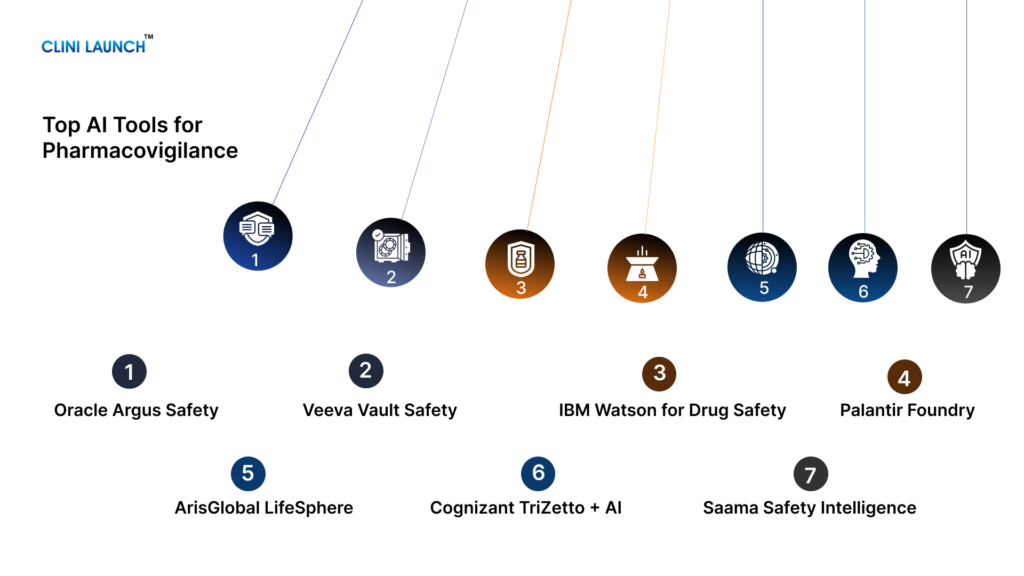
The tools covered in this article include Oracle Argus Safety, ArisGlobal LifeSphere Safety, Veeva Vault Safety, Deep Intelligent Pharma, Saama LSAC, IQVIA Vigilance Platform, Linguamatics I2E, TCS ADD, and Inovalon VigiLanz.
1. Enterprise Cloud Ecosystems (End-to-End PV Platforms)
These enterprise-grade AI pharmacovigilance tools automate large-scale ICSR processing, signal detection, literature review, and regulatory reporting workflows across global safety operations.
- Oracle Argus Safety + Empirica Signal
- Used by 19 of the top 20 global pharma companies
- Automates case intake, MedDRA coding, duplicate detection, and E2B submissions
- Empirica uses ML-based signal scoring and detection across the FDA Adverse Event Reporting System (FAERS), EHRs, and global safety databases.
Operational impact:
- Up to 40% reduction in manual review workload
- AI-assisted validation reduces E2B submission errors significantly
- ArisGlobal LifeSphere Safety
- AI-powered intake robots automate adverse event case processing
- Uses NLP to extract data from unstructured narratives and source documents
- ALMA AI engine assists MedDRA coding, case triage, ICSR processing, and narrative generation.
Operational impact:
- Narrative preparation time reduced from hours to minutes in some workflows
- Helps reduce alert fatigue for PV review teams
- Veeva Vault Safety
- Cloud-native PV platform built for faster case processing
- Uses AI to auto-populate structured case fields from source documents
- Integrates signal detection directly with labeling and change-control workflows Operational impact:
- Case intake-to-submission timelines reduced dramatically
- Used by 500+ life sciences organizations globally
2. AI-Native & Multi-Agent Pharmacovigilance Platforms
These AI-first pharmacovigilance platforms use autonomous AI agents, deep learning, and real-world evidence of analytics to move beyond traditional rule-based PV systems.
- Deep Intelligent Pharma (DIP)
- Singapore-based AI-native pharmacovigilance platform
- Uses multi-agent AI systems for automated drug safety workflows
- AI agents collaborate across intake, processing, and tracking functions Operational impact:
- Enables multilingual AI-driven safety workflow automation
- Designed for autonomous cross-functional PV workflows
- Saama Technologies (LSAC)
- AI-driven pharmacovigilance analytics platform focused on RWE integration
- Mines EHRs, literature, social media, and unstructured safety data
- Uses deep learning to detect ADR patterns and high-risk patient cohorts Operational impact:
- Designed to significantly improve aggregate reporting efficiency for pharmacovigilance teams.
- Faster signal review and contextual safety analysis
- IQVIA Vigilance Platform
- Combines global Real-World Evidence (RWE) datasets with proprietary AI algorithms
- Automates translation, data cleaning, parsing, and safety intake workflows
- Optimized for high-volume global case management
Operational impact:
- Faster processing of multilingual adverse event reports
- Improves scalability of global PV operations
3. Specialized NLP & Point Automation Solutions
These AI drug safety tools focus on solving specific pharmacovigilance bottlenecks like literature surveillance, linguistic extraction, clinical monitoring, and workflow acceleration.
- Linguamatics I2E
- Extracts adverse event insights from journals, trial reports, and regulatory documents
- Supports multilingual literature surveillance and detects hidden safety signals from unstructured data.
Operational impact:
- Accelerates literature review at large scale
- Improves cross-border pharmacovigilance surveillance
- TCS ADD (Advanced Drug Development)
- AI-enabled PV workflow automation suite
- Uses adaptive metadata repositories and advanced analytics
- Optimizes intake-to-closure pharmacovigilance workflows
Operational impact:
- Shortens case processing timelines
- Improves workflow standardization across safety operations
- Inovalon (Formerly VigiLanz)
- Converts live patient and hospital data into actionable safety alerts
- Widely used in antimicrobial surveillance and hospital safety monitoring Operational impact:
- Enables faster intervention in hospital safety events
- Improves real-time monitoring capabilities
| Category | Tools / Platforms | Key Focus | Best Use Case |
|---|---|---|---|
| Tier-1 Enterprise Leaders | Oracle Argus Safety + Empirica | Global ICSR processing, signal detection, regulatory compliance | Large-scale ICSR processing and global safety operations |
| Tier-1 Enterprise Leaders | ArisGlobal LifeSphere Safety | AI-driven case intake, NLP extraction, narrative automation | AI-assisted case intake and MedDRA coding |
| Tier-1 Enterprise Leaders | Veeva Vault Safety | Cloud-based PV workflows, automated case processing | Cloud-native pharmacovigilance workflows |
| Tier-2 AI Disruptors | Deep Intelligent Pharma (DIP) | Multi-agent autonomous pharmacovigilance workflows | AI-driven workflow automation |
| Tier-2 AI Disruptors | Saama Technologies (LSAC) | Real-world evidence analytics, ADR prediction | Real World Evidence (RWE) analysis and safety analytics |
| Tier-2 AI Disruptors | IQVIA Vigilance Platform | Multilingual safety data processing, AI-driven PV scaling | Global and multilingual safety operations |
| Tier-3 Specialized Tools | Linguamatics I2E | NLP-based literature surveillance and linguistic extraction | Literature surveillance and NLP extraction |
| Tier-3 Specialized Tools | TCS ADD | Intake-to-closure PV workflow acceleration | Pharmacovigilance workflow optimization |
| Tier-3 Specialized Tools | Inovalon (VigiLanz) | Real-time hospital safety and clinical surveillance | Real-time clinical safety monitoring |
Core Pillars of PV Automation
The specific workflows these tools are transforming can be categorized across four main pillars:
| Capability | Core AI Technology Used | Practical Impact |
|---|---|---|
| Intelligent Case Intake | Optical Character Recognition (OCR) & GenAI Narrative Parsing | Extracts demographics and event data from unstructured emails, PDFs, and notes. |
| Medical Coding & MedDRA Coding | Machine Learning Linkers (e.g., WHO Drug, MedDRA-Assist) | Maps raw text to MedDRA Lowest Level Terms (LLTs) and Preferred Terms (PTs). |
| Signal Detection & Risk Management | Disproportionality Analytics & Deep Learning | Analyzes population-scale data to identify true drug-safety signals from background noise. |
| Aggregate Authoring | Generative AI Draft Co-pilots | Automatically generates initial chronologies and baseline summaries for PSURs and DSURs. |
The Compliance Guardrail: While AI automates data entry, triage, and draft generation, regulatory bodies (like the FDA and EMA) still mandate a strict “human-in-the-loop” approach. Final causality assessments, medical reviews, and drug safety compliance decisions must remain firmly with trained pharmacovigilance professionals.
How to Choose the Right AI Drug Safety Software for Your PV Team
Not every AI drug safety software platform fits every pharmacovigilance team. Before you invest, ask these 4 questions:
- What is your volume?
If you’re processing 10,000+ ICSRs per year, you need enterprise-grade automation (Argus, Veeva, ArisGlobal). Under 2,000 cases? Saama or IBM Watson may be leaner fits.
- Where are your blind spots?
Literature overload → IBM Watson. Slow submissions → Veeva. Weak signal analytics → Saama.
- What markets do you report to?
EMA, FDA, PMDA, CDSCO, each has unique requirements. Oracle and ArisGlobal have the deepest multi-regional rule libraries.
- What’s your integration reality?
If your safety data lives in EDC, CTMS, or EHR systems, check out API compatibility before committing.
Limitations of AI in Pharmacovigilance
- AI systems are only as reliable as the data they are trained on; poor-quality or incomplete safety data can affect accuracy.
- Regulatory agencies still require human review for medical assessment, causality evaluation, risk management, and final safety decisions.
- AI models require continuous validation, monitoring, and compliance checks to ensure regulatory acceptance.
Future of AI in Pharmacovigilance
- Generative AI and agentic AI are expected to drive greater pharmacovigilance automation across case intake, safety case processing, and pharmacovigilance workflows.
- Real-world evidence and continuous safety monitoring will play a larger role in signal detection.
- Human oversight will remain essential for medical judgment, causality assessment, and regulatory compliance.
Learn AI-Powered Drug Safety Skills for the Future
Discover how AI is transforming pharmacovigilance, drug safety monitoring, and regulatory compliance. Gain practical exposure to AI-enabled safety workflows, adverse event processing, and modern pharmacovigilance tools through industry-focused training.
Clinical Research
Build practical skills required for alternative career paths in the pharmaceutical and healthcare industries. This program introduces clinical trial processes, regulatory documentation, drug safety monitoring, and research data management used in global drug development and clinical research operations.
Key Takeaways
- AI pharmacovigilance tools are helping automate ICSR processing, signal detection, literature surveillance, and regulatory reporting.
- Enterprise platforms such as Oracle Argus, ArisGlobal, and Veeva support large-scale pharmacovigilance operations.
- AI-driven solutions improve drug safety monitoring, efficiency, and scalability while supporting compliance requirements.
- Human oversight remains essential for medical review, causality assessment, and final safety decisions.
Start Your Career in AI-Powered Pharmacovigilance
Learn how leading pharmaceutical companies use AI pharmacovigilance tools for adverse event reporting, signal management, and drug safety compliance. Get industry-relevant training with placement support.
Conclusion
Manual pharmacovigilance is slow as well as patient safety risk. With adverse event volumes growing at 8% year-on-year and regulatory scrutiny tightening globally, the margin for error is shrinking fast.
The tools in this list aren’t future technology. They’re living, in production, and already helping safety teams process more cases faster, catch signals earlier, and file cleaner submissions. All without burning out the people behind them. As AI drug safety software continues evolving, companies are increasingly investing in pharmacovigilance automation and AI in pharmacovigilance to improve efficiency, scalability, and patient safety outcomes.
At CliniLaunch Research Institute, the Advance Diploma AI Integration in Drug Safety and Compliance course equips learners with practical knowledge in drug safety operations, adverse event case processing, regulatory reporting, signal management, and modern AI-enabled pharmacovigilance workflows.
About the Author
Anushree Saha specializes in creating healthcare education content across Clinical Research, Pharmacovigilance, Clinical Data Management, and life sciences careers. Her work is centered on making industry knowledge accessible, enabling learners to navigate career pathways and stay informed about evolving healthcare trends.