
Clinical Trial Salary in India has become increasingly competitive as pharmaceutical companies, CROs, and biotechnology firms continue to expand their clinical research operations.As global pharmaceutical companies, biotechnology firms, and Contract Research Organizations (CROs) expand their research operations, demand for skilled professionals continues to rise. India’s clinical trials market size is projected to grow from USD 1.61 billion in 2026 to nearly USD 2.95 billion by 2033, at a CAGR of around 9%, driven by increasing investments in drug development and clinical research.
But Clinical Trial Salary in India isn’t determined by experience alone. Your job role, employer, location, technical expertise, and therapeutic specialization all play a significant role in shaping your earning potential. As a result, professionals with similar qualifications can earn vastly different salaries, including noticeable differences in CRA Salary across industries and clinical trial types.
In this guide, we’ve compiled Clinical Trial salary facts every professional should know. From Clinical Trial Associate Salary and CRA Salary insights to city-wise salary trends, career progression, and practical ways to increase your earning potential, you’ll get a clear picture of what to expect from a clinical trial career in 2026.
What Really Determines Clinical Trial Salaries in India in 2026?
Two Clinical Research Associates with the same years of experience can have a salary difference of ₹5–10 LPA. Why? Because employers don’t just pay for experience—they pay for the complexity of the trials you manage, the therapeutic areas you work in, and the business impact you create. Here’s what makes the biggest difference.
1. The Phase of Clinical Trials You Work On
Insight: In clinical research, compensation is influenced not only by your job title but also by the complexity and responsibility of the studies you work on. Professionals involved in high-risk, early-phase Phase I trials or large global studies often handle greater scientific, regulatory, and operational responsibilities, making these roles more specialized and, in many organizations, better compensated.
Professionals working on Phase I and early-phase studies often command higher salaries because these trials involve first-in-human studies, intensive safety monitoring, and strict regulatory oversight. Likewise, Phase III global multicentric trials require coordination across multiple countries, making these roles more demanding and better compensated.
Simply put, the more complex the trial, the higher the earning potential.
2. Therapeutic Area Expertise Can Add a Premium
Clinical trial professionals aren’t just hired for monitoring skills, they’re hired for disease expertise.
Oncology, Rare Diseases, Immunology, Vaccines, Cell & Gene Therapy, and Neurology are among the highest-paying therapeutic areas in clinical research. These specialties demand niche expertise, involve high-value clinical programs, and require professionals who can navigate greater scientific and operational complexity.
Typically offer higher salaries because these studies are scientifically complex, involve advanced protocols, and require experienced professionals. Companies are often willing to pay a premium for candidates who can join projects with minimal training.
Perspective: In high-specialty therapeutic areas, companies aren’t simply paying for experience—they’re paying for confidence. Confidence that the right patients will be enrolled, the data will withstand regulatory review, and the study will progress without avoidable setbacks. That level of expertise is built over years of working with complex therapies, making skilled professionals both harder to find and more valuable to retain.
Explore Clinical Research Program at
Build expertise in clinical trial operations, regulatory guidelines, data management, and research methodologies through industry-focused training. This program prepares learners for real-world clinical research workflows including trial management, protocol execution, regulatory compliance, and global research practices.
View Course3. Global Trials Pay More Than Domestic Studies
A Clinical Research Associate managing an India-only study and another managing a US or EU-sponsored global trial may have the same designation—but not the same salary.
Global studies bring together international sponsors, research sites across multiple countries, and standardized clinical processes under a single protocol. Despite differences in healthcare systems and local regulations, every participating site is expected to generate consistent, inspection-ready data throughout the study.
Perspective: Global studies demand a different level of execution. Professionals are responsible for keeping multiple countries, vendors, investigators, and regulatory expectations moving in sync without compromising data quality or study timelines. That ability to manage complexity at scale is relatively uncommon, which is why multinational trial experience is often rewarded with higher compensation.
These additional responsibilities often translate into better compensation.
4. Sponsor Companies Usually Outpay CROs
One of the biggest salary jumps in clinical research often comes when professionals move from a Contract Research Organization (CRO) to a pharmaceutical or biotechnology sponsor company.
Sponsor companies own the clinical development program, while CROs execute specific trial activities. Sponsor-side professionals oversee development strategy, manage outsourced partners, and guide key decisions throughout the drug development process.
As a result, sponsor organizations typically offer higher fixed salaries, performance-based incentives, broader career pathways, and opportunities to work on regional and global programs.
Many Clinical Research Associates (CRAs) spend 3–5 years in a CRO building strong monitoring and trial management experience before transitioning to sponsor companies for better compensation and long-term career growth.
Perspective: Moving to a sponsor role means your contribution extends beyond trial execution. The focus shifts to guiding the overall success of a development program, making this experience more valuable to employers and often better rewarded.
5. Digital & AI Skills Are Becoming Salary Multipliers
Clinical trials are no longer paper-driven.
Companies increasingly value professionals who can work with:
- Electronic Data Capture (EDC) platforms
- Clinical Trial Management Systems (CTMS)
- Risk-Based Monitoring (RBM)
- AI-assisted document review
- Decentralized Clinical Trial (DCT) technologies
As hybrid and decentralized trials become more common in India, professionals with digital trial experience are gaining a competitive advantage in hiring and salary negotiations.
6. Inspection Readiness Is a High-Value Skill
Candidates with experience handling US FDA inspections, EMA audits, CDSCO inspections, sponsor audits, and ICH-GCP compliance are considered lower-risk hires, making them valuable for critical studies and leadership positions.
Perspective: Regulatory inspections evaluate more than documentation—they assess whether a clinical trial can withstand independent scrutiny. Professionals who have successfully navigated inspections understand how to identify compliance risks early, maintain inspection-ready studies, and respond confidently under pressure. Since their experience helps minimize regulatory setbacks and protects study credibility, employers often view them as trusted candidates for high-impact roles.
7. Managing Multiple Sites Increases Your Market Value
Managing multiple study sites, investigator relationships, site performance, patient recruitment, and trial timelines requires making informed decisions across environments where every site performs differently. Professionals must prioritize resources, address site-specific challenges without disrupting the broader study, and ensure that local setbacks do not become study-wide delays.
Perspective: Employers don’t value multi-site experience simply because it involves more sites—they value it because it demonstrates the ability to deliver consistent outcomes across unpredictable environments. Professionals who can maintain study performance despite varying investigators, recruitment rates, and operational challenges are often trusted with larger portfolios, strategic responsibilities, and higher-paying roles.
8. Companies Pay More for Professionals Who Can Reduce Trial Delays
Every delayed clinical trial can cost sponsors significant money through extended timelines, additional operational expenses, and delayed market entry.
Professionals who improve patient recruitment, minimize protocol deviations, resolve site issues before they escalate, support timely database lock, and maintain inspection-ready compliance help keep studies progressing as planned. Their contribution goes beyond day-to-day operations—they protect study timelines, data quality, and development milestones that directly influence a program’s success.
Perspective: In clinical research, employers don’t simply reward experience they reward predictability. Professionals who consistently prevent avoidable delays and keep studies moving forward become trusted problem-solvers rather than task managers. That ability to safeguard timelines and reduce operational risk often translates into stronger performance ratings, faster career progression, and higher compensation.
India vs Global Clinical Trial Salaries
In clinical research, international trial experience is often treated as a premium skill not just another line on a resume. Employers recognize that professionals who have successfully contributed to multinational studies can adapt to diverse regulatory expectations, global operating models, and larger development programs. Because this expertise is harder to find, it often strengthens a candidate’s negotiating power and opens the door to higher-paying opportunities.
| Country | Typical Salary Range | What Makes the Market Different? |
|---|---|---|
| India | ₹4–25+ LPA | Fast-growing clinical research market with opportunities across CROs, sponsors, biotech firms, and research hospitals. |
| United States | USD 70,000–150,000 | Large-scale global trials, advanced therapeutic research, and leadership roles in clinical development. |
| United Kingdom | GBP 35,000–75,000 | Strong emphasis on academic research, NHS collaborations, and multinational clinical studies. |
| Germany | EUR 50,000–90,000 | Home to leading pharmaceutical innovators with extensive investment in clinical R&D. |
| Australia | AUD 80,000–140,000 | Known for early-phase clinical trials, rapid study approvals, and a growing biotech sector. |
| Singapore | SGD 50,000–100,000 | Regional headquarters for global pharmaceutical companies managing Asia-Pacific clinical operations. |
Cities in India with Highest Clinical Trial Salaries
Clinical trial salaries don’t increase simply because a city has more companies they increase because different cities specialize in different parts of the clinical research ecosystem. Some cities are known for sponsor companies, others for patient recruitment, while some are emerging as hubs for AI-enabled and decentralized trials. Understanding these strengths can help you choose a city that aligns with your career goals.
Insight: In clinical research, salaries often follow ecosystems rather than locations. Cities that bring together sponsors, CROs, hospitals, academic research centers, and regulatory expertise create a stronger demand for specialized talent. As competition for experienced professionals increases, compensation tends to rise alongside it.
1. Bengaluru – Best for Innovation-Driven Clinical Research
Bengaluru is where clinical research intersects with technology. Many organizations here are integrating AI, cloud-based clinical platforms, data analytics, and digital health solutions into trial operations. This creates demand for professionals who can work beyond traditional site monitoring and contribute to data-driven clinical development. If you’re interested in combining clinical research with technology, Bengaluru offers some of the strongest long-term earning potential.
Insight: Bengaluru rewards professionals who can bridge clinical research with digital innovation. As AI, real-world data, cloud platforms, and global capability centres become integral to clinical development, professionals with both clinical and technology skills often command stronger salary growth than those in traditional monitoring roles.
2. Hyderabad – Best for End-to-End Drug Development Exposure
Hyderabad offers a unique advantage because professionals can be part of the entire drug development journey—from early research and manufacturing to clinical trials and regulatory submissions. With Genome Valley and a dense network of pharmaceutical companies, employees often gain cross-functional exposure, making them attractive candidates for higher-paying leadership roles later in their careers.
Insight: Hyderabad’s salary advantage comes from the depth of its life sciences ecosystem. Professionals often move across manufacturing, R&D, clinical development, regulatory affairs, and commercialization without changing cities, making cross-functional experience highly valuable to employers.
3. Mumbai – Best for Sponsor-Side Career Growth
Unlike cities dominated by execution teams, Mumbai houses the Indian headquarters of many pharmaceutical companies and global sponsors. As a result, professionals here are more likely to transition into strategic functions such as Clinical Project Management, Medical Affairs, Vendor Management, and Portfolio Management. These roles typically offer higher compensation than operational monitoring positions.
Insight: Mumbai offers access to decision-making functions rather than only trial execution. As professionals move closer to sponsor strategy, portfolio planning, and commercial operations, salary growth is often driven by business impact rather than years of experience.
4. Pune – Best for Fast Career Mobility
Pune has become a preferred destination for clinical research professionals because of its concentration of CROs and global capability centres. Instead of waiting years for internal promotions, professionals often accelerate their salary growth by moving between organizations as they gain experience. This dynamic job market makes Pune particularly attractive during the first five years of a clinical research career.
Insight: Pune’s competitive hiring market creates salary momentum. Professionals who develop niche expertise in monitoring, data management, pharmacovigilance, or clinical operations often receive salary increases by moving between organizations rather than waiting for annual increments.
5. Chennai – Best for Site-Based Clinical Research Experience
Chennai stands out for its extensive network of multispecialty hospitals and academic medical centres that participate in clinical trials. Professionals working here gain valuable experience in patient recruitment, investigator coordination, ethics committee processes, and trial execution at the site level. This practical exposure builds a strong foundation before moving into regional or global monitoring roles.
Insight: Chennai builds experience where clinical trials begin—with investigators and patients. Professionals who master site operations early often transition into CRA and regional monitoring roles with stronger salary potential because they understand trial execution from the ground up.
6. Delhi NCR – Best for Regulatory & Global Operations Roles
Delhi NCR offers opportunities beyond conventional clinical operations. Alongside CROs and sponsor companies, the region has a strong presence of regulatory consulting firms, medical writing organizations, and global support centres. Professionals looking to specialize in Regulatory Affairs, Quality Assurance, Clinical Documentation, or global trial coordination often find diverse and well-paying career options here.
Insight: Delhi NCR rewards specialization. Professionals working in regulatory affairs, quality systems, medical writing, and global clinical support often develop expertise that is transferable across therapeutic areas and international markets, increasing their long-term earning potential.
Clinical Trial Salary Snapshot Across India
The salary figures below offer a quick comparison of clinical trial opportunities across India’s major research hubs. While actual compensation depends on experience and employer, city-specific ecosystems play a significant role in shaping earning potential.
| City | Typical Clinical Research Salary* | Primary Strength | Best Career Stage |
|---|---|---|---|
| Bengaluru | ₹3.5–10 LPA | AI-enabled clinical research, digital health, GCCs | Mid to Senior |
| Hyderabad | ₹3–9 LPA | Drug development, Genome Valley, pharma ecosystem | Mid to Senior |
| Mumbai | ₹4–12 LPA | Sponsor companies, Clinical Project Management, Medical Affairs | Senior |
| Pune | ₹3–8.5 LPA | CRO ecosystem, fast career mobility | Early to Mid |
| Chennai | ₹2.8–7.5 LPA | Site management, investigator coordination, hospital-based trials | Entry to Mid |
| Delhi NCR | ₹3.5–11 LPA | Regulatory Affairs, QA, global clinical operations | Mid to Senior |
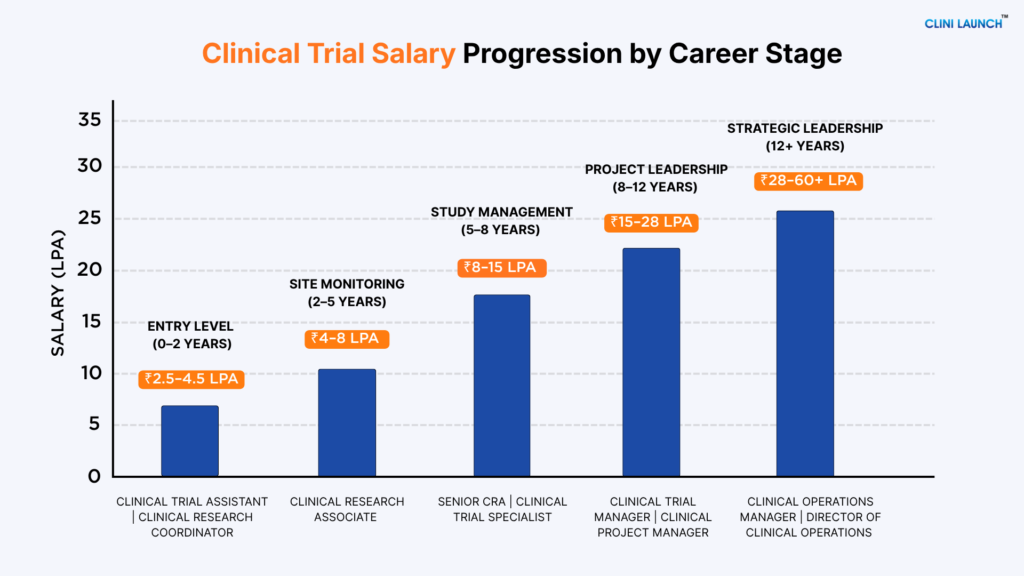
Clinical Trial Salary Growth by Career Stage
In clinical research, salary growth follows career progression rather than experience alone. As professionals advance from supporting clinical trial sites to managing studies, budgets, teams, and global programs, they become eligible for higher-paying roles with greater operational and strategic impact.
| Career Stage | Typical Role | Typical Salary (India) | What Drives Salary Growth? |
|---|---|---|---|
| Entry Level | Clinical Trial Assistant (CTA), Clinical Research Coordinator (CRC) | ₹2.5–4.5 LPA | Builds foundational skills in clinical trial coordination, documentation, and GCP compliance. |
| Site Monitoring | Clinical Research Associate (CRA) | ₹4–8 LPA | Takes ownership of independent site monitoring, compliance, and data quality. |
| Study Management | Senior CRA, Clinical Trial Specialist | ₹8–15 LPA | Manages multiple sites, mentors CRAs, and oversees study delivery across locations. |
| Project Leadership | Clinical Trial Manager, Clinical Project Manager | ₹15–28 LPA | Leads study budgets, vendors, timelines, and cross-functional teams. |
| Strategic Leadership | Clinical Operations Manager, Director of Clinical Operations | ₹28–60+ LPA | Oversees portfolios, global clinical programs, operational strategy, and business performance. |
How to Start a Career in Clinical Trials
Breaking into clinical research is less about choosing a job title and more about understanding how medicines move from the laboratory to patients. Employers look for candidates who not only have a relevant academic background but also understand the regulatory, scientific, and operational realities of clinical trials.
1. Build on the Right Academic Foundation
Clinical trials require professionals who can interpret medical information and understand research methodology. Graduates in Pharmacy, Life Sciences, Biotechnology, Medicine, Dentistry, Nursing, and Allied Health Sciences naturally align with these requirements, making them the primary talent pool for CROs, pharmaceutical companies, hospitals, and biotechnology organizations.
2. Learn How Clinical Trials Work in Practice
Academic knowledge alone rarely prepares candidates for the pace and expectations of the clinical research industry. Understanding how a study progresses from protocol approval to patient recruitment, monitoring, data collection, and regulatory submission helps bridge the gap between classroom learning and real-world trial execution. A strong grasp of ICH-GCP, Clinical Trial Phases (I–IV) informed consent, ethics committee procedures, and essential documentation forms the backbone of every clinical research role.
3. Develop Skills That Employers Evaluate During Hiring
Technical knowledge gets your résumé noticed, but practical capability often determines hiring decisions. Recruiters look for professionals who can accurately interpret protocols, maintain high-quality documentation, identify protocol deviations, communicate confidently with investigators and study teams, and handle trial records with precision. These skills demonstrate that a candidate can contribute to a study from day one.
4. Choose an Entry Point That Matches Your Strengths
Clinical research offers multiple entry routes rather than a single starting position. Depending on your interests, you may begin in Clinical Trial Operations, Site Coordination, Clinical Monitoring, Clinical Data Management, Pharmacovigilance, or Regulatory Affairs. Each pathway develops a different set of competencies while creating opportunities to move into broader operational, managerial, or strategic roles as your experience grows.
5. Invest in Continuous Learning
Clinical trials continue to evolve with AI-enabled workflows, Risk-Based Monitoring (RBM), Electronic Data Capture (EDC), Clinical Trial Management Systems (CTMS), real-world evidence, and decentralized clinical trial models. Professionals who continuously adapt to these changes remain competitive in the job market and are often better positioned for specialized roles, international opportunities, and long-term salary growth.
6. Keep Learning as the Industry Evolves
Clinical trials are increasingly adopting technologies such as Electronic Data Capture (EDC), Clinical Trial Management Systems (CTMS), Risk-Based Monitoring (RBM), AI-powered workflows, and Decentralized Clinical Trials (DCTs). Staying updated with these advancements can improve your employability and long-term career growth.
Conclusion
The clinical trial industry is no longer defined by a single career path or a fixed salary trajectory. As India’s role in global drug development continues to expand, professionals have more opportunities than ever to build specialized careers across clinical operations, project management, regulatory affairs, data management, and emerging digital trial technologies.
Rather than focusing only on your first salary, invest in building expertise that continues to create value throughout your career. Experience in complex clinical studies, globally accepted regulatory practices, and technology-enabled trial management can significantly improve both your career progression and earning potential. Professionals who consistently upskill and take on greater responsibilities are the ones who move from supporting clinical studies to leading them.
If you’re looking to build a strong foundation in this field, CliniLaunch Research Institute’s Offers Professional Program in Clinical Research is designed to bridge the gap between academic learning and industry expectations. With industry-oriented training, practical exposure, mentorship from experienced professionals, and career-focused placement support, the program equips aspiring clinical research professionals with the knowledge and skills employers actively seek.
Whether you’re a fresher exploring career opportunities or a working professional planning your next move, investing in the right training today can open doors to rewarding clinical research careers across CROs, pharmaceutical companies, biotechnology organizations, and global clinical development teams.
Frequently Asked Questions
1. What is the average Clinical Trial Salary in India in 2026?
Entry-level clinical trial professionals typically earn between ₹3–5 LPA. Salaries increase with experience, job role, therapeutic specialization, employer type, and exposure to global clinical trials.
2. What is the salary of a Clinical Research Associate (CRA) in India?
CRA Salary varies based on experience, trial complexity, and employer. Freshers generally start with competitive entry-level packages, while experienced CRAs managing global or multicentric studies can earn significantly higher salaries.
3. Which city offers the highest Clinical Trial Salary in India?
Cities such as Bengaluru, Hyderabad, Mumbai, Pune, Chennai, and Delhi NCR offer excellent opportunities. The best city depends on your preferred specialization, employer type, and long-term career goals.
4. Which skills can help increase Clinical Trial Salary?
Skills in ICH-GCP, Clinical Trial Management Systems (CTMS), Electronic Data Capture (EDC), Risk-Based Monitoring (RBM), AI-enabled clinical trials, regulatory compliance, and project management can improve earning potential.
5. Do sponsor companies pay more than CROs?
In many cases, yes. Sponsor companies often offer higher salaries, broader responsibilities, and better long-term career progression than Contract Research Organizations (CROs), particularly for experienced professionals.
6. Can freshers build a career in clinical trials?
Yes. Graduates from pharmacy, life sciences, medicine, nursing, and allied healthcare can begin with roles such as Clinical Trial Assistant (CTA), Clinical Research Coordinator (CRC), or Clinical Research Associate (CRA) after acquiring the required industry knowledge and practical skills.
7. How can I increase my Clinical Trial Salary?
Develop expertise in high-demand therapeutic areas, gain experience with global clinical trials, build proficiency in digital clinical trial technologies, and continuously upgrade your technical and regulatory skills.
8. Is clinical trials a good long-term career in India?
Yes. India’s expanding role in global drug development continues to create opportunities across clinical operations, regulatory affairs, project management, pharmacovigilance, and digital clinical trial technologies, making it a strong long-term career option.