
Best AI Tools for Clinical Research are software platforms that use artificial intelligence (AI), machine learning, and natural language processing (NLP) to improve clinical trial operations, patient recruitment, clinical data management, pharmacovigilance, regulatory compliance, and drug development. These tools help clinical research organizations (CROs), pharmaceutical companies, and research teams enhance efficiency, reduce manual workloads, improve data accuracy, accelerate clinical trial outcomes, support predictive analytics, streamline workflow automation, strengthen decision-making, optimize trial performance, and improve overall healthcare research productivity.
AI tools in clinical research are rapidly transforming clinical trials, drug discovery, medical writing, patient recruitment, and healthcare data analysis in 2026. Pharmaceutical companies, CROs, and healthcare organizations are increasingly adopting AI-driven platforms to improve research speed, accuracy, and decision-making.
Recent reports show growing industry adoption of AI for real-time clinical trial monitoring, protocol optimization, and faster drug development workflows. Industry experts at BioAsia 2026 also highlighted how AI is helping accelerate clinical research operations and improve healthcare innovation.
As Demis Hassabis, CEO of Isomorphic Labs, noted, the healthcare industry is now moving from proof of concept to scaling the technology in AI-driven drug discovery and life sciences
Artificial Intelligence is being applied across multiple stages of clinical research, from trial planning to post-market drug safety monitoring. AI helps identify eligible participants by analyzing electronic health records, reducing one of the biggest bottlenecks in clinical trials—patient recruitment. In study operations, AI-powered predictive analytics can forecast enrollment delays, protocol deviations, and site performance risks. Clinical data management teams use AI to automate data cleaning, query management, and anomaly detection, improving data quality and reducing manual workload. In pharmacovigilance, natural language processing (NLP) helps process adverse event reports, scientific literature, and safety databases more efficiently. AI is also accelerating drug development by analyzing biological and clinical datasets to identify potential drug targets and predict treatment responses. These applications are helping research organizations conduct faster, more data-driven, and cost-effective clinical studies while maintaining regulatory and quality standards.
Benefits of AI in Clinical Research
Artificial Intelligence (AI) is transforming clinical research by improving efficiency, accuracy, and decision-making across various stages of a clinical trial. AI helps accelerate patient recruitment, streamline data management, enhance protocol design, identify safety signals faster, and reduce operational costs. By automating repetitive tasks and enabling data-driven insights, AI supports faster drug development while maintaining high standards of quality and regulatory compliance.
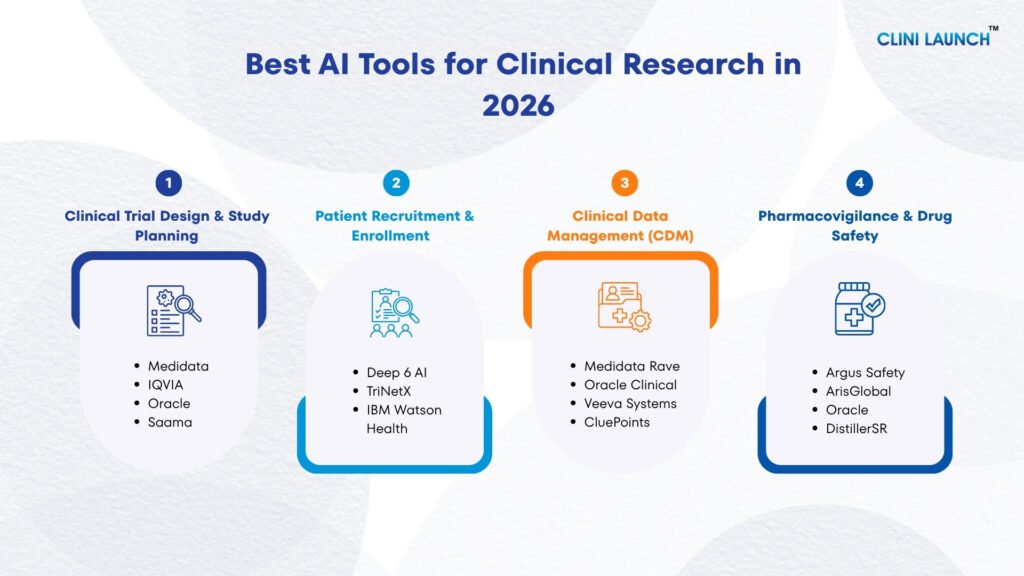
In this blog, we will explore the best AI tools in clinical research and their functions in various domains of clinical research such as :
- Clinical Trial Design & Study Planning
- Medidata
- IQVIA
- Oracle
- Saama
- Patient Recruitment & Enrollment
- Deep 6 AI
- TriNetX
- IBM Watson Health
- Clinical Data Management (CDM)
- Medidata Rave
- Oracle Clinical
- Veeva Systems
- CluePoints
- Pharmacovigilance & Drug Safety
- Argus Safety
- ArisGlobal
- Oracle
- DistillerSR
- Medical Writing & Regulatory
- ChatGPT
- Microsoft Copilot
- Trinka AI
- SciSpace
- Elicit
- Bioinformatics & Genomics Research
- AlphaFold
- BLAST
- Galaxy
- PyMOL
- Illumina
- Medical Imaging & Diagnostics Research
- PathAI
- Aidoc
- Viz.ai
- Google Health
- Healthcare Analytics & Real-World Evidence
- SAS
- Tableau
- Health Catalyst
- IQVIA
1. Trial Design & Study Planning
Clinical trial design is one of the earliest stages where the best AI tools for clinical research are used to improve study planning, protocol development, feasibility analysis, and site selection. Modern AI clinical trial software helps organizations reduce delays, improve protocol efficiency, and make faster, data-driven trial planning decisions. These AI healthcare tools are becoming essential in modern clinical research workflows.
Top AI Tools
- Medidata
An AI clinical trial software platform used for clinical trial management, electronic data capture (EDC), decentralized trials, and clinical data analytics. It helps improve trial planning, monitoring, and operational efficiency
- IQVIA
Provides AI healthcare tools for patient recruitment, healthcare analytics, real-world evidence (RWE), and clinical trial optimization using healthcare data and predictive analytics.
- Oracle
Offers AI-powered solutions for clinical trial management, clinical data management (CDM), safety monitoring, and regulatory compliance in clinical research.
- Saama
An AI-driven platform used for clinical analytics, trial oversight, risk management, pharmacovigilance, and automation in life sciences and clinical research.
A 2019 review published in Trends in Pharmacological Sciences discussed how AI is transforming clinical trial design by improving patient recruitment, cohort selection, and predictive trial analytics. The paper highlighted that AI-based approaches can help reduce trial failure rates and improve decision-making in drug development workflows.
2. Patient Recruitment & Enrollment
Patient recruitment is one of the biggest challenges in clinical trials. The best AI tools for clinical research use patient eligibility matching, EHR screening, recruitment forecasting, and clinical dataset analysis to identify suitable participants faster and reduce trial delays. Modern AI clinical trial software and AI healthcare tools are helping improve recruitment efficiency and enrollment planning.
Top AI Tools
- Deep 6 AI
An AI-powered patient recruitment platform that uses EHR screening and clinical data analysis to identify eligible participants for clinical trials faster and improve enrollment efficiency.
- TriNetX
A healthcare analytics and clinical research platform used for patient recruitment, feasibility analysis, and real-world clinical dataset analysis across global healthcare networks.
- IBM Watson Health
Provides AI healthcare tools for clinical data analysis, predictive analytics, patient insights, and decision support to improve clinical research and healthcare operations.
The real-world utility of these automated systems is heavily backed by clinical data. For instance, a 2026 study published by the American Society of Clinical Oncology (ASCO) evaluated an AI-driven prescreening platform that successfully analyzed 98,348 patients across 29 clinical trials, identifying 825 highly eligible candidates and directly facilitating 117 successful patient enrollments. Beyond merely expanding the pool of candidates, the deployment of this automated AI pipeline reduced manual chart screening time by 41% while decreasing the overall chart review workload ten-fold for clinical research staff.
3. AI Tools for Clinical Data Management (CDM)
Clinical trials generate massive amounts of data, and the AI tools for clinical research help automate data cleaning, query management, data validation, and anomaly detection processes. Modern AI clinical trial software and AI healthcare tools improve data accuracy, reduce manual review work, and streamline AI in clinical data management workflows.
Top AI Tools
- Medidata Rave
A widely used AI clinical trial software platform for electronic data capture (EDC), clinical data management, data validation, and query management in clinical trials.
- Oracle Clinical
An AI-powered clinical data management platform used for clinical trial data collection, validation, workflow automation, and regulatory-compliant data processing
- Veeva Systems
Provides AI healthcare tools for clinical operations, clinical data management, quality management, and regulatory workflows across life sciences organizations.
- CluePoints
An AI-driven risk-based quality management platform used for anomaly detection, centralized monitoring, and clinical trial data quality analysis.
4. AI Tools for Pharmacovigilance and Drug Safety
AI is playing a major role in pharmacovigilance by improving adverse event detection, safety signal monitoring, literature screening, and automated case processing. The AI tools for clinical research help drug safety teams process large volumes of safety data more efficiently, improve monitoring accuracy, and streamline pharmacovigilance workflows using advanced AI healthcare tools.
Top AI Tools
- Argus Safety
An AI-powered pharmacovigilance platform used for adverse event reporting, safety case processing, signal detection, and regulatory safety compliance.
- ArisGlobal
Provides AI healthcare tools for pharmacovigilance, drug safety monitoring, risk management, and automated safety workflows in life sciences.
- Oracle
Offers AI clinical trial software and pharmacovigilance solutions for safety data management, adverse event tracking, and regulatory reporting.
- DistillerSR
An AI-driven literature review and evidence management platform used for literature screening, systematic reviews, and clinical research data extraction.
5. AI Tools for Medical Writing and Regulatory Documentation
Medical writing teams are increasingly using AI tools for clinical report drafting, regulatory summarization, scientific literature summarization, and content generation assistance. The AI tools for clinical research help improve documentation speed, manage large volumes of scientific information, and streamline medical writing and regulatory workflows.
Top AI Tools
- ChatGPT
An AI-powered content generation tool used for clinical report drafting, scientific summarization, medical writing assistance, and regulatory documentation support.
- Microsoft Copilot
An AI productivity assistant that helps with document drafting, data summarization, workflow automation, and scientific content management.
- Trinka AI
An AI writing assistant designed for scientific and technical writing, helping improve grammar, clarity, compliance, and academic writing quality.
- SciSpace
An AI research platform used for scientific literature analysis, paper summarization, research assistance, and academic content understanding.
- Elicit
An AI research assistant that helps researchers search, summarize, and analyze scientific literature and research evidence more efficiently.
Clinical Research
Build practical skills required for alternative career paths in the pharmaceutical and healthcare industries. This program introduces clinical trial processes, regulatory documentation, drug safety monitoring, and research data management used in global drug development and clinical research operations.

6. AI Tools for Bioinformatics and Genomics Research
AI is heavily used in genomics and bioinformatics for genomic sequence analysis, protein structure prediction, biological data interpretation, and precision medicine research. The AI tools for clinical research and AI healthcare tools help researchers analyze complex biological datasets, accelerate drug discovery, and support advanced healthcare and precision medicine research.
Top AI Tools
- AlphaFold
An AI-powered protein structure prediction tool used in bioinformatics and drug discovery to predict 3D protein structures with high accuracy.
- BLAST
A bioinformatics tool used for genomic sequence analysis, sequence comparison, and identifying similarities between biological datasets.
- Galaxy
An open-source bioinformatics platform used for genomic data analysis, workflow management, and large-scale biological data interpretation.
- PyMOL
A molecular visualization tool widely used for protein structure analysis, drug discovery research, and biological data visualization.
- Illumina
A leading genomics technology platform used for DNA sequencing, genomic research, precision medicine, and large-scale biological data generation.
7. Medical Imaging & Diagnostics
AI-powered imaging tools help researchers with biomarker detection, AI-assisted radiology analysis, disease pattern identification, and imaging data interpretation.The best AI tools for clinical research and healthcare are increasingly being adopted in diagnostics, medical research, AI-assisted imaging workflows to enhance accuracy, accelerate analysis, and support deeper clinical insights.
Top AI Tools
- PathAI
An AI-powered pathology platform used for biomarker detection, disease analysis, and digital pathology research in healthcare and clinical studies.
- Aidoc
An AI healthcare imaging platform used for AI-assisted radiology analysis, medical imaging interpretation, and critical disease detection workflows.
- Viz.ai
Provides AI-powered medical imaging and stroke detection solutions that help improve diagnostics workflows and clinical decision-making.
- Google Health
Develops AI healthcare tools for medical imaging analysis, disease pattern identification, healthcare analytics, and AI-assisted diagnostics research.
8. AI Tools for Healthcare Analytics and Real-World Evidence
Healthcare analytics teams use AI tools for predictive healthcare analytics, population health analysis, treatment outcome evaluation, and real-world evidence analysis. These tools help organizations analyze patient outcomes, identify healthcare trends, generate real-world evidence, and support data-driven healthcare decision-making.
Top AI Tools
- SAS
A healthcare analytics platform used for predictive analytics, clinical data analysis, real-world evidence generation, and healthcare decision-making.
- Tableau
A data visualization and analytics tool used to analyze healthcare trends, patient outcomes, and population health data through interactive dashboards.
- Health Catalyst
An AI-driven healthcare analytics platform used for population health analysis, treatment outcome evaluation, and healthcare performance improvement.
- IQVIA
Provides healthcare analytics, real-world evidence, and AI-powered clinical insights to support clinical research and healthcare decision-making.
| Clinical Research Domain | Main Function | Top AI Tools | Skills Needed | Average Salary in India |
|---|---|---|---|---|
| Clinical Trial Design | Protocol optimization, feasibility analysis, site selection | Medidata, IQVIA, Oracle | Clinical trial knowledge, protocol understanding, analytics | ₹5–10 LPA |
| Patient Recruitment | Patient eligibility matching, EHR screening, recruitment forecasting | Deep 6 AI, TriNetX, IBM Watson Health | Patient screening, healthcare data analysis, EHR understanding | ₹4–8 LPA |
| Clinical Data Management | Automated data cleaning, query management, anomaly detection | Medidata Rave, Oracle Clinical, Veeva Systems | EDC systems, data review, query management | ₹4–9 LPA |
| Pharmacovigilance & Drug Safety | Adverse event detection, signal monitoring, literature screening | Argus Safety, ArisGlobal, DistillerSR | Drug safety, signal detection, case processing | ₹4–8 LPA |
| Medical Writing & Regulatory Affairs | Clinical report drafting, regulatory summarization, documentation support | ChatGPT, Microsoft Copilot, Trinka AI | Medical writing, scientific documentation, regulatory basics | ₹4–9 LPA |
| Bioinformatics & Genomics | Genomic analysis, protein structure prediction, precision medicine research | AlphaFold, BLAST, Galaxy | Genomics, Python, biological data analysis | ₹5–12 LPA |
| Medical Imaging Research | Biomarker detection, radiology analysis, disease pattern identification | PathAI, Aidoc, Viz.ai | Imaging analytics, diagnostics research, AI imaging tools | ₹5–10 LPA |
| Healthcare Analytics & RWE | Predictive healthcare analytics, population health analysis, treatment evaluation | SAS, Tableau, Health Catalyst | Healthcare analytics, SQL, data visualization | ₹5–11 LPA |
AI tools are transforming clinical research by improving data analysis, patient recruitment, clinical trial monitoring, pharmacovigilance, and AI-assisted healthcare imaging workflows. These technologies help research teams reduce manual work, improve accuracy, accelerate decision-making, and manage large volumes of clinical data more efficiently across the drug development process.
AI in Clinical Research: Key Statistics
- The global AI in Clinical Trials market is projected to grow from USD 1.32 billion in 2025 to USD 3.24 billion by 2030.
- The market is expected to register a CAGR of 19.7% between 2025 and 2030.
- Rapid adoption of AI technologies is being driven by the need to improve clinical trial efficiency, patient recruitment, and data analysis capabilities
- Pharmaceutical companies, CROs, and research organizations are increasingly investing in AI-powered solutions for clinical trial design, patient matching, site selection, trial monitoring, and data analysis.
- North America currently leads the adoption of AI in clinical trials, while the Asia
Career Opportunities in AI-Powered Clinical Research
AI is transforming clinical research and creating demand for professionals who can work with both clinical data and AI-driven technologies. Rather than replacing existing roles, AI is enhancing functions such as clinical data management, pharmacovigilance, and biostatistics through automation and advanced analytics.
Professionals are increasingly using AI tools for data cleaning, safety monitoring, patient recruitment, and predictive analysis. This shift is driving demand for roles such as Clinical Data Analyst, Pharmacovigilance Associate, Real-World Evidence Analyst, Healthcare Data Scientist, and Clinical Trial Technology Specialist.
As pharmaceutical companies and CROs continue adopting AI, individuals with a combination of clinical research knowledge, data skills, and AI awareness are likely to have strong career opportunities in the evolving life sciences industry.
Ready to pursue a career in Clinical Research?
Join CliniLaunch and build the knowledge, practical skills, and industry confidence needed to succeed in today’s life sciences landscape.
Conclusion
In 2026, AI is becoming an important part of clinical research. From clinical trial design and patient recruitment to pharmacovigilance, medical writing, diagnostics, and healthcare analytics, AI tools are helping improve efficiency, accuracy, and decision-making across research workflows.
As AI adoption continues to grow, professionals with knowledge of both clinical research and AI-driven technologies will have increased career opportunities in the healthcare and life sciences industry.
At CliniLaunch Research Institute, the Advance Diploma AI Integration in Drug Safety and Compliance course equips learners with practical knowledge in drug safety operations, adverse event case processing, regulatory reporting, signal management, and modern AI-enabled pharmacovigilance workflows.
No. AI automates routine tasks, but human expertise remains essential for clinical decisions, compliance, and trial management.
Basic AI knowledge, data analytics, NLP, predictive analytics, and familiarity with AI-powered clinical research tools.
Common platforms include Argus, ArisGlobal LifeSphere, Veeva Safety, and NLP-based safety monitoring tools.
CROs use AI for patient recruitment, site selection, data review, risk monitoring, and pharmacovigilance.
AI is expected to improve trial design, recruitment, monitoring, data analysis, and overall study efficiency.
Companies such as IQVIA, Labcorp, Thermo Fisher Scientific, Novartis, AstraZeneca, and Syneos Health are actively investing in AI-driven clinical research technologies.
About the Author
Pushpavathi is a healthcare and life sciences content specialist with a focus on Clinical Research, Artificial Intelligence in Healthcare, Clinical Data Management, Pharmacovigilance, Regulatory Affairs, and emerging healthcare technologies. She creates research-driven content that helps readers understand evolving industry trends, AI applications in drug development, clinical trials, and healthcare analytics. Her work bridges the gap between life sciences and technology, providing practical insights into career opportunities, industry innovations, skill requirements, and the future of AI-powered healthcare and clinical research.