Who is a Medical Transcription QA Analyst?
A Medical Transcription QA Analyst reviews and corrects medical reports created through transcription or speech recognition systems to ensure accurate healthcare documentation. They verify medical terminology, formatting, and clinical clarity before reports become part of patient records.
Medical Transcription QA Analysts mainly:
Healthcare documentation forms the backbone of clinical communication. Every diagnosis, procedure, and treatment decision depends on the accuracy of patient records. In this documentation ecosystem, Medical Transcription Quality Assurance (QA) Analysts play a critical role in ensuring that clinical reports are precise, structured, and compliant with healthcare documentation standards.
As healthcare institutions increasingly adopt speech recognition systems (e.g., Whisper models), automated transcription technologies, and electronic health records, the complexity of clinical documentation workflows continues to grow. Medical Transcription QA Analysts serve as the final checkpoint in this process, carefully reviewing physician dictations and correcting errors before reports become part of the official patient record.
Understanding these tools provides insight into how healthcare organizations maintain documentation accuracy, clinical clarity, and patient safety across complex documentation workflows. This article explores the tools, technologies, and skills that support the work of Medical Transcription QA Analysts in modern healthcare environments.
What does a QA Analyst do in Healthcare documentation?
Medical Transcription QA Analysts are responsible for reviewing clinical reports generated through transcription or speech recognition systems. These reports include discharge summaries, operative notes, consultation reports, and progress notes dictated by physicians during patient care.
Their primary responsibility is to ensure that documentation accurately reflects the physician’s clinical intent while maintaining correct medical terminology, structure, and formatting.
QA analysts carefully review transcripts to identify speech-recognition errors, incorrect medical terms, missing content, or formatting inconsistencies. Special attention is given to diagnoses, procedures, and clinical statements where even minor errors could alter the clinical meaning of the report.
It is important to note that Medical Transcription QA Analysts do not perform medical coding, billing, or clinical treatment. Their role is strictly focused on maintaining documentation quality, clarity, and accuracy.
Where do Medical Transcription QA Analysts fit in the Healthcare Documentation Workflow?
Healthcare documentation follows a structured workflow that converts physician dictation into finalized patient records. Medical Transcription QA Analysts operate at a critical stage within this process, ensuring clinical documentation workflow accuracy before reports are stored in Electronic Health Record systems.
The workflow typically includes the following stages:
- Physician dictation of patient encounters and procedures
- Speech recognition or transcription review process generates draft documentation
- Editing and formatting of the transcript
- Quality assurance review by Medical Transcription QA Analysts
- Final storage in Electronic Health Record (EHR) systems
By functioning as the final verification layer in this workflow, QA analysts ensure that clinical documentation is accurate, structured, and safe for use in patient care.
Tools used by Medical Transcription QA Analysts
Medical Transcription QA Analysts rely on multiple categories of tools to review clinical documentation, verify medical terminology, and ensure accurate patient record management. These tools support different stages of the documentation workflow and can be broadly categorized into basic reference tools, advanced healthcare systems, and AI-driven transcription technologies.
– Medical documentation programs are essential for healthcare providers to maintain structured, accurate patient records, which are necessary for treatment and legal compliance.
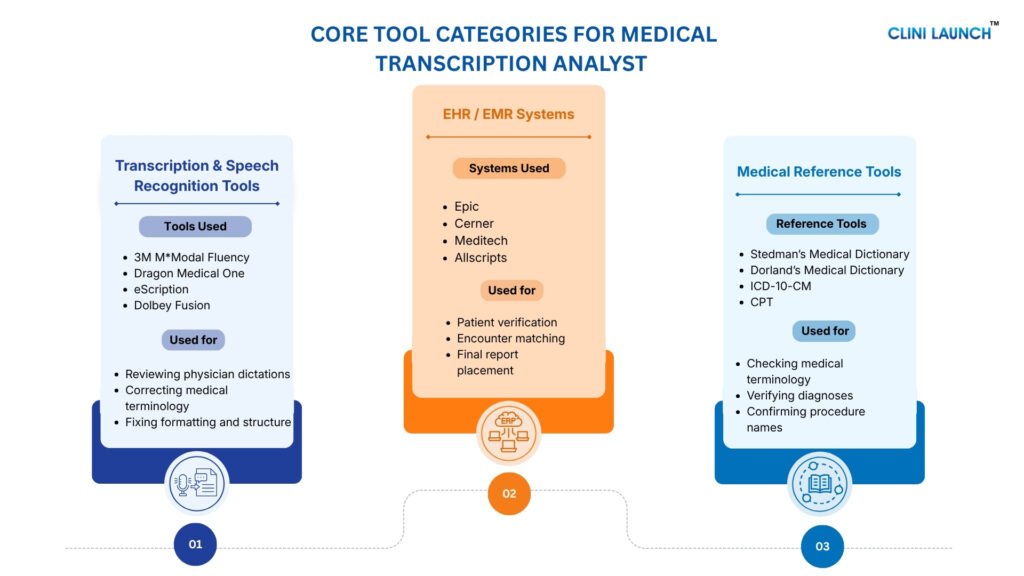
A. Speech Recognition Platforms Used for Medical Report Creation and QA Review
These platforms form the primary working environment for Medical Transcription QA Analysts. Physician dictations are converted into text using transcription or speech recognition technology, and QA analysts step in to review these reports before they become part of official medical records. Accuracy, clarity, and adherence to documentation standards are the focus at this stage. AI-powered clinical documentation is transforming healthcare by automating the creation of medical records, making the documentation process faster and more accurate
1. 3M M*Modal Fluency for Transcription
3M M*Modal Fluency is a medical transcription platform widely used by hospitals and healthcare documentation providers. It processes physician dictations and converts them into structured clinical reports such as discharge summaries, operative notes, and progress notes. The platform supports both traditional transcription and voice-recognized documentation.
QA analysts access this tool after the initial transcription or voice recognition output is generated. At this stage, the report is still a draft and has not yet been finalized or uploaded into the patient’s electronic health record. This makes it a critical checkpoint in the documentation process.
Within Fluency, the QA analyst carefully reviews the entire report for medical terminology accuracy, correct section placement, and completeness of dictated content. They correct transcription errors, standardize formatting, and ensure the report aligns with client or hospital documentation guidelines.
Fluency serves as the main workspace where documentation quality is controlled. Errors corrected at this stage prevent inaccurate or unclear information from reaching clinicians and becoming part of the permanent patient record.
2. Nuance Dragon Medical One
Dragon Medical One is a cloud-based speech recognition system used by physicians to dictate clinical notes in real time. The tool converts spoken medical narratives into text, often directly within clinical workflows. Due to the complexity of medical language, the output requires careful review.
QA specialists review documentation generated through Dragon Medical One after the physician completes dictation. These reports may pass through transcription or editing stages before reaching QA, depending on the organization’s workflow.
The QA analyst checks the speech-to-text output for recognition of errors, incorrect medical terms, and contextual inaccuracies. Special attention is given to diagnoses, procedures, and clinical statements where transcription inaccuracies could significantly alter the intended clinical meaning.
Dragon Medical One enables faster documentation but increases reliance on QA review. The QA analyst ensures that speed does not compromise clinical accuracy or clarity.
3. eScription (by 3M)
eScription is a medical transcription and speech recognition platform used by large healthcare organizations to generate draft clinical documentation. It supports high-volume dictation workflows across multiple medical specialties.
QA analysts work on reports generated within eScription before they are approved and released into the electronic health record system. This stage allows for thorough review while the document is still editable.
Using eScription, the QA analyst reviews medical terminology, verifies document structure, and ensures all dictated sections are present. They also confirm that abbreviations and specialty-specific terms are used correctly and consistently.
The platform helps manage large volumes of documentation, making QA review essential to maintain consistency and accuracy across reports.
4. Dolbey Fusion
Dolbey Fusion is an integrated medical transcription editing and quality management platform. It combines document editing with quality tracking features, making it useful for both transcription and QA teams.
QA analysts use Dolbey Fusion during the review and approval phase of medical reports. The platform is often used after initial editing and before final delivery to the client or hospital system.
In Dolbey Fusion, QA analysts review and edit reports, document identified issues and apply quality scores as per internal QA standards. The tool also allows analysts to track performance metrics and turnaround times.
Dolbey Fusion supports structured quality monitoring and helps organizations maintain consistent documentation standards across teams.
When selecting the best medical transcription software, it’s essential to consider accuracy, speed, and compatibility with your existing systems to streamline healthcare documentation processes.
Medical Transcription QA Tools
3M M*Modal Fluency
Nuance Dragon Medical One
eScription
Dolbey Fusion
Biostatistics
Build strong foundations in statistical methods used in clinical research and healthcare studies. Learn how clinical trial data is analyzed, interpreted, and validated to support evidence-based decisions and regulatory submissions.

B. EHR Systems Used to Store and Manage Finalized Patient Reports
Electronic Health Record (EHR) and Electronic Medical Record (EMR) systems are where finalized medical reports are stored as part of a patient’s official healthcare record. After transcription and QA review, reports are filed into these systems. Advanced Healthcare Documentation Systems ensure that documents are accurately linked to the correct patient, encounter, and physician before final sign-off.
Healthcare documentation software plays a critical role in organizing and managing patient data, ensuring that clinical records are accessible and accurately transcribed
5.Epic Systems
Epic is an Electronic Health Record system used by hospitals to manage patient medical information digitally. It stores clinical documents created during patient care, such as progress notes, discharge summaries, and operative reports. These documents are accessed by doctors, nurses, and care teams during treatment. Because many departments rely on Epic, the accuracy of stored records is critical.
Epic System is used after transcription and QA review are completed. Once a report is finalized, it is uploaded and stored in Epic as part of the patient’s permanent medical record. At this stage, the document is no longer a draft and becomes available for clinical decision-making. This makes the workflow position of Epic highly sensitive.
A QA analyst checks whether the report is attached to the correct patient profile and visit. They verify patient identifiers, encounter dates, and physician names to avoid mismatches. The analyst also confirms that the report type is correctly labeled, such as discharge summary or operative note. Any errors identified are corrected before final release.
Epic is where clinicians actually read and rely on medical reports. If a document is placed incorrectly, it can lead to serious confusion in patient care. QA verification in Epic ensures that accurate documentation reaches the right patient record. This step protects both patient safety and clinical accountability.
6.Oracle Cerner
Cerner is an Electronic Health Record system used by hospitals to store and manage patient clinical documentation. It holds physician notes, investigation reports, operative notes, and discharge summaries created during patient care. Multiple departments access these records simultaneously. Because of this shared access, documentation accuracy is essential.
Oracle, since acquiring Cerner, came into use after transcription and QA checks are completed. Once a report is approved, it is filed into Cerner as part of the patient’s official medical record. At this point, the document becomes available for doctors and care teams to review. Errors at this stage can directly affect clinical interpretation and patient care decisions.
The QA analyst verifies that the report is linked to the correct patient and hospital visit. They check encounter numbers, dates, and provider details for accuracy. The analyst also confirms that the document type is correctly categorized. Errors are corrected before the report is made visible to clinicians.
Cerner is a primary system clinicians rely on for patient information. Incorrect filing can lead to confusion or delays in care. QA review ensures that documentation stored in Cerner is accurate, reliable, and safe to use for treatment decisions.
7. Meditech
Meditech is an Electronic Health Record system commonly used in community hospitals and mid-sized healthcare facilities. It stores patient clinical documents generated during inpatient and outpatient care. These records support daily clinical activities across departments. Clear and correct documentation is necessary for smooth workflows.
Meditech is used after transcription review and QA approval. Once reports are finalized, they are entered into Meditech and become part of the patient’s permanent record. At this stage, reports are no longer editable for drafts. This makes accuracy checks especially important.
The QA analyst confirms that the report is placed under the correct patient and visit. They review document titles, dates, and physician details for correctness. The analyst also ensures the report matches the appropriate clinical encounter. Any discrepancies are resolved before final release.
Meditech supports day-to-day clinical documentation access. Errors in report placement can disrupt patient care and communication. QA verification helps maintain organized and dependable patient records.
8. Allscripts
Allscripts is an Electronic Health Record platform used by hospitals, clinics, and physician practices. It stores longitudinal patient records, including consultation notes and treatment documentation. These records are accessed across multiple care settings. Accuracy is essential to maintain continuity of care. Medical documentation software integrates transcription, speech recognition, and electronic health records to improve the accuracy and efficiency of patient record management.
Allscripts is used once transcription and QA checks are completed. Approved reports are uploaded into the system and become part of the patient’s ongoing medical history. At this stage, reports are shared across care teams. This makes proper filing critical.
The QA analyst verifies patient identifiers, visit details, and provider information. They ensure that reports are filed under the correct document category. The analyst checks that formatting and metadata match system requirements. Any filing errors are corrected before reports are finalized.
Allscripts supports continuity of patient care across visits and providers. Incorrect documentation of placement can affect future clinical decisions. QA review ensures reliable and accurate patient records over time.
EHR Systems Used by QA Analysts
Epic Systems
Oracle Cerner
Meditech
Allscripts
C. Medical Reference Tools Used to Verify Clinical Terminology and Procedures
Medical reference tools support Medical Transcription QA Analysts in verifying the accuracy of clinical language used in physician dictations. These tools are not used for billing or regulatory coding. Instead, they help QA analysts confirm correct medical terms, anatomy references, diagnoses, and procedures while reviewing clinical documentation. Reference tools act as verification support during transcription QA.
9. Stedman’s Medical Dictionary
Stedman’s Medical Dictionary is a widely used medical reference that explains medical terms, anatomy, procedures, and abbreviations. It is designed specifically for healthcare documentation and clinical usage. The dictionary provides clear definitions and correct spellings of medical terminology. It is commonly used in transcription and QA environments. Medical record scanning software is used to digitize physical patient records, making them easily accessible for transcription and quality assurance purposes.
QA analysts refer to Stedman’s while reviewing transcribed or voice-recognized reports. It is used during the editing and verification stage, before a report is finalized. The tool supports decision-making when terminology appears unclear or unfamiliar. It is accessed alongside transcription platforms.
The QA analyst checks the correct spelling and meaning of medical terms mentioned in dictation. They confirm anatomical references and procedure names. The analyst also verifies abbreviations to ensure they are expanded or used correctly. This helps maintain clarity in clinical documentation.
Accurate medical terminology is essential for clear communication among healthcare providers. Using Stedman’s helps prevent misunderstandings caused by incorrect or unclear terms. It supports consistency and professionalism in medical reports.
10. Dorland’s Illustrated Medical Dictionary
Dorland’s Illustrated Medical Dictionary is a comprehensive medical reference known for detailed explanations and visual clarity. It covers a wide range of medical terms, conditions, and anatomical concepts. The dictionary is often used as a secondary reference for deeper clarification. It is trusted in healthcare documentation settings.
QA analysts use Dorland’s when additional clarity is needed beyond basic definitions. It is consulted during report review when complex or specialty-specific terms appear. The tool supports accurate interpretation before finalizing documentation. It works alongside other reference resources.
The QA analyst reviews detailed definitions to confirm correct term usage. They cross-check complex medical language dictated by physicians. The analyst ensures that the selected term accurately represents the clinical context. This reduces ambiguity in reports.
Some medical terms have similar spellings or meanings. Dorland’s helps QA analysts avoid subtle errors that could change clinical interpretation. It strengthens documentation accuracy in complex cases.
11. ICD-10-CM
ICD-10-CM (International Classification of Diseases, 10th Revision, Clinical Modification) is a standardized classification system used to describe diseases and health conditions. While it is primarily associated with coding, it is also used as a reference for documentation review. The system provides standardized terminology for diagnoses. QA analysts use it strictly for validation, not coding.
QA analysts refer to ICD-10-CM during documentation review when diagnosis terms appear unclear or inconsistent. It is used before reports are finalized and filed into EHR systems. The tool supports terminology verification. It does not replace a coder’s role.
The QA analyst checks whether the diagnosis aligns with standard clinical terminology. They verify that the dictated diagnosis makes sense in the clinical context. The analyst does not assign or change codes. The focus remains on documentation clarity.
Using standardized diagnostic terminology improves consistency across medical records. It helps ensure that physician documentation aligns with accepted clinical language. This supports downstream clinical and administrative processes.
12. CPT
CPT, or Current Procedural Terminology, is a standardized system used to describe medical and surgical procedures. Although CPT is mainly used for billing, it also serves as a terminology reference. It helps clarify procedure names mentioned in clinical dictations. QA analysts use it only for understanding procedure language.
QA analysts refer to CPT during report review when procedures are dictated. It is used before reports are finalized and stored in the EHR. The tool helps verify that procedure names are correctly documented. It does not involve billing activities.
The QA analyst confirms that the procedure terminology dictated by the physician is correct and clearly stated. They ensure the wording matches standard procedural language. The analyst avoids altering clinical intent. The focus is on accurate documentation.
Clear procedure documentation is essential for clinical understanding and continuity of care. CPT terminology helps maintain consistency in how procedures are described. This reduces confusion for clinicians to review the report later.
Medical Reference Tools Used by QA Analysts
Stedman’s Medical Dictionary
Dorland’s Illustrated Medical Dictionary
ICD-10-CM
CPT
Key Skills required for Medical Transcription QA Analysts
Working with transcription QA systems requires a combination of medical knowledge, analytical ability, and technical familiarity with healthcare documentation platforms.
Medical Terminology Expertise: Strong understanding of anatomy, diseases, procedures, and pharmacological terms is essential for identifying transcription errors.
Attention to Detail: QA analysts must detect subtle documentation errors that could alter clinical meaning.
Healthcare Documentation Standards: Knowledge of report formatting, clinical documentation guidelines, and documentation structure ensures consistency across reports.
Technical Proficiency with Transcription Systems: Familiarity with speech recognition tools, transcription platforms, and EHR systems helps analysts manage documentation workflows efficiently.
Analytical Thinking: QA professionals evaluate documentation accuracy, identify error patterns, and maintain quality benchmarks.
Upskilling Opportunities for Medical Transcription QA Professionals
As healthcare documentation systems evolve, professionals working in transcription and documentation QA roles increasingly benefit from developing analytical and data interpretation skills.
Upskilling in areas such as Advanced Healthcare AI and analysis, clinical research data interpretation, and statistical methods can open pathways to broader roles in healthcare data management and quality analytics.
Programs such as the Advanced Diploma in Biostatistics help professionals build a strong foundation in statistical thinking, clinical data interpretation, and evidence-based healthcare analysis.
Future of Medical Transcription QA Tools
Healthcare documentation is undergoing rapid transformation with the integration of artificial intelligence and advanced speech recognition technologies. AI systems are increasingly capable of generating structured clinical documentation directly from physician dictation.
However, human oversight remains essential. Medical Transcription QA Analysts play a critical role in validating AI-generated transcripts, ensuring contextual accuracy, and maintaining documentation quality.
Future developments in this field may include:
- AI-assisted documentation review
- Automated quality scoring systems
- Real-time transcription validation
- Integrated transcription-EHR ecosystems
As technology evolves, QA analysts will increasingly work alongside intelligent documentation systems rather than being replaced by them.
Conclusion
Medical Transcription QA Analysts play an essential role in maintaining the accuracy and reliability of healthcare documentation. By using transcription platforms, electronic health record systems, and medical reference tools, they ensure that clinical reports are clear, structured, and correctly integrated into patient records.
As healthcare documentation continues to evolve with AI-driven technologies, the role of QA analysts remains vital in safeguarding documentation quality and supporting effective clinical communication.
Whether you are starting your journey in healthcare documentation or looking to strengthen your analytical skills, CliniLaunch Research Institute offers a Advanced Diploma in Biostatistics designed to build a strong foundation for data-driven roles in healthcare and quality assurance. Enroll now to take the next step toward a future-ready healthcare career.