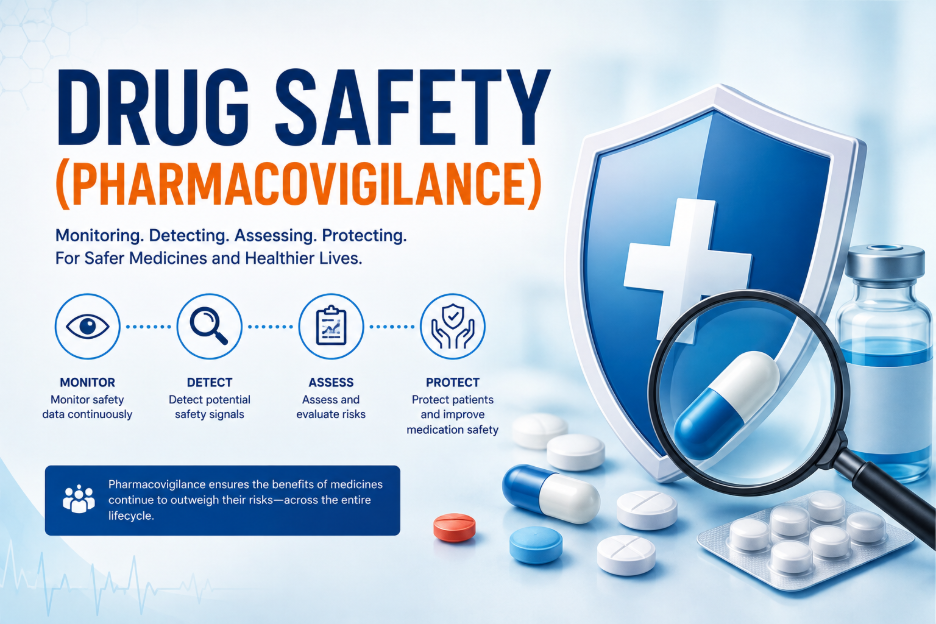
Drug safety (pharmacovigilance) is the process of monitoring, assessing, and preventing adverse effects of medicines across their lifecycle. It ensures that drugs remain safe in real-world use by analyzing safety data, detecting risks early, and supporting regulatory decisions for continuous patient safety.
Introduction
A clinical trial can show that a medicine works under carefully controlled conditions, but it cannot predict every risk that may emerge once the drug reaches everyday patients. After approval, medicines are used by people of different ages, health backgrounds, genetic profiles, and treatment histories. They may also be taken for longer periods, alongside other medicines, or in circumstances that clinical trials were never designed to replicate.
That is why Drug Safety, or Pharmacovigilance, remains essential long after approval. Defined by the WHO as the detection, assessment, understanding, and prevention of adverse effects and other medicine-related problems, pharmacovigilance follows a drug throughout its lifecycle. By combining adverse-event reports, clinical data, electronic health records, and emerging safety signals, it helps identify risks that may otherwise remain hidden. In a healthcare landscape where medicines reach patients faster and data grows more complex, pharmacovigilance turns real-world experience into action—helping regulators, healthcare professionals, and manufacturers make safer decisions.
What is Pharmacovigilance and Why it Matters
Drug Safety (Pharmacovigilance) is the structured process of collecting, analyzing, and interpreting medicine-safety data to identify risks and support appropriate action. It brings together adverse-event reports and safety signals to assess how medicines perform across their lifecycle.
At its core, Pharmacovigilance protects the benefit–risk balance of a medicine. A drug may be approved when its benefits outweigh known risks, but that balance can change as new evidence emerges. Continuous monitoring helps detect patterns that individual reports may not reveal.
The value of pharmacovigilance lies in turning scattered safety information into actionable evidence. Emerging signals can prompt further investigation, label changes, usage restrictions, or other regulatory measures. This ongoing surveillance helps ensure that medicines remain appropriately monitored as real-world evidence grows.
Pharmacovigilance matters because it directly influences:
- Ongoing Risk Evaluation: Ensures emerging risks are identified and managed systematically
- Regulatory Decisions: Supports safety updates, warnings, and compliance requirements
- Clinical Practice: Helps healthcare professionals make safer prescribing decisions
- Patient Outcomes: Reduces preventable adverse effects and improves overall treatment safe
How Pharmacovigilance is Managed Across the Drug Lifecycle
Pharmacovigilance follows a structured progression, where each stage contributes to new evidence about a medicine’s safety profile. This stepwise framework aligns with the drug development pathway described by the U.S. Food and Drug Administration, which includes discovery, preclinical research, clinical trials, regulatory review, and post-market monitoring.
Before a drug is tested in humans, its safety journey begins in the pre-clinical stage, where early risk signals are identified through laboratory and animal studies. This forms the foundation for all subsequent safety evaluations.
Phase 1, 2 & 3: Clinical Trials (Controlled Safety Observation in Humans)
Once human studies begin, safety is assessed under controlled and regulated conditions. These phases help establish an initial understanding of how the drug behaves in the human body, including dose tolerance, common adverse effects, and short-term safety patterns. However, the scope remains limited due to controlled environments and selected participant groups.
Regulatory Review (Structured Benefit–Risk Decision Making)
At this stage, all accumulated data is evaluated to determine whether the drug’s therapeutic benefits justify its identified risks. Approval is granted with clearly defined usage guidelines, safety warnings, and labeling requirements to ensure the drug is used under appropriate conditions.
Phase 4: Post-Marketing Surveillance (Expansion into Real-World Use)
After approval, the drug is used across a broader and more diverse population, where real-world variability comes into play. Differences in patient profiles, long-term use, and drug interactions begin to reveal safety insights that were not fully captured earlier.
Ongoing: Signal Detection & Risk Management (Continuous Safety Evaluation)
As data accumulates over time, it is systematically analyzed to identify emerging safety patterns. Validated risks lead to appropriate actions such as safety updates, usage restrictions, or regulatory interventions, ensuring that the drug continues to be used safely.
Professional Program in Clinical Research
Build practical skills required for alternative career paths in the pharmaceutical and healthcare industries. This program introduces clinical trial processes, regulatory documentation, Pharmacovigilance monitoring, and research data management used in global clinical research operations.
View CourseUnderstanding Adverse Drug Reactions Types and Classification
Medicines are designed to treat, manage, or prevent diseases—but they can also produce unintended effects, some of which can significantly impact patient safety and clinical outcomes. PubMed Central highlights that adverse drug reactions remain a major concern in healthcare due to their potential to cause harm.
What are Adverse Drug Reactions (ADRs)?
Adverse Drug Reactions (ADRs) are harmful or unintended responses to a medicine when taken at normal doses for treatment, prevention, or diagnosis. Clinical resources like StatPearls highlight ADRs as a central component of patient safety monitoring, ranging from mild discomfort to severe, life-threatening conditions.
Types of Adverse Drug Reactions
Not all adverse drug reactions occur in the same way. Some are predictable extensions of a medicine’s intended action, while others appear unexpectedly or after prolonged exposure. The Rawlins–Thompson A–D classification helps pharmacovigilance professionals organize reactions by predictability, dose relationship, timing, and mechanism.
- Type A (Augmented Reactions): These are predictable and arise from the medicine’s known pharmacological effects. They are often dose-dependent, with risk or severity increasing as the dose rises. For example, excessive insulin can cause hypoglycemia. Dose adjustment, schedule changes, or closer monitoring may help manage the reaction.
- Type B (Bizarre Reactions): These reactions are difficult to predict and usually lack a clear dose–response pattern. They may result from immune mechanisms, genetic susceptibility, or patient-specific factors. Severe hypersensitivity reactions, such as anaphylaxis, may require immediate treatment and permanent discontinuation of the suspected drug.
- Type C (Chronic Reactions): These develop gradually during prolonged or repeated exposure and may be mistaken for disease progression or unrelated health problems. Osteoporosis or adrenal suppression from long-term corticosteroid use are examples.
- Type D (Delayed Reactions): These become apparent after considerable time has passed, either during treatment or after exposure ends. Their delayed onset can make the connection to the medicine difficult to identify. Certain treatment-related cancers or reproductive effects may fall into this category.
Recognizing ADR types helps teams interpret safety reports, identify emerging patterns, assess patient risk, and choose appropriate monitoring or regulatory action.
Real-World Example: When ADRs Reveal Hidden Risks
A well-known case is Thalidomide, which was initially prescribed as a sedative and for managing morning sickness. While early use appeared safe, widespread exposure led to severe birth defects in newborns.
- These adverse effects were not fully identified during initial testing
- Real-world reporting helped uncover a clear safety signal
- This led to stricter regulatory frameworks and modern pharmacovigilance practices
Today, thalidomide is still used in specific medical conditions—but under strict regulatory controls, demonstrating how ADR insights can reshape drug usage rather than eliminate it entirely.
Why Understanding ADRs Matters
- Early Risk Detection: Helps identify harmful reactions before they become widespread
- Clinical Decision Support: Guides healthcare professionals in safer prescribing
- Patient Awareness: Encourages timely reporting of unusual symptoms
- Continuous Safety Monitoring: Strengthens the overall Pharmacovigilance system
Pharmacovigilance Across Clinical Trials and Post-Marketing
Pharmacovigilance changes as a medicine moves from a controlled trial to everyday use. Clinical studies provide the first safety evidence, while post-marketing surveillance shows how a treatment performs across larger, more diverse populations. Together, they support a continuous cycle of reporting, signal detection, evaluation, and risk management.
From Clinical Trials to Real-World Use
In clinical trials, safety teams track adverse events, serious adverse events, laboratory results, and treatment-related concerns within a defined study population. After approval, exposure increases and new factors such as age, comorbidities, polypharmacy, and longer treatment periods may reveal uncommon or delayed risks.
ADR Reporting and Monitoring
Adverse Drug Reactions (ADRs) may be reported by healthcare professionals, patients, researchers, or identified through medical literature and safety databases. Each report is reviewed for completeness, seriousness, expectedness, and possible association with the medicine. Reliable reporting helps distinguish isolated cases from patterns that require further investigation.
Post-Marketing Surveillance and Signal Detection
Post-marketing surveillance in pharmacovigilance uses real-world evidence to monitor a medicine after approval. Safety teams look for unusual reporting patterns or changes in known risks through ongoing Pharmacovigilance monitoring. A safety signal detection is not proof of causation; it is an alert that prompts deeper clinical and statistical assessment.
Risk Management in Pharmacovigilance
When evidence confirms or strengthens a safety concern, regulators and manufacturers may update product information, issue safety communications, introduce additional monitoring, restrict use, or recommend risk-minimization measures. This creates an ongoing loop: report → detect → assess → manage → monitor.
Together, these activities create a continuous safety cycle: detect → assess → investigate → manage → monitor.
Key Roles in Pharmacovigilance, Skills & Eligibility
Pharmacovigilance careers span the full safety lifecycle—from processing individual reports to evaluating population-level signals and supporting regulatory decisions. The right role depends on the level of clinical knowledge, analytical ability, and regulatory responsibility involved. For an overview of drug safety and pharmacovigilance careers, see the ABPI guide to working in drug safety and pharmacovigilance.
Key Roles and Responsibilities
| Role | Primary Responsibility |
|---|---|
| Drug Safety / Pharmacovigilance Associate | Processes adverse-event cases, verifies case details, maintains safety databases, and follows reporting timelines. |
| Drug Safety Scientist | Reviews aggregated safety data, evaluates benefit–risk profiles, and contributes to safety reports and risk assessments. |
| Medical Reviewer / Safety Physician | Provides clinical interpretation of adverse events and supports medical safety decisions. |
| Signal Detection Specialist | Analyzes large datasets to identify emerging safety signals and potential risks. |
| Regulatory Affairs Specialist | Prepares and coordinates safety-related regulatory submissions and ensures compliance with submission requirements. |
Skills Required
Successful Pharmacovigilance professionals typically combine data accuracy with clinical reasoning. Key skills include:
- Safety data handling and documentation
- Adverse-event and medical terminology knowledge
- Analytical and signal interpretation skills
- Pharmacovigilance regulations and GCP awareness
- Regulatory reporting and compliance
- Attention to detail and process discipline
- Communication and cross-functional collaboration
AI in Pharmacovigilance
As pharmacovigilance systems expand, the challenge is increasingly about managing scale, complexity, and speed. Artificial Intelligence in drug development can process large volumes of safety data, identify potential signals, structure information, and support faster expert review. However, AI should complement rather than replace pharmacovigilance professionals, with appropriate validation, human oversight, data privacy, and regulatory controls.
How AI is Transforming Drug Safety
- Intelligent Data Structuring: Converts unstructured reports and medical narratives into standardized, usable data.
- Pattern Recognition at Scale: Detects relationships across large datasets that may be difficult to identify manually.
- Continuous Learning: Uses new data to refine risk identification and classification.
- Expert Decision Support: Prioritizes relevant information while keeping human judgment central.
- Workflow Optimization: Reduces repetitive tasks, improving processing speed and consistency across pharmacovigilance operations.
Real-World Shift: From Reactive to Adaptive Systems
Traditional Pharmacovigilance systems are largely reactive, relying on accumulated reports and retrospective analysis. AI introduces a more adaptive approach, where systems continuously process incoming data, refine patterns, and support earlier, more informed interventions.
Why AI Matters in Drug Safety
- Handles Data Complexity: Manages large, diverse, and unstructured datasets efficiently
- Improves Consistency: Reduces variability in how safety data is interpreted
- Enhances Prioritization: Helps focus attention on high-risk signals
- Supports Scalable Systems: Adapts to growing volumes of global safety data
Conclusion
Pharmacovigilance (pharmacovigilance) is a continuous process that evolves as medicines move into real-world use. From identifying adverse drug reactions to understanding risks across different populations, it ensures that a drug’s benefit–risk balance is constantly evaluated.
This system works by turning safety data into informed decisions, supported by specialized professionals across the lifecycle. With the growing scale of healthcare data, AI is further strengthening how safety information is managed and analyzed.
Ultimately, pharmacovigilance ensures that medicines remain safe, effective, and reliable throughout their real-world use.
For freshers, developing practical skills and gaining industry-relevant knowledge can unlock diverse career opportunities and long-term growth in the healthcare and pharmaceutical sectors. At CliniLaunch Research Institute, we offer life science programs designed to prepare individuals for successful careers in pharma and healthcare industries.
Frequently Asked Questions
- Why is Pharmacovigilance important after a drug is approved?
Because clinical trials are limited, real-world use reveals new risks across diverse populations, long-term use, and drug interactions.
- What is the difference between side effects and ADRs?
Side effects are expected and often mild, while ADRs can be harmful, serious, and sometimes life-threatening.
- What are the main types of adverse drug reactions?
They include Type A (predictable), Type B (unpredictable), Type C (chronic), and Type D (delayed reactions).
- What is post-marketing surveillance (Phase 4)?
It is the monitoring of Pharmacovigilance after approval, where real-world data helps identify risks not seen in clinical trials
- What is signal detection in pharmacovigilance?
It is the process of identifying patterns or trends in safety data that may indicate a new or emerging risk.
- Why are special populations important in Pharmacovigilance?
Groups like children, elderly, pregnant women, and patients with comorbidities may respond differently to drugs, increasing safety risks.
- Who is eligible for Pharmacovigilance roles?
Individuals with backgrounds in life sciences, pharmacy, medicine, or allied healthcare fields are typically eligible.
- How is AI used in Pharmacovigilance?
AI helps automate case processing, detect patterns in large datasets, improve decision-making, and enhance workflow efficiency.
- Does AI replace Pharmacovigilance professionals?
No. AI supports experts by improving efficiency and insights, but human judgment remains essential for decision-making.
- What are adverse drug reactions (ADRs)?
ADRs are harmful or unintended responses to a medicine taken at normal doses for treatment, diagnosis, or prevention.