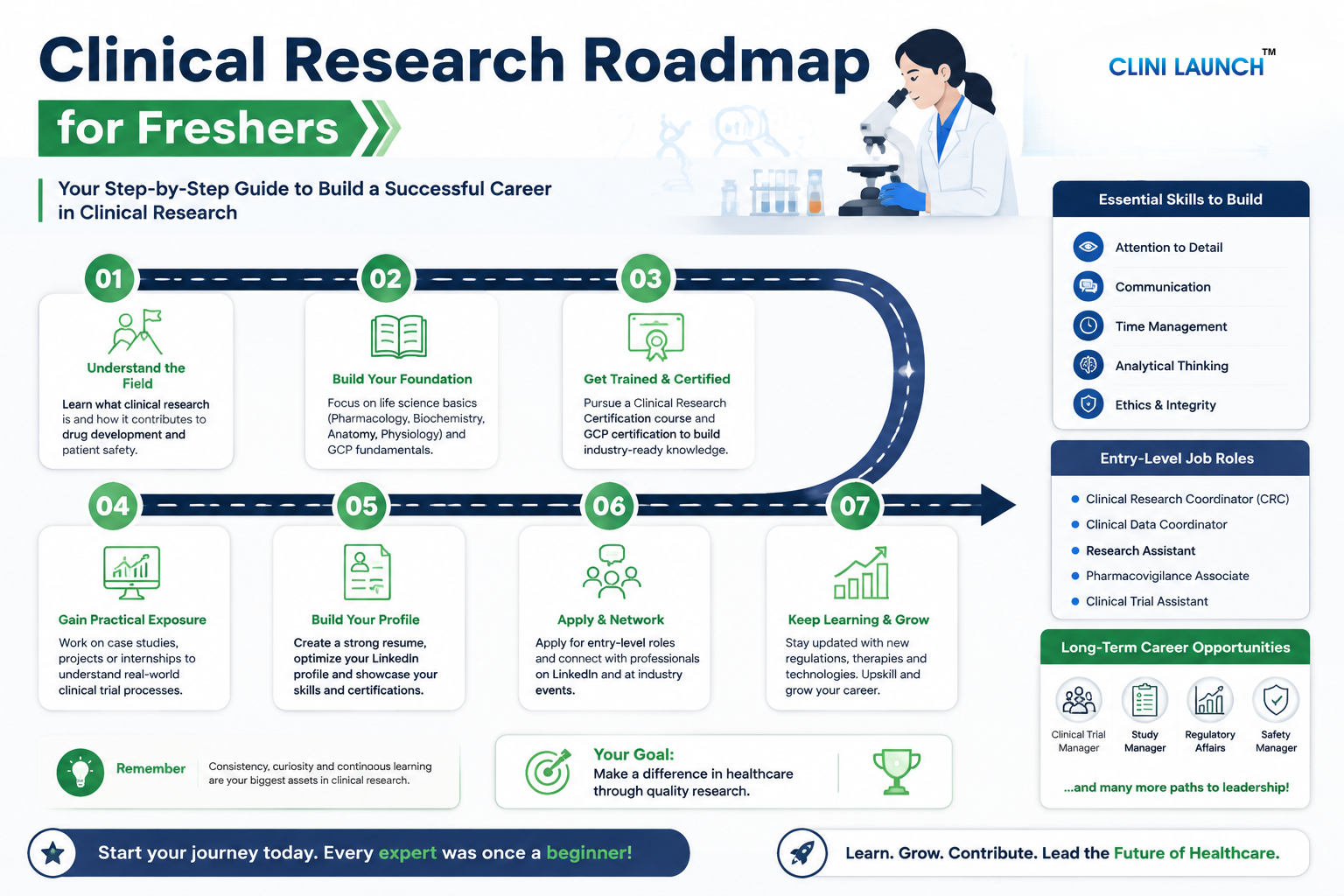
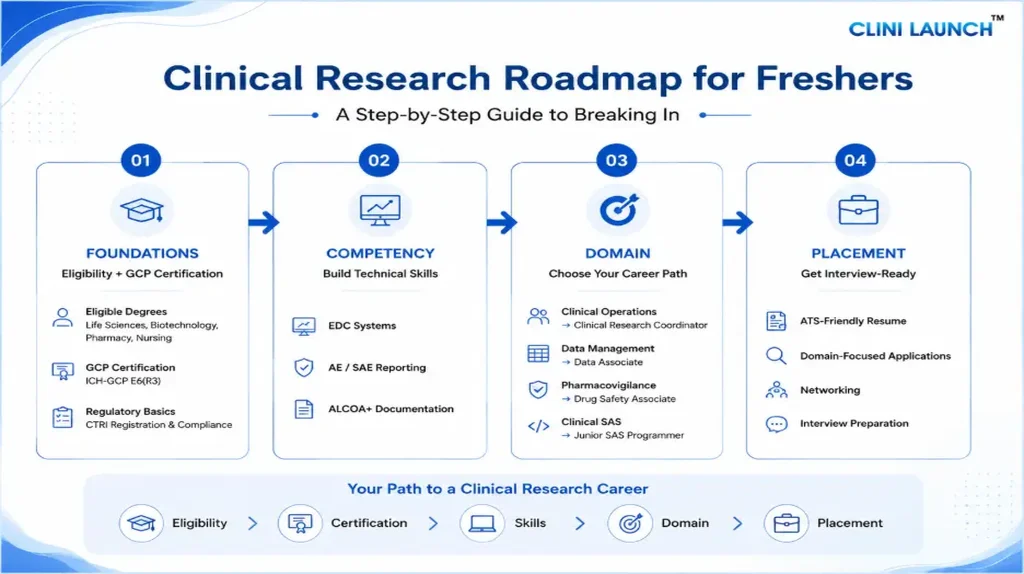
The clinical research roadmap for freshers includes four stages: foundations, competency, domain selection, and placement. It helps life-science graduates build GCP knowledge, technical skills, and practical exposure while navigating challenges at each stage, from building core knowledge to choosing a domain and preparing for recruitment. These decisions shape readiness for clinical research roles.
A life sciences degree covers pharmacology, biostatistics, and often the basics of GCP. Yet the growing healthcare and clinical research ecosystem offers graduates opportunities beyond traditional laboratory roles. India’s healthcare workforce exceeds 6 million, with over 6.3 million additional jobs expected by 2030. This expanding scope is encouraging more graduates to explore clinical research, making a clear clinical research roadmap valuable for navigating careers across clinical operations, data management, pharmacovigilance, and SAS programming.
Why Clinical Research is the Ultimate Launchpad for Life Science Graduates
Clinical research is the regulated evaluation of new drugs, vaccines, and medical devices. For life science graduates, it offers a pathway to apply scientific knowledge across a growing drug development industry.
- Growing market: India’s clinical trials market was valued at USD 2.16 billion in 2025 and is projected to reach USD 4.63 billion by 2034, at an 8.56% CAGR.
- Expanding CRO sector: CRO services are projected to grow from USD 1,865.6 million in 2026 to USD 3,025.3 million by 2031.
- Rising trial activity: Phase III trials account for nearly 34.9% of India’s clinical trial volume, supporting demand across clinical operations and data management.
- Stronger infrastructure: CDSCO and CII conducted a national medical-device regulatory workshop in June 2026, reflecting continued regulatory development.
- Skills matter: Industry growth alone does not guarantee placements; the India Skills Report 2026 emphasizes applied skills for graduate employability.
The Four-Phase of Clinical Research Roadmap
Phase 1: Academic and GCP Foundations
a. Eligibility. Recruiters check for regulated-research awareness before they check the degree itself, like-
- BSc/MSc Life Sciences, Microbiology, Biotechnology — Suitable for CRO and PV roles
- BPharm/MPharm — Strong fit for Pharmacovigilance, Regulatory Affairs, and Data Management
- BSc/MSc Nursing — Preferred for Clinical Operations and Site Coordination
- MBBS/BDS — Advantage in Medical Monitoring and Clinical Operations
- Allied Health Degrees — Accepted for Data Entry and Case Processing roles with GCP certification
b. GCP certification. Start with a recognized GCP course to understand the principles governing clinical research and strengthen your foundational knowledge.
c. Timing. Completing GCP certification closer to job applications can help keep knowledge current and gives candidates a credential to include when demonstrating role readiness.
| Course | Cost | Duration | Best For |
|---|---|---|---|
| Global Health Network — ICH-GCP E6(R3) | Free | Self-paced | First-time certification, broad recognition |
| NIDA CTN GCP | Free | ~6 hours | Structured, quiz-based learning |
Neither course guarantees an interview call, but entering the job market without any GCP grounding is close to a disqualification before an application is reviewed.
d. Practical exposure. Build experience through mock EDC exercises, case-processing practice, clinical-trial documentation, or relevant projects. This helps convert GCP knowledge into practical understanding and gives candidates stronger examples to discuss during interviews.
- Understand the clinical research ecosystem and drug development process.
- Learn clinical trial phases, stakeholders, and trial operations.
- Build foundations in Clinical Research & Management.
- Understand Pharmacovigilance & Drug Safety concepts.
- Develop knowledge of Clinical Data Management.
- Gain exposure to Medical Writing, Regulatory Affairs, and Healthcare AI.
Goal: Build the technical foundation needed to enter clinical research roles.
A fresher who can explain ALCOA+ with a concrete example — not just recite the acronym — stands out in a technical round.
- Assess your technical knowledge and identify gaps.
- Strengthen concepts through revision and weekly evaluations.
- Practise technical and HR mock interviews.
- Improve communication and articulation skills.
- Understand career roles and industry expectations.
- Receive role-based interview preparation and personalized feedback.
Goal: Build the confidence and skills required for entry-level recruitment.
Phase 3: Choosing an Entry-Level Domain
Clinical research is a cluster of departments, and choosing the right entry point requires understanding each domain’s work, skills, and growth trajectory.
| Domain | Fresher Entry Role | Daily Work | Growth Path |
|---|---|---|---|
| Clinical Operations | Clinical Research Coordinator | Site coordination, monitoring visit prep | CRA → Senior CRA → Project/Site Manager |
| Data Management | Data Entry / Junior Data Associate | EDC query resolution, database validation | DM Lead → Biostatistics-adjacent roles |
| Pharmacovigilance | Drug Safety / Case Processing Associate | ICSR intake, MedDRA coding, narratives | Senior DSA → Signal Management → PV Lead |
| Clinical SAS Programming | Junior SAS Programmer | Data listings, tables, figures | Independent Programmer → Lead Programmer |
- Clinical Operations: Suits people-facing candidates comfortable with travel, site coordination, and troubleshooting. Freshers should evaluate if this role matches their working style.
- Clinical Data Management: Fits detail-oriented candidates who prefer data review, query resolution, and accuracy over site monitoring activities.
- Pharmacovigilance: Offers strong fresher opportunities, supported by initiatives like PvPI, which trained 15,875 healthcare professionals through 219 virtual programmes in one cycle.
- Clinical SAS Programming: Requires coding and statistical skills but offers transferable expertise and strong growth potential after the initial learning phase.
Choose one primary domain for your initial applications. A focused profile makes your skills and career direction clearer to recruiters.
- Explore Clinical Research & Operations roles.
- Understand opportunities in Pharmacovigilance & Drug Safety.
- Explore Clinical Data Management career paths.
- Understand Medical Writing and Regulatory Affairs functions.
- Identify roles matching your qualification, skills, and interests.
- Target relevant roles such as CTA, CRC, Clinical Data Coordinator, or Clinical Research Assistant.
Goal: Choose an entry-level function with a clear career direction.
Phase 4: Resume and Job-Hunting Strategy
- Where to apply. Prioritize top CROs (IQVIA, ICON, Parexel, Syngene), pharma companies, and healthcare IT firms. Mid-tier CROs can also offer broader hands-on exposure, which is valuable early in your career.
- What can you expect to earn? Fresher CRA roles typically start around ₹2.5–4.5 LPA, with pay increasing significantly after gaining trial experience. Treat your first role as a career-building step, not the final destination.
- Beating the ATS. What Freshers Should Optimize:
- Use certification names exactly as issued (ICH-GCP, not “Good Clinical Practice guidelines”)
- Match job-specific tools (EDC, not “electronic data systems”)
- Mention your target domain early in the resume summary
- Add measurable exposure (40+ mock query resolutions, not “familiar with data cleaning”)
- Use the exact job designation applied for
- Networking beyond adding connections. Use LinkedIn strategically by engaging with industry professionals, joining clinical research groups, and seeking insights from recent hires instead of posting generic updates.
| Phase | Focus | Outcome |
|---|---|---|
| 1. Foundations | Eligibility + GCP + technical preparation | Foundational career readiness |
| 2. Placement Readiness | Role understanding + resume + interview preparation | Application readiness |
| 3. Domain Selection | Clinical Operations, CDM, PV, or SAS | Focused career direction |
| 4. Job Search | ATS + networking + applications | Targeted job opportunities |
- Build a role-focused clinical research resume.
- Optimise your LinkedIn profile.
- Understand job descriptions and eligibility requirements.
- Match your profile with suitable opportunities.
- Get support with applications and resume submissions.
- Prepare through 1:1 interview coaching and employer coordination.
Goal: Move from training to targeted applications and interviews.
PG Diploma in Clinical Research
Gain practical skills in clinical trials, GCP, pharmacovigilance, clinical data management, regulatory processes, and research documentation. Prepare for roles in CROs, pharma companies, hospitals, and healthcare research organizations.
View CourseConclusion: Building Your Clinical Research Career
Starting a successful clinical research career requires a proper Clinical Research roadmap, which is more than just the certificates. It needs the right combination of GCP knowledge, domain skills, practical exposure, and a focused career path.
At CliniLaunch Research Institute, Bangalore, the PG Diploma in Clinical Research helps aspiring professionals build industry-relevant skills through structured training in clinical trials, pharmacovigilance, clinical data management, regulatory concepts, and practical workflows.
With guided learning and career-focused preparation, CliniLaunch helps freshers take the next step toward becoming job-ready clinical research professionals.
Frequently Asked Questions (FAQs):
1. What qualification is required to start a career in clinical research?
Graduates from Life Sciences, Biotechnology, Pharmacy, Nursing, and allied healthcare fields can enter clinical research. GCP certification improves job readiness.
2. How can I become a clinical researcher after graduation?
Build clinical research foundations, complete GCP certification, choose a suitable domain, develop practical skills, and prepare for targeted applications.
3. Is GCP certification enough to get a clinical research job?
No. Along with GCP, employers value knowledge of clinical workflows, documentation, EDC systems, and safety reporting.
4. Which clinical research field is best for freshers?
It depends on your interests. Clinical Operations, Data Management, Pharmacovigilance, and SAS offer different career paths.
5. What skills should I learn before applying for clinical research jobs?
Focus on ICH-GCP, clinical trials, EDC, AE/SAE reporting, ALCOA+, and regulatory documentation.
6. Can biotechnology graduates apply for clinical research roles?
Yes. Biotechnology graduates can apply for roles in Clinical Operations, Data Management, Pharmacovigilance, and Clinical Trial Assistance.
7. What is the scope after completing a clinical research certification?
It prepares candidates for roles in CROs, pharma companies, hospitals, and research organizations.