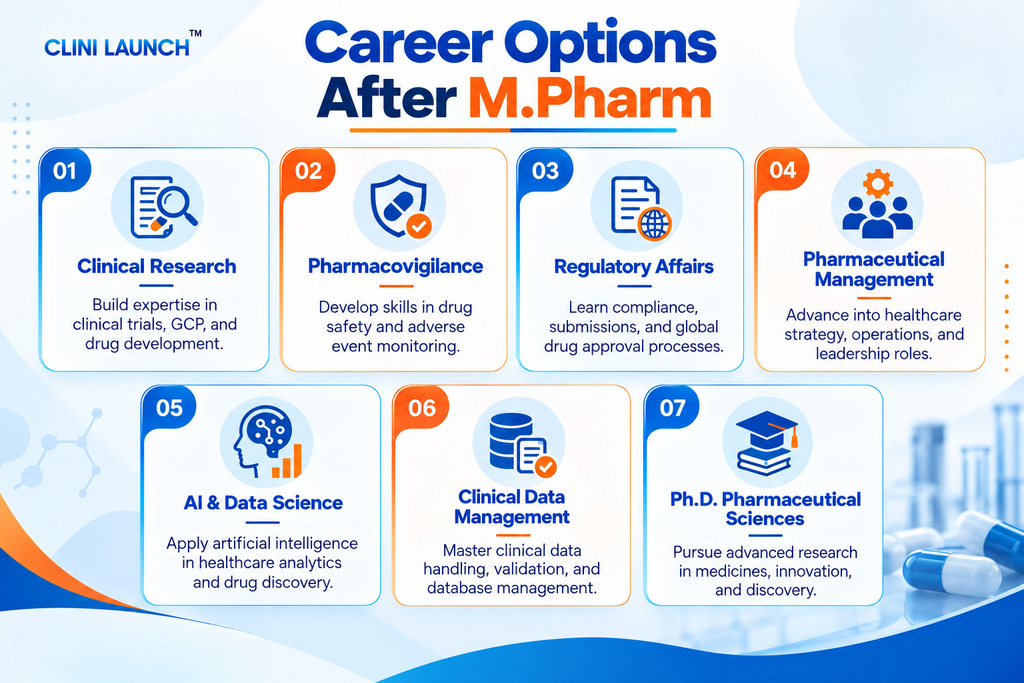
After completing an M.Pharm degree, graduates can pursue specialized courses in areas such as Pharmaceutical Management, Regulatory Affairs, Pharmacovigilance, Clinical Research, Clinical Data Management, Ph.D. in Pharmaceutical Sciences, and AI & Data Science in Drug Discovery. These courses help professionals develop advanced skills in research, drug development, healthcare management, and emerging pharmaceutical technologies.
An M.Pharm course provides a strong foundation in pharmaceutical sciences, covering areas such as drug development, formulation, pharmacology, and research methods. However, the pharmaceutical industry is rapidly evolving with advancements in biotechnology, clinical research, regulatory science, healthcare management, and artificial intelligence.
The growing focus on innovation in drug discovery and healthcare has increased the importance of specialized knowledge. The National Institutes of Health (NIH) highlights the role of artificial intelligence and data-driven approaches in advancing biomedical research and healthcare innovation.
Similarly, regulatory agencies such as the U.S. Food and Drug Administration (FDA) continue to develop guidelines and processes to support the safe and effective development of medicines.
In this blog, we explore the best courses after M.Pharm, why they are important, and what you can learn from each specialization.
Top 5 Courses After M.Pharm for Students
For Students exploring M.Pharm Career options there are diverse career paths and a wide range of courses. We have listed some of the top choices of the students.
1. Ph.D. in Pharmaceutical Sciences
Pharmaceutical research continues to play a major role in developing new medicines and therapies. According to the European Federation of Pharmaceutical Industries and Associations (EFPIA), the pharmaceutical industry invests heavily in research and development, with R&D being one of the largest areas of investment in the sector.
| Professional Certification in Regulatory Affairs Course | ||
| What You Will Learn | Duration | Career Options After the Course |
| Global regulatory guidelines, drug approval processes, CTD/eCTD submissions, compliance management, and post-marketing requirements | 3–6 Months | Regulatory Affairs Associate, Regulatory Submission Specialist, Compliance Specialist, Drug Approval Specialist |
4. Advanced Training in Pharmacovigilance and Drug Safety Course
A medicine’s safety monitoring does not stop after approval. Continuous monitoring helps identify adverse drug reactions and improves patient safety.
According to the World Health Organization (WHO), pharmacovigilance is essential for detecting, assessing, understanding, and preventing adverse effects associated with medicines. With millions of medicines prescribed worldwide, continuous drug safety monitoring has become an important part of healthcare systems.
| Advanced Training in Pharmacovigilance and Drug Safety Course | ||
| What You Will Learn | Duration | Career Options After the Course |
| Adverse drug reaction reporting, ICSR management, medical coding, signal detection, drug safety databases, and safety regulations | 3–6 Months | Pharmacovigilance Associate, Drug Safety Specialist, Safety Data Analyst, Medical Reviewer, Regulatory Safety Associate |
Advanced Diploma AI Integration in
Drug Safety and Compliance
Gain practical skills in pharmacovigilance workflows, AI-driven drug safety, signal detection, regulatory reporting, and compliance processes. Prepare for roles in drug safety, clinical research, pharma companies, CROs, and healthcare compliance teams.
View Course5. Clinical Research & Clinical Data Management Course
Clinical research is the bridge between laboratory discoveries and approved medicines.
According to clinical research guidelines, medicines must go through structured clinical trial phases to evaluate safety and effectiveness before approval. The International Council for Harmonisation (ICH) developed Good Clinical Practice (GCP) guidelines to ensure ethical and scientifically reliable clinical trials.
Clinical trials involve large amounts of patient and medical data, making clinical data management an essential part of modern drug development.
| Clinical Research & Clinical Data Management Course | ||
| What You Will Learn | Duration | Career Options After the Course |
| Clinical trial phases, ICH-GCP guidelines, clinical documentation, patient safety, data collection, validation, and clinical database management | 3–12 Months | Clinical Research Associate, Clinical Data Manager, Clinical Trial Coordinator, Clinical Trial Manager, Regulatory Specialist |
Advanced Diploma in Clinical Research, Cybersecurity & Cloud Technology
Gain practical skills in clinical research workflows, digital trial processes, clinical data management, cybersecurity, and cloud-based healthcare systems. Prepare roles in clinical research, pharma companies, CROs, healthcare technology, and data security teams.
View Course6. AI & Data Science in Drug Discovery Course
Pharmaceutical research is becoming increasingly data-driven. Artificial intelligence is being used in areas such as:
- Drug molecule screening
- Protein structure prediction
- Biomarker discovery
- Clinical trial optimization
The National Institutes of Health (NIH) recognizes artificial intelligence (AI) and machine learning as important tools for advancing biomedical research. NIH highlights that AI can support healthcare innovation by analyzing complex datasets, including electronic health records, omics data, and medical imaging data, helping researchers develop new approaches for disease understanding and treatment discovery.
AI-based drug discovery can help researchers analyze large biological datasets and accelerate early-stage research.
| AI & Data Science in Drug Discovery Course | ||
| What You Will Learn | Duration | Career Options After the Course |
| Python programming, machine learning, data analytics, bioinformatics, molecular modelling, and computational drug discovery | 3–12 Months | AI Healthcare Analyst, Bioinformatics Analyst, Computational Biologist, Drug Discovery Scientist, Healthcare Data Scientist |
Conclusion
The pharmaceutical industry is continuously evolving with advancements in drug discovery, clinical research, regulatory science, healthcare management, and artificial intelligence. For M.Pharm graduates, pursuing a specialized course can help expand their knowledge beyond core pharmaceutical concepts and develop expertise in emerging areas.
Whether your interest lies in research, regulatory affairs, drug safety, clinical trials, management, or AI-driven healthcare solutions, choosing the best courses after M.Pharm can help you strengthen your scientific foundation and stay updated with the changing needs of the pharmaceutical sector.
The best course is the one that aligns with your interests, learning goals, and the area of pharmaceutical science you want to explore further.
FAQs: Best Courses After M.Pharm
1. What are the best courses after M.Pharm for career growth?
The best courses after M.Pharm include Clinical Research, Regulatory Affairs, Pharmacovigilance, AI, Data Science, and Pharmaceutical Management.
2. What are the available M.Pharm career options in the pharmaceutical industry?
M.Pharm career options include clinical research, drug safety, regulatory affairs, medical writing, research, and pharmaceutical management roles.
3. How can I enter clinical research after completing M.Pharm?
M.Pharm graduates can pursue clinical research courses to develop skills in trials, documentation, compliance, and data management.
4. Is pharmacovigilance a good career choice after M.Pharm?
Yes, pharmacovigilance offers opportunities in drug safety monitoring, adverse event reporting, signal detection, and regulatory compliance.
5. What role does regulatory affairs play after M.Pharm?
Regulatory affairs professionals manage drug approvals, submissions, compliance processes, and communication with global regulatory authorities.
6. Can M.Pharm graduates build careers in artificial intelligence and healthcare analytics?
Yes, M.Pharm graduates can enter AI careers through training in healthcare analytics, machine learning, and drug discovery.
7. Should I pursue higher studies or professional courses after M.Pharm?
Professional courses help graduates gain specialized skills, while higher studies support advanced research and academic careers.
8. Which specialization is better after M.Pharm for industry jobs?
Clinical Research, Pharmacovigilance, Regulatory Affairs, and AI-driven healthcare specializations offer diverse pharmaceutical industry opportunities.
9. Can M.Pharm graduates switch from laboratory roles to management careers?
Yes, MBA Pharmaceutical Management programs help transition into healthcare operations, marketing, strategy, and leadership roles.