
Generative AI clinical research is becoming one of the essential healthcare career skills, supporting protocol development, patient recruitment, data management, safety monitoring, and clinical documentation. Alongside clinical research knowledge, AI literacy, data analysis, regulatory awareness, and critical thinking, it helps professionals use GenAI responsibly while maintaining accuracy, compliance, and patient safety.
As artificial intelligence continues to influence healthcare and clinical research, developing relevant Generative AI clinical trial increasingly means understanding the technologies shaping modern research environments. Yet adoption is still evolving. A 2025 survey of 302 organizations involved in clinical development found that only 10.7% had fully implemented AI/ML, showing that many organizations are still determining how best to integrate AI into clinical development.
Within this evolving landscape, Generative AI is gaining attention for its potential role in clinical trials. But understanding its significance requires more than looking at what the technology can generate. It is equally important to consider where it fits within clinical research, what opportunities it presents, and what factors will shape its responsible adoption. This article explores these dimensions, from current applications and potential benefits to challenges, governance, and future possibilities. First, let’s look at what Generative AI means in the context of ai clinical trials.
What is Generative AI Clinical Trials?
Generative AI (GenAI) is a form of artificial intelligence that creates new content by learning patterns from existing data. In Generative AI clinical research, it can summarize documents, extract relevant information, and answer questions using natural language.
Clinical trials generate large volumes of structured and unstructured data, including protocols, monitoring reports, medical narratives, and scientific publications. GenAI can help research professionals process this information more efficiently.
It is also important to distinguish Generative AI in clinical research from other technologies used in clinical research:
| Technology | Primary function | Example in clinical research |
|---|---|---|
| Automation | Performs predefined tasks | Routes documents for review |
| Traditional AI/ML | Identifies patterns or makes predictions | Identifies potential recruitment risks |
| Generative AI | Generates or transforms content | Summarizes a clinical-trial document |
While traditional machine learning can identify potential recruitment risks, GenAI can summarize supporting information for clinical teams. Ultimately, GenAI in clinical research augments information-intensive tasks rather than replacing professional expertise. Clinical judgment, scientific decisions, and regulatory accountability remain with qualified professionals.
AI Clinical Trials: Applications Across the Clinical Trial Lifecycle
Generative AI clinical trials is being explored across the clinical trial lifecycle, from protocol development and participant recruitment to data management and study reporting. While many applications aim to improve operational efficiency, emerging Generative AI applications in clinical trials could also influence how studies are designed, conducted, and monitored.
- Trial Design & Protocol Development
Generative AI can support clinical trial design and protocol development by drafting initial versions of clinical study protocols, case report forms, and related study documents using historical trial data and approved reference materials. In Generative AI clinical research, these capabilities can help research teams summarize existing evidence, identify missing information, and streamline study startup documentation.
According to a report by McKinsey & Company, GenAI-powered digital processes, such as automated trial document drafting, have reduced process costs by up to 50%. However, AI-generated protocols and regulatory documents still require review by qualified professionals to ensure scientific accuracy, methodological consistency, and compliance with applicable guidelines.
- Informed Consent
Generative AI can help simplify complex Informed Consent Forms (ICFs) by converting technical medical and legal language into clear, patient-friendly explanations. In GenAI clinical trials, it can support the creation of plain-language summaries, frequently asked questions, and interactive information modules that help participants better understand a study’s purpose, procedures, potential risks, and responsibilities.
Research published in PubMed Central highlights the potential of large language models to convert clinical information into accessible summaries, improving communication across different health literacy levels.
However, AI-generated consent materials require professional review to ensure accuracy and preserve essential risk information. GenAI should support, not replace, informed discussions between participants and clinical research teams.
- Patient Recruitment
Generative AI and AI-powered agents can support patient recruitment by analyzing electronic health records (EHRs) and comparing patient information against clinical trial inclusion and exclusion criteria. These applications of AI clinical trials can help research teams identify potentially eligible participants and reduce manual screening efforts.
Review literature in PubMed Central (PMC9414344) highlights that NLP-based screening drove an average 50% increase in correct patient identification. However, eligibility decisions require appropriate clinical review and patient privacy safeguards.
- Patient Engagement & Retention
Generative AI can support patient engagement and retention by personalizing study communications and providing round-the-clock conversational assistance for routine trial-related questions. In Generative AI clinical research, these tools can help participants access study information, raise concerns, and receive timely guidance while flagging potential disengagement risks for follow-up by the research team.
According to a Deloitte report, patient attrition can cost upwards of $20,000 per participant. Personalized communication and timely support may help address participant concerns and improve retention, although their effectiveness depends on the study context and appropriate clinical oversight.
- Clinical Data Management
Generative AI can support clinical data management by generating SAS or Python scripts to extract, transform, and organize raw clinical data into standardized formats such as CDISC SDTM and ADaM. These applications of GenAI clinical trials can help research teams streamline data processing and reduce repetitive programming tasks.
McKinsey & Company highlights how combining traditional AI and Generative AI can enable clinical databases to be auto-generated with a single click based on the master protocol, helping data management teams reduce manual database setup and query-related work.
- Synthetic Data Generation
Generative AI can support synthetic data generation by creating artificial patient datasets that replicate selected characteristics and patterns of real-world clinical data. In AI clinical trials, techniques such as Generative Adversarial Networks (GANs) can help researchers develop simulated patient cohorts for testing, modelling, and exploring potential synthetic control arms.
- Bias Detection & Mitigation
Generative AI can support bias detection by analyzing clinical trial data to identify potential gaps in participant representation across age, gender, and racial groups. Within Generative AI clinical research, AI-powered evaluation tools can help research teams assess eligibility criteria and identify patterns that may contribute to unequal participant selection across clinical trial sites.
Research frameworks published in PubMed Central explore AI-based approaches to evaluating eligibility criteria and improving equitable participant selection. Human review and multicenter validation remain essential to ensure that bias assessments are reliable and appropriate for diverse populations.
- AI Monitoring & Algorithm Vigilance
Generative AI systems used in clinical trials require continuous monitoring to detect hallucinations, performance degradation, and emerging security risks. In GenAI clinical trials, this practice, known as algorithm vigilance or algorithmovigilance, helps research teams identify issues and assess whether AI-generated outputs remain reliable over time.
A comprehensive analysis published on PubMed highlights systemic risks associated with generative AI in clinical operations, including technical drift. The findings reinforce the need for transparent data workflows and established algorithmovigilance frameworks to manage these risks and support alignment with Good Clinical Practice (GCP) guidelines.
- Risk-Based Oversight
Generative AI applications in clinical trials should be governed according to their potential impact on patient safety, data integrity, and regulatory compliance. Effective governance of AI clinical trials means that low-risk administrative tasks, such as document formatting, may require lighter review, while high-impact activities involving clinical data interpretation or regulatory submissions need stronger validation and human oversight.
10.Transparency & Trust
Generative AI can support transparency in clinical trials by maintaining traceable records of AI-generated content, including its source data, revisions, validation, and human approvals. In Generative AI clinical research, these records help research teams document how information was generated and reviewed, supporting auditability and reproducibility during regulatory assessments.
Explore Clinical Research Program at
Build expertise in clinical trial operations, regulatory guidelines, data management, and research methodologies through industry-focused training. This program prepares learners for real-world clinical research workflows including trial management, protocol execution, regulatory compliance, and global research practices.
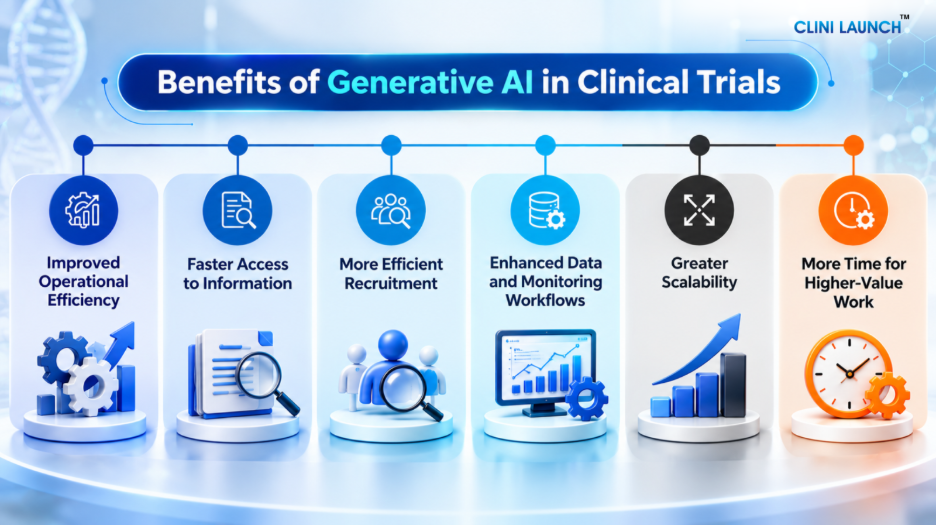
View CourseBenefits of Generative AI in Clinical Trials
Generative AI could improve clinical-trial operations by reducing manual effort, accelerating information-intensive workflows, and helping teams manage growing volumes of research information. Broader AI research, including Generative AI clinical research, also indicates potential gains in efficiency, recruitment, data management, monitoring, and resource utilization, while GenAI adds capabilities for natural-language interaction and content generation, making relevant healthcare career skills increasingly valuable for professionals working alongside these technologies.
- Improved Operational Efficiency
GenAI can reduce time spent on repetitive, information-intensive activities, helping research teams streamline workflows and focus on higher-value responsibilities.
- Faster Access to Information
By summarizing, organizing, and synthesizing complex research information, GenAI can help professionals find and use relevant knowledge more efficiently.
- More Efficient Recruitment
AI has shown potential to improve recruitment processes, while GenAI could complement these systems through personalized communication and accessible study information.
- Enhanced Data and Monitoring Workflows
GenAI can complement AI-enabled data and monitoring systems by helping teams interpret, summarize, and communicate information generated throughout a trial.
- Greater Scalability
As trial complexity and information volumes grow, GenAI could help organizations manage larger workloads without a proportional increase in manual effort.
- More Time for Higher-Value Work
By reducing selected routine workloads, GenAI can allow professionals to focus more on clinical judgment, scientific interpretation, study oversight, and decision-making.
Challenges and Risks of Generative AI Clinical Research
Despite its potential, Generative AI introduces challenges in clinical trials that must be carefully managed before it can be reliably integrated into clinical-trial workflows. Key concerns include model reliability, data privacy, accountability, bias, and data integrity.
1. Model Validation and Reliability
GenAI can generate inaccurate, inconsistent, or difficult-to-explain outputs. In clinical research, these limitations make rigorous validation, testing, documentation, and ongoing performance monitoring essential.
2. Data Privacy and Security
Clinical trials handle sensitive participant and health information. Using this data with GenAI can create privacy and security risks, particularly if identifiable information is exposed or retained. Strong data controls, appropriate de-identification, and secure AI environments are therefore essential.
3. Accountability for AI-Generated Outputs
When GenAI produces clinical, operational, or regulatory content, responsibility for inaccurate outputs must remain clearly defined. Qualified professionals should review and approve AI-generated content before it is used in consequential clinical or regulatory contexts.
4. Bias and Fairness
GenAI models can reproduce or amplify biases within their underlying data. In clinical research, this could affect participant representation, recruitment, and other study processes, potentially reinforcing existing disparities. Bias assessment and mitigation should therefore be incorporated throughout the AI lifecycle.
5. Data Integrity and Traceability
GenAI clinical trials can generate or transform research content, making it important to maintain a clear record of what was generated, how it was modified, and how it was reviewed. Robust documentation and audit trails can help preserve data integrity and accountability.
Regulatory and Governance Considerations for Generative AI
As Generative AI becomes increasingly integrated into clinical research, effective governance is essential to balance innovation with participant safety, data privacy, scientific integrity, and accountability. Regulatory approaches vary across regions, but risk-based oversight, transparency, and human supervision are becoming central to responsible AI governance.
Global Regulatory Landscape
Regulatory approaches to Generative AI vary across jurisdictions, with different levels of emphasis on risk, innovation, security, and government oversight. Global approaches to AI regulation reflect these differences in how governments seek to manage the opportunities and risks of Generative AI.
| Region | Approach | Key Focus |
|---|---|---|
| European Union | Risk-based regulation | Higher-risk AI systems and general-purpose AI models face stronger requirements |
| United States | Evolving, multi-layered oversight | Regulatory guidance, executive measures, voluntary initiatives, and state-level requirements |
| China | Centralized regulation | Algorithm governance, security, and oversight of generative AI |
| International | Emerging global frameworks | Responsible AI, transparency, human rights, and international cooperation |
Key Governance Priorities
For clinical research, regulation needs to address both how AI is used and the capabilities of the underlying AI models. Higher-risk applications require stronger safeguards than lower-risk uses.
Key priorities include:
- Risk-based oversight: Validation and human supervision should reflect the potential impact of each AI application.
- Auditing and validation: Higher-risk systems should undergo rigorous testing and, where appropriate, independent assessment before deployment.
- Continuous monitoring: AI systems should be monitored after deployment to identify performance changes, unexpected outputs, and emerging risks.
- Accountability and transparency: Organizations should document AI use, maintain traceability, and clearly define responsibility for AI-generated outputs.
- Human oversight: Generative AI should support rather than replace qualified clinical and scientific judgment, particularly when outputs could affect participants or study outcomes.
For clinical-trial organizations, these principles translate into stronger controls around privacy, data integrity, bias, validation, traceability, and regulatory compliance. Ultimately, effective governance can help unlock the potential of Generative AI while maintaining the participant protection and scientific rigor expected in clinical research.
Conclusion
Generative AI is poised to become an increasingly important part of clinical research, with the potential to influence how studies are planned, information is handled, and future research is developed. Yet its value will ultimately depend on responsible adoption, not simply on what the technology can do. As GenAI evolves, Healthcare career skills such as clinical expertise, scientific judgment, digital literacy, and the ability to work with emerging technologies will become increasingly valuable alongside appropriate governance and human oversight.
For clinical research professionals, staying prepared means understanding both the foundations of clinical research and the technologies shaping its future. Clinical Research Institute supports this development by helping professionals build relevant knowledge and practical skills for an evolving research environment. By combining clinical expertise with an informed understanding of Generative AI, the industry can move toward a more capable, responsible, and future-ready clinical research ecosystem.
Frequently Asked Questions
1. What is Generative AI in clinical trials?
Generative AI creates and summarizes content, supporting protocol development, patient recruitment, documentation, data management, and safety monitoring.
2. How is Generative AI clinical research transforming trials?
Generative AI clinical research streamlines trial design, informed consent, patient engagement, data management, synthetic data generation, and safety monitoring.
3. What are the benefits of AI clinical trials?
AI clinical trials improve efficiency, accelerate information access, support recruitment, and streamline clinical research workflows when appropriately validated.
4. What are the challenges of GenAI clinical trials?
GenAI clinical trials face challenges involving data privacy, security, bias, reliability, accountability, data integrity, and regulatory compliance.
5. What healthcare career skills are essential for Generative AI?
Healthcare career skills include clinical research knowledge, AI literacy, data analysis, regulatory awareness, critical thinking, and digital proficiency.
6. How can healthcare career skills support responsible AI implementation?
Healthcare career skills such as critical thinking, regulatory awareness, data literacy, and validation knowledge support responsible AI implementation.
7. What healthcare career skills will matter in future clinical research?
Healthcare career skills involving AI literacy, clinical research expertise, data analysis, digital proficiency, and ethical decision-making will remain valuable.