A clinical research portfolio is a collection of academic, mock, or self-directed projects that demonstrate a fresher’s practical understanding of clinical research. It can include clinical trial analysis, protocol review, CRF design, literature reviews, clinical data analysis, and regulatory exercises. A well-organized portfolio helps freshers showcase relevant skills, project work, and practical knowledge when applying for entry-level clinical research jobs.
For students and freshers looking to start a career in clinical research, academic qualifications are increasingly being supported by practical project work. A clinical research portfolio can demonstrate skills in areas such as clinical trial processes, research documentation, data handling, and regulatory concepts before entering the industry.
A strong portfolio can include academic, self-directed, simulated, or mock assignments designed to reflect common clinical research tasks. These clinical research projects for freshers give recruiters concrete examples of a candidate’s skills and practical understanding.
This practical preparation is becoming increasingly relevant as clinical research continues to generate opportunities across roles such as Clinical Research Associate (CRA), Clinical Trial Coordinator, Clinical Data Associate, Pharmacovigilance Associate, and Regulatory Affairs Associate. The scale of clinical trial activity supports this demand: a 2025 analysis of ClinicalTrials.gov data reported 404,637 interventional clinical trials listed as of March 2025, highlighting the sustained activity of clinical research over the last two decades.
This guide explores the key clinical research projects for freshers to include in a portfolio and the skills each project can demonstrate. It also explains how to structure and present these projects effectively to recruiters.
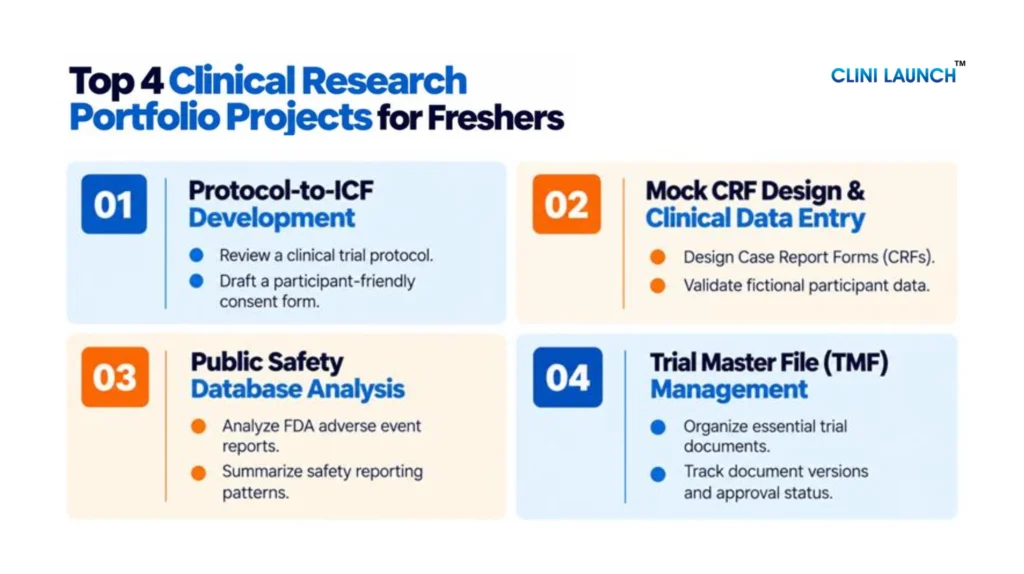
Top 4 Clinical Research Projects for Freshers
Building a clinical research portfolio helps freshers demonstrate their understanding of clinical trial processes beyond theoretical knowledge. These projects allow aspiring clinical research professionals to practice documentation, data handling, safety assessment, and trial management using publicly available information and simulated study scenarios.
1. Protocol-to-Informed Consent Form (ICF) Development
An Informed Consent Form (ICF) explains a clinical trial to potential participants in language they can understand. In this project, you will use a publicly available clinical trial protocol to develop a draft ICF that communicates the study’s purpose, procedures, potential risks, benefits, and participant rights.
What Does the Project Involve?
- Protocol Review: Identify the study objectives, eligibility criteria, procedures, duration, and safety considerations from a public clinical trial protocol.
- ICF Development: Prepare a 3–4-page draft covering the study overview, procedures, potential risks and benefits, participant responsibilities, voluntary participation, and withdrawal rights.
- Patient-Friendly Communication: Translate technical medical terminology into clear, understandable language while maintaining the meaning of the original protocol.
- Privacy and Confidentiality: Explain how participant information may be collected, protected, accessed, and used in accordance with applicable privacy requirements.
- Quality Review: Cross-check the draft against the protocol to ensure consistency and identify any missing or unclear information.
How Does It Help in Interviews?
This project helps you demonstrate your ability to interpret a protocol, communicate clinical information clearly, and understand the informed consent process. It can support interview discussions about participant recruitment, consent documentation, eligibility screening, and the responsibilities of a Clinical Research Coordinator.
Portfolio Deliverable: A draft ICF, a protocol summary, and a checklist showing how the information in the consent form maps to the source protocol.
| What the student needs to do | Resource links |
| Choose a trial with a clearly described study of design, eligibility criteria, and interventions. | ClinicalTrials.gov |
| Download the protocol or supporting documents if publicly available. If unavailable, use the public study record and clearly identify any information gaps. | ClinicalTrials.gov |
| Extract the objectives, participant criteria, procedures, duration, potential risks, and outcomes. | ICH E6 Good Clinical Practice |
| Identify the requirements for informed consent, participant rights, ethics review, and confidentiality. | ICMR Ethical Guidelines, CDSCO Rules |
| Write the study overview, procedures, risks, potential benefits, alternatives where relevant, voluntary participation, withdrawal rights, and contact information. | ICH E6 GCP |
| Replace unnecessary medical jargon with understandable language without changing the scientific meaning. | ICMR Ethical Guidelines |
| Compare each section against the source material and identify unsupported statements or missing details. | Original trial record and protocol; applicable ICH and ICMR guidance |
2. Mock Case Report Form (CRF) Design and Clinical Data Entry
A Case Report Form (CRF) is used to capture study-related information for each participant in a clinical trial. In this project, you will design a mock CRF for a simulated study involving a condition such as Type 2 Diabetes or hypertension and practise entering and reviewing sample data.
| What the student needs to do | Resource links |
| Choose a simulated study involving Type 2 Diabetes, hypertension, or another suitable condition. | ClinicalTrials.gov |
| List the data to collect, such as demographics, medical history, vital signs, and laboratory results. | ClinicalTrials.gov |
| Review how clinical data collection fields are structured and defined. | CDISC CDASH Standards |
| Create forms for screening, baseline assessment, follow-up visits, and relevant safety information. | CDISC |
| Define each field’s name, meaning, data type, units, permitted values, and validation rules. | CDISC Standards |
| Populate the CRF with invented participant IDs and realistic but fictional values. | Microsoft Excel |
| Check for missing fields, inconsistent dates, out-of-range values, and conflicting entries. Document queries rather than silently changing data. | Society for Clinical Data Management |
| Explain how the project maintains traceability, accuracy, and appropriate records of corrections. | ICH E6 GCP |
How Does It Help in Interviews?
This project gives you practical examples to discuss when answering questions about CRF design, EDC systems, data validation, data discrepancies, missing data, and data quality. It also helps you explain how you would identify an issue, document a query, and support accurate clinical trial data management.
Portfolio Deliverable: A mock CRF, a sample dataset containing fictional records, a data dictionary, and a data validation checklist.
3. Public Safety Database Analysis and Adverse Event Assessment
Pharmacovigilance involves monitoring, assessing, and managing information about the safety of medicines. In this project, you will analyse publicly available safety reports from a source such as the FDA Adverse Event Reporting System (FAERS) to identify reported events associated with a selected medicine or drug class.
| What the student needs to do | Resource links |
| Choose a medicine or drug class and define a reporting period for the analysis. | FDA FAERS Public Dashboard |
| Search the dashboard or download relevant public quarterly data files. | FDA FAERS |
| Review available fields, reporting limitations, duplicate reports, and data structure. | FDA FAERS FAQ |
| Learn the difference between an adverse event and a serious adverse event and understand the applicable seriousness criteria. | ICH Efficacy Guidelines |
| Identify duplicate records, missing values, inconsistent fields, and entries that cannot be reliably classified. | FDA FAERS FAQ |
| Calculate report counts and clearly defined proportions; summarise selected reactions using tables or charts. | Microsoft Excel |
| Explain reporting patterns and limitations without claiming that the medicine caused an event or that the results establish incidence. | FDA FAERS |
| Summarise the objective, data source, methods, findings, limitations, and conclusion. | WHO Pharmacovigilance Resources |
How Does It Help in Interviews?
The project helps you demonstrate analytical thinking, attention to detail, and familiarity with pharmacovigilance terminology. You can use it to discuss adverse event reporting, serious adverse events, data cleaning, safety case assessment, and the importance of accurate safety documentation.
An important interview point is that FAERS reports alone cannot establish that a medicine caused an event or determine the incidence of an adverse reaction. Your report should distinguish observed reporting patterns from proven causal relationships.
Portfolio Deliverable: A two-page safety analysis report, summary tables or charts, a data-cleaning log, and a brief explanation of the analysis methodology.
4. Trial Master File (TMF) Essential Documents Management
Career Focus: Clinical Trial Assistant (CTA)
What Is This Project?
A Trial Master File (TMF) contains essential documents that help demonstrate how a clinical trial was conducted and managed in accordance with applicable requirements. In this project, you will build a simulated TMF structure and document-tracking system based on the trial lifecycle and relevant ICH Good Clinical Practice guidance.
| What the student needs to do | Resource links |
| Learn why essential documents are maintained and how they support trial oversight and inspection readiness. | ICH E6 Good Clinical Practice |
| Divide the simulated study into start-up, conduct, and closeout phases. | ICH E6 GCP |
| List relevant protocol versions, ethics approvals, Investigator’s Brochure, investigator qualifications, consent documentation, and delegation records. | ICH E6 GCP CDSCO Rules |
| Organise mock records into logical categories and trial phases. | TransCelerate BioPharma |
| Record document title, category, owner, version, approval status, date, and filing status. | Microsoft Excel |
| Create mock version histories and practise identifying superseded, pending, or incorrectly filed documents. | ICH E6 GCP |
| Identify missing or outstanding records and document follow-up actions. | ICH E6 GCP |
| Summarise total documents, filed records, pending approvals, and outstanding filing items. | Microsoft Excel |
How Does It Help in Interviews?
This project provides practical examples for questions about essential documents, TMF maintenance, document version control, ethics approvals, study start-up, and inspection readiness. It also demonstrates organisational skills and an understanding of the documentation practices required for clinical trial support roles.
Portfolio Deliverable: A simulated TMF folder structure, an essential document checklist, a document-tracking register, and a dashboard showing documentation status.
Note: Use ICH E6(R3) as the reference framework where applicable, and verify local regulatory and institutional requirements. The project is a learning exercise, not an approved TMF or a substitute for site-specific procedures.
Clinical Research Projects: How it Helps Freshers
Clinical research involves much more than knowing terminology. Aspirants must understand protocols, documentation, data quality, participant safety, and regulatory expectations. The current ICH E6(R3) Good Clinical Practice guideline, finalized in 2025, describes GCP as a standard covering activity from trial planning and conduct through recording, analysis, and reporting
This makes a portfolio useful because clinical research projects for freshers give a structured way to demonstrate how they have applied what they learned. It should not be presented as equivalent to professional clinical trial experience; instead, it provides evidence of practical preparation for an entry-level role.
- Bridges the gap between theory and execution: Moving beyond textbook memorization allows you to demonstrate how ICH E6(R3) Good Clinical Practice guidelines translate to real study protocols. This shows hiring managers that you already understand the core principles of quality and risk management, which significantly shortens your operational learning curve once hired.
- Provides concrete talking points for interviews: Instead of relying only on academic degrees, a project gives you and the interviewer technical milestones to discuss. It allows you to answer situational questions using real examples from your project work, proving you can think critically about trial issues.
- Signals regulatory and compliance awareness: Mapping out essential trial documents or submission workflows shows you respect the strict legal boundaries of global trials. Demonstrating that you know how to track protocol deviations or differentiate between AEs and SAEs proves you can be trusted to follow compliance protocols.
- Highlights basic clinical software literacy: Building mock layouts of trial master files (TMF) or data capture flows shows you are familiar with digital workflows. In a tech-driven clinical environment, this baseline digital literacy means employers spend less time teaching you foundational system navigation.
Clinical Research
Build expertise in clinical trial operations, regulatory guidelines, data management, and research methodologies through industry-focused training. This program prepares learners for real-world clinical research workflows including trial management, protocol execution, regulatory compliance, and global research practices.
View CourseConclusion
A clinical research portfolio gives freshers a practical way to show what they can do before gaining formal industry experience. Through well-planned academic, mock, and self-directed projects, you can demonstrate your understanding of clinical trials, documentation, regulatory requirements, and clinical data.
Keep your portfolio simple, honest, and focused. Choose a few relevant projects, explain what you did and learned, and support your work with reliable sources. Most importantly, clearly label simulated or academic projects rather than presenting them as professional experience.
A strong portfolio does not need to be large. A few well-explained projects can help turn your clinical research knowledge into visible proof of practical skills.
Frequently Asked Questions (FAQs)
1. What is a clinical research portfolio?
A clinical research portfolio showcases academic, mock, or self-directed projects demonstrating clinical trial, documentation, data handling, and regulatory knowledge.
2. What clinical research projects are suitable for freshers?
Clinical research projects for freshers include trial analysis, literature reviews, mock protocol development, CRF design, data analysis, and safety assessments.
3. How can I find clinical research project ideas?
Explore clinical research project ideas through ClinicalTrials.gov, published research papers, public databases, and common clinical research workflows.
4. Do clinical research projects need to be based on real clinical trials?
No. Clinical research projects can use public trial data or simulated scenarios, clearly labelled as academic or mock work.
5. How many projects should I include in a clinical research portfolio?
Include three to five well-developed projects that demonstrate different skills and that you can confidently explain during interviews.
6. What should I include in a portfolio for clinical research jobs?
A portfolio for clinical research jobs should include project objectives, methods, outputs, key learnings, relevant skills, and source references.