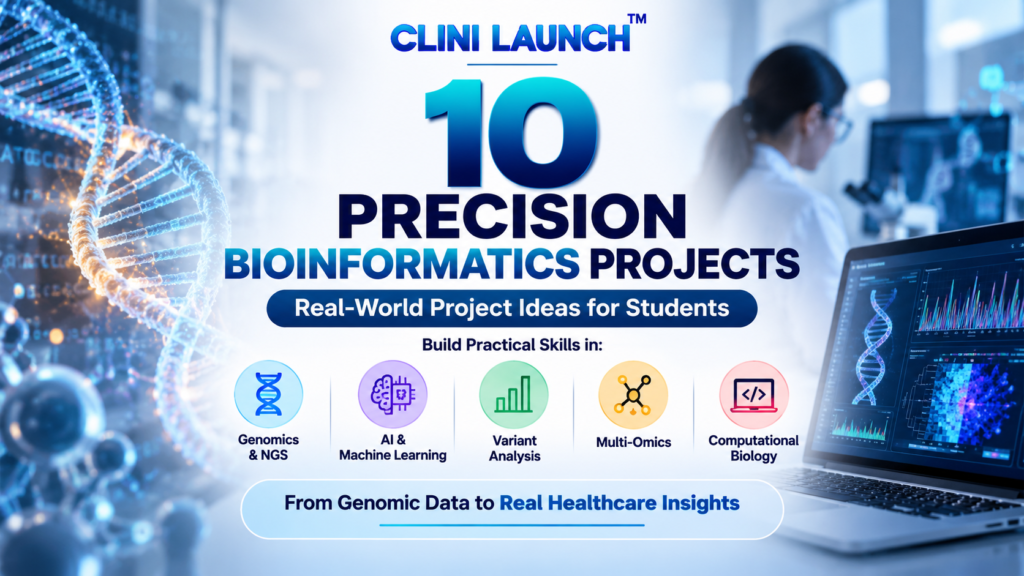
Precision bioinformatics projects combine genomics, artificial intelligence, and computational biology to transform complex biological data into meaningful healthcare insights. These real-world projects cover genomic data analysis, NGS workflows, variant interpretation, and precision medicine applications, helping learners build practical skills for modern life science research.
The first human genome draft cost roughly $300 million. By late 2015, a high-quality genome cost under $1,500. Sequencing got cheap. So why do tumours still get misjudged and rare variants still go unexplained?
Reading DNA is not the same as understanding it. Precision bioinformatics bridges this gap by transforming raw genomic data into meaningful insights about diseases, patients, and outbreaks.
Recruiters know this. They skim past another textbook BLAST run and stop at work that dares to interpret. Whether you want bioinformatics project ideas for a thesis or genomics projects for students who have outgrown tutorials, these ten projects, built on open genomic datasets and real clinical questions, show you where to begin.
Why Precision Bioinformatics Projects Matter Right Now
Precision medicine means the right therapy for the right patient. Computation makes that promise workable. And the raw material has never been more accessible:
- 4.5 million+ unique variation records sit in NCBI’s ClinVar, with over 4.27 million carrying clinical classifications.
- 200 million+ predicted protein structures live in the AlphaFold Database, against roughly 190,000 experimentally solved ones.
- 8,314 tumour samples across 32 cancer types are packaged in the MLOmics benchmark for machine learning.
A decade ago, genomic data was limited to large research teams. Today, it is accessible to anyone with curiosity, dedication, and the ability to transform data into discoveries.
One rule before you begin: pick a question, not a tool. “Which mutations distort this protein interface?” is a question. “Use a GNN” is a résumé fragment.
Reviewers can tell the difference.
10 Genomics Projects for Students at a Glance
| Sl. No. | Project | Core Data | Signature Skill |
| 1 | Multi-omics drug repurposing | MLOmics, STRING | Graph neural networks |
| 2 | Spatial deconvolution | GEO, Visium | Graph attention |
| 3 | Variant-to-function mapping | ClinVar, AlphaFold DB | Geometric deep learning |
| 4 | In silico perturbation | Geneformer | Foundation models |
| 5 | cfDNA fragmentomics | SRA, EGA | Feature engineering |
| 6 | De novo binder design | RCSB PDB | Generative biology |
| 7 | CRISPR off-target API | GRCh38 | Software engineering |
| 8 | Cryo-EM heterogeneity | EMPIAR | Variational autoencoders |
| 9 | Spatial multi-omics alignment | HuBMAP | Optimal transport |
| 10 | Wastewater surveillance | SRA | Workflow engineering |
Bioinformatics Projects for Beginners and Beyond: Where Should You Start?
Match ambition to your current stack, then stretch one notch.
- Starting out: Projects 10 and 2 reward Linux, Python and patience more than deep-learning theory. They are natural bioinformatics projects for beginners.
- Comfortable with Python and ML: Projects 1, 3, 5 and 7 balance modelling with engineering.
- Ready for research-grade difficulty: Projects 4, 6, 8 and 9 demand GPU access and a firm mathematical footing.
Treat this ladder as a suggestion, not a rule. Curiosity beats prerequisites, and a finished modest project always outshines an abandoned ambitious one.
Precision Informatics Course
Build advanced skills in bioinformatics, genomic data analysis, NGS workflows, precision medicine, computational biology, and AI-driven healthcare research.
View Course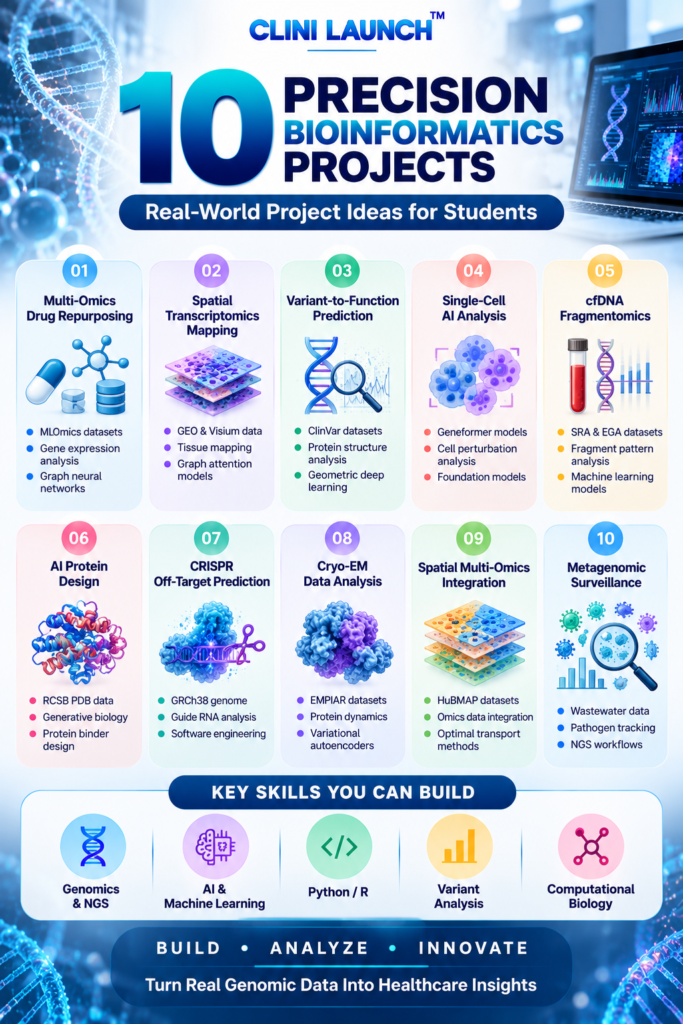
10 Bioinformatics Project Ideas Built on Real Genomic Datasets
Here are 10 research-driven bioinformatics projects based on real-world genomic datasets.
1. Multi-Omics Graph Integration for Drug Repurposing
Cancer involves changes across multiple molecular layers. This project combines gene expression, methylation, and copy-number data to identify patterns linked to cancer outcomes.
Steps to Build it:
- Get data: Download MLOmics from Hugging Face and select cancer multi-omics data.
- Prepare data: Match sample IDs and preprocess expression, methylation, and copy-number data.
- Build network: Use STRING API to create gene interaction networks.
- Train model: Build a GCN with PyTorch Geometric using multi-omics features.
- Interpret results: Use SHAP to identify important genes and features.
- Explore drug links: Map key genes to potential drug targets.
Project Output: An integrated multi-omics graph, trained GCN model, key molecular features, and potential drug-target candidates.
Why it lands: It demonstrates multi-omics integration, graph machine learning, model interpretability, and drug-target analysis in one project.
2. Spatial Transcriptomics Deconvolution with Graph Attention
Visium spots capture several cells at once. Single-cell RNA-seq reads individual cells but forgets where they lived. This project marries the two.
Steps to Build it:
- Get the data: Download paired scRNA-seq and Visium spatial datasets from NCBI GEO.
- Prepare the data: Use Scanpy to perform quality control, normalization, and basic preprocessing.
- Map the tissue: Represent spatial spots as nodes, connecting nearby spots based on physical distance.
- Build the model: Use a Graph Attention Network (GAT) to learn relationships between neighbouring spots.
- Predict cell types: Use the scRNA-seq data as a reference to estimate cell-type proportions in each spatial spot.
- Visualize results: Map predicted cell types back onto the tissue image to assess their spatial distribution.
Project Output: A spatial tissue map showing the predicted cell-type composition of individual spots.
Why it lands: It combines single-cell analysis, spatial transcriptomics, graph neural networks, and biological visualization in one project.
3. Variant Analysis: Variant-to-Function Mapping with Geometric Deep Learning
GWAS reveals which variants travel with disease. It rarely explains how they break a protein. This variant analysis project answers the “how.”
Steps to Build it:
- Get the data: Download pathogenic and benign missense variants from ClinVar.
- Get structures: Find the corresponding protein structures in the AlphaFold Database.
- Create 3D graphs: Use Graphein to represent protein structures as graphs.
- Build the model: Train a SchNet-style model using structural and electrostatic features around the variant sites.
- Compare variants: Analyze how pathogenic and benign variants differ in their predicted structural or functional effects.
- Validate results: Where experimental structures are available, compare them with AlphaFold predictions and report pLDDT confidence scores.
Project Output: A model that links genetic variants to predicted changes in protein structure and function.
Why it lands: It combines variant analysis, protein structure, 3D graph modelling, and deep learning in a precision bioinformatics workflow.
4. Zero-Shot Mutation Effect Prediction with Single-Cell Language Models
Foundation models learn patterns in gene regulation. Geneformer was pretrained on about 29.9 million human single-cell transcriptomes from 561 datasets.
Steps to Build it:
- Get the model: Load the pretrained Geneformer model from Hugging Face.
- Choose the data: Select exhausted T-cell profiles from a compatible single-cell dataset.
- Simulate a mutation: Remove a gene token such as PDCD1 from the cell profile.
- Run the model: Generate the cell representation before and after the simulated perturbation.
- Measure the change: Use Earth Mover’s Distance (EMD) to quantify the shift in cell state.
- Interpret the result: Compare the simulated changes to identify genes or pathways potentially affected by the perturbation.
Project Output: A computational estimate of how a gene perturbation may alter a single-cell state.
Why it lands: It combines single-cell foundation models, in-silico perturbation, and drug-target research. Document the Geneformer version used.
5. cfDNA Fragmentomics for Early Cancer Detection
Early tumours shed very little DNA into blood, so mutation hunting struggles. Fragmentomics changes the question. Instead of asking what mutated, ask how the fragments look. Cancer-derived cfDNA tends to be shorter by about 3–6 bases and more variable in length.
The evidence is real. A landmark study sequenced cfDNA from 208 cancer patients at just 1–2× coverage and detected 152 of them, a 73% sensitivity.
Steps to Build it:
- Get the data: Start with a public SRA cfDNA dataset containing cancer and control samples.
- Extract features: Use pysam to calculate fragment lengths, 5′ end motifs, and protection scores.
- Train the model: Use LightGBM to classify early-stage cancer and control samples.
- Evaluate results: Measure performance using AUROC, sensitivity, and specificity.
- Interpret features: Identify the fragmentomic patterns contributing most to predictions.
Project Output: A machine-learning model that uses cfDNA fragment patterns to distinguish cancer from controls.
Why it lands: EGA datasets may require controlled access, so SRA is a practical starting point.
6. Generative De Novo Protein Binder Design
Screening millions of molecules is a complex process. Generative biology takes a creative approach by designing proteins that naturally fit the target’s unique structure.
Steps to Build it:
- Choose the target: Select a cancer-relevant target such as PD–L1 from the RCSB Protein Data Bank.
- Generate structures: Use RFdiffusion to generate candidate protein backbones.
- Design sequences: Apply ProteinMPNN to generate sequences for the designed backbones.
- Screen designs: Use AlphaFold to assess predicted structure, pLDDT, and interface confidence.
- Rank candidates: Select promising designs based on structural and interface metrics.
Project Output: A ranked set of computationally designed protein binders for the selected target.
Why it lands: It demonstrates generative protein design, structural prediction, and computational drug discovery while highlighting the practical use of AI in bioinformatics.
7. A Production-Ready CRISPR Off-Target Service
A guide RNA that cuts the wrong place can sink a therapy. Software that scores that risk is real infrastructure.
Steps to Build it:
- Prepare the genome: Index the GRCh38 reference genome.
- Find targets: Use Bowtie2 to identify potential guide-matching sites.
- Score risk: Apply a mismatch-based scoring method that considers the distance from the PAM.
- Build the API: Use FastAPI to expose the scoring workflow as an endpoint.
- Test the service: Return results in JSON and measure response time and accuracy.
Project Output: A functional API that accepts guide sequences and returns ranked potential off-target sites.
Why it lands: It combines CRISPR analysis, bioinformatics pipelines, API development, and software testing in an industry-style project.
8. Cryo-EM Heterogeneity with Manifold Learning
Classical cryo-EM averages thousands of noisy projections into one static structure. Proteins, however, move. This project recovers the motion.
Steps to Build it:
- Get the data: Download a suitable particle dataset from EMPIAR.
- Preprocess: Use CryoSPARC to clean and prepare the particle stacks.
- Train the model: Build a Variational Autoencoder (VAE) using the processed particles.
- Explore the latent space: Identify patterns representing different protein conformations.
- Reconstruct structures: Use the decoder to generate corresponding 3D density volumes.
Project Output: A latent representation and 3D density maps showing different protein conformations.
Why it lands: It demonstrates cryo-EM data processing, dimensionality reduction, deep learning, and 3D structural analysis.
Mind this: Particle stacks are enormous. Begin with a small entry and scale up only after your pipeline behaves.
9. Spatial Multi-Omics Alignment with Optimal Transport
Spatial RNA shows where changes happen. Single-cell proteomics reveals the proteins involved. Together, they provide a more complete biological picture.
Steps to Build it:
- Get the data: Download adjacent tissue sections from HuBMAP with Xenium RNA and CODEX protein data.
- Prepare the data: Organize spatial coordinates and molecular features from both datasets.
- Align the data: Use the POT library to implement Fused Gromov-Wasserstein optimal transport.
- Match features: Balance spatial distance with RNA and protein similarity to identify corresponding regions.
- Visualize results: Plot the aligned tissue sections and inspect matched spatial regions.
Project Output: An aligned spatial map connecting RNA and protein patterns across tissue sections.
Why it lands: It combines spatial multi-omics, optimal transport, computational biology, and data visualization in one project.
10. Metagenomic Bio-Surveillance for Wastewater
Wastewater surveillance tracks community pathogen trends. CDC monitors about 1,500 wastewater sampling sites, with results available within 5–7 days. Human reads should be removed early.
Steps to Build it:
- Get the data: Download a suitable wastewater metagenomic dataset from SRA.
- Build the pipeline: Use Nextflow to automate the analysis workflow.
- Remove host reads: Use Kraken2 to filter human reads before downstream analysis.
- Estimate lineages: Apply Freyja to estimate pathogen lineage abundances.
- Track trends: Store results in PostgreSQL and create a dashboard to visualize changes.
Project Output: An automated pipeline and dashboard for tracking pathogen lineage trends in wastewater.
Why it lands: It combines metagenomics, NGS workflow development, pathogen surveillance, and data engineering in a deployable project.
How to Make Your Precision Bioinformatics Projects Portfolio-Ready
Completing a project is only the beginning. Reviewers look beyond execution and value how carefully you validate results. Small engineering practices reflect research maturity.
| Component | Weak | Strong |
| Code | Notebook only | Modular scripts, public GitHub repo, clear README |
| Validation | Random 80/20 split | Grouped or nested cross-validation by patient or batch |
| Environment | Manual installs | Docker or Singularity containers |
| Workflow | Loose Bash scripts | Snakemake or Nextflow |
Why does validation matter?
A random split can make a model appear stronger by learning hidden patterns from the same patient or dataset batch. Grouped validation provides a more realistic test and separates a working demo from reliable research.
Share your work on GitHub with a clear README covering the question, dataset, approach, results, and limitations. A recruiter may only spend a few minutes reviewing your project, so make every detail count.
Conclusion
Precision medicine needs people who can connect biology with technology. These projects show that the opportunity is within reach. The datasets are open, tools are available, and real-world questions remain.
Start small. Build, test, learn from failures, and improve with every step. Your first project is where the journey begins.
Ready to build these skills with structured guidance? Explore CliniLaunch’s Professional Program in Precision Informatics Course and turn one project into a career
Frequently Asked Questions (FAQs):
1. What skills are needed to work on precision bioinformatics projects?
Precision bioinformatics projects require skills in genomics, Python/R programming, data analysis, statistics, and biological databases. Basic knowledge of NGS and computational biology can help beginners start effectively.
2. Can beginners work on bioinformatics projects without prior research experience?
Yes, beginners can start with bioinformatics projects using public genomic datasets. Learning sequence analysis, basic coding, and biological concepts gradually helps build confidence.
3. Where can I find genomic datasets for bioinformatics projects?
Researchers and learners can access genomic datasets from platforms like NCBI, GEO, SRA, TCGA, and ClinVar for practicing genomic data analysis and research workflows.
4. How are precision bioinformatics projects different from traditional bioinformatics projects?
Precision bioinformatics projects focus on individual-level insights using genomic, clinical, and molecular data, while traditional projects often involve broader biological analysis.
5. Are bioinformatics projects useful for building a career in precision medicine?
Yes, practical bioinformatics projects help develop skills required in precision medicine, including variant analysis, genomic interpretation, biomarker discovery, and computational research.
6. Which programming languages are commonly used in bioinformatics projects?
Python and R are widely used for genomic data analysis, automation, statistical modelling, visualization, and machine learning applications in bioinformatics.
7. What are some beginner-friendly bioinformatics project ideas?
Beginners can explore projects involving sequence analysis, gene expression analysis, microbial identification, or basic NGS data processing before moving to advanced workflows.
8. How do NGS projects help in understanding modern healthcare research?
NGS projects allow learners to analyze genetic information, identify variations, study disease mechanisms, and understand how sequencing supports precision healthcare.
9. Can bioinformatics projects be completed using publicly available tools?
Yes, many bioinformatics projects can be developed using open-source tools, research databases, and freely available computational resources.
10. How can I showcase my precision bioinformatics projects professionally?
Create a portfolio with clear objectives, datasets, methodology, results, validation steps, and documented code to demonstrate practical research skills.