Precision bioinformatics and traditional bioinformatics differ in their approach to biological data analysis: traditional bioinformatics focuses on identifying broad patterns from large datasets, while precision bioinformatics uses individual genomic, multi-omics, and clinical data to generate personalized healthcare insights. Traditional bioinformatics builds the foundation for biological discovery through sequence analysis, genome studies, and research applications, whereas precision bioinformatics applies advanced analytics and AI to support targeted diagnosis, treatment selection, and personalized medicine.
Imagine the human body’s genetic code as a massive, chaotic library with billions of books. In layman’s terms, Bioinformatics is the science of building the digital catalog for this library. It uses computers and software to organize, sort, and identify broad patterns across massive biological datasets. On the other hand, Precision Bioinformatics is the process of analyzing an individual’s unique genetic information to identify specific biological changes that can support targeted, personalized treatment decisions. Sounds confusing? Let us break down precision bioinformatics vs bioinformatics in terms of features, applications, and use cases to give you better clarity.
Bioinformatics primarily uses computational tools, algorithms, and biological databases to organize and analyze large-scale biological datasets, helping identify patterns and relationships. Precision bioinformatics uses advanced approaches such as AI, machine learning, multi-omics analysis, and clinical data integration to generate personalized insights for individual patients.
This difference between precision bioinformatics vs bioinformatics goes beyond the tools they use; it lies in how biological data is interpreted and applied. While bioinformatics focuses on uncovering broad biological patterns, precision bioinformatics aims to generate insights specific to individual health profiles.
Cancer Research: Moving from Bioinformatics to Precision Bioinformatics
Understanding Cancer at Scale:
Large-scale projects like The Cancer Genome Atlas (TCGA) used bioinformatics to analyze thousands of tumor samples and identify common genetic mutations.
The Shift from Data to Decisions:
Researchers moved beyond mapping cancer-related changes to understanding which specific genetic alterations could influence patient outcomes.
Personalized Treatment Insights:
Precision bioinformatics combines genomic data, AI, and clinical information to identify patient-specific molecular patterns and support targeted treatment strategies.
What is Traditional Bioinformatics?
Traditional bioinformatics refers to the use of computational methods to collect, store, organize, compare, and analyze biological data. The National Center for Biotechnology Information (NCBI) defines bioinformatics as the application of computational approaches to biological datasets to support biological discoveries and predictions.
A major focus of traditional bioinformatics has been identifying general biological patterns across large datasets, such as comparing DNA sequences, studying gene functions, analyzing genetic variation, and reconstructing evolutionary relationships. Techniques such as sequence alignment remain fundamental to this approach because they help identify similarities between DNA, RNA, or protein sequences and reveal potential functional or evolutionary relationships.
Traditional workflows also commonly use a reference genome as a framework for analyzing sequencing data.
Key Characteristics of Traditional Bioinformatics
- Reference-based: Data is often analyzed against established reference genomes or databases.
- Cohort-oriented: The emphasis is commonly on patterns across populations, groups, or experimental datasets rather than a single patient’s complete clinical context.
- Pattern-focused: It helps identify conserved sequences, genetic variants, evolutionary relationships, and biological mechanisms.
- Research-driven: Its applications include sequence alignment, phylogenetics, genome annotation, population genetics, and disease-marker discovery.
Large population projects demonstrate this approach clearly. The 1000 Genomes Project, completed in 2015, analyzed 2,504 individuals across 26 populations and catalogued more than 88 million genetic variants, creating a widely used reference resource for studying human genetic variation. The project captured more than 99% of SNP variants occurring at frequencies above 1% across the sampled ancestries.
What is Precision Bioinformatics?
Precision bioinformatics is an advanced approach that applies computational methods to analyze an individual’s genomic, molecular, and clinical data to identify patient-specific biological insights. Unlike traditional bioinformatics, which primarily studies patterns across large datasets and reference genomes, precision bioinformatics focuses on understanding unique genetic variations and disease characteristics that can support personalized healthcare decisions.
It integrates genomic information with multi-omics data such as transcriptomics, proteomics, and metabolomics, along with clinical records, to create a more comprehensive view of disease biology. This enables researchers and healthcare professionals to identify biomarkers, predict treatment responses, and develop more targeted diagnostic and therapeutic strategies.
Key Characteristics of Precision Bioinformatics
- Individualized genomic analysis: Examines rare variants, inherited mutations, and disease-specific molecular changes unique to an individual or condition.
- Multi-omics integration: Combines genomics, transcriptomics, proteomics, metabolomics, and clinical data for deeper biological understanding.
- AI-driven prediction: Uses artificial intelligence and machine learning to identify patterns and predict outcomes such as disease progression or treatment response.
- Clinically focused: Translates complex molecular data into actionable insights for personalized healthcare decisions.
A 2020 review published in Nature Reviews Genetics highlighted that multi-omics integration can improve biological understanding by connecting molecular changes across different levels of cellular regulation.
Precision Bioinformatics Vs Bioinformatics: Key Differences at a Glance
Traditional bioinformatics and precision bioinformatics differ mainly in their data focus, analytical approach, and intended outcomes. While traditional bioinformatics focuses on discovering broad biological patterns, precision bioinformatics applies computational analysis to generate insights specific to an individual or a defined patient group.
| Feature | Traditional Bioinformatics | Precision Bioinformatics |
| Primary Focus | Population-level biological patterns | Individual patient-specific insights |
| Data Scale | Large datasets from populations, cohorts, and research studies | Individual genomic, molecular, and clinical datasets |
| Reference Used | Reference genomes and biological databases | Patient-specific genomic profiles and disease signatures |
| Data Type | Mainly genomic sequences and single-layer biological data | Multi-omics data (genomics, transcriptomics, proteomics, metabolomics) with clinical data |
| Analysis Approach | Sequence alignment, annotation, statistical analysis, and pattern identification | AI/ML models, predictive analytics, and advanced variant interpretation |
| Key Question Answered | “What patterns exist across biological datasets?” | “What does this specific biological profile mean for this patient?” |
| Primary Application | Genome research, evolution studies, biomarker discovery | Cancer profiling, rare disease diagnosis, pharmacogenomics, targeted therapies |
| Outcome | Generates biological knowledge and research insights | Generates actionable insights for personalized healthcare |
Real-World Applications of Bioinformatics and Precision Bioinformatics
Traditional bioinformatics supports large-scale biological research by analyzing complex datasets to identify patterns, understand biological mechanisms, and build foundational resources for scientific discovery.
Bioinformatics Applications
1. Drug Target Identification
Traditional bioinformatics helps researchers analyze genomic and biological databases to identify disease-related genes, proteins, and molecular pathways that may serve as potential drug targets.
2. Evolutionary and Pathogen Tracking
By comparing genomic sequences, bioinformatics helps scientists study genetic mutations, track pathogen evolution, and understand how infectious diseases spread across populations. It uses sequencing data, variant analysis, and phylogenetic methods to identify pathogen changes and trace transmission patterns. For example, the CDC uses microbial bioinformatics approaches to analyze genomic data and support pathogen surveillance during infectious disease outbreaks.
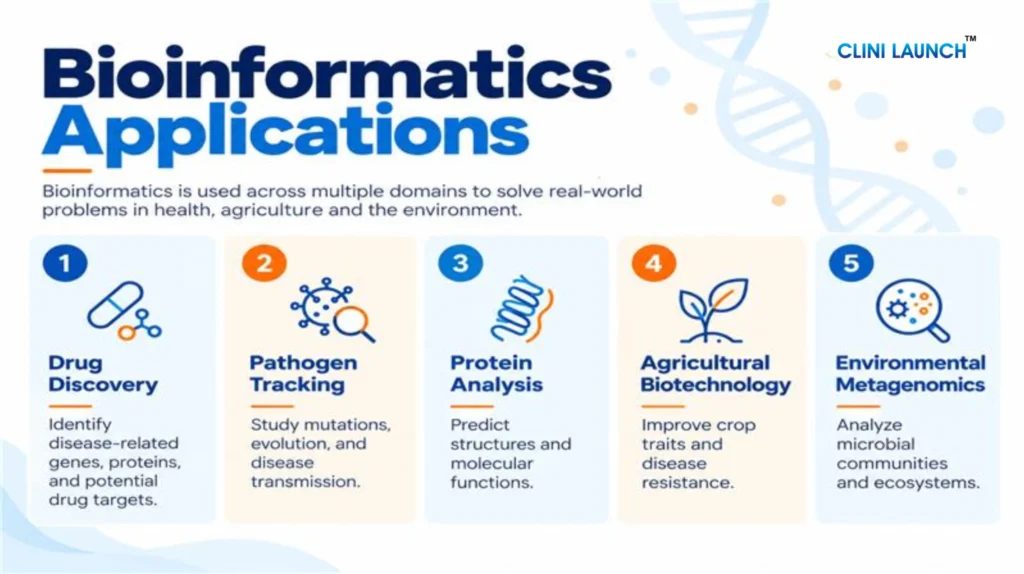
3. Structural Biology and Protein Analysis
Bioinformatics tools help predict protein structures, analyze molecular interactions, and understand how proteins function based on their genetic information. The European Bioinformatics Institute (EMBL-EBI) stands as a world-renowned authority driving these specific structural biology breakthroughs. The institute is famously known for co-hosting the groundbreaking AlphaFold Protein Structure Database alongside Google DeepMind to map structural variants globally.
4. Agricultural Biotechnology
Bioinformatics is used to analyze plant and animal genomes, helping researchers identify genetic traits linked to crop improvement, disease resistance, and livestock development. For example, large-scale projects supported by the USDA Agricultural Research Service (ARS) actively run cross-commodity bioinformatics workflows to isolate climate-resilience genes. These specialized informatics pipelines allow molecular breeders to identify vital markers for drought tolerance and crop pathogens without introducing foreign DNA into the crops.
5. Environmental Metagenomics
Bioinformatics enables the analysis of genetic material collected from environmental samples such as soil, water, and air to study microbial communities and ecosystem changes. A prominent real-world example is the Earth Microbiome Project, a massive global open-science initiative that uses standardized bioinformatics pipelines to map planetary microbial diversity. By analyzing tens of thousands of environmental samples simultaneously, researchers can track critical shifts in soil health, monitor ocean pollution, and forecast ecosystem responses to climate change.
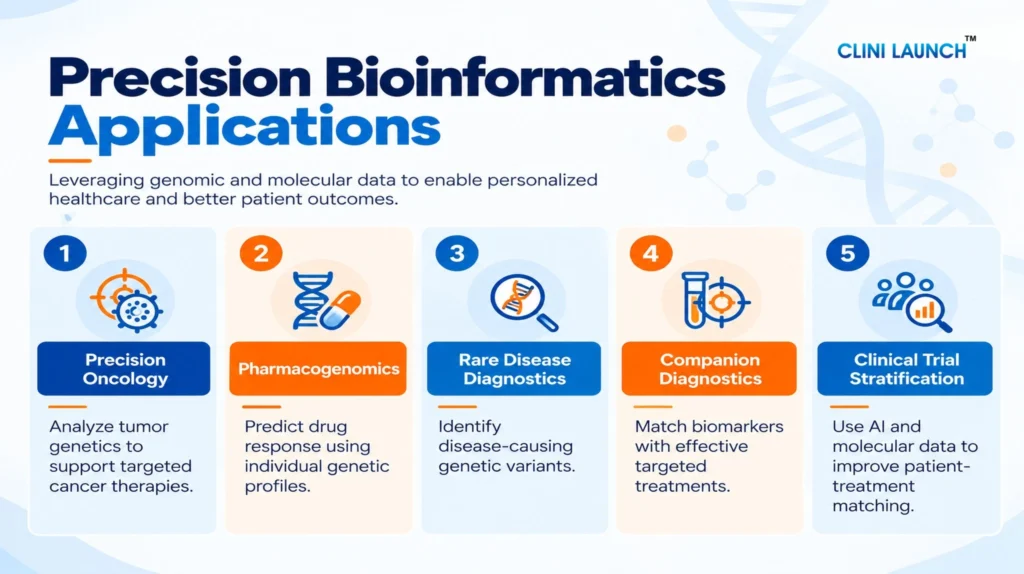
Precision Bioinformatics Applications
- Precision Oncology (Cancer Diagnostics)
Precision oncology analyzes patient tumor biopsies to match unique genetic mutations with targeted therapies. A notable example is the FDA-authorized MSK-IMPACT clinical sequencing test developed by the Memorial Sloan Kettering Cancer Center. For more details, visit Memorial Sloan Kettering Cancer Center.
- Pharmacogenomics
Screening a patient’s individual DNA before prescribing a drug to predict precisely how they will metabolize it, preventing life-threatening toxicities.
A prime clinical example is the Mayo Clinic RIGHT 10K Study, which pioneered preemptive, sequence-based pharmacogenomic screening. By sequencing the DNA of over 10,000 participants, researchers deposited genetic drug-response profiles directly into patients’ electronic health records.
- Rare Disease Diagnostics
Precision bioinformatics helps analyze patient-specific genetic variants by comparing sequencing data with clinical databases to identify disease-causing mutations. For example, the NIH ClinGen Initiative provides a curated knowledgebase that helps researchers and clinicians interpret the clinical significance of genes and genetic variants in precision medicine.
- Companion Diagnostics Development
Precision bioinformatics helps identify genetic markers that determine how patients respond to specific treatments, enabling more targeted therapies.
For example, companion diagnostics such as the HercepTest help identify HER2-positive breast cancer patients who may benefit from Herceptin (trastuzumab), demonstrating the role of precision approaches in targeted treatment selection.
- Clinical Trial Stratification
Precision bioinformatics uses AI and molecular profiling to group patients based on biological characteristics, helping match them with suitable therapies in clinical trials.
For example, the I-SPY 2 Trial uses biomarker analysis and predictive models to match breast cancer patients with experimental treatments based on their tumor profiles.
Precision Bioinformatics
Gain industry-ready skills to secure real-world systems. Learn ethical hacking, network defense, and threat detection with a strong focus on hands-on labs, compliance, and globally recognized certification standards.
View CourseConclusion
As biological research and healthcare continue to become more data-driven, expertise in computational biology is becoming increasingly valuable across life sciences, biotechnology, and healthcare industries. Building skills in bioinformatics and precision bioinformatics can help professionals understand complex biological datasets and contribute to emerging areas such as genomic research and advanced healthcare solutions.
At CliniLaunch Research Institute, learners can develop industry-relevant expertise through specialized Bioinformatics and Precision Bioinformatics courses designed to strengthen knowledge of biological data analysis, computational tools, and modern research approaches. With practical learning, expert guidance, and career-focused training, these programs help aspiring professionals prepare for opportunities in the evolving life sciences landscape.
Frequently Asked Questions
1. What is precision bioinformatics?
Precision bioinformatics combines genomic, clinical, and multi-omics data with computational methods to enable personalized healthcare insights.
2. What is the difference between precision bioinformatics and traditional bioinformatics?
Traditional bioinformatics studies broad biological patterns, while precision bioinformatics analyzes individual-level data for personalized healthcare decisions.
3. How does precision bioinformatics support precision medicine?
Precision medicine bioinformatics analyzes genetic and molecular data to predict treatment response and support targeted therapies.
4. What are the applications of precision bioinformatics?
Applications include cancer genomics, rare disease diagnosis, pharmacogenomics, biomarker discovery, and AI-based disease risk prediction.
5. How is advanced bioinformatics different from traditional bioinformatics?
Advanced bioinformatics uses AI, machine learning, and multi-omics approaches for complex biological data analysis.
6. What skills are required to learn precision bioinformatics?
Key skills include genomics, NGS analysis, programming, multi-omics, machine learning, and clinical data interpretation.
7. Who can pursue a precision bioinformatics course?
Life science, biotechnology, healthcare, pharmacy, and bioinformatics professionals can pursue precision bioinformatics courses.
8. What is the future scope of precision bioinformatics?
Precision bioinformatics has growing opportunities in genomic medicine, drug discovery, clinical research, and personalized healthcare.