AI in medical imaging uses artificial intelligence, machine learning, and deep learning to analyze X-rays, CT scans, and MRIs. It helps detect abnormalities, improve diagnostic accuracy, streamline radiology workflows, enhance image quality, and support early disease detection. It also creates career opportunities in medical data science, machine learning engineering, and healthcare AI integration.
When René Laënnec introduced the wooden stethoscope in 1816, it transformed how doctors examined patients. Today, AI in medical imaging is reshaping diagnosis through a new kind of diagnostic lens: neural networks. Between 1995 and 2025, radiology accounted for 76% of the 1,430 AI and machine learning medical devices cleared by the US FDA, highlighting its dominance in clinical AI adoption. Rather than replacing doctors, AI acts as a tireless assistant, helping flag subtle abnormalities, prioritize urgent scans, and reduce the risk of findings being overlooked during demanding clinical workloads. By combining computational speed with human medical expertise, it is changing how healthcare professionals interpret images and make diagnostic decisions.
Artificial intelligence medical imaging is making hospitals more efficient, with studies showing that AI can reduce scan report turnaround times by up to 26% in busy clinical settings. Beyond streamlining radiology workflows, AI healthcare imaging is also advancing surgical precision. In September 2026, researchers introduced a technique that matches existing 3D scans with live 2D X-rays in seconds, potentially making minimally invasive surgeries safer and more precise. These developments highlight how AI is expanding its role across medical imaging, from interpreting scans to supporting complex clinical procedures. In this blog, we will explore the key applications of AI in medical imaging, its benefits for healthcare professionals and patients, and the steps involved in implementing these technologies in clinical settings.
What Is AI in Medical Imaging?
Artificial intelligence medical imaging refers to the use of advanced computer systems to analyze medical scans, recognize complex visual patterns, and assist healthcare professionals in making faster and more informed diagnostic decisions. By processing large volumes of imaging data, AI helps identify potential abnormalities, assess anatomical structures, and support clinical interpretation.
The core technologies powering artificial intelligence medical imaging include:
- Convolutional Neural Networks (CNNs): Deep learning models that identify patterns, textures, and anatomical structures in medical images.
- Computer Vision and Pixel/Voxel Analysis: Processes pixels in X-rays and voxels in CT and MRI scans to detect potential abnormalities.
- Natural Language Processing (NLP): Combines imaging findings with clinical notes, previous radiology reports, and patient histories for better context.
- Generative AI and Synthetic Data: Enhances image quality, reduces noise, and supports faster image reconstruction in CT and MRI.
Together, these technologies help healthcare professionals identify suspicious abnormalities, prioritize urgent cases, and improve imaging workflows. AI supports clinical decision-making but does not replace professional medical judgment.
Top 3 Benefits of Artificial Intelligence in Medical Imaging
Artificial intelligence is transforming medical imaging by helping healthcare professionals interpret scans more efficiently, identify potential abnormalities, and manage increasing diagnostic workloads. Its applications support clinical decision-making while improving the consistency and speed of image analysis.
- Improved Diagnostic Accuracy and Reduced Human Error: AI algorithms analyze medical images to identify patterns associated with diseases, abnormalities, and structural changes. They can highlight suspicious regions that require closer examination, helping radiologists make more informed diagnostic decisions. By providing consistent image analysis, AI healthcare imaging can reduce the likelihood of overlooked findings and support more reliable interpretations. However, diagnostic accuracy still depends on image quality, model performance, and clinical validation.
- Faster Workflows and Reduced Radiologist Burnout: AI automates repetitive tasks such as image segmentation, preliminary analysis, and the prioritization of urgent scans. This helps radiologists manage large imaging workloads and focus their attention on complex cases that require detailed clinical assessment. Automated reporting support can also reduce administrative demands and improve workflow efficiency. By streamlining routine processes, AI healthcare imaging may help alleviate workload-related pressure on radiology teams.
- Early Detection of Subtle Abnormalities: AI systems can identify small lesions, faint structural changes, and complex imaging patterns that may be difficult to recognize during routine visual assessment. These capabilities are particularly valuable in applications such as cancer screening, lung nodule detection, and neurological imaging. By flagging suspicious findings for further review, AI can support earlier investigation and timely clinical intervention. However, AI findings require appropriate professional interpretation and do not guarantee early or accurate detection in every case.
AI Applications in Medical Imaging
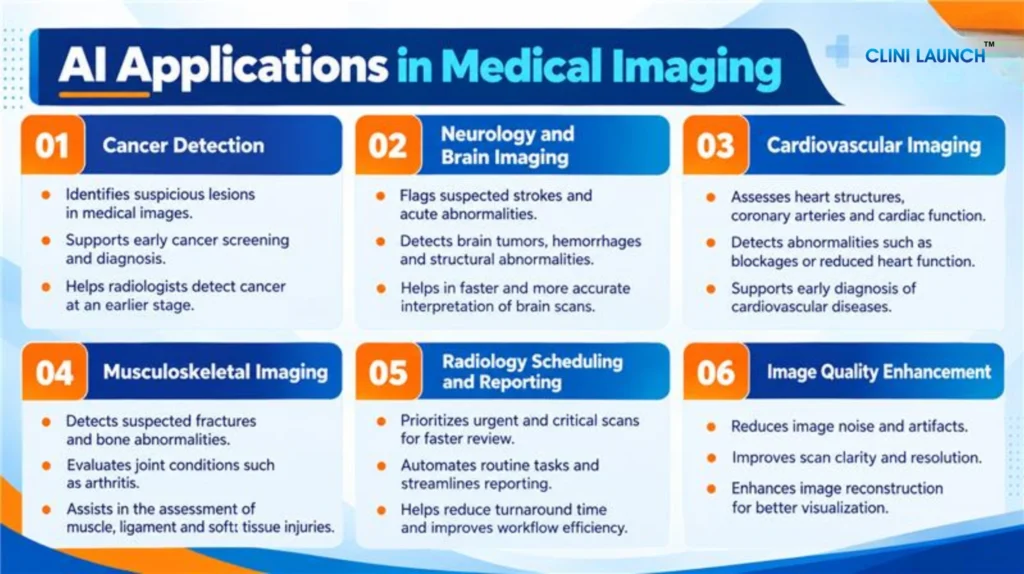
Artificial intelligence is being applied across multiple medical specialties to analyze scans, identify abnormalities, and support clinical decision-making. These applications help healthcare professionals interpret complex imaging data, streamline diagnostic workflows, and assess potential health conditions more efficiently.
- Cancer Detection and Oncology: AI algorithms analyze mammograms, CT scans, and other medical images to identify suspicious lesions, detect lung nodules, and assess tumor characteristics. They can help radiologists recognize subtle patterns that may require further investigation and support the measurement of tumor size. AI-assisted analysis can also contribute to cancer screening and treatment monitoring. These tools complement clinical assessment and do not independently establish a cancer diagnosis.
Use Case: The MASAI Trial, published on PubMed Central, found that AI-supported mammography increased cancer detection by 20% without increasing false positives. It also reduced radiologists’ screen-reading workload by 44%.
- Neurology and Brain Imaging: AI supports the analysis of brain CT scans and MRI images to identify abnormalities associated with neurological conditions. It can help flag suspected strokes, detect brain lesions, and quantify changes in brain structures associated with conditions such as Alzheimer’s disease. In emergency settings, AI-based alerts can help prioritize scans that may require urgent review. These capabilities support timely assessment and monitoring of neurological conditions.
Use Case: A CADTH evaluation of the RapidAI Stroke Platform examined AI-assisted stroke triage using non-contrast CT scans. The system enabled rapid alerts to specialists and was associated with reduced door-to-needle times for thrombolytic treatment.
- Cardiovascular Imaging: AI analyzes cardiac CT scans, MRI images, and other cardiovascular imaging data to assess heart structures, blood vessels, and cardiac function. Applications include coronary artery analysis, CT-derived fractional flow reserve estimation, and automated segmentation of cardiac chambers. These tools can help clinicians evaluate potential cardiovascular abnormalities and quantify relevant measurements. Their findings support clinical interpretation and must be considered alongside other diagnostic information.
- Musculoskeletal and Orthopedic Imaging: AI assists in analyzing X-rays, CT scans, and MRI images to identify suspected fractures, assess joint abnormalities, and evaluate bone structures. It can also support bone age assessment by analyzing skeletal development patterns in radiographs. These applications can help standardize measurements and flag findings for closer examination. Orthopedic specialists and radiologists use the results alongside clinical symptoms and other relevant evidence.
Use case: A clinical evaluation published in Diagnostic Imaging found that BoneView by GLEAMER increased fracture-detection sensitivity by 16–21% among human readers, depending on their clinical experience.
- Radiology Scheduling and Reporting: artificial intelligence medical imaging can analyze incoming scans to flag potentially urgent findings and help prioritize cases within radiology workflows. Natural language processing and generative AI tools can also assist with drafting preliminary radiology reports, organizing findings, and reducing repetitive documentation tasks. Integration with existing hospital systems can improve coordination between imaging departments and clinical teams. Human review remains essential to verify findings, correct errors, and finalize reports.
- Image Quality Enhancement: AI-powered reconstruction and image-processing techniques can reduce noise, improve image clarity, and help recover useful details from medical scans. In CT imaging, validated AI reconstruction methods may support lower radiation doses while maintaining diagnostically acceptable image quality. In MRI, AI can accelerate image reconstruction and potentially reduce scan acquisition times. The effectiveness of these methods depends on the imaging equipment, clinical application, and validation of the technology.
Use Case: A multi-reader validation study published on PubMed Central (PMC) found that SubtleMR by Subtle Medical enabled up to 60% shorter brain MRI scan times while maintaining or improving perceived image quality.
Key Factors for Implementing AI in Medical Imaging
Implementing Artificial Intelligence medical imaging requires healthcare organizations to evaluate system compatibility, patient data security, algorithm reliability, and clinical performance. The following factors help ensure that AI healthcare imaging solutions integrate effectively into clinical workflows.
- Integration with PACS/RIS Systems: Ensure AI tools integrate with existing Picture Archiving and Communication Systems (PACS) and Radiology Information Systems (RIS) to support seamless image analysis and efficient clinical workflows. A PubMed-published study reported that AI integration with PACS achieved diagnostic accuracy improvements of up to 93.2% in certain imaging applications, including tumour detection and anomaly identification.
- Data Privacy and Security: Protect sensitive patient information through encryption, access controls, secure data storage, and compliance with applicable healthcare privacy regulations.
- Overcoming Algorithmic Bias: AI models trained on limited or unrepresentative datasets may perform differently across patient populations, imaging equipment, and clinical settings. An RSNA study found that only 17% of 23 publicly available chest X-ray datasets reported patient race or ethnicity, highlighting gaps in data diversity. Using diverse datasets and evaluating model performance across different populations can help identify and reduce potential biases.
- Clinical Validation and Performance Monitoring: Evaluate AI accuracy, false-positive and false-negative results, and clinical suitability before deployment. Monitor performance regularly to maintain reliability and meet applicable regulatory requirements. AI model performance can degrade over time as patient demographics and clinical documentation patterns change, highlighting the need for regular monitoring and validation, according to research published in National Institutes of Health.
Career Opportunities of AI In Medical Imaging
The growing adoption of AI in medical imaging is creating opportunities across healthcare technology, data science, and clinical implementation. Careers in artificial intelligence medical imaging combine technical expertise with medical imaging knowledge and clinical workflow understanding.
Key Job Roles
- AI Product Managers (Healthcare): Connect clinical needs with technical teams to develop AI healthcare imaging solutions. They collaborate with radiologists and hospital administrators to improve usability and integrate AI into clinical workflows.
- Medical Data Scientists and Machine Learning Engineers: Develop and evaluate models for medical image classification, segmentation, and abnormality detection. They use programming, statistics, and deep learning to improve the reliability of artificial intelligence medical imaging systems.
- Clinical AI Integration Specialists: Integrate AI healthcare imaging tools with hospital systems, test compatibility, and troubleshoot implementation issues. They work with healthcare professionals and IT teams to ensure smooth clinical adoption.
- Radiology Technology Specialists: Operate AI-enabled imaging systems, maintain image quality, and interpret AI-generated alerts. They also support quality assurance and help healthcare teams use AI tools effectively in medical imaging.
Essential Skills for Artificial Intelligence Medical Imaging Roles
Professionals interested in artificial intelligence medical imaging can build skills in programming languages such as Python and, where relevant, C++, alongside mdical image processing and machine learning. Familiarity with DICOM, healthcare data standards, and imaging modalities such as CT, MRI, and X-ray can provide important domain knowledge.
- Programming and Data Analysis: Python, C++, statistics, and data preprocessing.
- Machine Learning Frameworks: PyTorch, TensorFlow, and relevant deep learning libraries.
- Medical Imaging Knowledge: DICOM, image segmentation, image reconstruction, and medical image analysis.
- Healthcare Technology and Security: PACS/RIS integration, data privacy, interoperability, and clinical workflow fundamentals.
The required skill set depends on the role. Technical positions may require programming and model development experience, while clinical integration roles may place greater emphasis on imaging workflows, system deployment, and healthcare operations.
AI & ML in Healthcare
Explore how artificial intelligence is transforming pharmaceutical research, from identifying potential drug targets to predicting molecular properties and evaluating drug safety. Develop relevant knowledge in machine learning, healthcare data analysis, and predictive modelling to understand how AI-driven technologies support data-informed research and healthcare innovation
View CourseConclusion
Artificial intelligence is transforming medical imaging, creating new possibilities for disease detection, diagnostic efficiency, and patient care. As AI healthcare imaging continues to evolve, professionals need the right skills to understand these technologies and apply them responsibly in clinical settings.
CliniLaunch Research Institute helps aspiring and working professionals build relevant healthcare and technology skills through its AI and ML in Healthcare training programs. Develop your understanding of healthcare data, machine learning, medical imaging applications, and emerging AI technologies to prepare for evolving opportunities in healthcare AI.
Explore AI and ML in Healthcare programs at CliniLaunch Research Institute to take the next step towards a technology-driven healthcare career.
Frequently Asked Questions
1. What is AI in medical imaging?
AI in medical imaging analyzes X-rays, CT scans, and MRIs to identify and support clinical diagnosis. abnormalities
2. How does artificial intelligence in medical imaging work?
It uses machine learning and deep learning algorithms to recognize image patterns, detect abnormalities, and assist clinical interpretation.
3. What are the major applications of artificial intelligence medical imaging?
Applications include cancer detection, brain imaging, cardiovascular assessment, fracture detection, image enhancement, and radiology workflow optimization.
4. What are the benefits of AI healthcare imaging?
AI healthcare imaging supports faster analysis, identifies subtle abnormalities, reduces repetitive tasks, and improves radiology workflow efficiency.
5. Can AI in medical imaging replace radiologists?
No, AI supports radiologists by highlighting suspicious findings and automating selected tasks, while professionals retain diagnostic responsibility.
6. How is AI used for cancer detection in medical imaging?
AI analyzes mammograms and CT scans to identify suspicious lesions, detect lung nodules, and support cancer screening.
7. What skills are required for a career in artificial intelligence medical imaging?
Key skills include Python, machine learning, medical image processing, DICOM, statistics, and healthcare data management.
8. What is the future of AI healthcare imaging?
AI healthcare imaging may advance through generative AI, automated analysis, predictive analytics, and improved diagnostic support systems.