NLP in healthcare uses artificial intelligence to extract, interpret, and organize information from clinical notes, electronic health records, and medical documents. It supports clinical documentation, medical coding, diagnostic assistance, patient communication, and biomedical research.
Healthcare organizations generate large volumes of patient information through electronic health records (EHRs), discharge summaries, prescription notes, radiology reports, and clinical research documents. NLP in healthcare helps process this information, particularly unstructured text that is difficult to search, organize, and analyze at scale.
Research published in the Journal of the American Medical Informatics Association notes that up to 80% of electronic medical record content may consist of unstructured data, including clinical notes and narrative reports.
Natural language processing healthcare solutions help address this challenge by extracting meaningful information from medical documents and converting unstructured text into usable data. This enables a range of NLP healthcare applications, including clinical documentation, medical coding, diagnostic support, patient communication, biomedical literature analysis, clinical trial patient matching, and drug development. The blog also explores how healthcare organizations can implement NLP, its integration with EHRs and digital health systems, key benefits, essential technical skills, salary expectations, and emerging career opportunities in healthcare AI.
What is NLP in Healthcare?
Natural Language Processing (NLP) is a branch of artificial intelligence (AI) that enables computers to understand, interpret, and analyze human language.
In healthcare, NLP applies these language-processing techniques to medical records and clinical documents, converting unstructured text into structured, searchable information that healthcare systems can use.
For example, NLP can analyze a physician’s notes to identify:
- Medications: Drugs prescribed or mentioned in patient records.
- Symptoms: Patient-reported symptoms and clinical observations.
- Diagnoses: Medical conditions documented by healthcare professionals.
- Treatment Details: Procedures, therapies, and treatment plans.
The extracted information can then be mapped to standardized clinical databases, supporting clinical decision-making, patient data analysis, medical research, and other healthcare applications.
Benefits of Natural Language Processing Healthcare Solutions
Natural language processing healthcare solutions help transform unstructured clinical text into actionable information. These NLP healthcare applications support efficient documentation, reduce manual data review, and improve access to clinical information for research and decision-making. A systematic review published in the Journal of Biomedical Informatics highlights their role in converting unstructured medical text into structured data for large-scale analysis.
Improved Efficiency and Reduced Administrative Burden
Healthcare professionals spend considerable time reviewing clinical notes, updating patient records, and extracting information from medical documents. Natural language processing healthcare solutions can automate parts of these tasks by identifying relevant details, summarizing clinical text, and organizing information into structured formats. These NLP healthcare applications help clinicians reduce repetitive documentation work and spend more time on patient care. A systematic review of NLP-based clinical documentation systems highlights their potential to reduce manual review and improve the efficiency of clinical information processing.
Improved Accuracy and Clinical Documentation
Natural language processing healthcare solutions can identify missing information, detect potential transcription errors, and extract relevant details from patient histories and clinical notes. By standardizing how information is captured and organized, these NLP healthcare applications can improve the completeness and consistency of medical records. Research supported by the Agency for Healthcare Research and Quality (AHRQ) explored how NLP could detect errors in speech-recognition-generated clinical documents, supporting more accurate documentation and patient safety. However, NLP outputs still require appropriate validation and human review.
Better Utilization of Healthcare Data for Research
Healthcare records contain valuable information about symptoms, diagnoses, treatments, and patient outcomes, much of which remains embedded in unstructured text. Natural language processing healthcare solutions can extract and organize this information from large volumes of clinical documents, making large-scale analysis more practical. Researchers can use these NLP healthcare applications to study disease patterns, identify potential risk factors, evaluate treatment outcomes, and support clinical research. Systematic reviews highlight the value of analyzing unstructured clinical notes to generate insights from real-world patient data.
Core NLP Healthcare Applications
NLP in healthcare transforms organizations by converting unstructured clinical text into actionable information. Its applications range from medical documentation and billing to clinical decision support, patient communication, and drug discovery. By extracting relevant information from medical records and scientific literature, NLP helps healthcare professionals and researchers process information more efficiently.
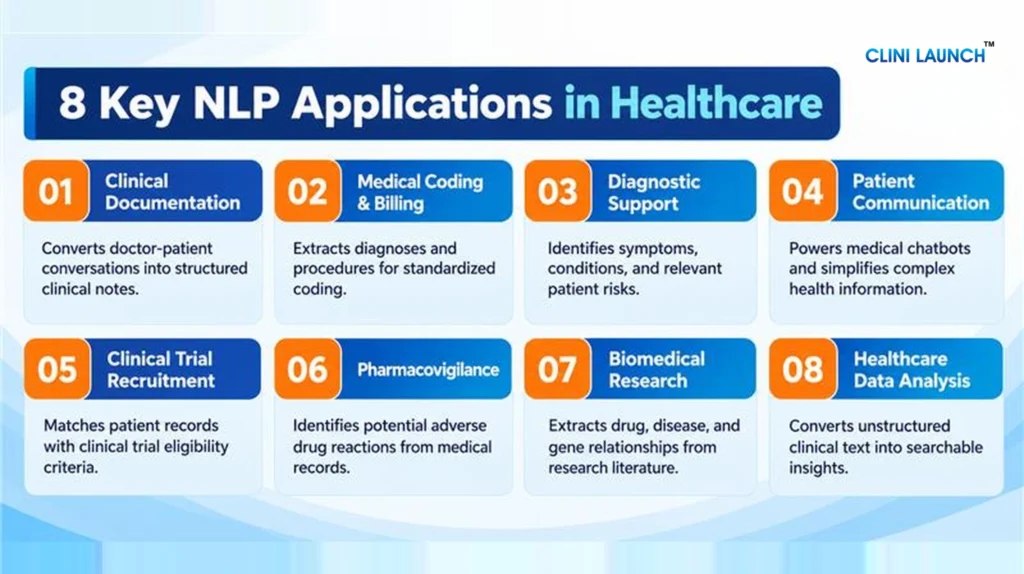
1. Improving Clinical Documentation
NLP in healthcare, combined with speech recognition and generative AI, can convert clinical conversations into draft medical notes and organize relevant information for electronic health records (EHRs). This reduces repetitive documentation tasks and allows clinicians to spend more time on patient care.
- Real-Time Speech-to-Text Dictation: Converts spoken clinical observations into text for medical documentation.
- Automated Clinical Summaries: Generates draft consultation summaries containing symptoms, examination findings, and treatment plans for clinician review.
A 2025 randomized clinical trial published in NEJM AI evaluated ambient AI scribes in clinical practice, investigating their impact on documentation and clinician workload.
2. Optimizing Medical Coding and Billing
Medical coding translates clinical documentation into standardized codes used for reimbursement, insurance claims, and healthcare administration. Natural language processing healthcare solutions can extract diagnoses, procedures, and medication information from clinical notes to suggest relevant codes and identify incomplete documentation. These NLP capabilities help coding teams improve efficiency and maintain consistency in medical coding.
- Automated Medical Code Extraction: Identifies clinical terms and suggests relevant ICD-10, CPT, and medication-related codes.
- Streamlined Claims Processing: Helps coding teams identify missing details and inconsistencies before claims are submitted.
A 2025 study on domain-specific language models investigated automated ICD-10 coding. In real-world clinical notes, the enhanced model achieved an exact-match accuracy of 69.20% and a category-match accuracy of 87.16%.
3. Supporting Diagnostic Accuracy
NLP in healthcare can analyze patient histories, consultation notes, and medication records to identify clinically relevant information that might be overlooked during manual review. When integrated with clinical decision support systems, it can flag potential medication risks, allergy discrepancies, and missing information for further assessment.
- Historical Record Analysis: Extracts documented symptoms, allergies, medications, and risk factors from previous clinical notes.
- Clinical Decision Support Alerts: Flags potential prescription-related concerns and discrepancies in patient records.
A study published in Mayo Clinic Proceedings: Digital Health in September 2025 evaluated an NLP model for identifying allergy-related information in unstructured medical records. The model achieved 87.28% accuracy in its reported evaluation, demonstrating the potential of NLP to support medication safety.
4. Enhancing Patient Communication
Natural language processing healthcare solutions enable healthcare organizations to develop conversational tools that interpret patient questions, collect symptom information, and explain medical terminology in accessible language. These NLP healthcare applications support patient education and help users navigate healthcare services, although they cannot replace professional diagnosis.
- Intelligent Medical Chatbots: Collect symptom information and help patients identify appropriate healthcare resources.
- Simplified Medical Summaries: Convert complex medical terminology into clearer explanations of diagnoses, test results, and treatment instructions.
A 2026 study published in Nature Health examined how people communicate symptoms when interacting with AI chatbots compared with physicians. The findings highlighted potential limitations in symptom reporting during chatbot interactions, emphasizing the need for careful evaluation of patient-facing AI tools.
5. Accelerating Drug Development
NLP helps researchers extract valuable relationships between drugs, genes, diseases, and molecular targets from scientific publications, biomedical databases, and patents. It can also analyze patient records against clinical trial eligibility criteria to identify potential participants and reduce manual screening efforts.
- Biomedical Literature Mining: Extracts drug–target relationships, molecular interactions, and potential research leads from scientific publications.
- Clinical Trial Patient Matching: Compares patient information with trial eligibility criteria to identify potentially suitable candidates for further assessment.
Additionally, the researchers conducted a pilot user study, where they asked two human clinicians to review six anonymous patient summaries and match them to six clinical trials. For each patient and trial pair, one clinician was asked to manually review the patient summaries, check if the person was eligible, and decide if the patient might qualify for the trial. For the same patient-trial pair, another clinician used TrialGPT to assess the patient’s eligibility. The researchers found that when clinicians use TrialGPT, they spent 40% less time screening patients but maintained the same level of accuracy.
Career Scope in Natural Language Processing Healthcare
Natural language processing healthcare is creating career opportunities at the intersection of healthcare, artificial intelligence, and data science. Hospitals, pharmaceutical companies, health-tech startups, insurance organizations, and healthcare analytics providers use NLP to extract insights from clinical records, automate documentation, and support medical research. This creates opportunities for professionals who combine technical expertise with an understanding of healthcare data and clinical workflows.
The US Office of the National Coordinator for Health Information Technology highlights the role of interoperability standards such as FHIR in connecting healthcare applications and exchanging clinical information. Professionals who understand these standards alongside NLP technologies can contribute to the development and integration of healthcare AI solutions.
Emerging Career Roles of NLP in healthcare
| Job role | Key responsibilities | Relevant skills | Salary Range |
| Clinical AI Engineer | Develop and integrate NLP systems for clinical documentation, information extraction, and decision support. | Python, PyTorch/TensorFlow, clinical workflows, EHR integration | ₹6–14 LPA |
| Healthcare Data Scientist | Analyze clinical records, identify patterns, and develop models for healthcare analytics. | Python, statistics, machine learning, data processing | ₹7.5–26 LPA |
| Medical NLP Researcher | Develop and evaluate language models for medical text classification, summarization, and information extraction. | NLP, deep learning, Hugging Face Transformers, biomedical text processing | NA |
| Healthcare Analytics Consultant | Help healthcare organizations implement data-driven solutions and improve clinical and administrative workflows. | Healthcare analytics, SQL, data interpretation, domain knowledge | ₹12–24 LPA |
Essential Skills for a Career in Healthcare NLP
A career in healthcare NLP requires a combination of programming, AI expertise, and healthcare domain knowledge. Python is widely used for text processing and model development, while PyTorch, TensorFlow, and Hugging Face Transformers support the development and evaluation of language models. Understanding HL7 FHIR, ICD-10, and SNOMED CT is also valuable for working with clinical records, standardized diagnoses, and healthcare data exchange.
Salary and Career Growth in Healthcare NLP
Healthcare NLP is a specialized field, and salaries depend on technical expertise, experience, employer, and location. Since dedicated healthcare NLP salary data is limited, the following figures use broader technology roles as indicative benchmarks in India.
| Related job role | Indicative annual salary in India |
| NLP Engineer | ₹6.5–14 LPA |
| Data Scientist | ₹7–15 LPA |
| Senior Data Scientist | ₹14–30 LPA |
With experience, professionals can progress from entry-level NLP development and data analysis into senior engineering, AI research, technical leadership, or healthcare AI consulting. Specialization in medical language models, clinical data interoperability, and responsible AI implementation can help professionals pursue more advanced roles.
AI & ML in Healthcare
Explore how artificial intelligence is transforming pharmaceutical research, from identifying potential drug targets to predicting molecular properties and evaluating drug safety. Develop relevant knowledge in machine learning, healthcare data analysis, and predictive modelling to understand how AI-driven technologies support data-informed research and healthcare innovation.
View CourseConclusion
Natural Language Processing is transforming healthcare by making unstructured medical information easier to analyze, organize, and use. From clinical documentation and medical coding to diagnostic support, patient communication, pharmacovigilance, and drug development, NLP in healthcare helps organizations extract meaningful insights from clinical records and research documents. These NLP healthcare applications demonstrate how natural language processing healthcare solutions can improve clinical workflows, support research, and make healthcare data more accessible.
Building expertise in Artificial Intelligence (AI) and Machine Learning (ML) in healthcare can help professionals prepare for emerging opportunities in clinical AI engineering, healthcare data science, medical NLP research, and healthcare analytics. CliniLaunch Research Institute offers healthcare-focused training programs to help learners develop relevant technical knowledge and industry-oriented skills. Explore AI and ML in Healthcare training at CliniLaunch to strengthen your understanding of emerging healthcare technologies and prepare for evolving career opportunities across hospitals, pharmaceutical companies, health-tech organizations, and clinical research.
Frequently Asked Questions
1. What is NLP in healthcare?
NLP in healthcare uses artificial intelligence to extract, interpret, and organize information from clinical notes and medical records.
2. What are the main applications of NLP in healthcare?
Common applications include clinical documentation, medical coding, diagnostic support, patient communication, pharmacovigilance, clinical trial recruitment, and biomedical research.
3. How does NLP work in healthcare?
NLP uses text classification, named entity recognition, and information extraction to identify relevant details from unstructured medical documents.
4. What are the benefits of using NLP in healthcare?
NLP reduces documentation workload, improves information accessibility, supports medical coding, and enables large-scale analysis of clinical records.
5. How is NLP used in electronic health records (EHRs)?
NLP extracts symptoms, diagnoses, medications, and medical histories from clinical notes to support structured documentation and data analysis.
6. What skills are required for a career in healthcare NLP?
Essential skills include Python, machine learning, deep learning, medical terminology, clinical data processing, and healthcare interoperability standards.
7. What career opportunities are available in healthcare NLP?
Career options include clinical AI engineer, healthcare data scientist, medical NLP researcher, and healthcare analytics consultant across healthcare organizations.
8. What are the challenges of implementing NLP in healthcare?
Key challenges include data privacy, inconsistent documentation, algorithmic bias, medical terminology interpretation, model accuracy, and clinical validation.