Genomics studies the complete DNA of an organism, enabling breakthroughs in precision medicine, disease prediction, and biotechnology. With rapid advances in AI and sequencing technologies, genomics is transforming healthcare, agriculture, and research by shifting focus from treatment to prevention and personalized solutions.
Genomics meaning is the study of the complete DNA of an organism helps us understand how all genes work together.
While genetics focuses on how single genes influence traits, genomics looks at the bigger picture how all genes interact, regulate each other, and shape complex systems like human health and disease. This shift from isolated gene analysis to system-level biology has positioned genomics as one of the most transformative fields in modern science.
The turning point came with the Human Genome Project (HGP), an international effort completed in 2003 that successfully mapped the entire human genome. What once took over a decade and nearly $3 billion to achieve can now be done in a matter of days at a cost of less than $1,000. This exponential drop in sequencing cost has made genomic technologies widely accessible to research, diagnostics, and clinical use.
Today, genomics sits at the center of multiple global advancements. It plays a critical role in
- personalized medicine, where treatments are tailored based on an individual’s genetic profile
- has been instrumental in tracking and understanding infectious diseases most notably during the COVID-19 pandemic
- genome sequencing helped identify and monitor viral variants in real time
- Integrating AI with genomic data is accelerating drug discovery, disease prediction, and personalized healthcare solutions
Valued at USD 21.76 billion in 2025, the global genomics market is poised for significant expansion, forecasted to hit USD 72.50 billion by 2033. This trajectory represents a robust CAGR of 18.2%, fueled by breakthroughs in genetic design and pathway engineering that are transforming healthcare, research, and industrial biotech.
From healthcare and pharmaceuticals to agriculture and forensic science, genomics is no longer a niche area of research it is emerging as a foundational pillar of how science, medicine, and technology evolve in the 21st century.
What is Genomics and Define Genomics in Biology?
At its simplest, to define genome in biology, it refers to the complete set of DNA present in an organism. It contains all the genetic information needed for growth, development, functioning, and reproduction.
To understand this clearly, it helps to break it down step by step:
- DNA (Deoxyribonucleic Acid) is the basic molecule that carries genetic information
- Genes are specific segments of DNA that provide instructions to make proteins
- The Genome is the entire collection of DNA, including all genes and other sequences
In humans, the genome consists of approximately 3 billion base pairs of DNA, organized into 23 pairs of chromosomes. However, not all of this DNA directly codes proteins.
The human genome contains approximately 3.2 billion base pairs, yet the DNA of any two people on Earth is 99.9% identical meaning that vast diversity in health, appearance, and disease risk emerges from just a 0.1% variation.
The genome, however, extends far beyond its genes. This is where one of genomics’ most compelling revelations lies: the distinction between coding and non-coding DNA.
Coding DNA refers to the sequences called exons that are transcribed and translated into proteins. Remarkably, only about 1-2% of the human genome’s three billion base pairs actually encode proteins. The remaining majority were long dismissed as biologically inert colloquially labelled junk DNA.
That label, however, is increasingly obsolete. Hidden among this non-coding majority are crucial regulatory elements that control the activity of thousands of genes, and these elements play a significant role in diseases such as cancer, heart disease, and autism. When mutations associated with traits or diseases are identified, they are most often found in these non-coding regions making their study central to modern genomics research.
This layered complexity is what fundamentally distinguishes genomics from classical genetics: it does not study one gene in isolation but interrogates the entire system its coding instructions, its regulatory switches, and everything in between.
Genetics focuses on individual genes and how a single gene influences a specific trait or condition.
Genomics, on the other hand, looks at the entire set of genes and how they interact with each other and the environment to shape complex biological outcomes.
A simple way to understand this:
- Genetics is like studying one page of a book
- Genomics is like understanding the entire library and how all the books connect
Core Concepts about Genomics
Genomics is the study of an organism’s complete DNA and how genes interact to control biological functions.
To understand genomics better, it’s important to grasp a few core ideas. These concepts form the conceptual foundation of how genetic information is encoded, expressed, and regulated — but they can be understood without going into heavy technical detail.
Central Dogma (DNA – RNA – Protein)
The central dogma explains how genetic information flows within a cell.
DNA encodes biological instructions → RNA transmits them → Proteins execute cellular functions
In simple terms, DNA is like a blueprint, RNA is the messenger, and proteins are the working molecules that carry out biological processes such as building tissues, regulating functions, and enabling reactions.
Variations (SNPs and Mutations Why They Matter)
Every individual’s genome is slightly different. These differences are called genetic variations.
One of the most common types is Single Nucleotide Polymorphisms (SNPs) small changes in a single DNA building block. The human genome contains millions of SNPs, which contribute to differences in traits like height, skin color, and disease susceptibility. Each person carries approximately 4–5 million SNPs, occurring roughly once per 1,000 nucleotides, influencing drug response, disease susceptibility, and environmental sensitivity.
Another critical form of variation is mutation a sequence-level or structural alteration in DNA, ranging from a single base change to larger structural alterations. Mutations can occur naturally over time or due to environmental factors such as radiation or chemicals. While many mutations are harmless, some can disrupt normal biological functions and lead to genetic disorders or diseases like cancer.
These variations can be neutral, adaptive, or disease-associated, while others can increase the risk of diseases or influence how a person responds to certain medications. This is why understanding genetic variation and mutations is central to personalized medicine and modern genomics research.
Gene Control Beyond DNA
Epigenomics studies change in gene activity that do not alter the DNA sequence itself. Think of it as a control system that decides which genes are turned “on” or “off.” Factors like lifestyle, environment, diet, and stress can influence these changes. It functions as a regulatory layer that modulates gene activity without altering the underlying DNA sequence.
For example, identical twins share the same DNA, but over time, differences in their environment can lead to different gene expression patterns this is the effect of epigenomics.
Genomics sits within a broader multi-omics framework:
- Transcriptomics — which genes are actively expressed
- Proteomics — proteins produced from those genes
- Metabolomics — real-time metabolic activity snapshot
- Metagenomics — sequencing entire microbial communities (e.g., gut microbiome)
Collectively, these form the backbone of modern precision medicine and systems biology.
The Many Faces of Genomics: Key Branches Explained
Genomics is not a single discipline it has evolved into a diverse ecosystem of specializations, including functional genomics, each addressing a distinct dimension of the genome:
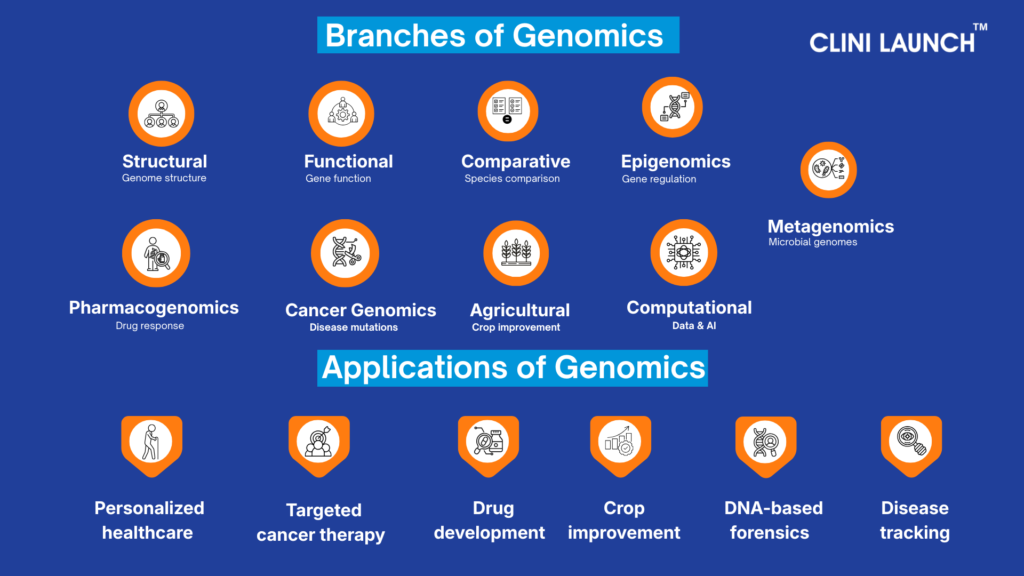
Together, these branches reflect genomics’ reach from the clinic to the farm, from the pharmacy to the supercomputer.
Why Genomics is Shaping the World Today
Understanding genomics is no longer optional it is central to modern science, medicine, and global health systems. It is reshaping how we understand health, respond to global challenges, and improve everyday life. It is actively reshaping medicine, agriculture, public health, and beyond. Here are the six most consequential impact areas:
Precision Medicine- Genomics enables treatment tailored to an individual’s genetic profile shifting healthcare from reactive to preventive. The global precision medicine market size was estimated at USD 87.50 billion in 2023 and is projected to reach USD 249.24 billion by 2030, growing at a CAGR of 16.3% from 2024 to 2030.
Cancer Genomics- Genomic profiling identifies actionable mutations, enabling targeted therapies over broad-spectrum chemotherapy. The precision oncology market is projected to grow from $132.87 billion to $341.51 billion by 2035.
Pandemic Preparedness- Viral genome sequencing tracked COVID-19 variants in real time, directly informing vaccine design and public health responses. Pathogen genomics combined with AI is now a core tool of precision public health, enabling population-level disease surveillance and targeted interventions. LinkedIn
Agriculture & Food Security- Genomic selection accelerates development of drought-resistant, high-yield crop varieties critical amid climate change and rising global food demand.
Evolution & Ancestry- Population-scale genomics studies human migration, diversity, and disease susceptibility across ethnic groups powering platforms like 23 and Me and AncestryDNA adopted by over 30 million users globally.
Forensics- Forensic genomics resolves cold cases through DNA profiling and familial DNA searching raising both scientific capability and ethical responsibility around genomic data.
Across these domains, genomics is driving faster insights, data-driven decisions, and precision interventions. Its ability to connect biological data with real-world outcomes is what makes it one of the most impactful scientific fields today.
Genomics in Action: Real-World Applications
The true value of genomics emerges through its real-world applications. From hospitals to farms to forensic labs, its applications are already shaping decisions and outcomes in ways that directly impact people.
Personalized Cancer Treatment
In many cancer hospitals today, treatment decisions are guided by genomic testing rather than trial-and-error approaches. For example, patients with specific mutations (like EGFR in lung cancer or BRCA in breast cancer) are given targeted therapies that directly act on those genetic changes. This approach has been shown to improve response rates significantly, with some targeted treatments increasing survival outcomes by 20–40% in certain cancer types.
Genetic Testing for Inherited Diseases
A healthy 32-year-old woman with a family history of breast cancer undergoes genome testing and tests positive for a BRCA1 mutation. That single genomic insight enables preventive intervention years before disease onset. When a germline variant is confirmed, testing is extended to family members to identify carriers who may benefit from risk-reducing surgery or early detection strategies. Today, whole genome testing is increasingly used to identify inherited disease risks and guide preventive care
Drug Response Prediction (Pharmacogenomics)
Not all medicines work the same way for everyone. Genomic insights help predict how a person will respond to a drug whether it will be effective, ineffective, or cause side effects. For instance, variations in genes like CYP450 can influence drug metabolism, and integrating this data has helped reduce adverse drug reactions.
Crime Investigation (DNA Profiling)
In forensic investigations, DNA profiling has become a decisive tool in solving cases. Even trace biological samples can be matched against databases to identify individuals with high accuracy. In several countries, DNA evidence has helped solve cold cases that remained unresolved for decades, with match probabilities often exceeding 1 in a billion.
Crop Improvement in Agriculture
Farmers today benefit from genomics through crops that are more resilient and productive. Genomic-assisted breeding has led to the development of drought-resistant rice and pest-resistant cotton, improving yields, and reducing dependency on chemical inputs. In some cases, yield improvements of 10–20% have been achieved under challenging environmental conditions.
Bioinformatics
Gain advanced expertise in computational biology and large-scale biological data analysis. This program prepares learners to work in genomics, precision medicine, and research-driven environments by combining bioinformatics concepts with real-world datasets and analytical tools.

The Technology Behind Genomics: Whole Genome Testing & Mapping
The power of genomics is driven by technologies that enable high-speed, high-precision DNA analysis.
- Next-Generation Sequencing (NGS) – Enables whole genome testing and genome-wide analysis by sequencing millions of DNA fragments in hours; costs have dropped from $3 billion to under $600.
- PCR (Polymerase Chain Reaction) Amplifies small DNA samples for detection and analysis in diagnostics and research.
- Microarrays – Analyze thousands of genetic variations simultaneously, widely used in large-scale genetic studies.
- CRISPR – A precise gene-editing tool, now entering clinical use with therapies approved for genetic disorders.
- Genome Mapping – Identifies gene locations, providing a structural reference for genomic analysis.
The Next Decade of Genomics: What to Expect
Genomics is rapidly evolving from analysis to prediction, precision, and real-time biological modeling.
Several emerging trends are redefining what’s possible:
AI in Genomics
Artificial intelligence is accelerating how genomic data is interpreted. Models like deep learning systems are now being used to predict protein structures, identify disease-associated mutations, and even assist in drug discovery. For example, AI-driven tools have reduced protein structure prediction timelines from years to hours or days, significantly speeding up research.
Single-Cell Genomics
Instead of studying bulk tissues, scientists can now analyze individual cells. This is crucial in fields like cancer research, where even a small group of cells can behave differently and drive disease progression. Single-cell analysis helps to uncover hidden cellular differences that were previously undetectable. The global single-cell analysis market size was estimated at USD 4.34 billion in 2023 and is projected to reach USD 13.69 billion by 2030, growing at a CAGR of 18.7% from 2024 to 2030.
Gene Editing & CRISPR
CRISPR-based therapies have crossed from research into clinical reality. With Casgevy approved for sickle cell disease in 2023, the next decade will see gene editing expand into cardiovascular disease, rare disorders, and potentially ageing biology.
Multi-Omics Integration
Combining genomics with transcriptomics, proteomics, and metabolomics is enabling a more complete understanding of biological systems. The global multiomics market size was estimated at USD 2.72 billion in 2024 and is projected to reach USD 9.81 billion by 2033, growing at a CAGR of 15.33% from 2025 to 2033. reflecting accelerating demand for integrated genomic, proteomic, and metabolomic insights.
Digital Twins & Predictive Biology
One of the most forward-looking ideas is the concept of a “digital twin” a virtual model of an individual’s biological system built using genomic and health data. This could allow doctors to simulate treatments and predict outcomes before applying them in real life.
- Whole genome sequencing dropping below $100, making population-scale genomics a routine clinical tool
- AI models predicting disease onset years before symptoms appear
- A global shift from disease treatment to genomics-guided prevention
- Growing urgency around data privacy and genomic ethics as genetic data becomes the world’s most sensitive personal identifier
Genomics Careers: Where Science Meets Opportunity!
Genomics is emerging as a high-impact career domain at the intersection of biology, data science, and technology.
Career Roles
- Research Scientist – Works on genetic studies, disease mechanisms, and innovation
- Bioinformatician – Analyzes genomic data using computational tools
- Clinical Geneticist – Applies genomics in diagnosis and patient care
- AI/Data Scientist (Genomics) – Uses machine learning to interpret biological data
- Pharmacogenomics Specialist – Studies how genes influence drug response
- Forensic / Agricultural Genomics Specialist – Applies genomics in law enforcement or agriculture
How to Get There
- Undergraduate (UG)
Biotechnology, Life Sciences, Genetics, Microbiology, or related fields
- Postgraduate (PG)
Genomics, Bioinformatics, Computational Biology, or specialized life science programs
- Certifications / Online Learning
Short-term courses in bioinformatics, genomics, or AI in life sciences (useful for skill-building or career transition)
- Hands-on Learning
Internships, research projects, or working with real genomic datasets to gain practical exposure
Skills Required
- Strong foundation in biology and genetics
Understanding DNA, genes, molecular biology, and disease mechanisms
- Data analysis and programming (Python, R)
Handling large genomic datasets, basic scripting, and statistical analysis
- Familiarity with bioinformatics tools and databases
Tools like BLAST, Galaxy, Bioconductor, and databases such as NCBI, Ensembl
- Basic understanding of AI/ML concepts
Useful for pattern detection, predictive modeling, and genomics data interpretation
- Analytical and problem-solving skills
Interpreting complex biological data and drawing meaningful insights
- Attention to detail
Critical for handling sensitive genetic data and avoiding errors
Genomics careers are growing rapidly, especially with increasing demand in healthcare, biotech, and data-driven research.
Bioinformatics
Build practical skills in bioinformatics used in genomics research, biotechnology, and drug discovery. This program focuses on applying computational tools to analyze biological data, interpret genetic information, and support modern healthcare and research environments.
Conclusion
The future of genomics is no longer a distant concept it is actively redefining how we understand, predict, and manage life itself. From understanding diseases at their root to enabling personalized treatments and predictive healthcare, its impact is only expected to grow stronger in the coming years.
As the field continues to evolve with AI, data science, and advanced technologies, the demand for skilled professionals in genomics is rising rapidly. For those looking to build a career in this space, developing the right combination of biological and computational skills will be key.
For those looking to build expertise in this field, structured training in genomics and bioinformatics can provide a strong foundation on – Advanced diploma in Bioinformatics or, PG Diploma in Bioinformatics at CliniLaunch Research Institute. Genomics is not just about understanding life it’s about shaping the future of it.
Start Your Career in Genomics Today
Get industry-ready with hands-on training in bioinformatics and genomics
Enroll Now